
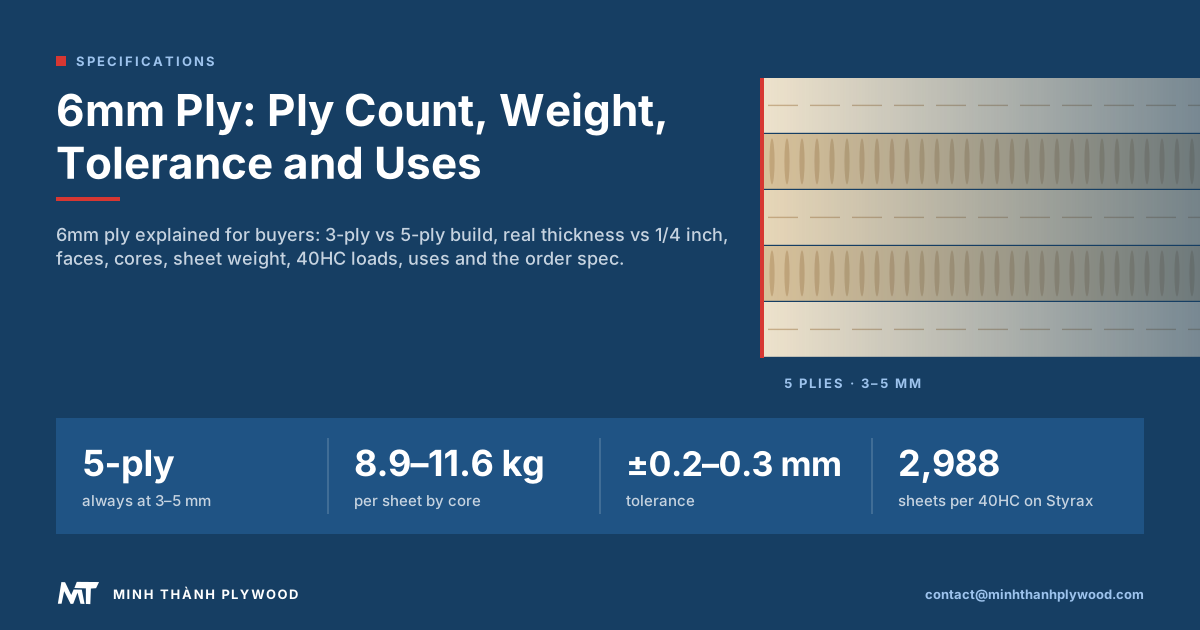
6mm ply is a thin plywood sheet with a finished thickness of 6 mm, used for cabinet backs, drawer bottoms, linings, door skins and packaging. A 6 mm sheet is sold as 3-ply or 5-ply, and more, thinner plies stay flatter. Minh Thanh Plywood makes 3–5 mm panels always 5-ply and confirms the ply count of a 6 mm panel with each order, in 1220 × 2440 mm and 1250 × 2500 mm, sanded to ±0.2–0.3 mm.
6mm ply in one paragraph
6mm ply is plywood with a finished thickness of 6 mm, measured face to face after sanding. It is the thickest of the thin panels and the thinnest that most furniture plants groove, paint and assemble without special handling. The build that matters is the ply count: five plies make a flat, stable sheet; three plies make a cheaper sheet that bends and splits.
At Minh Thanh Plywood, the 6 mm ply count and lay-up are confirmed with the order and stated on the proforma, with the core veneer thickness adjusted to the panel. The faces are sanded and polished, and furniture panels are held to ±0.2–0.3 mm, down to ±0.2 mm when the order asks.
| Line | 6 mm furniture plywood, Minh Thanh |
|---|---|
| Plies | Confirmed with the order, stated on the proforma (3–5 mm panels are always 5-ply) |
| Thickness tolerance | ±0.2–0.3 mm, down to ±0.2 mm |
| Sheet sizes | 1220 × 2440 mm, 1250 × 2500 mm, custom |
| Faces | Poplar, birch, EV, okoume, pine and others |
| Cores | White Styrax or eucalyptus; acacia on order |
| Glue | UF glue at E0 emission; MR or phenolic to order |
| Moisture at dispatch | 8–12 % |
| Emission proof | CARB P2 / TSCA Title VI, ICTT mill no. 23024 |
Is 6 mm the same as 1/4 inch plywood?
No: a full 1/4 inch is 6.35 mm, so a 6 mm sheet is 0.35 mm thinner. The inch is defined as exactly 25.4 mm (NIST). Dividing 6 by 25.4 gives 0.236 inch. In North America, sheets sold as “quarter-inch” are often metric 6 mm panels, or slightly under.
The difference matters wherever the panel fits a groove or a hardware part. A cabinet back cut for a 6.35 mm groove rattles at 6 mm; a groove cut at 6 mm will not take a full quarter inch. Write the metric thickness and the tolerance in the drawing and on the order, and keep the trade name only as a label.
| Name on the quote | Actual thickness | Note |
|---|---|---|
| 6 mm | 6 mm nominal, ±0.2–0.3 mm on sanded furniture panels | Metric, the drawing figure |
| 1/4 inch (full) | 6.35 mm | Imperial |
| “Quarter-inch” retail sheet | Often 6 mm or under | Ask for the metric figure |
5-ply vs 3-ply: why the ply count decides a 6 mm panel
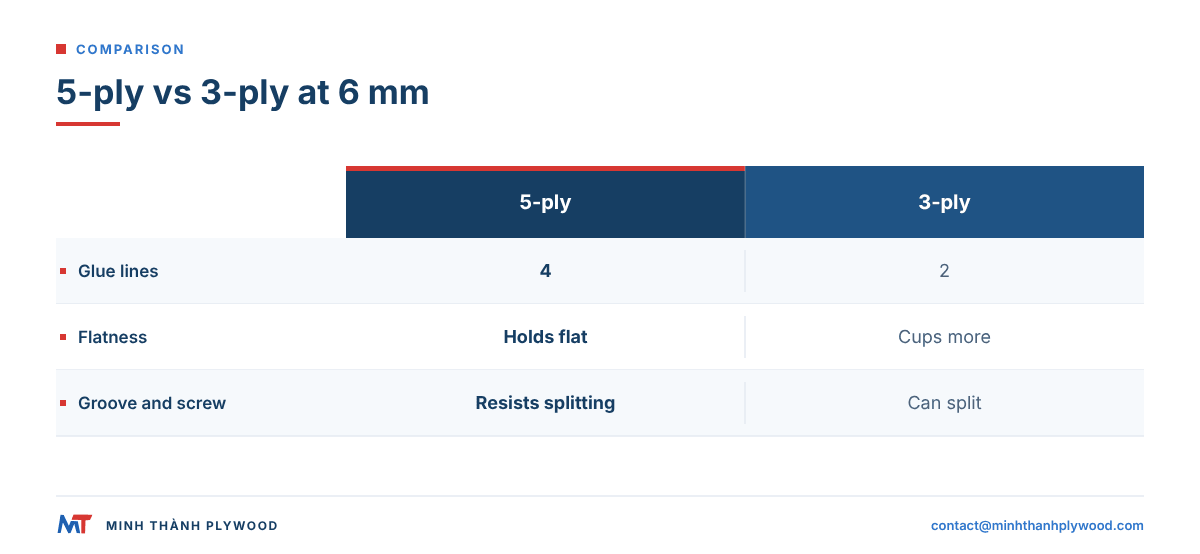
A 6 mm sheet can be 3-ply or 5-ply, and the 5-ply one is flatter, stiffer across both directions and less likely to split at a groove than a 3-ply sheet of the same thickness. The reason is veneer thickness: five plies in 6 mm means thinner veneers, more glue lines and a balanced build; three plies means thick veneers with one central core that does most of the work.
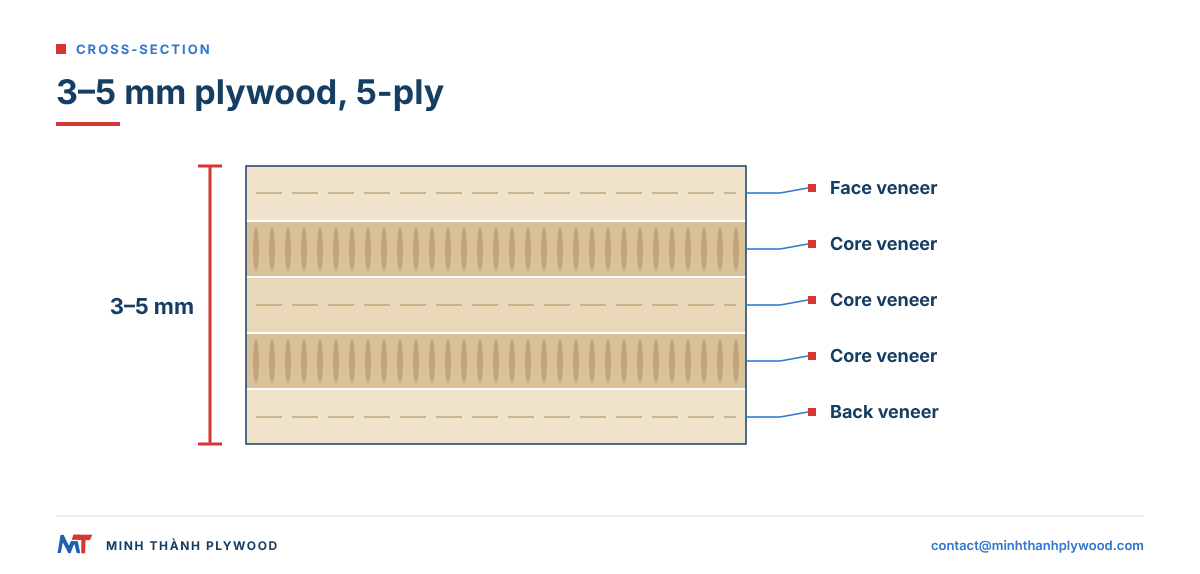
- 5-ply: face, cross-band core, centre core, cross-band core, back. The grain alternates, so the panel resists cupping and holds its shape when one face is painted or laminated.
- 3-ply: face, one thick core, back. Cheaper to make, but it flexes more along one direction, and a groove or screw near the edge can split the core.
Minh Thanh’s 3–5 mm panels are always 5-ply; the 6 mm ply count and lay-up are confirmed with the order. The ply count is not visible on the face, so it belongs on the quote and is checked on the sample edge. Count the glue lines with a magnifier: five plies show four glue lines.
Which face should a 6 mm sheet carry?
Choose the face by how the panel is finished, not by what is in stock. On thin plywood the face is a large share of the thickness, so it changes the look and the cost more than on an 18 mm panel.
- Poplar: pale and smooth, for painted backs, drawer bottoms and linings. Grades A/A, A/B and B/B.
- Birch: fine, hard grain for visible drawer bottoms, lacquered backs and parts seen from both sides. Graded D+, D and E in Vietnam.
- EV (engineered veneer): repeatable oak or walnut grain for backs and linings that must match the furniture.
- Okoume: even pinkish face for interiors.
- Pine: grades A/A, A/B and B/B (B/C for utility parts), for painted and craft work.
For a back that is never seen, a B/B pair keeps the cost down. For a drawer bottom seen when the drawer opens, A/B is enough. For an open shelf back seen from the front, choose A/A or A/B with the A face forward.
Which core: Styrax, eucalyptus or acacia?
For 6 mm panels, the core decides the weight and the stiffness. White Styrax and eucalyptus are the standard cores at Minh Thanh Plywood; acacia is made on order.
- Styrax: white, light and even. The lightest 6 mm panel, easy to handle and pale at the edge.
- Eucalyptus: denser and stiffer, for bottoms and backs that carry some load.
- Acacia: between the two in weight.
Premium thin veneer is scarce, so thin panels can take longer to make than thick ones. We keep the standard: the core veneers are graded and laid with the same care as on an 18 mm furniture panel, and core layers are stitched both horizontally and vertically.
How much does a 6 mm plywood sheet weigh?
A 1220 × 2440 × 6 mm sheet weighs about 8.9 kg on a Styrax core, 10.4 kg on acacia and 11.6 kg on eucalyptus. The weight is volume times density: one sheet is 0.0179 m³, multiplied by the reference density of the core.
| Core | Reference density | Weight per 1220 × 2440 × 6 mm sheet |
|---|---|---|
| Styrax | 500 kg/m³ | 8.9 kg |
| Acacia | 580 kg/m³ | 10.4 kg |
| Eucalyptus | 650 kg/m³ | 11.6 kg |
Weight decides handling on the line and the load in the container. A Styrax-core 6 mm sheet is light enough for one worker to carry and place, which matters on a cabinet line that fits hundreds of backs a shift. Our plywood weight calculator gives other sizes.
Thickness tolerance: what “6 mm” should mean on the order
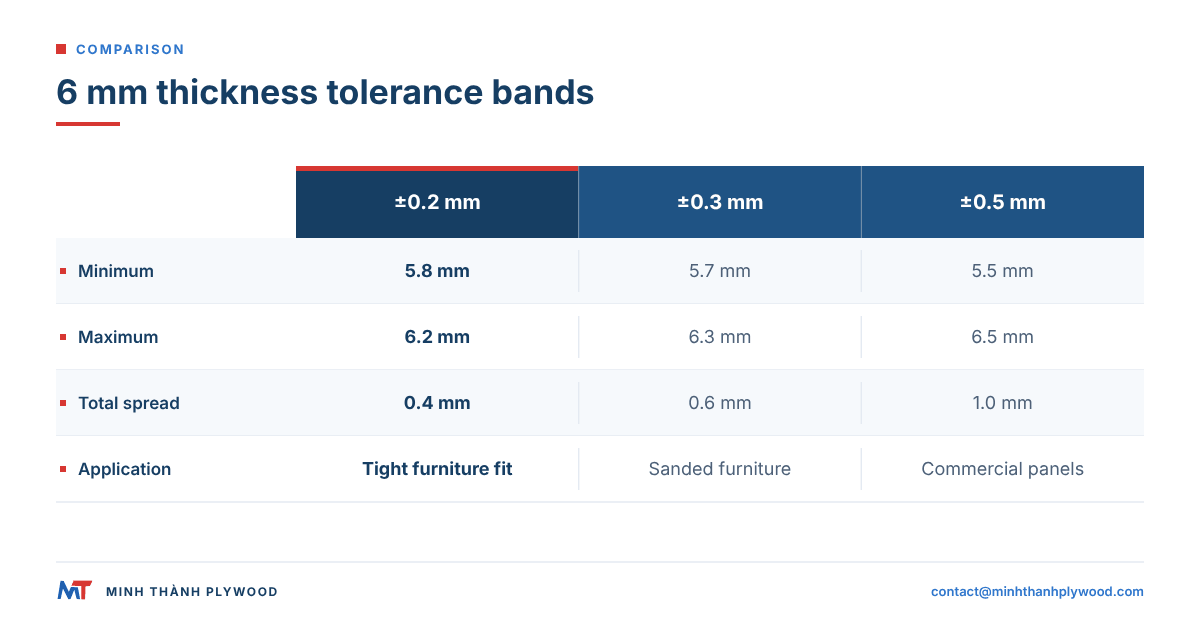
The order should state 6 mm with a tolerance, not “6 mm” alone. Minh Thanh’s sanded furniture panels use ±0.2–0.3 mm, down to ±0.2 mm; commercial panels use ±0.5 mm; length and width are held to ±2 mm.
| Tolerance written | Accepted range | Spread |
|---|---|---|
| 6 mm ±0.2 mm | 5.8–6.2 mm | 0.4 mm |
| 6 mm ±0.3 mm | 5.7–6.3 mm | 0.6 mm |
| 6 mm ±0.5 mm | 5.5–6.5 mm | 1.0 mm |
The tight tolerance comes from sanding and from pressing. Veneers and finished panels are dried to 8–12 % moisture content, so the sheet does not swell or shrink much after delivery. Measure samples with a caliper at the four corners and the middle of each long edge before you set the groove.
How strong is 6 mm plywood?
6 mm plywood is strong enough for parts it is fixed into, and too thin to span open gaps on its own. It works as a cabinet back held in grooves, a drawer bottom supported on four sides, a door skin glued to a frame or a lining screwed to battens.
Three things raise the strength of a 6 mm part:
- The build: more, thinner plies resist splitting and bending better than 3-ply.
- The support: a back in a groove on four sides, or with a centre rail on wide cabinets, stays flat.
- The core: eucalyptus is stiffer than Styrax for bottoms that carry weight.
For shelves, floors or anything that bridges a span, step up to 12, 15 or 18 mm. Our guide how much weight can plywood hold covers loads by thickness.
What is 6mm ply used for?
6mm ply is used where a part must be thin, light and flat, and is held by the furniture around it. These are the uses our buyers order it for:
- Cabinet and wardrobe backs: grooved or rebated into the carcass, often poplar B/B or EV. See back panels for cabinets and wardrobes.
- Drawer bottoms: in a groove on four sides; birch or poplar A/B.
- Furniture linings and partitions: inside cupboards, beds and storage units.
- Door skins: glued over a frame for flush interior doors.
- Display, shop-fit and exhibition panels: painted or laminated.
- Packaging that must look clean: retail boxes and cases.
- Crafts and laser work: where a flat, even face matters.
For panels below 6 mm, see our 4 mm plywood and 3 mm plywood guides.
6mm vs 4mm, 7mm and 9mm ply: which thickness for which part?
Choose the thinnest panel the part allows: thinner is lighter and costs less per sheet, but every millimetre adds stiffness. The common steps around 6 mm are these:
| Thickness | Typical part | Choose it when |
|---|---|---|
| 3–4 mm | Drawer bottoms on small drawers, light backs | The part is small and fully supported |
| 5–5.5 mm | Backs and bottoms in a groove | A drawing names it, or weight is tight |
| 6 mm | Cabinet backs, drawer bottoms, door skins, linings | The standard thin panel for furniture |
| 7 mm | Backs on wide cabinets, heavier bottoms | 6 mm flexes too much, or the groove is 7 mm |
| 9 mm | Drawer sides, backs that carry load | The part takes screws in its edge |
7mm ply sits within our 3–40 mm thickness range. Before switching from 6 mm, check the groove, the hardware and the fixing, because a thicker panel will not fit a 6 mm groove. Our plywood thickness guide shows every step.
Plywood sheets 6mm: 8 x 4, metric and cut-to-size sizes
The standard 6 mm plywood sheet is 1220 × 2440 mm, the metric form of 8 x 4 (8 ft × 4 ft). European furniture plants also order 1250 × 2500 mm. Minh Thanh Plywood makes both, plus custom sizes such as 1220 × 2500 mm and 1220 × 2280 mm.
When the part size is fixed, cut-to-size saves the buyer’s saw time and waste. One panel can be cut into 4, 6 or 8 pieces before packing, and the cut parts are shipped regularly to Italy and other European markets. Write the finished part size, the grain direction of the face and the tolerance on the order.
6mm ply sheet sizes and FOB price per sheet
Per-sheet FOB examples for the four sizes UK and EU buyers order. Each is the sheet volume times the starting price per cubic metre: commercial plywood from US$250/m³, furniture plywood from US$350/m³ (October 2026). They are raw FOB examples before freight, duty and grade, not a quoted sheet price.
| Sheet size | Volume at 6 mm | FOB example, commercial to furniture |
|---|---|---|
| 1220 × 2440 mm (8 x 4) | 0.0179 m³ | US$4.5–6.3 |
| 1250 × 2500 mm | 0.01875 m³ | US$4.7–6.6 |
| 607 × 1829 mm (handy panel) | 0.0067 m³ | US$1.7–2.3 |
| 606 × 1220 mm (handy panel) | 0.0044 m³ | US$1.1–1.6 |
The two handy sizes are the sheets UK builders’ merchants such as Wickes list beside the full 1220 × 2440 mm board. Minh Thanh Plywood cuts them from the full sheet before packing.
6mm plywood in the UK: what a “6 mm” sheet is called and costs on the shelf
UK merchants list thin hardwood plywood as 5.5 mm, not 6 mm; the prices below were checked on 21 October 2026. Wickes sells 5.5 mm in 1220 × 2440, 606 × 1220 and 607 × 1829 mm. Selco lists general-purpose 5.5 mm at £17.02 ex VAT (£20.42 inc VAT) for 2440 × 1220 mm, and £12.16 ex VAT for the 1829 × 607 mm FSC handy panel (Selco plywood range).
Selco’s 9 mm is £21.23 and its 18 mm marine plywood £79.10, both ex VAT. A true 6 mm sheet is a furniture and joinery thickness that UK buyers import, and an importer’s margin is the gap between that shelf price and the landed cost.
| UK point | Figure |
|---|---|
| Duty on hardwood-faced plywood (code 4412 33) | 6 % standard rate; 0 % for goods from Vietnam under the UK-Vietnam trade agreement |
| Standard to quote | BS EN 636: part 1 dry (service class 1), part 2 humid (class 2), part 3 exterior (class 3) |
| Glue that matches | UF for part 1, MR for part 2, phenolic WBP for part 3 |
| Sea transit from Hai Phong | 30–40 days to Northern Europe, which includes UK ports |
| Certification asked | FSC is a chain-of-custody certificate: state it on the enquiry |
Write the EN 636 part next to the glue on the order, so a UK yard reads the bond class without a call. Emission proof is CARB P2 / TSCA Title VI under ICTT mill no. 23024; the EN 717-1 method is tested through SGS on request.
Moisture, glue and outdoor use of 6 mm panels
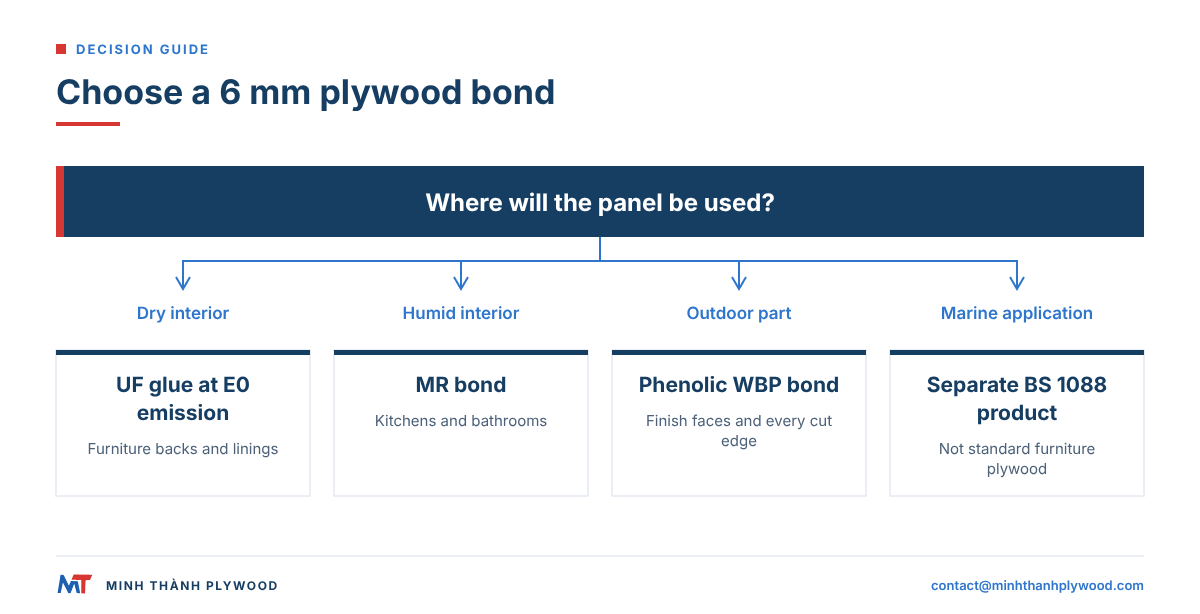
Standard 6 mm furniture plywood is an interior panel: UF glue at E0 emission, dried to 8–12 % moisture content. It is for dry rooms, where it stays flat and does not release much formaldehyde.
For humid rooms such as kitchens and bathrooms, order an MR (melamine-fortified) bond. For outdoor parts, order a phenolic (WBP) bond and finish the faces and every cut edge. Marine plywood in 6 mm is a separate product, made to BS 1088 by marine mills; our thin plywood is furniture and interior plywood.
For the US, panels must meet CARB Phase 2 / TSCA Title VI. Minh Thanh Plywood holds that certification under ICTT mill no. 23024, and six ASTM D6007 chamber tests between April 2025 and June 2026 averaged 0.014–0.032 ppm. The limit for veneer-core hardwood plywood is 0.05 ppm under EPA’s TSCA Title VI guidance.
Working with 6 mm ply: cutting, grooving and fixing
6 mm ply cuts cleanly with a fine-tooth blade if the sheet is supported along its full length. A few rules keep the face clean and the fit tight:
- Cut with the good face up on a table saw, or face down with a circular saw, so the exit side takes any tear-out.
- Score or tape the cut line on cross-grain cuts in birch and poplar faces.
- Size the groove to the measured panel, not the nominal figure: at ±0.2 mm, the panel can be 6.2 mm.
- Fix backs with glue and staples or small screws into the carcass edge, not into the 6 mm panel’s own edge.
- On a floor overlay, screw the 6 mm sheet to the subfloor in a grid, with joints staggered and a small gap at every edge.
For painted parts, a poplar or birch face sanded at the mill takes primer without extra sanding. Both faces are UV-ready for buyers who apply their own UV coating.
What does 6mm ply cost, and how is it packed?
Factory-direct, Minh Thanh Plywood’s furniture plywood starts from US$350/m³ and commercial plywood from US$250/m³, as of October 2026. One 1220 × 2440 × 6 mm sheet is 0.0179 m³, so the sheet price before freight is the cubic-metre price times 0.0179. The final price follows the face, core, glue, tolerance, size and quantity.
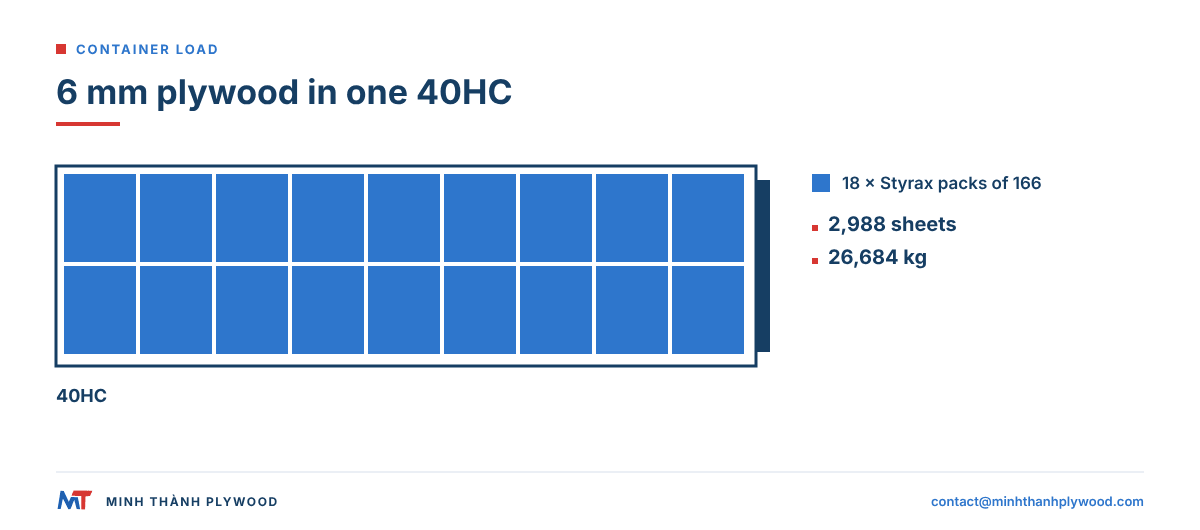
Thin panels pack many sheets to a pack. On our 40HC plan, packs are about 1,000 mm high, so a 6 mm pack holds 166 sheets before the weight cap:
| Core | Packs per 40HC | Sheets per pack | Sheets per 40HC | Approx. cargo weight |
|---|---|---|---|---|
| Styrax | 18 | 166 | 2,988 | 26,684 kg |
| Acacia | 16 | 166 | 2,656 | 27,622 kg |
Eucalyptus is heavier, so its 6 mm packs are capped by the 28,000 kg planning payload before the height. The minimum order is 1×40HC, with mixed specifications by agreement, so 6 mm backs can share a container with 18 mm carcass panels.
How to order 6mm ply from a Vietnamese mill
A 6 mm order is complete when two mills reading it would price the same sheet. Write these lines:
- Part: cabinet back, drawer bottom, door skin, lining or packaging.
- Build: 6 mm, ply count as agreed on the proforma.
- Face and back: species and grade pair, such as poplar B/B or birch D+/D.
- Core: Styrax, eucalyptus or acacia.
- Glue and emission: UF at E0; MR or phenolic if the part sees moisture; CARB P2 / TSCA Title VI for the US.
- Thickness tolerance: for example ±0.2 mm.
- Size: 1220 × 2440 mm, 1250 × 2500 mm, custom or cut-to-size.
- Packing and quantity: sheets per pack, packs, container and port.
Production takes 15–45 days after the 30% deposit, with the 70% balance against the scanned B/L. Sea transit from Hai Phong is about 30–40 days to Northern Europe and 15–25 days to the Middle East. Send the lines to contact@minhthanhplywood.com or WhatsApp +84 988 586 601: we reply within hours and send free samples. Our thin plywood page shows the full 3–6 mm range.
Buyer questions, answered
How many plies does 6mm ply have?
On the market a 6 mm sheet has either three plies of thicker veneer or five plies of thinner veneer, and five plies stay flatter and split less. At Minh Thanh Plywood, 3–5 mm panels are always 5-ply; the 6 mm ply count and lay-up are confirmed with the order and stated on the proforma.
Is 6mm ply the same as 1/4 inch plywood?
Not exactly. A full 1/4 inch is 6.35 mm, so 6 mm is 0.35 mm thinner. Sheets sold as quarter-inch in North America are often 6 mm or slightly under, so state the metric thickness and tolerance on the order.
How much does a sheet of 6mm ply weigh?
A 1220 × 2440 × 6 mm sheet weighs about 8.9 kg on a Styrax core, 10.4 kg on acacia and 11.6 kg on eucalyptus, at reference densities of 500, 580 and 650 kg/m³.
How strong is 6mm plywood?
Strong enough for supported parts such as cabinet backs, drawer bottoms, linings and door skins. It is not a shelf or floor panel on its own: over open spans it flexes, so it is fixed into grooves, rebates or onto a frame.
How much is a sheet of 6mm ply?
Factory-direct, furniture plywood starts from US$350/m³ and commercial plywood from US$250/m³ (October 2026). A 1220 × 2440 × 6 mm sheet is 0.0179 m³, so multiply the cubic-metre price by 0.0179 for the sheet price before freight.
What is 6mm ply used for?
Cabinet and wardrobe backs, drawer bottoms, furniture linings, door skins, partitions inside furniture, display and packaging panels, and crafts. Buyers ask for more, thinner plies on anything that is grooved, painted or seen.
Can 6mm plywood be used outdoors?
Only with an exterior bond. Interior 6 mm plywood with UF glue is for dry rooms; for outdoor or wet use order a phenolic (WBP) bond and finish the faces and edges.
Is there 6mm marine plywood?
Yes, marine plywood is made in 6 mm to BS 1088 by specialist marine mills. Minh Thanh Plywood's thin plywood is furniture and interior plywood, made with UF glue at E0 emission, or MR and phenolic bonds to order.
What size are 6mm plywood sheets?
The standard sheet is 1220 × 2440 mm, sold as 8 x 4 or 8 ft × 4 ft. Europe also uses 1250 × 2500 mm, and Minh Thanh Plywood cuts custom sizes such as 1220 × 2500 mm and cut-to-size parts.
Why do UK shops sell 5.5 mm instead of 6 mm plywood?
UK merchants stock thin hardwood plywood in 3.6, 5.5, 9 and 12 mm, so a 6 mm drawing is usually filled with 5.5 mm off the shelf. A 6 mm sheet to your build is ordered by container; state the thickness, the ply count and the ±0.2–0.3 mm tolerance.
How do I cut 6mm plywood without splintering?
Use a fine-tooth blade, support the sheet fully, and cut with the good face up on a table saw or face down with a circular saw. Tape or score the cut line on cross-grain cuts.
What is the difference between 6mm and 7mm ply?
7 mm is a thicker thin panel, used where 6 mm feels too flexible or a groove is cut at 7 mm. Check the groove and the hardware before switching, and order the thickness the drawing names.
How many sheets of 6mm plywood fit in a 40HC container?
On the Minh Thanh plan, 2,988 sheets of 1220 × 2440 × 6 mm on a Styrax core (18 packs of 166), or 2,656 sheets on acacia (16 packs of 166), within a 28,000 kg planning payload.