
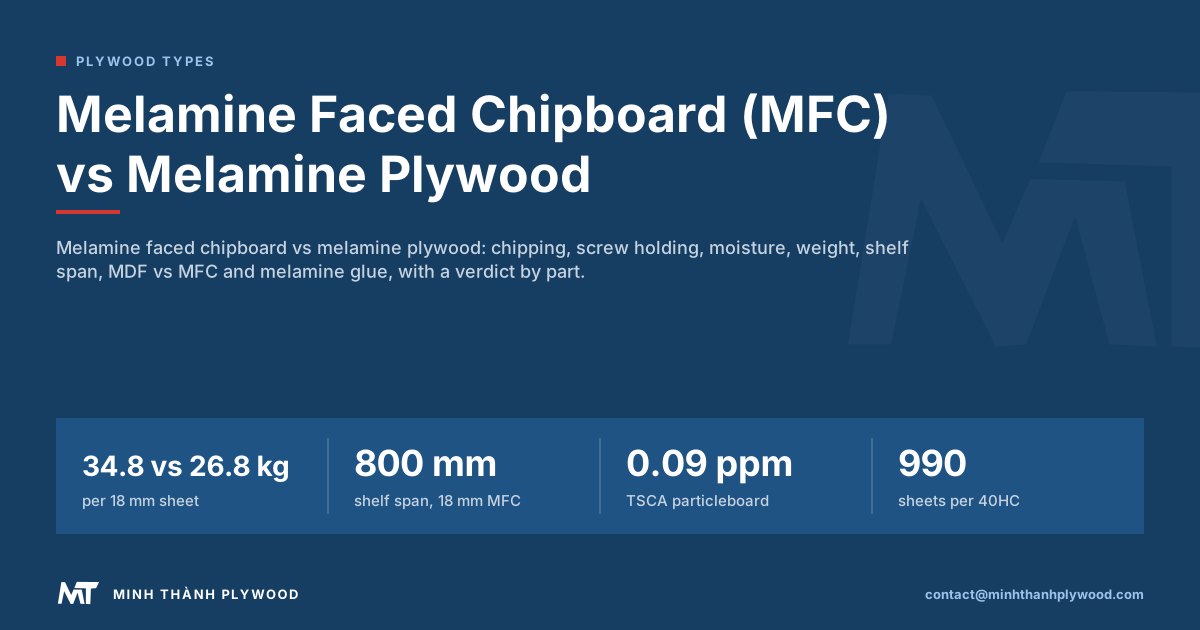
Melamine faced chipboard (MFC) is particleboard with melamine-resin decor paper fused to both faces: cheap, finished and easy to clean. Melamine-faced plywood puts the same surface on a cross-laminated veneer core, which chips less, holds screws better, swells less and weighs less. Use MFC for dry carcasses; use plywood where parts get wet, carry loads or travel. Minh Thanh Plywood makes the plywood core.
Melamine faced chipboard vs melamine plywood: the short answer
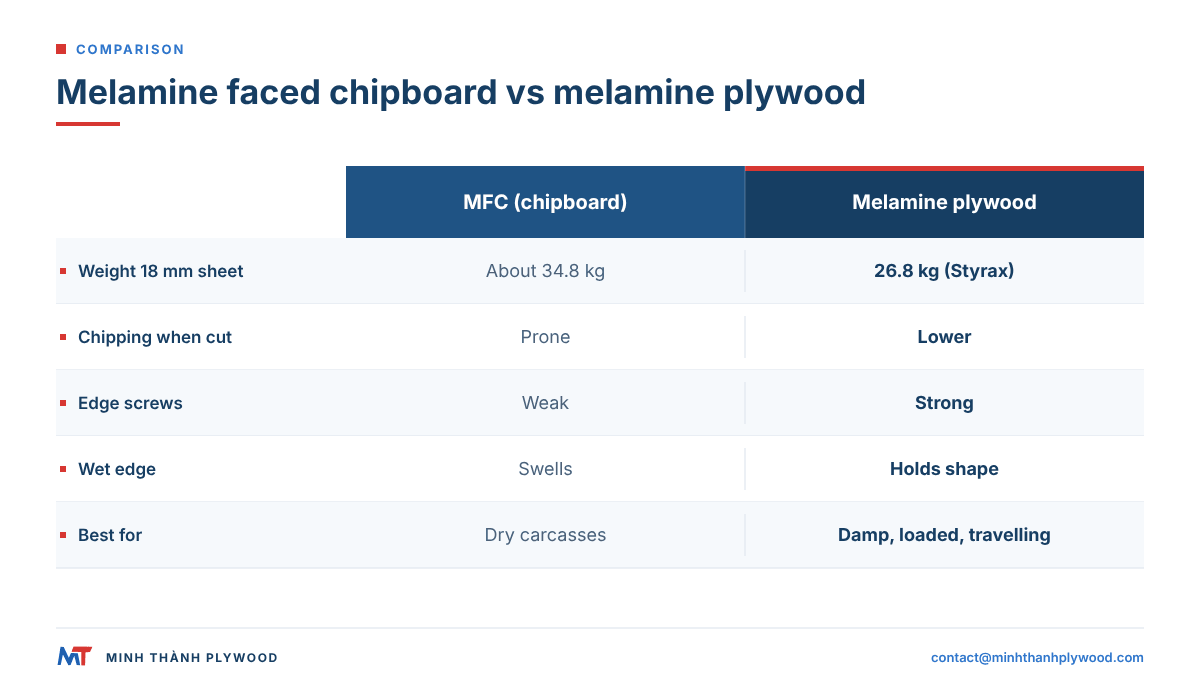
Melamine faced chipboard and melamine plywood share the same decorative surface; the core underneath decides how the part behaves. MFC is the lowest-cost finished board for dry carcasses. Melamine-faced plywood costs more and wins on edge chipping, screw holding, moisture, weight and load.
| Metric | Melamine faced chipboard (MFC) | Melamine-faced plywood |
|---|---|---|
| Core | Wood particles bonded with resin | Cross-laminated veneers |
| Weight, 18 mm, 1220 × 2440 mm | About 34.8 kg | 26.8 kg on a Styrax core |
| Edge chipping when cut | Prone without a scoring saw | Lower |
| Screw holding in the edge | Low; weak when re-driven | High |
| Swelling at a wet edge | High | Low, lowest with a water-resistant bond |
| Stiffness for shelves | Moderate | Higher per kilogram |
| Price | Lowest | Higher |
| Best for | Dry carcasses, wardrobes, flat-pack, office furniture | Sink bases, bathrooms, caravans, trailers, loaded shelves, export furniture |
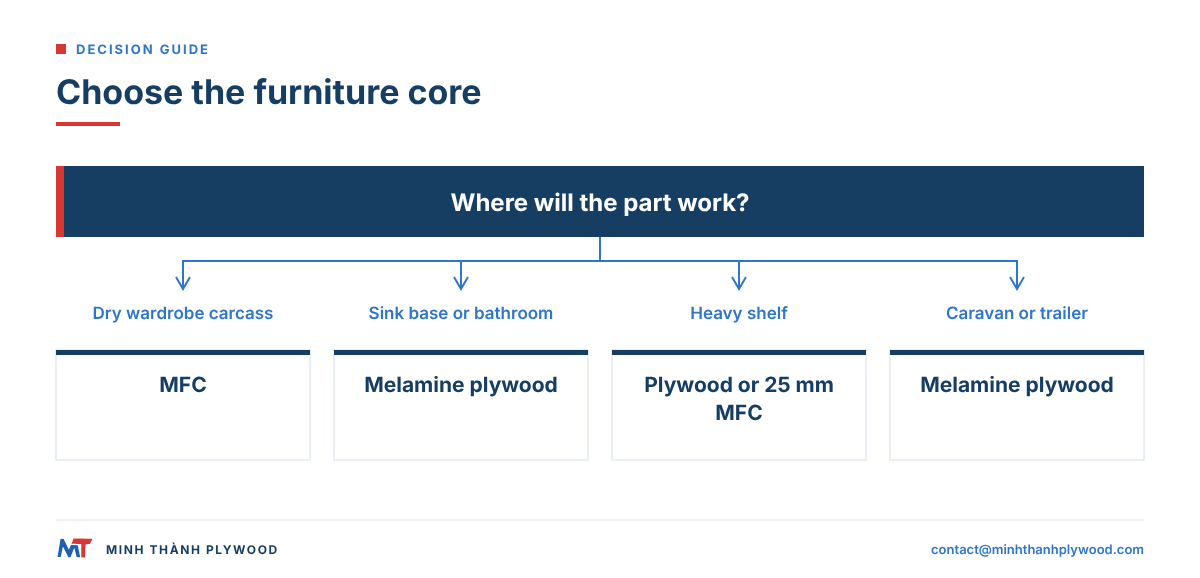
Verdict by use: MFC where the room is dry, the parts are joined with dowels or cam fittings, and cost decides. Melamine-faced plywood where parts get wet, carry weight, take screws in the edge or travel assembled.
What MFC sizes, decors and prices do UK buyers see?
UK retail MFC comes as full sheets, long boards and ready-cut furniture boards, in a short list of decors from the big panel makers. Prices below are typical UK retail read on 21 October 2026.
| Format and thickness | Price | Seller |
|---|---|---|
| White MFC sheet, 2440 × 1220 mm, 18 mm | £34.95 ex VAT (£41.94 inc VAT) | Sheet Materials Wholesale |
| Plain and woodgrain MFC board, 2.8 m × 18 mm | £16.49–18.75 each, 43 decors | Atlantic Timber |
| White high gloss MFC board, 2.8 m × 18 mm | £26.90 | Atlantic Timber |
| MFC board, 2.4 m × 15 mm | £13.18 | Atlantic Timber |
| Melamine edging tape | £1.68 | Atlantic Timber |
| White semi-edged furniture board, 2.5 m × 300 mm, 18 mm | £18.97 | B&Q |
| White semi-edged furniture board, 2.5 m × 600 mm, 18 mm | £26 | B&Q |
The pieces beyond the full sheet suit DIY and small joinery. B&Q sells 16 and 18 mm furniture boards ready cut, 2 to 2.5 m long and 200–600 mm wide, in white, oak and grey oak, as square, semi or fully edged boards. For trade volumes, the sheet is the unit: 2440 × 1220 mm in the UK, and 2800 × 2070 mm from European mills.
Decors. Most UK MFC is sold by decor code from EGGER and Kronospan. Cutmy lists 18 mm EGGER W1000 ST9 Premium White, U708 ST9 Light Grey, U899 ST9 Soft Black (also 25 mm), H1180 ST37 Natural Halifax Oak, H3710 ST12 Natural Carini Walnut and F800 ST9 Crystal Marble. The letters give the family (W white, U plain, H woodgrain, F pattern), the number the colour and the ST code the surface texture, so a buyer can reorder the same decor from any seller.
The step to melamine-faced plywood. A trade buyer who laminates its own boards buys the plywood core by the container: furniture plywood starts from US$350/m³, which is about US$19 raw FOB for an 18 mm 1220 × 2440 mm sheet (0.0536 m³), before melamine pressing, freight, duty and margin. Against the £35–42 retail MFC sheet, the plywood core is the higher-cost line, and the sections below show where it earns the difference: chipping, screw holding in the edge, wet edges and weight.
What is melamine faced chipboard (MFC board)?
Melamine faced chipboard is particleboard finished on both faces with decorative paper impregnated with melamine-formaldehyde resin, fused to the board in a short-cycle press. It is sold as MFC board, MFC wood, laminated chipboard and, in North America, thermally fused laminate (TFL) on particleboard.
How it is built:
- Core: wood particles and chips, bonded with resin and pressed into a board with fine particles at the faces and coarser ones in the middle.
- Surface: one impregnated decor paper on each face, the same decor or a balancing colour on the back.
- Press: heat cures the resin into a hard, closed surface in one step; the press plate sets the texture.
The surface is the same as on any other melamine board. The broader product family, with sizes, colours and textures, is covered in our melamine board guide.
What is conti board, or Contiboard?
Contiboard is a long-established UK trade name for melamine faced chipboard: white, coloured and woodgrain boards sold in shelf widths and full sheets, with matching iron-on edging. Contiboard white became the everyday name for any white MFC shelf.
For a buyer, “conti board” means MFC with these features:
- Pre-cut widths for shelving and carcass sides, as well as full sheets.
- Matching edging for the cut edges.
- White and woodgrain decors, the most stocked being white.
A furniture plant ordering in container loads specifies the same board by its real description, not the trade name: chipboard core class, emission class, thickness, decor and edging. The trade name alone does not say which core or emission class arrives.
Why does MFC chip, and does plywood chip less?
MFC chips because the hard melamine surface sits on loose particles; when a saw tooth exits the board, it breaks the surface away from the weak core. Melamine-faced plywood chips less, because the surface sits on continuous wood veneer that supports it at the cut.
How to cut either board cleanly:
- Scoring saw on the panel saw: a small blade scores the underside before the main blade cuts.
- Fine-tooth blade with a triple-chip or hollow-ground tooth when no scoring blade is available.
- Tape on the cut line for hand cutting, removed after the cut.
- Climb or compression router bits on CNC, so both faces are cut toward the core.
Chipped corners are also a transport problem. An MFC corner crushes when a carton is dropped; a plywood corner bends and recovers more often. That difference shows up in furniture shipped assembled, and in the returns that follow.
How do screw holding and hardware compare?
Plywood holds screws in the edge far better than MFC, and keeps its grip when a screw is taken out and driven again. MFC holds screws acceptably in the face and poorly in the edge.
What that means for the furniture design:
| Joint | MFC | Melamine-faced plywood |
|---|---|---|
| Screw into the edge | Weak; splits or strips | Good |
| Re-driven screw | Loses grip | Keeps most grip |
| Cam and dowel connectors | Standard, designed for MFC | Work well |
| Hinge cups in doors | Good with correct drilling | Good |
| Heavy hardware (lifts, pull-outs) | Needs inserts | Direct screws hold |
Flat-pack furniture is designed around MFC’s weakness: dowels, cam connectors and inserts carry the joint. Furniture that is screwed together, reassembled, or carries pull-outs and lift mechanisms benefits from a plywood core.
How do MFC and plywood behave in moisture?
Both resist splashes on the face; the difference is at the edge. Water that reaches a chipboard edge or drilled hole makes the particles swell, and the swelling does not go back. A plywood edge takes up far less water and keeps its shape.
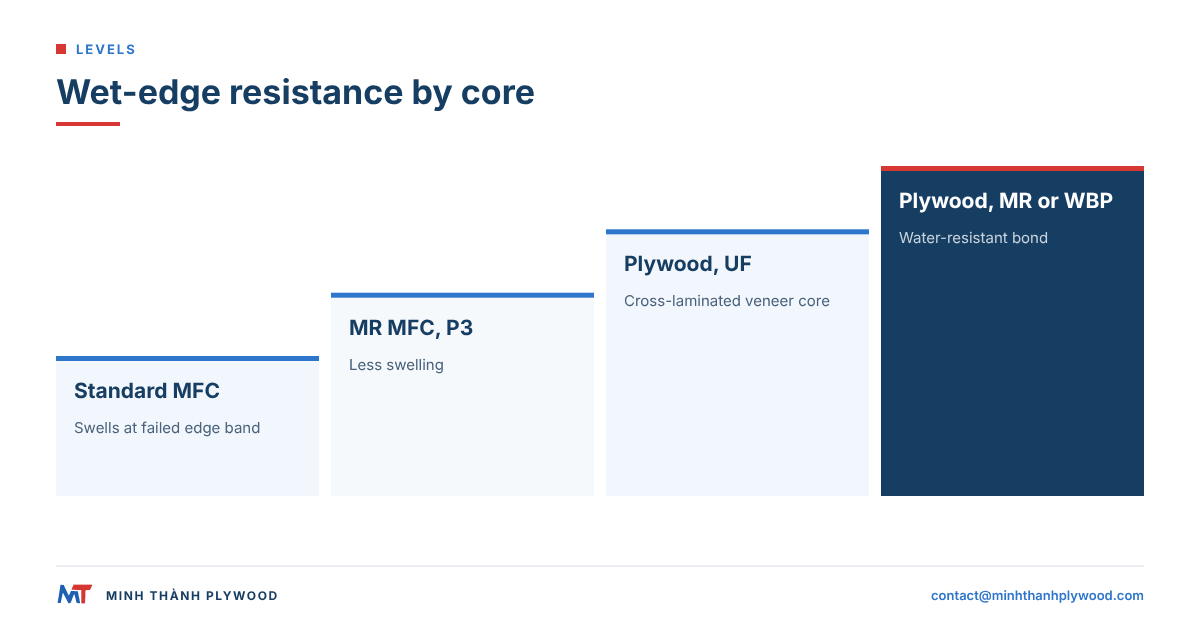
From weakest to strongest at a wet edge:
- Standard MFC: swells when an edge band fails.
- Moisture-resistant MFC (green-core, EN 312 class P3): swells less.
- Melamine-faced plywood with UF glue: cross-laminated veneers swell much less than particles.
- Melamine-faced plywood with melamine-fortified or phenolic (WBP) glue: the bond holds through damp service.
For kitchen sink bases, bathroom vanities, caravans, boat interiors and trailers, the plywood core is the safer board. Seal every edge and drilling in any case, with PUR glue on the edge bander where possible.
How much do the sheets weigh?
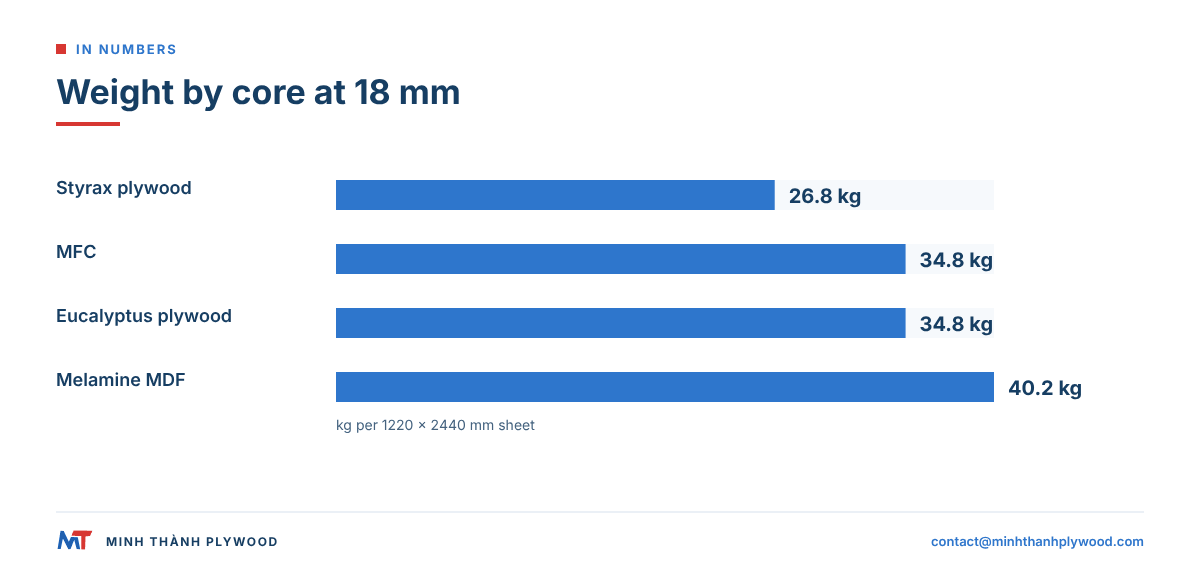
An 18 mm 1220 × 2440 mm sheet of MFC weighs about 34.8 kg; the same sheet of Styrax-core plywood weighs 26.8 kg. The difference is density: about 650 kg/m³ for chipboard against 500 kg/m³ for a Styrax core.
| 18 mm sheet, 1220 × 2440 mm | Density | Weight per sheet |
|---|---|---|
| Melamine faced chipboard | About 650 kg/m³ | About 34.8 kg |
| Melamine-faced MDF | About 750 kg/m³ | About 40.2 kg |
| Plywood, Styrax core | 500 kg/m³ | 26.8 kg |
| Plywood, Eucalyptus core | 650 kg/m³ | 34.8 kg |
The weights are density × sheet volume (1220 × 2440 × 18 mm), before the melamine paper. Weight matters three times: on the cutting line, in the finished furniture (wall units, caravan and trailer interiors), and in freight. At 18 mm, a 40HC planned at 28,000 kg carries 990 Styrax-core plywood sheets.
How far can melamine shelving span?
As a workshop guide, an 18 mm MFC shelf carrying book-type loads is kept to about 800 mm between supports; beyond that, it sags over time. Chipboard creeps under constant load, so a shelf that looks straight on day one bows in a few months.
Ways to carry a longer span:
- Thicker board: 25 mm MFC instead of 18 mm.
- Front lipping or rail: a solid strip on the front edge stiffens the shelf.
- Plywood core: cross-laminated veneers sag less and creep less than chipboard of the same thickness; a Eucalyptus core is stiffer than Styrax.
- Centre support: a fixed upright or a back rail fixed to the wall.
For heavy shelving in shops, archives and garages, specify plywood shelves or a thicker board rather than relying on MFC at its limit.
MDF vs MFC: which is better?
MDF and MFC answer different needs: melamine-faced MDF machines to a finer edge and profile, while MFC is lighter, cheaper and stronger against swelling in a dry carcass. Neither holds edge screws as well as plywood.
| Metric | Melamine-faced MDF | MFC |
|---|---|---|
| Core | Fine wood fibres | Wood particles |
| Machined edge and profile | Smooth, can be routed and painted | Coarse; must be banded |
| Weight, 18 mm sheet | About 40.2 kg | About 34.8 kg |
| Screw holding | Moderate | Low in the edge |
| Typical parts | Shaped doors, profiled fronts | Carcasses, shelves, wardrobes |
The “MDF vs MFC” choice usually ends with both: MFC for the carcass, MDF for shaped fronts. Where plywood replaces both, see plywood vs MDF and plywood vs chipboard.
Melamine glue vs melamine surface: what is MR glue in plywood?
“Melamine” names two different things in panel buying: the decorative melamine surface of MFC, and melamine glue (MR or MUF) inside plywood. Melamine glue is a melamine-urea-formaldehyde adhesive that bonds the veneers and resists moisture better than plain UF glue.
| Glue in plywood | What it gives | Typical use |
|---|---|---|
| UF glue at E0 emission | Light glue line, low emission | Dry-room furniture and interiors |
| Melamine-fortified (MR, MUF) | Better moisture resistance, light glue line | Kitchens, bathrooms, humid rooms |
| Phenolic (WBP) | Highest water resistance, dark glue line | Damp, exterior and boat interiors |
Which is better for furniture plywood? For dry-room furniture, UF glue at E0 emission is the standard at Minh Thanh. Melamine-fortified bonds suit kitchens and bathrooms; phenolic bonds suit damp and exterior parts and cost more, because the resin costs more and the panel is built for harder service. Both are made to the customer’s specification.
Can melamine glue plywood reach E0? Glue type and emission class are separate specifications. Ask for both lines on the order, and for the chamber test report behind the emission class.
Which decors and thicknesses are available?
MFC is made in white, plain colours, woodgrains and patterns, from about 8–25 mm thick, with 16 mm and 18 mm the furniture standards. Contiboard white and other white MFC are the volume product.
- 8–12 mm: backs, drawer bottoms, partitions.
- 16 mm: flat-pack furniture and wardrobe systems.
- 18 mm: kitchen carcasses, shelves, doors.
- 25 mm: heavy shelves, desk tops.
Melamine-faced plywood follows plywood formats: 1220 × 2440 mm and 1250 × 2500 mm, plus custom sizes. Minh Thanh’s plywood is made 3–40 mm thick, sanded to ±0.2–0.3 mm, down to ±0.2 mm, so the laminated board stays within a tight thickness band for grooves and connectors.
Which emission rules apply to MFC and melamine plywood?
Both boards must meet the emission rule of the market where the furniture is sold. In the EU, the limit is 0.062 mg/m³ for furniture and wood-based articles from 6 August 2026, under Regulation (EU) 2023/1464. In the United States, TSCA Title VI sets 0.09 ppm for particleboard and 0.05 ppm for hardwood plywood with a veneer core under 40 CFR 770.10. EPA’s stakeholder guidance explains how non-exempt laminated products are treated.
For the plywood core, Minh Thanh’s evidence:
- CARB P2 / TSCA Title VI certification, ICTT mill no. 23024.
- Six ASTM D6007 chamber tests, April 2025 to June 2026, on 9, 15 and 18 mm panels: averages of 0.014–0.032 ppm against the 0.05 ppm limit.
- Third-party testing to EN 717-1 or another buyer method through SGS on request.
The laminated board needs its own record from the laminator for the finished product.
Which board should you use for each furniture part?
Choose by the room, the joint and the load. The table gives a verdict by part.
| Furniture part | Better choice | Why |
|---|---|---|
| Wardrobe and bedroom carcasses | MFC | Dry room, cam and dowel joints, lowest cost |
| Office desks and storage | MFC, HPL for tops | Dry, flat-pack, cost |
| Kitchen wall and base carcasses | MFC or melamine-faced plywood | MFC for cost, plywood for longer life |
| Sink base and dishwasher side | Melamine-faced plywood | Edge swelling is the main failure |
| Bathroom vanities | Melamine-faced plywood, MR glue | Humidity |
| Caravan, trailer and boat interiors | Melamine-faced plywood | Weight, moisture, vibration |
| Heavy or long shelves | Plywood, or 25 mm MFC | Sag and creep |
| Furniture shipped assembled | Melamine-faced plywood | Corners and joints survive transport |
Trailer and caravan builders choose melamine-faced plywood for three reasons at once: a lighter sheet, screws that hold under vibration, and an edge that tolerates damp.
How do you specify melamine-faced plywood instead of MFC?
Write the order in seven lines so the core is never a surprise:
- Core: plywood, core species (white Styrax or Eucalyptus), stitched, pressed twice.
- Glue: UF at E0 emission for dry rooms; melamine-fortified or phenolic for damp rooms.
- Emission: class and market rule, with the test method.
- Thickness and size: for example 18 mm, 1220 × 2440 mm, ±0.2–0.3 mm on the sanded core.
- Face for lamination: sanded, even face; decor, texture and balancing paper as agreed with the laminator.
- Moisture content: 8–12 % at dispatch.
- Packing and quantity: sheets per pack, total sheets or m³, destination port.
Minh Thanh Plywood supplies the plywood core in full containers from Ha Hoa, Phu Tho, Vietnam: MOQ one 40HC with mixed specifications by agreement, 15–45 days after the 30% deposit, FOB Hai Phong, CFR or CIF, and free samples. Furniture plywood starts from US$350/m³ (October 2026). Send your core specification to contact@minhthanhplywood.com, or see furniture plywood from Minh Thanh.
Buyer questions, answered
What is melamine faced chipboard?
Melamine faced chipboard (MFC) is particleboard with decorative paper soaked in melamine resin fused to both faces under heat and pressure. It arrives finished in white, plain colours or woodgrain and is the most common carcass board in furniture.
What is Contiboard?
Contiboard is a long-established UK trade name for melamine faced chipboard, sold as white and woodgrain shelving and furniture boards with matching edges. In everyday use, 'conti board' means any MFC shelf board.
What is the difference between MDF and MFC?
MDF is fibreboard made from fine wood fibres; MFC is particleboard with a melamine face. Melamine-faced MDF machines to a finer edge and profile; MFC is lighter and cheaper. Both swell at unsealed edges.
Is MFC or plywood better for furniture?
MFC for low-cost, dry-room carcasses and shelving; plywood for parts that take screws in the edge, get damp, carry heavy loads or are transported assembled. Many plants use MFC for the carcass and plywood for the sink base and drawers.
How far can melamine shelving span?
As a workshop guide, 18 mm melamine faced chipboard shelves under book-type loads are kept to about 800 mm between supports. Plywood shelves of the same thickness sag less, and a front lipping or a 25 mm board extends the span.
Does melamine faced chipboard chip when cut?
Yes, the hard surface chips at the underside of the cut unless a scoring saw or a fine-tooth blade with tape is used. Plywood cores chip less, because the face sits on continuous veneer instead of loose particles.
Is MFC waterproof?
No. The melamine face resists splashes, but chipboard swells when water reaches an edge or a drilled hole. Moisture-resistant chipboard and sealed edges help; a plywood core with a water-resistant bond swells least.
What is laminated chipboard?
Another name for melamine faced chipboard: chipboard with a laminated decorative surface. Some suppliers use it for chipboard with HPL glued on, so ask whether the surface is melamine paper or high-pressure laminate.
What is melamine (MR) glue in plywood?
Melamine glue in plywood is a melamine-urea-formaldehyde adhesive that bonds the veneers and resists moisture better than plain UF glue. It is a bond inside the panel, not the decorative melamine surface of MFC.
Is melamine or phenolic glue better for furniture plywood?
For dry-room furniture, neither: UF glue at E0 emission is the standard. Melamine-fortified glue suits kitchens and bathrooms; phenolic (WBP) glue suits damp or exterior parts and costs more.
Can melamine glue plywood reach E0 emission?
The emission class is set by the full glue system and the test, not by the word melamine. Ask for the emission class and the chamber test report as a separate line from the glue type.
Why is phenolic glue plywood more expensive than melamine glue plywood?
Phenolic resin costs more, cures at higher press temperatures and gives a dark glue line, and the panels are usually built for exterior or damp use. Melamine-fortified glue costs less and keeps the glue line light.