
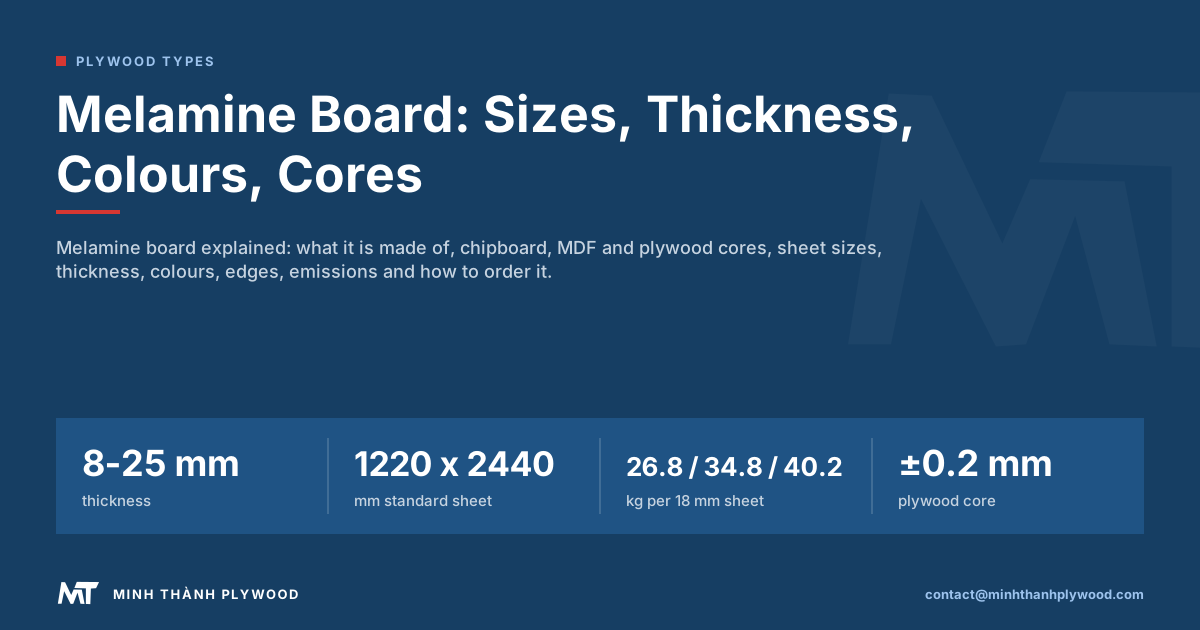
Melamine board is a wood-based panel, usually chipboard, MDF or plywood, with melamine-resin decorative paper fused to both faces under heat and pressure. It arrives finished, in white, plain colours or woodgrain, from 8–25 mm thick. The core decides weight, screw holding and moisture behaviour. Minh Thanh Plywood supplies the plywood core for melamine-faced plywood.
What is melamine board?
Melamine board is a wood-based panel finished on both faces with decorative paper soaked in melamine-formaldehyde resin, fused to the core in a hot press. The result is a ready-finished sheet: no sanding, staining or lacquer needed before it is cut into furniture parts.
Buyers meet it under many names: melamine faced board (MFB), melamine sheets, low-pressure laminate (LPL), thermally fused laminate (TFL) in North America, and MFC when the core is chipboard. All describe the same product family: a decorative resin surface on a core board.
The name says nothing about the core. A white melamine board can be chipboard, MDF or plywood underneath, and those three behave very differently in screw holding, weight, moisture and price. The first line of any melamine board order therefore names the core.
What sizes and prices does melamine board have in the UK?
UK buyers meet melamine board as full sheets, cut-to-size panels and ready-cut furniture boards. Full sheets are 2440 × 1220 mm (8 × 4 ft); UK cutters such as MDF Direct work from sheets up to 3050 × 1220 mm, and large-format 2800 × 2070 mm sheets go to furniture plants.
Thicknesses run from 3.2 mm single-sided (white-faced hardboard for backs and linings) to 8–25 mm double-sided, with 15, 16 and 18 mm the common furniture steps. Ready-cut furniture boards at DIY sheds come 2.0–2.5 m long and 200–600 mm wide in white and oak-effect finishes, as square, semi or fully edged panels, in 16 and 18 mm.
| Product (UK retail, read 21 October 2026) | Format | Price |
|---|---|---|
| White melamine faced chipboard, 18 mm | 2440 × 1220 mm sheet | £34.95 ex VAT, £41.94 inc VAT (Sheet Materials Wholesale) |
| White melamine faced MDF, 18 mm | 2440 × 1220 mm sheet | About £61.53 ex VAT (£20.65 per m², Materials Market) |
| White semi-edged MFC furniture board, 18 mm | 2.5 m × 300 mm | £18.97 (B&Q) |
| White semi-edged MFC furniture board, 18 mm | 2.5 m × 500 mm | £23.97 (B&Q) |
| White semi-edged MFC furniture board, 18 mm | 2.5 m × 600 mm | £26 (B&Q) |
| Delivery, cut-to-size merchant | England and Wales | £10–25 plus VAT by order value (MDF Direct) |
Typical UK retail for a full 18 mm sheet therefore sits at about £35–42 for chipboard core and about £62 and up for MDF core, before delivery. Importers and furniture plants that laminate their own boards buy the core by the container instead: furniture plywood starts from US$350/m³, which is about US$19 raw FOB for an 18 mm 1220 × 2440 mm sheet (0.0536 m³), before melamine pressing, freight, duty and margin.
That figure sets the plywood core against the chipboard sheet price above, so a trade buyer can see where the extra cost of a plywood core pays back in screw holding and weight.
Is melamine board the same as MFC?
No. MFC is melamine faced chipboard, one of three melamine board cores; melamine faced MDF and melamine faced plywood are the others. UK sheds sell MFC as “furniture board”, so the two names often mean the same product in a UK shop, but the core under the paper still decides screw holding and moisture. Name the core first on every order.
Is melamine board food safe?
The cured melamine surface is hard, closed and wipes clean, so it is the usual finish for kitchen cupboards, shelves and pantry units where packaged food sits. It is not a chopping surface, and the raw core at a cut edge is not food-safe, so band every edge. For worktops or any direct food-contact use, ask the supplier for a food-contact declaration for the surface and use HPL or solid wood instead.
What is the best thickness for melamine shelves?
Use 18 mm for shelves up to a normal cupboard span, and 25 mm or a plywood core for long spans and heavy loads, with a support under any shelf longer than about 800 mm. Thinner 8–12 mm boards belong to doors on light frames, backs and liners. MDF Direct gives the same band: 18–25 mm for shelves with spans and supports set to the load.
What is melamine board made of?
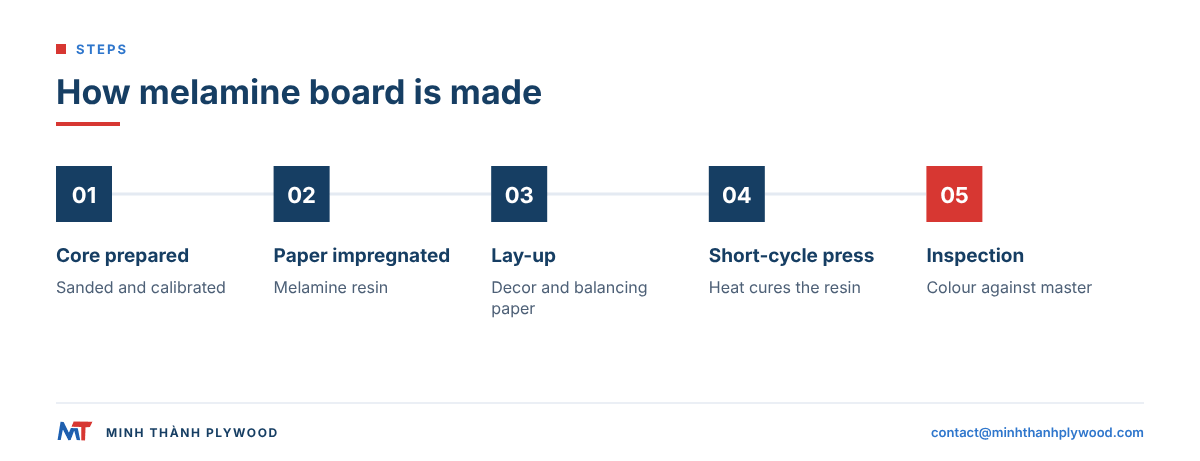
Melamine board is made of three parts: a core panel, decorative paper and melamine resin. The resin turns the paper into a hard, closed surface and bonds it to the core in one pressing. The European standard, EN 14322, defines melamine faced boards for interior use on particleboard, fibreboard and sandwich-board cores; melamine-faced plywood is made to the buyer’s specification.
The usual production sequence:
- Core preparation. A chipboard, MDF or plywood core is sanded and calibrated so its thickness is even across the sheet.
- Paper impregnation. Printed or plain-coloured decor paper is soaked in melamine-formaldehyde resin and dried to a controlled resin content.
- Lay-up. One impregnated paper goes on each face. A balancing paper on the back is essential: a sheet faced on one side only bows.
- Short-cycle pressing. Heat and pressure cure the resin in seconds; the press plate gives the surface its texture, from matt to gloss or woodgrain.
- Cooling and inspection. Sheets are stacked flat, checked for surface defects and colour against the master, then packed.
For a plywood core, step 1 is where the panel is won or lost. Melamine paper copies every dip in the core. Minh Thanh’s furniture plywood is pressed twice for this reason: the core board is pressed and calibrated first, then the face and back go on, so the surface that reaches the laminating press is flat and sanded to ±0.2–0.3 mm, down to ±0.2 mm.
Which cores are used: chipboard, MDF or plywood?
Melamine board is made on three cores, and the core decides how the finished part performs. Chipboard is the usual low-cost core; MDF gives a fine machined edge; plywood gives strong screw holding, low weight and good moisture behaviour.
| Core | Build | Typical density | Weight, 18 mm, 1220 × 2440 mm | Best at |
|---|---|---|---|---|
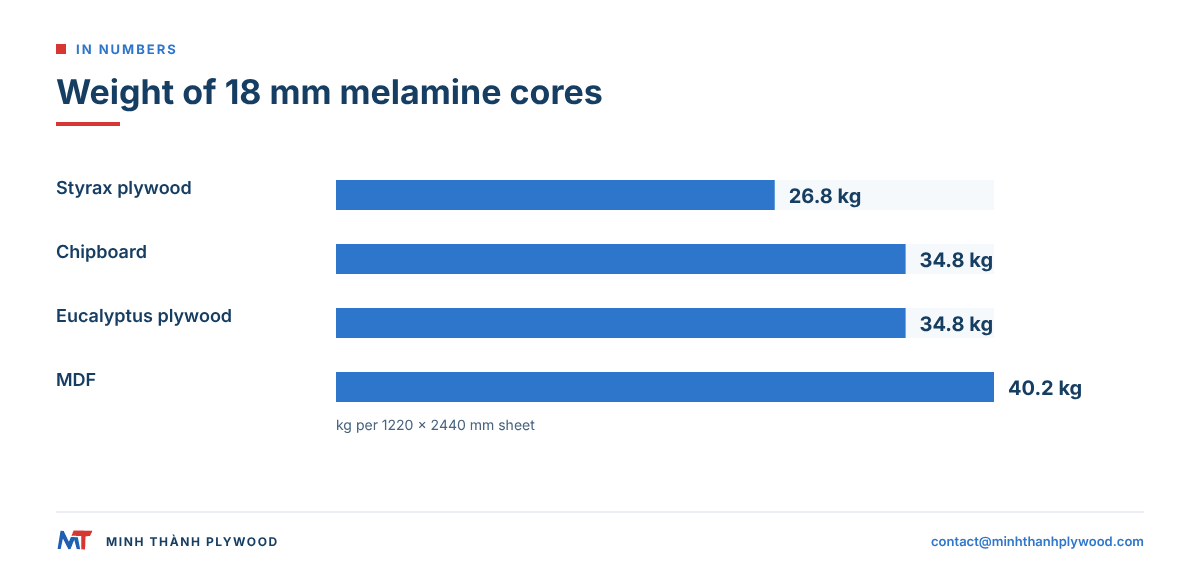
| Chipboard (particleboard) | Wood particles bonded with resin | About 650 kg/m³ | About 34.8 kg | Low cost carcasses, shelving, flat-pack |
| MDF | Wood fibres bonded with resin | About 750 kg/m³ | About 40.2 kg | Routed doors, profiled edges, painted parts |
| Plywood (Styrax core) | Cross-laminated veneers | 500 kg/m³ | 26.8 kg | Screw holding, damp rooms, transport-loaded furniture |
| Plywood (Eucalyptus core) | Cross-laminated veneers | 650 kg/m³ | 34.8 kg | Stiff shelves and heavier-duty parts |
The weight column is computed as density × sheet volume (1220 × 2440 × 18 mm). A Styrax-core plywood sheet is about a third lighter than an MDF sheet of the same size, which matters on the cutting line, in assembled furniture and under a container weight limit.
The deeper comparisons are in melamine-faced chipboard vs melamine plywood, particle board vs plywood and plywood vs MDF.
What is the difference between melamine board and laminate?
Melamine board is a low-pressure laminate: the resin-soaked paper is fused straight onto the core in one short press. High-pressure laminate (HPL) is a separate sheet, built from many layers of resin paper under much higher pressure, and glued to a core afterwards.
| Point | Melamine board (LPL / TFL) | HPL on a core |
|---|---|---|
| How it is made | One paper fused to the core in one press | Thick laminate sheet made first, then glued on |
| Surface thickness | A single paper layer | A multi-layer sheet |
| Impact and wear | Good for vertical and light-use horizontal parts | Higher; for worktops, counters, desks in heavy use |
| Cost | Lower | Higher |
| Typical parts | Carcasses, shelves, wardrobes, doors | Worktops, reception counters, laboratory tops |
“Laminate” in a shop often means HPL; “melamine” means the low-pressure board. Ask which one the quotation covers. HPL can be pressed on plywood, MDF or chipboard too, so the core question still applies.
What sizes do melamine sheets come in?
The standard melamine board size is 1220 × 2440 mm (4 × 8 ft). Large-format sheets such as 2800 × 2070 mm and 2750 × 1830 mm come from European chipboard and MDF lines and are sold to furniture plants that cut their own parts.
| Format | Size | Where it is used |
|---|---|---|
| 4 × 8 ft | 1220 × 2440 mm | Cabinet shops, export furniture, plywood cores |
| European plywood size | 1250 × 2500 mm | Plywood-core boards for European buyers |
| Large format | 2800 × 2070 mm | Furniture plants with panel saws |
| Large format | 2750 × 1830 mm | Furniture plants, shop fitting |
Plywood-core melamine boards follow plywood formats. Minh Thanh makes its plywood in 1220 × 2440 mm and 1250 × 2500 mm, plus custom sizes such as 1220 × 2500 mm and 1220 × 2280 mm, and cuts sheets into 4, 6 or 8 pieces on request. Write the bare core size and the finished size separately when the laminator trims after pressing.
What thickness is melamine board?
Melamine board is made from about 8–25 mm thick. Three thicknesses cover most furniture:
- 16 mm: flat-pack furniture, wardrobe interiors, drawer sides in many systems.
- 18 mm: the standard for kitchen and bathroom carcasses, shelves and doors; 18mm melamine board is the most stocked thickness.
- 25 mm: heavy shelves, desk tops, display bases.
Thinner boards, 8–12 mm, serve backs, drawer bottoms and partitions. Choosing between 16 mm and 18 mm is a system decision, not a quality one: connector fittings, hinge plates and drawer runners are drilled for one thickness, so a plant that changes thickness changes its hardware drilling too. Kitchen makers in Europe mostly standardise on 18 mm carcasses; flat-pack and wardrobe systems often stay on 16 mm to save weight and cost per carton. The quoted thickness is normally the finished board with both papers; the papers add very little, but hinge and connector drawings should use the finished value.
Plywood cores add a tolerance advantage. Sanded furniture plywood from Minh Thanh holds ±0.2–0.3 mm, down to ±0.2 mm, across 3–40 mm, so grooves for backs and drawer bottoms fit without re-setting the router between packs.
Which colours and finishes: white melamine board, black, grey or woodgrain?
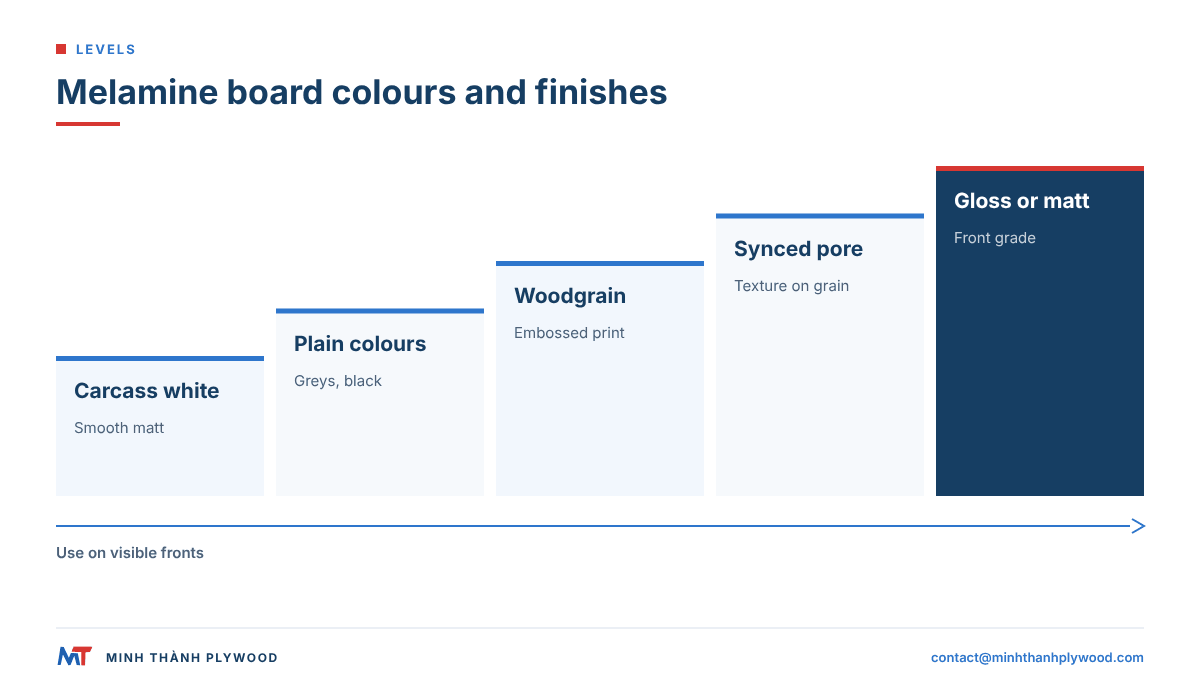
Melamine board comes in plain colours, woodgrain prints and stone or fabric patterns, each in a choice of surface texture. White melamine board is the volume product for carcasses and wardrobe interiors; black and grey melamine boards are the next most ordered plain colours.
Colour families
- Whites: pure, warm and premium whites; carcass white is often a separate, cheaper decor than door white.
- Plain colours: black, greys, beiges, and seasonal colours from the decor paper makers’ collections.
- Woodgrains: oak, walnut, ash, elm and many more, printed on paper; synchronised-pore textures follow the printed grain.
- Patterns: concrete, marble, textile and metal looks.
Textures and gloss
- Smooth matt or satin for carcasses.
- Woodgrain embossing for doors and visible panels.
- High gloss and super-matt for fronts, often with an anti-fingerprint surface.
Order colour against a physical master sample, not a screen image or decor number alone. Melamine board colours vary between presses and paper batches; a signed sample is the only fair reference when a later container arrives.
How durable is the melamine surface?
A melamine surface is hard, closed and easy to clean; it resists scratches, stains and household chemicals well for vertical parts and normal shelf use. Its weak points are impact at corners and abrasion on heavily used horizontal surfaces.
The European product standard for these boards is EN 14322, Wood-based panels. Melamine faced boards for interior uses, with the surface tests in EN 14323: scratch, abrasion, stain, cigarette burn, steam and crack resistance. Buyers specifying for contract furniture ask the board supplier for the classes the board meets on these tests.
Where wear is high, such as desks, counters and reception tops, step up to HPL on the same core. Where impact is the risk, such as low wardrobe corners and shop fittings, the core matters as much as the surface: a plywood core spreads a blow that would crush a chipboard corner.
How should melamine board edges be finished?
Every cut edge of melamine board needs banding: it covers the raw core, stops moisture getting in and protects the corner. The edge band is the detail that decides how long the part lasts.
| Edge band | Where it fits |
|---|---|
| Thin PVC or ABS band, 0.4 mm | Hidden edges, shelf backs, carcass inner edges |
| Thick PVC or ABS band, 1 mm | Visible carcass edges |
| Thick ABS band, 2 mm | Door edges, high-impact parts, rounded profiles |
| Melamine paper edge | Low-cost interior parts |
Three practical rules:
- Match the band to the board. Plain colours and woodgrains have matching band decors; order both from the same collection.
- Seal the core. Hot-melt or polyurethane glue on the edge bander closes the joint; PUR gives the better moisture seal in kitchens and bathrooms.
- Band plywood edges too. On melamine-faced plywood the band gives the same finished look as on chipboard; leave the edge open only when the ply stripes are part of the design.
What are the disadvantages of melamine board?
Melamine board has four practical disadvantages: chipping at the cut, surface damage that cannot be sanded out, swelling when water reaches the core, and poor edge screw holding on chipboard cores.
- Chipping. The hard surface chips on the underside of a cut unless the saw has a scoring blade. Hand-cut boards need tape on the cut line and a fine-tooth blade.
- No repair by sanding. A deep scratch or chipped corner goes through the paper; filler sticks can hide it, but the surface cannot be refinished like veneer.
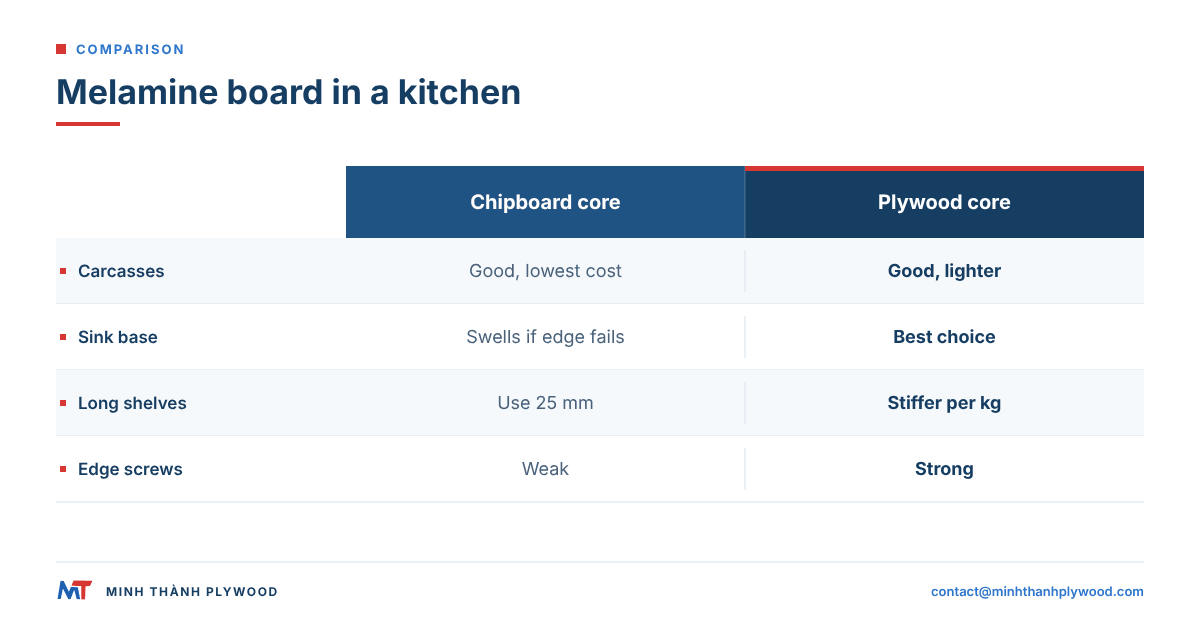
- Moisture at edges. The face resists water; the core does not. A failed edge band at a sink base lets water in and the chipboard swells.
- Screw holding. Chipboard holds screws poorly in the edge and loses grip when a screw is re-driven. Furniture designers use dowels, cam connectors or inserts instead.
- Weight. Chipboard and MDF cores make heavy sheets, which matters for wall cabinets, moving furniture and freight.
The last three are core problems, not surface problems. A melamine-faced plywood core holds edge screws better, swells less at a damp edge and weighs less, which is why it is used for sink cabinets, caravans, trailers and furniture that travels.
Can melamine board be painted?
Yes: melamine board can be painted if the surface is prepared so the paint can grip a closed, glossy face. Paint straight onto melamine peels.
- Clean with a degreaser to remove dust, oil and hand marks.
- Scuff the whole surface with fine abrasive until the gloss is gone; do not sand through the paper.
- Prime with a primer made for glossy surfaces, such as a shellac-based or bonding primer.
- Paint with two thin coats of a hard-wearing furniture or cabinet paint.
- Cure for the full time on the paint data sheet before fitting hinges or handles.
For new furniture, painting melamine board rarely makes sense: order the colour in the paper, or use a plywood or MDF part with a paintable surface. Minh Thanh’s plywood faces are sanded and UV-ready on both sides, for buyers who apply their own UV coating rather than a melamine paper.
Is melamine board waterproof?
No. Melamine board is water-resistant on the face and not waterproof as a panel. The resin surface sheds splashes; the wood-based core swells when water reaches an edge, a hinge hole or a damaged face.
How to improve moisture behaviour, in order of effect:
- Choose the core. Moisture-resistant chipboard (green-core, EN 312 class P3) and moisture-resistant MDF swell less than standard grades. Plywood with a melamine-fortified or phenolic (WBP) bond swells least, because the veneers are cross-laminated and glued with a water-resistant bond.
- Seal every edge. Band all four edges and the cut-outs for sinks and hobs; PUR glue seals better than standard hot-melt.
- Protect the drillings. Hinge cups and connector holes are open core; a sealant or plugged insert keeps water out.
A melamine face on plywood does not turn it into marine plywood, but it is the better melamine board for kitchens, bathrooms, boats’ interiors and caravans.
Is melamine board good for kitchen cabinets, and how long does it last?
Yes: melamine board is the most used carcass material in kitchen cabinets, because it arrives finished, is easy to clean and costs less than veneered or painted panels. It lasts as long as its edges stay sealed.
Where it fits in a kitchen:
| Kitchen part | Good melamine board choice |
|---|---|
| Wall and base carcasses | 18 mm white melamine board on chipboard or plywood core |
| Shelves | 18 mm; 25 mm or plywood core for long spans and heavy loads |
| Sink base | Plywood core with sealed edges, or moisture-resistant chipboard |
| Doors and drawer fronts | Woodgrain or plain melamine board with 2 mm ABS edges |
| Worktops | HPL rather than melamine board |
| Drawer bottoms and backs | Thin melamine board or thin plywood |
In a dry room, melamine furniture keeps its looks for many years; it fails at the edge, not at the face. In a kitchen, the sink base and the dishwasher side panel are where water attacks first. Those two parts are where a plywood core pays for itself.
Is melamine stronger than plywood, and what is melamine plywood?
Melamine is a surface, so the strength question is a core question: plywood is stronger than chipboard and MDF of the same thickness in screw holding and stiffness per kilogram. Melamine plywood is plywood with melamine paper fused to both faces, combining a veneer core with a finished decorative surface.
Why plywood performs better as a melamine core:
- Cross-laminated veneers carry load along and across the sheet, so a shelf sags less per kilogram of board.
- Screw holding in the edge is higher, because a screw grips continuous wood veneer instead of compressed particles.
- Moisture swells a plywood edge far less than a chipboard edge.
- Weight: an 18 mm Styrax-core sheet weighs 26.8 kg against about 34.8 kg for chipboard.
Melamine marine plywood is a trade name for melamine-faced plywood with a water-resistant phenolic or melamine-fortified bond. The name does not mean the panel meets a marine plywood standard; ask for the bond and the core, not the label.
Applying melamine to plywood is an industrial step: impregnated paper is fused to the plywood in a short-cycle hot press. A workshop that wants a melamine look on plywood glues on ready-made laminate sheets with contact adhesive or in a cold press instead. Either way, the plywood must be flat and calibrated, or the surface shows every dip.
Which emission grade should melamine board meet?
Melamine board for furniture should meet the emission rule of the market it is sold in: E1 or lower in Europe, with the REACH limit from August 2026, and CARB P2 / TSCA Title VI in the United States. The core and its glue set the emission; the melamine paper is a small part of it.
| Market | Rule | What to ask for |
|---|---|---|
| European Union | Regulation (EU) 2023/1464: 0.062 mg/m³ for furniture and wood-based articles from 6 August 2026 | Chamber test of the finished board, method stated |
| United States | TSCA Title VI, 40 CFR 770.10: 0.05 ppm hardwood plywood, 0.09 ppm particleboard, 0.11 ppm MDF | Certified core, label on the board |
| Buyer specifications | E0 or lower | Glue type and emission class on separate lines |
For a plywood core from Minh Thanh, the evidence is specific: UF glue at E0 emission as standard, CARB P2 / TSCA Title VI certification under ICTT mill no. 23024, and six ASTM D6007 chamber tests between April 2025 and June 2026 on 9, 15 and 18 mm panels that averaged 0.014–0.032 ppm. Testing to EN 717-1 or another buyer method is arranged through SGS on request.
How is melamine board cut to size, and what tolerance can you expect?
Cut-to-size services quote the tolerance, the smallest piece and the drilling rules, and your own drawing should match them. MDF Direct cuts to ±0.1 mm on precision saws; Cutmy cuts on CNC to ±1 mm, with a minimum piece of 100 × 50 mm. Edge banding is offered only on pieces larger than 160 × 160 mm, and a rounded edge band needs a corner radius of at least 50 mm. Hinge cups use the standard 35 mm hole, centred at least 70 mm from the door edge, and doors 1500–2200 mm tall take three hinges.
For a furniture plant the same list becomes the cutting spec: tolerance on length and width, a minimum part size, a banding rule and a hinge drilling pattern. A plywood core helps here too, because its sanded thickness of ±0.2–0.3 mm keeps hinge cups and grooves consistent from pack to pack.
How do you cut and drill melamine board cleanly?
Cut melamine board with the decorative face supported and the blade exiting into the core, never through an unsupported face. The surface is hard and thin, so a clean cut is about tooling, not force.
On a panel saw, a scoring blade cuts a shallow groove in the bottom face just ahead of the main blade, so the main blade exits into a clean line. On a CNC router, compression bits push the fibres of both faces toward the core. In a workshop without either, mark the cut, cover it with masking tape, and use a fine-tooth blade with the good face up on a table saw or down with a track saw.
Drilling follows the same logic:
- Brad-point or hinge-cup bits with sharp spurs, so the paper is cut before the hole is bored.
- Backing board under through-holes, so the bit does not blow out the far face.
- Correct speed: too slow tears the paper, too fast burns the resin.
- Seal the holes in kitchens and bathrooms before the hardware goes in.
A plywood core forgives tooling mistakes better than chipboard: the veneer behind the paper holds it in place where loose particles let it break away.
How should melamine board be received and stored?
Receive melamine board flat, dry and checked against the approved sample, then store it flat on bearers in a dry hall. Most complaints about melamine board start in the first week after delivery, not in the press.
Checks on arrival:
- Packs: corner and edge protection intact, no wet marks on the cardboard or pallet.
- Surface: a sample sheet per pack under good light for scratches, pressure marks and dust inclusions.
- Colour and texture: sheets from the new delivery beside the master sample and beside sheets already in stock.
- Flatness: a sheet laid on a flat table; a bowed sheet points to an unbalanced back paper or a wet core.
- Thickness: a caliper reading at the four corners and the middle of a few sheets.
Storage rules are simple. Keep sheets flat on bearers close enough to stop sagging, never on end against a wall for long. Keep the top sheet covered, keep the hall dry, and let boards adjust to the workshop for a day or two before cutting. Plywood cores travel well under these rules; Minh Thanh’s plywood leaves the factory at 8–12 % moisture content, and every shipment is photographed and filmed before loading, with the photos and video sent to the buyer.
How do you specify melamine board on an order?
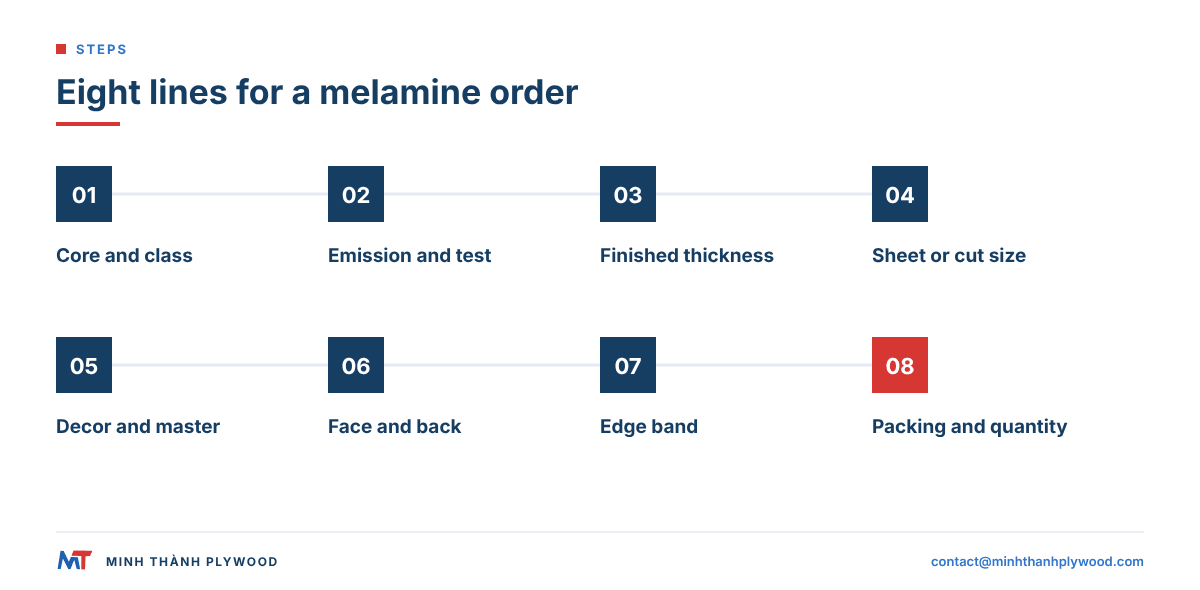
Write the melamine board order in eight lines so the core, surface and edges can be checked on arrival:
- Core: chipboard (with class), MDF (with grade), or plywood (core species, glue).
- Emission: class and the market rule, with the test method.
- Thickness: finished thickness and tolerance, for example 18 mm.
- Size: sheet size, for example 1220 × 2440 mm, or cut sizes.
- Decor: decor name and number, texture, gloss level, approved sample reference.
- Faces: decor on both faces, or decor and balancing colour.
- Edges: band material, thickness and matching decor.
- Packing and quantity: sheets per pack, protection boards, total sheets, destination port.
For a plywood core, add the plywood lines: core species, glue type, emission class, face preparation and moisture content at dispatch (8–12 % for furniture plywood).
Buying the plywood core for melamine-faced plywood from Vietnam
Importers and furniture plants in Mexico, Europe and elsewhere that laminate their own boards buy the plywood core in full containers from the mill that presses it. Minh Thanh Plywood is a plywood manufacturer in Ha Hoa, Phu Tho, Vietnam, with a capacity of 50,000+ m³ per year, built for furniture and interior plywood.
What the core arrives with:
- Build: white Styrax or Eucalyptus core, stitched horizontally and vertically, pressed twice, sanded and polished.
- Faces: EV, poplar, birch, okoume, pine, eucalyptus and others; a light, even face suits white and pale decors.
- Tolerance: sanded furniture panels ±0.2–0.3 mm, down to ±0.2 mm.
- Glue and emission: UF glue at E0 emission; melamine-fortified or phenolic (WBP) bonds to the customer’s specification for damp rooms.
- Documents: CARB P2 / TSCA Title VI, chamber test reports, ISO 9001:2015, and the EUDR compliance dossier with origin records and geolocation files.
- Load: at 18 mm, 990 Styrax-core sheets per 40HC planned at 28,000 kg.
Terms: MOQ one 40HC with mixed specifications by agreement, 15–45 days after the 30% deposit, FOB Hai Phong, CFR or CIF, and free samples. Furniture plywood starts from US$350/m³ (October 2026). Send your laminating line’s core requirements to contact@minhthanhplywood.com, or see furniture plywood from Minh Thanh.
Buyer questions, answered
What is melamine board made of?
A core panel, usually chipboard, MDF or plywood, with decorative paper soaked in melamine-formaldehyde resin pressed onto both faces. Heat cures the resin into a hard, closed surface bonded to the core.
Is melamine board the same as MFC?
MFC is melamine faced chipboard, one of three cores. Melamine board can also be melamine faced MDF or plywood. In UK shops MFC is sold as furniture board, so the names often match, but the core under the paper sets screw holding and moisture behaviour.
Is melamine board food safe?
The cured surface is hard and wipes clean, so it suits cupboards and shelves for packaged food. It is not a chopping surface and the raw core is not food-safe, so band every cut edge. For worktops use HPL or solid wood.
What is the best thickness for melamine shelves?
18 mm for normal cupboard spans, 25 mm or a plywood core for long, heavy shelves, with a support under spans beyond about 800 mm.
What sizes does melamine board come in?
The common sheet is 1220 × 2440 mm (4 × 8 ft). European panel mills also press large formats such as 2800 × 2070 mm and 2750 × 1830 mm, which furniture plants cut to their own part lists.
What thickness is melamine board?
Melamine board is made from about 8–25 mm. 18 mm is the standard for cabinet carcasses and shelves, 16 mm for many flat-pack and wardrobe systems, and 25 mm for heavy shelves and worktop-style parts.
Can melamine board be painted?
Yes, with preparation. Clean it, scuff the surface with fine abrasive, apply an adhesion primer made for glossy surfaces, then paint. Paint applied straight onto melamine peels at edges and handles.
What are the disadvantages of melamine board?
The surface chips at cut edges without a scoring saw, a damaged face cannot be sanded back, raw edges swell if water gets in, and chipboard cores hold screws poorly in the edge. Plywood cores answer the last two.
Is melamine board waterproof?
No. The melamine face resists splashes, but the core is wood-based and swells if water reaches an edge, a drilled hole or a damaged face. Sealed edges and a moisture-resistant core improve it; none makes it waterproof.
Is melamine stronger than plywood?
Melamine is a surface, not a core, so the comparison is between cores. Melamine-faced plywood is stiffer, lighter and holds screws better than melamine-faced chipboard of the same thickness.
What is melamine plywood?
Plywood with melamine paper fused to its faces: a cross-laminated veneer core with a ready-finished decorative surface. It is used where a cabinet part needs a melamine look and better screw holding or moisture behaviour than chipboard gives.
What is melamine marine plywood?
A trade term for melamine-faced plywood with a water-resistant phenolic or melamine-fortified glue. The melamine face does not make a panel marine plywood; that name belongs to plywood built to a marine standard such as BS 1088.
Is melamine board good for kitchen cabinets?
Yes for carcasses, shelves and many doors, as long as every edge is banded and the sink base is protected. For sink cabinets and humid kitchens, a plywood core with sealed edges keeps its shape longer.
What is the difference between melamine board and laminate?
Melamine board is low-pressure laminate: the resin paper is fused directly to the core in one press. High-pressure laminate (HPL) is a separate thick sheet made under higher pressure and glued on later; it resists impact and wear better.
How long does melamine board last?
In a dry room with banded edges, melamine furniture lasts for many years; the usual end of life is edge swelling or chipped corners, not surface wear. Kitchens and bathrooms shorten it unless the core and edges are moisture-resistant.