
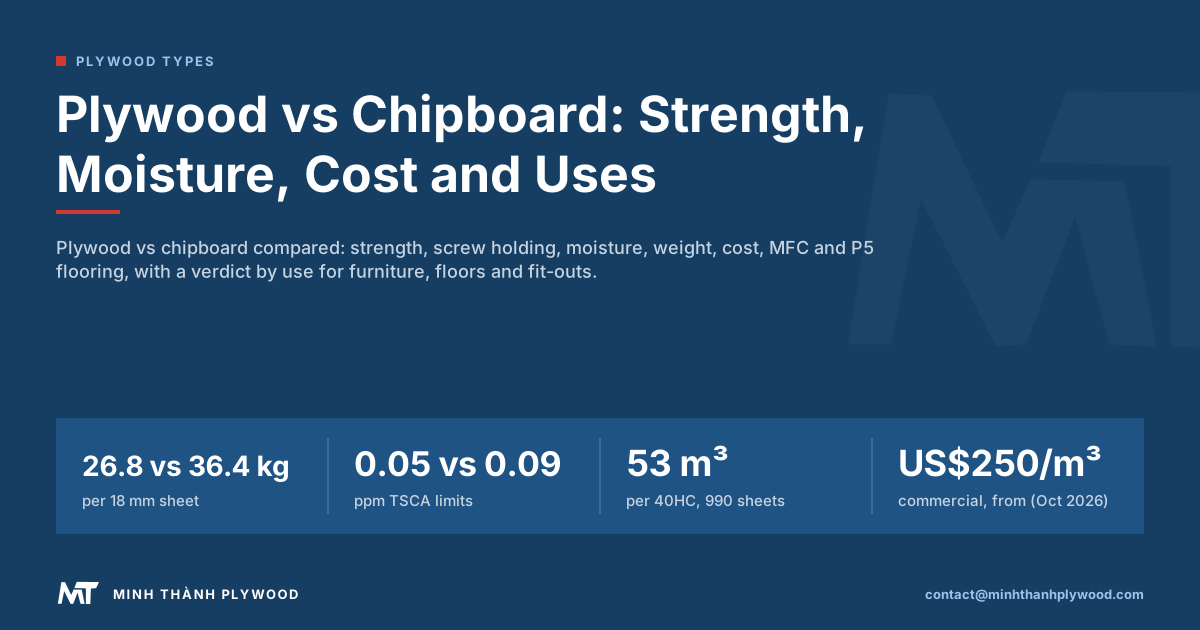
Plywood is stronger, lighter for its strength, holds screws better and survives wetting far better than chipboard; chipboard is cheaper per sheet, flat and easy to laminate. Use plywood for loaded shelves, kitchens, bathrooms, vans, floors that may get wet and anything screwed near an edge; use chipboard for dry, flat-pack furniture and dry floors. Minh Thanh Plywood makes furniture and commercial plywood in Vietnam.
Plywood vs chipboard: the short answer
Plywood is the stronger, lighter-for-strength and more water-tolerant board; chipboard is the cheaper, flatter board for dry furniture. The difference comes from how each is built: crossed sheets of wood veneer against pressed wood particles.
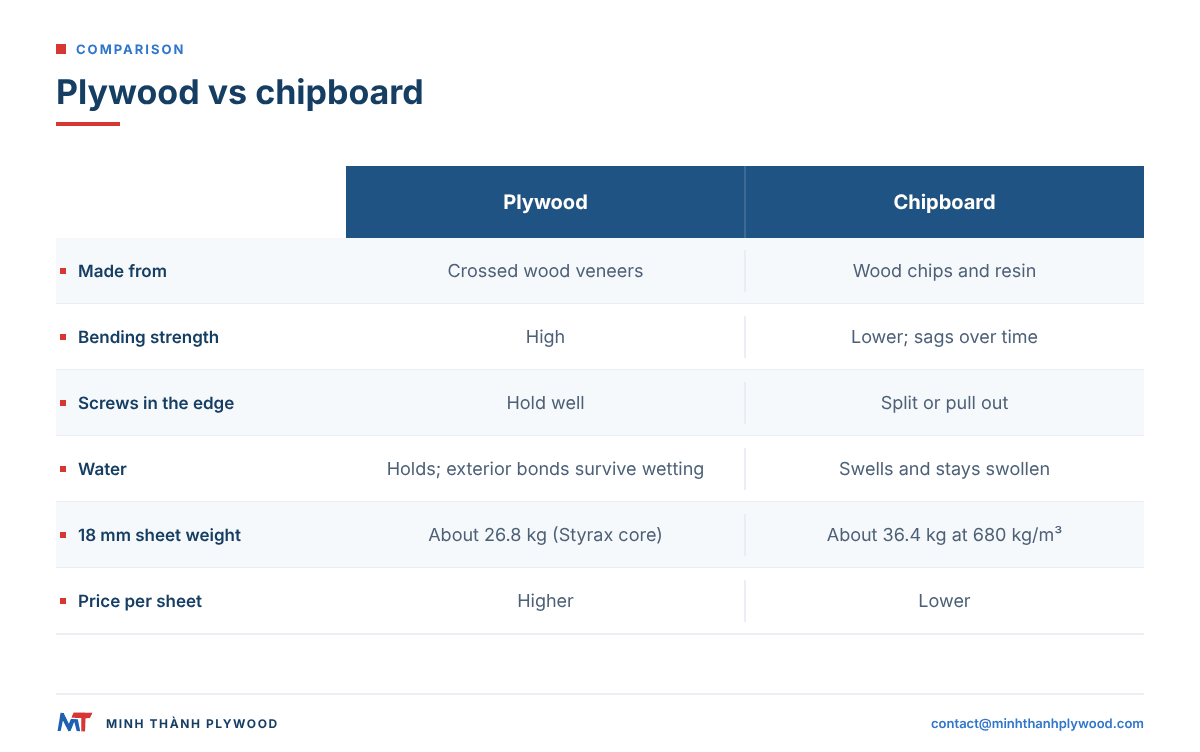
| Metric | Plywood | Chipboard (particleboard) |
|---|---|---|
| Made from | Thin wood veneers, grain crossed, glued | Wood chips, shavings and sawdust, bonded with resin |
| Bending strength | High: long fibres carry the load | Lower: short particles; sags under long-term load |
| Screw holding in the face | Very good | Fair; needs chipboard or confirmat screws |
| Screw holding in the edge | Good | Poor; splits or pulls out |
| Effect of water | Holds together; exterior grades survive wetting | Swells at edges and does not recover |
| Weight, 18 mm, 1220 × 2440 mm | About 26.8 kg on a Styrax core | About 36.4 kg at 680 kg/m³ |
| Surface | Real wood face, or overlay | Flat, smooth; usually laminated or melamine-faced |
| Price per sheet | Higher | Lower |
| Standards (Europe) | EN 636-1, -2, -3 by service class | EN 312, classes P1 to P7 |
| Best for | Loaded, damp or exposed parts, vans, floors that may get wet | Dry flat-pack furniture, dry floors, wall linings |
Verdict by use: plywood where load, water or fixings matter; chipboard where the part is dry, flat and price-led.
Chip board vs plywood: is chipboard the same as plywood?
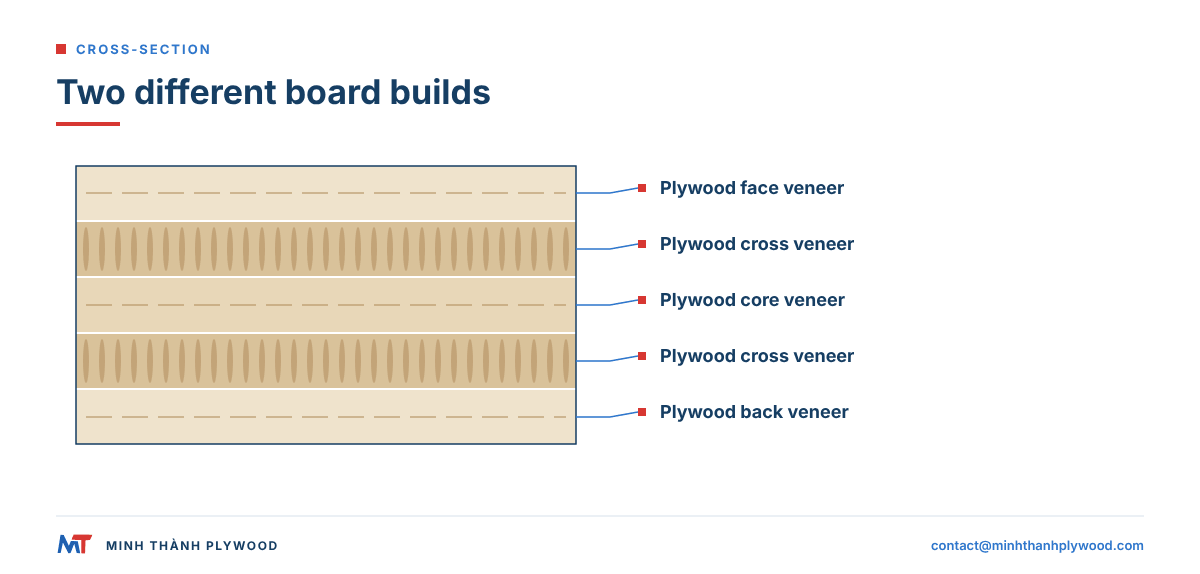
No. Chipboard is a particle board pressed from wood chips and resin; plywood is a veneer board glued from thin sheets of wood with the grain crossed. The edge tells them apart at a glance: chipboard shows a uniform grey-brown speckle, plywood shows distinct layers.
The names change by country, which confuses many searches:
- Chipboard is the usual name in the UK, Ireland, Australia and New Zealand.
- Particleboard or particle board is the same board in the US and in standards.
- MFC (melamine-faced chipboard) or MFB is chipboard with melamine decor paper on both faces.
- P5 flooring is moisture-resistant chipboard for load-bearing floors under EN 312.
- Plywood keeps its name everywhere; it is named by its face, such as birch, poplar or EV plywood.
Chip board vs plywood is therefore a comparison of two different builds, not two grades of one board. Both belong to the wider family of wood boards, alongside MDF, OSB and blockboard.
How is plywood made?
Plywood is made by peeling logs into thin veneers, drying them, gluing them with the grain of each layer at right angles to the next, and pressing the stack under heat. The crossed grain makes the panel strong and stable in both directions.
At Minh Thanh Plywood the furniture build runs like this:
- Peel and dry core veneers of white Styrax or Eucalyptus, to 8–12 % moisture at dispatch.
- Lay up the core with the grain crossed; core layers are stitched horizontally and vertically to keep joints closed.
- Press the core with UF glue at E0 emission and calibrate it to thickness.
- Press the faces, birch, poplar, EV, okoume or pine, onto the calibrated core: the second pressing.
- Sand and polish to a thickness tolerance of ±0.2–0.3 mm, down to ±0.2 mm.
An 18 mm furniture panel has 11–13 plies. That build is why a plywood shelf stays straight and a plywood carcass holds hinge screws for years.
What is in chipboard, and what is treated chipboard?
Chipboard is made from wood chips, shavings and sawdust, dried, mixed with resin and wax and pressed into flat sheets. Fine particles go to the surfaces and coarser ones to the middle, which gives a smooth face for laminating.
The resin decides what the board can do:
- Urea-formaldehyde (UF) for standard interior boards, P1 and P2.
- Melamine-urea-formaldehyde (MUF) or isocyanate (MDI) for moisture-resistant boards such as P3, P5 and P7.
- Fire-retardant additives for fire-rated grades, often dyed red.
“Treated chipboard” usually means moisture-resistant chipboard, dyed green in the UK so it can be recognised on site. It handles humidity and short wetting better than standard chipboard. It is not an exterior board: once water reaches the core and stays, the particles lose their bond and the board swells.
How do plywood and chipboard compare in strength?
Plywood is stronger than chipboard in bending, impact and fixing strength. In plywood, long wood fibres in the veneers carry the load; in chipboard, the load passes from particle to particle through resin. Typical test figures put plywood at more than twice the bending strength of chipboard, and it swells less after a soaking.
Typical test figures put numbers on the gap (Ply Online, plywood vs chipboard, 2025):
| Property | Plywood | Chipboard | Test standard |
|---|---|---|---|
| Bending strength (MOR) | 40–60 MPa | 11–25 MPa for standard grades | EN 310 for boards; EN 636 and EN 312 set the grade |
| Thickness swell after 24 h in water | 5–8 % (exterior grade, edges sealed) | 8–12 % for moisture-resistant P3; 15–25 % for standard | EN 317 swell test for EN 312 P3 chipboard; plywood figure indicative (EN 636-3 bond class, tested to EN 314-2) |
| Glue content by weight | a few % | about 6–12 % resin solids | Bond: EN 314-2 for plywood |
| Formaldehyde class | E0 (market term, e.g. ≤0.5 mg/L by the desiccator method) or E1 | E1 or E2 | EN 13986 defines E1/E2; state the test method for E0 |
The figures were read on 21 October 2026. Plywood is typically more than twice as strong in bending as chipboard, and it swells less than moisture-resistant chipboard and far less than standard chipboard after a soaking. The plywood side of the table follows BS EN 636:2012+A1:2015, which covers plywood for structural and general-purpose use in dry, humid or exterior conditions, and the glue-line test is BS EN 314-2, the BSI standard for plywood bonding quality requirements.
Three effects show up in use:
- Sag over time. A chipboard shelf carrying books creeps and bows; a plywood shelf of the same thickness stays straighter.
- Impact. A knock that cracks a chipboard edge only dents plywood.
- Fixings under load. Hinges and runners in plywood stay tight; in chipboard they loosen after repeated use.
Chipboard vs plywood strength also differs by direction. Plywood is strongest along the face grain and still strong across it, thanks to the crossed layers. Chipboard is the same in both directions but at a lower level. For any part that carries load for years, such as shelves, bed bases, worktop supports and van furniture, plywood is the safer choice.
Is 18 mm plywood stronger than 22 mm chipboard?
Generally yes: 18 mm plywood is stronger and stiffer in bending and holds fixings better than 22 mm chipboard, because plywood is the stronger material per millimetre. For a floor, though, the rule is the product’s span rating, not the thickness alone.
UK floor practice shows the point. P5 tongue-and-groove chipboard flooring is laid at 18 mm on joists up to 450 mm apart and at 22 mm on joists up to 600 mm apart. Plywood floor panels carry their own span ratings by thickness and grade. A thinner plywood floor can match a thicker chipboard floor, and stays firmer if the floor ever gets wet.
For shelves and furniture parts, 18 mm plywood replaces 22 mm chipboard in most designs, saving weight and depth. Test the actual part when it carries a heavy or long-term load.
Which is better for moisture: plywood or chipboard?
Plywood handles moisture far better than chipboard. Wet chipboard swells, especially at the edges, and stays swollen; plywood holds together, and plywood with an exterior bond survives repeated wetting.
The glue sets the level for plywood:
| Plywood bond | Where it works |
|---|---|
| UF glue at E0 emission | Dry interiors and furniture |
| MR / melamine-fortified glue | Kitchens, bathrooms, humid rooms, vans |
| Phenolic (WBP) glue | Exterior and wet exposure, with sealed edges |
Chipboard has moisture-resistant grades too, P3 for non-load-bearing use in humid conditions and P5 for load-bearing use in humid conditions. They resist humidity and occasional splashes. Neither is made for standing water, leaks or outdoor use.
In practice: a kitchen sink unit, a bathroom vanity, a shower-room floor, a boat or van interior all go plywood. A dry bedroom wardrobe can go either way.
Which holds screws better: plywood or chipboard?
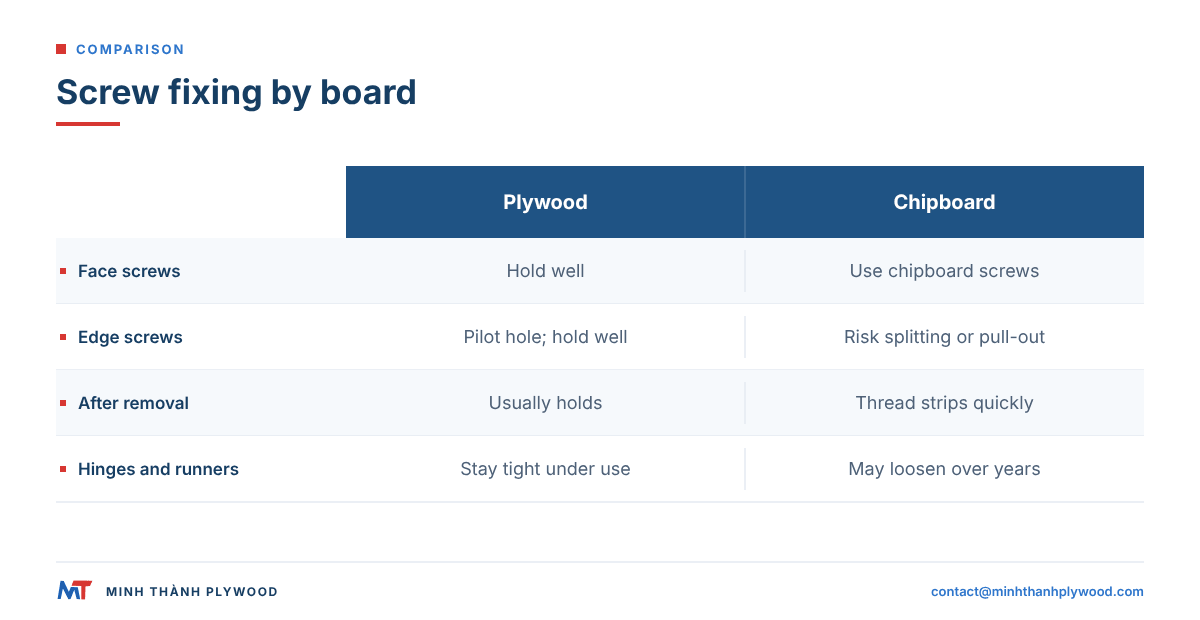
Plywood holds screws better than chipboard in the face and much better in the edge. Chipboard needs special screws, careful pilot holes and a safe distance from the edge.
| Fixing question | Plywood | Chipboard |
|---|---|---|
| Wood screws in the face | Hold well | Hold; chipboard screws work better |
| Screws into the edge | Hold well with a pilot hole | Split or pull out; use confirmat screws or dowels |
| Re-screwing after removal | Usually holds | Thread strips quickly |
| Hinges and drawer runners | Stay tight under use | Loosen over years |
| Nails | Hold; low splitting | Hold poorly in edges |
Coarse twin-thread “chipboard screws” grip particles better than wood screws. They also work in plywood, which is why the same screw box serves both boards on many sites.
For flat-pack furniture designed for chipboard, confirmat screws and cam fittings do the job. For furniture assembled with ordinary wood screws, or taken apart and moved, plywood keeps its joints.
Which is lighter and easier to install: plywood or chipboard?
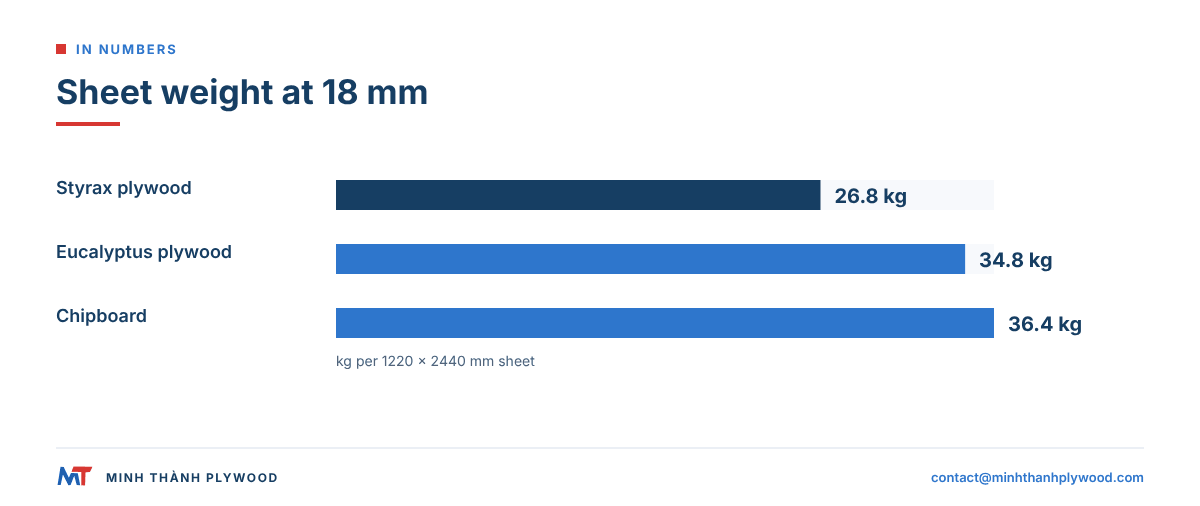
Plywood on a light core is lighter than chipboard of the same size. An 18 mm 1220 × 2440 mm sheet weighs about 26.8 kg in Styrax-core plywood, about 34.8 kg in Eucalyptus-core plywood at 650 kg/m³, and about 36.4 kg in chipboard at 680 kg/m³.
Standard chipboard runs at about 640–800 kg/m³ (ANSI A208.1 grade M), so it is heavier than most plywood. Lighter sheets mean easier handling on the line and on site.
Cutting and fitting:
- Chipboard cuts cleanly with a sharp blade, but the edge crumbles and needs banding or sealing.
- Plywood cuts cleanly along the grain; cross cuts need a fine blade or scoring to avoid face tear-out.
- Edges: plywood edges can stay visible on design furniture; chipboard edges are always banded.
For a DIY floor or a quick wall lining in a dry room, chipboard’s low price and smooth surface make it quick to fit. For anything you will carry, screw into the edge or take apart later, plywood is easier in the long run.
Plywood or chipboard for flooring?
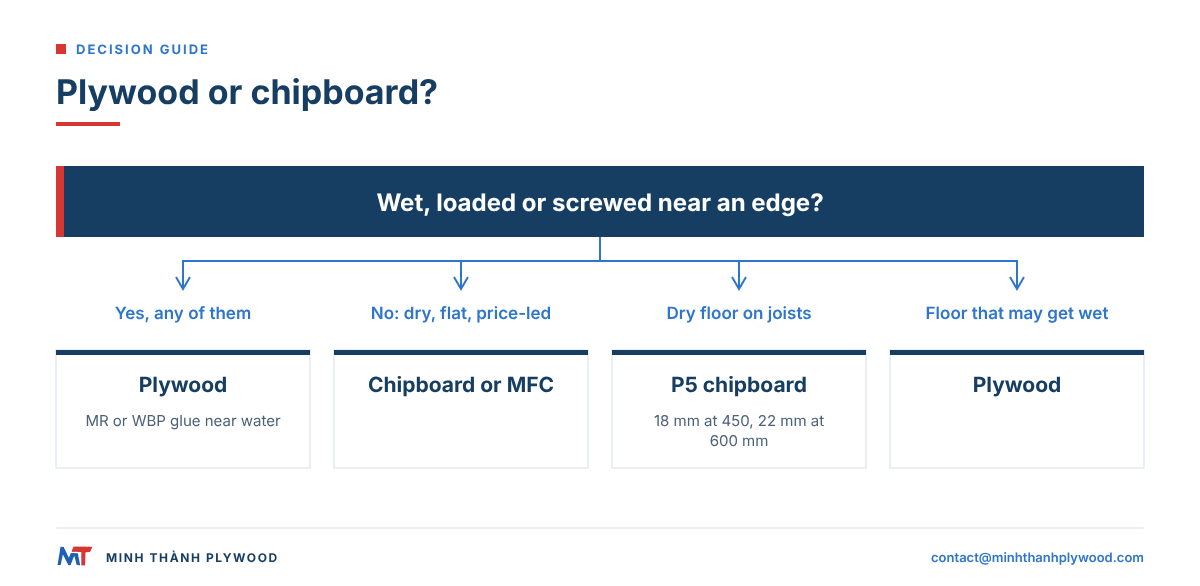
Use P5 chipboard for budget, dry, joisted floors; use plywood for floors that may get wet, carry heavy loads or must stay quiet and firm for years. That is the honest answer to plywood or chipboard for flooring.
| Floor situation | Better choice | Why |
|---|---|---|
| Dry upstairs floor on joists, budget build | P5 chipboard, 18 or 22 mm | Low cost, tongue-and-groove, quick to lay |
| Bathroom, kitchen, utility room | Plywood with MR or WBP glue | Survives leaks and splashes |
| Underlay for tiles or vinyl | Plywood | Stiff, stable, holds fixings |
| Heavy point loads, workshops | Plywood | Strength and impact resistance |
| Van, trailer and boat floors | Plywood | Moisture, vibration, fixings |
| Overlay on an old floor | Plywood, thin | Flat, light, screws hold |
Which makes less noise? Plywood floors stay quieter over time, because fixings stay tight and the board keeps its stiffness. Chipboard floors are more likely to creak as fixings loosen or after a leak softens the board.
MFC board vs plywood: melamine-faced chipboard or melamine plywood?
MFC board is chipboard with melamine decor paper on both faces; melamine plywood uses the same paper on a plywood core. MFC is cheaper; the plywood version is lighter for its strength, holds screws better and resists moisture better.
| Melamine-faced chipboard (MFC) | Melamine-faced plywood | |
|---|---|---|
| Core | Chipboard | Plywood |
| Decor | Melamine paper, same colours and textures | Melamine paper, same colours and textures |
| Screw holding | Fair; confirmat screws | Good in face and edge |
| Moisture | Swells if edges get wet | Holds; MR or WBP bond for wet rooms |
| Weight | Heavier | Lighter on a light core |
| Typical use | Flat-pack wardrobes, office desks, shelving | Kitchens, bathrooms, vans, boats, shop fittings |
| Price | Lower | Higher |
Melamine-faced chipboard vs plywood is the same decision as plain chipboard vs plywood, with the same decor on top. Buyers who want a real wood surface instead choose veneered plywood such as EV, birch or poplar faces, finished by their own lacquer or UV line. Minh Thanh panels leave the line sanded and polished, with both faces UV-ready. The two boards compare in more depth in melamine-faced chipboard vs melamine plywood.
Is plywood or chipboard cheaper?
Chipboard is cheaper per sheet: it is made from sawmill residues in a fast, continuous press. Plywood costs more because each sheet is laid up from graded veneers and pressed, and furniture plywood is pressed twice and sanded to tight tolerance.
Chipboard vs plywood cost looks different per part and per container:
- Per sheet: chipboard wins.
- Per kilogram of strength: plywood wins, because a thinner or lighter sheet does the same job.
- Per container: a 40HC carries more cubic metres of light plywood under the weight limit. At a 28,000 kg payload, 18 mm Styrax-core plywood loads 990 sheets, about 53 m³; chipboard at 680 kg/m³ reaches the weight limit at about 41 m³ before packaging.
- Over the life of the part: plywood avoids replacements where water or load would ruin chipboard.
Minh Thanh’s indicative starting prices are US$250/m³ for commercial plywood and US$350/m³ for furniture plywood (October 2026). The final price follows face, core, glue, thickness, size, quantity and delivery term.
How do plywood and chipboard compare on formaldehyde?
Both can be low-emission; the glue and the emission class decide. Plywood made with UF glue at E0 emission and chipboard made to a low-emission class can both meet European and US furniture rules, so ask for the class and the evidence.
The US rule shows the different limits. Under the federal formaldehyde standard for composite wood, hardwood plywood with a veneer core is limited to 0.05 ppm and particleboard to 0.09 ppm in 40 CFR 770.10, the rule of the US Environmental Protection Agency. Plywood has the tighter limit.
Minh Thanh’s furniture plywood holds CARB P2 / TSCA Title VI certification (ICTT mill no. 23024). Six ASTM D6007 chamber tests between April 2025 and June 2026, on 9, 15 and 18 mm panels, averaged 0.014–0.032 ppm against the 0.05 ppm limit. For European orders, SGS tests to EN 717-1 or the buyer’s method on request.
Which should you use? Plywood or chipboard by application
Choose by the three questions that matter: will the part get wet, will it carry load for years, and will it be screwed near an edge? One yes points to plywood.
| Application | Choice | Reason |
|---|---|---|
| Flat-pack wardrobes and bedroom furniture, dry | Chipboard or MFC | Low cost, flat, laminated |
| Kitchen wall and base units, dry | MFC, or plywood for premium | Budget vs lifetime |
| Sink units, bathroom vanities | Plywood, MR glue | Water and steam |
| Long or loaded shelves | Plywood | Resists sag |
| Children’s furniture, beds, bunk beds | Plywood | Fixing strength, impact |
| Van, caravan and boat interiors | Plywood | Weight, vibration, moisture |
| Shop fittings and display units | Plywood | Edges, fixings, reuse |
| Dry joisted floors | P5 chipboard | Cost |
| Wet-room floors and tile underlay | Plywood | Moisture, stiffness |
| Packing crates and pallets | Packing plywood | Strength, nail holding |
How do you order plywood to replace chipboard?
Specify the plywood by its job, and the mill matches the build. Six lines cover a furniture or fit-out order:
- Application: carcass, shelf, door, floor, van lining.
- Core: white Styrax for light furniture, Eucalyptus where density matters.
- Glue and emission: UF glue at E0 emission for dry interiors; MR for humid rooms; phenolic WBP for wet exposure.
- Face: poplar for paint, birch or EV for clear finishes; grade pair such as A/B.
- Size and thickness: 1220 × 2440 or 1250 × 2500 mm, 3–40 mm, or cut to size.
- Packing and quantity: packs, m³ or sheets, destination port.
Minh Thanh Plywood ships from one 40HC, with mixed specifications by agreement, 15–45 days after the deposit, FOB Hai Phong, CFR or CIF. Free samples come with the quotation. Send your list to contact@minhthanhplywood.com, or browse plywood products and poplar plywood for painted furniture.
Buyer questions, answered
Is chipboard stronger than plywood?
No. Plywood is stronger than chipboard in bending, in screw holding and in impact, because its cross-laminated veneers carry load along long wood fibres. Chipboard is made of short bonded particles and breaks more easily.
Is chipboard the same as plywood?
No. Chipboard, also called particleboard, is pressed from wood chips and resin; plywood is glued from thin sheets of wood veneer with the grain crossed. They look different on the edge and behave differently under load and water.
Is 18 mm plywood stronger than 22 mm chipboard?
Generally yes in bending and screw holding, because plywood is a stronger material per millimetre. For floors, use the span table for the exact product: 22 mm P5 chipboard is rated for joists at up to 600 mm centres, and plywood flooring has its own ratings.
Is plywood or chipboard cheaper?
Chipboard is cheaper per sheet. Plywood costs more per sheet but weighs less for its strength, holds fixings better and lasts longer where moisture or load is involved.
Which is better for flooring, plywood or chipboard?
Use P5 moisture-resistant chipboard for dry, joisted floors on a budget. Use plywood where the floor may get wet, carries heavy or point loads, or must stay quiet and firm for years, such as bathrooms, kitchens and vans.
What is MFC board?
MFC is melamine-faced chipboard: a chipboard core with melamine-impregnated decor paper pressed on both faces. It is the standard flat-pack furniture board. Melamine-faced plywood uses the same decor paper on a plywood core.
Can chipboard get wet?
Standard chipboard swells and loses strength when wet and does not recover. Moisture-resistant grades such as P3 and P5 resist humidity and short wetting but are not made for exterior use.
Which holds screws better, plywood or chipboard?
Plywood holds screws better in the face and especially in the edge. Chipboard needs chipboard screws or confirmat screws, and screws near its edge pull out or split the board.
Which is lighter, plywood or chipboard?
Plywood on a light core is lighter. An 18 mm 1220 × 2440 mm sheet weighs about 26.8 kg in Styrax-core plywood and about 36.4 kg in chipboard at 680 kg/m³.
Which makes less noise as a floor, chipboard or plywood?
Plywood floors usually stay quieter, because plywood holds its fixings and keeps its stiffness. Chipboard floors can creak as fixings loosen or the board softens after moisture.
What is treated chipboard?
Treated chipboard is chipboard made with a moisture-resistant resin, often dyed green in the UK, sometimes with fire-retardant additives. It handles humidity better than standard chipboard but still swells if soaked.
Is plywood or chipboard better for kitchen cabinets?
Plywood is better where cabinets meet water, steam or heavy loads, such as sink units and tall units. Melamine-faced chipboard is the budget choice for dry wall and base units.