
MDO vs MDF comes down to what is under the paint. MDO is exterior plywood with a resin-treated paper face; MDF is a sheet of wood fibre pressed with glue. MDO survives weather, holds screws and spans gaps; MDF gives the smoothest painted and routed surface indoors at a lower price. This guide compares them point by point and gives a verdict by use. Minh Thanh Plywood makes furniture and film-faced plywood in Vietnam.
MDO vs MDF: the short answer
In MDO vs MDF, choose MDO for anything outdoors, wet, load-bearing or screwed at the edge, and MDF for smooth painted and routed parts indoors where price matters. The two panels look alike under paint, but they are built completely differently.
- MDO (medium density overlay): exterior plywood with a resin-treated fibre overlay bonded to one or both faces. Strong, water-resistant, made for paint.
- MDF (medium density fibreboard): wood fibres mixed with resin and pressed into a uniform sheet. Smooth, uniform, easy to route, cost-effective, but weak in water and at the edge.
So the difference between MDO and MDF is the core: veneers and exterior glue in one, pressed fibre in the other. Everything else in this guide follows from that.
MDO vs MDF plywood compared point by point
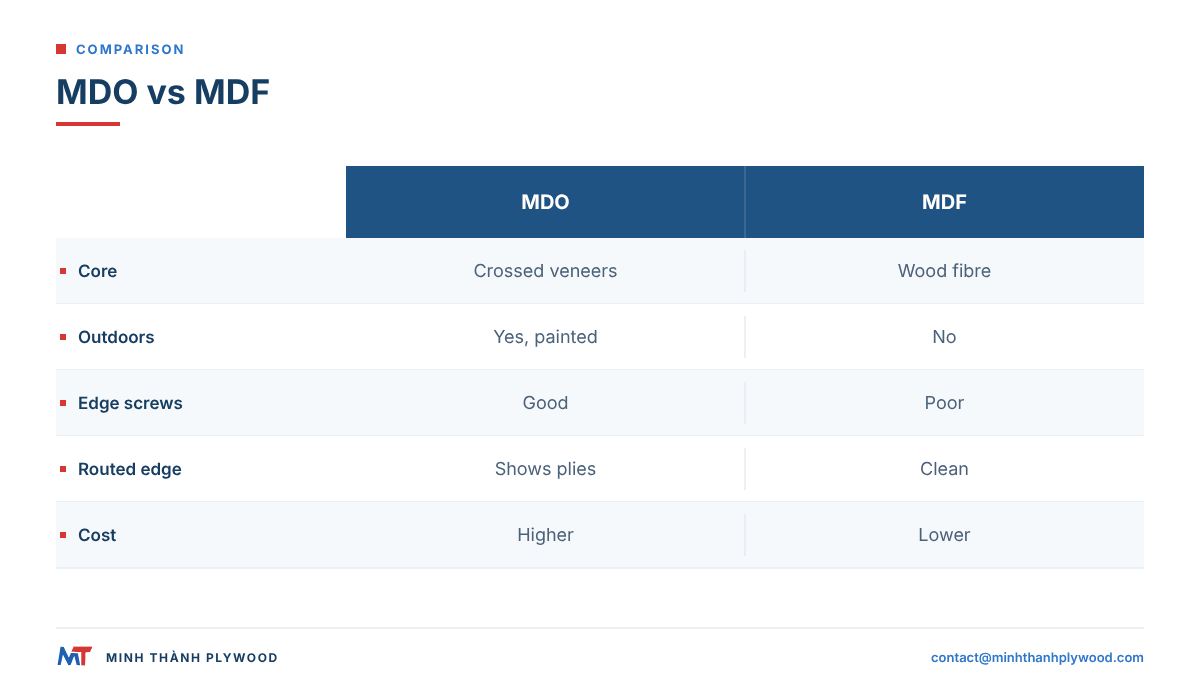
The table compares MDO and MDF on one property per row. Ratings are relative between the two panels.
| Property | MDO | MDF |
|---|---|---|
| What it is | Plywood with a paper overlay | Fibreboard, no veneers |
| Core | Cross-laminated wood veneers | Wood fibre and resin, uniform |
| Glue | Exterior, water-resistant | Usually interior UF |
| Water and weather | Exterior use with painted faces and sealed edges | Indoor only; swells when wet |
| Strength and stiffness | High, spans gaps between supports | Lower, sags over long spans |
| Screw holding, face | Good | Fair, needs pilot holes |
| Screw holding, edge | Good | Poor, splits and strips |
| Painted face | Very smooth, no grain | Very smooth, no grain |
| Painted edge | Shows plies; fill and seal | Absorbs paint; seal first |
| Routed profiles | Edge shows plies | Clean, even, the panel’s strength |
| Weight | Lighter for the same thickness | Heavier, dense |
| Cost | Higher | Lower |
| Concrete forms | Yes, in Concrete Form grade | No |
What is MDO plywood?
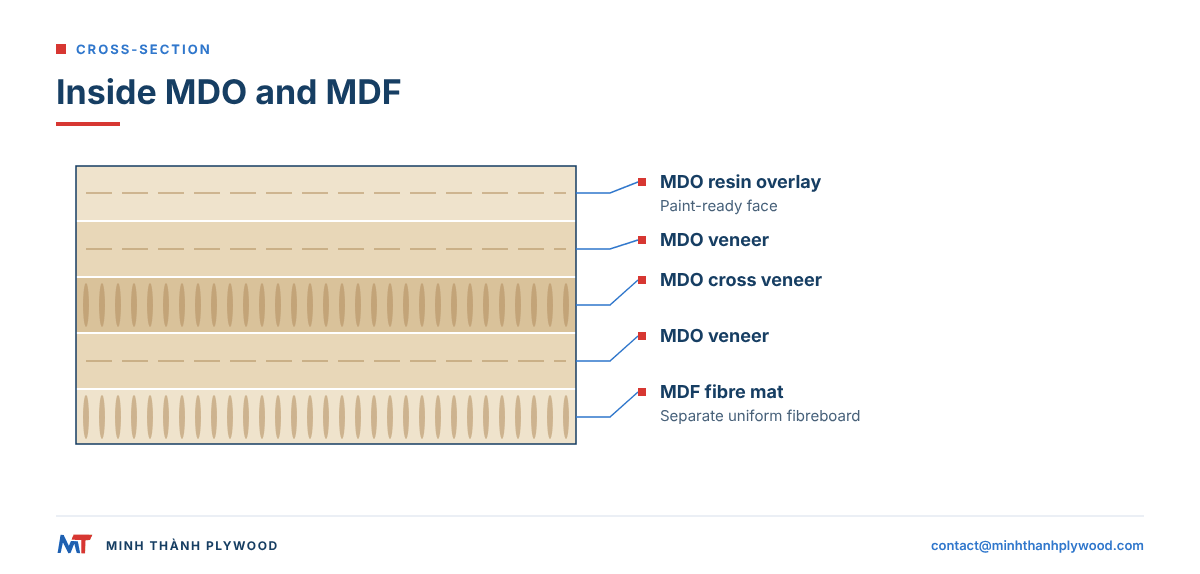
MDO plywood is exterior-glued plywood with a resin-treated fibre overlay, like a heavy paper, bonded under heat and pressure to one or both faces. The overlay hides the wood grain and gives a smooth, stable base for paint.
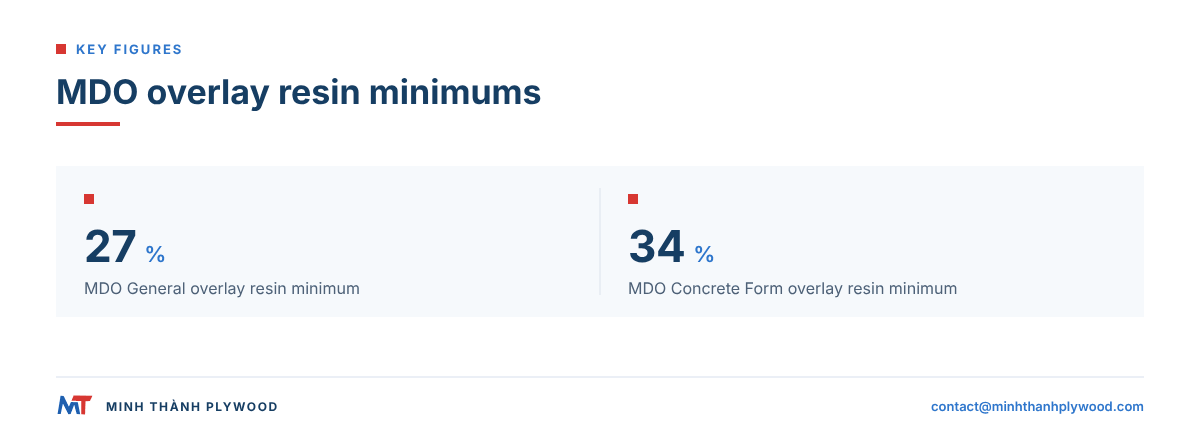
The overlay comes in grades with set minimum resin content. PS 1 sets minimum phenolic resin content at 27% for MDO General and 34% for MDO Concrete Form, measured by the volatile-free weight of fibre and resin, excluding the bond line. These figures describe the overlay, not the whole sheet.
- Faces: one side (MDO 1S) or both sides (MDO 2S) overlaid.
- Core: veneers, often softwood in North America; other species elsewhere.
- Glue: exterior grade, so the plies stay bonded in weather.
- Uses: signs, painted siding and soffits, outdoor cabinets, highway signs and, in its Concrete Form grade, concrete forms.
1-step vs 2-step MDO
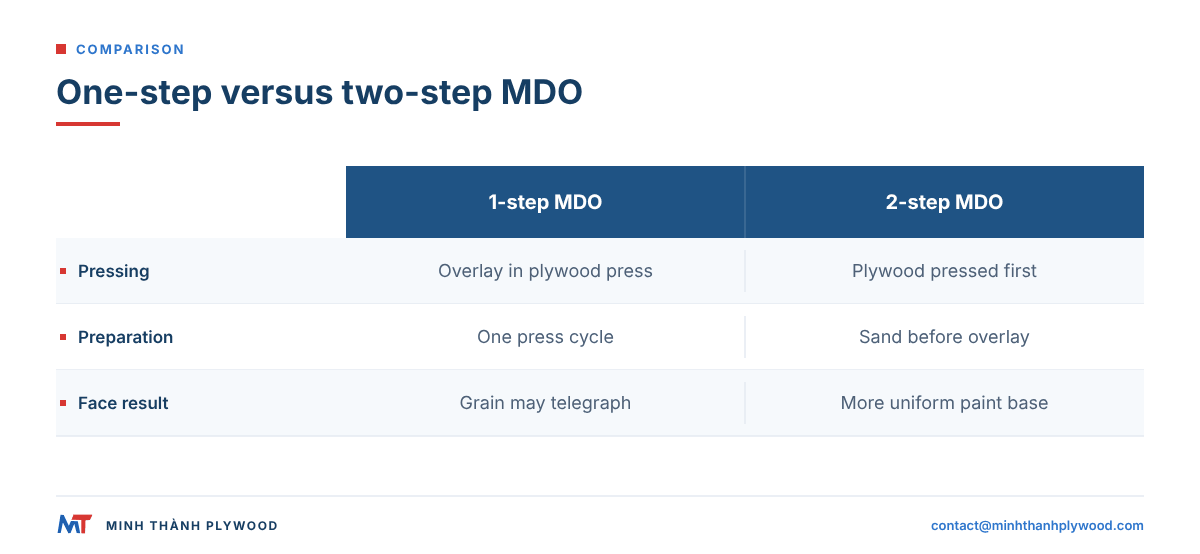
MDO is made one of two ways, and the difference shows in the paint. In a 1-step panel the overlay is bonded in the same press cycle that forms the plywood. In a 2-step panel the plywood is pressed first and sanded smooth, then the overlay goes on in a second press.
The 1-step route is faster and cheaper but can telegraph the veneer grain or patches through the overlay; the 2-step route gives a more uniform face and suits high-end painted finishes and signs (Roseburg; Richply, 2026). Dunn Lumber notes both MDO and HDO can be made either way, so confirm the process with the supplier rather than assuming it from the grade.
Our guide to HDO vs MDO plywood compares MDO with its high-density sister in detail.
What is MDF?
MDF, medium density fibreboard, is a panel made by breaking wood into fibres, mixing them with resin and wax, and pressing the mat into a sheet. It has no veneers and no grain, so it is the same all the way through.
- Strengths: smooth faces, uniform density, routes cleanly, no voids, cost-effective.
- Weaknesses: heavy, weak in water, poor screw holding in the edge, sags over long spans.
- Variants: moisture-resistant MDF (usually dyed green), fire-retardant MDF, lightweight MDF, and exterior-grade MDF made with water-resistant resins.
- Uses: painted cabinet doors, furniture parts, mouldings, shelving, speaker boxes, signs indoors.
MDF is not plywood. “MDF plywood” is a common request, but a panel is either fibreboard or plywood; MDO is the plywood one of this pair.
What is the difference between MDO and MDF plywood?
The difference between MDO and MDF is in the core and the glue. MDO is layers of wood veneer, each turned across the one below, bonded with exterior glue and covered with an overlay. MDF is loose wood fibre and resin pressed into one uniform layer.
| Build point | MDO | MDF | What it changes |
|---|---|---|---|
| Wood form | Whole veneers | Separated fibres | Veneers carry load along their length |
| Grain direction | Crossed ply to ply | None | Plywood resists splitting and sagging |
| Glue line | Between each ply | Spread through all fibres | MDF’s resin is everywhere, including edges |
| Surface | Overlay paper | Pressed fibre skin | Both paint smoothly |
| Edge | Layers of veneer | Uniform, porous fibre | Different edge treatment |
Crossed veneers give plywood its strength in both directions and its grip on screws. Uniform fibre gives MDF its clean routed edges and its flat, even face. Each panel’s strengths come straight from how it is made.
Moisture and outdoor performance
MDO is made for outdoor use and MDF is not. MDO’s exterior glue keeps the plies bonded in rain and humidity; standard MDF swells when water reaches its fibres and does not shrink back.
Why MDF is not recommended for outdoor use:
- Fibres swell when wet, most at the cut edges, and the swelling stays.
- Standard MDF resin is interior grade and weakens with repeated wetting.
- Paint does not save it: once water gets past the paint at an edge, a joint or a screw, the panel swells from inside.
Can MDO plywood get wet? Yes, within reason: the glue holds, and the overlay sheds water. The wood under the overlay still takes up water through bare edges and holes, so paint the faces, seal every edge and seal fixing holes. Our guide to how to seal plywood covers the steps, and is plywood waterproof? explains what each glue survives.
Moisture-resistant MDF performs better than standard MDF in humid interiors, such as kitchens and bathrooms, but it is still not an outdoor panel.
Strength, screw holding and edges
MDO is stronger and stiffer than MDF of the same thickness and holds screws far better, above all in the edge. Crossed veneers grip a screw thread and carry load along their length; fibreboard crumbles around a screw in its edge.
- Spans: MDO shelves and panels sag less between supports. Woodworkers report that 3/4 in MDF sags when unsupported over more than about 16-24 in (Sawmill Creek), so MDF shelves need a support or a front edge strip at that spacing, while plywood and MDO of the same thickness span further.
- Face screws: both hold; MDF needs pilot holes and coarse-thread screws.
- Edge screws: MDO holds; MDF splits unless drilled and screwed with confirmat screws or fitted with inserts.
- Impact: MDO resists dents and corner damage better.
- Hinges: hinge cups in MDF doors work, but screws loosen with heavy use; plywood holds them longer.
For cabinet carcasses, shelves and anything that carries weight, plywood is the stronger panel. Our guide to plywood vs MDF compares furniture plywood and MDF across cabinet uses.
Weight: which panel is lighter?
Plywood is usually lighter than MDF of the same size and thickness, because MDF is a dense panel. Actual weight depends on the species in the plywood and the density grade of the MDF.
Weight is density times volume. A 1220 × 2440 × 18 mm sheet has a volume of 0.0535824 m³. Our furniture plywood reference sheets weigh:
| Panel | Planning density | Sheet mass at 1220 × 2440 × 18 mm | In pounds |
|---|---|---|---|
| Plywood, white Styrax core | 500 kg/m³ | 26.8 kg | About 59 lb |
| Plywood, Eucalyptus core | 650 kg/m³ | 34.8 kg | About 77 lb |
| Standard MDF | 600-800 kg/m³ | 32.1-42.9 kg | About 71-95 lb |
MDF is typically 600-800 kg/m³ (Wikipedia). A Styrax-core plywood sheet is roughly 30% lighter than MDF at the same thickness. Check the supplier’s data sheet for the density of the MDF grade you buy and multiply by the same volume. Lighter panels are easier to carry, hang and ship, and a lower weight per sheet puts more sheets in a container before the payload limit.
Paint finish: can MDO plywood be painted?
Yes, MDO is made to be painted, and so is MDF. Both give a smooth face with no grain showing through; they differ at the edges and outdoors.
| Painting point | MDO | MDF |
|---|---|---|
| Face preparation | Light sand, primer | Light sand, primer |
| Grain showing through | No | No |
| Edges | Ply lines show; fill and sand | Absorb paint; seal or prime twice |
| Outdoors | Exterior acrylic over primer lasts for years | Not suitable |
| Spray finish | Very good | Excellent, the smoothest result |
For painted signs outdoors, MDO is the standard panel. For painted indoor doors with a routed profile, MDF gives the cleanest spray finish because the routed edge is as smooth as the face.
For furniture that is veneered or UV-coated rather than painted, a sanded plywood face is the base. Both faces of our furniture panels are UV-ready, made to the standard customers need to apply their own UV coating.
Routing and machining
MDF routes and machines more cleanly than MDO, because it has no plies and no grain. A routed profile on an MDF door edge is as smooth as the face; on MDO the plies show in the profile.
- Routed door profiles and mouldings: MDF.
- CNC parts with exposed edges, painted: MDF, or plywood with edges filled.
- CNC parts that carry load or screws: plywood.
- Dust: MDF makes fine dust. Use local exhaust ventilation to collect wood dust at its source when machining either panel.
- Tool wear: MDF’s resin and the overlay on MDO both wear tools; use carbide.
Many furniture makers combine the two: plywood carcasses for strength and screws, MDF doors for routed, painted fronts.
Do moisture-resistant and exterior MDF close the gap?
Moisture-resistant MDF closes part of the gap indoors, and exterior-grade MDF closes more of it outdoors, but neither matches MDO on screw holding, spans or impact. They are better fibreboards, not plywood.
| Panel | Humid interiors | Outdoors | Edge screws | Typical use |
|---|---|---|---|---|
| Standard MDF | Poor | No | Poor | Dry indoor furniture and doors |
| Moisture-resistant MDF | Good | No | Poor | Kitchens, bathrooms, window boards |
| Exterior-grade MDF | Good | Painted and detailed with care | Poor | Painted trim and mouldings |
| MDO plywood | Good | Yes, painted with sealed edges | Good | Signs, soffits, outdoor cabinets |
Moisture-resistant MDF uses resins and wax that slow swelling, which is enough for kitchen carcass backs and bathroom panels kept away from standing water. Exterior-grade MDF goes further with water-resistant resins and is sold for painted exterior trim, but it still needs every edge sealed and painted.
Where a part carries screws in its edge, spans between supports or takes knocks, plywood remains the safer panel. Where the part is a painted profile in a damp room, moisture-resistant MDF is often the cost-effective middle choice.
Emissions: what the rules say about MDF and plywood
In the US, the TSCA Title VI rule sets formaldehyde limits by panel type: 0.05 ppm for hardwood plywood, 0.11 ppm for MDF and 0.13 ppm for thin MDF (EPA formaldehyde emission limits, checked on 3 November 2026). Each panel must be certified to its own limit.
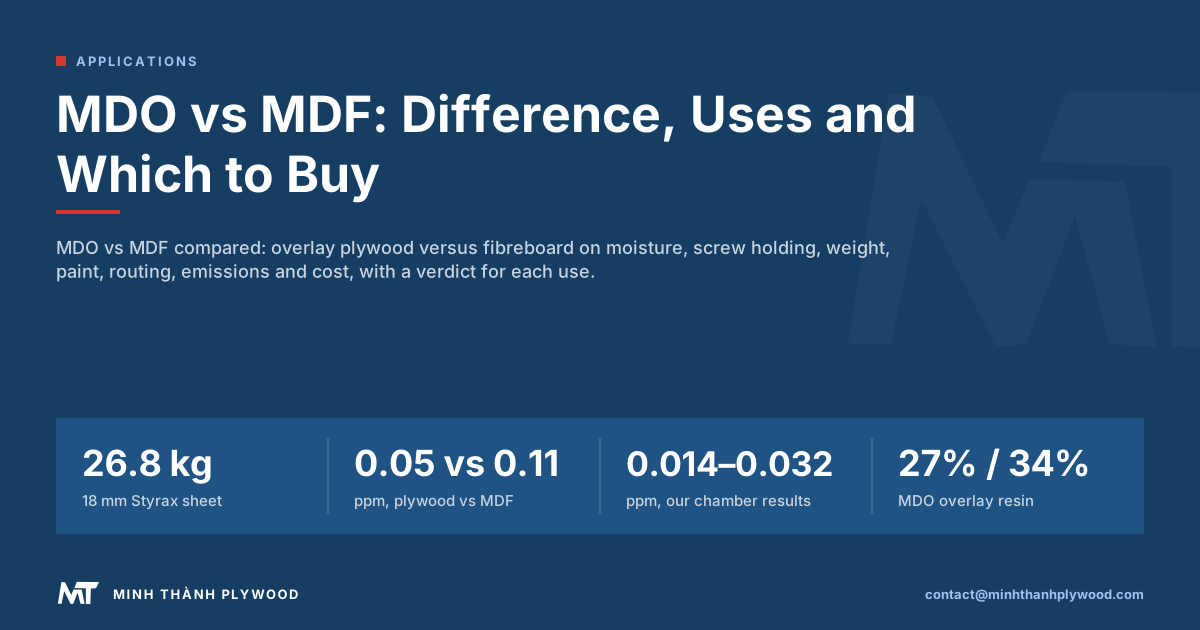
Our furniture plywood uses UF glue at E0 emission. Six ASTM D6007 chamber tests between April 2025 and June 2026, on 9, 15 and 18 mm panels, averaged 0.014–0.032 ppm, against the 0.05 ppm limit for veneer-core hardwood plywood; three were run by Shanghai Hongjun and three by ICTT Vietnam. We hold CARB P2 / TSCA Title VI certification as ICTT mill no. 23024.
For buyers selling into the US or Europe, ask for the certificate and the test reports for the panel you buy, whichever panel it is.
Cost: is MDO more expensive than MDF?
Yes, MDO costs noticeably more than standard MDF of the same thickness, and plywood in general costs more than MDF. The price buys weather resistance, strength and screw holding.
| Cost point | MDO | MDF |
|---|---|---|
| Sheet price | About 1.8-2.6x MDF, see the listing table below | Lowest |
| Waste and rejects outdoors | Low | High: MDF fails outside |
| Edge treatment cost | Fill and seal | Seal and prime |
| Hardware cost | Standard screws | Pilot holes, confirmats or inserts |
| Freight per sheet | Lower: lighter | Higher: heavier |
| Service life outdoors | Years with paint | Not suitable |
Typical US retail listings for a 3/4 in x 4 x 8 ft sheet in October 2026 show the ratios (a sample of listings, not a quote):
| Panel, 3/4 in x 4 x 8 ft | Listed price | Ratio to MDF |
|---|---|---|
| Square sanded MDF (Lowe’s) | US$49.96 | 1.0x |
| Birch veneer-core plywood (Builders’ General) | About US$85 | About 1.7x |
| MDO, good one side (Hamshaw Lumber) | US$88.75 | About 1.8x |
| MDO, good two sides (Moore Lumber) | US$109.99 | About 2.2x |
| MDO industrial grade, two sides (Requarth) | US$131.65 | About 2.6x |
A woodworker on Sawmill Creek who priced MDO for shop cabinets found it about 50% dearer than birch plywood and used birch instead, which fits the table: a two-sided MDO sheet sits roughly 30% above birch plywood and more than twice standard MDF.
Compare cost per finished, accepted part, not per sheet. For indoor painted doors, MDF usually wins on cost. For anything outdoors or load-bearing, MDO or plywood wins once failures and repairs are counted. For furniture and interior plywood from Vietnam, our indicative prices start from US$350/m³ (October 2026); face, core, glue, thickness, size and quantity set the final price.
Is MDO plywood better than MDF for cabinets?
MDO is better than MDF for cabinets in wet or outdoor places, and for any cabinet where screws and hinges carry load. MDF is better for indoor painted doors with routed profiles, where smoothness and price matter most.
| Cabinet part | Dry indoor | Bathroom and laundry | Outdoor kitchen |
|---|---|---|---|
| Carcass | Plywood | Plywood or MDO | MDO or exterior plywood |
| Shelves | Plywood | Plywood | MDO |
| Painted doors, flat | MDF or MDO | MDO or moisture-resistant MDF | MDO |
| Painted doors, routed | MDF | Moisture-resistant MDF | MDO with a simple edge |
| Veneered doors | Veneered plywood | Veneered plywood | Not usual |
MDO vs MDF for concrete formwork
MDF is never used for concrete formwork: wet concrete and water make it swell and lose strength in a single pour. MDO in its Concrete Form grade is used for forms that need a smooth, matte concrete surface.
The other common forming panels are HDO, with a harder, resin-rich overlay, and film-faced plywood, with a phenolic film on both faces. As an industry guide, film-faced plywood with melamine glue gives about 12–15 uses and phenolic (WBP) glue up to about 25, with proper handling, release agent and edge sealing.
We make film-faced plywood alongside our furniture panels, with a ±0.5 mm thickness tolerance and melamine-fortified or phenolic (WBP) glue to your specification. Our film-faced plywood page lists the build; for an MDO-specified project, quote it as a film-faced alternative and approve a trial pour first.
Which panel for which project?
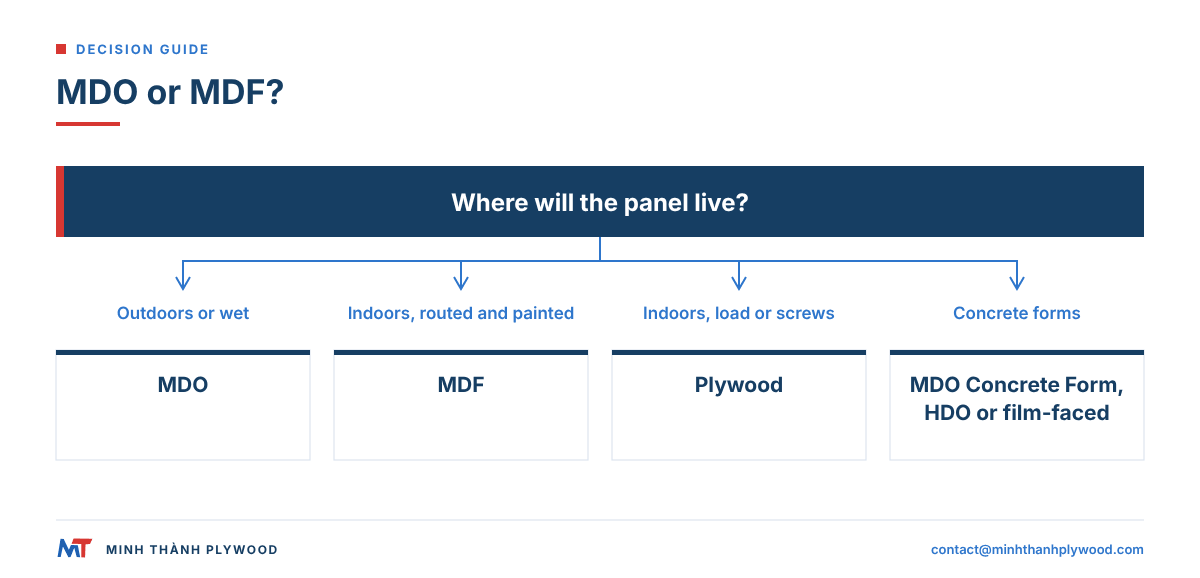
Choose MDO for weather, strength and screws; choose MDF for smooth indoor painted and routed parts at a lower price. The matrix below gives the verdict for common projects.
| Project | Choose | Why |
|---|---|---|
| Outdoor signs | MDO | Paints smooth, survives weather |
| Painted exterior trim, soffits and fascia | MDO | Exterior glue, stable paint base |
| Outdoor kitchen cabinets | MDO | Water resistance and screw holding |
| Indoor painted cabinet doors with profiles | MDF | Clean routed edges, lowest cost |
| Indoor painted wall panels | MDF | Smooth and cost-effective |
| Bookshelves and long shelves | Plywood | Less sag |
| Bathroom vanities | MDO or plywood | Moisture and screw holding |
| Speaker boxes | MDF or plywood | MDF for dense, dead walls; plywood for weight |
| Concrete forms | MDO Concrete Form, HDO or film-faced | Water-resistant glue |
| Indoor signs and displays | MDF | Smooth and cheaper |
What this means for your order
If your product needs plywood’s strength, screw holding or moisture resistance, specify it fully. Send these lines with your request:
- Application: furniture, cabinets, signs, exterior panels or formwork.
- Core: white Styrax or Eucalyptus core as standard.
- Glue and emission: UF glue at E0 emission for interiors; MR or melamine-fortified and phenolic (WBP) bonds to your specification.
- Face: birch, poplar, EV, okoume or pine, sanded and UV-ready; or film-faced for forms.
- Size and thickness: 1220 × 2440 mm or 1250 × 2500 mm, 3–40 mm, sanded to ±0.2–0.3 mm.
- Packing and quantity: from one 40HC, mixed specifications by agreement.
Minh Thanh Plywood presses furniture-grade panels twice as standard: the core board is pressed and calibrated, then face and back are pressed on. Production takes 15–45 days after the deposit, and free samples are available. See all our plywood products, or read about MDO plywood in our overlay guide.
Buyer questions, answered
What is the difference between MDO and MDF plywood?
MDO is real plywood, cross-laminated veneers with exterior glue, faced with a resin-treated paper overlay. MDF is not plywood: it is wood fibre mixed with resin and pressed into a uniform sheet. MDO is built for weather and strength, MDF for smooth indoor finishes.
Why is MDF not recommended for outdoor use?
Standard MDF swells when water reaches its fibres, especially at cut edges, and does not recover. Its usual glue is not made for weather, so even painted MDF fails outdoors once water gets past the paint.
Is MDO plywood better than MDF for cabinets?
For painted cabinets in wet areas, such as bathrooms, laundries and outdoor kitchens, MDO is better because it resists moisture and holds screws. For dry indoor cabinet doors with routed profiles, MDF gives a smoother result at a lower cost.
Can MDO plywood be painted?
Yes. MDO is made to be painted: its paper overlay gives a smooth, even surface without grain showing through. Use a quality primer and exterior acrylic paint, and seal the plywood edges.
Can MDO plywood get wet?
Yes. MDO is exterior plywood with water-resistant glue, so rain does not delaminate it. Paint the faces and seal the edges, because water entering bare edges still makes the wood swell.
Is MDO heavier than MDF?
Usually not. MDF is a dense panel, and a sheet of MDF is typically heavier than an MDO sheet of the same thickness. Actual weight depends on the species in the plywood and the density grade of the MDF.
Can MDF be used for concrete formwork?
No. MDF swells and loses strength when wet concrete and water reach it. Concrete forms use MDO Concrete Form grade, HDO or film-faced plywood, all with water-resistant glue.
Which holds screws better, MDO or MDF?
MDO holds screws much better, in the face and especially in the edge, because the cross-laminated veneers grip the thread. MDF strips easily in its edge and needs pilot holes, confirmat screws or inserts.
Is MDO more expensive than MDF?
Yes, MDO usually costs noticeably more per sheet than standard MDF of the same thickness. The price buys weather resistance, strength and screw holding that MDF cannot give.
What is MDO plywood used for?
Signs, painted exterior panels, soffits and fascia, outdoor cabinets and furniture, highway signs, and concrete forms in its Concrete Form grade.