
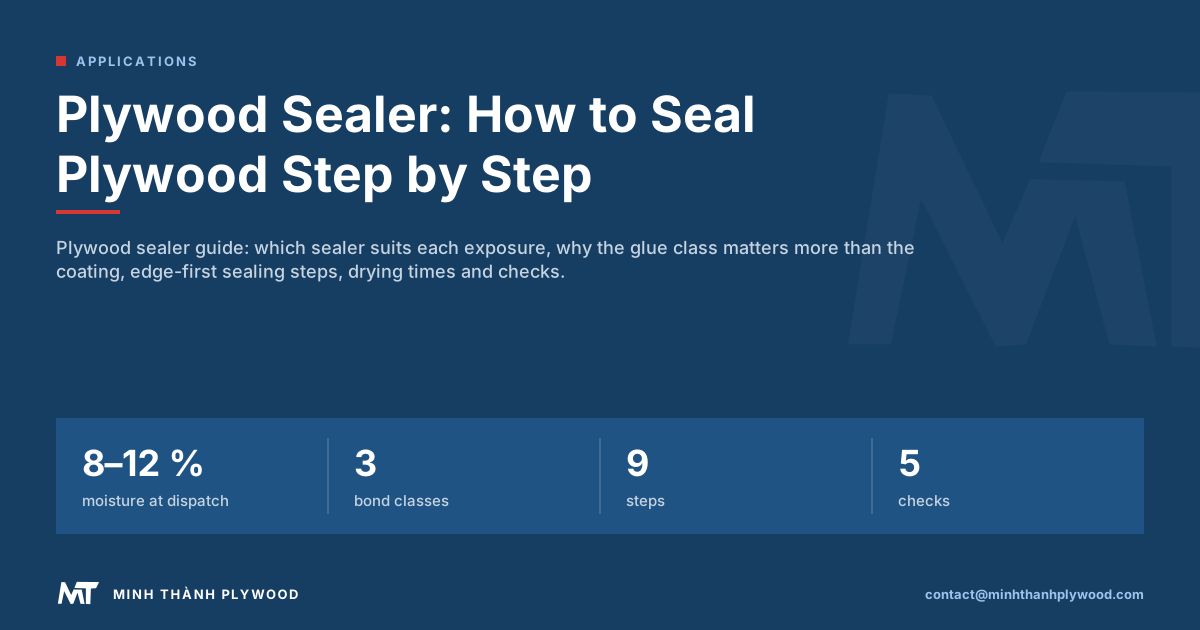
The best plywood sealer depends on where the panel will live: a sanding sealer or water-based polyurethane indoors, a penetrating sealer under paint or a spar varnish outdoors, and epoxy for marine work. Seal the edges first, then both faces. A sealer slows water down; it cannot turn an interior glue line into an exterior one. Minh Thanh Plywood makes furniture and exterior plywood in Phu Tho, Vietnam.
What plywood sealer should you use?
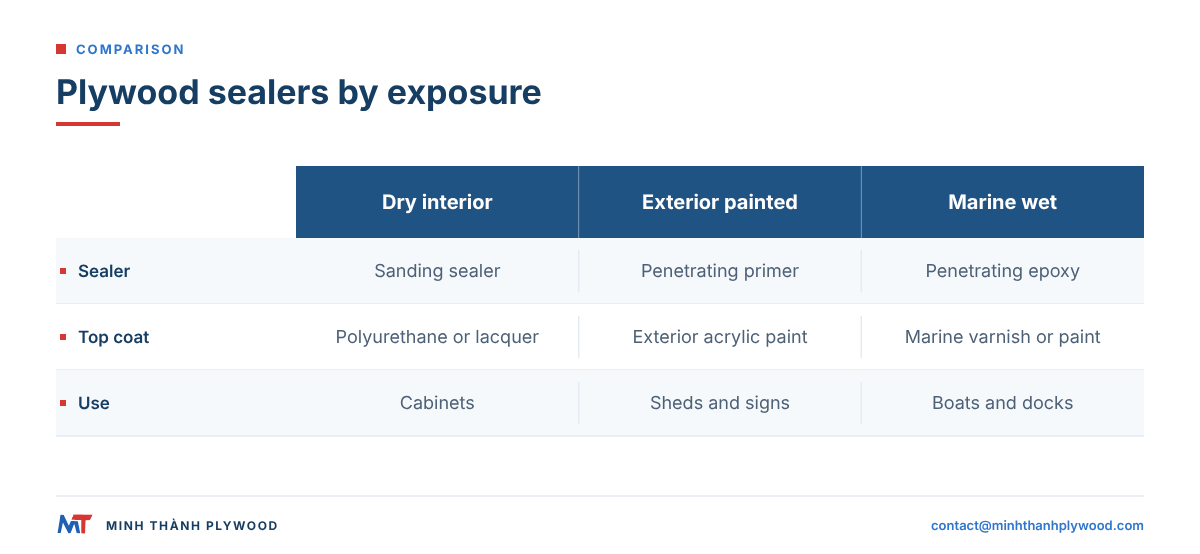
Choose the plywood sealer by exposure. The panel’s glue and its use decide the coating, not the other way round.
| Exposure | Sealer | Top coat | Example uses |
|---|---|---|---|
| Dry interior | Sanding sealer, or a thinned first coat of the finish | Water-based polyurethane, lacquer, oil | Furniture, cabinets, wall panels |
| Interior, damp areas | Water-based or oil-based polyurethane | Two to three coats of the same | Bathroom vanities, laundry shelves |
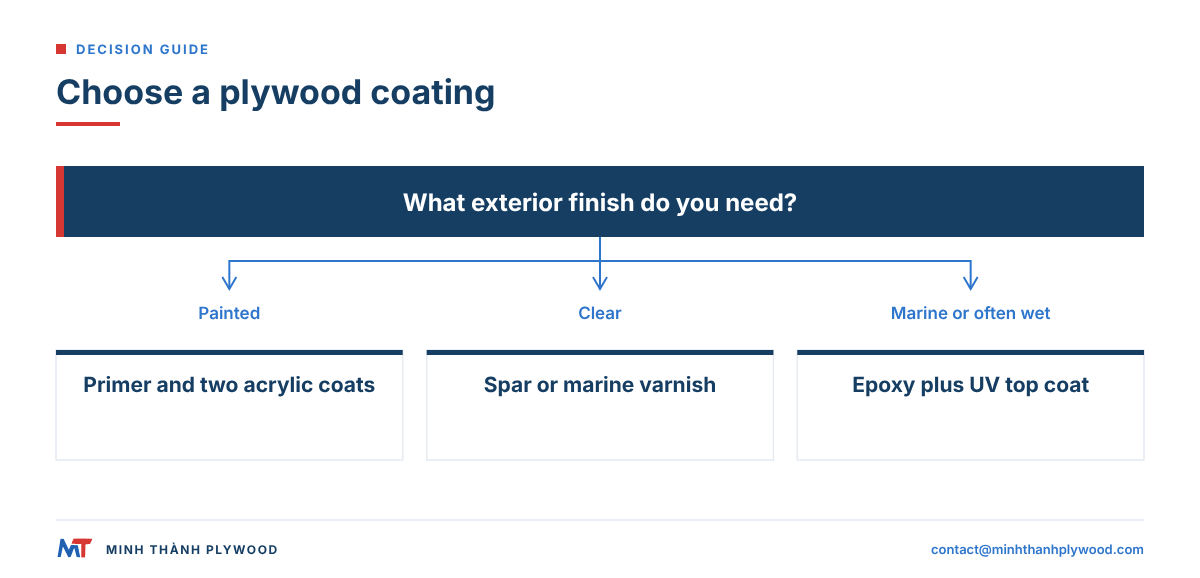
| Exterior, painted | Penetrating water-repellent sealer or primer | Exterior acrylic paint | Sheds, sheathing, soffits, signs |
| Exterior, clear | Thinned spar varnish as sealer | Several coats of spar or marine varnish | Doors, outdoor furniture, decorative panels |
| Marine and wet | Penetrating epoxy | Epoxy build coats, then marine varnish or paint | Boats, docks, planters, wet rooms |
Sealing plywood well is mostly about coverage: every edge and both faces, at the same build. A good sealer on one face and bare edges fails faster than a cheap sealer applied everywhere.
Does plywood need to be sealed?
Plywood needs to be sealed when it will get wet, sit outdoors or be painted. Dry interior furniture panels need a finish for wear and cleaning, and a sealer coat under that finish makes it smoother and more even.
Bare plywood takes up water through its faces and, much faster, through its edges, where every ply shows end grain. Water makes wood swell and shrink, raises the grain, and in time feeds mould and decay. Sunlight greys and checks bare faces outdoors.
What sealing does:
- Slows water uptake, so the panel moves less with the weather.
- Fills the pores, so paint and varnish go on evenly.
- Protects the edges, where water gets in first.
- Reduces raised grain on the faces after the first coat is sanded.
What sealing does not do: it does not change the glue between the plies. That comes next.
Glue class first: why the bond matters more than the sealer
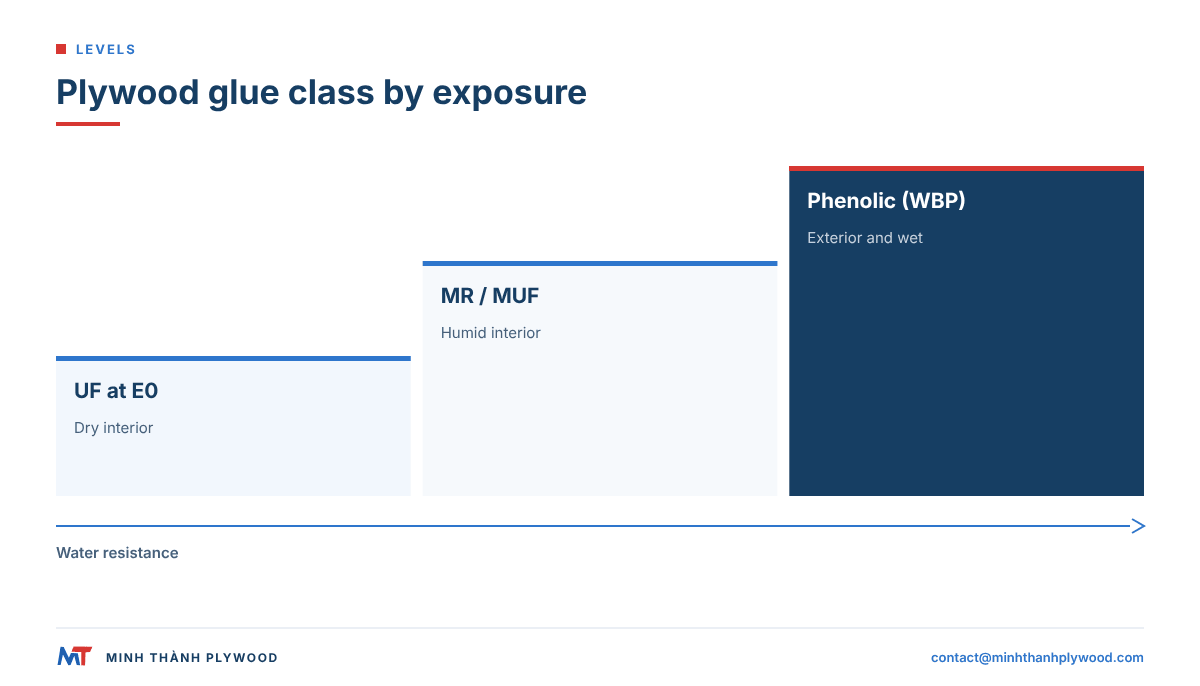
The glue that bonds the plies decides how much water plywood survives; the sealer only decides how fast water reaches it. Seal an interior panel as well as you like, and it still delaminates if it stays wet long enough.
| Glue (bond) | Water resistance | Where it belongs | Sealer’s job |
|---|---|---|---|
| UF glue (urea-formaldehyde) at E0 emission | Dry interior | Furniture, cabinets, interior panels | Wear, cleaning, even finish |
| MR or melamine-fortified (MUF) | Humid interior, short wet spells | Kitchens, bathrooms, protected exterior | Keep water away from the glue line |
| Phenolic (WBP) | Exterior and wet | Exterior plywood, formwork, marine use | Protect the wood itself from water and sun |
European standards set the same ladder. EN 314-2 sorts plywood bonds into Class 1 (dry), Class 2 (humid) and Class 3 (exterior), and the European plywood specifications for dry, humid and exterior use follow the same order. Read the bond line on your order before choosing a coating.
Glue type and emission class are separate specifications. Our furniture and interior panels use UF glue at E0 emission as standard; MR or melamine-fortified and phenolic (WBP) bonds are made to the buyer’s specification. Our guide is plywood waterproof? explains what each bond survives.
Types of plywood sealer compared
Plywood sealers split into two families: penetrating sealers that soak into the wood, and film-forming sealers that build a layer on top. Most finishing systems use one of each.
| Sealer | Type | Coverage | Typical recoat | Best for | Limits |
|---|---|---|---|---|---|
| Penetrating water-repellent | Penetrating | High | Same day to next day | Exterior plywood under paint | Wears off on its own in sun |
| Sanding sealer | Film, thin | High | About an hour to a few hours | Interior furniture before lacquer or polyurethane | Not a final finish |
| Water-based polyurethane | Film | Medium | A few hours | Interior furniture, cabinets, damp interiors | Clear only; less flexible outdoors |
| Oil-based polyurethane | Film | Medium | Overnight | Interior, hard-wearing surfaces | Yellows over time |
| Spar or marine varnish | Film, flexible | Medium | Overnight | Exterior clear finish, boats | Needs renewing every season or two in sun |
| Epoxy sealer | Penetrating then film | Low | Several hours to a day | Marine, wet areas, edges | Breaks down in sunlight; needs a top coat |
| Exterior acrylic primer | Film | Medium | A few hours | Painted exterior plywood | Needs paint on top |
Coverage is relative: thin penetrating sealers go furthest per litre, epoxy least. Follow the label for exact coverage and recoat times, because temperature and humidity change both.
How to seal plywood: step by step
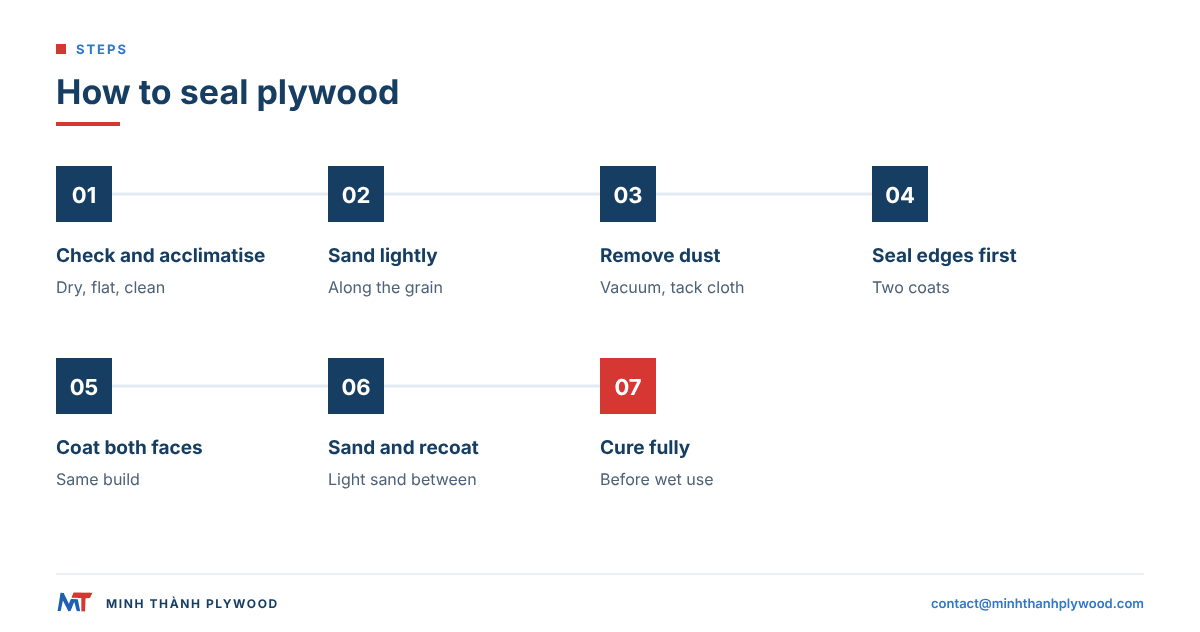
Seal plywood in this order: prepare, seal edges, seal both faces, build the finish, then cure. The steps below suit most sealers; the label sets coat thickness and times.
- Check the panel: dry, flat and clean. Plywood leaves the factory at 8–12 % moisture content; a panel that has stood in rain must dry first.
- Let it acclimatise for a few days in the room or climate where it will be used.
- Sand the faces along the grain, without sanding through the thin face veneer: start at 80-100 grit only if the face is rough, and finish at 180-220 grit.
- Remove all dust with a vacuum and a tack cloth.
- Condition soft faces such as birch and pine with a pre-stain wood conditioner if you will stain; leave it on for 15 minutes before staining. A stained face needs about 24 hours to dry before the sealer goes on.
- Seal the edges first, with two coats or a thicker coat, working the sealer into the end grain.
- Coat the first face thinly and evenly, then the second face. Both faces, same build.
- Let it dry for the recoat time on the label (about 2 hours is typical for a water-based finish, 4-6 hours for oil-based polyurethane), then sand lightly with 220 grit to remove raised grain.
- Apply the next coats, 2-3 in total, to edges and both faces, sanding lightly with 220 grit between coats.
- Let it cure fully before use, wetting or stacking.
Our guide to how to sand plywood covers the sanding steps without breaking through the face.
Edge-first sealing: why edges come before faces
Seal the edges first because plywood takes up water many times faster through its edges than through its faces. Every ply is cut across its fibres at the edge, so the edge is all end grain.
- Two coats on edges for each one on the faces is a good working rule.
- Seal every cut, including holes drilled for fixings and cut-outs for sinks and sockets.
- Round sharp arrises slightly: a coating thins out on a sharp edge and fails there first.
- Fill voids on the edge with filler before sealing, so the coat bridges a solid surface.
- Use edge banding or lipping on interior furniture for a durable, cleanable edge.
Film-faced and exterior panels are often edge-sealed at the factory. Recoat every edge you cut on site. Our guide to how to seal plywood edges goes through each panel type.
Best sealer for exterior plywood
The best sealer for exterior plywood is a penetrating water-repellent sealer or primer under a good exterior paint. Pigment blocks sunlight, which is what breaks down clear finishes and greys bare wood. Use a panel with phenolic (WBP) glue and renew the coating on a schedule, because sun and rain wear every film.
How long it lasts depends on the finish and the upkeep. Bare plywood outdoors may last only a few years, while properly sealed and maintained plywood can last 10-20 years or more; a primer coat usually needs reapplying every 1-2 years (Toolstation, 2026). Plan the repaint date when you seal, not when the paint peels.
- Painted: penetrating sealer or primer, then two coats of exterior acrylic paint. Longest life and least maintenance.
- Clear: several coats of spar or marine varnish, renewed before the film cracks. Expect to recoat every season or two in full sun.
- Semi-transparent stain: shows the grain, lasts longer than clear varnish, needs renewing.
- Bare: greys, checks and roughens; only for temporary work.
The US Forest Products Laboratory’s Wood Handbook (FPL-GTR-282, 2021) treats finishing as a system: paint and solid stains protect wood from sunlight best, and clear film finishes outdoors need the most frequent renewal.
For outdoor uses, start from exterior or CDX-type plywood with water-resistant melamine-fortified or phenolic (WBP) glue. Our exterior plywood page lists the build.
How to seal marine plywood
Seal marine plywood with epoxy, then protect the epoxy from sunlight with marine varnish or paint. Marine plywood has a water-resistant glue line, but its wood still takes up water and decays if left bare.
- Sand lightly and remove dust.
- Apply a thin penetrating epoxy to the edges and both faces, so it soaks into the surface.
- Build two or three coats of laminating epoxy, wet on tacky or after light sanding per the label.
- Sand the cured epoxy to a dull, even surface.
- Top coat with marine varnish for a clear finish or marine paint for colour.
- Seal every fixing hole with epoxy before fitting hardware.
Epoxy is the waterproof sealant for plywood that best keeps water out, but it chalks and breaks down in sunlight. The top coat is what protects it. Our marine plywood buying guide covers the panel itself.
How do you waterproof plywood with a waterproof sealant for plywood?
A waterproof plywood sealer keeps liquid water from reaching the wood for as long as the film stays whole, which is why a sealed panel still needs a water-rated glue line. It does not make the panel itself waterproof, and the protection ends where the film is scratched, cracked or missing.
- The film must be continuous: edges, holes and both faces.
- Movement cracks films: wood still moves a little with humidity, and brittle films crack at joints.
- Sunlight degrades films: renew clear coatings outdoors on a schedule.
- Trapped water does damage: water that gets behind a film through a crack cannot dry out.
For panels that will be wet often, buy the bond first: phenolic (WBP) glue for exterior and marine uses. Then the sealer protects the wood.
Does sealing stop plywood warping?
Sealing reduces plywood warping when both faces and all edges get the same coating, because the panel then takes up and loses moisture evenly on both sides. Sealing only one face can make warping worse.
Warping comes from uneven moisture: one face wetter than the other swells more and bows the panel. A balanced coating slows moisture change on both sides at the same rate.
- Coat the back as well as the face, even on cabinet backs and the underside of tops.
- Same number of coats on both faces.
- Store and finish panels flat, on even bearers, not leaning against a wall.
- Start with a flat, balanced panel: an odd number of plies, matching face and back, moisture at 8–12 %.
Our furniture-grade panels are pressed twice as standard: the core board is pressed and calibrated, then face and back are pressed on, which gives a flat, balanced sheet to seal.
How long does sealer take to dry on plywood?
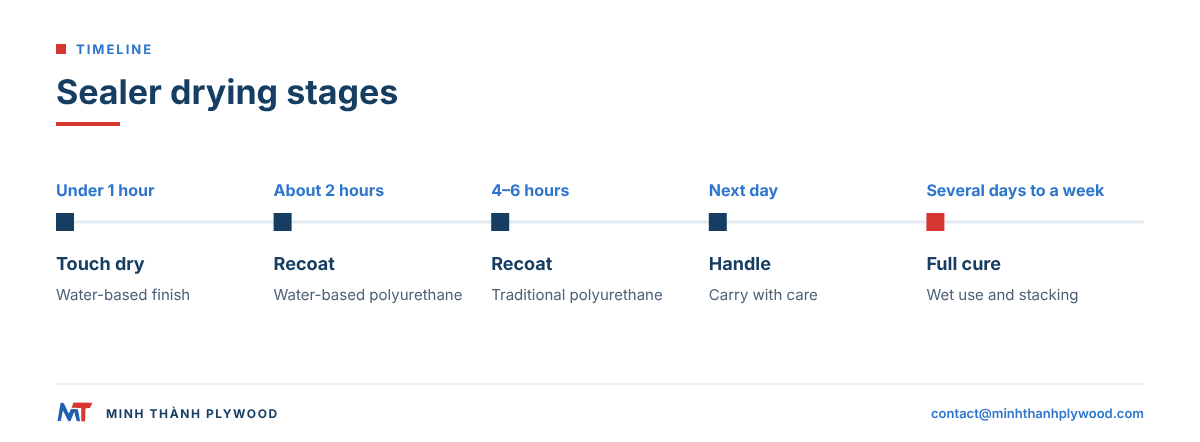
Water-based sealers are usually dry enough to recoat in a few hours, oil-based polyurethane and spar varnish overnight, and epoxy in several hours to a day. Full cure takes days longer than surface dry.
| Stage | What it means | Typical time | What you can do |
|---|---|---|---|
| Touch dry | Surface no longer tacky | Under 1 hour for water-based finishes | Nothing yet; dust can still stick |
| Recoat | Dry enough for the next coat | 2 hours for water-based polyurethane; 4-6 hours for traditional polyurethane; overnight for spar varnish | Sand lightly and recoat |
| Handle | Film hard enough to move the panel | The next day | Carry, fit, assemble with care |
| Full cure | Film at full hardness and water resistance | Several days to about a week | Wet use, stacking, heavy wear |
For a stained face, allow about 24 hours before the sealer, then 4-6 hours between sealer coats. The times are for 20-25 °C and moderate humidity; the label of your product sets the figure. Cold and damp slow every stage; warm, dry air with gentle ventilation speeds them. Do not stack sealed panels face to face before full cure, or they stick.
Sealing furniture plywood indoors
Seal interior furniture plywood with a sanding sealer or a thinned first coat of the finish, sand it smooth, then build two or more coats of lacquer, water-based polyurethane or oil. The sealer coat stops blotching and gives an even base.
- Sanded faces: our furniture panels have sanded and polished faces, so a light sand with fine abrasive is enough before sealing.
- UV-ready faces: both faces are made to the standard customers need to apply their own UV coating on a factory line.
- Blotch-prone faces: birch and pine faces can blotch under stain; a sealer or wash coat first evens it out.
- Edges: edge banding or lipping on visible edges, sealer on hidden ones.
For clear finishes in more depth, see our guide comparing varnish and clear finishes for plywood and the pillar guide on how to finish plywood.
Checks after sealing
Check a sealed panel before it goes into use. Five checks catch most failures:
- Water bead test: drops of water on face and edge should bead and stay on the surface.
- Edge check: every cut edge and hole is coated, with no bare end grain.
- Even sheen: dull patches show thin coating or a missed area.
- Film adhesion: on a test offcut, a crosshatch cut with tape pressed on and pulled should lift little or no film.
- Flatness: the panel lies flat after the last coat has cured.
Mark the date of coating on site records. Exterior and marine finishes need renewing, and the date sets the next inspection.
Buying plywood sealer locally
Plywood sealers are sold through paint and hardware stores in every market; the choice is the sealer type, not the country. Ask for the type in the table above by name.
- India: major paint makers sell PU sealers, melamine sealers and exterior primers through paint dealers and online marketplaces. PU sealer under PU clear is the common furniture system.
- Australia: hardware chains, such as Bunnings, and marine chandlers stock penetrating sealers, exterior primers, spar and marine varnishes and epoxy kits for marine plywood.
- Middle East, for example Amman, Jordan: paint and hardware stores sell exterior acrylic primers and paints, polyurethane and epoxy coatings.
- Singapore: annual mean relative humidity is about 82 % (Meteorological Service Singapore, 1991-2020), so humidity is a year-round condition and even interior panels should be sealed on every face and edge. Hardware retailers such as HardwareCity stock wood varnishes (Nippon Paint Timberlac is listed at S$31), and dealers for Nippon Paint carry sealers and exterior primers; the same shop’s marine range includes Jotun clear sealers for boat and wet-area work.
- Europe and North America: every type is available from paint and DIY chains and from marine suppliers.
Wherever you buy, match the sealer to the exposure and to the plywood’s glue, and use the top coat the sealer maker names.
What this means for your order
Choose the bond on the order to suit the exposure, then choose the sealer. Send these lines with your request:
- Application: interior furniture, damp interior, exterior or marine.
- Glue and emission: UF glue at E0 emission for dry interiors; MR or melamine-fortified and phenolic (WBP) bonds to your specification.
- Core: white Styrax or Eucalyptus as standard.
- Face: sanded and UV-ready for factory finishing, or utility C/D faces for painted exterior work.
- Size and thickness: 1220 × 2440 mm or 1250 × 2500 mm, 3–40 mm.
- Packing and quantity: from one 40HC, mixed specifications by agreement.
Production takes 15–45 days after the deposit, and free samples are available to test your sealer on. See our furniture plywood from Vietnam page for interior panels.
Buyer questions, answered
What is the best sealer for plywood?
Indoors, a sanding sealer or water-based polyurethane; outdoors, a penetrating water-repellent sealer under paint, or a spar or marine varnish for a clear finish; for boats and wet areas, epoxy saturation coated with a UV-resistant varnish or paint.
Does plywood need to be sealed?
Plywood that gets wet, sits outdoors or will be painted should be sealed, edges first. Dry interior furniture panels need a finish for wear and cleaning, and a sealer coat under it gives a smoother, more even result.
How do you waterproof plywood?
Start with a panel whose glue is rated for water, such as phenolic (WBP) bonded exterior or marine plywood. Seal every cut edge, coat both faces with a sealer suited to the exposure, and keep a paint or varnish film maintained over it.
What is the best sealer for exterior plywood?
Paint over a penetrating sealer or primer gives exterior plywood the longest life, because the pigment blocks sunlight. For a clear look, use several coats of spar or marine varnish and renew them before the film cracks.
Does sealing stop plywood warping?
Sealing reduces warping when both faces and all edges are coated equally, because the panel then takes up and loses moisture evenly. Sealing one face only can make warping worse.
How do you seal marine plywood?
Sand lightly, seal the edges and both faces with a thin penetrating epoxy, then build two or three coats of epoxy. Top it with marine varnish or paint, because epoxy breaks down in sunlight.
Should marine plywood be sealed?
Yes. Marine plywood has a water-resistant glue line, but its wood still takes up water, swells and decays if left bare. Seal it with epoxy and protect the epoxy from sunlight with varnish or paint.
How long does sealer take to dry on plywood?
Water-based sealers are usually dry to recoat in a few hours, oil-based polyurethane and spar varnish overnight, and epoxy in several hours to a day by product and temperature. Full cure takes days longer than surface dry.
Can you use wood sealer instead of varnish on plywood?
A wood sealer is the first coat: it soaks in, stabilises the surface and seals the pores. Varnish is the protective film on top. On most plywood you use both: sealer first, then two or more coats of varnish or paint.
Is water seal enough for plywood outdoors?
A penetrating water seal for plywood slows water uptake and is a good base, but on its own it wears off within a season or two in full sun. Paint or varnish over it lasts longer.