
An LVL scaffolding board is a scaffold plank made of laminated veneer lumber: thin veneers glued with the grain along the board, then proof-tested and marked for scaffold use. It is straighter and more even in strength than a sawn timber board. This guide covers sizes, the BS 2482, AS/NZS 1577 and OSHA rules, a comparison with timber and aluminium-plywood decks, and checks on delivery, from Minh Thanh Plywood.
What is an LVL scaffolding board?
An LVL scaffolding board is a scaffold plank made from laminated veneer lumber: thin wood veneers glued together with the grain running along the board’s length. After pressing it is cut to plank size, proof-tested and marked, so each board carries a known working load.
LVL replaced sawn timber on many sites for three reasons:
- Even strength. Knots and defects are spread across many veneers, so one weak spot cannot run through the whole section.
- Straightness. The board stays flat and true; it does not twist or cup like some sawn boards.
- Grading by testing. Each board can be proof-loaded, instead of graded by eye.
LVL boards look like timber boards from above. On the edge you can see the thin veneer layers, all running the same way.
LVL scaffold board sizes
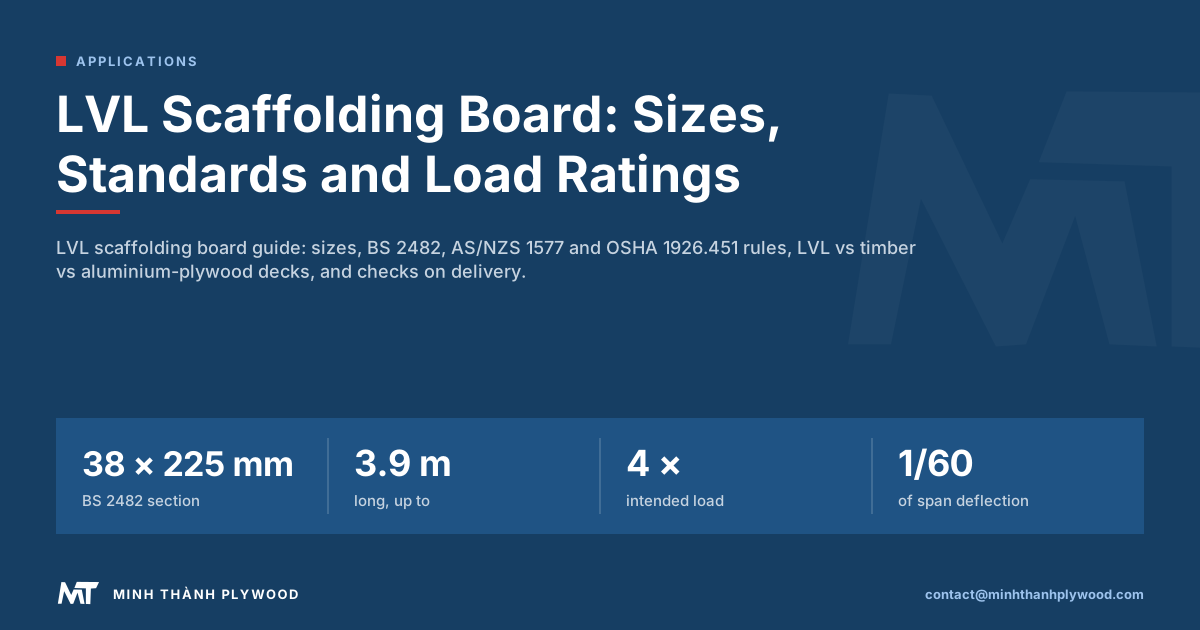
LVL scaffold board sizes follow the timber boards they replace. In BS 2482 markets, including the UK, the Gulf and much of Africa, the standard section is 38 × 225 mm, in lengths up to 3.9 m. In North America, LVL planks match the nominal 2 × 10 or 2 × 12 inch sawn plank.
| Market | Standard or rule | Typical section | Length | End marking |
|---|---|---|---|---|
| UK, Gulf (UAE, Saudi Arabia, Qatar), Africa | BS 2482 | 38 × 225 mm | Up to 3.9 m | Metal end bands, stamped marking |
| Australia, New Zealand | AS/NZS 1577 | Close to the timber plank it replaces | By scaffold bay | Marked plank class |
| United States | OSHA 29 CFR 1926.451 | Nominal 2 × 10 or 2 × 12 inch | By bay, often 8 to 16 feet | Maker’s label and load rating |
| Europe | EN 12811-1 for scaffold systems | Set by the system maker | System bay lengths | System marking |
Sizes are as sold in the Gulf market, for example an end-banded BS2482 board listed by a UAE building materials supplier, checked 20 October 2026. Always ask for the full board specification and test certificate; the section alone does not give the load rating.
Buying LVL scaffolding boards in the UAE and Gulf: sizes, weights and prices
In the UAE, Saudi Arabia, Qatar and other Gulf markets, LVL scaffolding boards are bought to the BS 2482 section of 38 × 225 mm, with end bands and a test certificate. Stockists in Dubai, such as Duscaff in Dubai Industrial City, list lengths from 0.5 m to 6.0 m. The common steps are 1.2, 1.8, 2.4, 3.0 and 3.9 m.
Prices are per board. One Sinopro listing for a 38 × 225 × 3900 mm OSHA-proof LVL board shows a reference price of AED 52 per piece at a minimum order of 130 pieces (checked on 21 October 2026); most Gulf stockists quote on request by WhatsApp or phone, and the final price follows length, end bands, test certificate and quantity.
| Length | Volume | Weight at 580–700 kg/m³ |
|---|---|---|
| 1.2 m | 0.0103 m³ | 6.0–7.2 kg |
| 1.8 m | 0.0154 m³ | 8.9–10.8 kg |
| 2.4 m | 0.0205 m³ | 11.9–14.4 kg |
| 3.0 m | 0.0257 m³ | 14.9–18.0 kg |
| 3.9 m | 0.0333 m³ | 19.3–23.3 kg |
Weights are computed from the 38 × 225 mm section and a reference density of 580–700 kg/m³, the range of Acacia and Eucalyptus LVL. A 3.9 m board is about 20 kg, a one-person lift.
Main contractors usually ask for the supplier’s certificate and the board marking before the boards go on site.
A Gulf buyer’s checklist:
- Section and length to BS 2482, with the tolerance on the order.
- Test certificate naming the standard, test method and load.
- Marking on every board: maker, standard, batch.
- End bands fitted at both ends.
- Moisture and storage plan: sun and sand damage boards stored in the open.
- Packing: strapped bundles with corner protection for container transport.
Heat and strong sun dry out the face, so keep bundles shaded and covered after delivery.
What a Gulf importer gets from Minh Thanh Plywood direct
Gulf container buyers order from Minh Thanh Plywood the parts of a scaffold system that a plywood and LVL mill makes well, shipped by 40HC, CFR or CIF to Jebel Ali, with 15–25 days at sea:
- Anti-slip plywood deck units, 12–21 mm, hexagonal phenolic film of about 220 g/m², cut to the frame size.
- LVL billets and members of Acacia or Eucalyptus, which a scaffold-board maker with a proof-test rig cuts, bands and marks locally to BS 2482.
We do not proof-test or mark finished scaffold planks, so rated 38 × 225 mm boards come from a stockist or a plank maker.
Which standards apply to LVL scaffold planks?
LVL scaffold planks are covered by the scaffold rules of the market where they are used: BS 2482 in the UK and Gulf, AS/NZS 1577 in Australia and New Zealand, OSHA 29 CFR 1926.451 in the United States, and EN 12811-1 for European scaffold systems.
What each one sets:
- BS 2482 covers timber scaffold boards: sizes, grading, end banding and marking. LVL boards sold in BS 2482 markets follow its sizes and marking.
- AS/NZS 1577 covers scaffold planks of timber, LVL and metal, with plank classes and test methods.
- OSHA standard 1926.451 sets the general requirements for scaffolds in US construction, including load capacity, planking and overhang.
- EN 12811-1 sets performance requirements for European scaffold systems, including deck units.
The board’s marking should name the standard and its maker. A board with no marking is a board with no rating.
Are LVL scaffold boards OSHA compliant?
LVL scaffold boards can be OSHA compliant when they are made, proof-tested and labelled for scaffold use and used within their rating. OSHA does not approve products; it sets what a scaffold and its parts must do, so the maker’s label and load rating are what a site inspector checks.
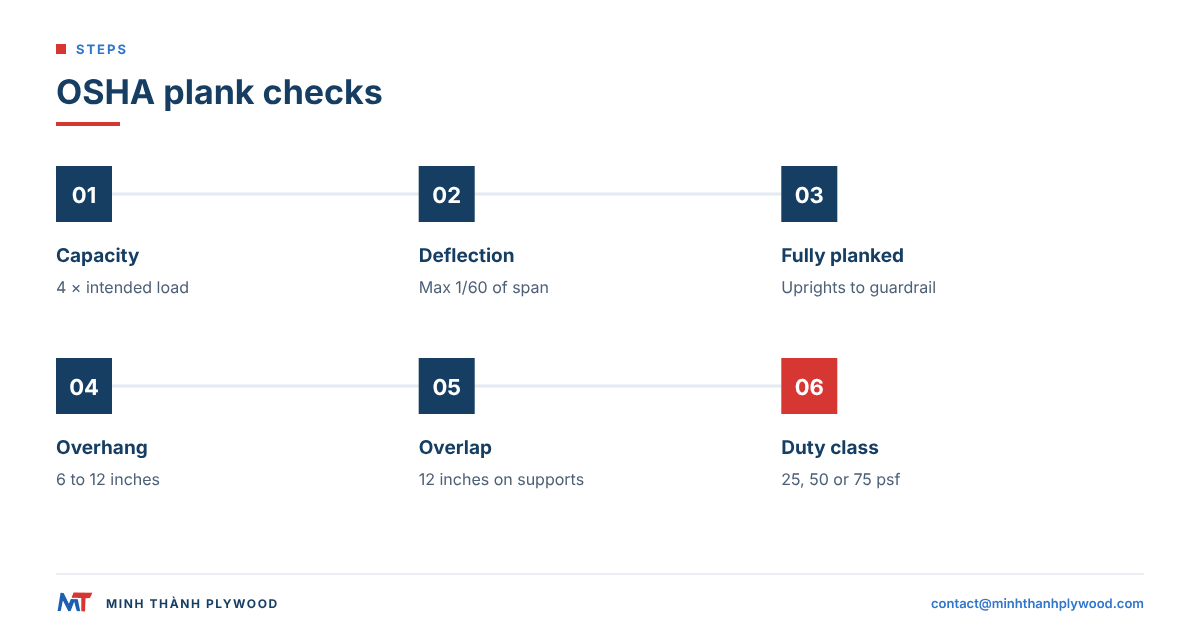
The OSHA rules that apply to planks, from 29 CFR 1926.451:
- Capacity: each scaffold component must support, without failure, its own weight and at least four times the maximum intended load applied to it.
- Deflection: platforms must not deflect more than 1/60 of the span when loaded.
- Planking: each platform on working levels must be fully planked or decked between the front uprights and the guardrail supports, with only small gaps allowed.
- Overhang: uncleated plank ends must extend at least 6 inches past the centre of the support and, for platforms 10 feet or shorter, no more than 12 inches, unless guarded or tested.
- Overlap: where planks overlap, they must overlap by at least 12 inches over supports, unless nailed or restrained.
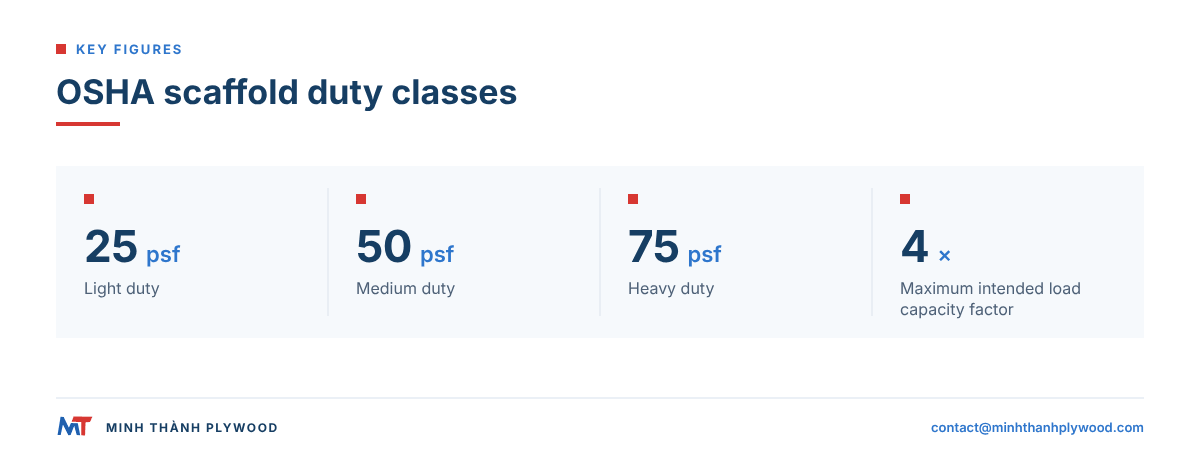
- Duty classes: Appendix A lists light-duty (25 pounds per square foot), medium-duty (50) and heavy-duty (75) loads for design.
A plank that is labelled for scaffold use states its allowable span and load. Use it inside both, and the four-times factor is met by design.
LVL vs timber vs aluminium-plywood scaffold decks
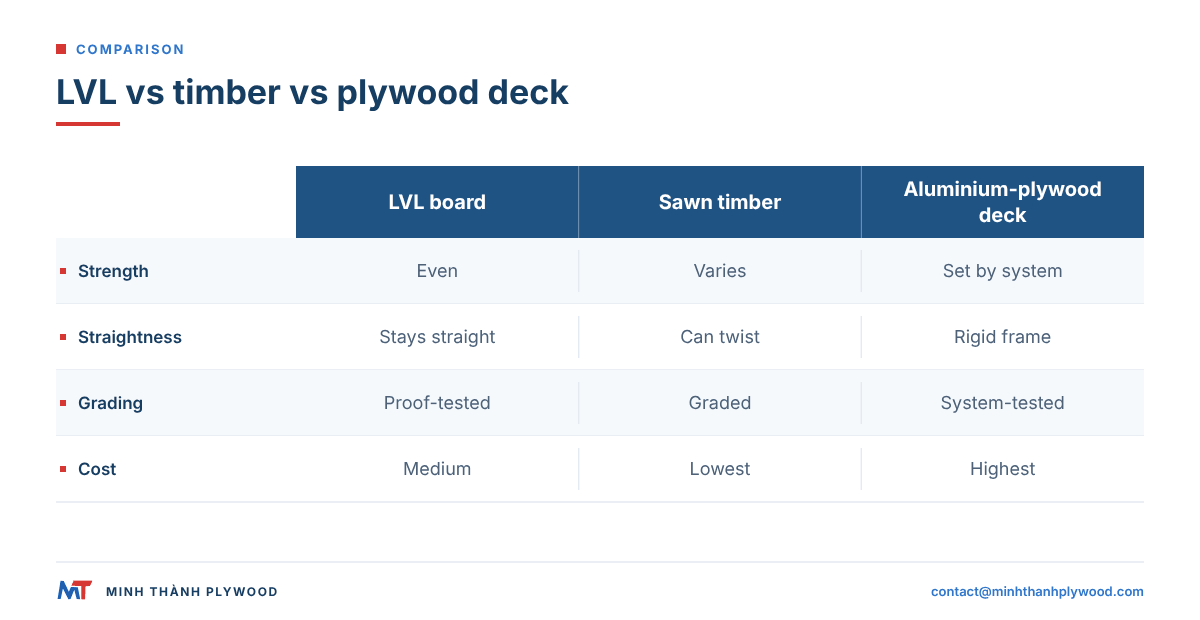
LVL boards give the most even strength for a wooden plank, sawn timber is cheapest but varies most, and aluminium-frame decks with a plywood surface are lightest and last longest on system scaffolds.
| Factor | LVL scaffold board | Sawn timber board | Aluminium-frame plywood deck |
|---|---|---|---|
| Strength consistency | High, defects spread out | Varies board to board | High, set by the system |
| Straightness | Stays straight | Can twist, bow or cup | Flat, rigid frame |
| Weight | Similar to timber | Similar to LVL | Lightest per area |
| Grip | Wood face, can be slippery when wet | Wood face | Anti-slip plywood or textured surface |
| Grading | Proof-tested, labelled | Visual or machine graded | System-tested unit |
| Damage response | Shows delamination, splits | Shows splits, rot | Replace the plywood surface |
| Cost | Medium | Lowest | Highest |
| Typical use | Tube-and-fitting and frame scaffolds | Tube-and-fitting scaffolds | System scaffolds |
For site boards in general, see our guide to scaffold boards.
Laminated scaffold boards: LVL and other laminated planks
Laminated scaffold boards are planks built from glued layers rather than cut from one log. LVL is the most common type; others are glued from thicker sawn lamellas, like a small glulam beam.
| Type | Layers | Strength consistency | Where it is sold |
|---|---|---|---|
| LVL scaffold board | Many thin peeled veneers, grain parallel | Highest | Worldwide |
| Glued laminated plank | A few sawn lamellas glued face to face | High | North America, some European systems |
| Sawn timber board | One piece | Lower, graded board by board | Worldwide |
The thinner the layers, the more evenly defects are spread, which is why LVL planks can be proof-tested to a narrow rating. Both laminated types need an exterior glue line; ask which adhesive is used and how the plank was tested.
How long do LVL scaffold boards last?
LVL scaffold boards last several years on site when they are stored, used and inspected well. Their life ends with damage, not age: a board with a split, open glue line, burn or crushed end is taken out of service that day.
What shortens board life:
- Standing water and wet storage, which swell the ends and weaken glue lines over time.
- Mortar, cement and chemicals left to set on the face, which hide cracks and add weight.
- Use as ramps, sole plates or mixing boards, which crushes fibres the rating depends on.
- Cutting boards to length, which removes end bands and the marking.
What extends it: covered storage on level bearers, cleaning after each job, and a recorded inspection before each use. Rental fleets that inspect every return keep boards in service longest.
LVL scaffold planks: how they are made
LVL scaffold planks are made by gluing rotary-peeled veneers into a long billet with all the grain running one way, then cutting, testing and marking each plank. The steps are close to those of any LVL; the difference is the testing at the end.
- Peeling: logs are peeled into thin veneers.
- Drying and grading: veneers are dried and sorted; the strongest grades go to the outer layers.
- Gluing: an exterior-grade, water-resistant adhesive, typically phenolic, is spread on each veneer.
- Lay-up: veneers are laid with the grain parallel and joints staggered, so no two joints line up.
- Pressing: the billet is hot-pressed into one solid section.
- Ripping and cutting: the billet is ripped into plank widths and cut to length.
- Proof-testing: each plank is loaded beyond its working load and checked.
- Marking and banding: planks are stamped; boards for BS 2482 markets get metal end bands.
Our LVL follows steps 1 to 6 for furniture frames, door members and packaging. We do not proof-test or mark LVL for scaffold use.
Scaffolding plywood: plywood scaffold decks and walkways
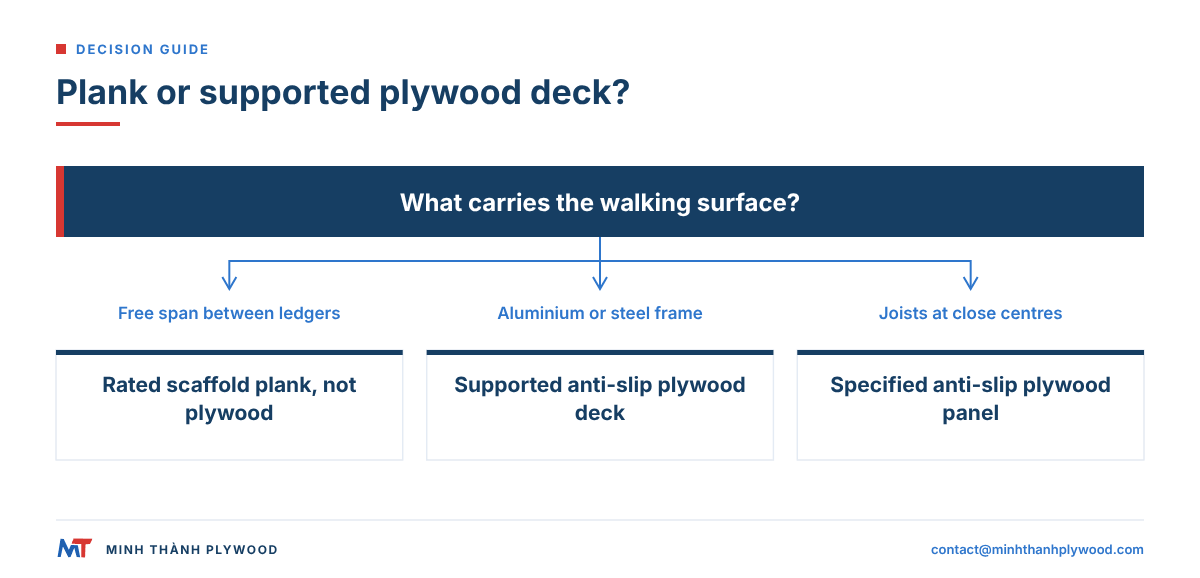
Scaffolding plywood is the deck surface of system scaffold platforms, not a plank in its own right. Aluminium or steel frames carry the load, and a plywood panel, usually with a phenolic anti-slip film, makes the walking surface.
Why plywood is used on decks rather than as planks:
- Crossed veneers make it stiff in both directions, so it spreads foot loads to the frame.
- Phenolic film protects the face from water, mortar and wear, and gives grip.
- Replaceable panels let rental companies renew the surface while keeping the frame.
Common deck panel specifications use 9 to 12 mm plywood in frames, and 18 to 21 mm for decks laid over joists. Hexagonal or mesh phenolic film gives grip in wet weather.
Plywood scaffolding planks: when do they work?
Plywood scaffolding planks work only as a supported deck surface, never as a free-spanning plank between ledgers. Plywood loses stiffness along its length compared with LVL, because half of its veneers run across the board.
Where plywood works on a scaffold or temporary structure:
| Use | Plywood | Support |
|---|---|---|
| System scaffold deck unit | Phenolic anti-slip plywood | Aluminium or steel frame |
| Loading bay or landing | 18 to 21 mm anti-slip plywood | Joists or beams at close centres |
| Temporary walkway or stage platform | 18 mm anti-slip plywood | Designed frame |
| Hoarding and edge protection | Exterior or film-faced plywood | Posts and rails |
For platforms and stages, see our guide to plywood for stages, platforms and walkways, which covers slip ratings.
How to inspect LVL scaffold boards on delivery and before use
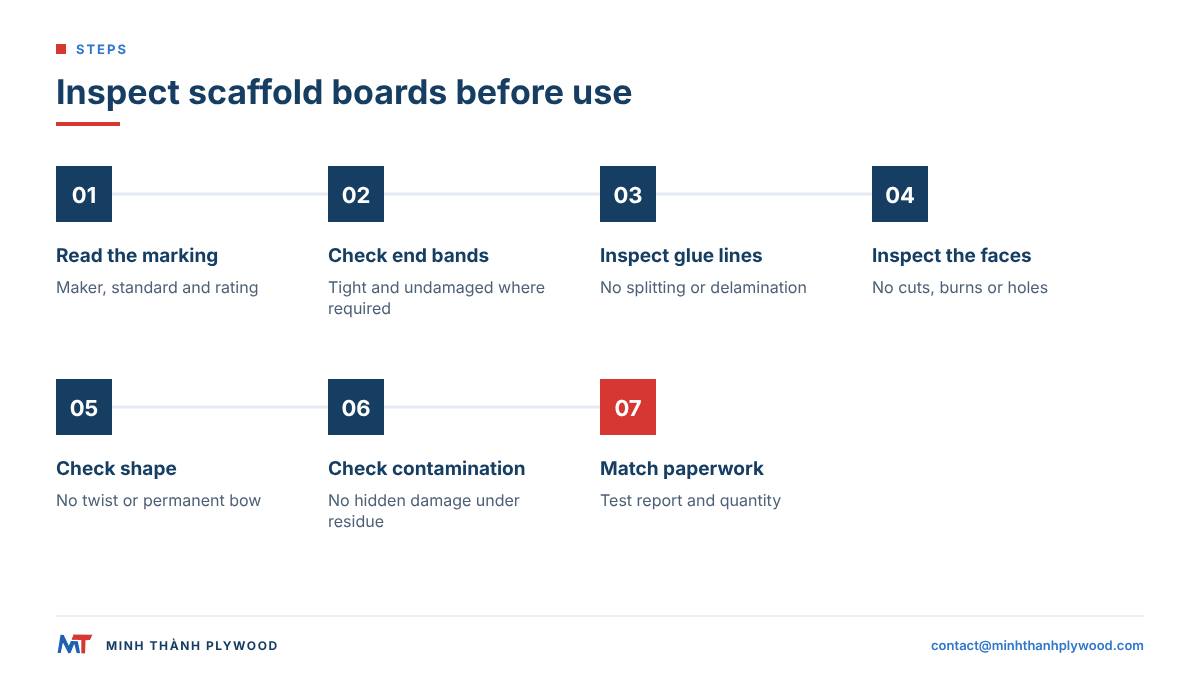
Inspect LVL scaffold boards when they arrive and before every use, and remove any damaged board from service at once. A quick check takes a few seconds per board.
- Marking: each board carries the maker, standard and rating; reject unmarked boards.
- End bands: on BS 2482 boards, the bands are tight and undamaged.
- Edges: no delamination, open glue lines or splits between veneers.
- Faces: no deep cuts, burns, saw kerfs or holes drilled through.
- Straightness: the board lies flat; no twist or permanent bow.
- Contamination: no heavy mortar, paint or chemical build-up that hides damage.
- Paperwork: the delivery matches the test report and the order quantity.
Keep boards on level bearers under cover, with air between layers, and never use them as sole plates, mixing boards or ramps for plant.
What Minh Thanh Plywood supplies
Minh Thanh Plywood makes LVL and plywood for specified components, not rated scaffold planks. For scaffold boards, buy proof-tested, marked planks from a scaffold-plank maker; for deck surfaces, walkways and site panels, our range fits.
- LVL (laminated veneer lumber) from Acacia or Eucalyptus plantation veneers, in billet formats of 1220 × 2440 or 1250 × 2500 mm, for furniture frames, door members and packaging. Density: Acacia about 580 kg/m³, Eucalyptus 650–750 kg/m³.
- Bonds for LVL: UF at E0 for interiors, E1 as an option, MR / melamine-fortified or phenolic WBP for water resistance.
- Anti-slip plywood on order, 12–21 mm, hexagonal or mesh phenolic film of about 220 g/m², for deck units and walkways.
- Film-faced plywood 12–21 mm for formwork and hoarding.
- Testing: third-party testing to the buyer’s method is arranged through SGS on request.
- Product and test records are on our quality page.
Read the industrial plywood guide for more site and industrial uses.
Send a deck panel or LVL specification
A typical line: “Anti-slip plywood for scaffold deck units, 12 mm, hexagonal phenolic film face, smooth film back, Eucalyptus core, phenolic WBP glue, cut to your frame size, one 40HC, CIF Jebel Ali.” Send it through the contact page or to contact@minhthanhplywood.com; we reply within hours, and samples are free.
Buyer questions, answered
Are LVL scaffold boards OSHA compliant?
They can be. OSHA 1926.451 requires every scaffold component to support its own weight and at least four times the maximum intended load. LVL planks sold for US scaffolds are proof-tested and labelled by their maker; use only planks marked for scaffold use.
What size is an LVL scaffolding board?
In BS 2482 markets, including the UK and the Gulf, LVL boards follow the timber board size of 38 × 225 mm, in lengths up to 3.9 m. In the US, LVL planks match the nominal 2 × 10 or 2 × 12 inch sawn plank they replace.
Is LVL stronger than a timber scaffold board?
LVL is more even rather than always stronger: its veneers spread out knots and grain defects, so every plank behaves close to the rated value. Sawn boards vary more from one board to the next and must be graded for scaffold use.
What is the difference between LVL and plywood scaffold boards?
LVL has all veneers running along the board, which makes it a beam that spans between supports. Plywood crosses its veneers, so it is used as a deck surface on a frame, as in aluminium-frame scaffold decks.
How long do LVL scaffold boards last?
Several years on site with proper care: stored flat and dry, kept clean of mortar and chemicals, and inspected before each use. Remove a board at once if it shows splits, delamination, burns or damaged ends.
Can LVL scaffold boards get wet?
Yes, they are made with an exterior bond for site weather. Repeated soaking still shortens their life, so store them under cover, off the ground and with air between the boards.
What is the maximum overhang for a scaffold plank?
Under OSHA 1926.451, an uncleated plank must extend at least 6 inches past the centre of its support and, for platforms 10 feet or shorter, no more than 12 inches, unless it is guarded or tested for the extra overhang.
What are scaffold load ratings?
OSHA lists light-duty (25 pounds per square foot), medium-duty (50) and heavy-duty (75) platforms. The scaffold designer picks the duty class; the plank and its span must then meet it with the four-times safety factor.
Does Minh Thanh sell LVL scaffold planks?
Minh Thanh Plywood makes LVL from Acacia or Eucalyptus veneers for furniture frames, door parts and packaging members, and anti-slip plywood for platform decks. It does not sell proof-tested scaffold planks.