
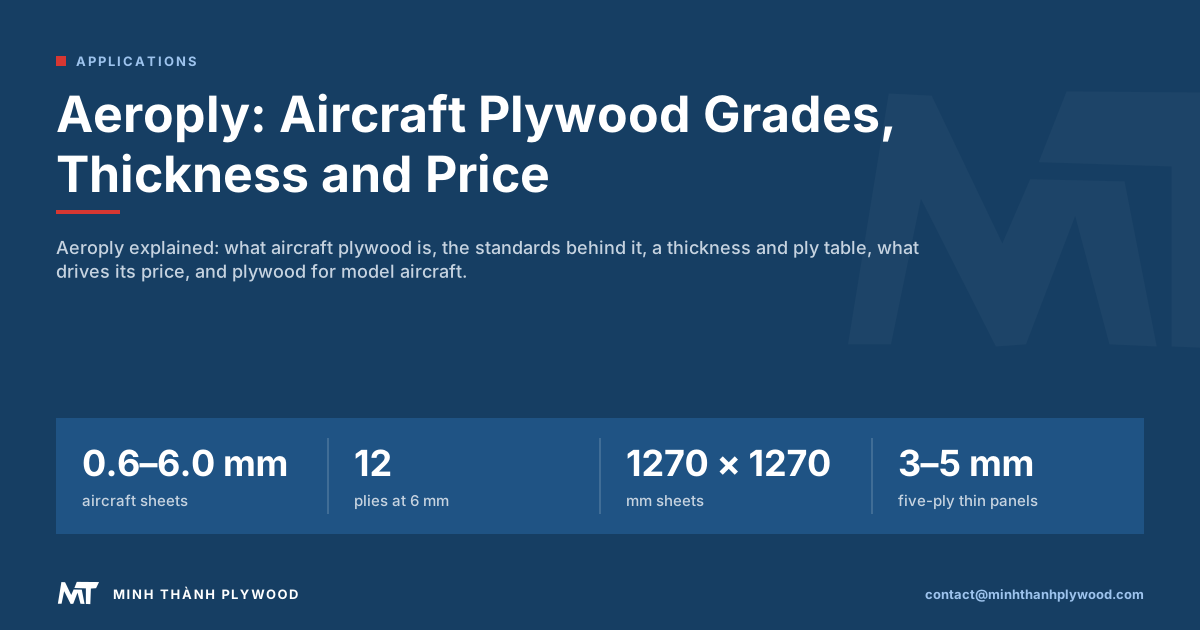
Aeroply, or aircraft plywood, is very thin, high-grade plywood made from birch or mahogany veneers with a boil-resistant bond, produced and certified to an aviation specification for airframes and their repair. It sells by the sheet from a few specialist mills. Below: grades, a thickness table, price drivers and what model builders use instead, from Minh Thanh Plywood, a furniture plywood maker.
What is aircraft plywood?
Aircraft plywood is thin, high-grade plywood produced to an aviation specification for aircraft structures. It is made from selected birch or mahogany veneers, bonded with a boil-resistant resin, and sold with documents that trace each sheet to a production lot and a named aviation specification.
Three things separate it from ordinary plywood:
- Very thin veneers. A sheet of 1.0 mm can have three plies; ordinary furniture panels start at about 3 mm.
- Specification. The sheet is made and inspected to an aviation standard, not a furniture or construction grade.
- Traceability. Each sheet carries a stamp or label that ties it to its lot and test records.
Aircraft plywood was used widely in the 1930s and 1940s for fuselage skins, wing leading edges and ribs, and it is still used in homebuilt, vintage and glider aircraft, where restorers need panels that match the original design.
Aero plywood and aeroply wood: are they the same thing?
Yes. Aero plywood, aeroply wood, aircraft ply and aircraft grade plywood all mean the same product: thin plywood made to an aviation specification. “Aeroply” is the short trade name used mostly in the UK, Ireland and Commonwealth markets.
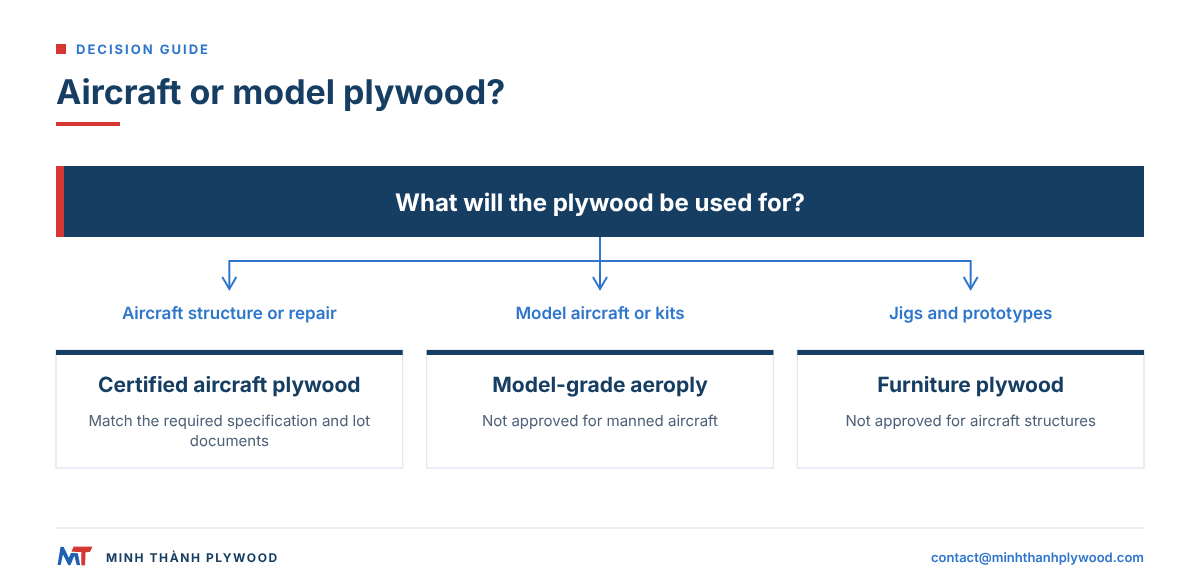
The words are used loosely online, though. Some craft and model shops call any thin birch sheet “aeroply” even when it carries no aviation paperwork. If you need the panel for a part that flies with a person on board, the name is irrelevant; the certificate and the lot paperwork are what count.
| Term | What it usually means | Approved for aircraft? |
|---|---|---|
| Aircraft plywood, aircraft grade plywood | Plywood made to an aviation specification | Yes, with lot documents |
| Aeroply, aero plywood, aeroply wood | Trade name for the same product, UK usage | Yes, when sold by an aviation supplier |
| Model aircraft plywood | Thin birch or poplar sheet for models | No |
| Lite ply | Light poplar plywood for model formers | No |
| Birch plywood (furniture) | Birch-faced panel graded for appearance | No |
Which standards define aircraft grade plywood?
Aircraft grade plywood is defined by aviation material specifications rather than by furniture or construction standards. The specification the aircraft design or the airworthiness authority names is the one to buy to.
The references a buyer meets most often:
- DIN 5507 (Germany): the classic standard for aircraft plywood (“Flugzeugsperrholz”), still cited for birch aeroply.
- BS V3 (United Kingdom): the British aircraft plywood specification, cited in older British designs.
- MIL-P-6070 (United States): the US military specification for aircraft plywood, cited in American kit and restoration plans.
- Germanischer Lloyd (GL) approval: an approved production standard many European suppliers sell to.
- Accepted alternatives: national light aircraft bodies can accept equivalent material. In the UK, the Light Aircraft Association accepts SATCo-certified birch plywood in place of GL material, as the supplier’s published range explains.
These documents set veneer quality, ply construction, bond tests and marking. Several are old and partly withdrawn, but plans and maintenance manuals still name them, so suppliers keep selling against them.
How is aeroply made?
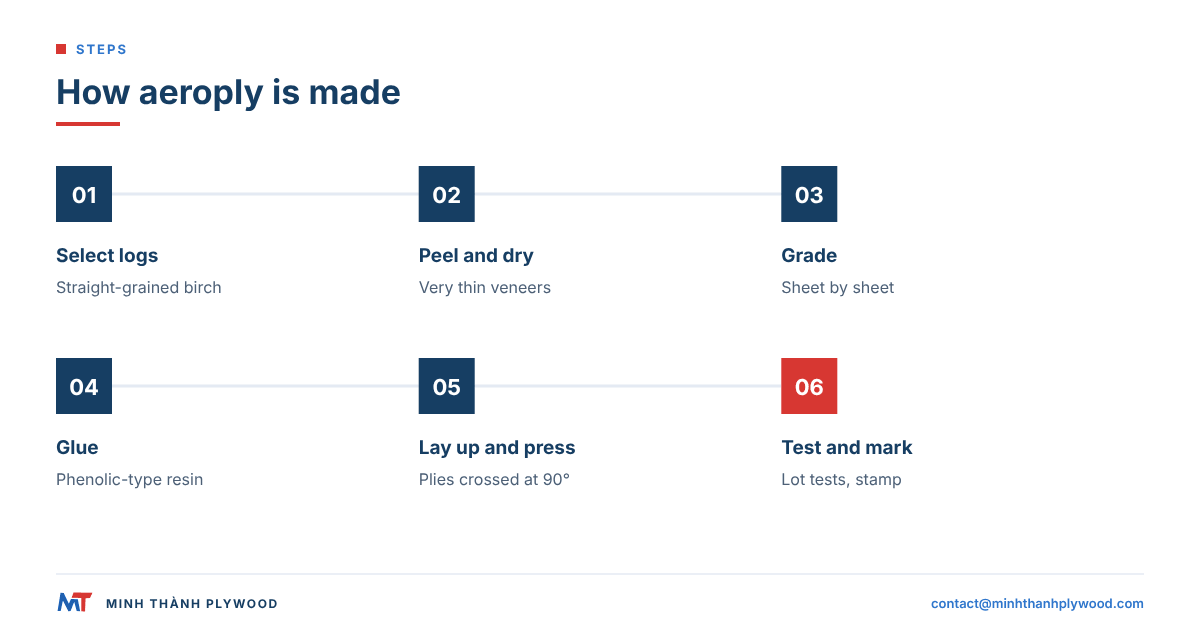
Aeroply is made from thin rotary-cut veneers that are selected, dried, glued with a boil-resistant resin and hot-pressed in small lots. The process is close to that of other plywood; the difference is in veneer selection, veneer thickness and inspection.
- Log and veneer selection. Straight-grained birch or mahogany logs are peeled into very thin veneers.
- Drying and grading. Veneers are dried and graded sheet by sheet; splits, knots and grain run-out are rejected.
- Gluing. A phenolic-type resin, often as a glue film, is applied so the bond survives boiling and long service.
- Lay-up. Veneers are crossed at 90 degrees; thin sheets use three plies, thicker sheets add plies in proportion.
- Hot pressing and sanding. The sheet is pressed, cooled and sanded or left unsanded to the specification.
- Testing and marking. Samples from each lot are tested for bond and strength, and sheets are stamped with the lot.
Our own process for furniture plywood shares steps 1 to 5 but works with thicker veneers and appearance grades. We stitch core veneers across and along the panel and press furniture panels twice: the core board is pressed and calibrated, then the faces go on.
Aircraft plywood thickness and ply table
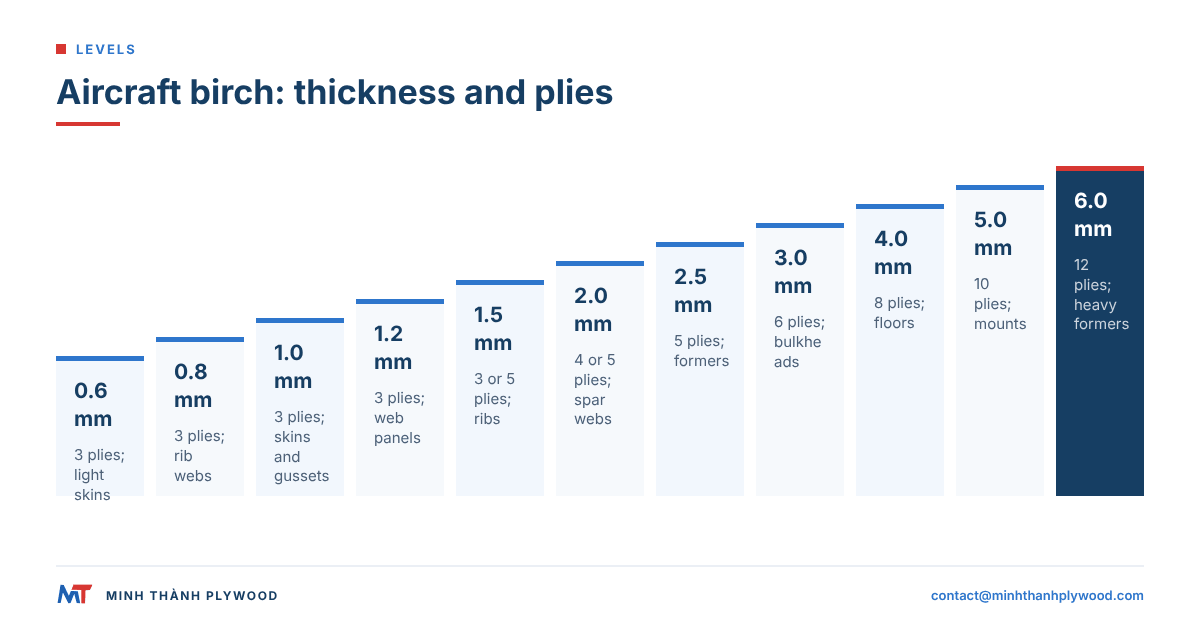
Aircraft birch plywood is made from about 0.6 mm to 6.0 mm, and the ply count rises with thickness. One UK aviation supplier lists its SATCo birch range on sheets of 1270 × 1270 mm, with quarter sheets of 635 × 635 mm.
| Thickness (mm) | Plies | Full sheet weight (kg) | Typical use |
|---|---|---|---|
| 0.6 | 3 | 0.7 | Light skins, leading-edge wraps |
| 0.8 | 3 | 0.9 | Skins, rib webs |
| 1.0 | 3 | 1.4 | Skins, gussets |
| 1.2 | 3 | 1.7 | Gussets, web panels |
| 1.5 | 3 or 5 | 1.8 | Ribs, gussets, doublers |
| 2.0 | 4 or 5 | 2.3 to 2.4 | Spar webs, formers |
| 2.5 | 5 | 2.8 | Formers, bulkheads |
| 3.0 | 6 | 3.4 | Bulkheads, floors |
| 4.0 | 8 | 4.5 | Floors, seat backs |
| 5.0 | 10 | 5.7 | Floors, mounts |
| 6.0 | 12 | 6.8 | Firewall backing, heavy formers |
Source: the published range of Aircraft Plywood and Timber, checked 20 October 2026. Uses are typical examples; the aircraft’s drawings decide.
Compare that with furniture plywood. Our thin range is 3, 4 and 5 mm, all five-ply, on sheets of 1220 × 2440 mm or 1250 × 2500 mm. A 6 mm aircraft sheet has twelve plies; a 6 mm furniture panel usually has three or five. More, thinner plies give even strength in every direction, at much higher cost.
Aeroply sheet sizes and per-sheet prices
UK and model-shop stockists sell aeroply by the sheet, not by the cubic metre, and the sheet sizes differ by use.
| Sheet | Size | Where it is sold | Price seen (checked 21 October 2026) |
|---|---|---|---|
| Aircraft birch Grade III, 0.8 and 1.5 mm | 1525 × 1525 mm | Chiltern Timber, UK | £44.00 to £68.00 per sheet, falling as the order grows from one sheet to twenty or more; cutting service £1.00 plus £5.00 set-up |
| SATCo aircraft birch | 1270 × 1270 mm, quarter sheet 635 × 635 mm | UK aviation stockist | Per sheet, by thickness |
| Model-grade aeroply, 1.5 to 6 mm | 12 × 6 in, 12 × 36 in, 36 × 36 in (915 × 915 mm) | Vortex-RC, India | 3 mm from ₹85 to ₹510 by sheet size |
Three points help a UK buyer. Stockists price per sheet and most offer a cut-to-size service, so ask for the quarter or strip you need instead of the full sheet.
A 36 × 36 in sheet of 3 mm model aeroply weighs about 1.18 kg, or 130 g per square foot, and the thickness steps match the table above: 2 mm for firewalls, motor mounts and control horns on small electric models, 3 mm for bigger planes, and 4 to 6 mm for nitro and large gas models. Full 1525 × 1525 mm and 1270 × 1270 mm sheets suit builders who cut many parts; small sheets suit one-off repairs.
Buy aeroply in the UK
- Aviation material stockists sell certified birch with lot paperwork, in 0.6 to 6.0 mm, for airframe work.
- Timber merchants such as Chiltern Timber sell aircraft birch Grade III by the sheet with panel cutting.
- Model and hobby shops sell 1.5 to 6 mm model-grade aeroply in small sheets for kits and laser cutting.
- Art-school and maker shops, such as the Royal College of Art shop, sell a 1.5 mm aeroply quarter sheet for models.
Birch aircraft plywood or mahogany?
Birch aircraft plywood is the default today: it is light, stiff, even in strength and widely approved. Mahogany aircraft plywood is reddish, slightly softer and mainly bought to match older designs that specify it.
| Property | Birch aircraft plywood | Mahogany aircraft plywood |
|---|---|---|
| Main source | Finland and the Baltic region | Tropical hardwood (khaya and similar) |
| Strength and stiffness | High and very even | Good, slightly lower |
| Typical use | Skins, ribs, gussets, bulkheads | Restoration of designs that call for it |
| Availability | Stocked by aviation suppliers | Limited, often to order |
| Look | Pale, fine grain | Reddish brown |
Spruce, the other classic aircraft wood, is used as solid timber for spars and longerons, not as plywood skins. Poplar is used in model lite ply and also as a core in some aircraft-grade mahogany plywood: Aircraft Spruce’s product specification lists poplar or basswood cores in panels meeting MIL-P-6070. The aircraft’s required material specification decides which construction is acceptable.
What is the strength of aircraft plywood?
Aircraft plywood is strong for its weight because it uses thin, defect-free veneers crossed at right angles in many plies. Strength is fixed by the specification, which sets minimum tensile, shear and bond values the lot must pass.
Four properties matter to a designer:
- Tensile strength along and across the sheet, kept close in both directions by the crossed plies.
- Shear strength, which keeps skins and webs from buckling under torsion.
- Bond durability after boiling and ageing, so the plies stay together in damp hangars.
- Strength-to-weight ratio, the reason thin plywood still competes with metal on light aircraft.
Exact design values come from the standard and the supplier’s test report for that lot, not from general tables. A furniture panel is never rated for these values, however good its face looks. For US-registered aircraft, the FAA’s Advisory Circular 43.13-1B covers acceptable methods for wood structure, including plywood.
How is aircraft plywood different from laminated wood?
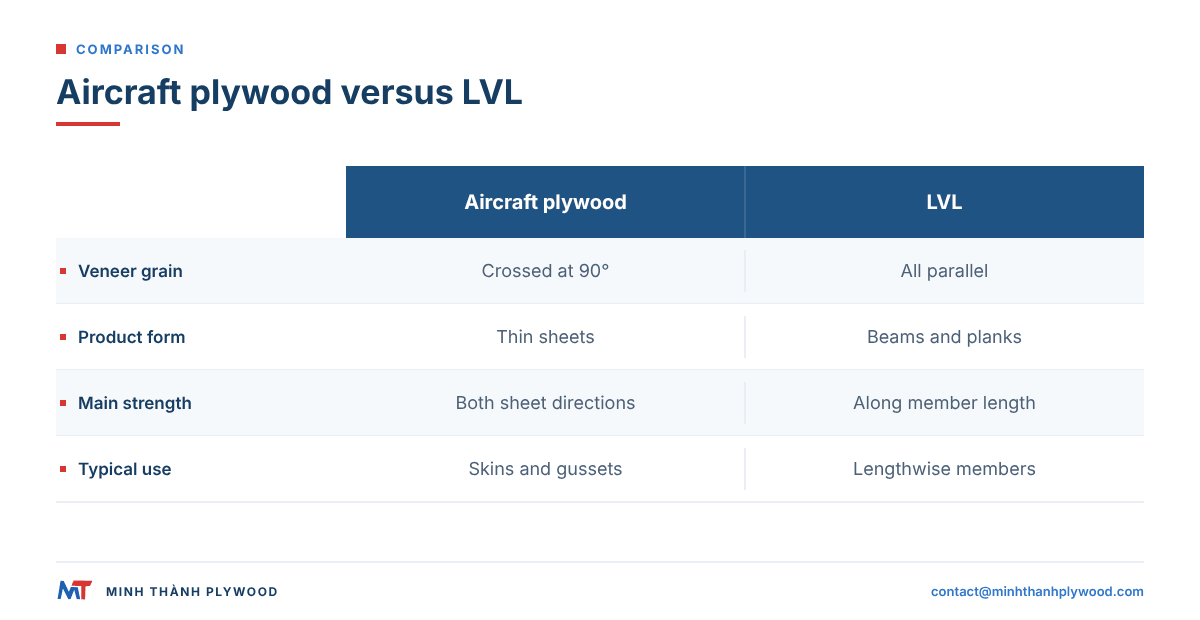
Aircraft plywood crosses each veneer at 90 degrees to the next, so a sheet is strong in both directions. Laminated wood such as LVL lays every veneer with the grain running the same way, so a member is strong along its length and weaker across it.
That difference decides the job. Plywood makes skins, webs, gussets and bulkheads, where load comes from several directions. Laminated wood makes beams, spars and planks, where load runs along one axis. Our guide to LVL scaffold boards shows the same logic on a building site: the long grain carries the span.
| Feature | Aircraft plywood | Laminated veneer lumber (LVL) |
|---|---|---|
| Veneer direction | Crossed at 90 degrees | All parallel |
| Form | Thin sheets | Beams, billets, planks |
| Strong in | Both sheet directions | Length of the member |
| Typical aircraft part | Skins, ribs, gussets | Not common; solid spruce is used for spars |
Aircraft plywood price: what drives it?
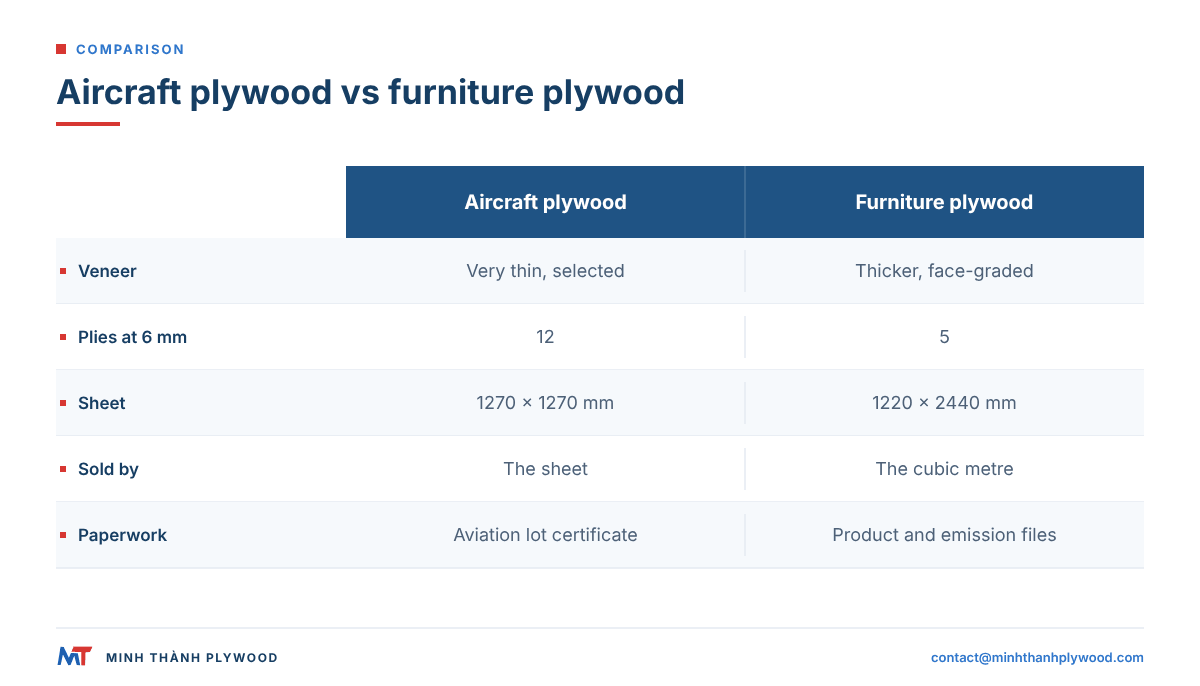
Aircraft plywood costs many times more per square metre than furniture plywood because of how it is made and sold: selected thin veneers, small lots, sheet-by-sheet inspection, certification and small, carefully packed shipments.
| Price driver | Aircraft plywood | Furniture plywood |
|---|---|---|
| Veneer | Very thin, selected, few defects allowed | Thicker, graded for the face |
| Plies per millimetre | High | Lower |
| Lot size | Small batches | Full presses, container loads |
| Inspection | Each sheet, with lot tests | Sampling plus appearance grading |
| Paperwork | Aviation lot paperwork | Product and emission documents |
| Sheet size | Small, for example 1270 × 1270 mm | 1220 × 2440 mm or 1250 × 2500 mm |
| Selling unit | By the sheet | By the cubic metre |
| Freight | Courier or groupage | One 40HC container |
For scale: as of October 2026 our furniture and interior plywood starts from US$350/m³ FOB, sold by the container. Aircraft plywood is quoted per sheet, and a few sheets can cost as much as a cubic metre of furniture panels. Buy it from an aviation supplier, and budget for courier freight.
Where to buy aircraft plywood
Buy aircraft plywood from an aviation material supplier that sells it with the lot paperwork your aircraft needs. Searches such as “aeroplane plywood Denmark buy” or “thin aeroply Ireland” lead to the same small group of specialists, because few mills make it.
Check four things before you order:
- The specification on the paperwork matches the one in your plans or maintenance manual.
- The lot number is on the sheets and on the paperwork.
- The thickness and ply count match the drawing; a 2.0 mm sheet in four plies is not the same as one in five.
- Your airworthiness body accepts the material, if you build under a national light aircraft scheme.
Most European buyers order from UK, German, Finnish or Danish aviation stockists, and US builders from American aircraft supply houses. A general timber yard or a plywood exporter cannot sell airworthy sheets, even if it stocks thin birch.
Plywood for model aircraft and laser cutting
Model aircraft plywood does not need aviation paperwork; it needs light weight, flat sheets and clean laser cuts. Builders use lite ply for formers and thin birch plywood for ribs, firewalls and parts that take screws or engine loads.
| Model part | Common sheet | Why |
|---|---|---|
| Fuselage formers, light ribs | Lite ply (poplar) | Lightest option |
| Firewalls, wing joiners, motor mounts | Birch plywood | Holds screws and loads |
| Laser-cut kits | Thin birch-faced plywood | Clean edge, even burn |
| Thin skins on scale models | True aeroply | Thinnest sheets |
This is where a furniture mill’s thin range fits. Our thin plywood is five-ply at 3, 4 and 5 mm, with birch, poplar or other faces over a white Styrax core of about 500 kg/m³. Kit makers, toy and craft workshops and laser-cutting shops buy it by the container for parts that do not fly with people on board. Lasers carry workplace hazards of their own, so read OSHA’s laser hazards page before setting up a cutting bench.
Why aircraft plywood is a specialist niche
Aircraft plywood is a niche because demand is small and the cost of approval and lot testing is high. Most aircraft are metal or composite, so the market is homebuilt, vintage, glider and restoration work, served by a few mills and stockists.
For a mill, the economics are clear. A press that makes approved thin sheets in small lots cannot run container volumes of furniture panels at the same time. That is why furniture and construction plywood makers, in Vietnam and elsewhere, do not offer airworthy plywood, and why buyers should be wary of anyone who claims to sell “aircraft grade” sheets by the container without lot certificates.
What this means for your order
Split the order by use. Buy approved aeroply only for parts that fly, from an aviation supplier, and buy thin furniture plywood for everything else: jigs, templates, mock-ups, models, cabin furniture prototypes and laser-cut kits.
For the second group, Minh Thanh Plywood supplies:
- Thin panels of 3, 4 and 5 mm, always five-ply, with Styrax or Eucalyptus cores.
- Birch-faced plywood from 3 to 40 mm, faces sanded and polished, both sides UV-ready.
- Tight thickness down to ±0.2 mm on sanded furniture panels, which keeps laser focus and slot fits steady.
- UF glue at E0 emission as standard, with melamine-fortified or phenolic WBP bonds made to your specification.
- Free samples for a laser or machining trial, and production in 15–45 days after deposit.
- Emission and quality records on our quality page.
Plywood is processed wood and sits outside the ISPM 15 standard, so panels need no ISPM 15 mark; solid sawn-wood bearers under the packs do. Read the industrial plywood guide for other technical uses, and our guide to the best plywood for outdoor signs if your parts will live outside.
Send a thin plywood specification
Write the line you would send: “Thin plywood, 4 mm five-ply, birch face D+/D, Styrax core, UF glue at E0 emission, sanded, 1220 × 2440 mm, for laser-cut model kits, one 40HC, CIF your port.” Send it through the contact page or to contact@minhthanhplywood.com; we reply within hours, and samples are free.
Buyer questions, answered
What is aircraft grade plywood?
Aircraft grade plywood is thin birch or mahogany plywood made with a boil-resistant bond and certified to an aviation specification such as DIN 5507, BS V3, MIL-P-6070 or a Germanischer Lloyd approval. Each sheet is traceable to its production lot.
What is aeroply made of?
Most aeroply today is birch: thin rotary-cut birch veneers, often from Finland, bonded with a phenolic-type resin. Mahogany aircraft plywood also exists and was common in older designs.
How thin does aircraft plywood go?
Specialist stock starts at 0.6 mm in three plies and runs to 6.0 mm in twelve plies, on sheets of 1270 × 1270 mm in one UK range. Thinner veneers per ply are what set it apart from furniture plywood.
Is aircraft plywood stronger than normal plywood?
Per kilogram, yes: thin, defect-free veneers and more plies per millimetre give it a high strength-to-weight ratio and very even properties. A normal furniture panel uses fewer, thicker plies and is graded for appearance, not airworthiness.
Can I use birch plywood from a furniture mill on an aircraft?
Not on any part that carries flight loads. Airworthy parts need plywood certified to the specification the aircraft's design or the airworthiness authority names, with its lot paperwork. Furniture birch plywood suits jigs, cabin furniture mock-ups and models.
What plywood do model aircraft builders use?
Model builders use lite ply (poplar) for light formers, thin birch plywood of 1.5 to 6 mm for laser-cut ribs, formers and firewalls, and true aeroply only for the thinnest skins.
Why is aircraft plywood so expensive?
It is made in small lots from selected thin veneers, pressed with more plies per millimetre, inspected sheet by sheet and sold with lot paperwork. Small sheet sizes and air or courier freight add to the price per square metre.
Does Minh Thanh make aircraft plywood?
No. Minh Thanh Plywood makes furniture and interior plywood, including five-ply thin panels of 3, 4 and 5 mm with birch or other faces, for furniture, models, crafts and laser-cut parts that do not fly.
What is the difference between aircraft plywood and laminated wood?
In plywood each veneer is laid at 90 degrees to the next, so the sheet is strong in both directions. In laminated wood such as LVL the grain of all veneers runs the same way, making a member strong along its length.