
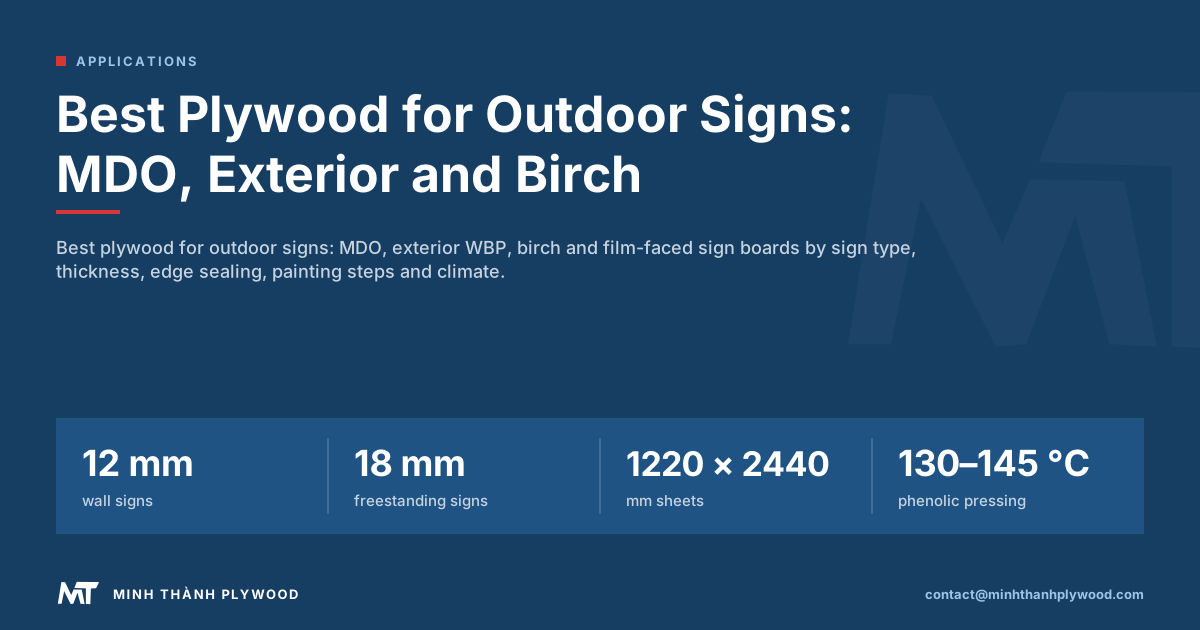
The best plywood for outdoor signs is MDO (medium density overlay): exterior plywood with a resin-treated paper face that takes paint and vinyl smoothly and resists weather. Exterior WBP plywood works for painted and routed signs when well primed, birch suits carved and laser-cut signs, and film-faced plywood suits site hoardings. This guide compares them by sign type, from Minh Thanh Plywood, a plywood maker in Vietnam.
What is the best plywood for outdoor signs?
The best plywood for outdoor signs is MDO, medium density overlay plywood: an exterior-glue panel with a resin-treated paper face that is smooth, paint-ready and weather-resistant. Sign painters and sign shops have used it for decades because paint and vinyl sit flat on it and the grain never shows through.
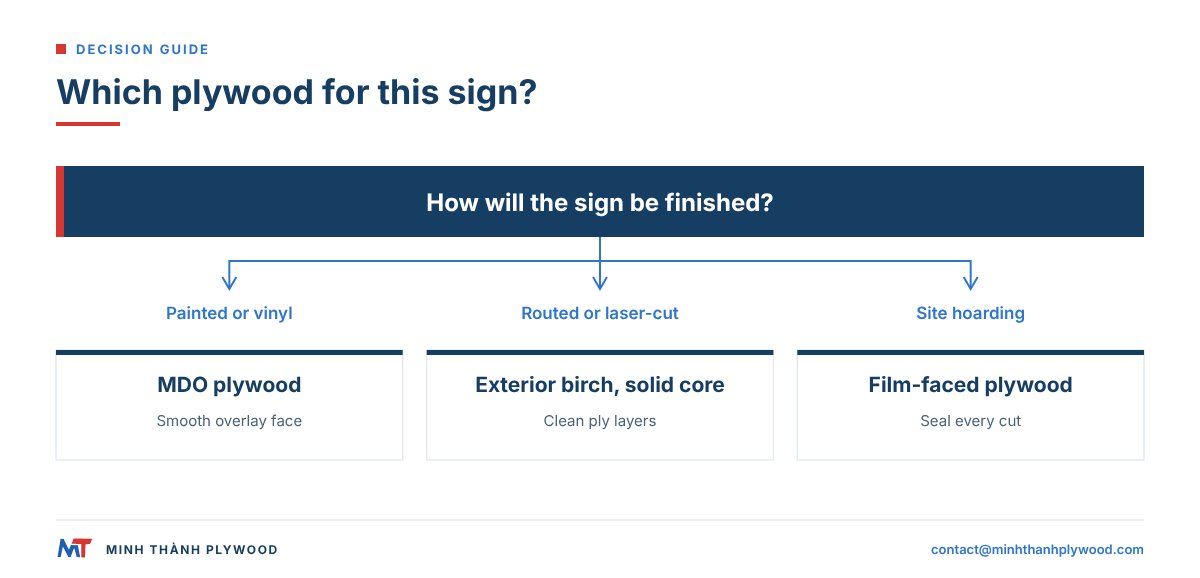
The right panel depends on the sign:
| Sign type | Best plywood | Why |
|---|---|---|
| Painted sign, hand-lettered | MDO | Smooth overlay holds paint and fine lines |
| Vinyl lettering or printed graphics | MDO, or film-faced plywood for short-term use | Flat, sealed face for adhesion |
| Routed or carved sign | Exterior birch or solid-core exterior plywood | Gap-free core, clean cut layers |
| Laser-cut letters and shapes | Thin birch plywood, exterior bond | Even plies, clean edge |
| Construction hoarding | Film-faced or exterior plywood | Low cost per square metre, weather-resistant |
| Rustic or natural-wood sign | Exterior plywood with a good face | Visible grain under a clear finish |
In every case the glue must be exterior: phenolic WBP or, for protected positions, melamine-fortified. Interior UF-bonded plywood will delaminate outdoors.
What is MDO plywood, and why do sign makers use it?
MDO plywood is exterior plywood with a resin-impregnated fibre (paper) overlay bonded to one or both faces under heat and pressure. The overlay gives a uniform, smooth surface that takes paint, primers and vinyl, and it stops face checking, the small cracks that open in bare wood faces outdoors.
Why sign makers choose it:
- Paint-ready: the overlay has no grain raise and needs little sanding.
- Hides the wood: knots, patches and grain do not show through the paint.
- Weather-resistant: the overlay sheds water and protects the face veneer.
- Available single- or double-sided: double-sided MDO for freestanding signs seen from both sides.
MDO is stocked by specialist lumber yards rather than every home store. It is heavier and costs more than plain exterior plywood, but it saves primer, sanding and repainting. Our guide to MDO plywood covers its build and grades.
Sign board plywood: MDO, HDO, exterior, birch and film-faced compared
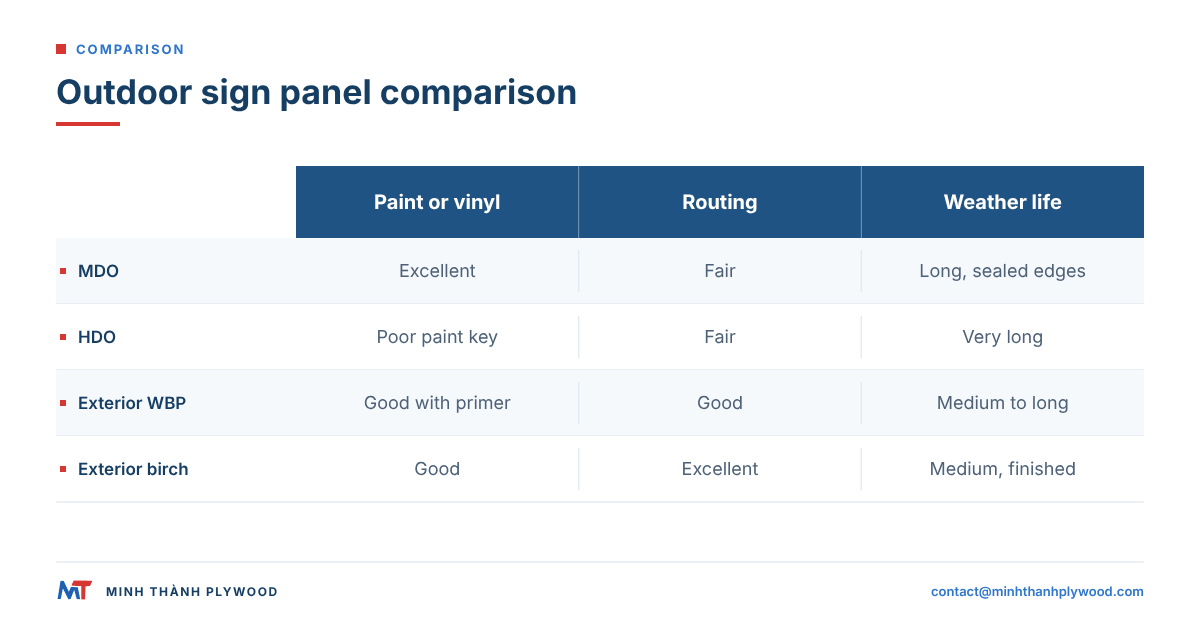
Sign board plywood comes in five common forms, and each suits a different sign. The table compares them on the points a sign maker checks.
| Panel | Face | Paint and vinyl | Routing and carving | Weather life | Cost |
|---|---|---|---|---|---|
| MDO | Resin-treated paper overlay | Excellent | Fair, the overlay chips at cuts | Long when edges are sealed | Medium to high |
| HDO | Hard, resin-rich overlay | Poor for paint, good for some films | Fair | Very long | High |
| Exterior WBP plywood | Wood veneer, C/D or better | Good with primer; grain may show | Good with a solid core | Medium to long with paint | Low to medium |
| Exterior birch plywood | Birch veneer, fine grain | Good | Excellent, clean layers | Medium with finish | Medium to high |
| Film-faced plywood | Smooth phenolic film | Good for vinyl, paint needs a key | Fair | Medium; edges need sealing | Low to medium |
HDO is built for concrete forms and is a poor choice for painted signs, because paint does not key into its hard overlay. See HDO vs MDO plywood for the full difference.
Plywood for outdoor signs: what the glue must be
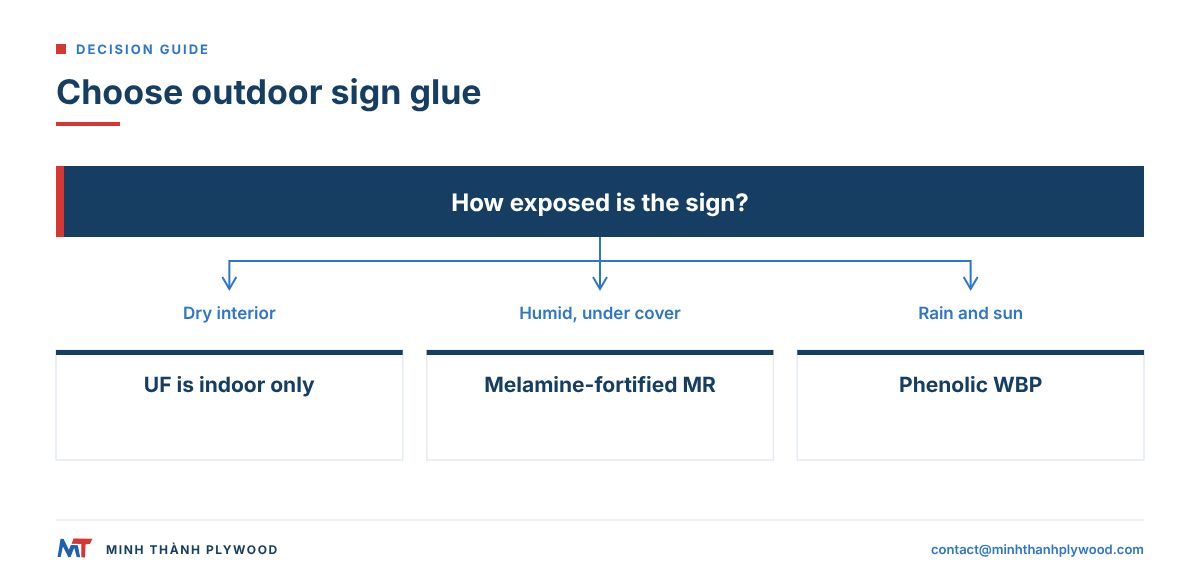
Plywood for outdoor signs must have an exterior glue line, phenolic WBP for exposed signs and at least melamine-fortified for signs under cover. The glue holds the plies together when rain, dew and sun cycle the panel every day.
| Glue | Exposure | Fit for signs? |
|---|---|---|
| UF (urea-formaldehyde) | Dry interiors | No, delaminates outdoors |
| Melamine-fortified (MR) | Humid, covered positions | Under canopies, inside shopfronts |
| Phenolic WBP | Weather, rain, sun | Yes, for exposed signs |
The bond is only part of it. A panel with a WBP bond and gaps in the core can still fail, because water collects in the voids and the face blisters. Look at the panel edge: a sign blank should show tight, continuous plies.
Ask the supplier which standard the exposure class refers to. The BSI description of BS EN 636:2012+A1:2015 covers plywood for dry, humid or exterior conditions. The glue line is then tested to BS EN 314-2:1993, which sets bonding-quality requirements. For US projects, NIST lists PS 1-22 as the current structural plywood standard.
Our exterior plywood uses water-resistant melamine-fortified or phenolic adhesive; phenolic WBP is pressed at 130–145 °C. The melamine-fortified bond is made to a 12-hour boiling requirement.
What thickness plywood for an outdoor sign?
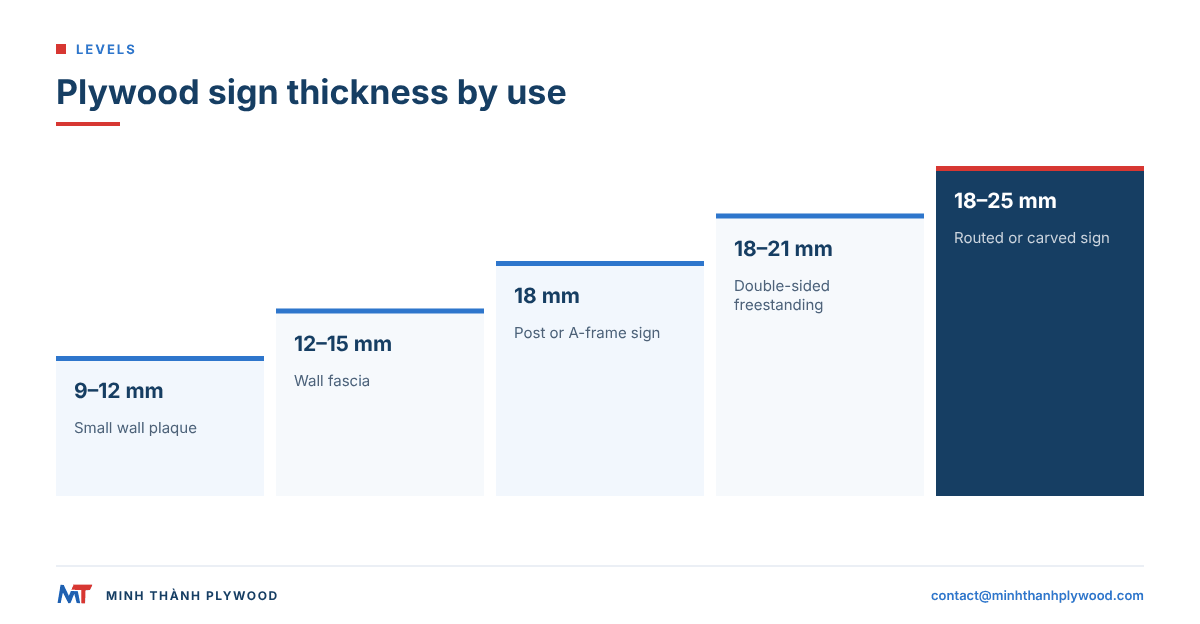
Use about 12 mm (1/2 inch) plywood for signs fixed flat to a wall and 18 mm (3/4 inch) for freestanding, post-mounted, A-frame and sandwich-board signs. Thicker panels resist wind, flex less between posts and hold fixings better.
| Sign | Thickness | Note |
|---|---|---|
| Small wall plaque, door sign | 9 to 12 mm | Fixed flat, no wind load |
| Wall-mounted fascia sign | 12 to 15 mm | Fixed to battens with an air gap |
| Post-mounted sign | 18 mm | Bolted to two posts |
| A-frame or sandwich board | 18 mm | Takes knocks and wind |
| Double-sided freestanding sign | 18 to 21 mm | Stiffness across the span |
| Routed or carved sign | 18 to 25 mm | Depth for the carve |
| Construction hoarding panel | 12 to 18 mm | Fixed to a frame |
In inches, sign shops use 1/2 in plywood for signs up to roughly 2 × 3 ft and 3/4 in for spans over 3 ft without flex, per Custom Signs Today (August 2026). These thicknesses follow sign-trade practice, such as the MDO guidance from a sign-painting publication. Large signs on posts need an engineered frame; the panel is the face, not the structure.
Exterior sign board plywood for routed and carved signs
Exterior sign board plywood for routed and carved signs needs a solid, gap-free core and thin, even plies, so the router shows clean layers and no voids. A cheap panel with core gaps shows holes in every letter.
What to specify:
- Core: gap-free, with core veneers joined so there are no open joints. Our cores are stitched both horizontally and vertically.
- Plies: more, thinner plies give clean steps in V-carved letters.
- Glue: phenolic WBP, so cut layers do not open outdoors.
- Face: birch or a good hardwood face if the carving stays natural; any sound face if it is painted.
After carving, seal the carved surfaces as carefully as the edges. Every carved letter exposes end grain and glue lines, and that is where water enters.
Birch plywood for signs and laser-cut lettering
Birch plywood is the first choice for laser-cut letters, shaped signs and fine routed detail, because its fine grain and even plies cut cleanly. For outdoor use, order it with an exterior bond and finish it on every face and edge.
Where birch plywood works on signs:
- Laser-cut letters and logos fixed to a backing board.
- Shaped hanging signs for shops, cafés and markets.
- Indoor feature signs with a clear finish over the birch face.
- Exhibition and display graphics under cover.
Our birch plywood has imported birch faces over white Styrax or Eucalyptus cores, 3–40 mm, sanded and polished, with both faces UV-ready. Birch grades are quoted as face/back pairs such as D+/D, matched to an approved sample. The bond is made to the customer’s specification, so outdoor sign blanks can be ordered with phenolic WBP.
Film-faced plywood for hoardings and temporary signs
Film-faced plywood is a cost-effective choice for construction hoardings, site signs and temporary event signs. Its smooth phenolic film takes printed vinyl and paint with the right primer, and its exterior bond handles a building season outdoors.
What to know before you specify it:
- Vinyl: printed vinyl bonds well to clean film; test the adhesive on a sample.
- Paint: the film is glossy, so it needs a light key sanding and an adhesion primer.
- Edges: film-faced panels come with sealed edges; reseal every cut.
- Reuse: hoarding panels can be reused on the next site if their edges are kept sealed.
Our film-faced plywood is 12–21 mm, with 120–135 g/m² standard film or premium film from 135 g/m², on Eucalyptus or Acacia cores, with melamine-fortified or phenolic WBP glue, ±0.5 mm thickness tolerance and 1220 × 2440 or 1250 × 2500 mm sheets.
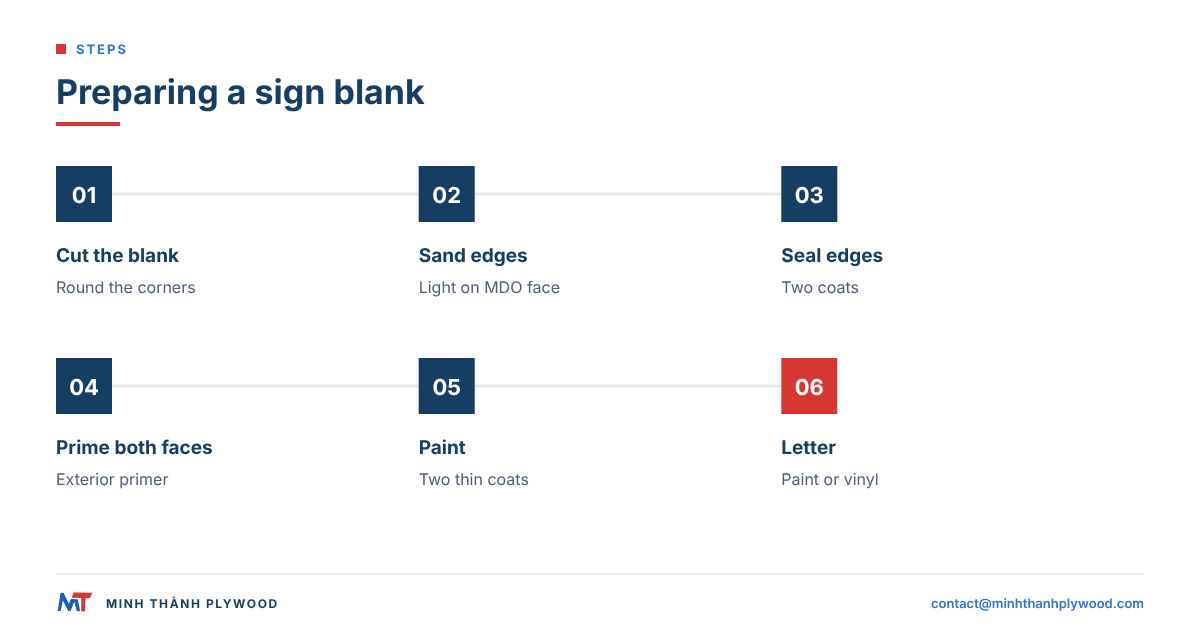
How to prepare plywood for sign painting
Prepare plywood for sign painting by sealing the edges, priming both faces and painting in thin, even coats. The full process, including drying time between coats, usually takes about three days.
- Cut the blank to size and round the edges with a 1/8 in roundover bit or a sanding block, so paint wraps them instead of bridging a sharp 90-degree edge.
- Sand the edges smooth; on MDO, sand the face only lightly to keep the overlay intact.
- Seal the edges with an exterior primer, edge sealer or thin epoxy, two coats until they stop soaking it up.
- Prime both faces with an exterior primer suited to the topcoat, including the back.
- Let the primer dry fully, then de-nib with fine abrasive.
- Apply the background colour in two thin coats of exterior paint.
- Letter or apply vinyl once the paint has cured.
- Topcoat if required with a UV-stable clear coat for printed graphics.
Paint the back as well as the face. A panel painted on one side only takes up moisture unevenly and can cup on the wall.
How to weatherproof a plywood sign
Weatherproof a plywood sign by sealing every edge, painting both faces, mounting it with an air gap and maintaining the edges. Edges and the bottom of the sign fail first, because water runs down and sits there.
| Risk | What happens | Prevention |
|---|---|---|
| Water at raw edges | Plies swell, paint lifts | Seal edges, wrap paint round them |
| Water behind the sign | Back stays wet, face blisters | Mount on battens or spacers with an air gap |
| Sun and UV | Paint chalks and fades, face checks | UV-stable paint, MDO or film face |
| Fixings | Rust stains, water along screws | Stainless fixings, sealed holes |
| Standing water on top edge | Rot at the top edge | Cap or chamfer the top edge |
| Ground contact | Wicking and rot | Keep the panel clear of soil and paving |
A painted MDO sign with sealed edges, primer, 2 to 3 thin paint coats and 2 UV-resistant topcoats lasts 5 to 10 years with annual maintenance, according to sign makers (Custom Signs Today). Plan an inspection every season. Touching up a worn edge takes minutes; replacing a delaminated sign takes a new blank and a new lettering job.
Best plywood for outdoor signs in the UAE, Singapore and hot climates
In the UAE, Saudi Arabia, Singapore and other hot or humid markets, the best plywood for outdoor signs is MDO or exterior WBP plywood, edge-sealed and finished with UV-stable paint. Heat, strong sun and humidity attack the finish and the edges faster than in temperate climates.
| Climate | Main threat | What to specify |
|---|---|---|
| Hot and dry (UAE, Saudi Arabia, Qatar) | Strong sun, heat, dust | MDO or film face, UV-stable light-coloured paint, sealed edges |
| Hot and humid (Singapore, Malaysia, Philippines) | Rain, high humidity, mould | Phenolic WBP bond, all six sides sealed, air gap behind |
| Coastal sites | Salt spray | Stainless A4 fixings, frequent edge recoating |
| Monsoon markets | Heavy rain cycles | Chamfered top edges, drip details, sealed fixings |
Dark colours get much hotter in the sun than light ones, which stresses paint and glue lines. Choose lighter backgrounds for large signs in full sun, and keep fresh plywood shaded and wrapped on site before painting.
How to mount an outdoor plywood sign
Mount an outdoor plywood sign on battens, spacers or posts so air moves behind it, and fix it with stainless steel hardware through sealed holes. A sign fixed flat against a wall stays wet at the back after every rain.
Mounting rules sign installers follow:
- Leave an air gap of 1/4 to 1/2 in behind wall signs with treated battens or plastic spacers.
- Pre-drill and seal every fixing hole with primer or epoxy before the screw goes in.
- Use stainless fixings, A4 grade near the coast, so rust does not stain the face.
- Keep the bottom edge clear of the ground, paving and splash zones.
- Bolt post-mounted signs through both posts, with washers to spread the load on the face.
- Add a top cap or drip edge on large fascia signs so water does not sit on the top edge.
Large signs need a frame designed for the local wind load. The plywood is the sign face; the frame, posts and fixings carry the wind.
Plywood sign board material: sizes and formats
Plywood sign board material comes in standard sheets of 1220 × 2440 mm (4 × 8 ft) and 1250 × 2500 mm, which suit most sign blanks with little waste. Larger signs are built from several panels on a frame.
Plan your cutting before ordering:
- Standard blanks: sign shops nest common sizes on full sheets to limit offcuts.
- Custom sizes: sizes such as 1220 × 2500 or 1220 × 2280 mm can be made to order.
- Cut-to-size: one panel cut into 4, 6 or 8 pieces saves cutting time on repeat blanks.
- Tolerance: sanded furniture panels hold ±0.2–0.3 mm on thickness; commercial and exterior panels ±0.5 mm; length and width ±2 mm.
For repeat programmes, such as franchise shopfronts or real estate signs, cut-to-size blanks keep every sign the same. See our cut-to-size plywood page.
MDO sign board alternatives when MDO is not available
When an MDO sign board is not available, use exterior WBP plywood with a good face, fill and sand it, and prime it well. The result is close to MDO for painted signs, with more preparation work.
A practical substitute route:
- Choose a sound face with few knots and patches.
- Fill open defects with an exterior filler.
- Sand smooth and remove dust.
- Apply a high-build exterior primer in two coats, sanding between them.
- Paint as for MDO.
Plywood vs aluminium composite, Alumalite and aluminium for outdoor signs
Sign shops weigh plywood against metal-faced and plastic substrates on price, life and look. The figures below are what working sign makers report on the Signs101 forum and what Custom Signs Today publishes (checked on 21 October 2026).
| Substrate | Cost cue | Life cue | Fits |
|---|---|---|---|
| MDO plywood, painted | Over US$60 for a 1/2 in one-sided primed sheet | 5 to 10 years with maintenance; painted or cut-vinyl signs reported at 10 years | Carved, routed and painted signs, post-mounted panels |
| Ready one-sided composite board (Be Bond type) | Under US$40 per sheet | Not stated | Flat vinyl graphics on walls |
| Dibond / aluminium composite (ACM) | Priced by the shop | Cheap grades rated about 4 years outdoors | Printed panels, flat wall signs |
| Alumalite (corrugated plastic with aluminium skins) | Priced by the shop | Used by shops for most exterior signs | Light panels, large flat faces |
| Aluminium sheet, .040 to .063 in | Priced by the shop | No rot; some shops prefer a .063 pan face to MDO or Dibond for simple rectangles | Simple rectangles on walls |
Plywood gives what the metal and plastic substrates do not: depth for a carve, a wood edge and a warm look, and it can be re-routed and repainted. Printed vinyl lasts about 5 years on any substrate, so a sign that needs a plain printed face for a short life can go on a composite board; a sign that must be carved, painted and kept for a decade belongs on MDO.
Film-faced plywood is another route for vinyl graphics. For hand-lettered signs, the film is too glossy without a key, so MDO or primed exterior plywood is better.
What this means for your order
For a sign shop, sign maker or distributor buying by the container, write the sign use, the face, the bond and the size on separate lines. That lets the mill match the panel to the sign instead of quoting a general exterior board.
Minh Thanh Plywood supplies:
- Exterior plywood with C/D utility faces, phenolic WBP or melamine-fortified glue, 3–40 mm, for painted signs, hoardings and backing boards.
- Birch-faced plywood with the bond to your specification, for routed, carved and laser-cut signs.
- Film-faced plywood for hoardings and vinyl graphics.
- Stitched cores, pressed twice for furniture-grade panels, so routed edges show tight plies.
- Order terms: MOQ one 40HC with mixed specifications by agreement, production 15–45 days after deposit, FOB Hai Phong, CFR or CIF, free samples.
- Product and test records are on our quality page.
Read our industrial plywood guide for other outdoor and technical uses, or our guide to LVL scaffold boards for site timber.
Send a sign board specification
A typical line: “Exterior plywood for painted outdoor signs, 18 mm, phenolic WBP glue, face sanded, Eucalyptus core, 1220 × 2440 mm, plus 12 mm in the same spec, one 40HC, CIF Dubai.” Send it through the contact page or to contact@minhthanhplywood.com; we reply within hours.
Buyer questions, answered
What is the best plywood for outdoor signs?
MDO (medium density overlay) plywood is the best for most painted and vinyl outdoor signs: its resin-treated paper face is smooth, holds paint well and hides the wood grain. Use exterior-glue plywood in every case.
What thickness plywood for an outdoor sign?
Use about 12 mm (1/2 inch) for signs fixed flat to a wall and 18 mm (3/4 inch) for freestanding signs, A-frames, post-mounted and double-sided signs that face wind.
Can I use regular plywood for an outdoor sign?
Only for short-lived signs. Interior plywood uses UF glue that weakens when wet, and its plies separate outdoors. Choose exterior plywood with a phenolic WBP bond and seal all edges.
How do you weatherproof a plywood sign?
Seal every edge with primer or epoxy, prime both faces with an exterior primer, then apply two coats of exterior paint or a clear exterior finish, and recoat the edges whenever the paint wears.
What is MDO plywood used for?
MDO is used for outdoor signs, billboards, highway signage, painted fascias and concrete forms that need a smooth finish. The overlay gives a paint-ready face that does not show grain through the paint.
Is MDO better than HDO for signs?
For painted signs, yes: MDO is made to take paint. HDO has a harder, more resin-rich overlay built for repeated concrete pours, and paint bonds less readily to it.
What plywood is best for routed or carved signs?
A plywood with a solid, gap-free core and thin, even plies, such as exterior birch or a stitched hardwood core, so the router cut shows clean layers without voids.
How long does a plywood sign last outdoors?
Several years with a sealed, painted MDO or exterior panel, and much longer if edges and paint are maintained. An unsealed edge is where most outdoor signs fail first.
What is the best plywood for outdoor signs in the UAE or Singapore?
In hot, sunny or humid climates choose exterior WBP-bonded plywood or MDO, seal all edges, use a UV-stable exterior paint, and mount signs with an air gap behind them so they dry out.
Does Minh Thanh make MDO plywood?
Minh Thanh Plywood supplies exterior plywood with phenolic WBP or melamine-fortified glue, birch-faced panels and smooth film-faced plywood. Send the sign type and finish, and we quote the matching panel.