
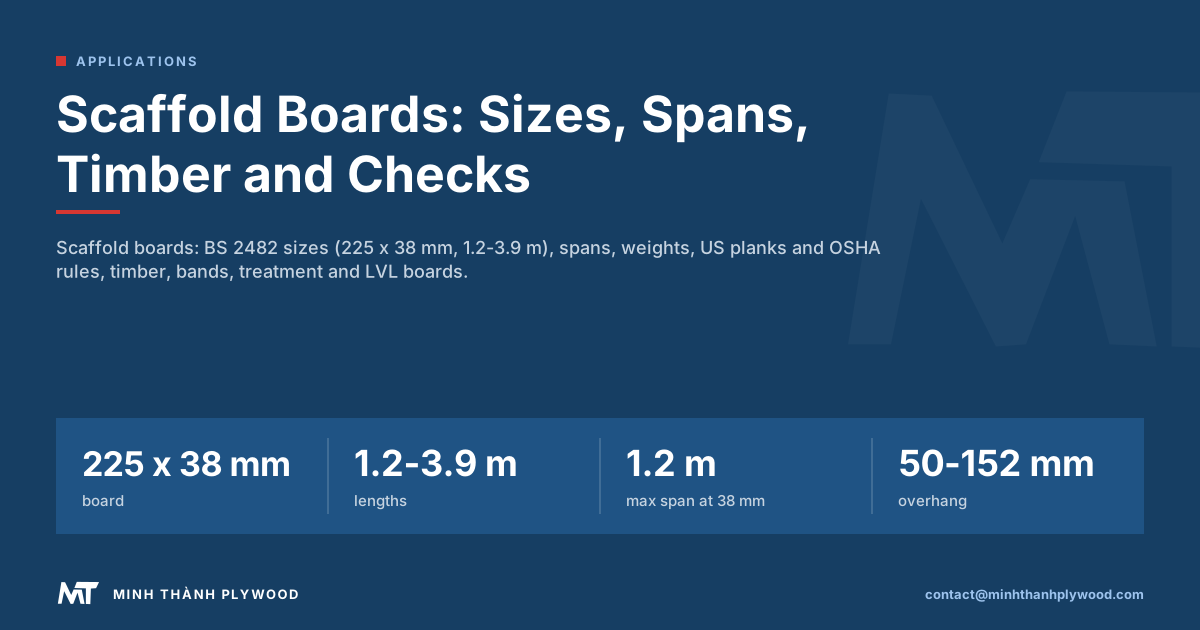
Standard scaffold boards in the UK are 225 mm wide and 38 mm thick, in lengths from 1.2 m to 3.9 m (4 to 13 ft), made from strength-graded softwood to BS 2482. A 38 mm board spans at most 1.2 m between supports; the thicker 63 mm board spans further. In the US the equivalent is a 2x10 or 2x12 plank under OSHA rules. Minh Thanh Plywood explains the sizes, checks and the LVL alternative.
What size are scaffold boards?
The standard scaffold board is 225 mm wide and 38 mm thick, in lengths from 1.2 m to 3.9 m (4 to 13 ft). That is the board specified by BS 2482, the British Standard for timber scaffold boards, and it is the size most of Europe, the Middle East and Commonwealth countries build with.
The non-mandatory OSHA Appendix A to 1926 Subpart L lists solid-sawn plank spans of 10, 8 and 6 ft for full-thickness lumber at 25, 50 and 75 psf, respectively. OSHA 1926.451(a)(1) generally requires each scaffold and component to support its own weight and at least four times the maximum intended load. The USDA Forest Service Wood Handbook, FPL-GTR-190 (2010) covers wood strength, moisture and fastenings; it does not assign a scaffold plank grade.
| Scaffold board dimensions | UK board (BS 2482) | US plank (2x10) | US plank (2x12) |
|---|---|---|---|
| Width | 225 mm | 9.25 in (235 mm) | 11.25 in (286 mm) |
| Thickness | 38 mm (also 63 mm) | 1.5 in (38 mm) dressed, 2 in full-thickness | 1.5 in (38 mm) dressed, 2 in full-thickness |
| Common lengths | 1.2-3.9 m (4-13 ft) | 8-16 ft | 8-16 ft |
| Rules | BS 2482, NASC TG20 | OSHA 29 CFR 1926.451 | OSHA 29 CFR 1926.451 |
The scaffold board width of 225 mm is fixed so that boards butt side by side on a standard tube scaffold: five boards make a working platform of 1,125 mm, which matches the common five-board lift.
How long are scaffold boards?
Scaffold boards are cut to lengths that match the bay sizes of tube and fitting scaffolds. The stock lengths in the UK, with their approximate dry weights for a 225 x 38 mm board at 500 kg/m³:
| Length | In feet | Weight (dry, approx.) |
|---|---|---|
| 1.2 m | 4 ft | 5.1 kg |
| 1.5 m | 5 ft | 6.4 kg |
| 1.8 m | 6 ft | 7.7 kg |
| 2.1 m | 7 ft | 9.0 kg |
| 2.4 m | 8 ft | 10.3 kg |
| 3.0 m | 10 ft | 12.8 kg |
| 3.6 m | 12 ft | 15.4 kg |
| 3.9 m | 13 ft | 16.7 kg |
Weight is width x thickness x length x density: 0.225 x 0.038 x 3.9 m x 500 kg/m³ = 16.7 kg. A board that has stood in the rain carries much more water and can weigh noticeably more, which matters for manual handling on site.
The 3.9 m (13 ft) board is the longest standard length; longer platforms are built by overlapping or butting boards over extra supports.
Scaffold board prices in the UK
UK merchants price new boards by length and material. These are retail prices excluding VAT at a large online scaffolding supplier in October 2026; trade accounts and pallet quantities are lower.
| Board | Whitewood to BS 2482 | Galvanised steel |
|---|---|---|
| 3 ft (0.9 m) | £3.81 | not listed |
| 4 ft (1.2 m) | £7.06 | not listed |
| 8 ft (2.4 m) | £9.31 | £12.84 |
| 10 ft (3.0 m) | £11.06 | £15.96 |
| 13 ft (3.9 m) | £14.50 | £20.77 |
| Pack of 100, 13 ft | £1,450 | not listed |
Another UK supplier lists a new 10 ft board at £13.43 ex VAT, sold as UK-made European whitewood with the BS 2482 Kitemark and end hoop irons. Flame-retardant Euro Class B boards, used on sites with fire-safety rules, are priced on request, and composite boards are also sold in 3.9 m lengths. Reclaimed 225 × 38 mm boards sold for furniture and shelving are a separate market and are not for scaffold use.
What the price list means for a trade buyer: a Kitemarked whitewood board is the benchmark for access scaffolds, so any other board is judged against its strength grade, its marking and its price per metre. Minh Thanh does not sell timber scaffold boards; we supply LVL and plywood for the decks, hatch panels and edge boards below, quoted FOB Hai Phong by the container, so the landed price per square metre of deck can be set beside the whitewood price per board.
How far can a scaffold board span?
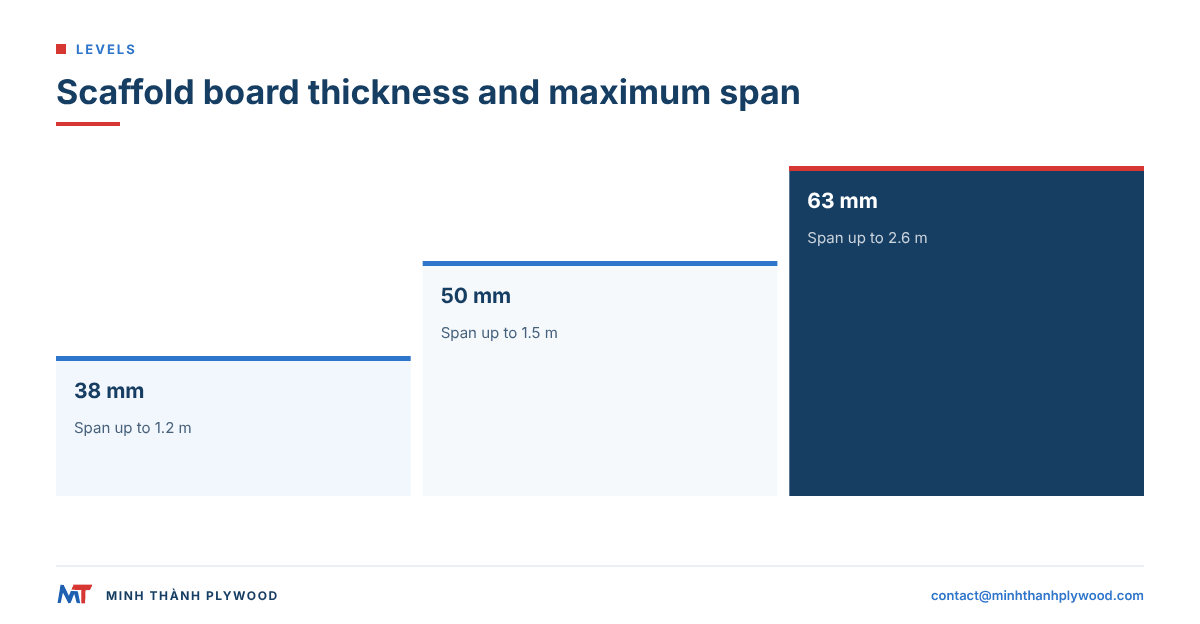
A 38 mm scaffold board spans no more than 1.2 m between supports. Thicker boards span further, which is why bay widths and board thickness are chosen together.
| Board thickness | Maximum span between supports | Typical use |
|---|---|---|
| 38 mm | 1.2 m (1.5 m for the machine-graded 1.5 m grade) | Standard access and working scaffolds |
| 63 mm | 2.5 m | Long spans, heavy-duty platforms |
The span is the clear distance between the transoms (or putlogs) the board rests on. A board laid over a longer span bends more and can break under a concentrated load, so the maximum span is stamped on BS 2482 boards.
What wood are scaffold boards made from?
Scaffold boards are made from strength-graded softwood. In the UK and Europe that means European whitewood (spruce) or redwood (Scots pine); in North America, southern yellow pine and Douglas fir.
Strength grading is what separates a scaffold board from a builder’s plank. Each board is graded either by machine (a stress-grading machine bends it and measures its stiffness) or visually by a trained grader who checks knots, slope of grain, splits and wane. BS 2482 boards carry an “M” or “V” mark for the method used.
Engineered boards are the other option. LVL (laminated veneer lumber) planks are made by gluing many thin veneers with the grain running the same way, which spreads knots and defects through the board instead of concentrating them. The result is a plank with more predictable strength and less splitting; see our LVL scaffold boards guide for grades and load ratings.
Are scaffold boards treated?
Most new timber scaffold boards are supplied untreated. Boards are inspected before each use and replaced when damaged, so the industry relies on grading and inspection rather than preservative to keep them safe.
Treated boards exist for specific needs:
- Preservative-treated boards for long-term or permanent scaffolds in wet conditions.
- Fire-retardant-treated boards where a site, such as a refinery or a public building, demands reduced flame spread.
Treatment can change the board’s weight and, with some chemicals, its strength class, so buy treated boards graded and marked after treatment. Boards painted all over are a warning sign: paint can hide splits, rot and grade marks.
Banded or unbanded scaffolding boards?
Choose banded boards for scaffolding. A galvanised steel band, nailed across each end, stops a split from opening along the board when it is dropped or loaded at the end.
Unbanded boards are cheaper and are sold for decking, staging and joinery, but on a scaffold an unbanded end can split under the next heavy drop. Check the bands at every inspection: a loose, rusted through or missing band means the board is repaired or retired.
How do you choose and check scaffold boards, step by step?
Follow the same sequence for every delivery and every lift:
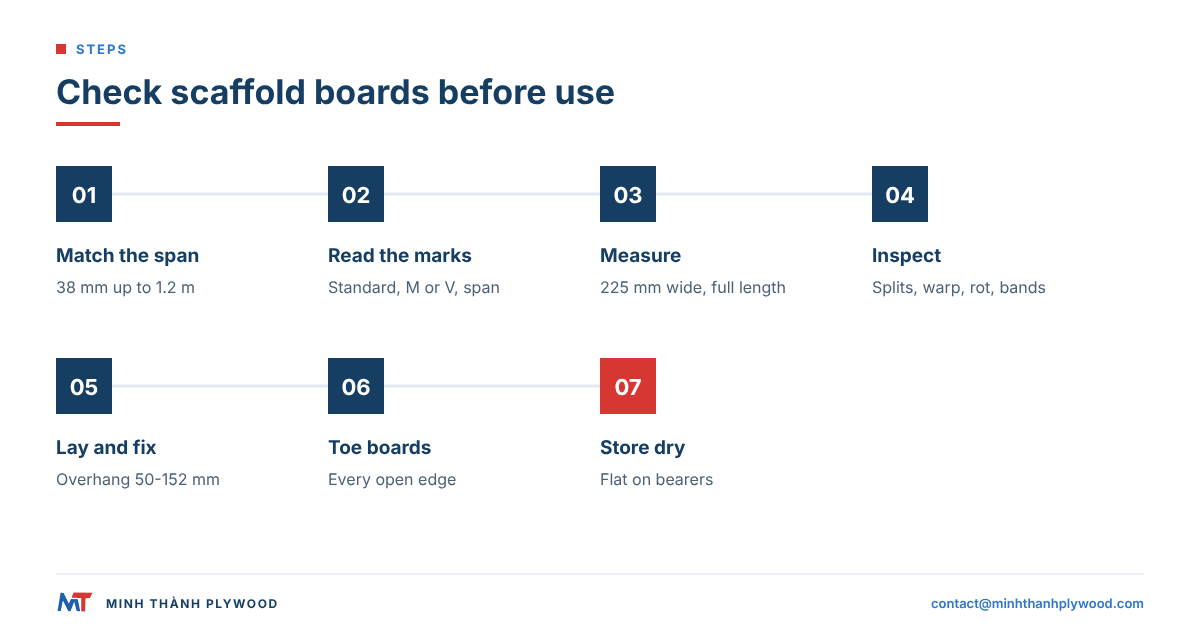
- Match the board to the span. 38 mm boards for bays up to 1.2 m (1.5 m for the machine-graded 1.5 m grade); 63 mm boards for longer spans.
- Read the marks. A BS 2482 board shows the standard number, the supplier’s identification, the grading method (M or V) and the maximum span.
- Measure. Width 225 mm, thickness to the stated size, length to the order. Boards sawn short after damage do not reach two supports with the right overhang.
- Inspect each board. Reject boards with splits beyond the band, warping or twist, large knots on the edge, rot, fungal growth, burns, chemical or paint contamination, or a missing band.
- Lay and fix. No span between supports exceeds the board’s marked maximum, and long boards rest on at least three supports; ends overhang the support by at least 50 mm and no more than four times the thickness (50-152 mm for a 38 mm board).
- Add toe boards and guardrails on every working platform edge.
- Store off the ground, flat on bearers and under cover, so boards stay dry and straight.
Under the US rule, each plank end extends at least 6 in (15 cm) past the centreline of its support and no more than 12 in (30 cm) for planks 10 ft or shorter, as set out in OSHA 29 CFR 1926.451.
How many scaffold boards do you need for a platform?
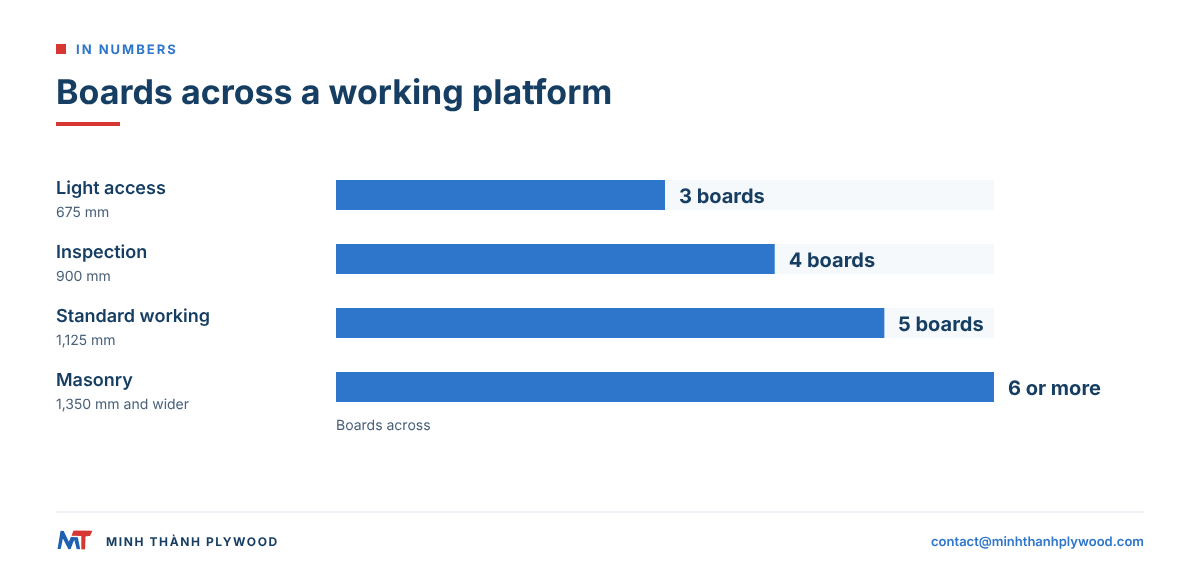
Count boards by platform width and bay length. A standard working platform is five 225 mm boards wide, which gives 1,125 mm of deck; a lighter access platform may be three or four boards, and a heavy-duty platform for masonry is often wider.
| Platform | Boards across | Deck width |
|---|---|---|
| Light access | 3 | 675 mm |
| Inspection and light work | 4 | 900 mm |
| Standard working platform | 5 | 1,125 mm |
| Masonry and heavy duty | 6 or more | 1,350 mm and wider |
Along the scaffold, each board needs a support under both ends, an overhang of 50-152 mm and no span over 1.2 m for 38 mm boards. A 3.9 m board, for example, covers three 1.2 m spans (3.6 m) with 150 mm of overhang at each end. Boards per run are the boards across the platform times the board lengths needed along it.
Add toe boards for every open edge of every working lift, and keep spare boards on site: a board found damaged at the morning inspection must be replaced before work starts.
What are toe boards and sole boards?
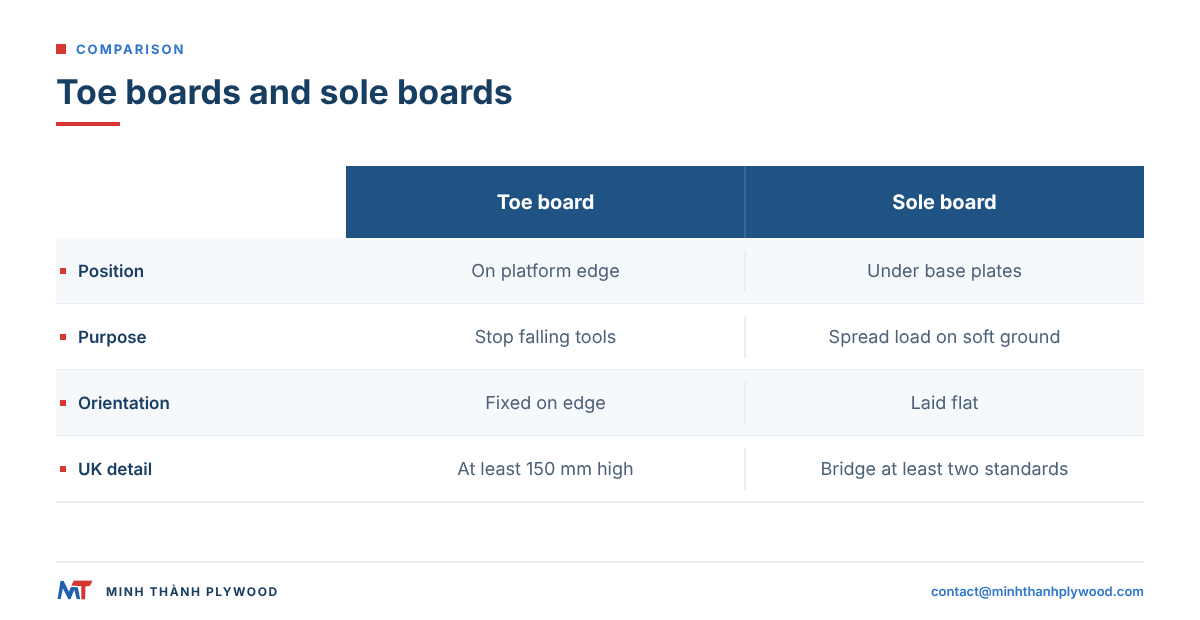
A toe board is a board fixed on edge along the outside of a working platform to stop tools and materials falling off. A sole board is a board laid flat under the base plates of the scaffold to spread the load into soft ground.
- Toe boards are usually cut from standard scaffold boards and stand at least 150 mm high in UK practice; OSHA requires toeboards at least 3.5 in (9 cm) high where they are used.
- Sole boards sit under the base plates on soil, grass or tarmac, long enough to bridge at least two standards so one soft spot does not sink a single leg.
Retired scaffold boards are often cut down as sole boards, but they still need to be sound: a rotten sole board defeats its purpose.
What load can a scaffold plank carry under OSHA?
OSHA sets the maximum span of solid sawn wood planks by the load the platform must carry, in pounds per square foot (psf). The table in Appendix A to Subpart L gives:
| Intended load | Full-thickness undressed lumber | Nominal-thickness lumber |
|---|---|---|
| 25 psf (light duty) | 10 ft | 8 ft |
| 50 psf (medium duty) | 8 ft | 6 ft |
| 75 psf (heavy duty) | 6 ft | Not listed |
These spans apply to scaffold-grade solid sawn planks. LVL planks carry their maker’s load ratings instead, proof-tested and stamped on the plank.
Are used and reclaimed scaffold boards safe?
Used boards are safe on a scaffold only if they pass the same inspection as new boards. Hire firms grade returned boards, repair bands and cut out damaged ends; a board cut shorter than its marked length goes back into a shorter length class.
Reclaimed scaffold boards sold for furniture, shelving and flooring are boards that have left scaffold use for good. They make attractive rustic timber, but they should never go back onto a scaffold, and boards from industrial sites can carry paint, oil or chemical contamination that needs cleaning before indoor use.
When do LVL boards beat timber scaffold boards?
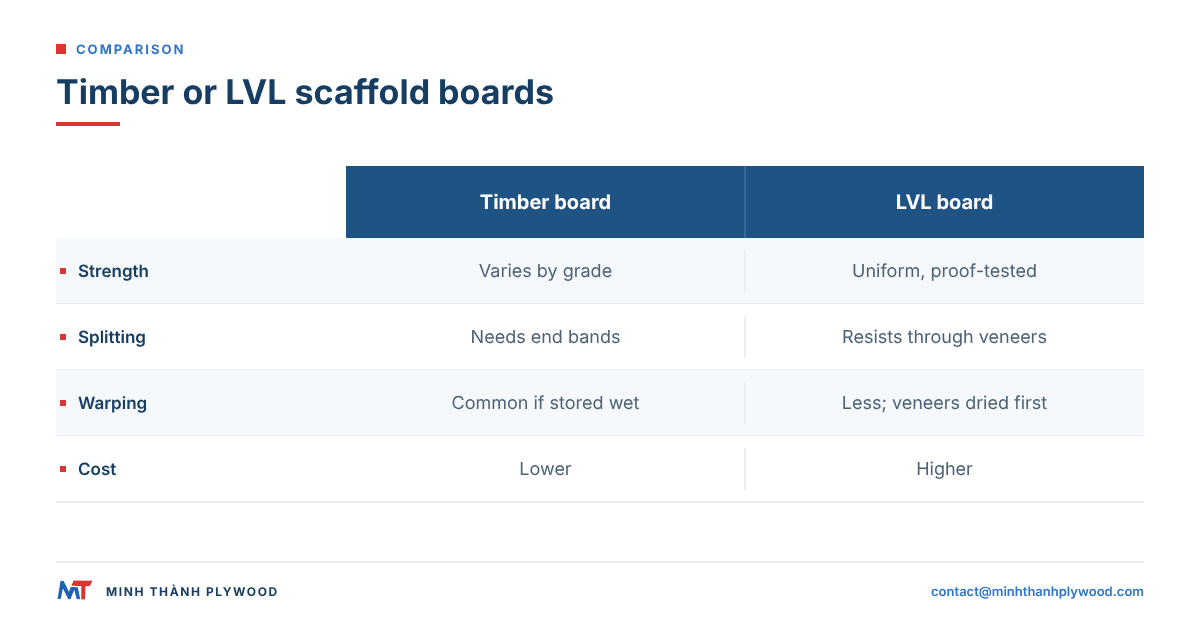
LVL boards win when strength must be predictable and boards must last. Because an LVL plank is built from many thin veneers, a knot or a split in one veneer is backed by the layers around it; the board does not fail at one hidden defect the way a sawn board can.
| Factor | Timber scaffold board | LVL scaffold board |
|---|---|---|
| Strength consistency | Varies by grade and by board | Uniform, proof-tested |
| Splitting | Needs end bands | Resists splitting through the veneers |
| Warping and twist | Common in wet storage | Less, because the veneers are dried before laminating |
| Cost per board | Lower | Higher |
| Repair | Cut down to shorter lengths | Cut down to shorter lengths |
Timber boards remain the cost-effective choice for general access scaffolds with daily inspection. LVL suits rental fleets, heavy-duty platforms and markets that specify OSHA-rated planks.
Where does plywood fit in scaffold boarding?
In scaffold boarding, plywood is used as platform decking, hatch and trap-door panels, edge protection boards and hoarding, rather than as individual scaffold boards.
- Anti-slip plywood, with a textured film face, makes walkway and platform decks that stay safer when wet. Minh Thanh makes anti-slip plywood on order.
- Exterior plywood glued with melamine-fortified or phenolic (WBP) glue serves for hoarding and temporary covers.
- Film-faced plywood with ±0.5 mm thickness tolerance is used for decks that are cleaned and reused.
Our guides to plywood for stages and platforms and industrial plywood cover slip ratings and deck thicknesses.
What should you send to get a quote for LVL boards or deck plywood?
Send the use, the size and the load, and the mill can quote the right section. A specification for scaffold LVL or platform plywood covers:
- Use: scaffold plank, toe board, sole board, platform deck or hatch.
- Section and length: for example 225 x 38 mm in 3.9 m, or a full 1220 x 2440 mm deck panel and its thickness.
- Load class or span the board must meet.
- Glue: phenolic (WBP) or melamine-fortified for outdoor use.
- Surface: plain, film-faced or anti-slip.
- Quantity and packing: from one 40HC container, with mixed specifications by agreement.
LVL (laminated veneer lumber) is available from Minh Thanh, and anti-slip plywood is made on order. Production takes 15-45 days after the 30% deposit, FOB Hai Phong, CFR or CIF. Send your section, length and load to contact@minhthanhplywood.com, and the reply comes within hours.
Buyer questions, answered
What size are scaffold boards?
The standard UK scaffold board is 225 mm wide and 38 mm thick, made to BS 2482, in lengths from 1.2 m to 3.9 m (4 to 13 ft). The heavier 63 mm thick board is made for longer spans.
How long are scaffold boards?
UK boards come in 1.2, 1.5, 1.8, 2.1, 2.4, 3.0, 3.6 and 3.9 m lengths, which match 4, 5, 6, 7, 8, 10, 12 and 13 ft. The 3.9 m (13 ft) board is the longest standard length.
What wood are scaffold boards made from?
Strength-graded softwood: European whitewood (spruce) or redwood (Scots pine) in the UK and Europe, and southern yellow pine or Douglas fir planks in North America. Engineered LVL planks are the main alternative to sawn timber.
Are scaffold boards treated?
Most new timber scaffold boards are supplied untreated, because the boards are inspected and replaced rather than kept for decades. Treated boards, with preservative or fire retardant, are ordered where the site or contract asks for them.
How far can a 38 mm scaffold board span?
A 38 mm BS 2482 board spans at most 1.2 m between supports, or 1.5 m for the machine-graded 1.5 m grade; a 63 mm board spans up to 2.5 m. BS 2482 does not cover 50 mm boards.
How much does a scaffold board weigh?
A dry 3.9 m board of 225 x 38 mm weighs about 16.7 kg at 500 kg/m³; a 2.4 m board about 10.3 kg. Wet boards weigh noticeably more.
What are the metal bands on scaffold board ends for?
The galvanised steel bands nailed across each end stop splits from running along the board. A board with a missing or loose band should be repaired or taken out of use.
How far should a scaffold board overhang its support?
In the UK, at least 50 mm and no more than four times the board thickness, so 50-152 mm for a 38 mm board. Under OSHA, at least 6 in past the centre of the support and, for planks up to 10 ft, no more than 12 in.
Can old scaffold boards be reused on a scaffold?
Only if they still pass inspection. Boards that are split, warped, rotten, contaminated or cut short are retired from scaffold use for good; reclaimed boards sold for furniture and decor are not scaffold boards any more.
Are LVL scaffold planks better than timber boards?
LVL planks are more consistent in strength and less prone to splitting and warping, because the timber's defects are spread across many thin veneers. Timber boards are cheaper and easier to cut and replace.
Does Minh Thanh supply scaffold boards?
Minh Thanh supplies LVL (laminated veneer lumber) and makes plywood, including anti-slip plywood on order for platform decks. Send your length, section and load requirements and we quote the LVL or plywood that fits.