
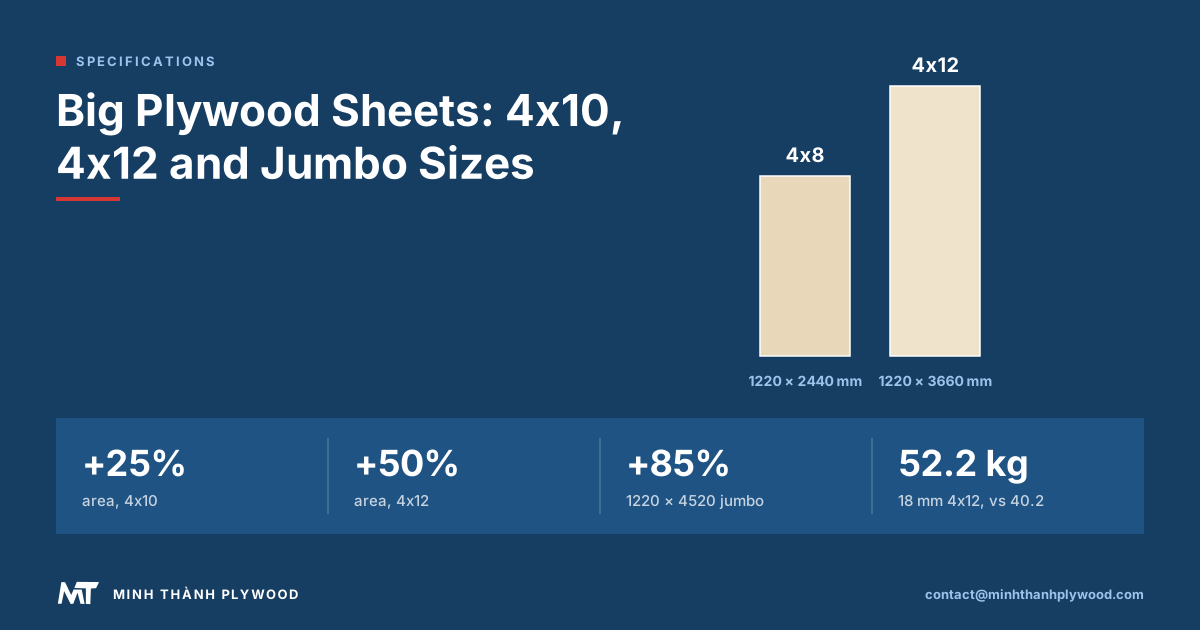
Big plywood sheets go beyond the standard 8x4 (1220 × 2440 mm): 4x10 (1220 × 3050 mm), 4x12 (1220 × 3660 mm), 5x10 (1525 × 3050 mm) and scarf-jointed jumbo panels such as 1220 × 4520 mm. They save joints on long or wide parts and cost more to make, ship and handle. This guide from Minh Thanh Plywood, a Vietnamese manufacturer, sets out the sizes, how they are made, their weight and when a standard sheet does the job better.
How big are plywood sheets?
Most plywood sheets are 4 ft × 8 ft, made as 1220 × 2440 mm in export mills, with 1250 × 2500 mm common in continental Europe. Big plywood sheets start where those stop: 10 ft and 12 ft lengths, 5 ft widths and scarf-jointed jumbo lengths. Sizes in feet convert at exactly 25.4 mm to the inch (NIST).
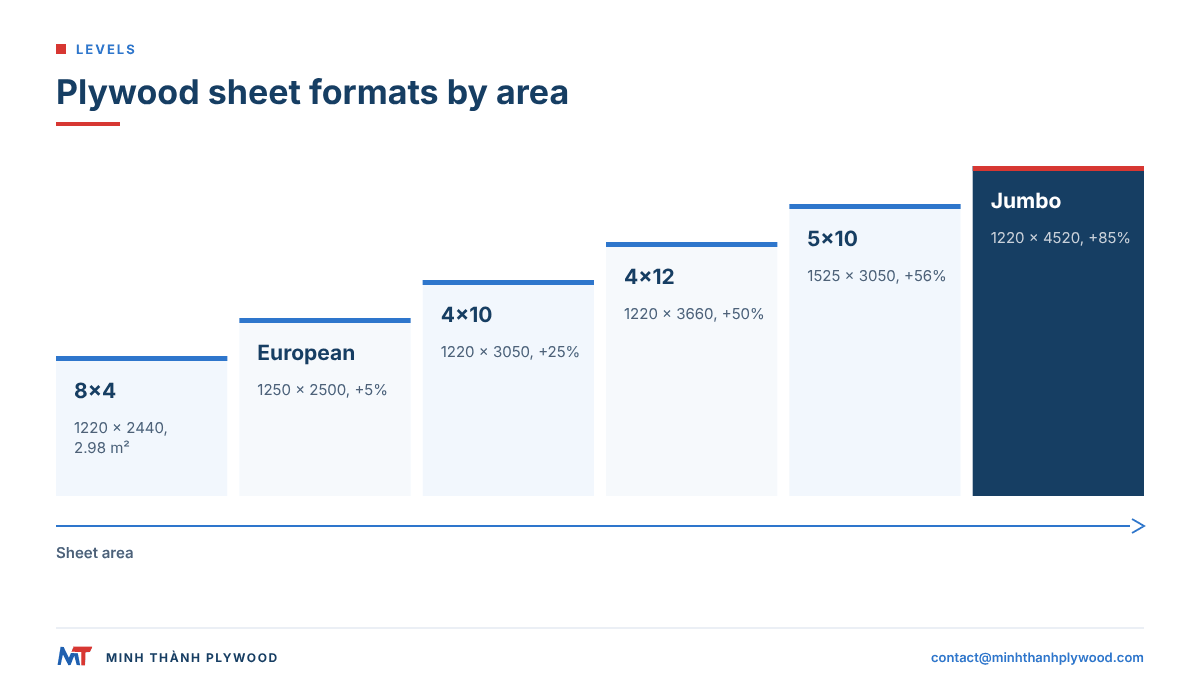
| Format | mm | feet / inches | Area | Area vs 8x4 |
|---|---|---|---|---|
| 8x4 (standard) | 1220 × 2440 | 4 × 8 ft (48 × 96 in) | 2.98 m² | — |
| European | 1250 × 2500 | 49.21 × 98.43 in | 3.13 m² | +5% |
| 4x10 | 1220 × 3050 | 4 × 10 ft (48 × 120 in) | 3.72 m² | +25% |
| 4x12 | 1220 × 3660 | 4 × 12 ft (48 × 144 in) | 4.47 m² | +50% |
| 5x10 | 1525 × 3050 | 5 × 10 ft (60 × 120 in) | 4.65 m² | +56% |
| Jumbo, scarf-jointed | 1220 × 4520 | about 4 × 14.8 ft | 5.51 m² | +85% |
The first two formats are what nearly every mill presses. The rest are specialty sizes, made by fewer mills and stocked by fewer merchants.
What is the largest sheet of plywood?
The largest sheet of plywood pressed in one piece in regular trade is around 1525 × 3050 mm (5x10) or 1220 × 3660 mm (4x12). Panels longer than a press can take are made by scarf-jointing sheets end to end, such as 1220 × 4520 mm jumbo panels.
Scarf-jointed panels can run longer still for trailer floors, boat building and long formwork. Their length is set by the jointing line, the truck and the container, not by the press. For most buyers, the practical limits are handling and transport: a 4.5 m panel of 18 mm weighs about 50–65 kg and needs long forks and support along its whole length.
Large plywood sheets: how are they made?
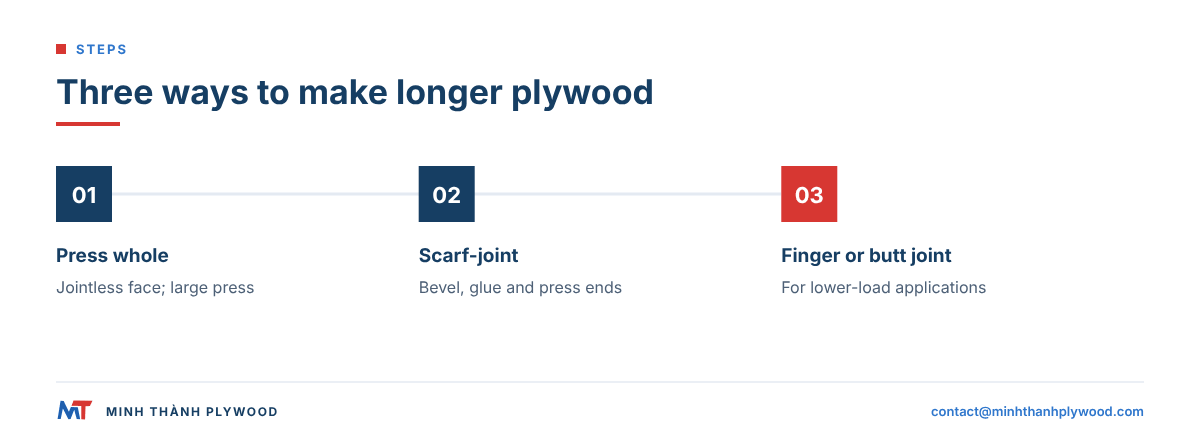
Large plywood sheets are made in one of three ways, and the method decides the price, the look and the strength along the joint.
- Pressed whole. The mill lays up veneers longer or wider than 8x4 and presses the sheet in one piece. This needs long veneer, wide dryers and a large press. It gives a jointless face and is how 4x10, 4x12 and 5x10 birch sheets are made.
- Scarf-jointed. Standard sheets are cut with long, matching bevels at the ends, glued and pressed together. The joint is as thick as the panel and nearly as strong. Jumbo panels and long vehicle floors are made this way.
- Finger-jointed or butt-jointed with splines. Cheaper joints used on some formwork and packing panels. They are fine where the joint carries little load.
Ask which method a quote uses. A scarf joint shows as a fine line across the face, so for visible furniture a pressed-whole sheet is the only jointless option.
4x10 plywood and 10 foot plywood
4x10 plywood is a 1220 × 3050 mm sheet, 4 ft × 10 ft. It is the most common 10 foot plywood, with 25% more area than an 8x4.
It is used where 8 ft runs short:
- Wall sheathing and lining for 10 ft ceilings, so one sheet covers floor to ceiling with no horizontal joint.
- Truck and trailer side walls and floors cut to body length.
- Shop fitting and display walls with tall panels and no cross joints.
- Formwork for taller concrete lifts.
The same sheet is sold as 10 x 4 plywood or 3050 × 1220 mm in markets that write the length first. If grain direction matters for your part, say “face grain along the 3050 mm length” on the order.
Which large sizes does each market use?
Each market has its own step up from the standard sheet, so “large” means a different size in Sydney, Chicago or Milan. Match the size to the market’s framing and machinery, not to the largest sheet on offer.
| Market | Standard sheet | Common longer sheets |
|---|---|---|
| North America | 4 × 8 ft (1219 × 2438 mm) | 4 × 9 ft, 4 × 10 ft, 4 × 12 ft |
| Australia and New Zealand | 1200 × 2400 mm | 1200 × 2700 mm, 1200 × 3000 mm |
| United Kingdom | 2440 × 1220 mm (8x4) | 3050 × 1220 mm (10x4) and 3050 × 1525 mm (10x5) from wholesalers |
| Continental Europe | 1250 × 2500 mm | 1250 × 3000 mm in some ranges; 1525 × 3050 mm birch |
| Asia, Middle East, Africa | 1220 × 2440 mm | 1220 × 3050 mm on order |
The longer sheets follow wall heights: 9 ft and 10 ft ceilings in North America, 2.7 m and 3.0 m ceilings in Australia. A wall lined with one sheet from floor to ceiling needs no horizontal joint and no extra framing behind it. Our guide to plywood sizes in Australia and New Zealand covers that market in detail.
4x12 plywood and 12 foot sheets
4x12 plywood is a 1220 × 3660 mm sheet, 4 ft × 12 ft, with 50% more area than an 8x4. It is rarer than 4x10 and is sold mainly for 12 ft walls, long benches and vehicle bodies.
A 4x12 sheet of 18 mm plywood weighs about 40.2 kg at 500 kg/m³ and about 52.2 kg at 650 kg/m³. That is beyond what one person can carry safely, so sites using 4x12 need two people or a lifter for every sheet. Order it where the saved joint matters more than the handling.
How much does a big plywood sheet weigh?
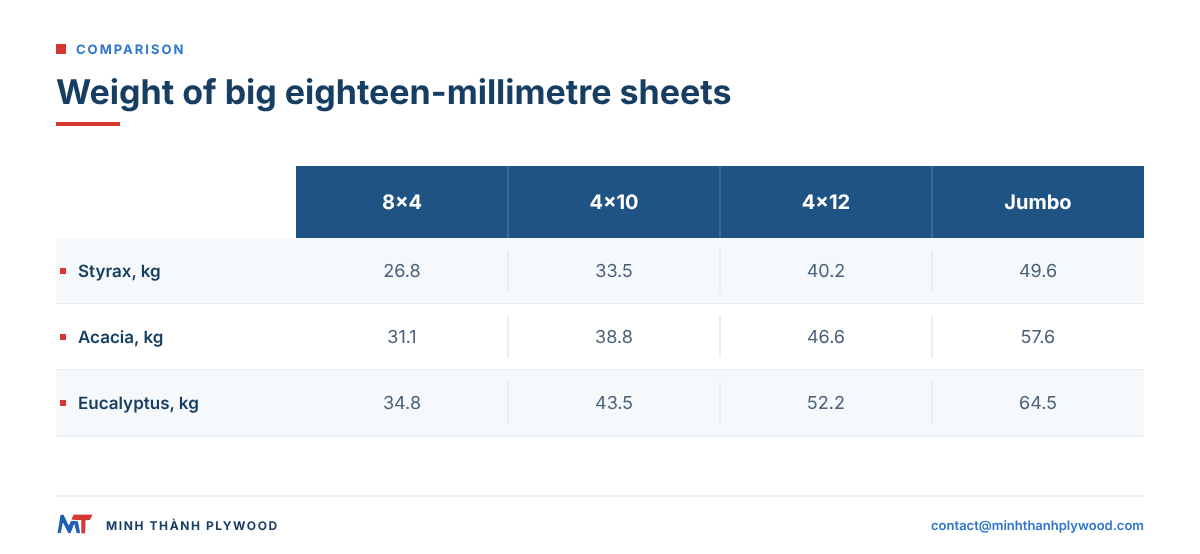
A big plywood sheet weighs its volume times the density, so weight rises with both size and core. The table gives 18 mm sheets at the reference densities of Styrax (500 kg/m³), acacia (580 kg/m³) and eucalyptus (650 kg/m³) cores.
| Format, 18 mm | Volume | 500 kg/m³ | 580 kg/m³ | 650 kg/m³ |
|---|---|---|---|---|
| 1220 × 2440 mm | 0.0536 m³ | 26.8 kg | 31.1 kg | 34.8 kg |
| 1220 × 3050 mm | 0.0670 m³ | 33.5 kg | 38.8 kg | 43.5 kg |
| 1220 × 3660 mm | 0.0804 m³ | 40.2 kg | 46.6 kg | 52.2 kg |
| 1220 × 4520 mm | 0.0993 m³ | 49.6 kg | 57.6 kg | 64.5 kg |
For a big sheet, a light core matters more than for a standard one. A Styrax-core 4x12 weighs less than a eucalyptus-core 4x10, 40.2 kg against 43.5 kg at 18 mm, and many European furniture buyers choose Styrax for its light weight and pale, even core.
When are big plywood sheets worth ordering?
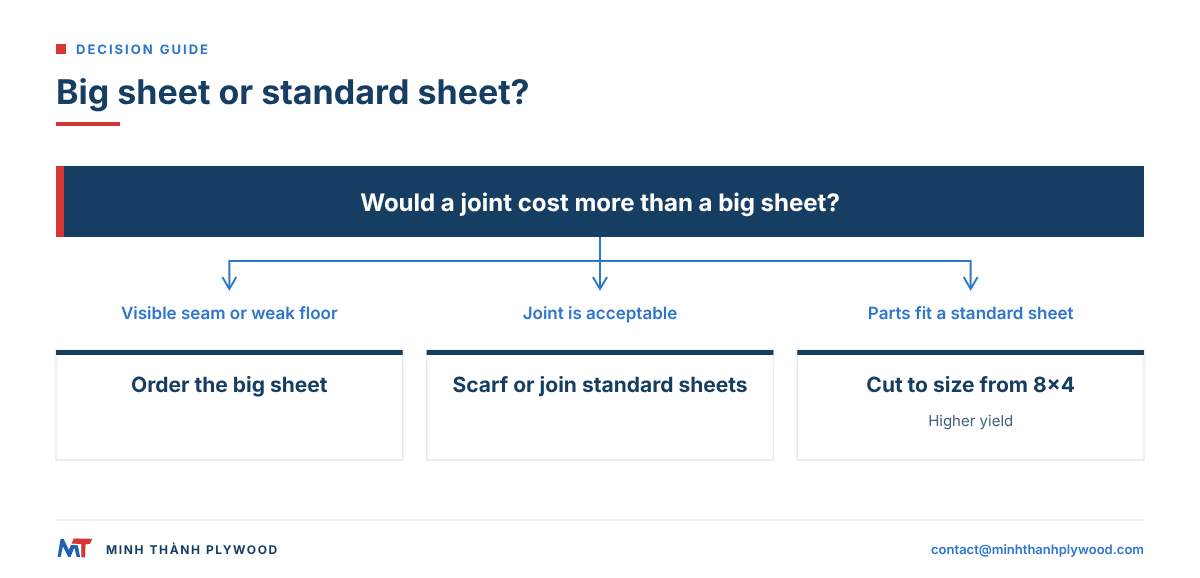
Big plywood sheets are worth ordering when a joint would cost more than the larger sheet: a seam that shows, a joint that weakens a floor, or labour to join many small sheets on site.
| Use | Big sheet worth it? | Why |
|---|---|---|
| One-piece tabletops and counters over 2.5 m | Yes | No joint on a visible face |
| Truck, trailer and container floors | Yes | Fewer joints, cut to body size |
| 10 ft and 12 ft walls | Often | One sheet floor to ceiling |
| Stage and exhibition panels | Often | Faster build, fewer seams |
| Kitchen and wardrobe carcasses | Rarely | Parts nest well on standard sheets |
| Shelving, drawers, doors | No | Standard sheets cut them with less waste |
| Packing crates | No | Joints are cheap; price per m³ rules |
For furniture parts, the cutting yield on 1220 × 2440 or 1250 × 2500 mm sheets is usually higher than on large sheets. Our guide to 5x10 plywood compares part yields sheet by sheet.
How much does a big piece of plywood cost?
A big sheet costs more per cubic metre than a standard sheet, and much more per sheet. A 4x10 holds 25% more panel than an 8x4, a 4x12 50% more and a 1220 × 4520 mm jumbo 85% more.
The format premium per cubic metre comes from three places: few mills press large sheets, the scarf-joint or large-press work adds labour, and long sheets are slower to pack, load and unload. Compare a large-sheet quote with the cost of the standard sheets plus the joints you would otherwise make. Our guide to plywood price by thickness shows how to turn a price per cubic metre into a sheet price.
Big plywood sheet prices in the UK
A UK buyer pays about £15 ex VAT for a 3.6 mm 10x4 sheet and about £44 ex VAT for an 18 mm 10x4 sheet of eucalyptus-faced, poplar-core hardwood plywood, against £3.51 and £17.57 of raw panel at our furniture FOB price. The UK figures are Sheet Materials Wholesale listings read in October 2026; the wholesaler says oversized sheets run from 3.6 to 25 mm and start from about £17 + VAT.
| UK wholesale sheet (B/BB, CE2+, EN 636-2 Class 2) | Price ex VAT | Per m³ | Our raw FOB panel at US$350/m³ |
|---|---|---|---|
| 3.6 mm, 3050 × 1220 mm (10x4) | £15.10 | about £1,127 | US$4.69, about £3.51 |
| 3.6 mm, 3050 × 1525 mm (10x5), pack of 170 | £18.75 | about £1,120 | US$5.86, about £4.39 |
| 18 mm, 3050 × 1220 mm (10x4), 18 to 34 sheets | £43.96 | about £656 | US$23.44, about £17.57 |
The FOB column is a raw panel value (price per cubic metre times volume), before freight, the format premium, duty and the importer’s margin. UK duty on Vietnamese plywood is 0% under the UK-Vietnam trade agreement (UK Trade Tariff, 4412339090, read in October 2026). UK VAT is 20%. The pound figures use US$1.3345 to £1 (exchangerates.org.uk, read in October 2026).
UK shop listings name the sheet by standard (B&Q, read in October 2026). Hardwood-faced eucalyptus or poplar-core panels are listed as EN 636-2 with a Class 2 bond and CE 2+ marking, alongside B/BB birch plywood, structural hardwood plywood at 18 and 25 mm, and marine plywood at 9, 12 and 18 mm. The bond classes come from EN 314-2, and marine plywood is made to BS 1088. Write the class on the order: we press to the bond it names and arrange third-party testing to your method through SGS on request.
How do big plywood sheets ship in containers?
Big plywood sheets ship in packs on long pallets, and the load plan changes with the format. A 40 ft container takes sheets up to scarf-jointed jumbo lengths, but larger, heavier packs need their own plan rather than a copy of the 8x4 plan.
For a standard 1220 × 2440 mm sheet we load packs about 1,000 mm high, 18 packs per 40HC on a Styrax core, to a planning payload of 28,000 kg. Large formats reach the same weight limit with fewer sheets, so freight per sheet rises with the area. Ask your supplier for the sheets per pack, pack weight and container plan before you book.
On arrival, long sheets need long forks, flat storage on enough bearers to stop sagging, and edge protection. Damaged ends on a 4 m sheet cost more than on a 2.4 m one.
How do you cut big sheets of plywood without chipping?
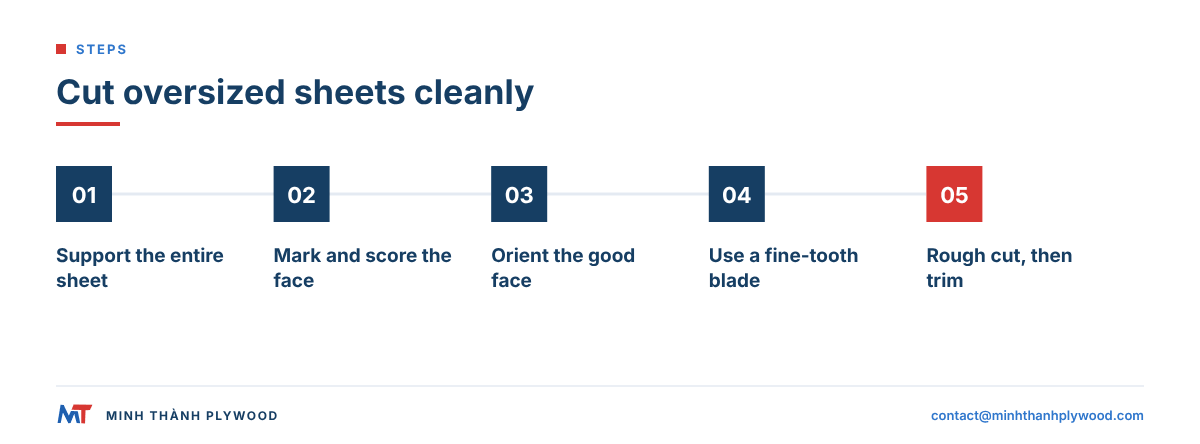
Cut big sheets on a panel saw or with a guided track saw, with the sheet supported on both sides of the cut so the offcut cannot drop and tear the face.
- Support the whole sheet on a cutting table, foam board or several trestles, including the part that will fall away.
- Mark and score the face along the line, or tape it, to stop fibres lifting.
- Keep the good face where the teeth enter: face up on a table or panel saw, face down under a handheld circular saw.
- Use a sharp fine-tooth blade for plywood and feed steadily.
- Cut long sheets to rough size first, then trim to final size on the saw.
For repeated parts, order them cut to size at the mill: the parts arrive clean-cut and the waste stays at the factory.
What sizes does a Vietnamese plywood mill press?
Vietnamese plywood mills press mainly the two world-standard formats, 1220 × 2440 and 1250 × 2500 mm, and some make custom sizes close to them. At Minh Thanh Plywood we press both formats as standard, plus custom sizes such as 1220 × 2500 and 1220 × 2280 mm.
For big parts, three routes work with a Vietnamese supply:
- Cut-to-size from standard sheets. We cut one panel into 4, 6 or 8 pieces to order; cut-to-size orders ship regularly to Italy and other European markets.
- Join on site or in the factory with a scarf or a structural joint where one is acceptable.
- LVL for long structural members. Laminated veneer lumber, with all veneers running the same way, suits long beams, frames and shelving rails; see our LVL page.
Cut-to-size is also the route for UK buyers who now pay a cutting service: UK cutters such as Cutmy hold a CNC tolerance of ±1 mm, down to 100 × 50 mm parts (Cutmy, read in October 2026). Our length and width hold ±2 mm on the sheet and parts are cut to the sizes you send.
Thickness runs from 3 to 40 mm on our sheets, so a thick standard sheet can often replace a thinner large sheet that needed extra framing.
What should you write on an order for big plywood sheets?
Write the size in millimetres, the grain direction, the thickness with its tolerance, the jointing method allowed and the build. For a project first drawn on large sheets, add the part list so the mill can propose the sheet that cuts it best.
For a project drawn on big sheets, the line can read:
Plywood 1220 × 2440 mm, face grain along 2440 mm, 18 mm ±0.2 mm, Styrax core stitched, double pressed, UF glue at E0 emission, poplar face A/B sanded both sides, cut to the attached part list, no joints on visible parts, FOB Hai Phong.
Send it through the cut-to-size plywood page or to contact@minhthanhplywood.com; our quality and certificates page lists the documents that come with the order. Samples are free, and replies come within hours. Our plywood sheet sizes guide compares the standard formats.
Buyer questions, answered
How big are plywood sheets?
The standard sheet is 4 ft × 8 ft, made as 1220 × 2440 mm, and Europe also uses 1250 × 2500 mm. Large sheets include 4x10 (1220 × 3050 mm), 4x12 (1220 × 3660 mm) and 5x10 (1525 × 3050 mm).
What is the largest sheet of plywood?
Pressed in one piece, the large formats in regular trade reach about 1525 × 3050 mm and 1220 × 3660 mm. Longer panels are made by scarf-jointing sheets end to end, for example 1220 × 4520 mm jumbo panels, and can run longer for vehicle and boat work.
Does plywood come in 10 foot lengths?
Yes. 4x10 plywood is 1220 × 3050 mm and 5x10 is 1525 × 3050 mm. Both are specialty sizes, stocked by fewer merchants than 8x4.
How big is a sheet of plywood in inches?
A standard sheet is 48 × 96 inches. A 1220 × 2440 mm export sheet is 48.03 × 96.06 inches, and a 4x10 sheet is 48 × 120 inches.
How much does a big plywood sheet weigh?
Weight is volume times density. At 18 mm and 500 kg/m³, a 4x10 sheet weighs about 33.5 kg, a 4x12 about 40.2 kg and a 1220 × 4520 mm jumbo panel about 49.6 kg; a eucalyptus core weighs 30% more.
What is a scarf joint in plywood?
A scarf joint glues two sheets end to end along long matching bevels, so the joint is as thick as the panel and nearly as strong. It is the usual way to make plywood longer than a press can take.
How much is a big piece of plywood?
More per cubic metre than a standard sheet. A large sheet holds 25–85% more panel than an 8x4, and the format adds a premium because few mills press it and it costs more to ship and handle.
How do you cut big sheets of plywood?
On a panel saw or with a guided track saw, with the sheet fully supported on both sides of the cut. Score or tape the face along the line, and keep the good face where the blade enters to avoid chipping.
What sizes does Minh Thanh Plywood press?
1220 × 2440 and 1250 × 2500 mm as standard, plus custom sizes such as 1220 × 2500 and 1220 × 2280 mm. We also cut panels into 4, 6 or 8 pieces to order.
Are big plywood sheets stronger than standard sheets?
The panel itself is no stronger. A large sheet removes joints, which helps floors, walls and decks stay stiff and even, but the thickness, core and glue decide the strength.