
To import plywood from Vietnam to the UK, classify the panel under heading 4412, claim the 0% UK-Vietnam Free Trade Agreement rate with a EUR.1, run due diligence under the UK Timber Regulations, then clear it with a GB EORI number and 20% import VAT. Minh Thanh Plywood ships from Hai Phong to UK ports on FOB, CFR or CIF terms, from one 40HC.
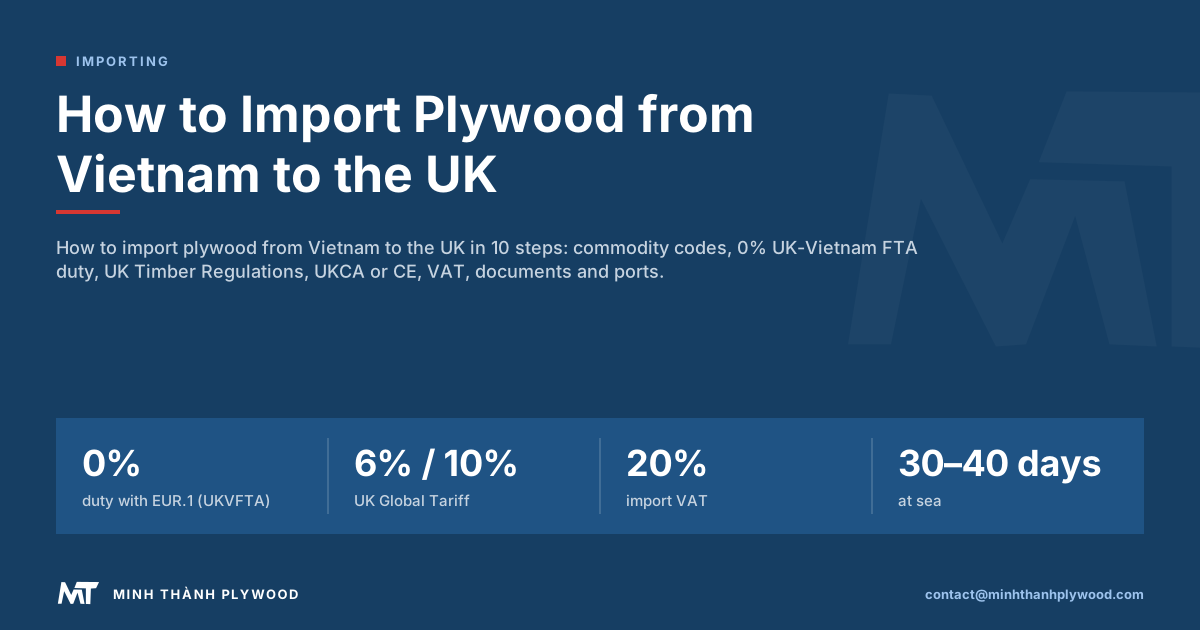
How to import plywood from Vietnam to the UK, step by step
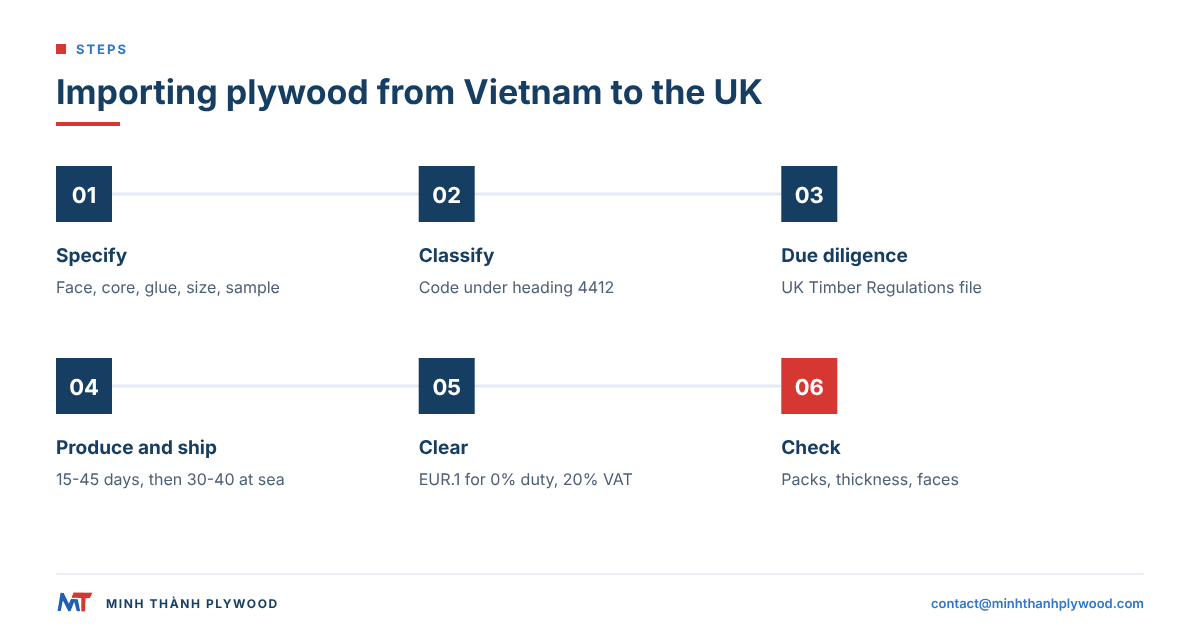
To import plywood from Vietnam to the UK, agree the specification and sample, classify the panel, obtain a GB EORI number and complete timber due diligence. Check construction marking where relevant, arrange shipping documents and origin proof, then declare the goods and account for duty and VAT before the arrival inspection.
- Write the specification: face and back species and grade, core, glue and emission class, thickness, size, finish, packing and quantity.
- Approve a free sample against that specification before any payment.
- Classify the panel under a 10-digit commodity code in heading 4412, decided by the outer plies.
- Get a GB EORI number if your business does not have one; customs declarations need it.
- Set up UK Timber Regulations due diligence for the supplier, species and harvest origin.
- Check whether the panels are construction products that need UKCA or CE marking.
- Sign the proforma invoice on FOB Hai Phong, CFR or CIF and pay the 30% deposit; production takes 15–45 days.
- Approve pre-loading photos and video and receive the commercial invoice, packing list, bill of lading and EUR.1.
- Clear the container through your customs broker on the Customs Declaration Service, claiming 0% duty and accounting for 20% VAT.
- Check the container on arrival against the packing list and the approved sample.
The rest of this guide takes each UK step in turn. The general sequence for any destination is in our pillar guide to importing plywood from Vietnam.
Which commodity code does plywood from Vietnam take in the UK?
Plywood takes a commodity code under heading 4412 of the UK Trade Tariff, and the outer plies decide the subheading. The core species does not change the code.
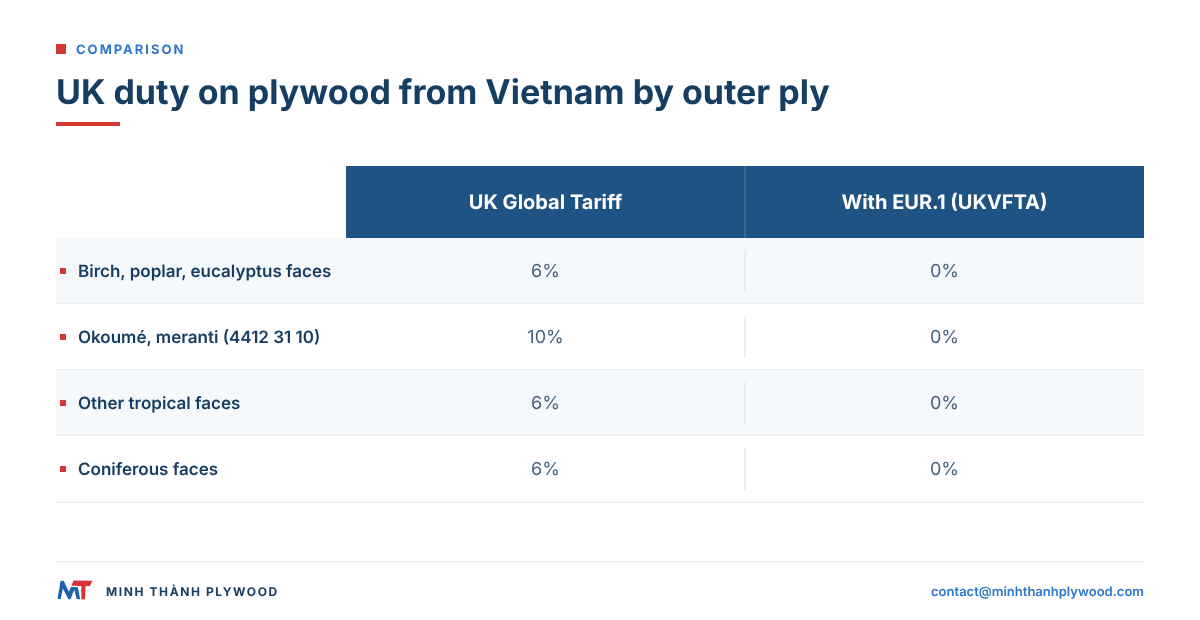
| Outer ply (face or back) | UK subheading | UK Global Tariff | UK-Vietnam FTA rate |
|---|---|---|---|
| Birch | 4412 33 10 | 6% | 0% |
| Poplar or aspen, no birch | 4412 33 20 | 6% | 0% |
| Eucalyptus, beech, oak and other listed temperate hardwoods | 4412 33 30 to 4412 33 90 | 6% | 0% |
| Other non-coniferous hardwood | 4412 34 00 | 6% | 0% |
| Okoumé, meranti, sapelli and other species named in 4412 31 10 | 4412 31 10 | 10% | 0% |
| Other tropical hardwood, such as bintangor | 4412 31 90 | 6% | 0% |
| Both outer plies coniferous, such as pine | 4412 39 00 | 6% | 0% |
Rates read from the UK Trade Tariff on 20 October 2026. The last two digits of the 10-digit code depend on details such as coating and the type of panel, so agree the full code with your broker from the invoice description. Laminated veneer lumber has its own subheadings, 4412 41 to 4412 49.
What import duty does the UK charge on Vietnamese plywood?
The UK charges 0% duty on Vietnamese plywood with valid origin proof under the UK-Vietnam Free Trade Agreement (UKVFTA), a rate in force since 1 January 2025 on the plywood lines above. Without origin proof the UK Global Tariff applies: 6% on most plywood and 10% where an outer ply is one of the tropical species named in 4412 31 10.
Duty is charged on the customs value, which in the UK is the CIF value: the price of the goods plus freight and insurance to the UK border. On a CIF value of about US$408 per m³, the 6% rate would add about US$24.47 per m³, so the EUR.1 is worth more than most price negotiations. The full calculation for one container is in our landed cost guide.
The UK applied no anti-dumping measure to plywood from Vietnam when we read the tariff on 20 October 2026. The tariff does carry import prohibitions on wood products from Russia and Belarus, which do not concern Vietnamese-origin goods.
How do you claim the UK-Vietnam FTA rate?
You claim the UKVFTA rate by entering the preference on the import declaration and holding a valid origin document from the exporter, normally a EUR.1 movement certificate issued in Vietnam. Your broker quotes the document reference on the declaration and keeps a copy on file.
Four details decide whether the claim holds:
- The description matches. The EUR.1, commercial invoice and packing list describe the same goods, quantities and marks.
- Direct transport. The goods travel to the UK without entering the market of a third country on the way; a transhipment port on the bill of lading is normal.
- The origin is genuine. The panel meets the agreement’s origin rule for heading 4412, which the exporter confirms when the certificate is issued.
- The document is on time. Ask for the EUR.1 with the shipping documents, so your broker has it before the ship arrives.
Minh Thanh supplies the certificate of origin with every shipment, together with the commercial invoice, packing list and bill of lading. The certificate of origin guide covers EUR.1 and other origin documents in detail.
What do the UK Timber Regulations require from a plywood importer?
The UK Timber Regulations (UKTR) require the operator, the business that first places plywood on the market in Great Britain, to use a due diligence system so that no illegally harvested timber is placed on the market. For imported plywood the operator is normally the importer. The rules, enforced by the Office for Product Safety and Standards (OPSS), have applied in Great Britain since 1 January 2021 with the same requirements as the former EU Timber Regulation (gov.uk guidance).
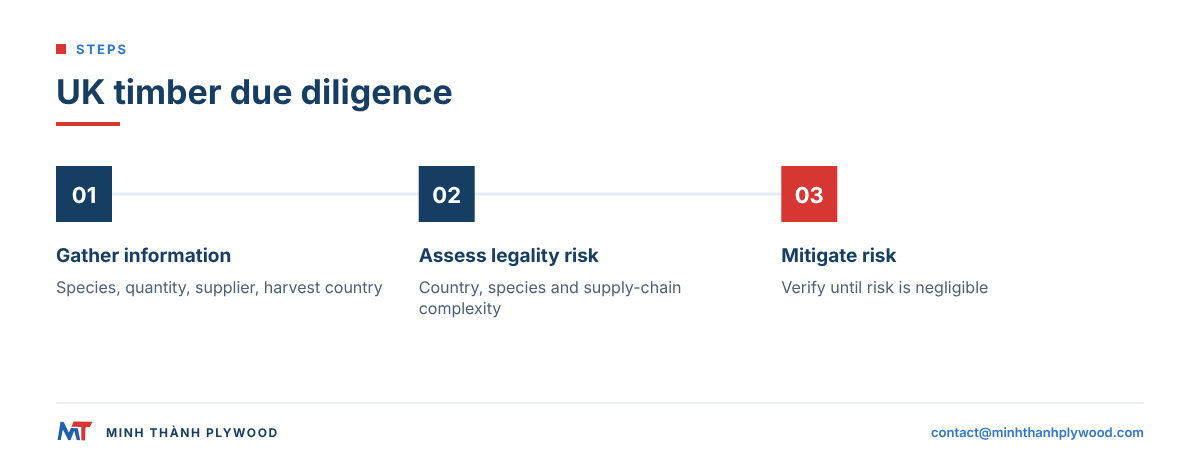
The due diligence system has three parts:
- Information: species, quantity, supplier, country of harvest and compliance with the laws there.
- Risk assessment: against the criteria in the regulations, such as country and species risk and supply-chain complexity.
- Risk mitigation: further information or verification until the risk is negligible.
Plywood is a composite, so each species is assessed: face, back and core. A trader that buys plywood already on the GB market keeps records of whom it bought from and sold to. OPSS can ask to see the system and its records and can act against an operator whose due diligence falls short.
For a Minh Thanh panel the information is short and specific: the face species, the core species (white Styrax or eucalyptus, grown as plantation timber around our factory in Ha Hoa, Phu Tho) and the harvest origin, supplied with the order.
Does EUDR apply to plywood imported into the UK?
No, not in Great Britain. The EU Deforestation Regulation (EUDR) is EU law; England, Scotland and Wales apply the UK Timber Regulations instead. A GB importer files no EUDR due diligence statement.
Northern Ireland is different. Under the Windsor Framework, EU product rules continue to apply there, and the UK government publishes guidance on placing deforestation-free products on the market in Northern Ireland. Plywood placed on the market in Northern Ireland follows the EUDR timetable, which applies from 30 December 2026 for large and medium operators.
Minh Thanh supplies the EUDR compliance dossier, origin records and geolocation files, with orders. A UK importer selling into both markets can use the same file for its UKTR due diligence and for EU or Northern Ireland customers.
Do you need UKCA or CE marking for plywood in the UK?
You need UKCA or CE marking only for plywood placed on the market as a construction product covered by a designated standard, such as wood-based panels for use in construction under BS EN 13986. Furniture, cabinet and interior plywood bought for making furniture does not carry UKCA or CE marking.
For construction products, Great Britain accepts both marks. The government’s guidance on construction products records that, following a ministerial statement of 2 September 2024, the CE mark remains available for placing construction products on the GB market, and the UKCA mark can also be used with a UK approved body.
At Minh Thanh, CE is available* for construction panels, and the order states the intended use, so the right documents are prepared before production. A buyer who resells furniture plywood into construction work should agree that change of use before ordering, not after delivery.
*Supplied directly or through qualified partner mills.
What formaldehyde and quality evidence do UK buyers ask for?
UK furniture and joinery buyers ask for low formaldehyde emission, a known glue type and tight thickness tolerance, backed by test reports rather than a label alone. Our furniture and interior plywood uses UF glue at E0 emission as standard, with MR or phenolic (WBP) bonds made to the buyer’s specification.
The evidence we supply is the CARB P2 / TSCA Title VI certificate (ICTT mill no. 23024) and six ASTM D6007 chamber tests from April 2025 to June 2026, three by Shanghai Hongjun and three by ICTT Vietnam, on 9, 15 and 18 mm panels, averaging 0.014–0.032 ppm against the 0.05 ppm CARB Phase 2 limit. Panels meet the emission and quality requirements European buyers ask for, and third-party testing to the buyer’s method, for example EN 717-1, is arranged through SGS on request.
On quality, furniture-grade panels are pressed twice as standard: the core board is pressed and calibrated, then face and back are pressed on. Sanded furniture panels hold ±0.2–0.3 mm thickness tolerance, down to ±0.2 mm, and dispatch at 8–12% moisture content. These are the figures to write into a UK purchase specification, so the arrival check has something to measure against. The formaldehyde emission page explains E0, E1 and the test methods.
Which documents does a UK plywood import need?
A UK plywood import needs the four core shipping documents, a EUR.1 for the preferential rate, and the due diligence records the importer keeps.
| Document | Who provides it | Why the UK needs it |
|---|---|---|
| Commercial invoice | Minh Thanh | Customs value, description, species and quantity |
| Packing list | Minh Thanh | Pack numbers, sheets, m³ and weights; checked on arrival |
| Bill of lading | Carrier, via the seller or forwarder | Title to the goods and release at the UK port |
| EUR.1 certificate of origin | Issued in Vietnam, sent by Minh Thanh | 0% duty under the UK-Vietnam FTA |
| Insurance certificate | Minh Thanh under CIF, or your insurer | Cover for the sea leg |
| UKTR due diligence file | Importer, with supplier data | Species, harvest origin and risk assessment |
| Emission and quality files | Minh Thanh, on order | CARB P2 / TSCA certificate, chamber test reports, SGS tests on request |
| Declaration of performance and marking | Manufacturer, construction products only | UKCA or CE for panels sold for construction |
Plywood itself is processed wood and is outside ISPM 15. Solid sawn-wood bearers or pallets under the packs are in ISPM 15 scope and must carry the heat-treatment mark. The full checklist is in plywood import documents.
Which UK port, Incoterm and transit time should you plan for?
Plan for a UK deep-sea container port, CIF or FOB terms, and about 30–40 days at sea from Hai Phong, the Northern Europe range, plus 15–45 days of production after the deposit. From deposit to arrival that is roughly 45–85 days before customs clearance.
Felixstowe, Southampton and London Gateway receive most direct services from Asia; choose by distance to your warehouse and your forwarder’s contract rates. Port charges, customs brokerage and haulage are UK-side costs quoted in pounds by your forwarder.
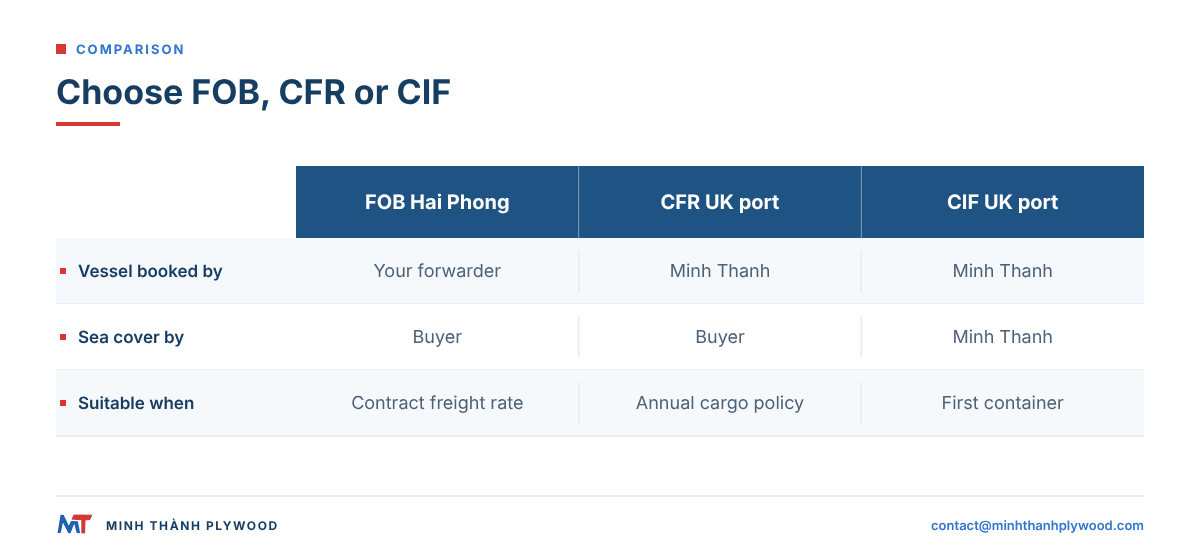
| Incoterm | Vessel booked by | Sea-leg cover arranged by | Choose it when |
|---|---|---|---|
| FOB Hai Phong | Your forwarder | You | You have a forwarder with a contract rate from Vietnam |
| CFR UK port | Minh Thanh | You | You hold an annual cargo policy |
| CIF UK port | Minh Thanh | Minh Thanh, for your benefit | A first container, or no forwarder yet |
How are customs clearance and import VAT handled in the UK?
Customs clearance in the UK is a declaration on the Customs Declaration Service (CDS), normally lodged by a customs broker or freight forwarder in your name with your GB EORI number. The declaration carries the commodity code, the customs value, the preference claim with the EUR.1 reference and the VAT treatment.
Import VAT is 20% of the customs value plus duty and incidental costs to the destination. A VAT-registered importer can use postponed VAT accounting, which declares and reclaims the import VAT on the same VAT return, so no VAT cash leaves the business at the border. Without it, the broker pays the VAT through a deferment account and recharges it.
Send the broker the invoice, packing list, bill of lading and EUR.1 before the ship arrives. Most delays and storage charges at UK ports come from a missing origin document, a description that differs between documents, or an unclear commodity code.
What does a container of plywood cost landed in the UK?
A container of plywood landed in a UK port costs the FOB price plus freight, insurance, 0% duty with a EUR.1, and UK port, broker and haulage charges; import VAT is recovered by a VAT-registered buyer. Minh Thanh quotes furniture plywood from US$350/m³ and commercial plywood from US$250/m³ FOB Hai Phong (October 2026).
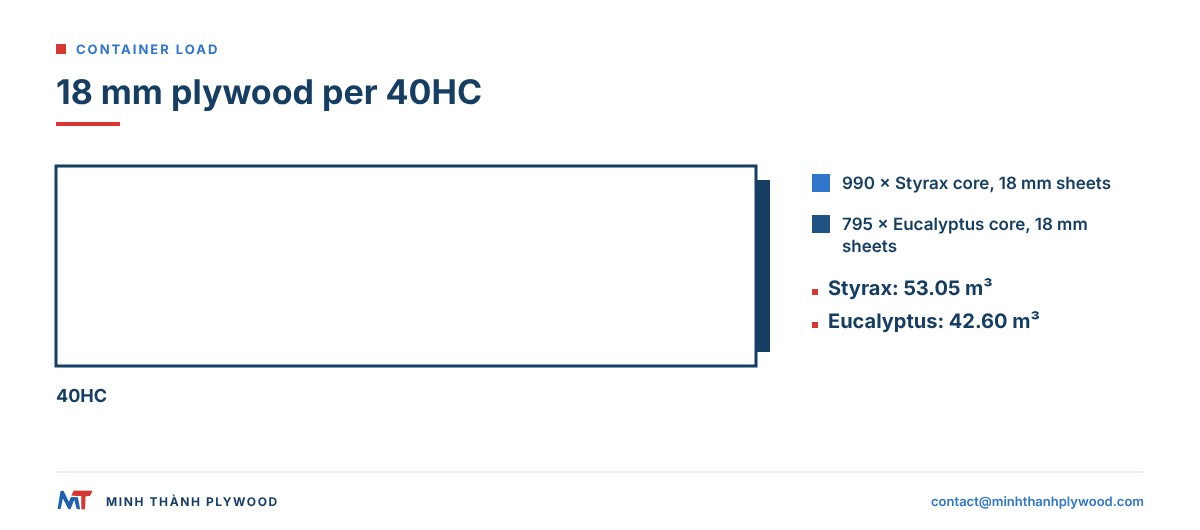
Freight per m³ depends on how many m³ the 40HC carries. With 18 mm sheets, a Styrax-core load of 990 sheets is 53.05 m³ and a eucalyptus-core load of 795 sheets is 42.60 m³, so the same freight quote costs about 25% more per m³ on the heavier core. Thinner panels carry more sheets per pack and hit the 28,000 kg planning payload later. Try your own thickness in the container packing calculator.
| Cost layer (one 40HC to Felixstowe) | Figure | Source |
|---|---|---|
| Sea freight Hai Phong to the UK | About US$2,200 to US$4,700 per 40ft container, which is US$41 to US$89 per m³ on a 53.05 m³ Styrax load | Published Vietnam-UK benchmarks (Tradlinx, Freightamigo) |
| Felixstowe port levy on a full import container | £26.16 green energy transfer levy | Port of Felixstowe rates, 1 April 2026 |
| Standard port cost per container | About £136 including security fee | Universal Customs Clearance, 2026 |
| Duty with EUR.1 | 0% | UK Trade Tariff, 20 October 2026 |
Freight is the swing line: the same container costs more or less depending on the month, so ask for a dated quote from your forwarder when you price the order. The 0% duty and the m³ in the box are what we control, and both work in your favour.
How to import plywood from UK to USA: can Vietnamese plywood be re-exported?
If you are working out how to import plywood from UK to USA, the answer starts with origin. Plywood imported into the UK can be re-exported to the USA, but the US duties follow the Vietnamese producer and exporter, not the UK seller. The US anti-dumping case on hardwood and decorative plywood from Vietnam states that a third-country exporter takes the cash deposit rate of the Vietnamese producer and exporter that supplied it, and that panels further processed in a third country by cutting, drilling or similar work stay in scope.
So routing through the UK changes the paperwork, not the duty. A UK distributor selling to US customers needs the same origin, species and formaldehyde files as a US importer buying direct. The US rates, scope and document rules are in our US duty guide.
The same logic answers the shorter question of how to import plywood from the UK into any country: the importing country applies its own tariff and trade measures by the plywood’s origin, and the UK seller supplies the origin documents it received from the mill.
Should you inspect the plywood before it ships?
Yes for a first container: a third-party pre-shipment inspection costs about US$250 to US$350 per inspector-day in South-East Asia (Tetra Inspection, 2026 pricing guide), a small share of a container worth many thousands of dollars. One inspector-day covers a plywood container: pack count, thickness and size against the specification, moisture, face grade against the approved sample, and loading.
Minh Thanh works with inspection from the start. Every container is photographed and filmed before loading, SGS tests to the buyer’s method are arranged on request, and a buyer’s own inspector or a third-party firm is welcome in the factory before the container is sealed. Agree the inspection date with the production date, so the report arrives before the balance is due.
What should you check when the container arrives in the UK?
Check the seal, the pack count and the panels before you sign for the container, and record every difference with photos and pack numbers.
- Seal and doors: photograph the seal number and the closed doors, then the first view inside.
- Pack count: count packs against the packing list and compare with the pre-loading photos.
- Thickness: caliper several sheets from different packs against the ordered tolerance.
- Moisture: measure a sample of sheets; dispatch moisture is 8–12%.
- Faces: compare faces and backs with the approved sample, under daylight.
- Report: send photos, pack numbers and measurements to the supplier the same week.
The pre-loading photos and video we send with every container give you the condition at Hai Phong to compare against.
What should you send Minh Thanh for a UK quote?
Send one specification line with the UK port and the term, and we return a price per m³, a packing plan and a production date. For example:
18 mm furniture plywood, 1220 × 2440 mm, birch face/back D+/D, white Styrax core, UF glue at E0 emission, sanded both sides, 1×40HC, CIF Felixstowe, EUR.1 required.
We confirm the price on the proforma invoice after the free sample is approved. Send your line to contact@minhthanhplywood.com or WhatsApp +84 988 586 601, or use the contact form; we reply within hours. The furniture plywood range shows the faces and cores available.
Buyer questions, answered
How do I import plywood from Vietnam to the UK?
Agree the specification and a free sample, classify the panel under heading 4412, get a GB EORI number, run UK Timber Regulations due diligence, and clear the container with a EUR.1 for 0% duty and 20% import VAT.
What is the import duty on plywood from Vietnam to the UK?
With a valid EUR.1 under the UK-Vietnam Free Trade Agreement, 0% since 1 January 2025. Without origin proof, the UK Global Tariff is 6% on most plywood and 10% with an outer ply of okoumé, meranti or another species named in 4412 31 10.
Does EUDR apply to plywood imported into Great Britain?
No. EUDR is EU law and does not apply in England, Scotland or Wales, where the UK Timber Regulations apply. Northern Ireland follows the EU rules, so plywood placed on the market there is in EUDR scope.
Do I need UKCA marking to import plywood into the UK?
Only for plywood placed on the market as a construction product under a designated standard such as BS EN 13986, where UKCA or CE marking applies. Furniture and interior plywood does not carry UKCA or CE marking.
Who must do due diligence under the UK Timber Regulations?
The operator, the business that first places the plywood on the GB market, usually the importer. It gathers information on species, origin, supplier and legality, assesses the risk and mitigates it to negligible before sale.
Can I use postponed VAT accounting for plywood imports?
Yes. A VAT-registered UK importer can account for the 20% import VAT on its VAT return through postponed VAT accounting instead of paying it at the border.
Which UK port is best for plywood from Vietnam?
The port nearest your warehouse with a direct service from Asia; Felixstowe, Southampton and London Gateway receive most deep-sea container lines. Sea time from Hai Phong is in the Northern Europe range of about 30–40 days.
Can plywood imported into the UK be re-exported to the USA?
It can, but the US applies duties by the Vietnamese producer and exporter, not the UK seller. A UK re-exporter takes the rate of the Vietnamese supplier, and the US anti-dumping case covers hardwood plywood further processed in a third country.
How much does freight from Vietnam to the UK cost per container?
Published benchmarks for a 40ft container from Hai Phong to the UK run from about US$2,200 to US$4,700, which is US$41 to US$89 per m³ on a 53.05 m³ Styrax-core load. Ask for a dated quote when you price the order.
Should I inspect plywood from Vietnam before shipment?
For a first container, yes. A third-party inspection costs about US$250 to US$350 per inspector-day and checks pack count, thickness, moisture and faces against the approved sample before the balance is paid.
What is the minimum order to import plywood from Minh Thanh to the UK?
One 40HC container, with mixed specifications by agreement. Production takes 15–45 days after the 30% deposit, and the balance is paid against the scanned bill of lading or by irrevocable L/C at sight.