
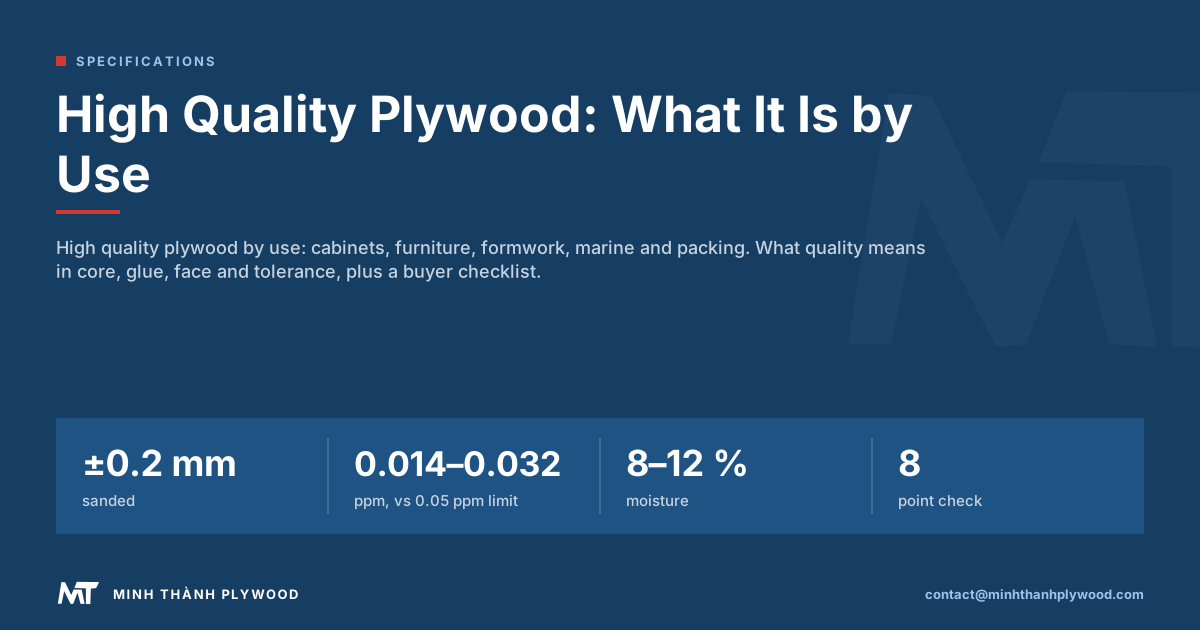
The highest quality plywood is the one built right for its use: for furniture and cabinets, a closed, stitched core, double pressing, UF glue at E0 emission, A-grade or D+ faces and ±0.2 mm thickness; for formwork, phenolic film and a waterproof bond. Minh Thanh Plywood builds furniture-grade panels to that list, and this guide shows how to check any offer against it.
What is the highest quality plywood?
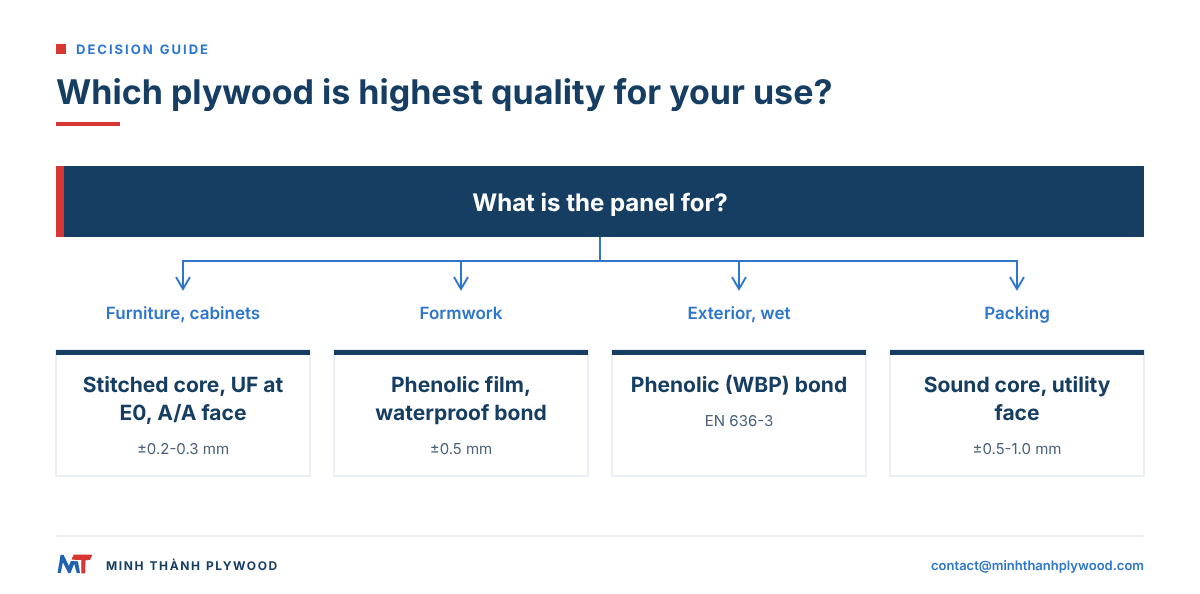
The highest quality plywood is the panel built correctly for its use, with nothing weak in the core, glue or face. “Best” depends on the job: the top furniture panel would fail as concrete formwork, and the top formwork panel is the wrong surface for a kitchen door.
For the uses most buyers ask about, high quality plywood means:
- Furniture and cabinets: a closed, stitched core, double pressing, UF glue at E0 emission, A/A or D+/D faces, sanded, thickness tolerance near ±0.2 mm.
- Concrete formwork: a dense core, a waterproof phenolic bond and a phenolic film face.
- Exterior and wet areas: a phenolic (WBP) or melamine-fortified bond rated for exterior use.
- Marine: panels made to BS 1088, a separate class with its own species and defect rules.
- Packing and crates: a sound core and a cost-effective face, with the thickness and nail holding the crate needs.
The rest of this guide explains each part of the build, so you can tell which offer is actually high quality plywood.
High quality plywood by use: the short answer
Match the build to the use and quality follows. This table gives the specification a buyer should expect at the top of each use.
| Use | Core | Glue and bond | Face | Thickness tolerance |
|---|---|---|---|---|
| Kitchen and bathroom cabinets | Stitched Eucalyptus or Styrax, no gaps | UF at E0, or MR for humid areas | A/A, A/B or D+/D | ±0.2–0.3 mm |
| Furniture and wardrobes | Stitched Styrax or Eucalyptus | UF at E0 emission | A/A or engineered veneer (EV) to sample | ±0.2–0.3 mm |
| Wall panels and interiors | Light Styrax | UF at E0 emission | One visible face A grade | ±0.2–0.3 mm |
| Concrete formwork | Dense hardwood | Phenolic, waterproof | Phenolic film | ±0.5 mm |
| Exterior sheathing, stair treads | Hardwood | Phenolic (WBP) or melamine-fortified | C/D utility | Written on the order |
| Packing and crates | Sound hardwood | Bond to the crate’s exposure | Cost-effective utility | ±0.5–1.0 mm |
The tolerances are the ones we make to at the factory for furniture, film-faced and packing panels. A higher grade than the use needs adds cost without adding value: a B/B face is right for a painted or laminated part.
Which plywood is the highest quality in the US: Baltic birch, marine, hardwood veneer core?
In the US, the highest quality plywood for furniture and cabinets is void-free all-birch Baltic birch (BB/BB, 13 plies at 3/4 in, 18 mm), and for boats it is marine plywood made to BS 1088. Hardwood veneer-core plywood with an A1 face is the usual choice where the face matters most. CDX is the low end: it is a sheathing grade, not a furniture grade.
| Panel | Core and ply count | Face and grade | Typical US price, 3/4 in (18 mm) 4 × 8 ft sheet |
|---|---|---|---|
| Baltic birch BB/BB | All-birch, void-free, 13 plies | BB both sides | US$84.95 at Toledo Plywood, US$91.59 at Baird Brothers |
| Baltic birch B/BB | Same core | One cleaner B face | US$116.90 at Berta Store |
| Marine plywood, BS 1088 | Void-free veneer core, waterproof bond | A/B or B/BB | US$119.95 (marine fir, Toledo Plywood), US$151.06 (AB marine, Builders General) |
| Hardwood veneer core, A1 | Veneer core, grade of the back sets the price | A-grade face, 1 back | US$104.90 for A1 birch at Schillings |
| MDF core | Fibre core, no voids, heavy | Thin veneer face | Flat and paintable, weak screw hold in the edge |
| Lumber core | Solid strips between face veneers | Veneer face | Holds screws in the edge, strip joints can telegraph |
| CDX softwood | Veneer core with voids allowed | C face, D back | Lowest-priced sheathing grade, voids allowed in the core |
Ply count is the quick test. A 3/4 in panel of 13 plies has a thin, even veneer in every layer, while ordinary 3/4 in plywood often has 5 to 7 layers with a thick core veneer that can hide voids. ApplePly-type multi-ply panels also run 13 plies at 3/4 in but use a maple or birch face over a mixed hardwood core; the face veneer is much thinner than on Baltic birch, so sanding through is the risk.
Sizes follow the inch trade: 1/4 in is 6 mm, 1/2 in is 12 mm and 3/4 in is 18 mm, on a 4 × 8 ft sheet (1220 × 2440 mm). Real US panels run slightly under nominal (3/4 in sold as 23/32 in, about 18.3 mm), while metric Baltic and Vietnamese panels are a true 18 mm.
US grades work on two systems. Softwood plywood is graded A to D under Voluntary Product Standard PS 1 (current edition PS 1-22), with the face letter first and the back letter second: C allows knotholes up to 1.5 in and D allows knots up to 2.5 in, which is why two sheets that look alike can differ by US$40 a panel. Hardwood plywood adds a back number from 1 (best) to 4 (worst), so A1 is the premium furniture panel and D4 the cheapest.
Our panel sits against these as the container alternative: stitched, double-pressed 11-13 ply 18 mm furniture plywood with a closed core, UF glue at E0 emission and a CARB P2 / TSCA Title VI certificate, from US$350/m³ (October 2026). At 0.0536 m³ per 1220 × 2440 mm × 18 mm sheet, that price is a raw FOB example of about US$19 per sheet before freight, duty and importer margin, not a delivered sheet price. For an importer, the gap to the US$85-US$117 shelf price of a Baltic birch sheet is the margin that pays for freight, duty and handling.
What does quality mean in plywood?
Plywood quality is decided in three places: the core, the glue line and the face. A panel is only as good as the weakest of the three.
- Core: the veneers inside. They decide flatness, screw holding, stiffness and whether the panel hides voids.
- Glue line: the bond between plies. It decides whether the panel survives humidity or water, and how much formaldehyde it emits.
- Face: the visible veneer. It decides appearance, how well it takes paint, lacquer or UV coating, and the grade printed on the quote.
Most buyers judge plywood by the face because it is what they see first. Most failures start in the core: a gap under a beautiful face shows up later as a dent, a blister or a screw that will not hold.
Core and ply quality: what makes a good plywood core?
A good plywood core is closed, even and flat: no gaps between veneer pieces, no overlaps, no soft or broken veneer, and the same thickness across the sheet. Ply quality, the state of each core layer, is the single biggest difference between a top panel and a cheap one.
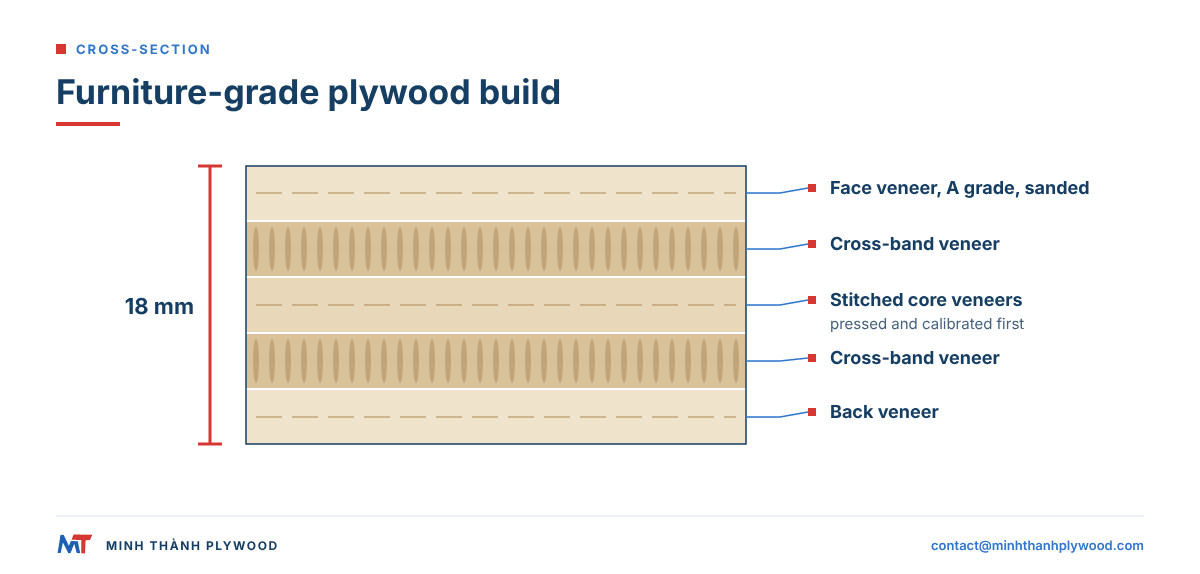
What we do at the factory to keep the core closed:
- Sort core veneers by thickness and moisture, so each layer is even.
- Stitch the core both horizontally and vertically, so veneer pieces cannot drift apart in the press.
- Press and calibrate the core board first, sanding it to an even thickness.
- Press the face and back on in a second press cycle.
The core species matters too. Furniture panels use white Styrax or Eucalyptus cores as standard, with Acacia and Pine cores made on order. Styrax is light and even; Eucalyptus is dense and holds screws well. Our plywood density guide gives the weight and use of each core.
Glue and bond: which glue makes high quality plywood?
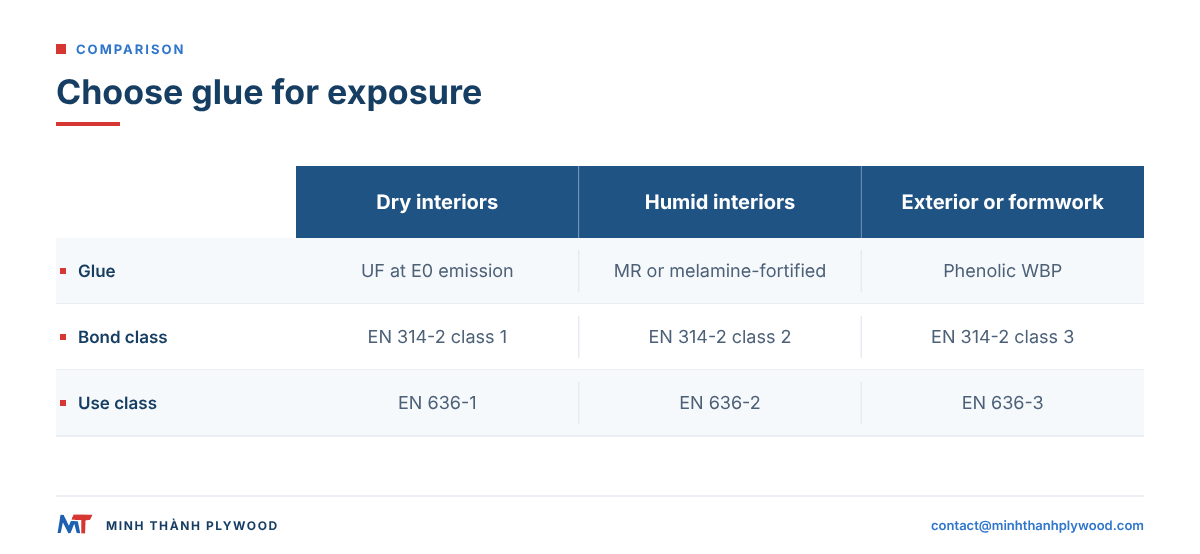
The right glue is the one rated for the panel’s exposure; there is no single best glue. A furniture panel needs a low-emission interior glue; a formwork panel needs a waterproof one.
| Glue | Where it belongs | European bond class |
|---|---|---|
| UF glue at E0 emission | Furniture, cabinets, interiors in dry rooms | EN 314-2 class 1, EN 636-1 dry use |
| MR or melamine-fortified UF | Kitchens, bathrooms, humid interiors | EN 314-2 class 2, EN 636-2 humid use |
| Phenolic (WBP) | Exterior, formwork, wet use | EN 314-2 class 3, EN 636-3 exterior use |
The BSI description of BS EN 636:2012+A1:2015 covers plywood for dry, humid or exterior conditions, which is where the use classes in the table come from.
Two specifications are often confused: the bond (how well the glue line resists water) and the emission class (how much formaldehyde the panel gives off). E0 and E1 are emission classes, not glue types. A high quality furniture panel states both: for example, UF glue at E0 emission, bond class 1. Our standard for furniture and interior panels is UF glue at E0 emission; MR/melamine-fortified and phenolic bonds are made to the buyer’s specification.
Face grades: what is the highest face grade?
The highest face grade depends on the grading system the face belongs to. Each species is graded on its own ladder, so “grade A” on poplar and “B” on birch can both be the top of their scale.
| Face species | Grade ladder, high to low | Top grade for visible furniture |
|---|---|---|
| Poplar | A/A, A/B, B/B (also coded B/BB, BB/CC, CP) | A/A |
| Pine | A/A, A/B, B/B, B/C for utility parts | A/A |
| Eucalyptus | A/A, A/B, B/B | A/A |
| Birch, Vietnamese names | D+, D, E, quoted as pairs such as D+/D or D/E | D+/D |
| Birch, European ladder | B, BB, CP, C | B/BB |
Our birch faces are named D+, D and E in Vietnam; individually D+ is about B, D about BB and E about CP/C, so D+/D is about B/BB. Whatever the ladder, the face is matched to the buyer’s approved sample, which is the real reference on the order. A/A suits two visible faces; A/B suits one visible face; B/B suits painted or laminated parts. More detail is in our birch plywood grades guide.
Thickness tolerance and flatness
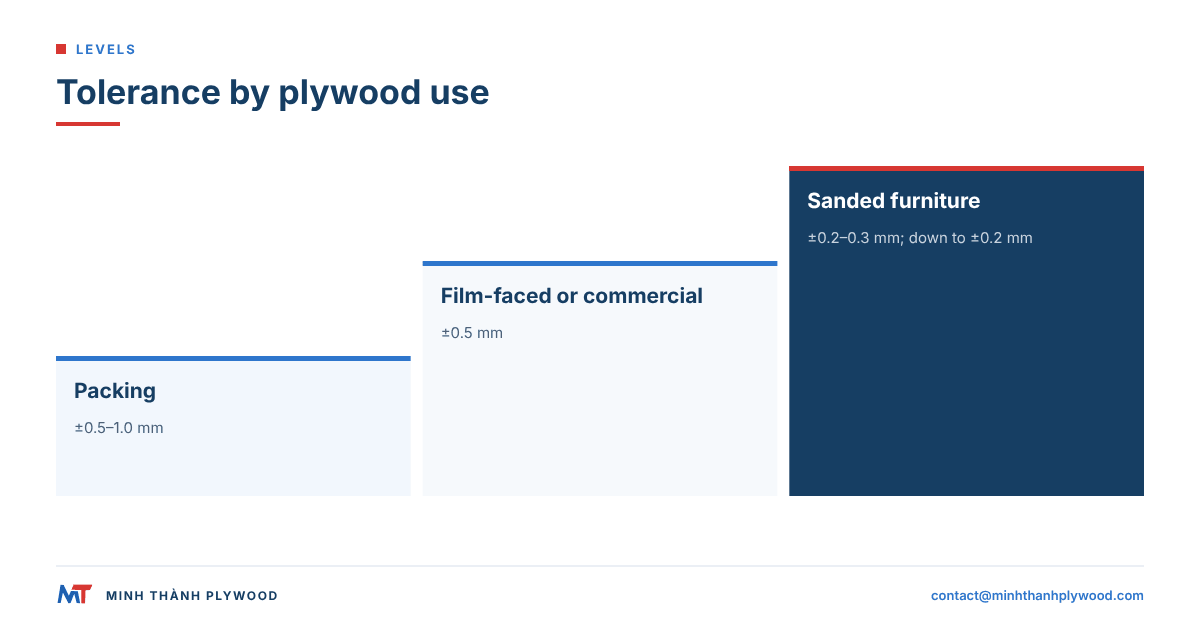
Tight thickness tolerance is the clearest mark of a high quality furniture panel, because every edge band, hinge and CNC program depends on it. Our sanded furniture panels are made to ±0.2–0.3 mm, down to ±0.2 mm; commercial and film-faced panels to ±0.5 mm; packing panels to ±0.5–1.0 mm; length and width to ±2 mm.
Double pressing is how the tolerance is reached. The core board is pressed and calibrated first, so its thickness is even before the faces go on; pressing the faces in a second cycle keeps them flat and stops core irregularities from showing through. Single-pressed panels can look the same on delivery, but they are harder to hold to a tight tolerance and more likely to show telegraphing under gloss finishes.
Flatness follows from the same build plus moisture control. Our veneers and finished panels are dried to 8–12 % moisture content at dispatch, the normal range for furniture plywood, so panels stay flat in a heated workshop.
Emission: is low formaldehyde part of quality?
Yes: for furniture and interior plywood, low formaldehyde emission is part of quality, because buyers in Europe and the US will not accept panels that fail their emission rules. The proof is a test with a method and a date, not the word “E0” on a quote.
Our furniture panels use UF glue at E0 emission. Six third-party chamber tests to ASTM D6007, between April 2025 and June 2026, on 9, 15 and 18 mm panels averaged 0.014–0.032 ppm. Three were run by Shanghai Hongjun and three by ICTT Vietnam. We hold CARB P2 / TSCA Title VI certification as ICTT mill no. 23024.
The limit for veneer-core hardwood plywood is 0.05 ppm under 40 CFR 770.10, and the US EPA overview of formaldehyde emission standards for composite wood products sets out the wider framework.
For buyers who test to a European method, third-party testing to EN 717-1 or another method is arranged through SGS on request.
What is the best quality plywood in the UK?
For UK furniture, shopfitting and joinery, the best quality plywood is a birch or hardwood-faced panel on an even, closed core, with a bond class that matches the room and low formaldehyde emission. For load-bearing floors and roofs, quality also means the right declared structural performance for the design.
UK buyers specify plywood by the European standards: EN 636-1 for dry use, EN 636-2 for humid use and EN 636-3 for exterior use, with the face graded to the species ladder. What separates top panels in UK joinery is the same list as anywhere: flat, calibrated thickness, no core voids, faces matched to the sample, and documents for every shipment.
For furniture and interior plywood shipped from Vietnam to the UK, that is the specification we make: stitched core, double pressing, UF glue at E0 emission, sanded faces to sample and calibrated thickness. Structural and exterior uses follow their own rules; our exterior plywood grades guide covers them.
How do you identify high quality plywood?
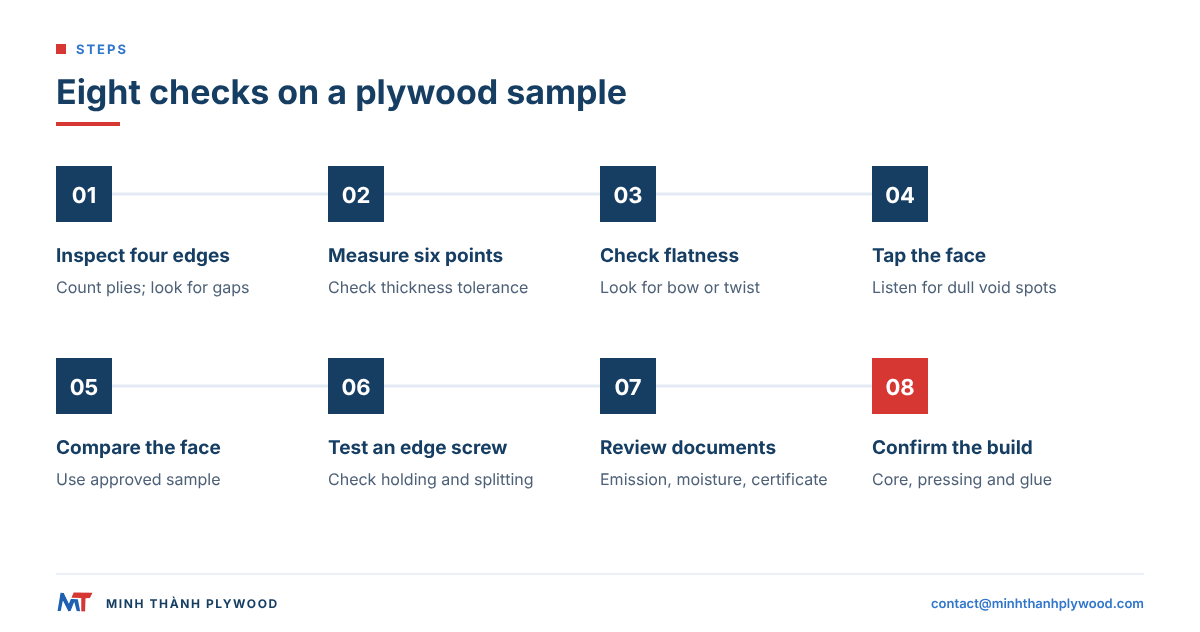
You identify high quality plywood by checking the build, not the label. These checks take minutes on a sample or a delivered sheet.
- Look at all four edges. Count the plies, look for gaps, overlaps and soft veneer. A closed edge with even plies is the first sign of a good core.
- Measure thickness at six points with a caliper; compare the spread with the tolerance on the order.
- Lay the sheet flat on a level surface and check the corners and the middle for bow.
- Tap the face with a knuckle along a line; a dull spot can mean a void or poor bonding underneath.
- Check the face in daylight against the approved sample: colour, grain, knots, repairs.
- Cut a strip and screw into the edge; a sound core holds without splitting.
- Ask for documents: emission test reports with method, laboratory and date; certificate numbers you can check; moisture at dispatch.
- Ask how it is made: core species, stitching, single or double pressing, glue type and emission class.
A supplier who answers the last two points precisely, in writing, usually makes what they promise.
What is high quality plywood called?
High quality plywood is sold under trade names that point to its use and its face grade. None of these names is a single standard, so the name only helps when the build is written next to it.
- Furniture-grade or cabinet-grade plywood: panels made for visible furniture parts, with sanded faces and a tight tolerance.
- Interior-grade plywood: furniture-grade panels with an interior bond, usually UF glue.
- A/A, A/B or B/BB plywood: names that use the face grade pair as the product name.
- Fancy or decorative plywood: panels with a high-value decorative face such as oak, walnut or EV.
- Marine plywood: panels made to BS 1088, with a waterproof bond and strict defect limits.
- Film-faced plywood: formwork panels with a phenolic film face and a waterproof bond.
When an offer says “high quality plywood”, ask which of these it is and what the core, glue and tolerance are. Our guide to Vietnamese plywood quality shows how a mill’s build compares between grades.
Does higher quality plywood cost more?
Yes: higher quality plywood costs more, mainly through the face, the core and the build. Our indicative starting prices in October 2026 are from US$350/m³ for furniture and interior plywood and from US$250/m³ for commercial plywood.
What moves the price within a quality level:
- Face species and grade: an A/A face uses only the best veneer; a B/B face uses more of the log.
- Core species: a denser core uses more timber per cubic metre.
- Build: stitching, double pressing and calibrated sanding add process time.
- Glue: phenolic and melamine-fortified bonds cost more than UF.
- Thickness and size: thin panels and custom sizes take more work per cubic metre.
Paying for quality the part does not need is the most common waste. Put the A/A face on visible parts and a B/B face on the hidden ones, and split them into two specifications on the same container.
Where to buy high quality plywood: choosing a manufacturer
Buy high quality plywood from the manufacturer that presses it, or from a supplier who names that mill. The questions that identify a capable furniture-plywood manufacturer in Vietnam are the same anywhere:
| Question | What a capable manufacturer shows |
|---|---|
| Do you make the panel yourselves? | Factory video call, real photos and videos of production |
| How is the core built? | Stitched core, double pressing, core species named |
| What are your tolerances? | Written tolerance for each product line |
| What is your emission proof? | Certificate number and test reports with method, laboratory and date |
| Can I see a sample first? | Free samples to your specification |
| How do I know the shipment matches? | Photos and video of every shipment before loading |
Minh Thanh Plywood is a manufacturer in Ha Hoa, Phu Tho, built for top-grade furniture and interior plywood, with Europe as its main market and a capacity of 50,000+ m³ per year. We hold CARB P2 / TSCA Title VI, ISO 9001:2015 and TCVN 11902:2017 certification, and we supply the EUDR compliance dossier (origin records and geolocation files) with orders.
How Minh Thanh builds furniture-grade plywood
Our furniture-grade plywood is built to the list in this guide as standard, not as an upgrade.
| Specification | Minh Thanh furniture plywood |
|---|---|
| Core | White Styrax or Eucalyptus; Acacia and Pine on order; stitched both ways |
| Pressing | Double pressing: core board pressed and calibrated, then faces pressed on |
| Glue | UF glue at E0 emission; MR/melamine-fortified and phenolic to order |
| Faces | 10+ face veneers: EV, poplar, birch, Okoume, pine and more, sanded and polished |
| Face grades | Matched to the approved sample: A/A, A/B, B/B; birch D+/D, D/E |
| Thickness | 3–40 mm, tolerance down to ±0.2 mm |
| Sizes | 1220 × 2440 mm and 1250 × 2500 mm, custom such as 1220 × 2500 mm, cut-to-size |
| Moisture | 8–12 % at dispatch |
| Surface | Both faces UV-ready, for the buyer’s own UV coating |
| Emission proof | CARB P2 / TSCA Title VI, ICTT mill no. 23024; chamber results 0.014–0.032 ppm |
Every shipment is photographed and filmed before loading, and buyers get the photos and video. Production takes 15–45 days after the 30% deposit.
What to write on the order for high quality plywood
Write the build, not the word “quality”: core, pressing, glue and emission, face pair, thickness and tolerance, moisture. A line both sides can measure is what makes high quality plywood arrive as ordered.
18 mm, 1220 × 2440 mm, poplar A/A faces on stitched Eucalyptus core, double pressed, UF glue at E0 emission, sanded both faces, thickness tolerance ±0.2–0.3 mm, moisture 8–12 % at dispatch, face matched to approved sample, 1 × 40HC.
Add the parts the panels are for and the market’s emission rule, and we will propose the core and face for each part. Send your specification through the furniture plywood page and ask for free samples of the faces you are considering.
Buyer questions, answered
What is the highest quality of plywood?
For furniture and cabinets, the highest quality plywood has a closed, stitched core, double pressing, UF glue at E0 emission, A/A or D+/D faces and a thickness tolerance near ±0.2 mm. For outdoor or wet use, quality starts with a phenolic (WBP) bond.
What is high quality plywood called?
It goes by furniture-grade, cabinet-grade or interior-grade plywood, and by its face grade: A/A or A/B for poplar and pine, B/BB for European birch, D+/D on the Vietnamese birch ladder. Marine plywood is a separate class made to BS 1088.
What is the best quality plywood in the UK?
For UK furniture and joinery, buyers treat birch or hardwood-faced plywood on an even, closed core, bonded for its service class under EN 636 and low in formaldehyde, as high quality. For structural use, the panel also needs the right declared performance.
How do I identify high quality plywood?
Check the edges for gaps and overlaps, measure thickness at several points, look at the face against the approved sample, ask for the glue type and emission test reports, and check flatness on a sheet laid on a flat surface.
Is birch plywood the highest quality plywood?
All-birch plywood is dense and stiff, and B/BB birch faces are a high grade, but birch is one species, not a quality level. A birch face on a poor core is low quality; an EV or poplar A/A face on a stitched, double-pressed core is high quality.
Does high quality plywood cost more?
Yes, mainly through the face grade, the core species and the build. Our furniture and interior plywood starts from US$350/m³ and commercial plywood from US$250/m³ (October 2026); the final price depends on face, core, glue, thickness, size and quantity.
What is ply quality?
Ply quality is the state of each veneer layer: even thickness, no open splits, tight joints and full glue contact. Good ply quality is what keeps a panel flat and free of core voids.
Is E0 plywood higher quality than E1?
E0 and E1 are emission classes, not quality grades. E0 means lower formaldehyde emission; it says nothing about the core or face, so ask for both the emission class and the build.
How do I identify high quality furniture grade plywood manufacturers in Vietnam?
Ask for a factory video call, certificates with numbers you can check, emission test reports with method and date, a free sample to your specification, and photos and video of a loaded container before shipment.
Is commercial plywood good quality?
Commercial plywood is made for hidden and packing uses, with cost-effective faces and a wider tolerance of ±0.5 mm. It is good quality for those jobs, but not a substitute for furniture-grade plywood on visible parts.