
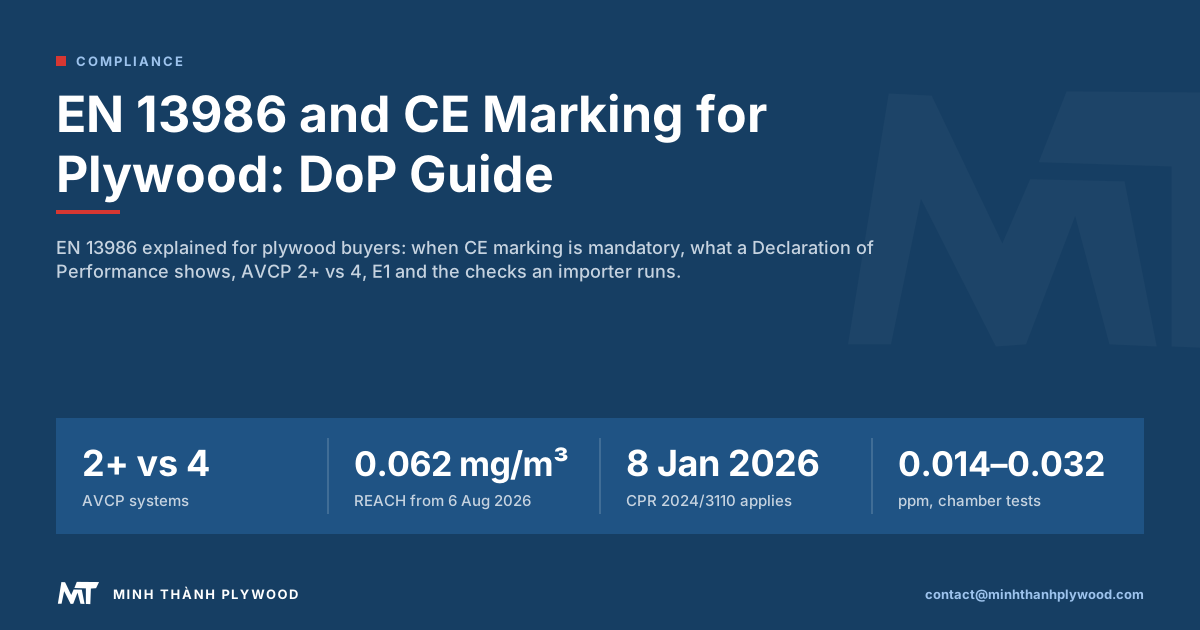
EN 13986 is the European standard for wood-based panels used in construction. Plywood sold in the EU for floors, walls, roofs or other construction works needs CE marking and a Declaration of Performance under it; furniture and interior plywood does not. Minh Thanh Plywood makes furniture panels for Europe and supplies CE-marked construction plywood through qualified partner mills.
What is EN 13986 for plywood?
EN 13986 is the harmonised European standard for wood-based panels used in construction, current edition EN 13986:2004+A1:2015. It covers plywood, OSB, particleboard, fibreboard and solid wood panels, and it sets three things: which characteristics a manufacturer must declare for each intended use, which system of assessment and verification of constancy of performance (AVCP) applies, and what the CE marking must show.
The standard sits under the EU Construction Products Regulation, Regulation (EU) No 305/2011 (checked 20 October 2026). Because it is harmonised, a panel that is in its scope and placed on the EU market for construction must carry CE marking and come with a Declaration of Performance. Panels outside its scope, such as furniture plywood, are not CE marked under it.
EN 13986 does not define plywood quality on its own. It points to the product standards that do: EN 636 for plywood specifications, EN 314-2 for bond quality, EN 717-1 for formaldehyde release and EN 789 or EN 12369-2 for structural values. The A1 amendment of 2015 added racking strength, embedment strength and air permeability to the characteristics a manufacturer can declare.
Does plywood need CE marking?
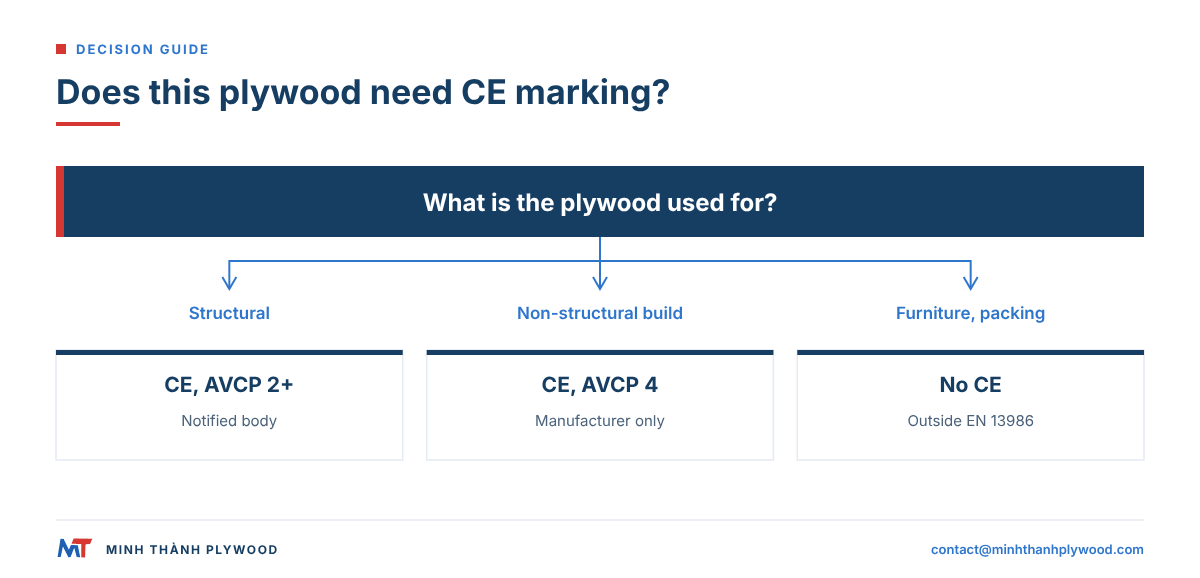
Plywood needs CE marking when it is placed on the EU market for use in construction works. Floors, sheathing, structural decking, stair treads and permanent cladding are construction uses. Plywood for furniture, cabinets, shop fittings, packaging, crates and interior joinery outside the building structure is outside EN 13986, so the Construction Products Regulation does not require a CE mark.
| Use of the plywood | CE marking under EN 13986 | AVCP system | Who is involved |
|---|---|---|---|
| Structural: floors, roof and wall sheathing, load-bearing parts | Required | 2+ | Manufacturer and a notified body |
| Non-structural construction: linings, ceilings, non-load-bearing cladding | Required | 4 | Manufacturer only |
| Furniture, cabinets, shop fittings | Not required | – | – |
| Packaging, crates, pallets | Not required | – | – |
| Concrete formwork | Set by the buyer’s market and tender | Often 2+ | Manufacturer and a notified body |
The question to ask is the intended use, not the panel type. The same 18 mm birch-faced panel can be furniture plywood in one order and structural plywood in another; only the second needs a Declaration of Performance and a CE label.
Which plywood uses fall under EN 13986: structural or non-structural?
EN 13986 splits construction uses into structural and non-structural, and into dry, humid and exterior conditions. Structural means the panel carries load in the works: a floor deck, a roof sheathing, a racking wall. Non-structural means it is part of the building but carries no design load: a ceiling lining, an interior wall panel.
The service condition decides the plywood class. EN 636-1 covers plywood for dry conditions, EN 636-2 for humid conditions and EN 636-3 for exterior conditions. A structural floor in a heated building is EN 636-1 S or EN 636-2 S; roof sheathing that can get wet during construction is usually specified as EN 636-2 S or EN 636-3 S. The S marks structural use, G marks general (non-structural) use.
For a buyer, the practical line is simple: write the use and the EN 636 class in the order, and the supplier knows which Declaration of Performance and which AVCP system apply.
AVCP System 2+ vs System 4 for plywood
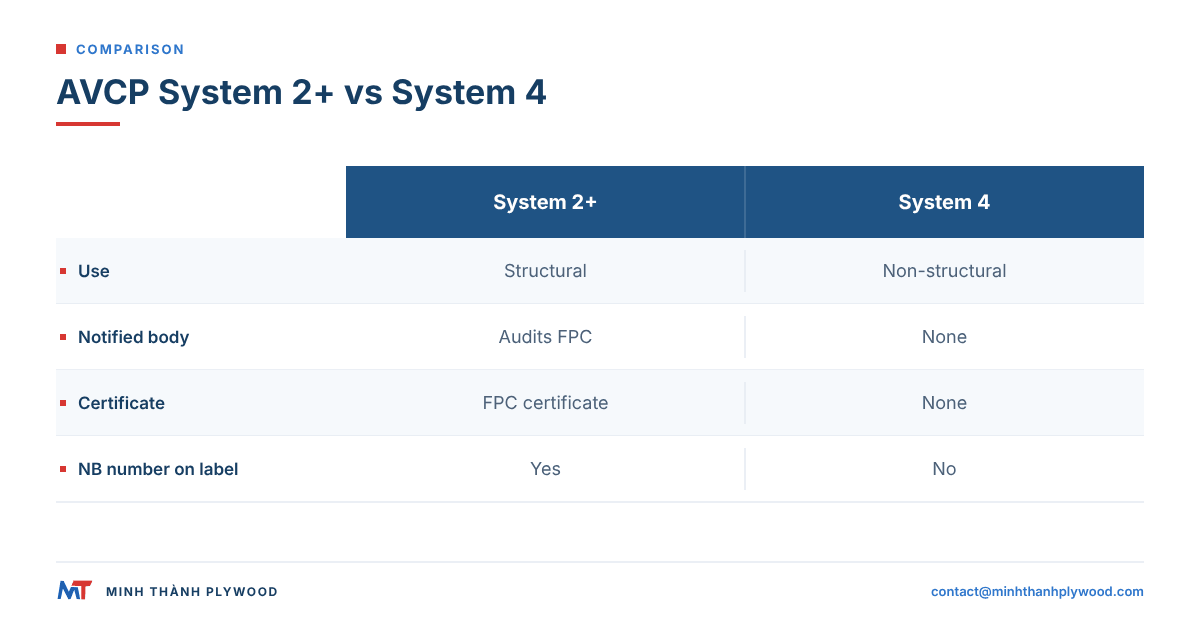
System 2+ applies to structural plywood and needs a notified body; System 4 applies to non-structural construction plywood and the manufacturer acts alone. The difference shows on the CE label: a 2+ label carries the notified body’s four-digit identification number, a System 4 label does not.
| Task | System 2+ (structural) | System 4 (non-structural) |
|---|---|---|
| Product-type determination (initial testing or calculation) | Manufacturer | Manufacturer |
| Factory production control (FPC) | Manufacturer | Manufacturer |
| Initial inspection of the plant and the FPC | Notified body | – |
| Continuous surveillance of the FPC | Notified body | – |
| Certificate issued | Certificate of conformity of the FPC | None |
| Notified body number on the CE label | Yes | No |
A “CE 2+ plywood” offer therefore means three things: the plywood is declared for structural use, a named notified body audits the factory’s production control, and the manufacturer’s Declaration of Performance lists the structural values. Reaction to fire can bring its own AVCP system for panels with a fire-retardant treatment; untreated plywood uses the class listed in EN 13986.
What is a Declaration of Performance for plywood?
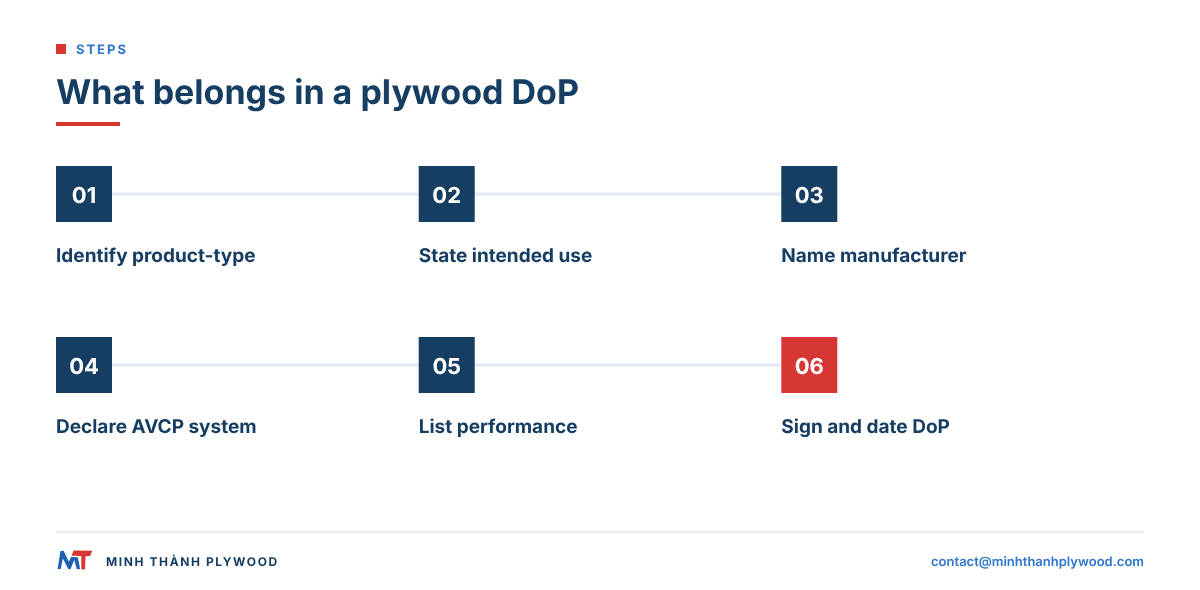
A Declaration of Performance (DoP) is the manufacturer’s signed statement of the performance of a construction product for its intended use, drawn up before the CE mark is affixed. For plywood under EN 13986, a DoP form contains:
- DoP reference number, which the CE label repeats.
- Unique identification code of the product-type, for example the panel name and thickness range.
- Intended use, such as “structural use in humid conditions (EN 636-2 S)”.
- Manufacturer’s name and contact address.
- AVCP system: 2+ or 4.
- Harmonised standard: EN 13986:2004+A1:2015, and for System 2+ the notified body’s name, number and the FPC certificate number.
- Declared performance, characteristic by characteristic: bending strength and modulus of elasticity, bond quality and class, formaldehyde class, reaction to fire, biological durability, pentachlorophenol content and any other value the intended use needs. “NPD” (no performance determined) is allowed for characteristics the use does not require.
- Signature, name, place and date.
The DoP is supplied in paper or electronic form in the language the member state of sale requires. A buyer can ask for it with the quotation; a mill that cannot send one has no CE-marked product of that type.
What the CE label on plywood shows
The CE label on plywood is a short summary of the Declaration of Performance, printed on the panel, the pack label or the accompanying documents. A complete label shows:
- the CE symbol;
- the last two digits of the year the CE mark was first affixed;
- the manufacturer’s name and registered address;
- the unique identification code of the product-type;
- the DoP reference number;
- the reference to EN 13986;
- the intended use and the declared levels or classes, such as EN 636-2 S, bond class 2, E1 and the reaction-to-fire class;
- for System 2+, the notified body’s identification number.
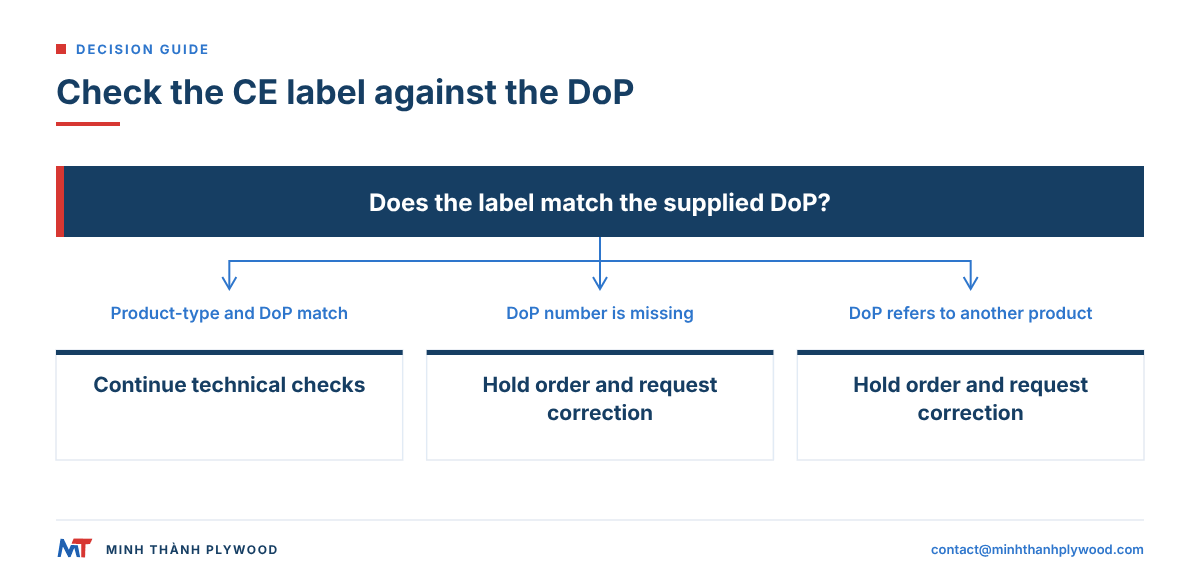
Check that the DoP number on the label matches the DoP you received. A label with a CE symbol and no DoP number, or a DoP number that leads to a different product-type, is a reason to hold the order until the supplier corrects it.
EN 636 and EN 314-2: the plywood classes behind the DoP
EN 636 sets the requirements for plywood in each service class, and EN 314-2 sets the bond quality behind it. The two are what a Declaration of Performance actually rests on for plywood.
| Service class | Product standard | Bond class (EN 314-2) | Test pretreatment (EN 314-1) | Typical use |
|---|---|---|---|---|
| Dry | EN 636-1 | Class 1 | Soaking 24 hours in water at 20 °C | Interior floors and linings in heated buildings |
| Humid | EN 636-2 | Class 2 | Boiling 6 hours, cooling 1 hour in water | Roof and wall sheathing, protected outdoor parts |
| Exterior | EN 636-3 | Class 3 | Cyclic boiling (4 h boil, drying, 4 h boil) or 72 hours boiling | Exposed outdoor parts, formwork |
EN 314-2 judges the glue line by shear strength and the share of wood failure: the lower the shear strength, the more wood failure the sample must show. A urea-formaldehyde bond meets Class 1; melamine-fortified bonds reach Class 2; phenolic (WBP) bonds are made for Class 3.
The glue and the emission class are separate specifications. Minh Thanh furniture panels use UF glue at E0 emission; melamine-fortified and phenolic (WBP) bonds are made to the customer’s specification for humid and exterior plywood, such as our exterior plywood.
Formaldehyde: E1 under EN 13986 and the REACH limit from 6 August 2026
EN 13986 declares formaldehyde release as class E1 or E2, with E1 measured in the EN 717-1 chamber. E1 is the class every panel in the DoP is expected to meet for European construction use, and it is a line in the Declaration of Performance, not a separate certificate.
Since 6 August 2026 a stricter rule applies to all wood-based articles, construction or not. Regulation (EU) 2023/1464 (REACH Annex XVII, entry 77; checked 20 October 2026) bans placing furniture and wood-based articles on the EU market if their formaldehyde emission exceeds 0.062 mg/m³ under the regulation’s test conditions. For other articles the limit is 0.080 mg/m³, and vehicle interiors follow from 6 August 2027. Articles used only outdoors are excluded.
Minh Thanh furniture plywood is made for this market. The panels use UF glue at E0 emission, and we hold CARB P2 / TSCA Title VI certification (ICTT mill no. 23024). Six ASTM D6007 chamber tests on 9, 15 and 18 mm panels between April 2025 and June 2026 averaged 0.014–0.032 ppm against the 0.05 ppm limit. Third-party testing to the buyer’s method, EN 717-1 included, is arranged through SGS on request. Our formaldehyde emission page explains the classes.
Reaction to fire and the other declared characteristics
Reaction to fire is declared as a Euroclass on every construction plywood DoP. Untreated plywood above the minimum density and thickness listed in EN 13986 takes the class given there without further testing, commonly D-s2,d0; a better class needs a fire-retardant product tested and certified on its own.
The other characteristics a plywood DoP can declare are:
- Bending strength and modulus of elasticity, parallel and perpendicular to the face grain, from EN 789 tests or the values in EN 12369-2; our guide to plywood strength values explains them.
- Bond quality, the EN 314-2 class above.
- Biological durability, the use class the panel can serve without treatment.
- Pentachlorophenol content, declared below the limit in EN 13986.
- Water vapour permeability, airborne sound insulation, sound absorption and thermal conductivity, usually from the table values in the standard.
- Racking strength, embedment strength and air permeability, added by the A1 amendment.
Test methods behind the DoP
Each declared value traces back to a named test method, and EN 13986 (68 pages, written by CEN/TC 112, the technical committee for wood-based panels) points to them. Ask which method produced the number on your DoP:
| Declared characteristic | Test method | What it measures |
|---|---|---|
| Bending strength and modulus of elasticity | EN 310 (values for structural use via EN 789 or EN 12369-2) | Load at failure and stiffness of a test strip |
| Bond quality | EN 314-1 pretreatment, EN 314-2 requirements | Shear strength and wood failure of the glue line |
| Formaldehyde release | EN 717-1 chamber (EN 717-2 gas analysis for plywood production control) | Emission class E1 or E2 |
| Biological durability | Use classes of EN 335 | Whether the panel can serve in dry, humid or exterior hazard conditions without treatment |
| Reaction to fire | EN 13501-1 | Euroclass, for example D-s2,d0 |
CEN/TC 112 lists the standard as under systematic review in 2026 (stage ‘decision to confirm’, completion date 28 October 2026), so check the edition cited on the supplier’s DoP before you order.
A characteristic the intended use does not need can be declared “NPD”. A structural DoP without bending strength and modulus of elasticity is incomplete.
Who is responsible: manufacturer, importer or distributor?
The manufacturer draws up the Declaration of Performance, runs the factory production control and affixes the CE mark; the importer checks that this has been done before placing the plywood on the EU market. When the importer sells under its own name or changes the product, it takes on the manufacturer’s duties.
Under the Construction Products Regulation the importer:
- checks that the manufacturer has done the AVCP, drawn up the DoP and the technical documentation;
- checks that the CE marking is on the product and the DoP and instructions come with it;
- puts its own name and contact address on the product or packaging;
- keeps a copy of the DoP for ten years after the product is placed on the market;
- stops supply and informs the authority if it has reason to think the performance is not as declared.
Distributors check the CE mark and the documents before they sell. Vietnamese origin changes nothing in this chain: a CE-marked panel from Vietnam carries the same DoP as one from a European mill.
The new Construction Products Regulation (EU) 2024/3110
The new Construction Products Regulation, Regulation (EU) 2024/3110 (checked 20 October 2026), entered into force on 7 January 2025 and applies from 8 January 2026. It replaces Regulation (EU) No 305/2011, with parts of the old regulation kept for a transition that runs until 8 January 2040.
For plywood buyers today, the working documents do not change overnight. Harmonised standards cited under the old regulation, EN 13986 among them, keep applying until a new standard for wood-based panels is cited under the new one. When that happens, the Declaration of Performance becomes a declaration of performance and conformity, and the new regulation also provides for a digital product passport for construction products, set out product family by product family. Our article on the EU digital product passport for plywood covers the data it will ask for.
What an EU importer checks before ordering CE plywood
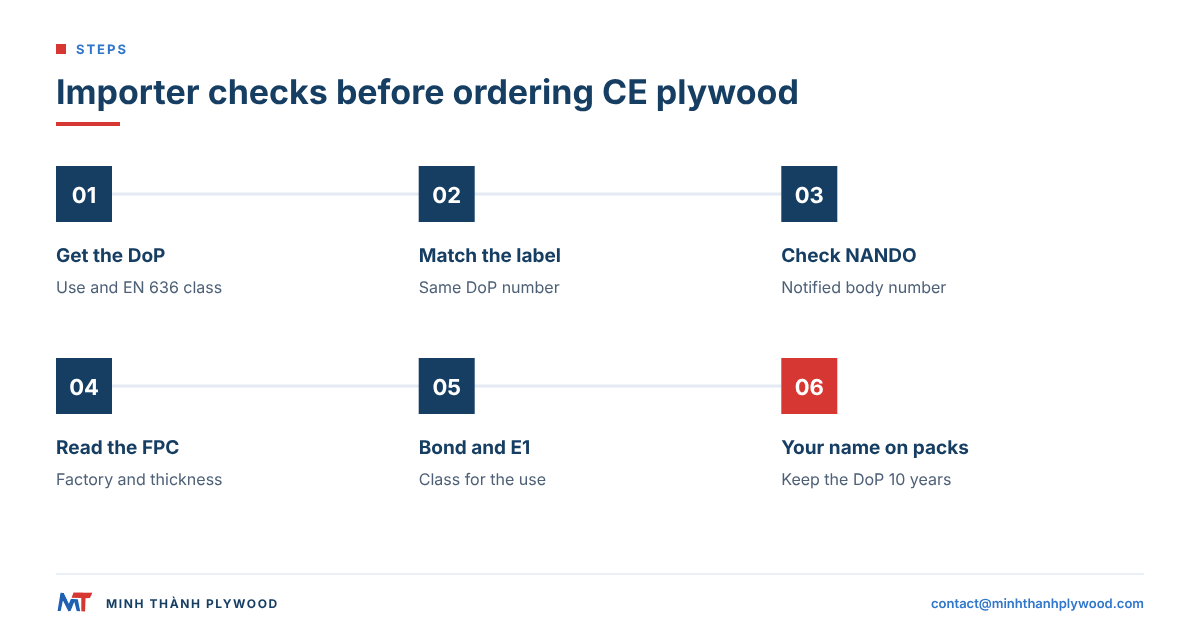
Run these checks on the offer before the order, not on arrival:
- The DoP itself: ask for it with the quotation, read the intended use and the EN 636 class.
- The DoP number on the label matches the DoP and the product-type you ordered.
- The notified body number (System 2+) appears in the European Commission’s NANDO database as notified for the Construction Products Regulation and for wood-based panels.
- The FPC certificate names the factory that presses the panels and covers the product-type and thickness range of your order.
- The bond class is right for the use: Class 2 or 3 for anything that can get wet.
- Formaldehyde is declared E1, and the articles you make from the panels meet the REACH limit.
- Reaction to fire is declared and matches the building rules of your project.
- The language of the DoP and the instructions matches the country of sale.
- Your own name and address will go on the pack labels.
A supplier that answers these nine points in one email has done CE marking before.
CE plywood from Vietnam: what Minh Thanh supplies
Minh Thanh Plywood is a Vietnamese manufacturer built for top-grade furniture and interior plywood, with Europe as its main market. Those panels need no CE marking: they ship with the documents furniture buyers ask for, and CE-marked construction plywood is available* for buyers who need it.
| Document | Status at Minh Thanh |
|---|---|
| CE marking and Declaration of Performance (EN 13986) | Available* |
| CARB P2 / TSCA Title VI | Held, ICTT mill no. 23024 |
| ASTM D6007 chamber tests | Six reports, April 2025 – June 2026, 0.014–0.032 ppm average |
| ISO 9001:2015 quality management | Held, KAC25/0185 |
| TCVN 11902:2017 veneer-faced plywood | Held, VietCert 141.1-VNC-HC |
| PPWR packaging test | SGS, September 2026, pass against the 100 mg/kg limit |
| EUDR compliance dossier | Supplied with orders: origin records and geolocation files |
*Supplied directly or through qualified partner mills.
Buyers in Belgium, Germany, the Czech Republic or any other EU country ask the same two questions: CE marking for construction plywood, and EUDR for every wood product. The EU Deforestation Regulation, Regulation (EU) 2023/1115, applies to plywood importers, and we supply the EUDR compliance dossier with orders. Vietnam is classed as low risk in Implementing Regulation (EU) 2025/1093, which allows simplified due diligence (both checked 20 October 2026). The application date is 30 December 2026 for large and medium operators, as set by Regulation (EU) 2025/2650. Our EUDR traceability page and the quality overview list the files.
What to write in your RFQ for CE-marked plywood
State the use and the declaration you need, so the quotation comes back on the right product-type. A complete line reads:
18 mm × 1220 × 2440 mm; face/back: eucalyptus B/B; core: Eucalyptus; phenolic (WBP) bond; intended use: structural, humid conditions, EN 636-2 S; CE marking under EN 13986, AVCP 2+, DoP in German; formaldehyde E1; 1×40HC CIF Hamburg; EUDR dossier with the shipping documents.
For furniture plywood, replace the CE line with the emission evidence you need, for example “UF glue at E0 emission, CARB P2 / TSCA Title VI, SGS EN 717-1 test on request”. Minh Thanh sends free samples and replies within hours: write to contact@minhthanhplywood.com or WhatsApp +84 988 586 601.
Buyer questions, answered
Does plywood need CE marking?
Only when it is placed on the EU market for use in construction works, such as floors, walls, roofs or sheathing. Plywood for furniture, cabinets, packaging or interior joinery is outside EN 13986 and carries no CE mark under the Construction Products Regulation.
What is EN 13986?
EN 13986:2004+A1:2015 is the harmonised European standard for wood-based panels used in construction. It lists the characteristics a manufacturer declares, the conformity assessment system for each use, and the content of the CE marking.
What is the difference between CE 2+ and CE 4 plywood?
System 2+ applies to structural plywood: a notified body inspects the factory and certifies its production control. System 4 applies to non-structural construction uses: the manufacturer determines the product-type and runs its own production control without a notified body.
What is a Declaration of Performance for plywood?
A Declaration of Performance (DoP) is the manufacturer's signed statement of the declared values of a construction product, such as bending strength, bond class, formaldehyde class and reaction to fire, for its intended use. The CE label refers to it by number.
Who issues a CE certificate for plywood?
For structural plywood under System 2+, a notified body issues the certificate of conformity of the factory production control. The manufacturer still draws up the Declaration of Performance and affixes the CE mark. Under System 4 there is no third-party certificate.
How long is a CE certificate for plywood valid?
The CE mark has no expiry date. The notified body's factory production control certificate stays valid while surveillance audits continue and the product, glue system and standard are unchanged; a change in any of them means reassessment.
Do I need CE marking and EN 13986 for plywood imported from Vietnam?
The rule is the same as for European plywood: construction plywood needs CE marking and a Declaration of Performance, furniture plywood does not. The importer checks that the manufacturer has done both before placing the panels on the market.
Is E1 the same as CE marking?
No. E1 is the formaldehyde class declared inside the Declaration of Performance under EN 13986. CE marking covers the whole set of declared characteristics for construction use; E1 is one of them.
What does an EU importer of plywood have to keep?
A copy of the Declaration of Performance for ten years after the product is placed on the market, and proof that the CE marking and the manufacturer's technical documentation are in place. The importer's name and contact address go on the product or its packaging.
Does Minh Thanh supply CE-marked plywood?
Yes, CE-marked construction plywood is available* from Minh Thanh for buyers who need it, with the Declaration of Performance. Our furniture and interior panels are made for European buyers and need no CE marking. *Supplied directly or through qualified partner mills.
Which other EU rules apply to plywood besides CE marking?
The REACH formaldehyde limit for wood-based articles from 6 August 2026, the EUDR due diligence for wood products from 30 December 2026, and the PPWR for the packaging. CE marking under EN 13986 only covers construction uses.