
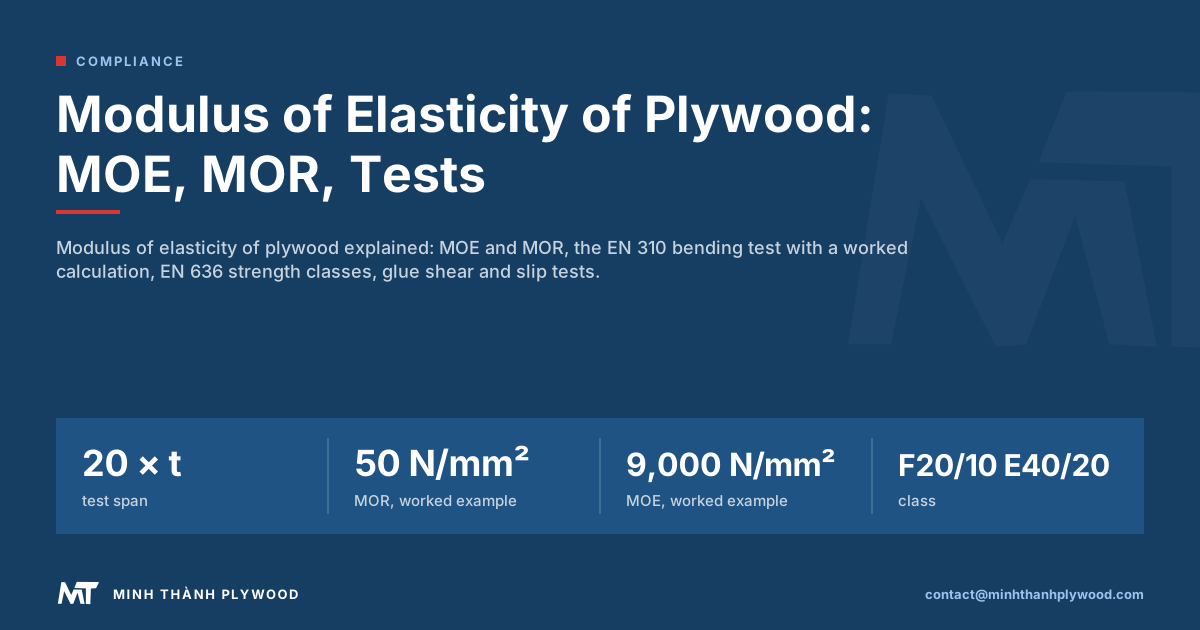
The modulus of elasticity (MOE) of plywood measures its material stiffness: the ratio of bending stress to strain in the elastic range, given in N/mm² from the EN 310 three-point bending test, together with bending strength (MOR). Minh Thanh Plywood explains the test, the calculation, the EN 636 classes and the shear and slip values a datasheet should carry.
What is the elastic modulus of plywood?
The elastic modulus of plywood, also called the modulus of elasticity (MOE) or Young’s modulus, is the ratio of bending stress to strain while the panel still springs back. It tells you how stiff the panel is, in N/mm², which is the same unit as MPa; 9,000 N/mm² is 9 GPa.
Plywood has two values, not one. MOE parallel to the face grain (Em,0) is measured with the face veneers running along the span; MOE perpendicular (Em,90) with the face veneers running across it. The parallel value is always the higher one, and a datasheet that gives a single MOE without a direction is incomplete.
For a buyer, MOE answers practical questions: how much a shelf sags, how far a floor deck deflects between joists, how much a formwork panel bows under wet concrete. Strength answers a different one: the load at which the panel breaks.
Typical MOE of plywood by type, in N/mm² and psi
Published MOE of plywood runs from about 4,000 to 12,500 N/mm², depending on species, ply count and whether the figure is a design value or a test mean. To convert, 1,000 N/mm² is about 145,000 psi, and 1 GPa is 1,000 N/mm².
| Plywood or panel type | MOE along the face grain | In psi | Basis and source |
|---|---|---|---|
| Finnish conifer plywood, 15 mm, 11 plies, sanded | 4,750 N/mm² (3,300 N/mm² across) | about 689,000 psi (479,000 psi across) | BS 5268-2 grade modulus, service classes 1 and 2, as tabulated by Roymech |
| Finnish birch plywood, 18 mm, 13 plies | 7,452 to 10,048 N/mm² (the two directions) | about 1,081,000 to 1,457,000 psi | Mean bending moduli, UPM WISA-Form Birch datasheet |
| Plywood in general | 7,000 to 8,600 N/mm² | about 1,015,000 to 1,247,000 psi | Engineering Toolbox panel table, density 400 to 600 kg/m³ |
| US structural softwood plywood, Group 1 face plies | about 12,500 N/mm² | about 1,815,000 psi | Plywood Design Specification Table 2 |
| LVL for contrast (Kerto-S) | 13,800 N/mm² mean, 11,600 N/mm² characteristic | about 2,001,000 psi mean | Metsa Wood declaration of performance |
Read the rows as indicative ranges, not a datasheet: a US softwood panel is typically quoted at 1.5 to 1.8 million psi, so check the datasheet of the panel you buy. Three patterns hold across the table:
- Design values sit below test means. The Roymech grade modulus for 15 mm conifer plywood (4,750 N/mm²) is a design figure; mean values from a test, like the birch figures above, are higher. Compare mean with mean.
- Density lifts MOE. In a laboratory comparison of nine-ply panels, eucalyptus plywood (about 700 to 720 kg/m³) showed higher MOR and MOE than poplar plywood (about 500 to 560 kg/m³). Eucalyptus-core hardwood panels such as ours stiffen with their core, while poplar and okoume panels are lighter and more flexible.
- Moisture changes the number. Published values assume a stated moisture content, usually the equilibrium of 12 %, and plywood loses stiffness as it gets wetter. Ask for the moisture at test.
The perpendicular value is the lower one in every row where it is given, which is why the next sections separate the two directions.
Bending strength of plywood (MOR) vs modulus of elasticity
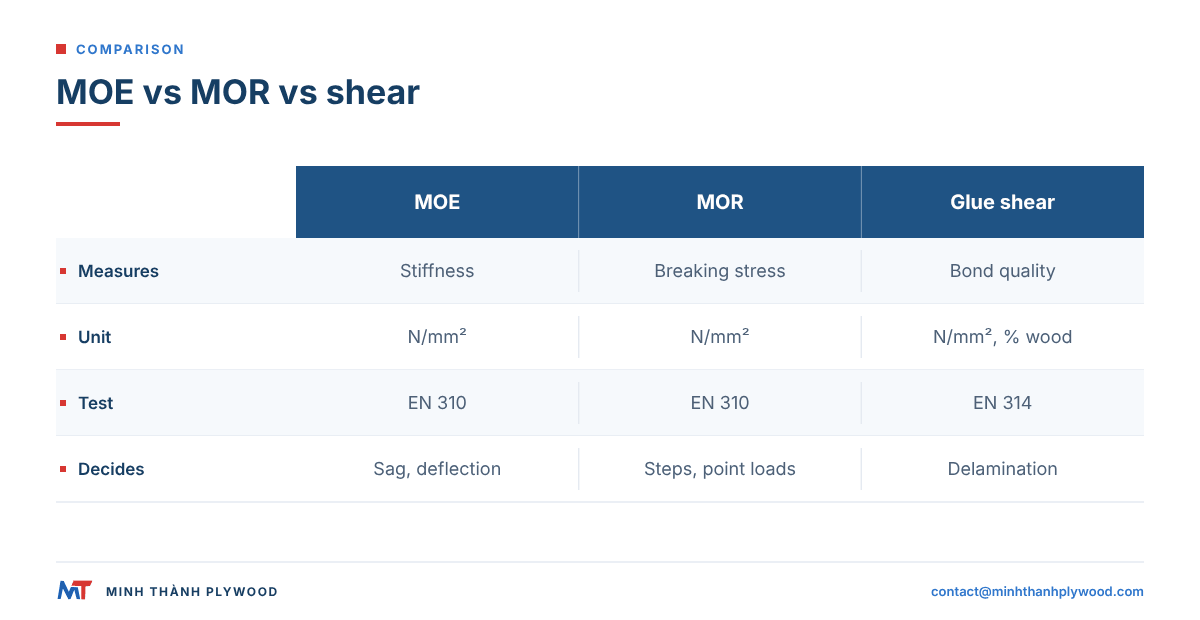
Bending strength (MOR, modulus of rupture) is the stress at which a plywood sample breaks in bending; MOE is how stiff it is before that point. Both come from the same test on the same sample, which is why datasheets list them side by side.
| Value | What it measures | Unit | Where it decides | Test |
|---|---|---|---|---|
| MOE, modulus of elasticity | Stiffness in the elastic range | N/mm² | Sag of shelves, deflection of floors and formwork | EN 310 (EN 789 for structural values) |
| MOR, bending strength | Stress at failure in bending | N/mm² | Steps, cantilevers, point loads | EN 310 (EN 789) |
| Shear strength of the glue line | Bond quality after a pretreatment | N/mm² and % wood failure | Delamination in humid or exterior use | EN 314-1, judged by EN 314-2 |
| Compressive strength | Stress at failure under crushing | N/mm² | Load under posts and fixings | EN 789 |
| Slip resistance | Grip of the surface | R class or pendulum value | Floors, trailer decks, stages | DIN 51130, EN 16165 |
Plywood flexural strength is another name for MOR. A panel can pass on strength and fail on stiffness: a long shelf in thin poplar plywood rarely breaks, but it can sag visibly, so the MOE is the value to compare for spans.
How the EN 310 bending test works
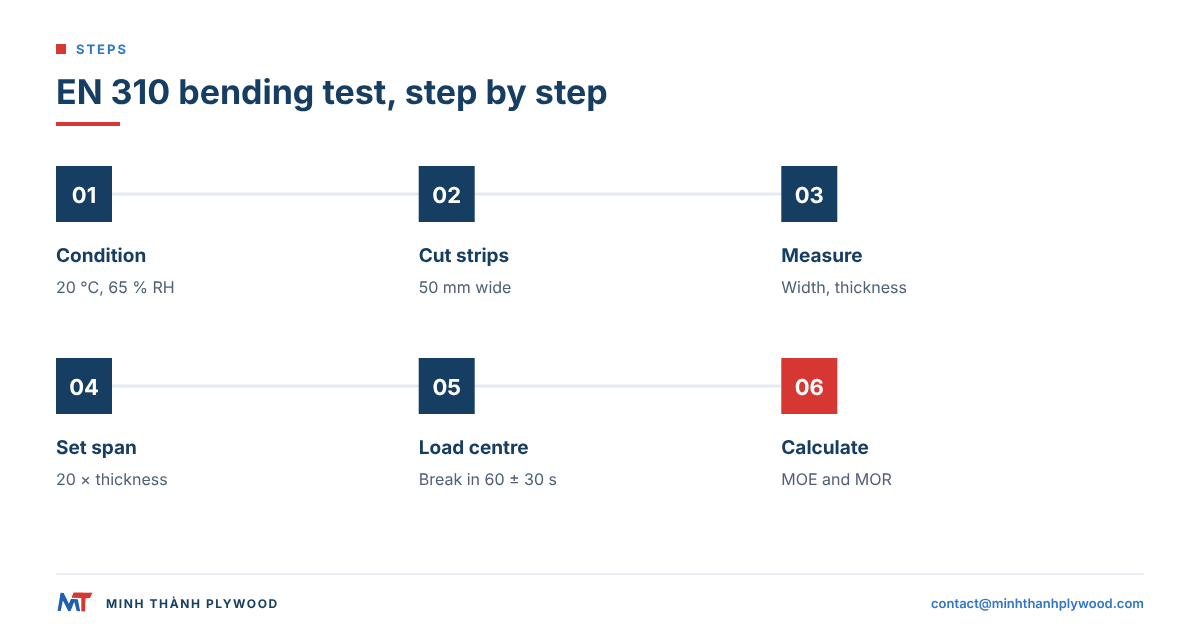
EN 310 measures MOE and MOR with a three-point bending test on small strips cut from the panel. The laboratory runs it in this order:
- Condition the samples at 20 °C and 65 % relative humidity until their mass is stable, so moisture does not change the result.
- Cut the strips: 50 mm wide, with a length of 20 times the thickness plus 50 mm, half with the face grain along the strip and half across it.
- Measure width and thickness of each strip to 0.1 mm or better; thickness enters the result squared and cubed.
- Set the span at 20 times the nominal thickness between the two supports, 360 mm for an 18 mm panel.
- Load the centre at a constant rate, so that the strip breaks in 60 ± 30 seconds.
- Record load and deflection through the elastic range, and the maximum load at failure.
- Calculate MOE from the straight part of the load-deflection curve and MOR from the maximum load, then report the mean of each direction.
The full test is short: a set of strips from one panel is conditioned, cut and broken in a few days. Minh Thanh arranges it through SGS on request, on panels from your production.
How to calculate MOR and MOE: a worked example
MOR and MOE come from two short formulas in EN 310. F is the load in newtons, l the span, b the width, t the thickness and a the deflection, all in millimetres, and the example below applies them to a standard test strip:
- MOR = 3 × Fmax × l ÷ (2 × b × t²)
- MOE = l³ × (F2 − F1) ÷ (4 × b × t³ × (a2 − a1)), with F1 at about 10 % and F2 at about 40 % of the maximum load.
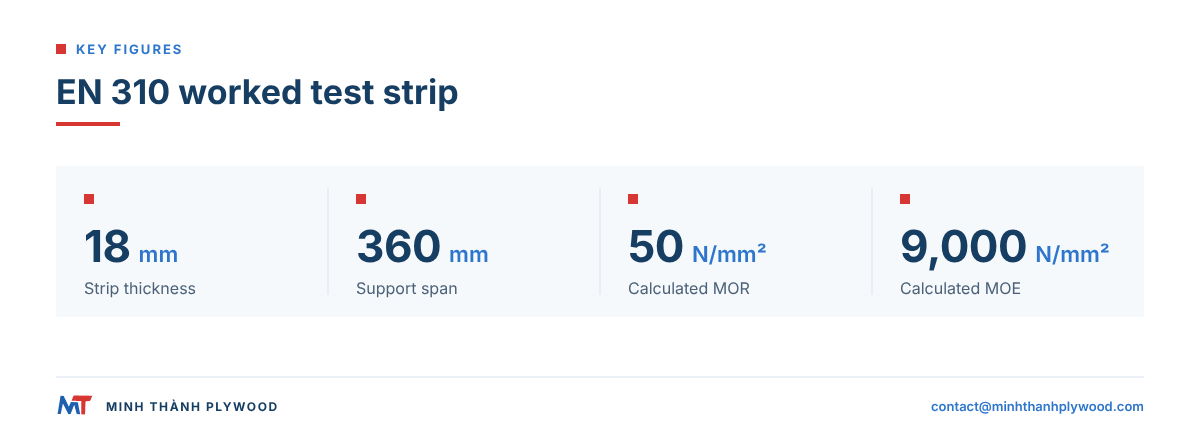
Take an 18 mm strip, 50 mm wide, on a 360 mm span, that breaks at 1,500 N:
- t² = 18 × 18 = 324; 2 × 50 × 324 = 32,400.
- 3 × 1,500 × 360 = 1,620,000.
- MOR = 1,620,000 ÷ 32,400 = 50 N/mm².
For MOE, the load rises by 450 N between F1 and F2 while the centre deflects a further 2.0 mm:
- l³ = 360³ = 46,656,000; × 450 = 20,995,200,000.
- t³ = 5,832; 4 × 50 × 5,832 × 2.0 = 2,332,800.
- MOE = 20,995,200,000 ÷ 2,332,800 = 9,000 N/mm².
The same arithmetic shows why thickness accuracy matters. If the strip were 18.2 mm thick and the laboratory used 18 mm, the stiffness term would be off by (18.2 ÷ 18)³, about 3.4 %, and the strength term by about 2.2 %. Calibrated panels held to ±0.2–0.3 mm give test results that repeat.
Section properties of plywood per 1 m width
Section properties turn a panel’s MOE into a deflection: stiffness is MOE times the second moment of area (I), and bending resistance is the section modulus (Z). For a 1 m wide strip of solid section, I = b × t³ ÷ 12 and Z = b × t² ÷ 6.
| Thickness | I per 1 m width (gross) | Z per 1 m width (gross) |
|---|---|---|
| 12 mm | 144,000 mm⁴ | 24,000 mm³ |
| 18 mm | 486,000 mm⁴ | 54,000 mm³ |
The 18 mm panel is 1.5 times as thick as the 12 mm one and 3.4 times as stiff in I, because stiffness grows with thickness cubed. Design tables such as BS 5268-2 list lower effective values, because the cross veneers add little in bending. For Finnish birch-faced plywood of 15 mm and 11 plies, the table gives I of 224,000 mm⁴ and Z of 32,200 mm³, about 20 % and 14 % below the gross values. Use the effective figures from the panel’s datasheet or the standard for design, and the gross ones for a quick estimate.
Why plywood has a parallel and a perpendicular value
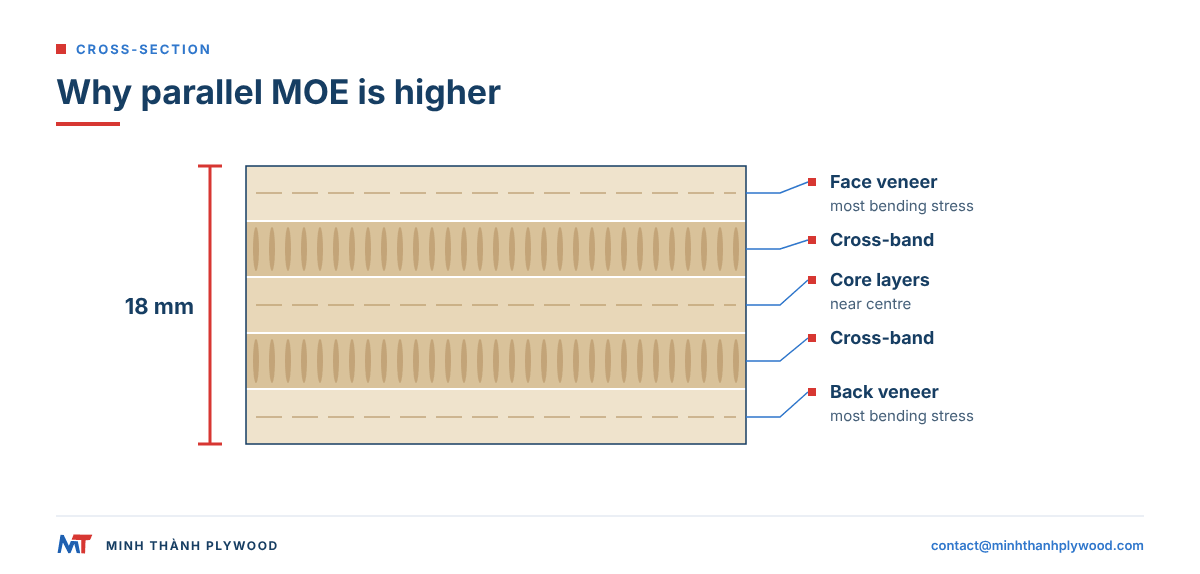
Plywood is stiffer along the face grain because its outer veneers run that way, and the outer layers carry most of the bending stress. In bending, stress is highest at the top and bottom surfaces and zero at the centre, so the face and back decide most of the stiffness in their direction.
An 18 mm panel is usually built from 11–13 plies, with alternating grain. Along the length, the face, the back and every second core layer run with the span. Across the width, the two outer veneers are the “wrong way”, and the next layers in carry the load from a shorter lever arm. The result is a perpendicular MOE well below the parallel one, and the gap narrows as the ply count rises.
For a design, this means one rule: put the face grain across the supports. A floor deck laid with the face grain along the joists, or a shelf cut with the grain running front to back, uses the weaker direction of the panel.
What changes the modulus of elasticity of plywood
Five things move the MOE of a plywood panel, in this order of effect:
- Species and density. Denser wood is stiffer. Birch faces give the highest values of the common plywood faces; a heavier core lifts stiffness as well. Reference core densities: Styrax about 500 kg/m³, Acacia about 580 kg/m³, Eucalyptus about 650 kg/m³.
- Ply layout. The share of veneer running with the span, and how far from the centre it sits, sets the parallel and perpendicular values.
- Moisture. Wood loses stiffness as it takes up water. Minh Thanh dries veneers and finished panels to 8–12 % moisture content at dispatch, the normal range for furniture plywood.
- Bond and pressing. A full, even glue line lets the layers work together; gaps and voids in the core act like missing wood.
- Thickness accuracy. A panel that varies in thickness gives varying test results, as the worked example shows.
Glue type changes MOE little in dry conditions. It matters once the panel gets wet, which is the job of the bond class in EN 314-2.
EN 636 strength classes: reading F20/10 E40/20
EN 636 classes plywood for structural use by bending strength (F classes) and bending stiffness (E classes), each given parallel and perpendicular to the face grain. The BSI description of BS EN 636:2012+A1:2015 (checked on 27 October 2026) covers plywood for structural and general-purpose use in dry, humid or exterior conditions. “F20/10 E40/20” reads as follows:
| Part of the class | Meaning | Value |
|---|---|---|
| F20 | Characteristic bending strength, parallel | 20 N/mm² |
| /10 | Characteristic bending strength, perpendicular | 10 N/mm² |
| E40 | Mean modulus of elasticity, parallel (class number × 100) | 4,000 N/mm² |
| /20 | Mean modulus of elasticity, perpendicular | 2,000 N/mm² |
Characteristic strength is a low-end value, the level that 95 % of samples reach, so it sits well below the mean MOR a laboratory reports. Do not compare a datasheet’s mean MOR with an F class directly; compare class with class, or mean with mean.
For structural plywood sold in the EU, the class or the declared values go into the Declaration of Performance under EN 13986, the harmonised standard for wood-based panels. CE marking itself rests on the Construction Products Regulation, Regulation (EU) No 305/2011 (checked 20 October 2026). Our guide to EN 13986 and CE marking explains when that applies.
Compressive strength of plywood and flexural strength
The compressive strength of plywood is the stress at which it crushes under a load in its plane, tested to EN 789 for structural plywood and declared parallel and perpendicular to the face grain like bending values. It is lower than the bending strength of the same panel, and like MOE it is higher along the face grain.
Compression decides where a load is concentrated: under a post on a deck, at a hinge or bolt on a box, on the bearing edge of a beam. Plywood flexural strength, the bending MOR, decides spans and steps. For furniture parts, the screw holding and edge compression of the core matter more than either; a dense, void-free core takes screws and edge loads better than a light one with gaps.
Compression perpendicular to the panel surface, the crushing of the panel under a point load, depends mostly on core density. Eucalyptus and Acacia cores are heavier than Styrax and resist dents better, at the cost of weight per sheet.
Glue shear strength of plywood: EN 314
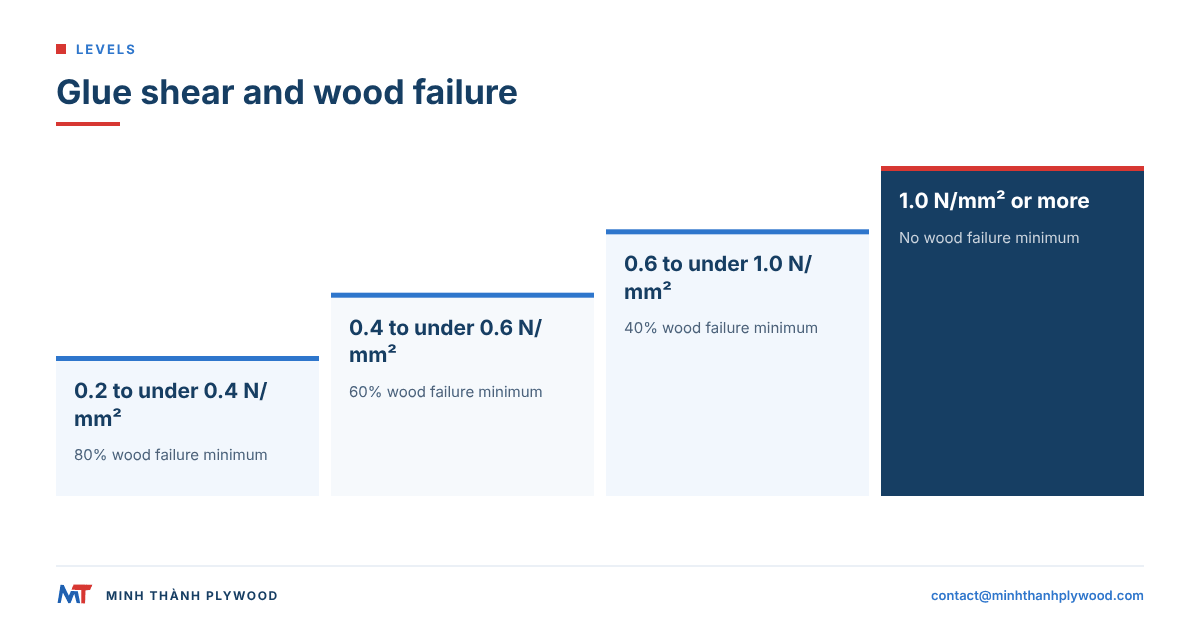
The glue shear strength of plywood is tested with EN 314-1 and judged with EN 314-2: a notched sample is pretreated in water, then pulled apart in shear, and the result is read together with the share of wood failure on the broken surface. The BSI description of EN 314-2 (accessed 27 October 2026) defines its scope as bonding-quality requirements.
| Mean shear strength fv | Minimum apparent wood failure |
|---|---|
| 0.2 ≤ fv < 0.4 N/mm² | 80 % |
| 0.4 ≤ fv < 0.6 N/mm² | 60 % |
| 0.6 ≤ fv < 1.0 N/mm² | 40 % |
| fv ≥ 1.0 N/mm² | No requirement |
The pretreatment decides the bond class: soaking 24 hours in water at 20 °C for Class 1 (dry), boiling 6 hours and cooling 1 hour for Class 2 (humid), and cyclic or 72-hour boiling for Class 3 (exterior). The 72-hour boil is a bond test on a sample, not an emission test and not a marine rating on its own.
Minh Thanh furniture panels use UF glue at E0 emission, a Class 1 bond for dry interior use; melamine-fortified and phenolic (WBP) bonds are made to the customer’s specification, as on our exterior plywood.
Plywood slip resistance standards: DIN 51130 and EN 16165
Slip resistance of plywood floors is rated with DIN 51130 R classes or the methods of EN 16165, which brings the inclined ramp, the pendulum and the tribometer into one European standard. The ramp test is the one most buyers know:
| R class (DIN 51130) | Ramp angle at which the tester slips |
|---|---|
| R9 | 6–10° |
| R10 | over 10–19° |
| R11 | over 19–27° |
| R12 | over 27–35° |
| R13 | over 35° |
The pendulum test gives a pendulum test value (PTV); the UK Slip Resistance Group guidance reads 36 or more as low slip potential in wet conditions. A ramp class and a pendulum value are different measurements and do not convert into each other, so state which one your project requires.
The class belongs to the surface, not to the board. A hexagon-pattern film on anti-slip plywood, which Minh Thanh accepts on order, is tested as delivered; a smooth film-faced plywood of the same core gives a different result.
Abrasion resistance of film-faced and anti-slip plywood
Abrasion resistance of a film-faced panel is tested with a Taber abraser: a pair of abrasive wheels turns on the surface until the film wears through, and the result is the number of revolutions. A heavier film and a phenolic film with more resin last longer; the core does not change the number.
Ask for the Taber result together with the film weight and colour you are ordering, because the value belongs to that film. For trailer floors and stage decks, the abrasion of the anti-slip pattern decides how long the R class holds; for formwork, the film’s resistance to wear and release agent decides the number of pours.
Which values to ask for in a plywood datasheet
A plywood datasheet worth comparing gives each value with its direction, its test standard and the panel it was measured on. Ask for:
- MOE and MOR, parallel and perpendicular, mean values, EN 310 (or the EN 636 class and EN 789 values for structural use).
- The panel build: thickness, ply count, face and core species.
- Bond class to EN 314-2, with the pretreatment.
- Density of the panel as tested.
- Moisture content at test.
- For film or anti-slip faces: film weight, Taber result and the slip class or pendulum value of the delivered surface.
- The laboratory and the date of the report.
Values without a build and a standard cannot be compared. Where a mill has no report for your exact specification, the reliable route is a test on your own production: Minh Thanh arranges third-party testing to the buyer’s method through SGS on request.
What Minh Thanh controls that moves the numbers
Stiffness and strength are decided on the factory floor, before any test. Minh Thanh controls the steps that move them:
- Double pressing. Furniture-grade panels are pressed twice as standard: the core board is pressed and calibrated, then face and back are pressed on. The calibrated core gives the face an even bed and the panel an even thickness.
- Stitched cores. Core layers are stitched both horizontally and vertically, so the core is closed and the layers work together in bending.
- Thickness tolerance. Sanded furniture panels are held to ±0.2–0.3 mm, down to ±0.2 mm, which keeps test results repeatable.
- Moisture. Veneers and finished panels go out at 8–12 % moisture content.
- Core choice. Styrax for lighter panels, Eucalyptus for heavier, harder ones; Acacia and Pine cores on order.
These are the build details to put in the specification. The quality page shows the certificates and test reports Minh Thanh holds.
What to write in your RFQ when strength values matter
Put the use, the build and the test in one line, so the quotation is for a panel that meets your numbers:
18 mm × 1220 × 2440 mm; face/back: birch D/E; core: Eucalyptus, stitched, double pressed; melamine-fortified bond, EN 314-2 Class 2; MOE and MOR to EN 310, parallel and perpendicular, SGS report on the first production; thickness ±0.3 mm; 1×40HC CIF your port.
Minh Thanh sends free samples of the specified panel for your own tests and replies within hours: contact@minhthanhplywood.com or WhatsApp +84 988 586 601.
Buyer questions, answered
What is the modulus of elasticity of plywood?
It is the panel's stiffness in bending: the ratio of stress to strain in the elastic range, measured with the EN 310 three-point bending test and given in N/mm² (MPa), parallel and perpendicular to the face grain.
How do you calculate MOR for plywood?
MOR equals 3 × maximum load × span divided by 2 × width × thickness squared. For an 18 mm, 50 mm wide sample on a 360 mm span that breaks at 1,500 N, MOR is 50 N/mm².
What is the difference between MOE and MOR?
MOE measures stiffness, how little the panel bends under a load it can carry. MOR measures strength, the stress at which it breaks. A shelf that sags fails on MOE; a step that cracks fails on MOR.
Is plywood flexural strength the same as bending strength?
Yes. Flexural strength, bending strength and modulus of rupture (MOR) name the same value: the maximum bending stress a sample carries before it fails in the EN 310 test.
Why is plywood stiffer along the face grain?
The face and back veneers run along the panel length and sit farthest from the centre, where bending stress is highest. Across the panel the outer veneers are cross-grain, so the perpendicular MOE is lower.
What does F20/10 E40/20 mean on plywood?
It is the EN 636 strength class: characteristic bending strength of 20 N/mm² parallel and 10 N/mm² perpendicular, and mean modulus of elasticity of 4,000 N/mm² parallel and 2,000 N/mm² perpendicular to the face grain.
What is the glue shear strength requirement for plywood?
EN 314-2 links shear strength to wood failure: from 0.2 to below 0.4 N/mm² the sample needs at least 80 % wood failure, and at 1.0 N/mm² or more no wood failure is required. The pretreatment sets bond class 1, 2 or 3.
Which standard covers slip resistance of anti-slip plywood?
DIN 51130 rates floors R9 to R13 on an inclined ramp, and EN 16165 brings the ramp, pendulum and tribometer methods into one European standard. Buyers ask for the class or the pendulum value of the actual surface.
Can Minh Thanh test MOR and MOE on my order?
Yes. Third-party testing to the buyer's method, such as EN 310 for bending or EN 314 for bond quality, is arranged through SGS on request, on panels from your production.
Does a thicker panel always have a higher MOE?
No. MOE is a material value, so thickness is already divided out. A thicker panel is stiffer as a part, because stiffness grows with thickness cubed, but its MOE depends on species, ply layout and bond.