
CE2+ ply is plywood CE-marked for structural use under system 2+ of the EU Construction Products Regulation. The mill tests the panel and runs factory production control; a notified body certifies and audits that control. The mark proves declared structural performance, not water resistance. Minh Thanh Plywood explains the DoP, the label, UKCA and Q-Mark, and what to put in an order.
What is CE2+ plywood?
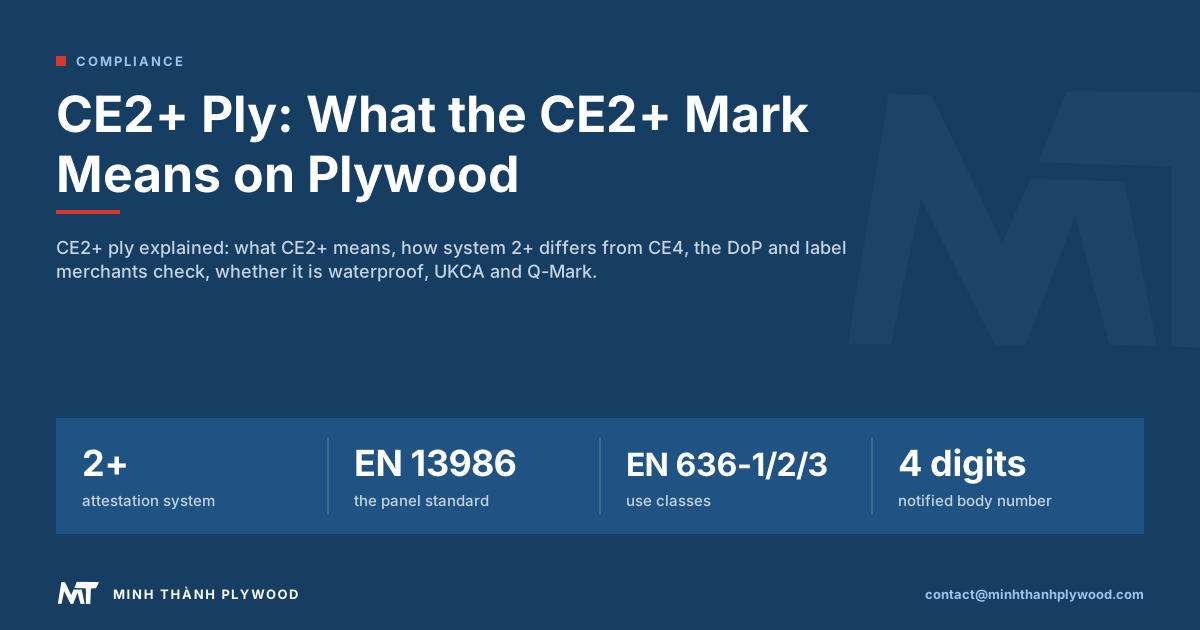
CE2+ ply is plywood that carries the CE mark for structural use under assessment system 2+ of the EU Construction Products Regulation. The “2+” names the level of third-party control: the mill tests its panels and runs factory production control, and a notified body certifies that control and audits it every year.
The term is trade shorthand, common with UK and Irish builders’ merchants: “CE2+ marine”, “CE2+ shuttering ply”, “18 mm hardwood CE2+”. The panel itself shows the CE mark and the notified body’s four-digit number, not the letters “CE2+”.
What CE2+ ply proves is narrow and useful: the strength, stiffness and bond values in its Declaration of Performance were checked by an independent body. That is why it is the minimum for load-bearing floors, roof decks and wall sheathing in the EU and UK.
CE2+ meaning: what does the “2+” stand for?
The “2+” is one of the systems of assessment and verification of constancy of performance (AVCP) set by Regulation (EU) No 305/2011, the Construction Products Regulation. Each system says who checks what before a product can carry the CE mark.
| System | Who does the type testing | Who checks factory production control | Used for plywood |
|---|---|---|---|
| 1 | Notified product certification body | Notified body, initial and ongoing | Some reaction-to-fire classes |
| 2+ | Manufacturer | Notified body certifies and audits it every year | Structural use |
| 3 | Notified testing laboratory | Manufacturer alone | Some reaction-to-fire classes |
| 4 | Manufacturer | Manufacturer alone | Non-structural use |
For plywood, the harmonised standard is EN 13986, which covers “wood-based panels for use in construction”. Its annex assigns system 2+ to panels for structural use and system 4 to non-structural panels. So the CE2+ meaning, in one line, is “structural plywood with an independently audited factory”.
How does a plywood mill get CE2+?
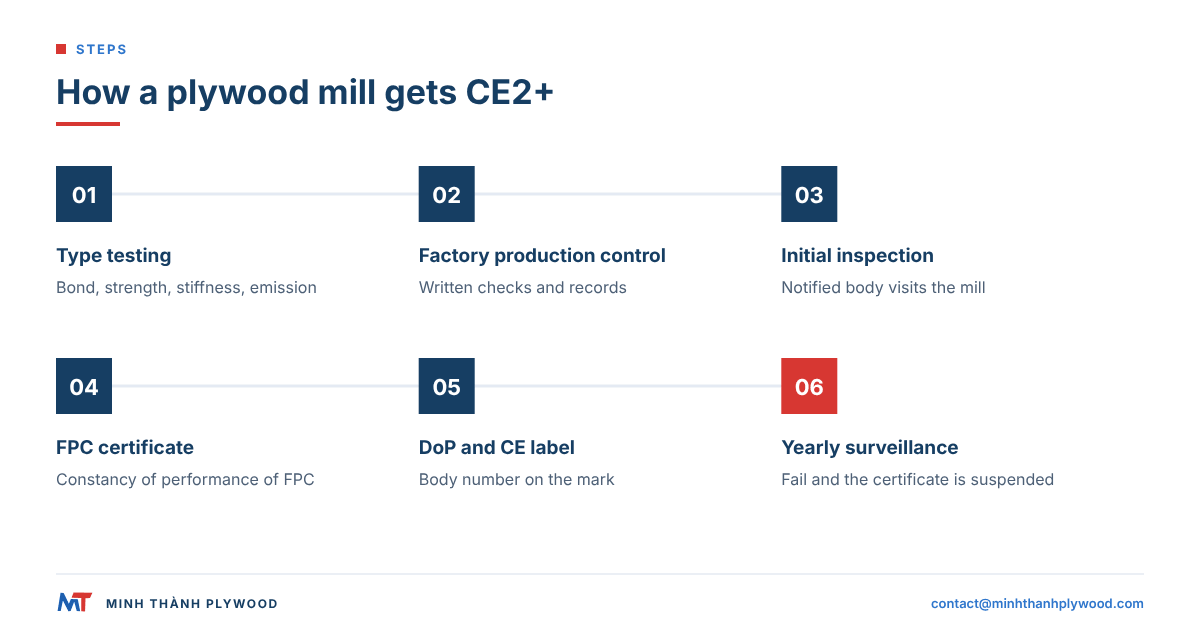
A plywood mill gets CE2+ by proving the panel’s performance, setting up factory production control and passing a notified body’s inspection. The process runs in six steps:
- Type testing. The mill determines the product type: bond quality to EN 314, bending strength and stiffness to EN 310 or EN 789, formaldehyde class, and the other characteristics it will declare.
- Factory production control (FPC). A written system of incoming veneer and glue checks, process records, regular bond and dimension tests, and handling of non-conforming panels.
- Initial inspection. The notified body visits the mill and checks the FPC against EN 13986.
- Certificate. The notified body issues a certificate of constancy of performance of factory production control.
- Declaration of Performance and CE label. The mill writes the DoP and applies the CE mark with the notified body number.
- Continuous surveillance. The notified body audits the FPC again, normally every year.
If surveillance fails, the certificate is suspended and the panels can no longer be sold as CE2+.
CE2+ vs CE4: what is the difference?
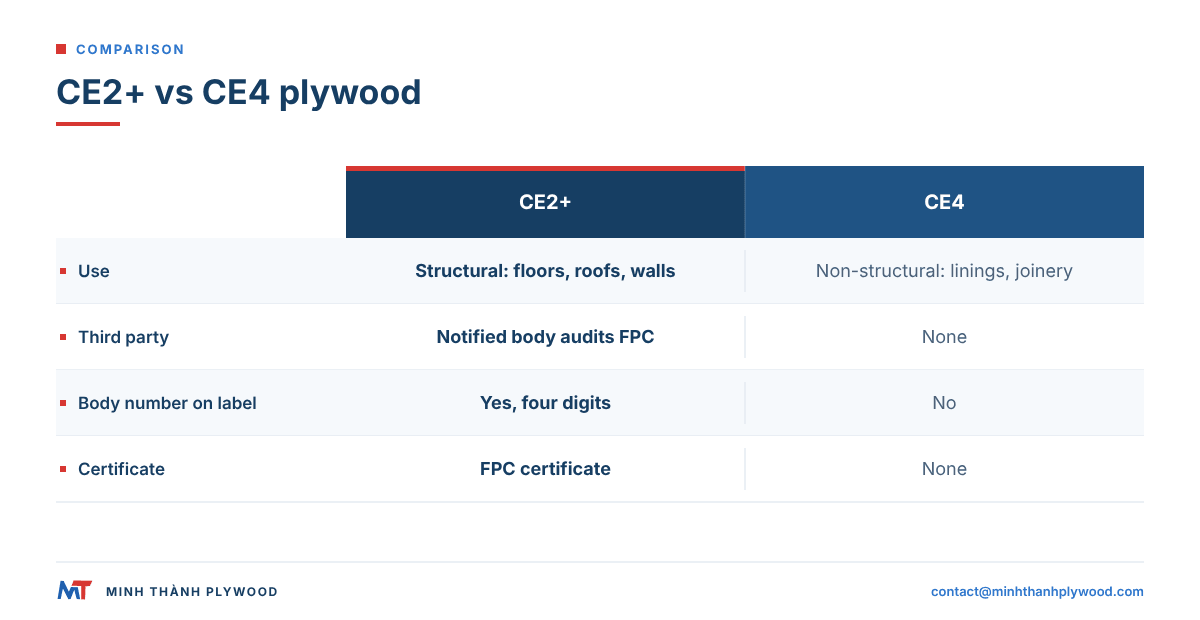
CE2+ plywood is approved for structural work with third-party oversight; CE4 plywood is self-declared and for non-structural work only. Both carry the CE mark, so the difference is in the documents and the label.
| Point | CE2+ | CE4 |
|---|---|---|
| Intended use | Structural: floors, roofs, walls, load-bearing parts | Non-structural: linings, joinery, packing |
| Third party | Notified body certifies and audits FPC | None |
| Notified body number on label | Yes, four digits | No |
| Certificate | Certificate of constancy of performance of FPC | None |
| Declared values | Strength, stiffness, bond, density, formaldehyde and more | Fewer characteristics |
| Price | Higher: audits, testing, selected veneer | Lower |
Merchants in the UK and Ireland sell both side by side. CE4 panels are not inferior for their own use: a cupboard back or a crate does not need structural verification. They are wrong only when used where the building rules ask for a structural panel.
Which plywood needs CE2+?
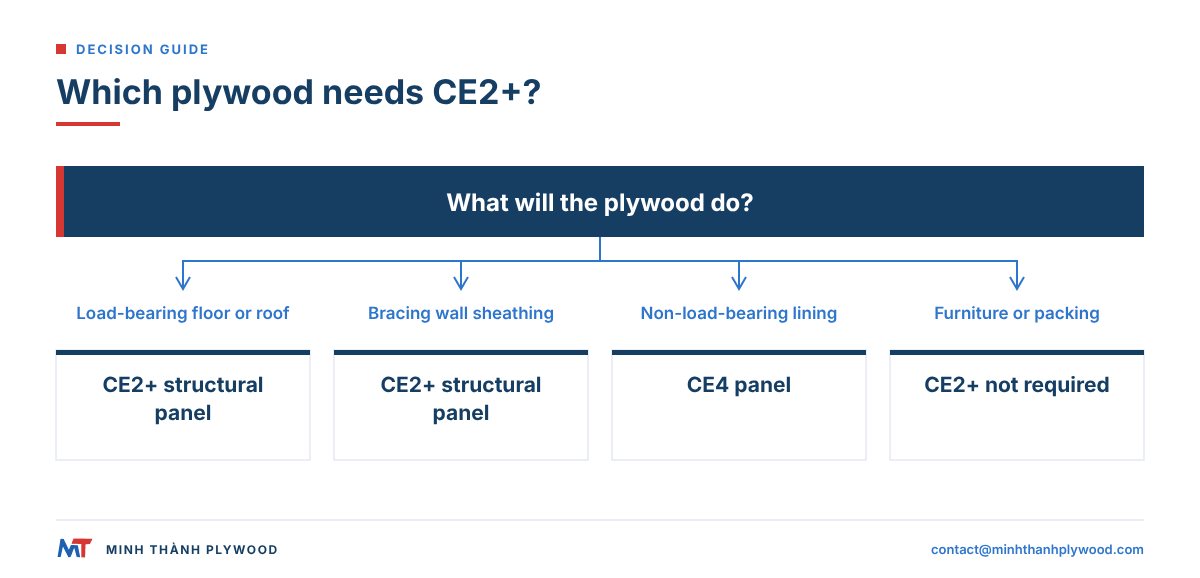
Plywood needs CE2+ when it carries load or bracing in a building: suspended floors, roof decks, wall sheathing that braces the frame, structural web members and site hoardings designed as structures. Building control officers and engineers ask for the DoP for these uses.
Plywood that does not need CE2+:
- Furniture and cabinet plywood. Outside the scope of EN 13986; no CE mark needed.
- Interior linings and joinery that carry no load: CE4 is enough.
- Packing and crating plywood: not a construction product.
- Concrete formwork: usually specified by reuse and film quality rather than CE2+, although some contractors ask for it.
Structural softwood plywood, such as Nordic spruce or pine, and hardwood plywood, such as eucalyptus or birch, can both be CE2+. The species changes the declared strength class, not the system.
Is CE2+ plywood waterproof?
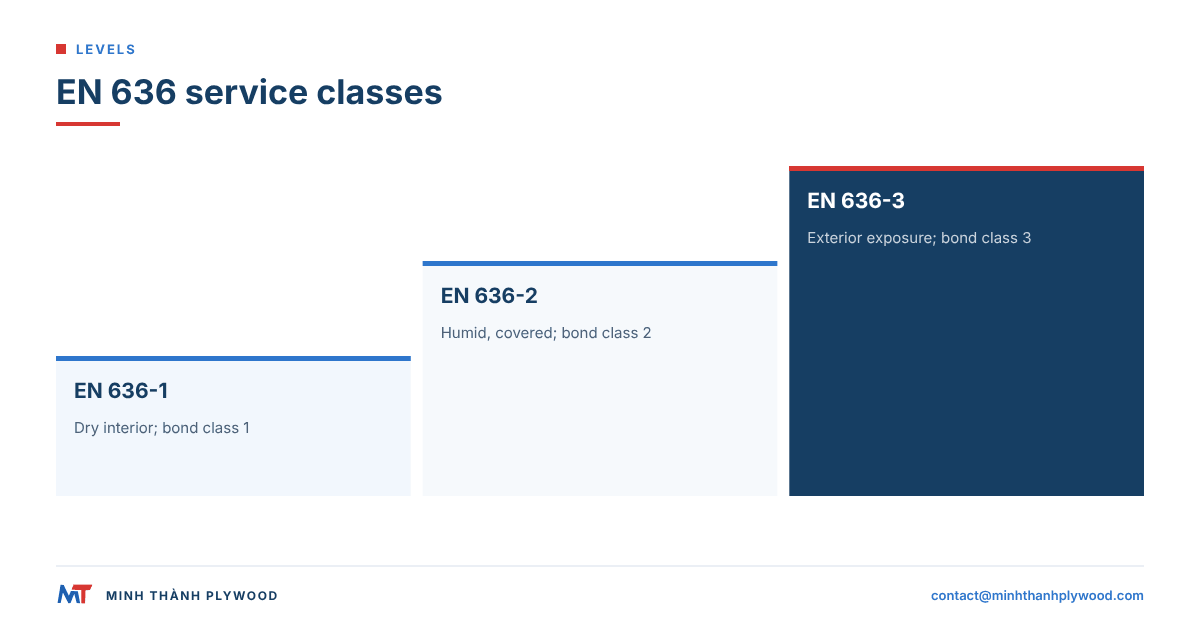
CE2+ plywood is not automatically waterproof; CE2+ describes the verification system, while the EN 636 class on the Declaration of Performance describes the conditions the panel can take. The BSI listing for BS EN 636:2012+A1:2015 identifies plywood specifications for dry, humid and exterior conditions. Read the class, not the mark.
| EN 636 class | Service conditions | Bond class (EN 314-2) | Typical use |
|---|---|---|---|
| EN 636-1 | Dry, heated interiors | Class 1 | Interior structural parts |
| EN 636-2 | Humid, covered, no direct weather | Class 2 | Roof decks under covering, wall sheathing |
| EN 636-3 | Exterior, exposed to weather | Class 3 | External sheathing, hoardings, marine-style use |
An “S” after the class, such as EN 636-2 S, marks a panel for structural use. For outdoor or wet work, ask for EN 636-3 with bond class 3; the glue is normally phenolic (WBP) or a melamine-fortified system tested to that class.
What should the Declaration of Performance show?
The Declaration of Performance (DoP) states, in one document, what the plywood is for and the values the mill declares for it. A UK or EU merchant checks it before listing a structural panel.
A complete DoP for CE2+ plywood shows:
- A unique DoP number and the product-type code.
- The intended use: structural, with the EN 636 class, for example EN 636-2 S.
- The AVCP system: 2+.
- The notified body: name, number and the FPC certificate number.
- Declared performance: bending strength and stiffness (or strength class), bond quality, formaldehyde class, reaction to fire, density, biological durability class where relevant.
- The harmonised standard: EN 13986.
- Signature, date and place of the manufacturer.
A DoP that lists “NPD” (no performance determined) for strength or bond cannot back a structural use.
What does the CE label on CE2+ plywood look like?
The CE label on CE2+ plywood shows the CE mark, the notified body number, the manufacturer, the DoP reference and the key declared values. It is printed on the panel edge or face, or on the pack label when the panel is too small.
Typical label content:
- CE mark followed by the four-digit notified body number.
- Manufacturer name and address, or a code that leads to it.
- Year the marking was first affixed.
- DoP reference number.
- EN 13986 and the product description, such as “EN 636-2 S”.
- Key declared values: formaldehyde class, reaction to fire, bond class.
If the label has no notified body number, the panel is CE4, whatever the invoice says.
What is Q-Mark plywood, and how does it relate to CE2+?
Q-Mark plywood is plywood certified under BM TRADA’s Q-Mark scheme, a voluntary UK product certification that sits on top of CE2+. The scheme audits the mill and tests samples regularly, then lists approved products, which gives merchants a second check on imported structural plywood.
Q-Mark became common for hardwood plywood from Asia sold in the UK, because merchants wanted independent proof beyond the manufacturer’s own declaration. A Q-Mark panel is normally also CE2+ or UKCA-marked; Q-Mark does not replace the legal mark.
For a buyer, Q-Mark answers one question that CE2+ alone leaves open: has an independent body tested this mill’s panels from the market, not just audited its paperwork?
CE2+, UKCA or Q-Mark: what do UK and Irish merchants ask for?
UK and Irish merchants ask for the legal mark of their market first, then for Q-Mark as extra assurance on imported structural plywood. The marks fit together like this:
| Mark | Legal or voluntary | Market | Who verifies |
|---|---|---|---|
| CE2+ | Legal for structural use | EU, Ireland, Northern Ireland | EU notified body |
| UKCA 2+ | Legal for structural use | Great Britain | UK approved body |
| Q-Mark | Voluntary | UK | BM TRADA |
| CE4 / UKCA 4 | Legal for non-structural use | EU / GB | Manufacturer |
Irish merchants list “CE2+” in product names because Irish building rules follow the EU regulation. British merchants list CE2+, UKCA or both, and often Q-Mark beside them. Check the current GB rules for which mark your channel accepts before you order.
How do you verify a CE2+ claim?
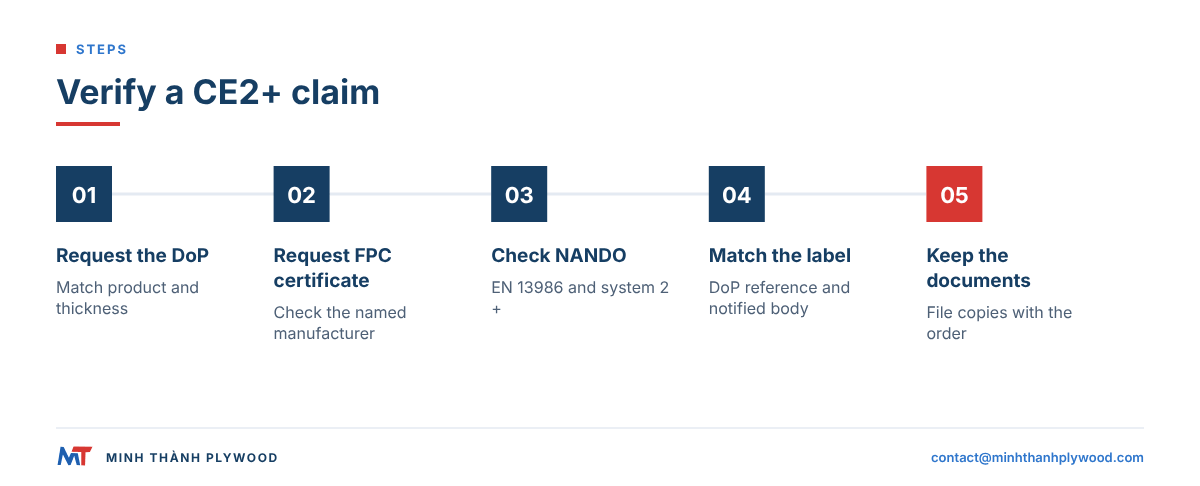
Verify a CE2+ claim with three documents and one database check, before the order is confirmed:
- Ask for the DoP for the exact product and thickness.
- Ask for the certificate of constancy of performance of FPC, issued by the notified body.
- Check the notified body in the European Commission’s NANDO database: it must be notified for EN 13986 and system 2+.
- Match names: the certificate names the mill that makes the panel, and the DoP number matches the label on a sample.
A certificate issued to another factory, or a DoP without a notified body, means the panel is not CE2+ for your purposes. Keep copies in the order file; building control may ask for them.
What does CE2+ not tell you?
CE2+ tells you the declared structural values were verified; it does not tell you the face grade, thickness tolerance or the core build. Two CE2+ panels of the same class can look and machine very differently.
Write these as separate lines in the order:
- Face and back grade, for example B/BB or C/D.
- Core species and build, including whether cores are stitched to close gaps.
- Thickness tolerance, such as ±0.5 mm for commercial and film-faced panels.
- Formaldehyde emission, which for indoor use is better proven by a chamber test: Minh Thanh’s six ASTM D6007 tests averaged 0.014–0.032 ppm against the 0.05 ppm CARB Phase 2 limit.
Strength values themselves, MOR and MOE, are explained in our guide to plywood strength values.
What CE2+ ply is on UK shelves?
British merchants stock CE2+ ply in three builds, and the labels name the standard the mill must match. The sheet is almost always 1220 × 2440 mm (4 × 8 ft), and the label cites BS EN 13986:2004+A1:2015.
| Build | Face and core | Grade and standard on the label | Thicknesses listed |
|---|---|---|---|
| Structural softwood | Softwood, phenolic glue | C+/C face, EN 314-2 bond class 3, formaldehyde class E1 | 18 mm at Wickes; 18 mm at Davies Timber |
| Elliotis pine | Pine, EN 636-3 S | C+/C | 12 mm at Silverton |
| Hardwood-faced | Grandis eucalyptus faces, poplar core | BB/CC, for structural use in high humidity or occasional wetting | 5.5, 9, 12 and 18 mm at Silverton |
| Marine | Indonesian hardwood | BS 1088, third-party approved, E1, CE2+ | 12 mm at Silverton |
Merchant listings seen October 2026. Structural CE2+ panels sit above CE4 panels in price, because the mill carries notified-body certification and factory production control on top of the board; the Davies listing for 18 mm adds local delivery of £18–40 by distance. When you ask Minh Thanh for CE2+ plywood, send the build, grade, glue class and thickness list from this table and the use, so the quote matches the label your merchant or inspector expects.
What does this mean for your plywood order?
State the use and the class first: “structural, EN 636-2 S, CE2+” or “non-structural, CE4”. The mill can only quote the right veneer, glue and documents once it knows which one you need.
CE-marked plywood is available* from Minh Thanh, with the Declaration of Performance. Our exterior plywood uses melamine-fortified or phenolic (WBP) glue to the customer’s specification, and our film-faced plywood serves formwork. Standard sizes are 1220 × 2440 mm and 1250 × 2500 mm; production takes 15–45 days after the 30% deposit, minimum one 40HC with mixed specifications by agreement.
*Supplied directly or through qualified partner mills.
Send your lines, use, EN 636 class, CE system, thickness, size, face grade and quantity, to contact@minhthanhplywood.com or through the contact form. Our certificates page lists the documents we hold.
Buyer questions, answered
What does CE2+ mean on plywood?
CE2+ means the plywood is CE-marked under assessment system 2+, the system for structural wood-based panels. A notified body has inspected the mill's factory production control and audits it every year, so the declared strength and bond values can be trusted.
Is CE2+ plywood waterproof?
Not necessarily. CE2+ proves structural verification, not water resistance. Exposure is set by the EN 636 class on the Declaration of Performance: EN 636-1 for dry, EN 636-2 for humid and EN 636-3 for exterior conditions.
What is the difference between CE2+ and CE4 plywood?
CE2+ plywood is approved for structural use, with a notified body certifying the factory production control. CE4 plywood is self-declared by the manufacturer, with no third-party involvement, and may only be used for non-structural work.
Can I use CE4 plywood for flooring or roofing?
Not where the floor or roof deck is a structural element under the building rules. Load-bearing floors, roof decks and wall bracing need plywood declared for structural use, which in the EU and UK means CE2+ or UKCA 2+.
What is Q-Mark plywood?
Q-Mark is a voluntary BM TRADA certification scheme for plywood sold in the UK. It adds regular audits and sample testing of the mill on top of the CE2+ requirements, which gives merchants extra confidence in imported structural plywood.
Does furniture plywood need CE marking?
No. CE marking under EN 13986 applies to wood-based panels used in construction works. Plywood for furniture, cabinets and interior joinery does not need CE marking or a Declaration of Performance.
How do I check that a CE2+ claim is real?
Ask for the Declaration of Performance and the certificate of constancy of performance of factory production control, then check the notified body number in the European Commission's NANDO database and confirm that the certificate names the mill and the product.
Is CE2+ the same as UKCA?
They follow the same standard, EN 13986, and the same 2+ system. UKCA is the mark for Great Britain, with a UK-approved body instead of an EU notified body. Many mills selling to the UK hold both.
Does Minh Thanh supply CE2+ plywood?
CE-marked plywood is available*, with the Declaration of Performance. Our own exterior plywood is made with melamine-fortified or phenolic (WBP) glue to the customer's specification; send the structural class and use in your request for quotation.