
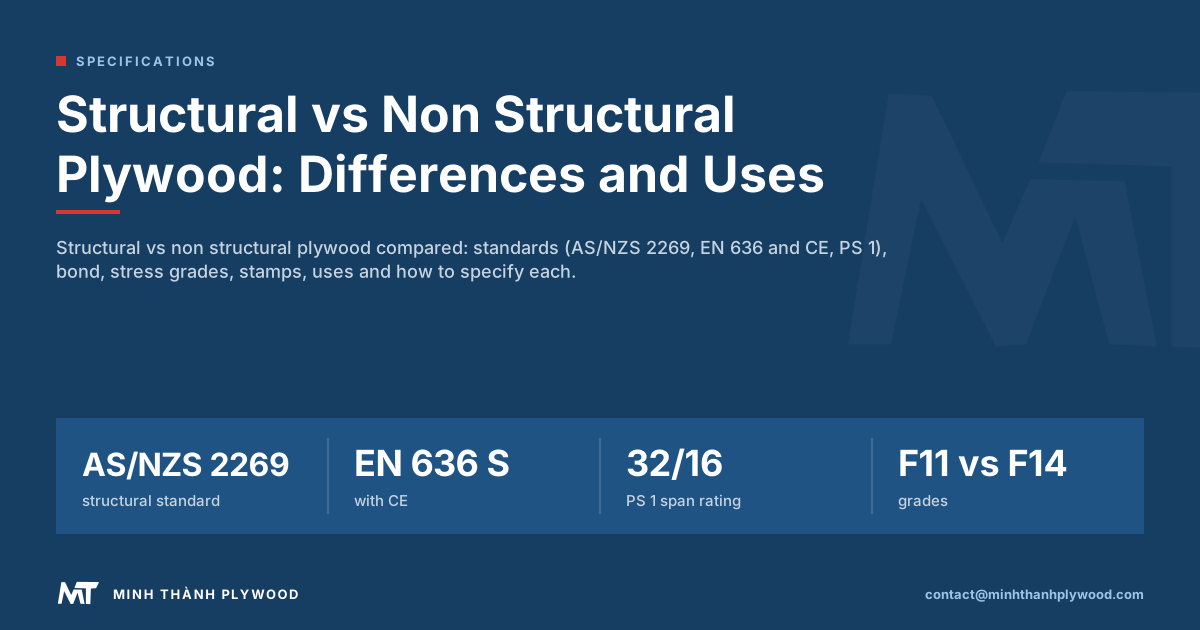
Structural plywood is certified to a structural standard (AS/NZS 2269, EN 636 with CE marking, or US PS 1) and carries a stamp with its stress grade and bond. Non-structural plywood is made for appearance and is not rated to carry building loads. Minh Thanh Plywood makes furniture plywood and construction panels to the buyer's specification.
Structural vs non structural plywood: the short answer
Structural plywood is certified to a structural standard, tested for strength and stiffness, glued with a permanent bond and stamped. Non-structural plywood is graded for its face and workability, with no certified strength.
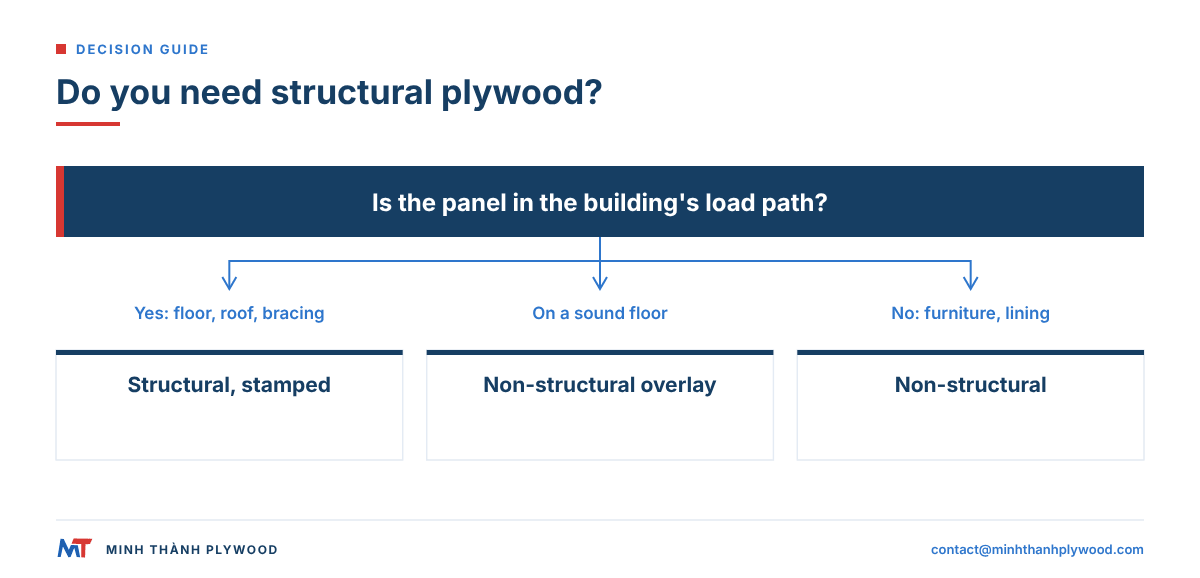
If a building code, an engineer or a drawing calls for a load-bearing panel (floors over joists, roof decks, bracing walls), only stamped structural plywood is allowed. Everywhere else, non-structural plywood is the usual choice and often the better one.
On cost, Kosmex (checked on 21 October 2026) puts structural plywood at a 20–40 % premium over an equivalent non-structural panel, paying for certification, graded veneers and the phenolic bond. Non-structural commercial plywood from our mill starts from US$250/m³ and furniture plywood from US$350/m³ FOB Hai Phong (October 2026), which is where non-structural saves money when no code asks for a stamp.
The difference is not how the panel looks. Two 12 mm sheets can come off the same press line and be stacked side by side in a yard. One carries a stamp that says it was tested to AS/NZS 2269, EN 636 with CE marking, or US PS 1; the other does not. The stamp is what lets a builder, an inspector or an insurer rely on the panel.
Structural or non-structural plywood in the UK: floor over joists or overlay?
In the UK, the first question is whether the sheet is the floor or goes on top of one. A new floor deck over joists needs structural plywood: EN 636-2 or -3 class S, CE marked to EN 13986, with a declaration of performance. An overlay or underlay on a sound floor, for vinyl, LVT or carpet, takes non-structural sanded plywood of 5.5 to 9 mm. Roofs, bracing and stud walls follow the engineer’s drawing.
UK merchants label the two plainly. Wickes (checked on 21 October 2026) sells “Structural CE2+” softwood plywood in 12 and 18 mm and “Non-Structural” hardwood plywood from 3.6 to 18 mm.
What is structural plywood?
Structural plywood is plywood made and certified to carry building loads, with declared strength and stiffness values an engineer can design with. It is made to a structural product standard, tested in a laboratory, monitored by an independent certification body and marked on every sheet.
Three things define it:
- A structural product standard: AS/NZS 2269 in Australia and New Zealand, EN 636 with CE marking under EN 13986 in Europe and the UK, PS 1 (or PS 2 for performance-rated panels) in the US, and JAS in Japan.
- A permanent bond: phenolic or an equivalent bond that does not lose strength when wet. AS/NZS 2269 requires a Type A bond.
- A declared stress grade or class: F-grades in Australia (F7 to F34), bending and stiffness classes in Europe (for example F20/10 E40/20), Structural I or span ratings in the US.
Typical structural uses are floors over joists, roof sheathing, bracing walls, concrete formwork, beams and portal frames, and engineered parts such as I-joist webs. The uses of plywood in construction guide lists them by building element.
What is non structural plywood?
Non-structural plywood is plywood made for appearance, flatness and workability, without a certified load rating. It covers most of the plywood sold in the world: furniture and cabinet panels, wall linings, door skins, shop fitting, joinery, displays and packing.
Non-structural does not mean weak or poor quality. A sanded furniture panel is often made to tighter thickness tolerances and with better faces than a structural sheet. What it lacks is a tested, declared strength value and a stamp, so it cannot be used where the code needs one.
In Australia and New Zealand, non-structural plywood has its own standards: AS/NZS 2270 for interior plywood and AS/NZS 2271 for exterior plywood. In Europe, EN 636 covers both, and a panel declared for non-structural use (the “G” general-purpose class) is a different product from one declared “S” for structural use. Retail sheets labelled “non-structural plywood 12 mm” in Australian and New Zealand stores are usually AS/NZS 2270 or 2271 panels.
Structural vs non-structural plywood: side-by-side comparison
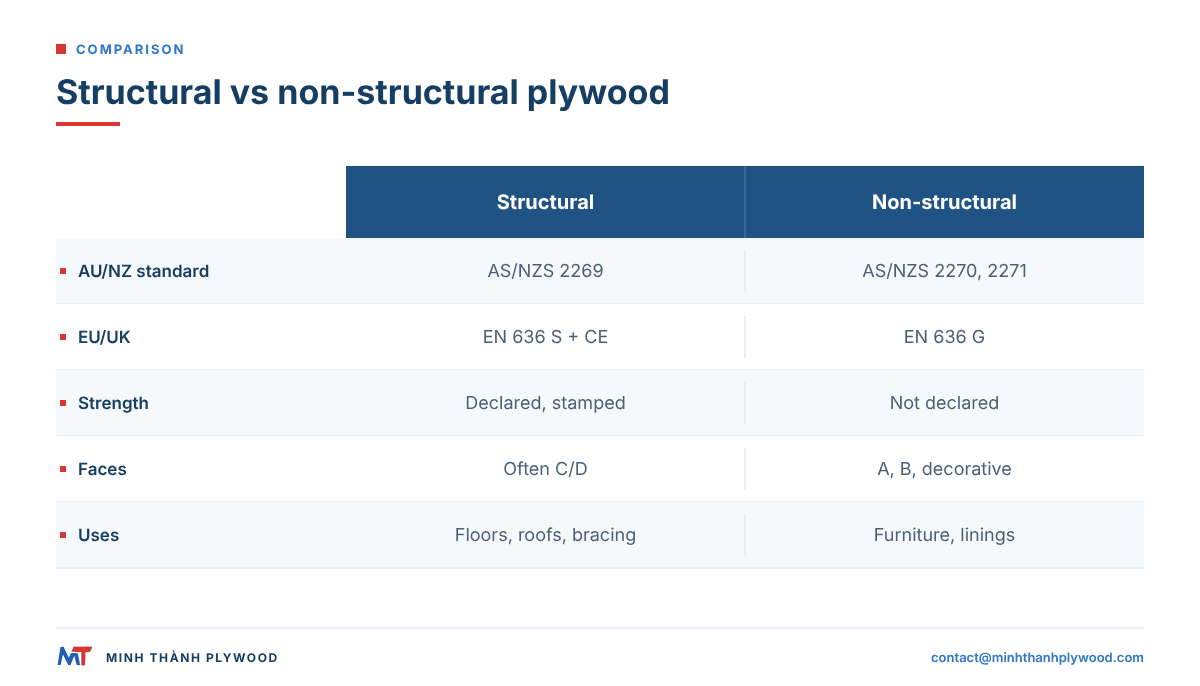
The table compares the two on the lines a buyer specifies, one metric per row.
| Metric | Structural plywood | Non-structural plywood |
|---|---|---|
| Product standard (AU/NZ) | AS/NZS 2269 | AS/NZS 2270 (interior), AS/NZS 2271 (exterior) |
| Product standard (EU/UK) | EN 636 class S, CE marked under EN 13986 | EN 636 class G, or no declared class |
| Product standard (US) | PS 1 or PS 2, agency stamp | Hardwood plywood to ANSI/HPVA HP-1 |
| Glue bond | Permanent: Type A phenolic (AU/NZ), exterior bond | Interior UF, MR or exterior, by use |
| Strength values | Declared: F-grade, strength and stiffness class, span rating | Not declared |
| Third-party control | Required: independent certification and audits | Optional |
| Marking | Grade stamp on every sheet | Label or none |
| Face grade | Often C/D: appearance is secondary | A, B or decorative faces: appearance matters |
| Core voids | Limited by the standard | Set by the buyer’s spec |
| Typical uses | Floors, roofs, bracing, formwork, beams | Furniture, cabinets, linings, joinery, packing |
| Cost | About 20–40 % above an equivalent non-structural panel | The base price; mill FOB from US$250/m³ commercial, US$350/m³ furniture |
| Who decides | The code, the engineer or the drawing | The buyer |
The two rows that matter most are “strength values” and “marking”. Everything else can be ordered on either panel: a non-structural panel can have a phenolic bond, and a structural panel can have a sanded face.
Which standards make a panel structural, market by market?
A panel is structural in a market only when it is made and certified to that market’s structural standard. A stamp from one market does not carry over to another. The standards differ by region: AS/NZS 2269 in Australia and New Zealand, EN 636 with EN 13986 in Europe, and PS 1 or PS 2 in North America.
- Australia and New Zealand: AS/NZS 2269. Structural plywood with a Type A bond, a stress grade from F7 to F34, face grades A, S, B, C and D, and third-party certification. Non-structural panels are AS/NZS 2270 (interior) and AS/NZS 2271 (exterior).
- European Union and United Kingdom: EN 636 and EN 13986. EN 636 sets the plywood specification for dry (EN 636-1), humid (EN 636-2) and exterior (EN 636-3) conditions, each as general purpose (G) or structural (S). A structural panel is CE marked (UKCA in Great Britain) to EN 13986, with a Declaration of Performance and factory production control audited by a notified body under system 2+. BS EN 636:2012+A1:2015 covers plywood for structural and general-purpose use in dry, humid or exterior conditions.
- United States and Canada: PS 1 and PS 2. PS 1 is the US Voluntary Product Standard for structural plywood; PS 2 covers performance-rated wood structural panels. Panels carry an agency stamp with the span rating (for example 32/16), the exposure class and the mill number. CSA O121 and O151 are the Canadian equivalents.
- Japan: JAS. Structural plywood under the Japanese Agricultural Standard carries a JAS mark.
In Europe, CE marking is a legal requirement for construction products covered by a harmonised standard, set by the Construction Products Regulation (EU) No 305/2011, which is being replaced in stages by Regulation (EU) 2024/3110.
How do you read a structural plywood stamp?
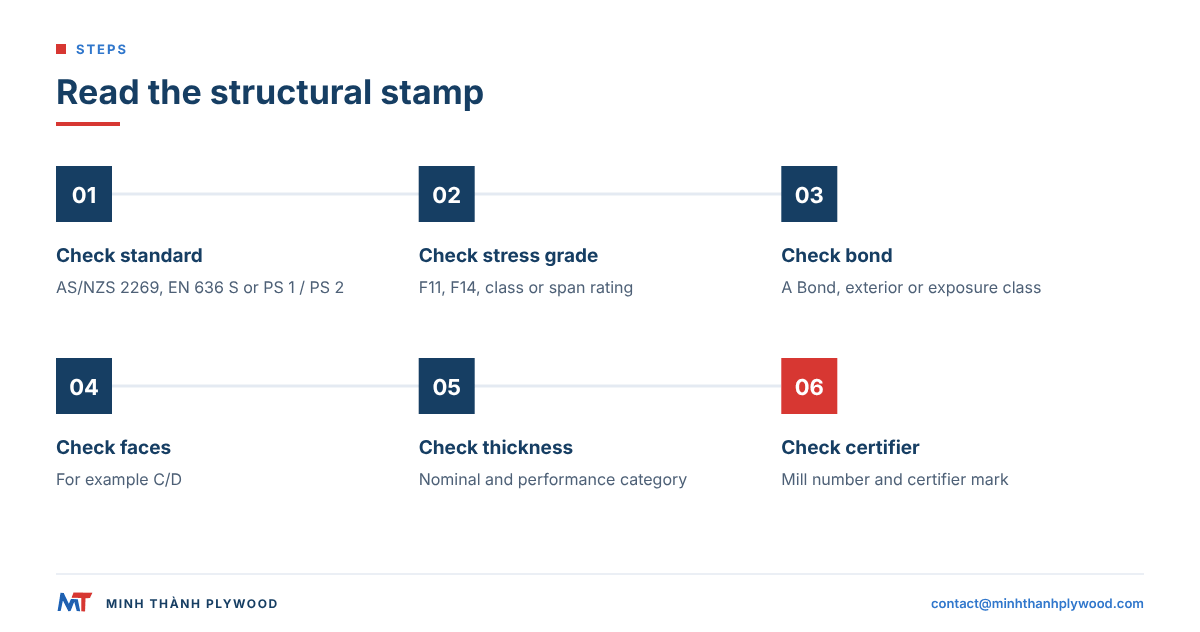
Read a grade stamp line by line against the exact product standard it names: the stamp is the panel’s certificate, and each line answers one question.
- Standard: AS/NZS 2269, EN 636-2 S or EN 636-3 S with CE, PS 1-22 or PS 2.
- Stress grade or class: F11, F14 or F17 in Australia; strength and stiffness classes in Europe; a span rating or “Structural I” in the US.
- Bond: “A Bond” in Australia; the EN 636 part (1, 2 or 3) in Europe; “Exterior” or “Exposure 1” in the US.
- Face grades: for example “CD” (C face, D back).
- Thickness: nominal and, in the US, the performance category such as 23/32.
- Mill and certifier: the mill number and the certification body’s mark.
A stamp that lists only a thickness and a brand, or “structural grade” with no standard, is not a structural stamp. For a CE-marked panel, ask for the Declaration of Performance: it lists the declared values the stamp refers to.
How do strength, bond and durability differ on a specification?
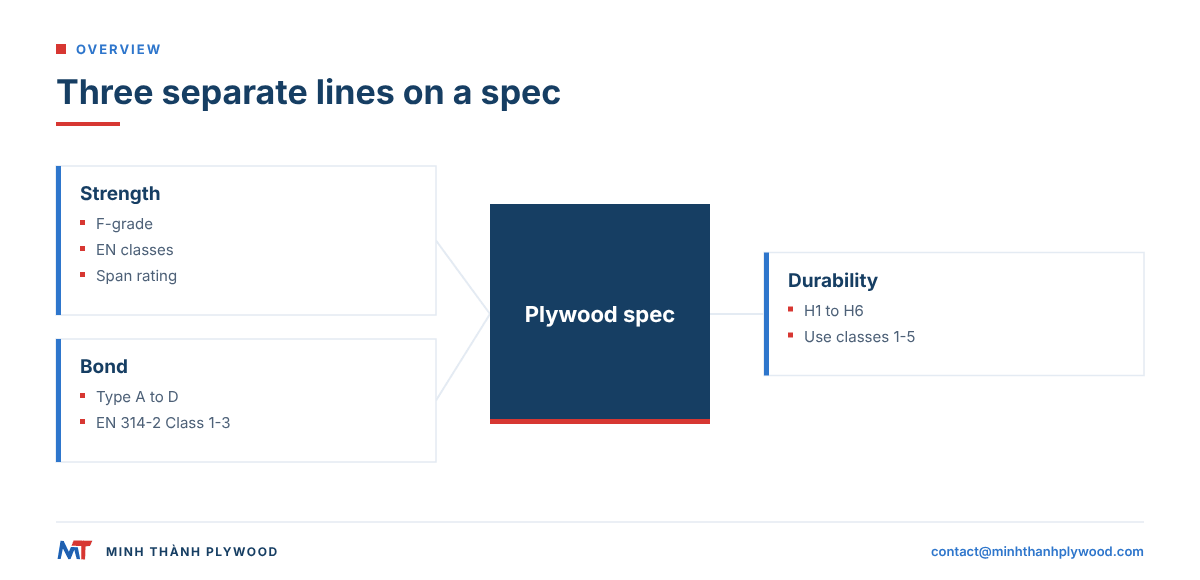
Strength, bond durability and biological durability are three separate lines, and buyers who merge them order the wrong panel.
| Line | What it answers | Typical values | Standard |
|---|---|---|---|
| Strength and stiffness | How much load the panel carries and how far it spans | F11, F14; F20/10 E40/20; span 32/16 | AS/NZS 2269; EN 636 with EN 12369-2; PS 1 |
| Bond durability | Whether the glue line survives moisture | Type A, B, C, D; EN 314-2 Class 1, 2, 3 | AS/NZS 2098.2; EN 314-2 |
| Biological durability | Whether the wood resists rot and insects | H1 to H6 treatment; use classes 1 to 5 | AS/NZS 1604; EN 335 |
A panel can have the best bond and still not be structural, and it can be structural and still rot outdoors without treatment. A deck that stays wet needs all three lines: a structural grade, an exterior bond and a treatment or naturally durable species. The exterior plywood page covers bond choices for outdoor panels.
Why does direction matter in structural plywood?
Plywood is stronger and stiffer along the face grain than across it, so structural values are declared in two directions. In a European class such as F20/10 E40/20, the first number of each pair is along the face grain and the second across it: the panel is twice as strong and stiff in one direction as in the other.
That is why floors and roofs are laid with the face grain across the joists or rafters, and why span tables state the direction. A structural sheet laid the wrong way can deflect far more than the design assumed, even with the right stamp. Australian F-grades and US span ratings assume the panel is laid with the face grain across the supports.
What is non structural plywood used for, and what is structural plywood used for?
Structural plywood goes where the panel is part of the building’s load path; non-structural plywood goes everywhere else. The split by use:
| Use | Structural plywood needed? | Usual panel |
|---|---|---|
| Floor over joists | Yes | Structural, often tongue and groove |
| Roof sheathing | Yes | Structural sheathing grade |
| Bracing walls | Yes | Structural with nailing schedule |
| Concrete formwork | Usually | Structural or film-faced formwork panel |
| Floor overlay or underlay on a sound floor | No | Non-structural, sanded |
| Kitchen cabinets and wardrobes | No | Furniture plywood |
| Wall and ceiling linings | No | Decorative or paint-grade panel |
| Shop fitting and displays | No | Furniture or decorative panel |
| Packing cases and crates | No (unless lifting is engineered) | Packing plywood |
| Stage decks and platforms outside the code | No, but check loads | Thick sanded or film-faced panel |
For floors, see the plywood flooring and tongue and groove plywood guides; for roofs, plywood roof sheathing.
Can you use non structural plywood for flooring?
Not as the structural floor over joists in a building covered by a code: that layer must be stamped structural plywood of the grade and thickness the span table gives. Non-structural plywood can be used on top of a structural floor, as an overlay or underlay for vinyl, tiles or timber.
Three cases cover most questions:
- New floor over joists: structural plywood, laid with the face grain across the joists, glued and fixed to the schedule.
- Overlay on an existing sound floor: non-structural sanded plywood, often 5.5–9 mm, fixed to the boards below; see plywood underlayment.
- Furniture platforms, stages and display floors outside the code: non-structural panels are used, but the loads still need checking by someone who knows them.
A flooring retailer that sells “non-structural plywood” for floors is selling an overlay, not a floor deck.
Is CDX plywood structural or non-structural?
CDX describes the faces and the bond, not the strength: C face, D back, exterior glue. In the US, CDX sold with an APA or other agency stamp under PS 1 or PS 2 is a rated structural sheathing panel; without a stamp, the same letters carry no structural rating.
Outside North America the letters are used loosely for utility exterior panels. The CDX vs ACX and BCX plywood guide explains the face letters. Minh Thanh makes exterior and CDX-type plywood with utility C/D faces and a melamine-fortified or phenolic (WBP) bond, for outdoor uses such as stair treads and wall sheathing, to the buyer’s specification.
Which wood species go into structural and non-structural plywood?
Structural plywood is made from species with known, even strength: Douglas fir and southern pine in North America, radiata and hoop pine in Australia, spruce and birch in Europe, and dense plantation hardwoods such as eucalyptus in panels certified for structural use. The species has to be tested in that build before the panel can be graded.
Non-structural plywood uses a much wider range, chosen for the face: birch, poplar, okoume, pine, engineered veneer and many tropical faces. Minh Thanh’s furniture panels use white Styrax or Eucalyptus cores as standard, with Acacia and Pine cores on order, and 10+ face veneers. Reference densities for planning are Styrax 500, Acacia 580 and Eucalyptus 650 kg/m³.
Density alone does not make a panel structural: a dense eucalyptus-core panel is stiff, but it is structural only once tested and stamped to a standard.
Appearance grade vs structural qualification: why the face grade misleads
A face grade describes how a panel looks; a structural qualification describes what it can carry. The two are independent, and a good-looking face says nothing about strength.
Structural sheathing often has C/D faces with knots and patches because nobody sees it. Furniture plywood has A/A, A/B or birch D+/D faces because everyone sees it. A buyer comparing “B/BB birch” with “F14 CD” is comparing a look with a strength.
Minh Thanh grades faces as face/back pairs matched to the approved sample: A/A, A/B and B/B for poplar, pine and eucalyptus faces; D+/D and D/E for birch, comparable to the European birch ladder (D+ about B, D about BB). Those are appearance grades for furniture and interiors.
Why is there no universal equivalence between grades?
Stress grades and layups do not convert one-to-one between markets, because each standard tests and declares strength in its own way. An F14 panel in Australia, a CE-marked EN 636-3 S panel with its declared classes and a US 32/16 span-rated sheet are each designed against their own code.
What a buyer can do is compare the declared values the engineer needs (bending strength and stiffness along and across the grain, at the thickness ordered) and let the project’s engineer or code decide. A sheet certified for Europe still needs its own certification to be sold as structural in Australia, and the other way round.
How do you buy structural plywood from Vietnam?
Buy structural plywood from Vietnam the way you would from any origin: name the standard and the certification you need first, then the thickness and faces. A mill can press a panel to a structural layup only when it holds, or works through a mill that holds, the certification for your market.
Steps that work:
- State the standard and class: for example EN 636-3 S with CE marking, or AS/NZS 2269 F14 with a Type A bond.
- Ask for the certificate and Declaration of Performance naming the panel, the thickness range and the certification body.
- Order a sample and test it: third-party testing to the buyer’s method is arranged through SGS on request at Minh Thanh.
- Check the stamp on arrival on every pack against the certificate.
What Minh Thanh adds as proof for the non-structural panels it presses: CARB P2 / TSCA Title VI certification (ICTT mill no. 23024), six ASTM D6007 chamber tests between April 2025 and June 2026 averaging 0.014–0.032 ppm against the 0.05 ppm limit, and third-party testing to your method through SGS on request. Structural stamps stay with the certificate holder for your market.
Minh Thanh’s construction range covers construction plywood, film-faced, exterior and CDX-type panels and LVL. CE marking is available*.
*Supplied directly or through qualified partner mills.
Interior vs exterior non-structural plywood: AS/NZS 2270 vs AS/NZS 2271
Non-structural plywood comes in two families, and the bond is what separates them. In Australia and New Zealand, AS/NZS 2270 covers interior plywood for dry uses, and AS/NZS 2271 covers exterior plywood with a bond that survives weather, for cladding, soffits, signs and outdoor joinery.
Neither carries a stress grade. An exterior non-structural sheet can sit outdoors for years with its glue intact, but it is still not a structural panel: it has no declared strength and no stamp that a building inspector accepts for a floor or a bracing wall.
The same split exists on any order from a mill, written as the glue line:
- Dry interiors: UF glue at E0 emission, the standard bond for furniture and interior panels.
- Humid rooms: melamine-fortified (MR) bond.
- Outdoor parts: phenolic (WBP) bond, as on the exterior plywood range.
For retail sheets marked “non-structural plywood 9 mm” or “12 mm” in Australian and New Zealand stores, the label on the sheet says which of the two standards applies.
Is film-faced formwork plywood structural?
Film-faced formwork plywood is a structural-use panel when it is certified as such, and a formwork panel without a certificate is a site panel whose strength the formwork designer has to judge. The film is a surface for concrete; it says nothing about the panel’s strength.
Formwork carries the weight of wet concrete between bearers, so many markets treat it as a structural use. In Europe, formwork plywood used as a construction product is declared under EN 13986; in Australia, formply is graded under its own standard with an F-grade. A buyer ordering film-faced plywood for a project with an engineered formwork design should order the standard and grade the design names.
Minh Thanh produces film-faced plywood for formwork and site uses, at a ±0.5 mm thickness tolerance.
Which mistakes do buyers make between structural and non-structural plywood?
Most problems come from treating one property as if it were another. Six mistakes come up again and again:
- Reading the face grade as a strength grade. “B/BB” is a look; “F14” is a strength.
- Reading “exterior” as “structural”. An exterior bond survives weather; it does not certify load capacity.
- Reading “CDX” as a rating. Without an agency stamp, the letters are only faces and glue.
- Buying a stamp for the wrong market. A US span-rated sheet is not an AS/NZS 2269 panel, and the other way round.
- Laying a structural panel the wrong way. Face grain along the joists cuts the stiffness the span table assumed.
- Paying for structural where it is not needed. Cabinets, linings and furniture gain nothing from a stress grade and lose face quality.
A good order names the use first. When the use is load-bearing, the next line is the standard; when it is not, the next line is the face.
Where non-structural plywood from a furniture mill is the better choice
For every part that is not in the building’s load path, a non-structural furniture panel is usually the better buy: flatter, smoother, tighter in thickness and cheaper per usable face than a structural sheet.
Minh Thanh’s furniture plywood is built for top-grade furniture and interiors, with Europe as its main market:
- Pressed twice: the core board is pressed and calibrated, then face and back are pressed on.
- Stitched cores: core layers stitched both horizontally and vertically, so the layers lie closed.
- Tight tolerance: ±0.2–0.3 mm on sanded panels, down to ±0.2 mm.
- Emission: UF glue at E0 emission; CARB P2 / TSCA Title VI certified (ICTT mill no. 23024). Six ASTM D6007 chamber tests between April 2025 and June 2026 on 9, 15 and 18 mm panels averaged 0.014–0.032 ppm against the 0.05 ppm limit.
- Moisture: 8–12 % at dispatch.
Those lines matter for cabinets, wardrobes and linings, and none of them is a structural rating.
How much does each panel weigh, and how many fit a container?
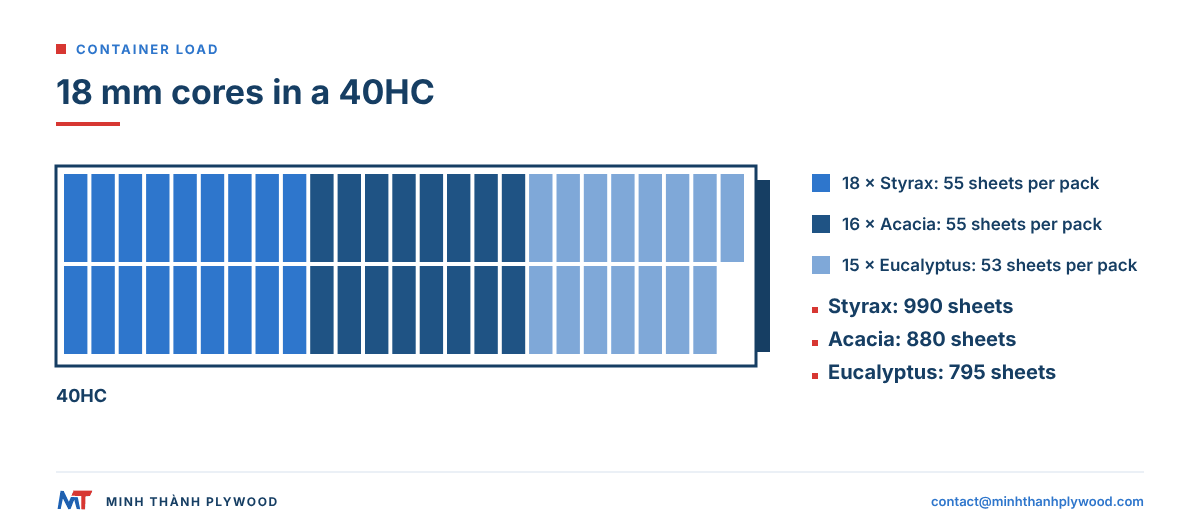
Weight depends on the core density and thickness, not on whether the panel is structural. At 18 mm and 1220 × 2440 mm, a sheet weighs about 26.8 kg on Styrax, 31.1 kg on Acacia and 34.8 kg on Eucalyptus.
| Core at 18 mm | Packs in a 40HC | Sheets | Volume | Weight per sheet |
|---|---|---|---|---|
| Styrax | 18 × 55 | 990 | About 53 m³ | 26.8 kg |
| Acacia | 16 × 55 | 880 | About 47 m³ | 31.1 kg |
| Eucalyptus | 15 × 53 | 795 | About 43 m³ | 34.8 kg |
Packs are about 1,000 mm high, then capped by weight within a 28,000 kg planning payload; a lower booking limit lowers the count. Mixed containers of furniture and construction panels are normal by agreement.
How do you specify structural or non-structural plywood on an order?
Write the standard first for structural plywood and the face first for non-structural plywood. Two order lines show the difference:
Structural: 18 mm × 1220 × 2440 mm, EN 636-3 S, CE marked to EN 13986 with Declaration of Performance, phenolic bond, C/D faces, for floor decks; stamp on every sheet; 1×40HC; CIF your port.
Non-structural: 18 mm × 1220 × 2440 mm, poplar face A/B, Eucalyptus core, UF glue at E0 emission, sanded both faces, tolerance ±0.2 mm, for kitchen cabinets; 1×40HC mixed with 3 mm backs; CIF your port.
Minimum order is one 40HC, mixed by agreement; production takes 15–45 days after the 30% deposit, FOB Hai Phong, CFR or CIF, and free samples come first. In October 2026 furniture plywood starts from US$350/m³ and commercial plywood from US$250/m³, FOB Hai Phong. Send your line to contact@minhthanhplywood.com or WhatsApp +84 988 586 601; replies come within hours.
Buyer questions, answered
What is the difference between structural and non structural plywood?
Structural plywood is tested and certified to a structural standard, carries a stamp with its stress grade and a permanent bond, and may be used where a building code needs a load-bearing panel. Non-structural plywood is graded for its face and has no certified strength.
What is non structural plywood?
Non-structural plywood is plywood made and graded for appearance and workability rather than certified load capacity: furniture, cabinet, lining, decorative and packing panels. In Australia and New Zealand it is made to AS/NZS 2270 (interior) or AS/NZS 2271 (exterior).
What is non structural plywood used for?
Furniture, kitchen cabinets, wardrobes, wall and ceiling linings, shop fitting, joinery, door skins, displays, packaging and crates: any part where the panel is supported by a frame or does not carry building loads.
Can you use non structural plywood for flooring?
Not as a structural floor over joists where a building code applies; that needs structural plywood with a stamp. Non-structural plywood can be used as an overlay or underlay on top of an existing structural floor, or in furniture platforms and stage decks outside the code.
Is CDX plywood structural?
In the US, CDX sold with an APA or other agency stamp under PS 1 or PS 2 is a rated structural sheathing panel. 'CDX' alone only describes C and D faces with an exterior bond; without a stamp it carries no structural rating.
How do I know if plywood is structural?
Look for the grade stamp on the face or edge. It names the standard (AS/NZS 2269, EN 636 with CE marking, PS 1 or PS 2), the stress grade or span rating, the bond type and the certifying body. No stamp means no structural rating.
Is structural plywood waterproof?
Its glue bond is permanent: AS/NZS 2269 requires a Type A phenolic bond, and EN 636-3 panels pass exterior bond tests. The wood itself is not waterproof and still needs treatment or protection where it stays wet.
What does F11 mean on plywood?
F11 is a stress grade under AS/NZS 2269, set by the panel's tested bending strength and stiffness. A higher F-grade is a stronger, stiffer panel, so F14 carries more load than F11 at the same thickness and span.
Is marine plywood structural?
Marine plywood made to BS 1088 or AS/NZS 2272 is a quality standard for boatbuilding with a permanent bond and durable species. It is not automatically a certified structural panel under building codes unless it also carries a structural stamp.
Is structural plywood stronger than non structural plywood?
Not always in raw strength: a dense hardwood furniture panel can be stiff. The difference is that structural plywood's strength is tested, declared and stamped, so an engineer can design with it; non-structural plywood's strength is unknown on paper.
Does Minh Thanh make structural plywood?
Minh Thanh's main product is furniture and interior plywood, which is non-structural. Its construction range covers film-faced, exterior and CDX-type panels with phenolic (WBP) bonds, and CE marking is available* through the mill or qualified partner mills.
Can non structural plywood be used outdoors?
Only an exterior non-structural panel with a phenolic (WBP) or melamine-fortified bond, such as AS/NZS 2271 plywood, for cladding, signs or outdoor furniture. Interior panels with UF glue should stay in dry rooms.