
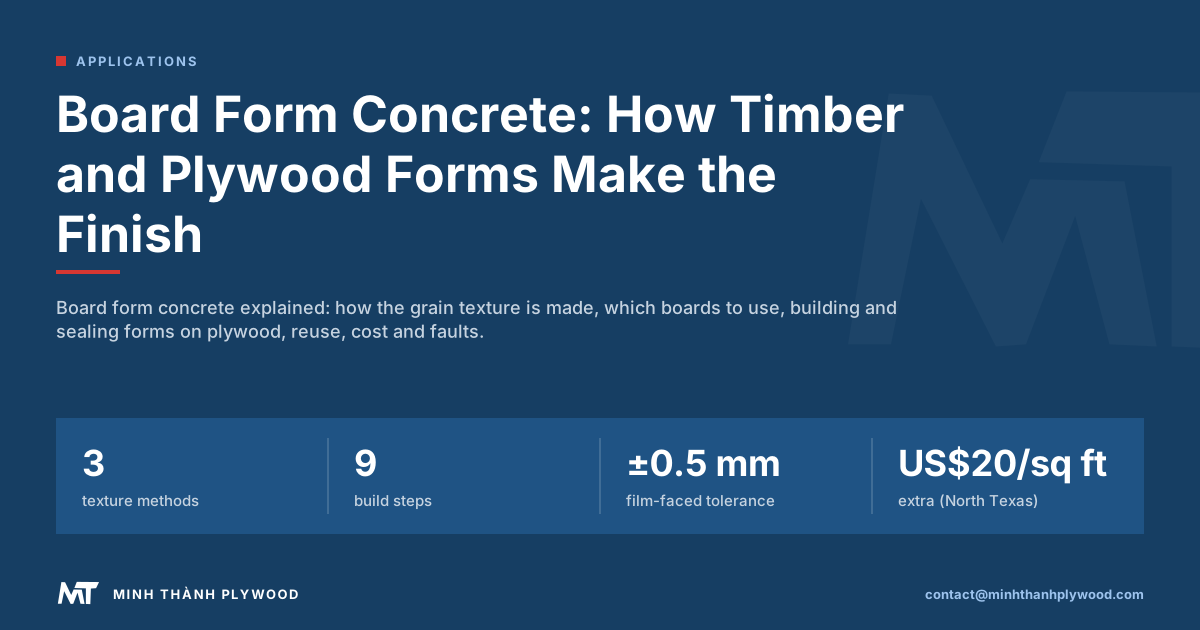
Board form concrete is concrete cast against timber boards so the wall keeps the print of the wood grain, the joints and the board widths. The finish is made by the boards, but the form behind them is plywood: it carries the pressure and keeps the wall straight. Minh Thanh Plywood makes film-faced formwork plywood; this guide covers boards, backing, sealing, reuse and cost.
What is board form concrete?
Board form concrete is architectural concrete cast against timber boards, so the wall keeps a permanent print of the wood: the grain, knots, board widths and the thin lines at the joints. Architects also call it board-formed concrete or board-marked concrete.
It differs from ordinary cast concrete in one way: the form face is chosen for its look, not only for its strength. A standard wall is cast against smooth film-faced plywood and comes out flat and grey. A board form concrete wall is cast against boards that were selected, cut and prepared, and the concrete records every one of them.
The finish became an icon of modernist architecture, from Le Corbusier’s late work and Paul Rudolph’s to many recent houses and museums. Today it appears on facades, stair cores, fireplaces, retaining walls and garden walls.
How the board texture is made: three methods
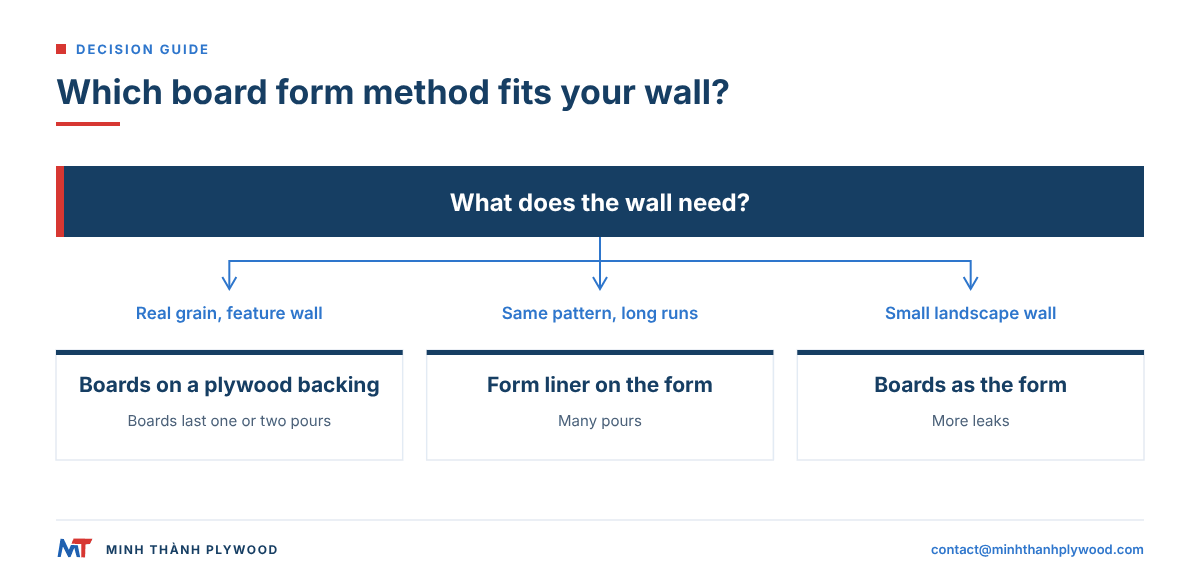
There are three ways to produce a board form concrete finish: rough-sawn boards fixed to a plywood form, boards used as the form itself, and form liners moulded with a board pattern. The method decides the realism, the reuse and the cost.
| Method | How it works | Texture | Reuse | Best for |
|---|---|---|---|---|
| Boards on a plywood backing | Boards screwed to the face of a plywood form | Real grain, crisp joints | Boards: first one or two pours; plywood: many | Feature walls, facades |
| Boards as the form | Boards nailed to studs without a sheet behind | Real grain, more leaks and steps | Low | Small walls, garden work |
| Form liner | Elastomeric or plastic mat with a board pattern, fixed to the form | Repeated pattern, very even | Many pours | Long walls, precast panels |
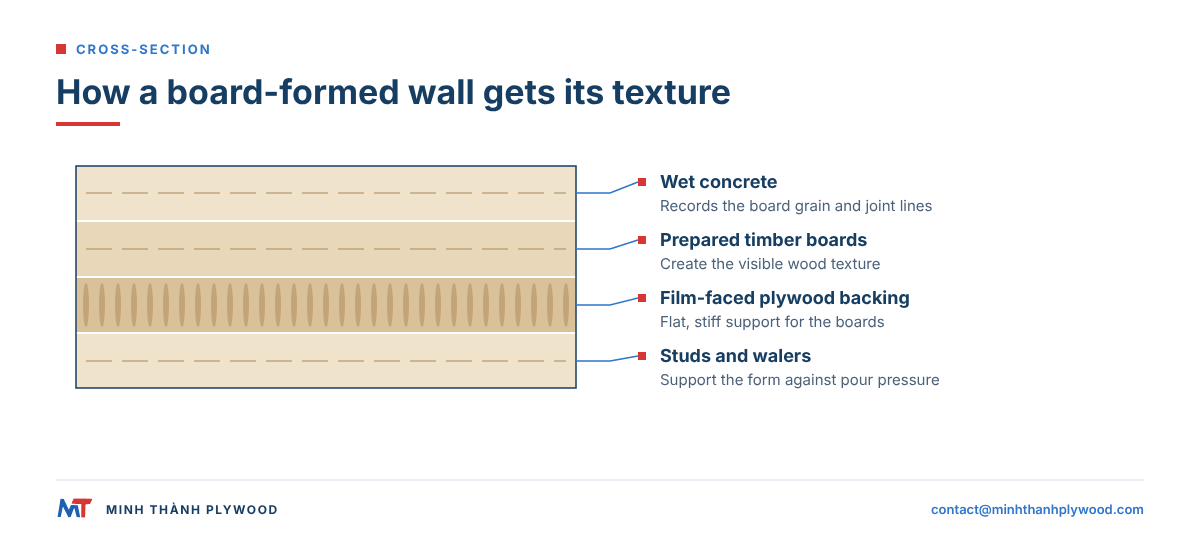
Most architects who want the real look choose the first method. The plywood takes the pressure of the wet concrete and keeps the wall plumb and straight, while the boards only make the surface. Boards used as the whole form tend to bow between studs and leak at every joint.
Which boards give the best finish?
Rough-sawn softwood boards with a strong grain give the clearest board form texture; Douglas fir, spruce-pine-fir and pine are the common choices, and cedar gives a softer print. Buyers who need certified timber for the boards can ask for FSC chain of custody certification. The board surface, width and orientation then shape the look.
- Surface: rough-sawn boards print saw marks and grain. Planed boards give a calmer, smoother print. Sandblasted boards print the deepest grain, because blasting removes the soft earlywood faster than the hard latewood.
- Width: narrow boards, around 4 to 6 inches nominal, give the classic rhythm; mixed widths give a more random look.
- Orientation: horizontal boards are the classic; vertical boards make a wall look taller; offset joints avoid a grid.
- Moisture: dry boards absorb water from the mix and darken the surface; boards that are too wet shrink apart before the pour.
On the Life of an Architect blog, architect Bob Borson describes a wall built with 2x spruce-pine-fir stock ripped in half, with tooling marks removed and the boards sandblasted to raise the grain (Life of an Architect).
Can you use plywood to form concrete?
Yes, plywood is the standard sheet material for concrete forms: it is flat, stiff, large and easy to cut, fix and strip. For a smooth wall the plywood face is the finish; for a board form concrete wall it is the backing that the boards are fixed to.
Not every plywood suits forming. The sheet must resist water and alkaline concrete, keep its glue bond when wet and stay flat across many pours. That is why formwork plywood is a separate product:
- Film-faced plywood: a phenolic film pressed on both faces, a hardwood core and water-resistant glue; it strips cleanly and is reused.
- Plain exterior plywood: cheaper, for one or two pours or for backing boards that carry the finish.
- Interior furniture plywood: not for formwork; UF glue is not made for wet concrete.
Minh Thanh makes film-faced plywood in 1220 × 2440 mm sheets, held to a thickness tolerance of ±0.5 mm, so neighbouring panels meet flush and the boards on them line up.
How to form a concrete wall with plywood and boards
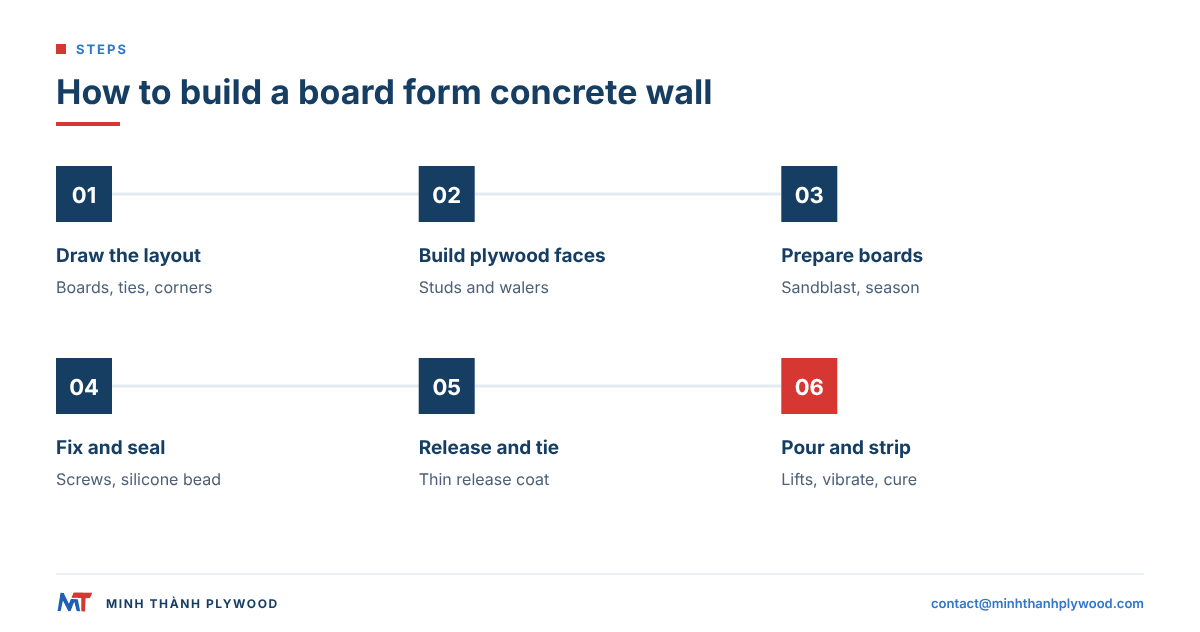
A board form concrete wall is built as a normal plywood wall form, with the boards added to its inside face before the two sides are closed. Draw the layout, build the plywood faces, fix and seal the boards, tie the form, pour in layers, then strip on time and cure. These are the steps in order.
- Draw the board layout. Set out board widths, joint lines, tie holes and corners on an elevation so the pattern meets at openings.
- Build the plywood faces. Fix film-faced or exterior plywood to studs and walers sized for the pressure of the pour.
- Prepare the boards. Cut to length, remove tooling marks, sandblast if wanted, then seal or season them.
- Fix the boards to the plywood. Use screws from the back or the face so boards stay tight to the sheet; nails let them spring.
- Seal the joints. Run a continuous bead of silicone or a tape along every joint so paste cannot leak.
- Apply release agent. A thin, even coat on every board, wiped off where it pools.
- Close and tie the form. Set the second face, fit form ties at the planned positions, brace the form plumb.
- Pour in layers and vibrate. Place concrete in even lifts and vibrate each lift without touching the boards.
- Strip on time and cure. Strip carefully so the boards do not tear the surface, then cure the wall.
The American Concrete Institute publishes the formwork guides (ACI 347) that engineers use to size studs, walers and ties for the pour rate. In the US, OSHA standard 1926.703 sets the safety requirements for cast-in-place concrete formwork.
How to seal boards and release the form cleanly
Boards for board form concrete must be sealed or seasoned before the first pour and coated with release agent before every pour, because raw timber absorbs water and draws cement paste into its surface. Without that step the wall comes out patchy and dusty where the boards were.
The usual preparation:
- Season new boards: brush a cement slurry on the boards and wipe it off, or cast a small trial panel first. This evens out absorption between new and used boards.
- Seal the faces: a thin form sealer slows water uptake without hiding the grain.
- Seal the joints: a silicone bead or foam tape stops leaks and the dark lines they cause.
- Release agent every time: a chemical release agent applied thinly; too much leaves stains and bug holes.
Wood sugars in some timbers can slow the setting of the concrete skin and leave a dusty surface; seasoning the boards with cement slurry reduces this. A sample panel cast with the same boards, mix and release agent is the only reliable way to approve the finish before the real wall. How timber takes up and loses moisture is covered in the Wood Handbook of the US Forest Products Laboratory.
Why the plywood backing decides a straight wall
The plywood behind the boards decides whether a board form concrete wall comes out straight, because the boards are too thin to resist the pressure of wet concrete on their own. A stiff, flat backing panel keeps every board in one plane.
What to look for in the backing sheet:
- Flatness and tolerance: panels with an even thickness keep joints between sheets flush, so no step shows through the boards. Film-faced panels from Minh Thanh are held to ±0.5 mm.
- Water-resistant glue: phenolic or melamine-fortified glue that keeps its bond when the form is wet for days.
- A closed hardwood core: holds the screws that fix the boards, pour after pour.
- Sealed edges: painted panel edges keep water out of the core.
An 18 mm film-faced panel is the common thickness for wall forms. For the backing of a board-formed wall, a cheaper exterior panel also works, as long as it is flat and the glue is water-resistant. The formwork materials comparison sets plywood against steel, aluminium and plastic.
How many times can the boards and forms be reused?
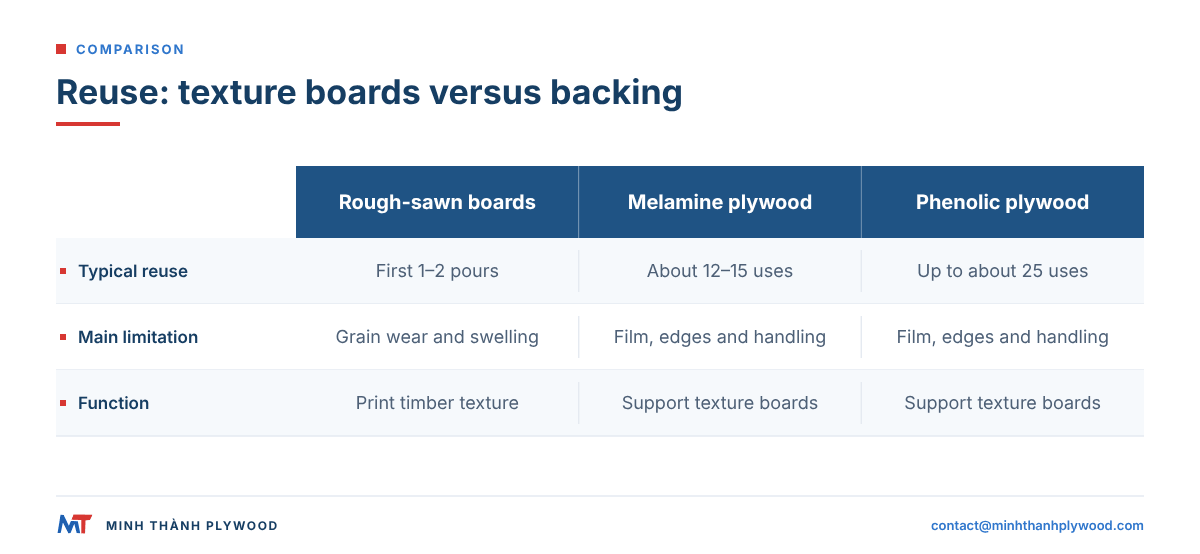
Rough-sawn boards give their best board form texture on the first one or two pours; after that the grain wears, paste clogs the surface and the boards swell and split. The plywood backing behind them lasts much longer.
| Part of the form | Typical reuse | What limits it |
|---|---|---|
| Rough-sawn boards | First one or two pours for a crisp print | Grain wear, swelling, paste build-up |
| Planed or sealed boards | A few more pours | Joint gaps as boards dry and shrink |
| Film-faced plywood backing | Many pours | Edge damage, film wear, handling |
| Elastomeric form liner | Many pours with the same pattern | Tears and cleaning |
As a rule of thumb, melamine-glued film-faced panels give around 12 to 15 reuses and phenolic-glued panels up to about 25, always with proper handling, release agent and edge sealing. On a board-formed wall the boards wear out long before the plywood does, so contractors keep the backing panels and replace the boards. For a direct comparison of reuse and finish, see plywood vs steel formwork.
Designing board form concrete walls
Board form concrete walls look best when the board layout, tie holes and joints are drawn as part of the design, because the wall shows every decision. Five details make the difference.
- Board rhythm: one width for a calm look, mixed widths for a random one; keep the pattern continuous round corners.
- Tie holes: place form ties on a regular grid aligned with board joints; the cones become a visible pattern.
- Panel joints: align plywood sheet joints with board joints so any step falls on a line.
- Corners and edges: a small chamfer strip at external corners stops the arris from breaking when the form is stripped.
- Openings: set out boards from the centre of doors and windows so cuts are equal on both sides.
On exterior board form concrete walls, a clear water-repellent sealer after curing keeps rain stains and dirt out of the textured surface.
Board formed concrete panels and form liners
Board formed concrete panels are precast or site-cast panels made in moulds lined with real boards or with a form liner, so long walls get the same texture from repeated casts. Liners are the usual choice when a pattern must repeat exactly.
- Precast panels: cast flat in a factory mould, so the board face is easy to set out and inspect; panels are then lifted into place.
- Form liners: elastomeric liners are moulded from real boards and reused for many pours; they give an even pattern without board swelling.
- Tilt-up walls: cast on the slab with liners or boards, then tilted up.
Real boards give more variation from board to board, which many architects want. Liners give consistency and speed on long runs. Both need a flat, stiff carrier: the mould bed or a plywood form face.
Board form look without pouring: decorative concrete wall panels
Many Canadian buyers of board form concrete want the look on an interior wall, not a pour. That is a different product: thin, factory-cast concrete-look panels, sold by the box for feature walls, fireplace surrounds and shower or lobby accents. RealCast board-form panels are a typical example. They are fibre-reinforced concrete about 3/8 in thick (roughly 10 mm), weigh about 2.5 lb per square foot, cover 3.3 square feet a panel and sell for about US$23 per square foot, or roughly C$25 to C$30 per square foot at Canadian retailers.
| Point | Decorative board-form panels | Cast-in-place board-formed concrete |
|---|---|---|
| What you build | A veneer glued to a wall | The structural wall itself |
| Formwork | None | Boards or liners on a plywood form face |
| Structure | None; the wall behind carries the load | Yes, reinforced and engineered |
| Where | Interior feature walls, fireplaces | Foundations, retaining and architectural walls |
| Board texture | Moulded from a real board | Imprinted by the boards or liner |
| Typical cost basis | Per square foot of panel | Wall cost plus a finish premium |
Choose panels for a non-structural interior accent. Choose real board-formed concrete when the wall must carry load, face the weather or run longer than a panel box can cover; that wall needs a plywood form face, and that is where formwork plywood earns its place. In Canada, specify the concrete to CSA A23.1 and design the formwork to CSA S269.3, with ACI 347 as the guide many engineers add for pour rate and pressure.
How much does board form concrete cost?
Board form concrete costs more than a smooth cast wall because the boards are bought, prepared, fixed and sealed by hand, and they are reused only a few times. The extra cost sits in labour and in the boards, not in the concrete.
Published figures give an idea of the premium. Architect Bob Borson reported about US$20 per square foot extra for a board-formed finish in North Texas, covering the wood, ripping, sandblasting and lining the formwork (Life of an Architect). In metric that is about US$215 per square metre; for a Canadian budget, convert at the day’s rate (at an assumed C$1.40 per US$ it is about C$300 per square metre) and add Canadian labour. Total installed wall prices quoted for the US are higher, since they include the structural wall itself.
What moves the price on your project:
- board species and preparation (sandblasting adds a step);
- the complexity of the pattern, corners and openings;
- reuse: backing panels that last many pours cut the cost per square metre;
- a sample panel, which is worth its cost on any visible wall.
Common board form concrete problems and their causes
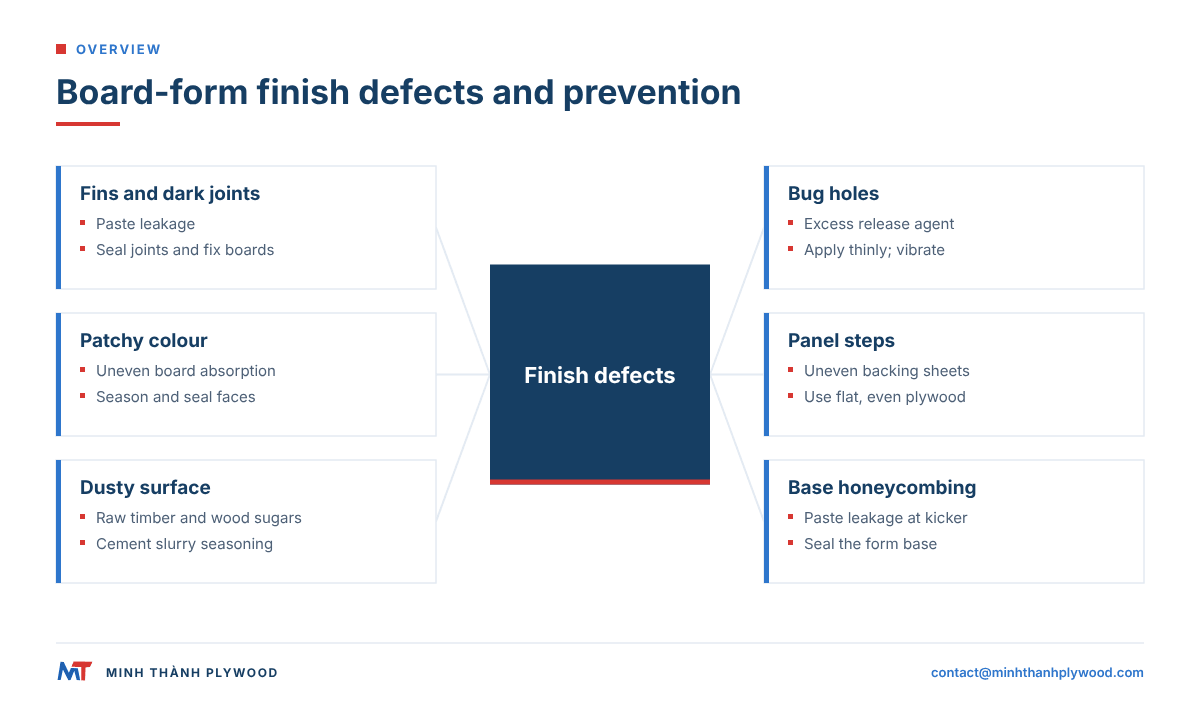
Most board form concrete problems come from leaks, uneven absorption or poor vibration, and each one has a cause in the form. Fix the form and the finish follows.
| Problem | Usual cause | Prevention |
|---|---|---|
| Fins and dark lines at joints | Paste leaking between boards | Tight joints, sealant bead, screws |
| Patchy colour between boards | New and used boards absorbing differently | Season all boards, seal faces |
| Dusty, soft surface | Wood sugars, raw timber | Cement slurry seasoning, release agent |
| Bug holes (surface pores) | Too much release agent, poor vibration | Thin release coat, vibrate each lift |
| Steps between panels | Uneven backing sheets | Flat panels with an even thickness |
| Honeycombing at the base | Paste leaking at the kicker | Seal the base of the form |
Smooth or board-formed: choosing the finish
Choose a smooth finish when the wall is structural, hidden or will be clad, and choose board-formed concrete when the wall itself is the feature. The smooth wall is faster and cheaper; the board-formed wall gives warmth and texture.
| Point | Smooth (film-faced plywood) | Board-formed |
|---|---|---|
| Look | Flat, even, grey | Wood grain, joint rhythm |
| Form face | Film-faced plywood | Boards on a plywood backing |
| Reuse of the face | Many pours | First one or two pours for the boards |
| Labour | Lower | Higher: board prep and fixing |
| Tolerance for defects | Shows every blemish | Texture hides small marks |
Many projects combine both: smooth film-faced concrete for slabs and cores, board-formed concrete for the visible facade or the wall behind a stair.
What this means for your formwork order
For a board form concrete project, the plywood order covers the backing panels that stay in service after the boards are replaced, so specify them for flatness, glue and reuse.
A formwork plywood specification looks like this:
- Application: wall forms, backing for board-formed concrete and smooth walls
- Core: hardwood core, closed
- Glue: phenolic (WBP) or melamine-fortified, water-resistant
- Face: film-faced both sides, edges sealed
- Thickness and size: 18 mm, 1220 × 2440 mm, tolerance ±0.5 mm
- Packing and quantity: export pallets, one 40HC, destination port
Minh Thanh’s minimum order is one 40HC with mixed specifications by agreement, and production takes 15–45 days after the deposit; how panels are checked is on our quality page. See what formwork is and wood formwork for concrete for the wider system, then send your specification to contact@minhthanhplywood.com.
Buyer questions, answered
What is board form concrete?
Board form concrete is architectural concrete cast against timber boards, so the hardened surface shows the wood grain, knots and joint lines of the boards. It is also called board-formed or board-marked concrete.
Can I use plywood to form concrete?
Yes. Plywood is the standard sheet for concrete forms. Film-faced plywood gives a smooth face and many reuses; for a board finish, timber boards are fixed to the inside of the plywood form.
How do you form a concrete wall with plywood?
Build two plywood faces on studs and walers, tie them together at the wall thickness, brace them plumb, seal the joints, apply release agent and pour in layers. For a board finish, screw the boards to the plywood face first.
What wood is best for board form concrete?
Rough-sawn softwoods with strong grain, such as Douglas fir, spruce-pine-fir and pine, give the clearest print. Cedar gives a softer texture. Sandblasting the boards first exaggerates the grain.
How many times can you reuse boards for board-formed concrete?
Rough-sawn boards give their crispest texture on the first one or two pours, then the grain wears and the boards swell. The plywood backing behind them is reused many more times with proper handling, release agent and edge sealing.
Do you have to seal boards for board-formed concrete?
Yes. New boards absorb water and give a patchy, dusty surface, so they are sealed or seasoned with a cement slurry and then coated with release agent before every pour. Joints are sealed with a bead of silicone or tape.
How much does board form concrete cost?
It costs more than a smooth wall because the boards are cut, prepared and fixed by hand. Life of an Architect reported about US$20 per square foot extra in North Texas; total wall prices quoted in the US run higher.
What is the difference between board-formed concrete and a form liner?
Board-formed concrete uses real timber boards in the form. A form liner is a rubber or plastic mat moulded with a board pattern, fixed to the form face and reused for many pours with the same texture.
Why does board-formed concrete have dark lines at the joints?
Cement paste leaks into gaps between boards and forms thin fins or dark lines. Tight joints, a sealant bead and screws instead of nails keep the lines fine and even.
Is board formed concrete used for exterior walls?
Yes. Board form concrete walls are common on facades, retaining walls and garden walls. The concrete is the finish, so it is often sealed against staining after curing.