
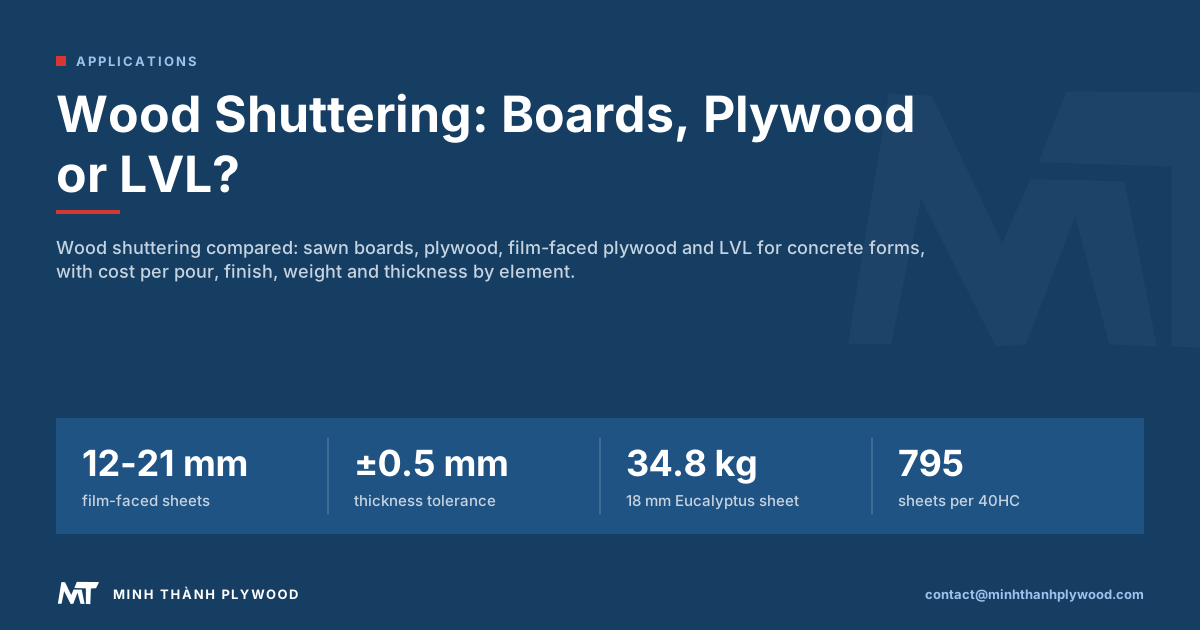
Wood shuttering is timber used as a temporary mould for wet concrete: sawn boards, plywood sheets, film-faced plywood and LVL or timber bearers. For repeated pours, film-faced plywood gives the smoothest face at the lowest cost per pour; sawn boards suit one-off or textured work. Minh Thanh Plywood makes film-faced plywood on Eucalyptus or Acacia cores at ±0.5 mm.
What is wood shuttering?
Wood shuttering is the timber mould that holds wet concrete in shape until it can carry itself. It has two parts: the sheathing, which touches the concrete and gives the surface, and the support, the joists, walers and props that carry the sheathing and the pressure of the concrete.
The words change with the market. Shuttering is the usual term in the UK, India, the Gulf and much of Africa; North American contractors say formwork or concrete forms. All of them describe the same job. Our pillar on what formwork is covers the whole system, including steel and aluminium; this guide covers the wood.
Four woods do almost all of the work on site:
- Sawn boards: softwood planks nailed edge to edge, the oldest wood forms for concrete.
- Bare plywood: exterior-grade sheets without a film, used for a few pours.
- Film-faced plywood: plywood with a resin film on both faces and sealed edges, the standard reusable sheathing.
- LVL and sawn timber: straight members for bearers, joists and walers behind the sheathing.
UK shuttering prices and sizes: what does wood shuttering cost?
UK merchants sell shuttering ply in 2440 × 1220 mm (8 × 4 ft) sheets, 12 mm from about £16 and 18 mm from about £25 per sheet before VAT in October 2026. Buying by the sheet at these prices is right for one small job; a contractor who reuses forms or buys in volume prices film-faced sheets by the container instead. These prices are indicative and move weekly, so check the live merchant price.
| UK item (October 2026) | Size | Price before VAT |
|---|---|---|
| Elliottis pine shuttering ply, 12 mm (Wern Wood) | 2440 × 1220 mm | About £15.83, up to 10% off in bulk |
| Softwood shuttering ply, 18 mm (Builders Megastore) | 2440 × 1220 mm | About £25.29 |
| Shuttering ply, 18 mm, usually Brazilian softwood, face plugged and sanded (Bennetts Timber) | 2440 × 1220 mm | Merchant price list |
| Sawn green shuttering board (Silverton Builders Merchants) | 22 × 100 mm and 22 × 150 mm, 4800 mm long | Merchant price list |
| C24 bearers (Silverton) | 47 × 100 mm, 2400 or 6000 mm long | Merchant price list |
Our film-faced sheets come in the same 1220 × 2440 mm size, in 12–21 mm, and are quoted FOB Hai Phong or CIF to your UK port per container, with the quotation naming the bond and film. Because a film-faced sheet is reused, compare cost per pour (below), not cost per sheet.
Is shuttering ply structural? Not by default. Merchant shuttering ply is formwork sheathing: it carries concrete pressure over supports spaced by the designer. Check the panel’s declared structural grade and properties against the design. EN 636 covers both structural and general-purpose plywood, so the standard number alone does not identify a structural grade. A formwork designer, not the merchant, sets the bearer and waler spacing.
What type of wood is best for formwork?
Film-faced plywood is the best wood for formwork that will be used more than a few times. The film gives a smooth, sealed face, the water-resistant bond survives wet concrete, and a calibrated sheet keeps joints flush. A contractor pouring floor after floor gets the most pours and the cleanest concrete for each dollar spent on it.
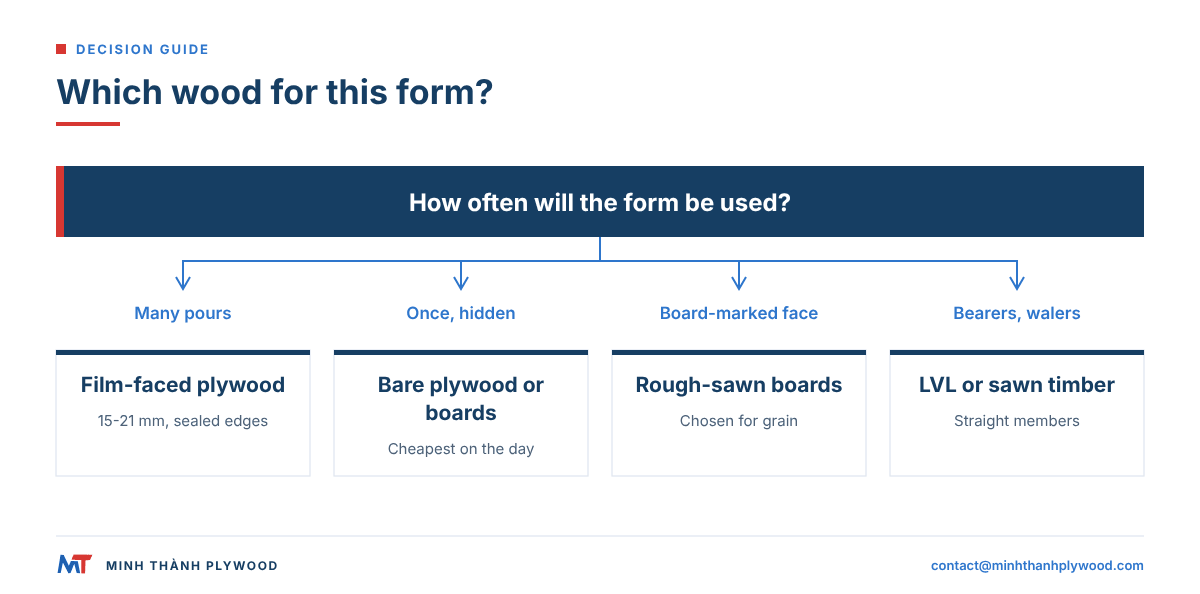
The best wood still depends on the pour:
- Repeated walls, columns and slabs: film-faced plywood, 15–21 mm.
- A one-off footing or a pour that will be buried: bare exterior plywood or sawn boards, whichever is cheaper on the day.
- A board-marked architectural face: rough-sawn boards, chosen for their grain. Our guide to board-formed concrete shows how that finish is made.
- Bearers, joists and walers: LVL or straight sawn timber, because they carry load along their length.
Hardwood plywood beats a softwood board on hardness: the face resists the dents from vibrators and the abrasion from stripping. A Eucalyptus or Acacia core is heavy and hard, which is why most film-faced panels from Vietnam use one.
Wood forms for concrete compared: sawn boards, plywood, film-faced plywood and LVL
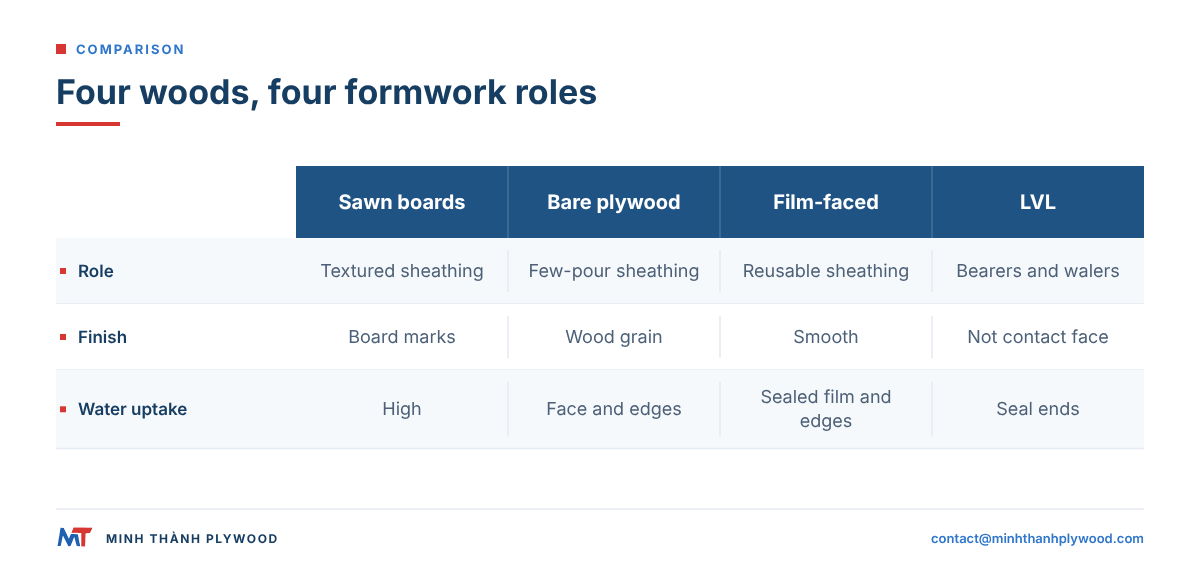
The four woods differ most in finish, number of pours and labour. The table compares them on one row per metric.
| Metric | Sawn boards | Bare exterior plywood | Film-faced plywood | LVL |
|---|---|---|---|---|
| Role in the form | Sheathing for small or textured work | Sheathing for a few pours | Reusable sheathing | Bearers, joists, walers |
| Concrete finish | Board marks, joints every plank | Wood grain printed, some fibre pull | Smooth, even, few joints | Not a contact face |
| Pours per piece | Lowest; boards split and cup | Low; face absorbs water | Highest of the wood options | Many, as a support member |
| Joints per 3 m² wall | Many, one per board | Two or three sheet joints | Two or three sheet joints | — |
| Water uptake | High at every face | Face and edges absorb | Film sealed; edges sealed | Ends need sealing |
| Labour to build | Highest: cut, nail, fill gaps | Low: full sheets | Low: full sheets | Low: straight, even lengths |
| Waste after the job | Highest | Medium | Lowest per pour | Low |
| Typical thickness | Boards 22–25 mm (UK green boards 22 × 100 or 22 × 150 mm) | 12–18 mm | 12–21 mm | By the engineer’s section |
Read the table by job, not by price per piece. Boards are cheap to buy and expensive to build with; film-faced plywood costs more per sheet and less per pour. LVL does a different job and belongs behind the plywood, not in front of it.
What is shuttering plywood?
Shuttering plywood is plywood made to mould wet concrete. In most markets the term means film-faced plywood: thin hardwood veneers cross-laminated with a water-resistant glue, pressed flat, with a resin-impregnated paper film bonded to both faces and the edges sealed with paint.
Three parts decide how it performs:
- The film: phenolic resin paper, usually brown or black, that gives the smooth face and stops the concrete bonding to the wood. Our film-faced plywood page lists the film masses we press.
- The core: hardwood veneers, at Minh Thanh mostly Eucalyptus at 650–750 kg/m³ or Acacia at about 580 kg/m³. A dense, well-joined core resists bending between bearers and holds screws and nails.
- The bond: melamine-fortified or phenolic WBP (weather and boil proof) glue. Phenolic WBP is the choice for the longest reuse in wet service.
Shuttering ply also goes by formwork plywood, concrete form plywood and marine shuttering in some markets. The name changes nothing; the film, core and bond on the quotation tell you what you are buying.
Is shuttering plywood waterproof?
Shuttering plywood is water-resistant where it matters: the film face sheds water and the melamine-fortified or phenolic bond holds the veneers together in wet concrete and rain. The weak points are cut edges, screw holes and scratches through the film, which expose bare wood.
Water that reaches the core through an open edge swells the outer veneers and lifts the film. That is how most film-faced sheets fail early: not at the face, but along the edge. Three habits keep the sheet dry:
- Seal every fresh cut and hole with edge paint before the sheet goes back into service.
- Store sheets flat on bearers, off the ground, under a cover.
- Keep stacks out of standing water on site.
A bond test is the real measure of water resistance. Our melamine-fortified exterior specification uses a 12-hour boiling requirement, and phenolic WBP panels are hot-pressed at 130–145 °C. Ask for the bond type by name on the quotation instead of relying on the word waterproof.
Cost per pour: when cheap wood is a false economy
The cost that matters in wood shuttering is the cost per pour, not the price per sheet. Divide what the sheet costs delivered by the number of usable pours it gives, then add the labour to build and strip it each time.
Cost per pour = (delivered price per sheet ÷ usable pours) + labour per pour + waste disposal
The arithmetic punishes cheap wood in three ways:
- Fewer pours. A bare sheet or a board that absorbs water swells, splits and sticks after a few uses. A film-faced sheet at twice the price that gives three times the pours costs a third less per pour.
- More labour. Boards need cutting, nailing and gap filling at every form; a full 1220 × 2440 mm sheet covers about 3 m² in one lift.
- More repair. Grout leaks through board joints leave honeycombing and fins that a crew has to grind or patch on the finished concrete.
Cheap wood is the right answer when the form is used once and the concrete is hidden: a blinding layer, a buried footing, a ground beam. For anything poured more than a few times or left exposed, the sheet with the film is cheaper over the job. Our comparison of plywood vs steel formwork runs the same arithmetic against metal systems.
How much does wood shuttering weigh per square metre?
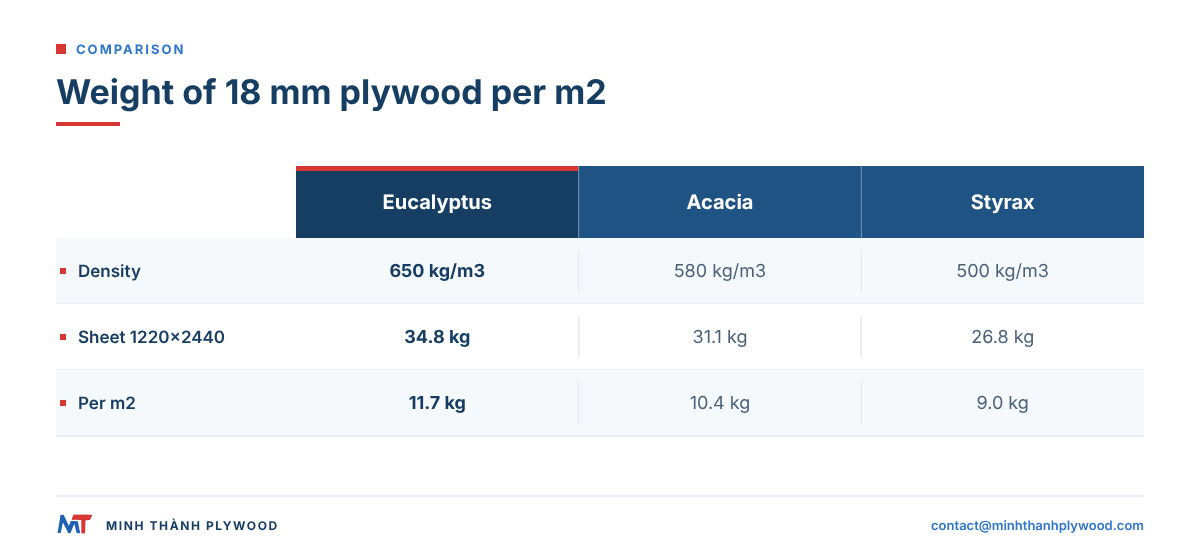
An 18 mm plywood shuttering sheet weighs about 10.4–11.7 kg per square metre, depending on the core species. Weight sets how many sheets a crew can lift by hand and how much a crane lift carries.
Sheet weight follows from density × volume. A 1220 × 2440 × 18 mm sheet holds 0.0536 m³ of wood:
| Core and thickness | Density | Sheet weight | Weight per m² |
|---|---|---|---|
| Eucalyptus, 18 mm | 650 kg/m³ | 34.8 kg | 11.7 kg |
| Acacia, 18 mm | 580 kg/m³ | 31.1 kg | 10.4 kg |
| Styrax, 18 mm (furniture core) | 500 kg/m³ | 26.8 kg | 9.0 kg |
| Sawn softwood boards, 25 mm | 500 kg/m³ | — | 12.5 kg |
The denser Eucalyptus core is heavier but stiffer and harder, which is why it is a common choice for shuttering. Styrax is our light furniture core; it is listed only to show the range. Boards of the same coverage weigh more than 18 mm plywood because they are thicker, and they arrive in many pieces instead of one.
Which thickness of plywood for which part of the form?
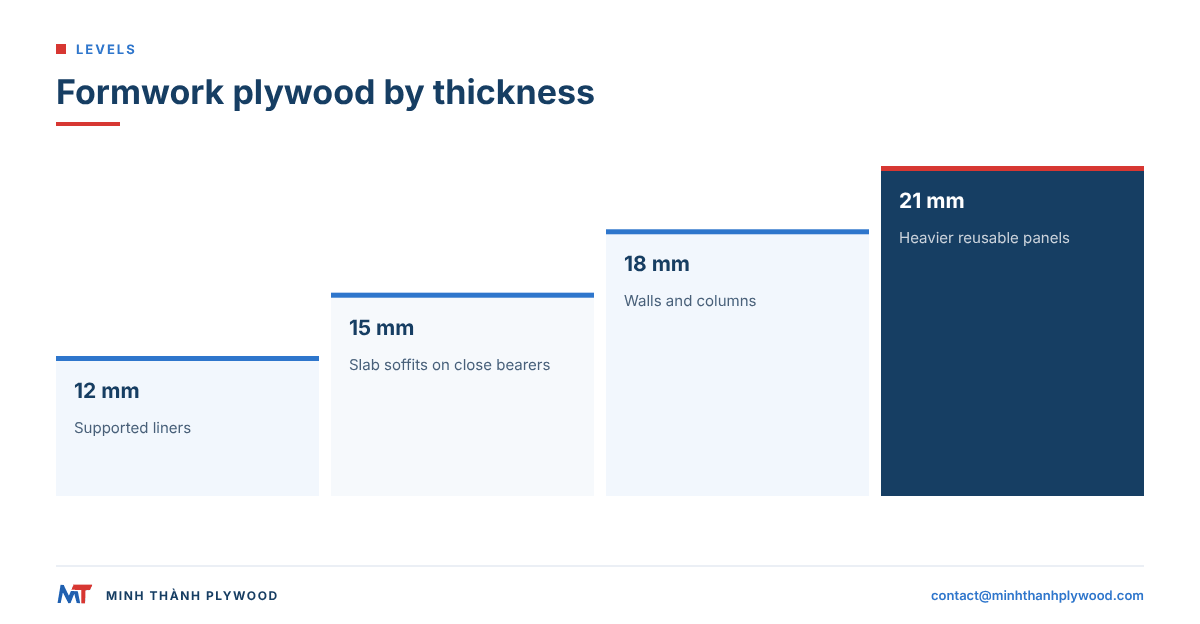
Concrete forms use plywood from 12 to 21 mm, and the bearer spacing in the formwork design sets which one. Wet concrete pushes hardest at the bottom of a tall wall pour, so walls and columns take thicker sheets or closer supports than slab soffits.
| Form element | Usual sheet | Why |
|---|---|---|
| Liners, supported light forms | 12 mm | Backed by a frame or another sheet |
| Slab soffits on close bearers | 15 mm | Carries the slab weight between joists |
| Walls and columns | 18 mm | Higher lateral pressure from the pour |
| Heavier form panels, long reuse | 21 mm | Stiffer between walers, more pours |
Follow the formwork engineer’s layout for bearer centres and pour rate; the table shows common practice, not a design. When the drawing names a structural grade for the plywood, include it in the enquiry with the test evidence the project needs.
How to build basic wooden concrete forms
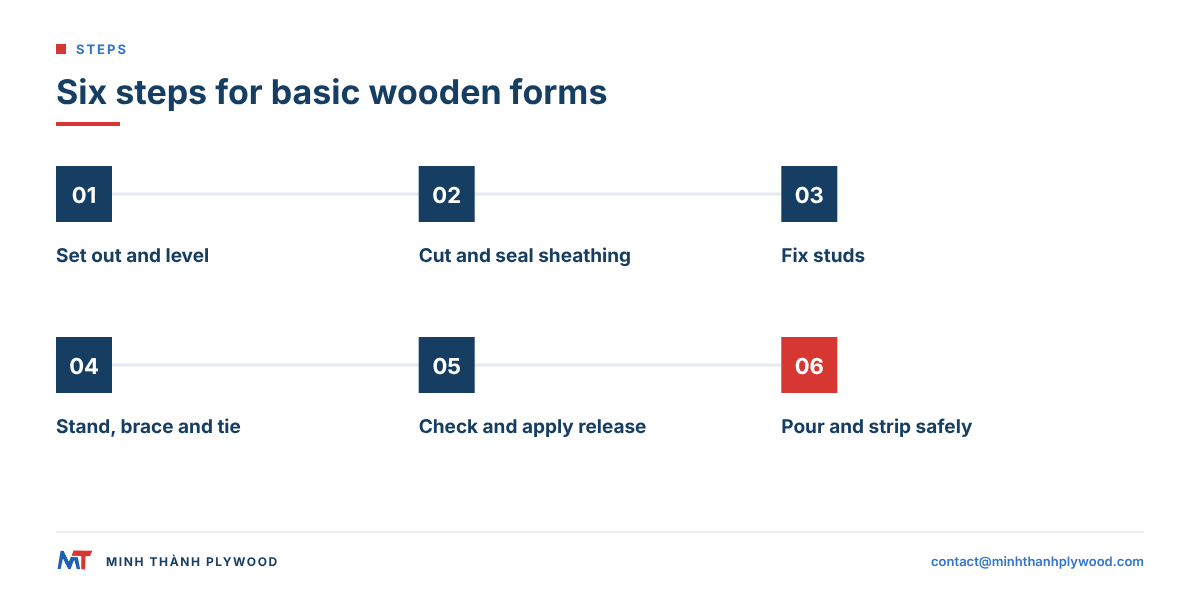
Basic wooden concrete forms for a footing, a low wall or a slab edge take six steps. The method below suits small pours; tall walls and suspended slabs need an engineered design.
- Set out and level. Mark the concrete line with string and pegs, and check the ground under the form is firm and level.
- Cut the sheathing. Cut film-faced or exterior plywood to the face height plus a few centimetres; seal every cut edge at once.
- Fix the studs. Screw vertical studs to the back of each sheet at the spacing the sheet thickness allows, with the smooth face towards the concrete.
- Stand, brace and tie. Stand the panels on the line, brace them back to stakes and tie opposite faces through the pour with form ties at the planned spacing.
- Check and release. Check line, level and plumb, close any gaps at the joints, and coat the contact face with release agent.
- Pour, then strip. Pour in layers, vibrate, and strip only when the concrete has reached the strength the specification sets; clean and stack the panels flat.
Board forms follow the same steps with planks instead of sheets, and need every board joint closed to stop grout leaking.
How do you make shuttering plywood last more pours?
Shuttering plywood lasts longest when the film stays whole and the edges stay sealed. Most early failures come from site handling, not from the panel.
- Release agent every pour. A thin, even coat on the film stops the concrete bonding and makes stripping clean.
- Strip with care. Use wedges and bars against the frame, never against the film face, and do not drop sheets from height.
- Clean at once. Remove concrete residue with a scraper or soft brush while it is fresh; wire brushes cut the film.
- Seal new damage. Paint cut edges, holes and deep scratches before reuse.
- Stack flat and covered. Store on level bearers with the films face to face, off wet ground.
- Rotate faces. Use the better face for exposed concrete and the other for hidden pours.
Cutting a sheet once, to the most-used panel sizes, keeps edges sealed longer than recutting on every job. Our cut-to-size plywood service shows how panels can arrive pre-cut.
Why does thickness tolerance matter in shuttering?
Thickness tolerance matters because two sheets that meet on a wall or soffit leave a step in the concrete when their thicknesses differ. A step means grinding on exposed work and a grout leak at the joint.
We press commercial and film-faced plywood to ±0.5 mm on thickness (quality and tolerances) and ±2 mm on length and width. On an 18 mm sheet that keeps the finished thickness between 17.5 and 18.5 mm, so neighbouring sheets sit close to flush on a level bearer. Square sheets also close the joint line along the full height of a wall panel.
Check two things on arrival: measure thickness at several points around a sheet with a caliper, and lay two sheets edge to edge on a flat surface to see whether the joint closes.
What does this mean for your formwork plywood order?
An order of film-faced plywood from Vietnam is specified by thickness, core, bond, film and size, and loaded by weight. This is how we quote and ship it.
| Order item | Minh Thanh practice |
|---|---|
| Thickness | 12–21 mm for film-faced sheets, ±0.5 mm |
| Core | Eucalyptus (650–750 kg/m³) or Acacia (about 580 kg/m³) |
| Bond | Melamine-fortified or phenolic WBP, named on the quotation |
| Sizes | 1220 × 2440 and 1250 × 2500 mm |
| 40HC load, 18 mm | 795 sheets on Eucalyptus (15 × 53), 880 on Acacia (16 × 55), capped by weight |
| MOQ and lead time | One 40HC; production 15–45 days after the 30% deposit |
| Payment and terms | 70% against the scanned B/L or L/C at sight; FOB Hai Phong, CFR or CIF |
| Samples | Free samples |
Every shipment is photographed and filmed before loading, and you receive the photos and video. The film-faced plywood page has the full product specification.
Which safety rules apply to wooden formwork?
Formwork must carry every load placed on it until the concrete can carry itself, and site rules say so in plain terms. In Great Britain the duty to plan, manage and monitor temporary works sits under the Construction (Design and Management) Regulations 2015 and the Health and Safety at Work etc. Act 1974.
Contractors meet it with BS 5975, the code of practice for temporary works procedures and falsework, an appointed temporary works coordinator, a design check and a permit to load or strike before each pour; the Health and Safety Executive’s falsework guidance (CIS56) names poor coordination between trades and suppliers as a leading cause of failures.
In the United States, the rule is OSHA standard 1926.703. It states that “formwork shall be designed, fabricated, erected, supported, braced and maintained so that it will be capable of supporting without failure all vertical and lateral loads that may reasonably be anticipated to be applied to the formwork” (OSHA 1926.703, checked 20 October 2026).
For wooden forms that means a design for any wall or slab of real height, drawings kept on site, sheets and bearers inspected before each pour, and damaged panels taken out of service. Our sibling guides on formwork materials compared and plastic vs plywood formwork compare wood with the other systems a site may use.
To quote film-faced plywood for your next pour, send the thickness, core, bond, film colour, sheet size, quantity and destination port. Our team replies within hours.
Buyer questions, answered
What type of wood is best for formwork?
Film-faced plywood is the best wood for repeated formwork: a smooth resin film on both faces, a water-resistant bond and a flat, calibrated sheet. Sawn softwood boards suit one-off pours and board-marked finishes, and LVL or sawn timber carries the panels as bearers.
What is shuttering plywood?
Shuttering plywood is plywood made to mould wet concrete. The usual form is film-faced plywood: hardwood veneers cross-laminated with a water-resistant glue, a resin-impregnated film on both faces and sealed edges, most often 12–21 mm thick.
Is shuttering plywood waterproof?
The film face is water-resistant and the bond in shuttering plywood is made for wet service, so the panel survives wet concrete and rain. Cut edges and drilled holes are open wood: seal them after every cut or the core takes up water.
What thickness of plywood is used for concrete forms?
Most concrete forms use 12–21 mm plywood: 12 mm for supported liners and light forms, 15 mm for slab soffits on close bearers, 18 mm for walls and columns and 21 mm for heavier form panels. The engineer's bearer spacing sets the final choice.
Can I use ordinary plywood for concrete forms?
Ordinary interior plywood is a poor choice for formwork, because its glue and bare face are not made for wet concrete. Use exterior plywood with a water-resistant bond for a few pours, and film-faced plywood when the forms will be reused.
How much does an 18 mm shuttering sheet weigh?
A 1220 × 2440 × 18 mm sheet weighs about 34.8 kg on a Eucalyptus core at 650 kg/m³ and about 31.1 kg on an Acacia core at 580 kg/m³, or roughly 11.7 and 10.4 kg per square metre.
Why use LVL in formwork?
LVL is laminated veneer lumber with the grain running along the member, so it makes straight, even bearers and walers. It carries the plywood sheets; it is not usually the concrete-contact face.
Which side of film-faced plywood faces the concrete?
Both faces of standard film-faced plywood carry the same film, so either face can go against the concrete. Use the cleaner, undamaged face for exposed work and keep the other for hidden pours.
Is shuttering ply structural?
Not by default. Merchant shuttering ply is sheathing that spans supports set by a formwork designer. Specify the structural grade and declared properties required by the design; an EN 636 reference or a CE mark alone does not establish suitability.
What does shuttering plywood cost in the UK?
In October 2026 UK merchants list 2440 × 1220 mm shuttering ply from about £16 for 12 mm and about £25 for 18 mm per sheet before VAT. Prices move weekly, so check the live merchant price.
What is the difference between shuttering and formwork?
Shuttering and formwork mean the same temporary mould for concrete. Shuttering is the common term in the UK, India and the Middle East; formwork is more common in North America and in engineering documents.
How many sheets of 18 mm film-faced plywood fit in a 40HC?
Our 40HC plan carries 795 sheets of 1220 × 2440 × 18 mm on a Eucalyptus core (15 packs of 53) and 880 sheets on an Acacia core (16 packs of 55), each capped by weight.