
Natural birch shows the tree's full colour range on one face, creamy sapwood with streaks of light reddish-brown heartwood; white birch is sorted to sapwood only, a near-uniform pale cream. Choose white birch for pale, even clear finishes and natural birch for a warmer, varied look at a lower price. Minh Thanh Plywood matches the birch face to the colour sample you approve.
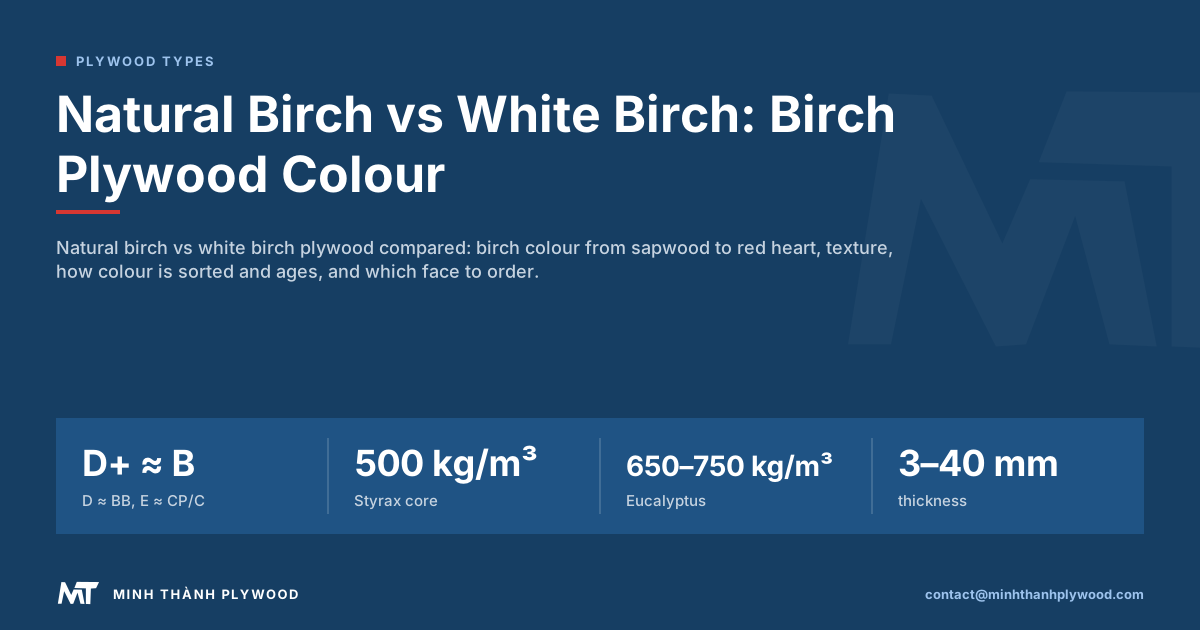
Natural birch vs white birch: the short answer
Natural birch and white birch are the same wood sorted two ways: natural birch keeps the log’s mix of pale sapwood and darker heartwood on one face, while white birch is selected to sapwood only for an even, pale cream face.
| Point | Natural birch | White birch (select white) |
|---|---|---|
| Colour | Cream to pale yellow, with light reddish-brown streaks | Even pale cream to off-white |
| Variation across a sheet | Moderate to high | Low |
| Sheet-to-sheet match | Varies, best sorted by bundle | Close |
| Veneer yield per log | High | Lower, only sapwood used |
| Price | Lower | Higher for the same grade |
| Under clear finish | Warm, lively, natural | Pale, calm, Scandinavian look |
| Under paint | No difference | No difference |
| Best for | Painted work, warm interiors, budget furniture | Clear-finished cabinetry, retail fixtures, pale interiors |
The verdict: pay for white birch only where a clear finish shows the face and the design needs a pale, even colour. Everywhere else, natural birch does the same job for less.
What colour is birch wood? Birch color by species
In North America “white birch” is first a tree, paper birch, so the species decide hardness, weight and colour before any plywood sorting does:
| Species | Also called | Janka hardness | Dried weight | Heartwood and sapwood |
|---|---|---|---|---|
| Paper birch (Betula papyrifera) | White birch | 910 lbf | 610 kg/m³ | Light reddish-brown heart, nearly white sapwood |
| Yellow birch (B. alleghaniensis) | Swamp birch | 1,260 lbf | 690 kg/m³ | Light reddish-brown heart, nearly white sapwood |
| Sweet birch (B. lenta) | Black or cherry birch | 1,470 lbf | 735 kg/m³ | Light reddish-brown heart, nearly white sapwood |
Figures are from the Wood Database species pages (read October 2026); paper birch is about 15% lighter than yellow or sweet birch and much softer, as the WoodWeb birch guide also notes. Birch lumber retails around US$3-6 per board foot (Vermont Woods Studios), which is lumber, not a plywood sheet price.
White birch plywood is not paper birch. On a plywood order, “white birch” is a sapwood-sorted face selection, not the species. Any of these birches can be sorted to white. The sheet is priced above natural birch for the same grade because only the sapwood is used, so ask for the white option as its own priced line.
Birch colour (birch color in US spelling) is creamy white to pale yellow in the sapwood and light to medium reddish-brown in the heartwood. The USDA Wood Handbook describes the commercial birches this way, and most logs hold both zones.
The colour depends on the species and the part of the log:
- Silver and downy birch (Betula pendula, Betula pubescens), the European birches, are pale, with little heartwood in young logs.
- Yellow birch (Betula alleghaniensis), the main North American hardwood birch, has more reddish heartwood.
- Paper birch (Betula papyrifera), also called white birch as a tree name, is pale and soft-textured.
So “white birch” means two things in trade: a tree species in North America, and a colour selection of any birch veneer. On a plywood order, it almost always means the colour selection.
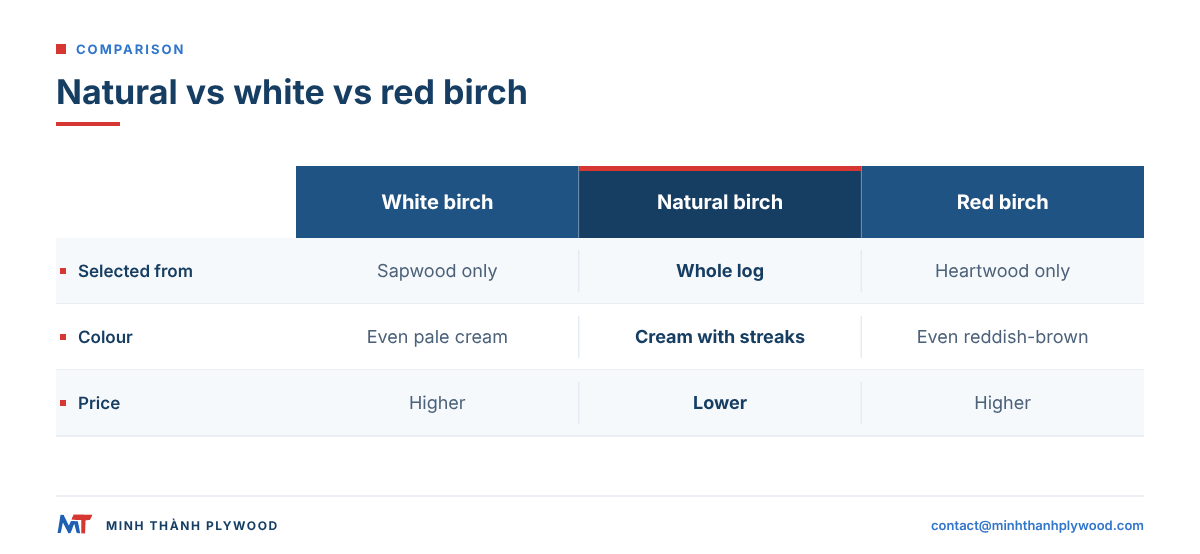
What is natural birch?
Natural birch is birch veneer that has not been sorted for colour. A natural birch face can be all pale, mostly pale with a darker streak, or a mix of cream and light brown, depending on where in the log the veneer came from.
What buyers see on natural birch faces:
- Cream to pale yellow background from the sapwood.
- Light reddish-brown streaks or bands where the peel reached heartwood.
- Small colour shifts across joints on spliced faces.
Natural birch is the default on most birch plywood, because it uses the whole log. It looks warm and lively under a clear finish and disappears completely under paint, which makes it the sensible choice for painted cabinets, carcasses and furniture parts with a laminate or a coloured lacquer.
What is white birch plywood?
White birch plywood has a face of birch veneer sorted to sapwood only, so the whole sheet is an even pale cream. In North American catalogues it is called “select white birch”; in other markets simply white or light birch.
White birch is sorted at the veneer stage. Only veneer without visible heartwood goes to white faces, and the rest goes to natural faces. That is why white birch costs more for the same grade: fewer sheets per log qualify.
Choose white birch for clear-finished fronts, retail fixtures, children’s furniture, wall panelling and any design where pale wood is the point. Order white for both faces when the back shows, for example on open shelving.
What is red birch?
Red birch is the opposite selection: veneer sorted to heartwood, with an even light reddish-brown colour. It is less common than white birch because heartwood is the smaller part of most birch logs.
Red birch suits warm interiors where the designer wants a cherry-like tone without stain. It is ordered by colour sample, like white birch, and it costs more than natural birch for the same reason: the selection uses only part of the log.
Birch ply texture: grain, figure and natural marks
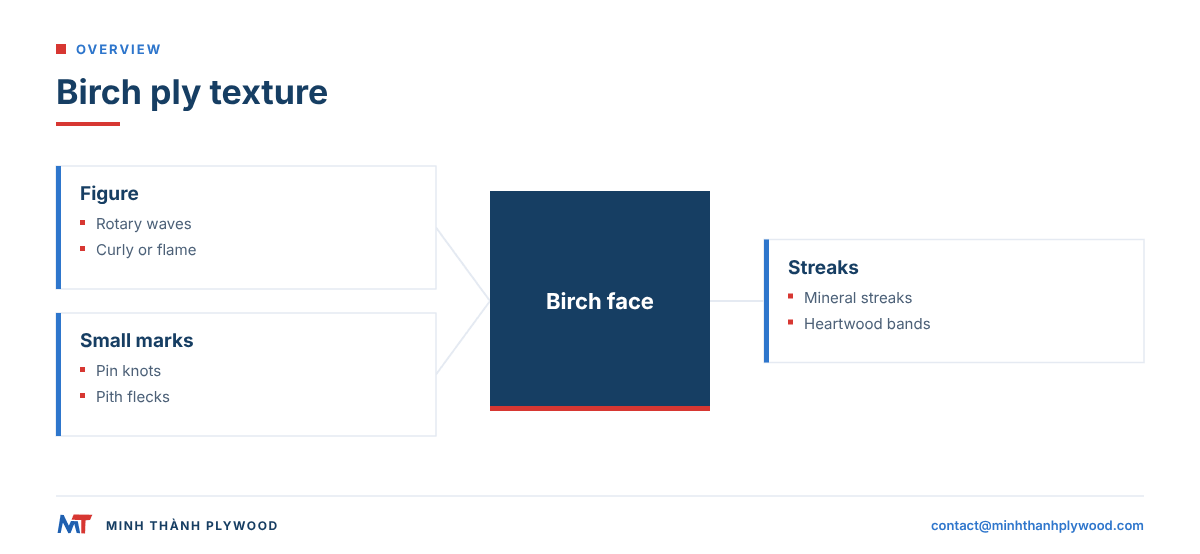
Birch has a fine, even texture and a faint grain that is often slightly wavy. Plywood faces are rotary-cut, so the grain shows as a broad, soft figure rather than the straight lines of sawn boards.
Natural marks you will see, and how they relate to grade:
| Mark | What it looks like | Effect on look |
|---|---|---|
| Rotary figure | Broad, soft waves across the face | Normal on every birch face |
| Curly or flame figure | Ripples that shimmer under light | Prized on clear finishes |
| Pin knots | Small dark dots, a few mm across | Limited on higher grades |
| Pith flecks | Short brown dashes along the grain | Natural, limited on higher grades |
| Mineral streaks | Grey-green or brown lines | Limited on higher grades |
| Colour streaks | Heartwood bands on natural faces | Removed by white selection |
Texture is the same on natural and white faces. The colour selection removes heartwood colour, not figure or small marks; those are controlled by the face grade.
How birch colour is sorted and graded
Colour and grade are two separate lines on a birch plywood order. The grade limits knots, patches, splits and defects; the colour selection limits heartwood. A face can be D+ grade and natural, or D+ grade and white.
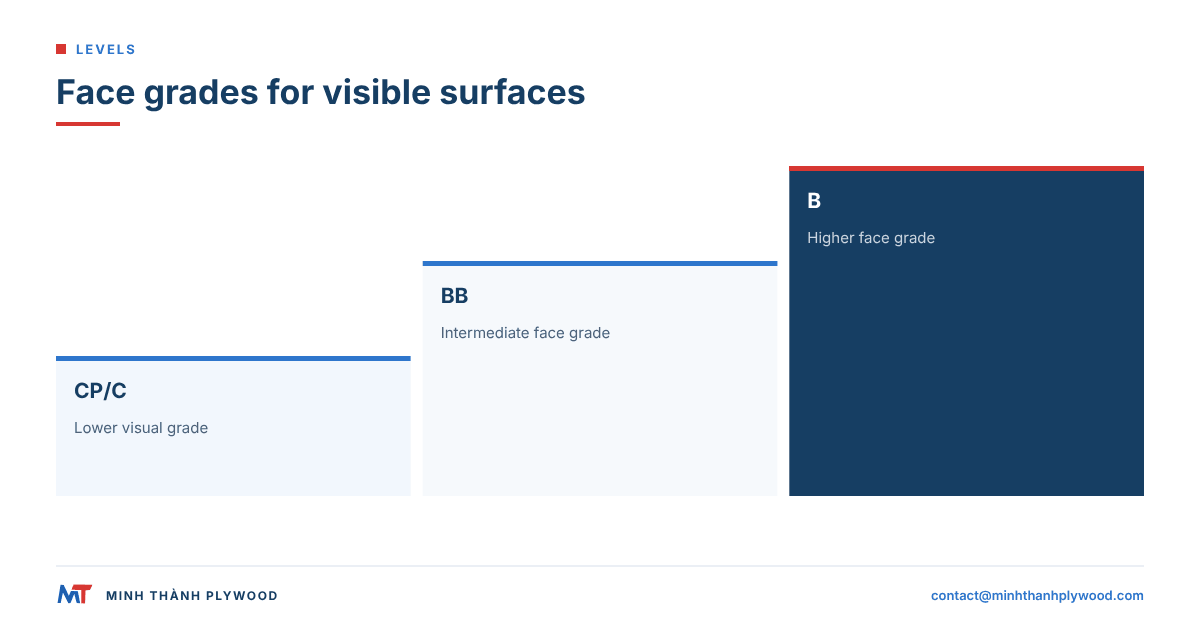
At Minh Thanh, birch face grades are named D+, D and E (from the higher grade down) and quoted as face/back pairs such as D+/D or D/E. The ladder is comparable to the European birch grades:
| Minh Thanh face grade | Comparable European grade | Typical finish |
|---|---|---|
| D+ | B | Clear finish on visible faces |
| D | BB | Clear or stained finish, backs of visible parts |
| E | CP/C | Paint, laminate or covered faces |
So D+/D is comparable to B/BB, and D/D to BB/BB. The colour you want is then fixed by the approved sample: we keep your colour sample with the order and grade the next production run to it. Grade rules are explained in birch plywood grades.
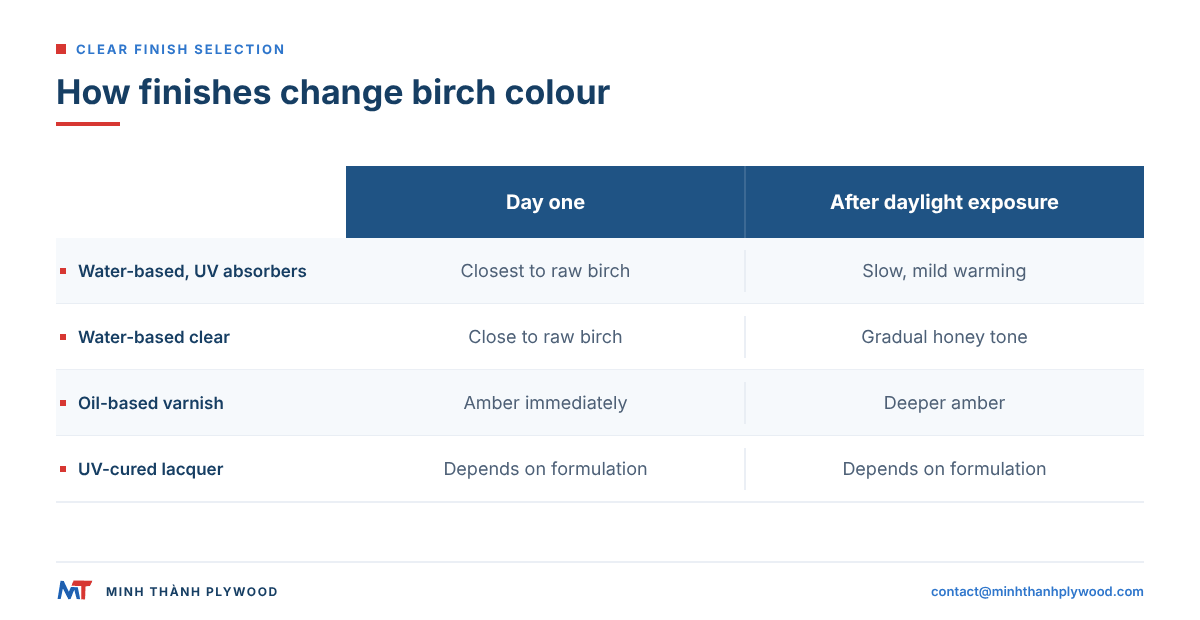
How birch colour changes with age and finish
Birch darkens slowly under light, from cream toward honey and amber, and the finish adds its own tone on top. White birch changes most visibly, because there is more pale wood to warm up.
| Finish | Colour on day one | After months in daylight |
|---|---|---|
| Water-based clear lacquer with UV absorbers | Closest to raw wood | Slow, mild warming |
| Water-based clear lacquer | Close to raw wood | Gradual warming to honey |
| Oil-based varnish or oil | Amber from the start | Deeper amber |
| UV-cured lacquer | Depends on the formulation | Depends on the formulation |
| Paint | Colour of the paint | No wood colour change |
To keep a white birch face pale, finish it with a water-based clear lacquer that carries UV absorbers, and keep it out of direct sun. Minh Thanh birch-faced panels are sanded, polished and UV-ready on both faces, to the standard customers need to apply their own UV coating.
Birch colour under stain and paint
Birch can blotch under thin, penetrating stains, because its density changes across the face and the soft areas absorb more colour. Natural birch shows this more, since its heartwood and sapwood take stain differently.
Three ways to get an even stained colour:
- Seal first with a wood conditioner or a thinned sealer coat.
- Use a gel stain or a toner that sits on the surface rather than soaking in.
- Test on an offcut of the same bundle, with the full finish system.
Under paint, colour selection is irrelevant: order natural birch, or another face such as Poplar, and spend the saving on a smooth, sanded surface.
Edge colour: why the core matters
On birch-faced plywood, the face is birch but the edge shows the core. Edge colour is therefore a core choice, and it matters on any design with exposed edges.
| Core | Edge colour | Typical choice |
|---|---|---|
| White Styrax | Pale, close to the birch face | Exposed-edge furniture, light weight (about 500 kg/m³) |
| Eucalyptus | Darker, pinkish-brown | Heavier, firmer panels (650–750 kg/m³) |
Vietnamese birch-faced plywood is imported birch veneer on a Vietnamese core; there is no birch core in Vietnam. Minh Thanh uses white Styrax or Eucalyptus cores as standard, stitched both ways and pressed twice for furniture grade. If your edges show, order Styrax core with white or natural birch faces for a pale, continuous look. Face and core options are on our birch plywood page.
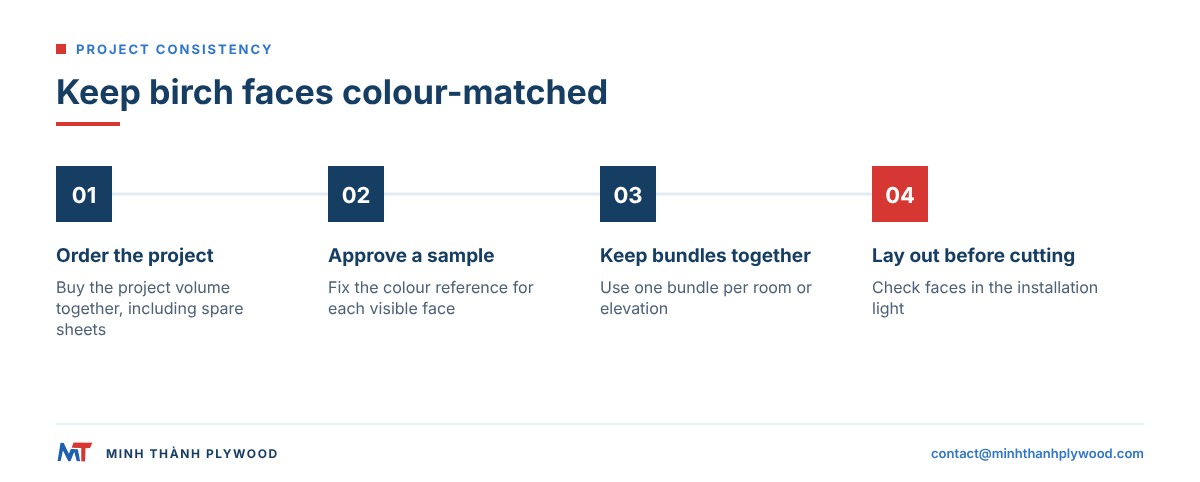
How do you keep birch colour matching across a project?
Birch colour matches best when one project’s panels come from one production run, sorted to one approved sample. Colour changes between logs, so two orders months apart will never be identical, even in white birch.
Four habits keep a cabinet run or a shop fit-out even:
- Order the whole project at once, plus a few spare sheets for repairs and late changes.
- Approve a colour sample for each face before production and keep it with the purchase order.
- Ask for packs by bundle, and use one bundle per room or per elevation.
- Lay out the sheets before cutting in the light where the furniture will stand, and place the most even faces on doors and fronts.
For a natural birch face, the same habits turn variation into a feature: streaks run in the same direction and the room reads as one. For white birch, they keep neighbouring doors from showing a step in tone. Minh Thanh grades every repeat order to the colour sample you approved the first time, so a second container for the same project stays in the same range.
Which birch colour should you choose?
Choose the colour by what the finished part shows. A short decision list:
- Painted or laminated part: natural birch, or a lower face grade; colour does not matter.
- Clear finish, warm interior, budget: natural birch, sorted by bundle so neighbouring panels match.
- Clear finish, pale even look: white birch on both visible faces, water-based finish.
- Clear finish, warm even look: red birch, or natural birch with a toner.
- Exposed edges: add a white Styrax core to the order.
For other faces with a pale look, such as Poplar or Okoume, see plywood face veneers and colours. For how veneer faces are made and joined, see wood veneer sheets.
How to order birch plywood by colour
A birch plywood order that gets the colour right names it separately from the grade and fixes it with a sample. Send these lines:
- Face and back grade: for example D+/D.
- Colour selection for each face: natural, white or red.
- Core: white Styrax for pale edges, Eucalyptus for density.
- Glue and emission: UF glue at E0 emission is our standard for furniture panels.
- Thickness and size: 3–40 mm; 1220 × 2440 or 1250 × 2500 mm; tolerance down to ±0.2 mm on sanded panels.
- Finish plan: clear, stained, painted or UV-coated by you.
- Quantity, packing and port.
The emission line matters because the limits are legal ones. For hardwood plywood with a veneer core, the US limit is 0.05 ppm under 40 CFR 770.10. In the EU, furniture and wood-based articles must not release more than 0.062 mg/m³ from 6 August 2026 under Regulation (EU) 2023/1464.
Ask for a free sample of the exact face and colour; we keep the approved sample as the reference for every repeat order. MOQ is one 40HC, production 15–45 days after the deposit. Send your list to contact@minhthanhplywood.com or WhatsApp +84 988 586 601 (Lisa); we reply within hours.
Buyer questions, answered
What is the difference between natural birch and white birch?
Natural birch is unselected for colour, so a face mixes pale sapwood with darker heartwood. White birch is sorted to sapwood only and looks evenly pale cream. Both are the same wood and can carry the same grade.
What colour is birch wood?
Birch sapwood is creamy white to pale yellow; the heartwood is light to medium reddish-brown. Most birch logs contain both, which is why unselected birch shows streaks of colour.
What is red birch?
Red birch is birch veneer sorted to heartwood, with an even light reddish-brown colour. It is the opposite selection to white birch and is less common.
Does birch plywood turn yellow?
Yes. Birch darkens slowly toward honey and amber under light, and oil-based finishes add their own amber tone. A water-based clear finish with UV absorbers keeps it paler for longer.
Is white birch plywood more expensive than natural birch?
Usually yes. Sorting veneer to sapwood only uses fewer sheets from each log, so white birch faces cost more than natural birch of the same grade.
Does birch take stain well?
Birch can blotch under thin, penetrating stains because its density varies across the face. Use a wood conditioner or a gel stain, and test on an offcut of the same panel first.
What does birch ply texture look like?
Birch has a fine, even texture with a faint, often wavy grain. Rotary-cut faces show a broad, soft figure, and small pin knots, flecks and mineral streaks appear on lower grades.
Is grade the same as colour on birch plywood?
No. Grade limits knots, patches and defects; colour is ordered separately. A D+ face can be natural or white, so name both on the order.
Why are the edges of my birch plywood darker than the face?
The edge shows the core, not the face. A birch-faced panel on a white Styrax core has a pale edge; on a Eucalyptus core the edge is darker and pinkish-brown.