
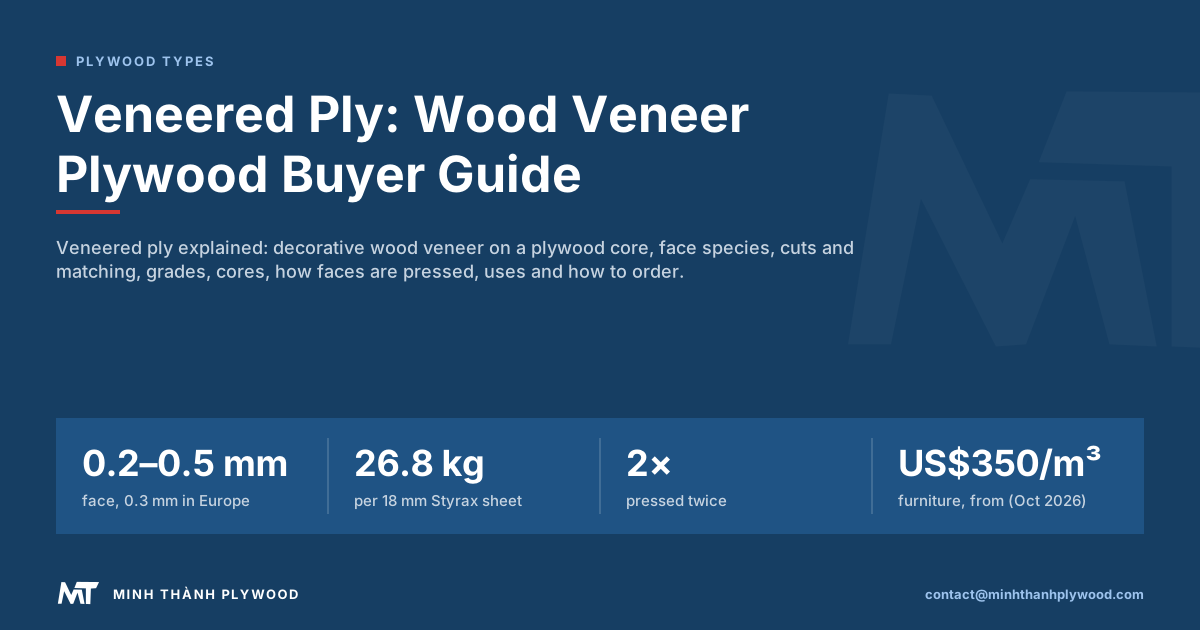
Veneered ply is plywood with a decorative wood veneer pressed on the face and back, chosen for looks, over a core chosen for weight and strength. It gives the look of solid wood on a flat, stable sheet for cabinets, doors, wall panels and furniture. Minh Thanh Plywood presses birch, poplar, EV, okoume, pine and other faces on white Styrax or Eucalyptus cores in Vietnam.
What is veneered ply?
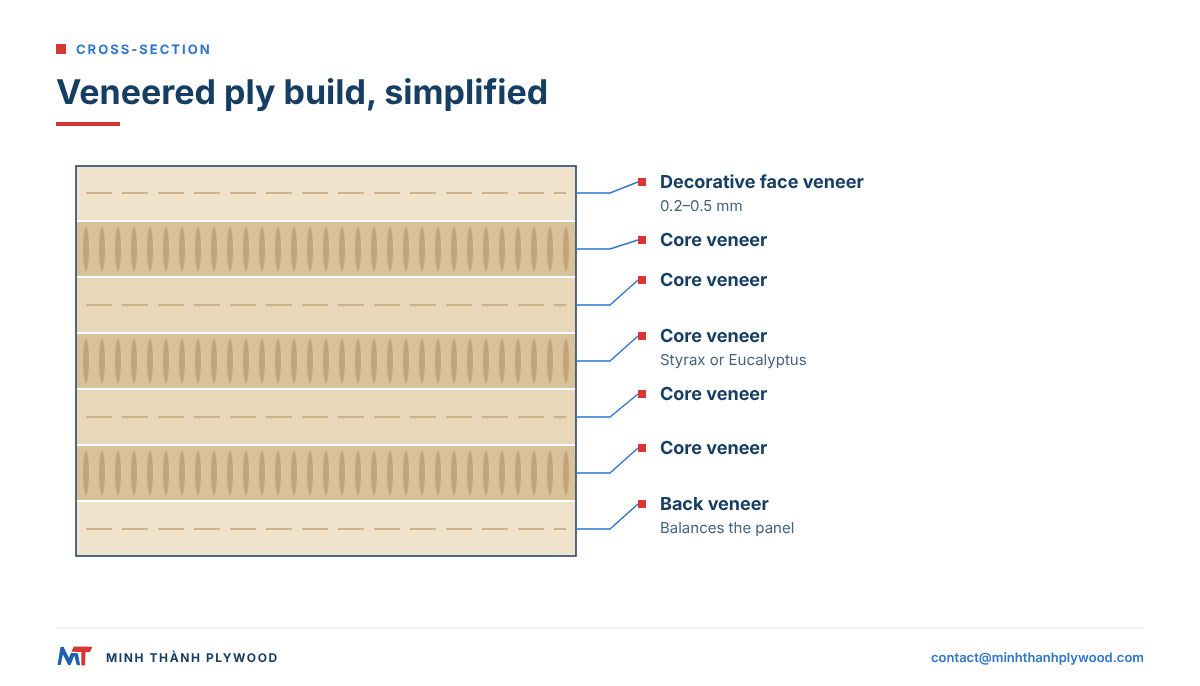
Veneered ply is a plywood panel faced with a decorative wood veneer on both sides: the face for looks, the back for balance, and a core of crossed plies for strength. It gives a real wood surface on a flat, stable, cost-effective sheet.
The three parts each do one job:
- Face veneer: the decorative wood the user sees, 0.2–0.5 mm before pressing.
- Core: crossed veneer plies that carry load and hold screws; at Minh Thanh, white Styrax or Eucalyptus.
- Back veneer: a veneer on the other side that keeps the panel flat, often one grade lower.
Veneered plywood, wood veneer plywood, veneer board and veneered board all name the same family. In everyday trade the panel is named by its face: birch, poplar, okoume, pine or EV plywood. The look of each face, with a colour chart, is in plywood face veneers and colours.
Plywood and veneer: what is the difference?
Veneer is one thin sheet of wood; plywood is a panel made of many veneers glued with the grain crossed. Veneered plywood joins them: a decorative veneer on a plywood core.
| Veneer sheet | Plywood | Veneered ply | |
|---|---|---|---|
| What it is | One thin sheet of wood | Panel of crossed veneers | Plywood core with decorative face and back |
| Thickness | 0.2–0.5 mm for decorative faces | 3–40 mm | 3–40 mm |
| Self-supporting | No; must be glued to a substrate | Yes | Yes |
| Looks set by | The species and cut | The face ply | The chosen decorative face |
| Typical buyer | Workshops veneering their own panels | Builders, packers, furniture plants | Furniture, cabinet and door makers |
Buyers who veneer their own boards buy loose wood veneer sheets. Buyers who want a ready panel buy veneered plywood and skip the pressing.
Which face species can you order on veneered plywood?
Any species that can be cut to veneer can face a plywood panel. The faces Minh Thanh presses most are EV (engineered veneer), poplar, birch, okoume and pine, with bintangor, eucalyptus, gurjan, sapele and other decorative faces on request: more than 10 in all.
| Face | Look | Typical use |
|---|---|---|
| Oak, crown cut | Cathedral figure, pale to mid brown | Natural face for UK furniture and joinery; EV oak-look from Minh Thanh where every sheet must match |
| Oak, quarter cut | Straight stripe with ray fleck | Natural face for doors and panelling; EV straight-grain oak-look as the matched alternative |
| Walnut | Dark chocolate brown, swirling figure | Natural face for premium cabinets; EV walnut-tone from Minh Thanh for long runs |
| Ash | Pale cream with open grain | Natural face for light interiors; EV pale straight-grain as the alternative |
| EV (engineered veneer) | Fixed colour and pattern: straight grain, crown, oak-look; pale, white, red or walnut tones | Doors, kitchens, wall panels that must match |
| Birch | Near-white to pale yellow, fine figure | Clear-finished furniture and cabinets |
| Poplar | Plain cream | Painted, lacquered and laminated furniture |
| Okoume | Pinkish-beige, soft wavy figure | Warm-toned furniture, doors, van fit-outs |
| Pine | Honey tone, ring grain, sound knots | Rustic and Nordic-style furniture, shelving |
| Gurjan, bintangor | Red-brown | Shop fitting, darker furniture |
| Sapele (on request) | Red-brown stripe | Decorative joinery |
Oak, walnut and other premium species are widely used for veneered panels in Europe. Where the budget or the run length does not suit natural oak or walnut faces, EV in oak-look patterns and walnut tones gives a matching look on every sheet.
How are decorative veneers cut and matched?
How a veneer is cut sets its figure, and how the leaves are joined sets the pattern across the sheet. Both belong on the order for decorative faces.
Cuts:
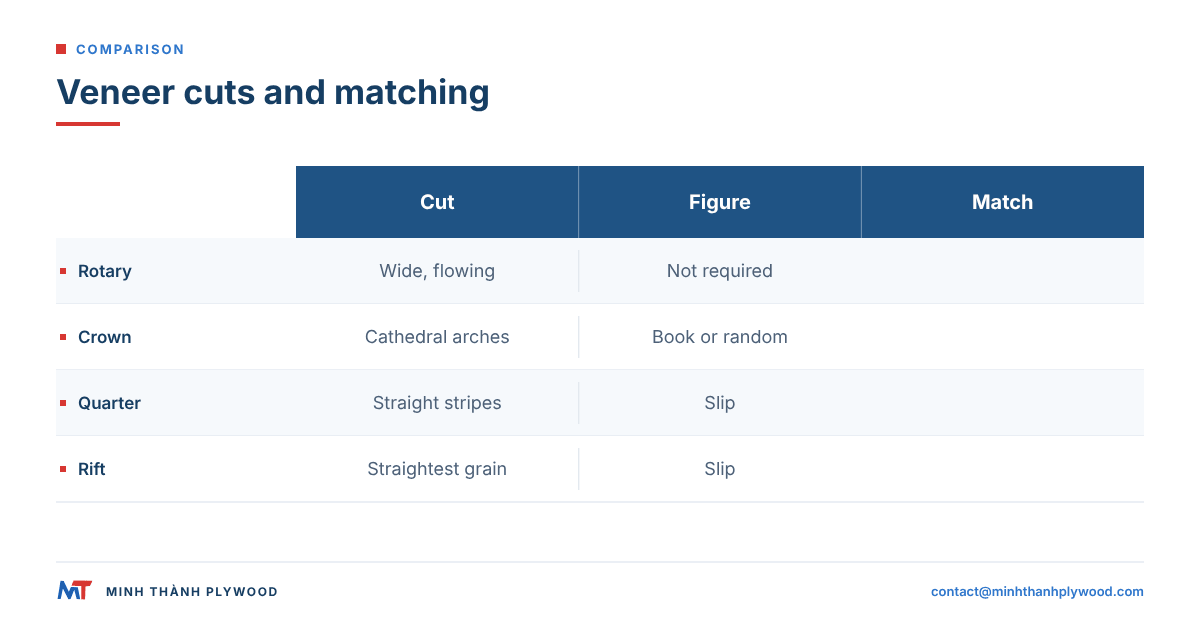
- Rotary cut: the log turns against a knife and the veneer peels off like a roll. Wide, flowing figure; one or two pieces cover a sheet. Birch, poplar, okoume, eucalyptus and bintangor faces are rotary cut.
- Crown or flat cut: a half log sliced front to back; cathedral arches in the middle of each leaf.
- Quarter cut: sliced across the growth rings; straight, even stripes.
- Rift cut: sliced at an angle to the rays; the straightest grain, used mainly on oak.
Matching of sliced leaves:
- Book match: every second leaf flipped, so neighbouring leaves mirror each other.
- Slip match: leaves slid side by side in order, repeating the figure.
- Random match: leaves mixed for a natural, plank-like look.
Engineered veneer needs no matching: the pattern is set in the block and repeats on every sheet.
Which core is best for veneered plywood?
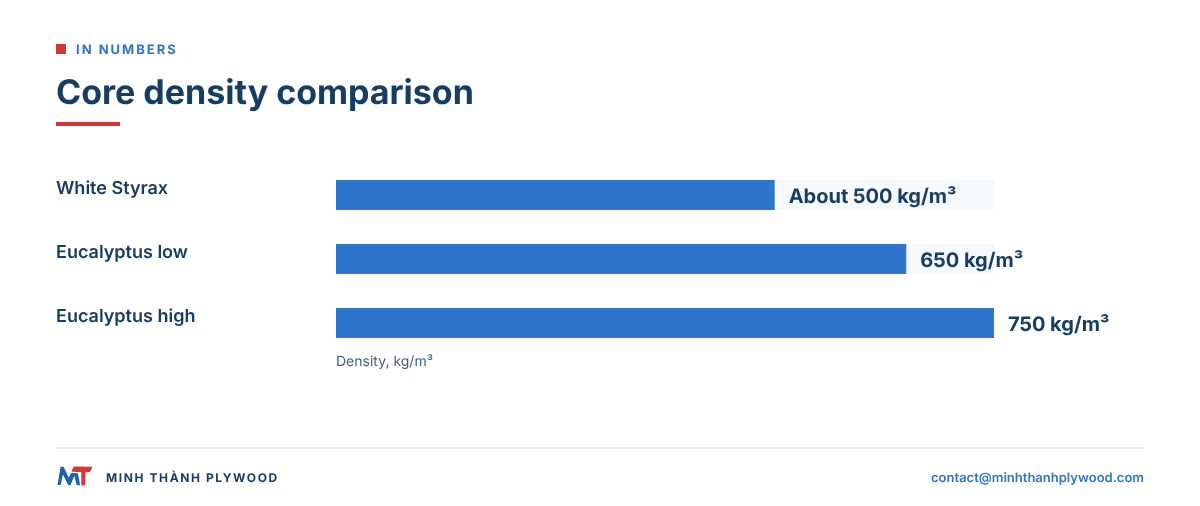
Choose the core by weight, edge look and screw holding; the face does not change these. For most veneered furniture, a white Styrax core is the best balance: light, pale and stable.
| Core | Density | Edge | Best for |
|---|---|---|---|
| White Styrax | About 500 kg/m³ | Pale, even | Cabinets, doors, furniture with banded edges |
| Eucalyptus | 650–750 kg/m³ | Pink-brown | Parts carrying hinges, drawers, heavy shelves |
| Acacia or pine | Made on order | Light brown | Specific customer builds |
An 18 mm 1220 × 2440 mm sheet weighs about 26.8 kg on Styrax and about 34.8 kg on Eucalyptus at 650 kg/m³. Many European furniture buyers choose Styrax for its light weight and clean edge. Both standard cores are stitched horizontally and vertically, so joints stay closed under a thin face.
Veneer is also pressed on MDF and particleboard. Plywood cores weigh less for their strength and hold screws better; MDF gives the smoothest base for very thin faces. The comparison is in veneered panels.
How is decorative veneer pressed onto Vietnamese plywood?
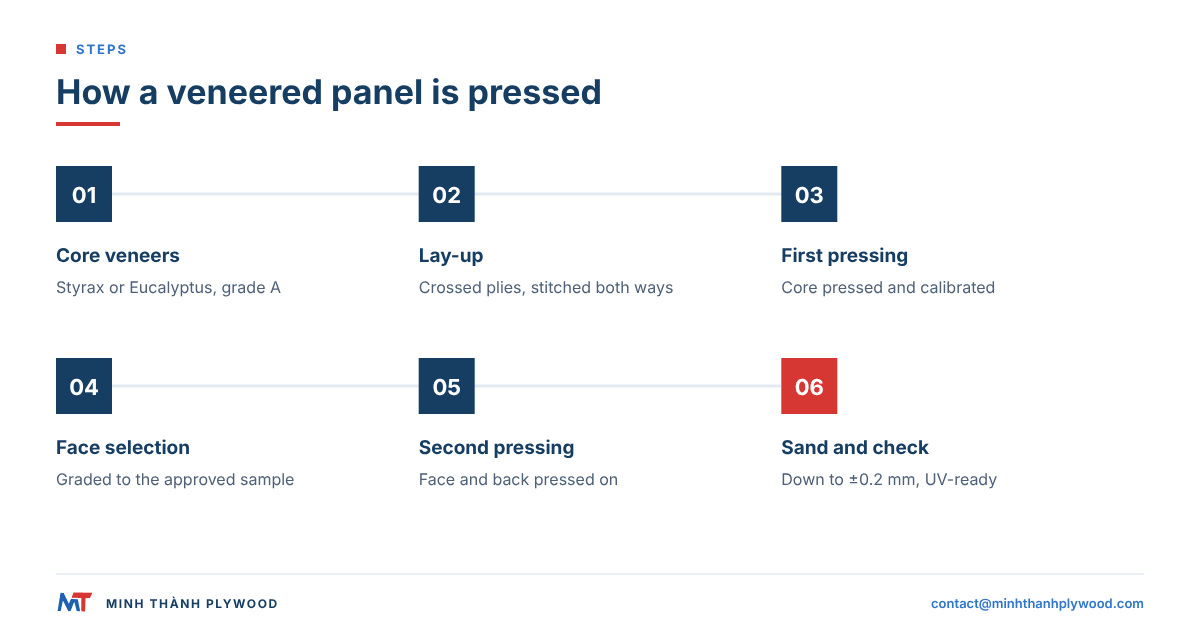
At Minh Thanh Plywood, veneered furniture panels are pressed twice: first the core board is pressed and calibrated to thickness, then the face and back veneers are pressed on. Calibrating the core first is what keeps a thin decorative face flat.
The sequence, step by step:
- Core veneers of white Styrax or Eucalyptus are peeled, dried and graded A for furniture panels.
- Core lay-up: plies crossed, joints stitched horizontally and vertically, 2–4 outer plies as standard and every ply on request.
- First pressing: the core board is pressed with UF glue at E0 emission and calibrated by sanding.
- Face selection: face and back veneers are graded against the buyer’s approved sample.
- Second pressing: face and back are pressed onto the calibrated core.
- Finishing: the panel is sanded and polished; both faces leave the line UV-ready.
- Check and pack: thickness to ±0.2–0.3 mm, down to ±0.2 mm; panels dried to 8–12 % moisture; packs photographed and filmed before loading.
Ply count follows thickness: 3–5 mm panels are always five plies, and 18 mm panels have 11–13 plies.
How do you apply wood veneer to plywood yourself?
To veneer plywood yourself, glue a veneer sheet to a flat plywood substrate under even pressure, and veneer the back too so the panel stays flat. A vacuum bag or a veneer press gives the even pressure; contact cement suits small parts.
- Choose a flat, sanded substrate: plywood with a smooth, calibrated face.
- Cut the veneer 10–20 mm oversize on every side.
- Spread the glue evenly on the substrate: PVA or urea glue for pressing, contact cement on both surfaces for small parts.
- Lay the veneer with the grain running the way the part needs it.
- Press evenly: in a vacuum bag or press, or with a veneer roller for contact cement.
- Veneer the back with a sheet of similar thickness to balance the panel.
- Trim and sand lightly with a fine grit, then finish.
For more than a few panels, buying veneered plywood ready-pressed costs less than doing it by hand. The factory press bonds face and back evenly at heat across the whole sheet.
Should veneered plywood be veneered on one side or two?
Veneer one side when the other side is hidden, and both sides when the panel is seen from both sides or must stay flat. A/CC is the usual one-side grade: a good face (A) and a plain back (CC). A/B puts a good face on one side and a sound, lightly marked face on the other, for shelves, doors and open units.
Balance matters: a panel veneered on one side only pulls toward the veneered face as the glue and wood move with humidity, while a panel with similar faces on both sides stays flatter. For a thin panel or a large door, order both sides, or add a balancing veneer or laminate to the back.
What face grades are used on veneered plywood?
Faces are graded by how many knots, patches and colour streaks they show, and quoted as face/back pairs. The approved sample fixes the look of the order.
- Poplar, pine and eucalyptus faces: A/A, A/B and B/B, with B/C for pine utility parts.
- Birch faces: D+, D and E in Vietnam, quoted as D+/D or D/E. As a buying comparison, D+ is close to European B and D close to BB, so D+/D reads roughly as B/BB.
- EV faces: the same grade on face and back, or one grade lower on hidden backs (A/A, A/B, B/B).
Buy by what the user will see. A/A suits doors and panels seen on both sides; A/B suits cabinet sides with one show face; B/B suits painted or covered parts.
What is veneered plywood used for?
Veneered plywood is used wherever a real wood look meets a flat, stable sheet: kitchen and bathroom cabinets, wardrobes, doors, wall panelling, shop fittings, furniture and vehicle interiors.
| Use | Typical build |
|---|---|
| Kitchen and bathroom cabinet carcasses | 15–18 mm, birch, poplar or EV face, Styrax core; MR glue near water |
| Cabinet and wardrobe doors | 18 mm EV or birch D+/D for clear finishes |
| Door skins and door components | Thin 3–5 mm panels, five plies |
| Wall panelling and ceilings | EV or okoume for repeatable colour |
| Shop fittings and displays | EV, bintangor or birch |
| Van and boat interiors | Okoume or poplar on Styrax, MR or WBP glue |
| Drawer bottoms and cabinet backs | 3–6 mm poplar or eucalyptus faces |
Cut-to-size panels save waste on repeat parts: one sheet cut into 4, 6 or 8 pieces is a service Minh Thanh ships regularly to Italy and other European markets.
How do you finish veneered plywood?
Finish veneered plywood like the solid species, but sand gently: the face is only 0.2–0.5 mm thick, and 0.3 mm is usual on European furniture plywood. Heavy sanding cuts through to the core.
- Clear lacquer or UV coat on birch, EV, okoume and pine. Minh Thanh panels leave the line UV-ready on both faces, so a UV coating line can run them directly.
- Oil or hard-wax oil on okoume, pine and birch for a warm, natural look.
- Stain on birch, okoume and eucalyptus, after a pre-stain conditioner.
- Paint on poplar faces, with a primer; seal pine knots with a shellac-based primer first.
Edges of veneered plywood are usually banded with matching veneer tape or a solid wood lipping, or left as a design feature on a pale Styrax core.
How do you check engineered veneer plywood from Vietnam before ordering?
Check the face, the core, the glue and the documents, then hold the order to an approved sample. These checks apply to any engineered veneer plywood supplier in Vietnam.
- Pattern and colour: approve a sample sheet of the exact EV code; samples are free at Minh Thanh.
- Core: name the core species and ask for a cut edge; Styrax for light furniture, Eucalyptus for density.
- Glue and emission: glue type and emission class on separate lines, with the evidence. Minh Thanh’s furniture panels use UF glue at E0 emission and hold CARB P2 / TSCA Title VI certification (ICTT mill no. 23024). The bond class follows BS EN 314-2:1993, the bonding-quality requirements standard.
- Tolerance and flatness: thickness tolerance in writing, down to ±0.2 mm for sanded furniture panels.
- EU documents: the EUDR compliance dossier (origin records and geolocation files) for EU orders, which fall under Regulation (EU) 2023/1115.
- Proof before loading: photos and video of your own packs; every Minh Thanh shipment is photographed and filmed before loading.
Six ASTM D6007 chamber tests on Minh Thanh panels, by Shanghai Hongjun and ICTT Vietnam between April 2025 and June 2026, averaged 0.014–0.032 ppm. The limit for hardwood plywood with a veneer core is 0.05 ppm under 40 CFR 770.10. SGS tests to EN 717-1 or the buyer’s method on request.
What sizes and thicknesses does veneered plywood come in?
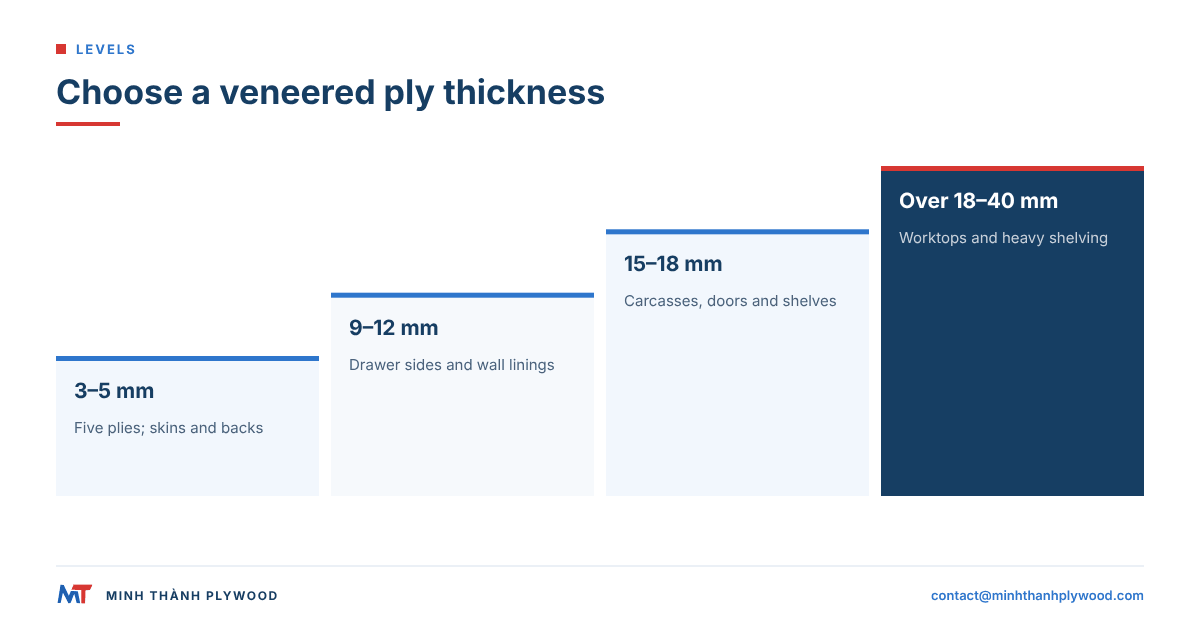
Minh Thanh presses veneered plywood from 3 to 40 mm, in 1220 × 2440 mm and 1250 × 2500 mm sheets, plus custom sizes such as 1220 × 2500 mm and 1220 × 2280 mm.
- Thin 3–5 mm: always five plies, for door skins, backs and drawer bottoms.
- 9–12 mm: drawer sides, light panels, wall linings.
- 15–18 mm: carcasses, doors and shelves; 18 mm has 11–13 plies.
- Over 18 mm, up to 40 mm: worktops, heavy shelving, stair and furniture parts.
Thickness tolerance on sanded furniture panels is ±0.2–0.3 mm, down to ±0.2 mm; length and width are held to ±2 mm.
What does veneered plywood cost?
Price follows the face first, then the core, glue, thickness and size. Imported faces such as birch and okoume cost more than poplar or eucalyptus; a higher grade pair costs more than a lower one; thin sheets cost more per cubic metre than 15–18 mm.
Minh Thanh’s furniture and interior plywood starts from US$350/m³ (October 2026). The quotation is per cubic metre by thickness, with the face, grade, core, glue and packing on separate lines.
UK buyers searching “veneered ply” compare sheet prices at merchants. Sheet Materials Wholesale lists oak-veneered poplar ply, one side crown cut, grade A/CC, 2440 × 1220 mm, and oak-veneered birch ply with both sides faced (Sheet Materials Wholesale, October 2026):
| UK merchant sheet | Thickness | Price per sheet, ex VAT |
|---|---|---|
| Oak veneered poplar, 1 side crown cut, A/CC | 3.6 mm | £36.80 |
| Oak veneered poplar, 1 side crown cut, A/CC | 6 mm | £37.65 |
| Oak veneered poplar, 1 side crown cut, A/CC | 9 mm | £48.89 |
| Oak veneered birch, 2 sides crown cut, A/B | 10 mm | £121.80 |
UK veneered ply is sold in 2440 × 1220 mm and 2500 × 1250 mm sheets, 3.6 to 25 mm thick, in A/CC and A/B grades, at E1 formaldehyde emission, with FSC-certified lines. Our price is a different kind of number: furniture and interior plywood from US$350/m³ raw FOB, quoted per cubic metre, from one 40HC container, with US orders backed by CARB P2 / TSCA Title VI and six ASTM D6007 chamber tests. A merchant sheet price includes the importer’s margin, duty, freight and a single-sheet cut; a container price is for the importer who stocks many sheets.
How do you order veneered ply from Minh Thanh Plywood?
Send the six lines of the specification by email or WhatsApp; we reply within hours. Each line is a field on the proforma:
- Application: cabinet, door, wall panel, furniture part.
- Face and back: species, cut, colour or EV code, grade pair such as A/B or D+/D.
- Core: white Styrax or Eucalyptus.
- Glue and emission: UF glue at E0 emission; MR or phenolic WBP to your specification.
- Sheet: thickness, size, sanded and polished, UV-ready faces.
- Packing and quantity: packs, marks, m³ and destination port.
The minimum order is one 40HC, with mixed thicknesses, grades and faces by agreement; production takes 15–45 days after the 30% deposit, with the 70% balance against the scanned B/L. Write to contact@minhthanhplywood.com, or see EV plywood, birch-faced plywood and the furniture plywood range.
Buyer questions, answered
What is veneer plywood?
Veneer plywood, or veneered plywood, is a plywood panel with a decorative wood veneer on its face and back. The face is chosen for looks, the core for weight, stiffness and screw holding.
What is the difference between veneer and plywood?
Veneer is a single thin sheet of wood, usually 0.2–0.5 mm for decorative faces. Plywood is a panel made of many veneers glued with the grain crossed. Veneered plywood combines the two: decorative veneer on a plywood core.
Is veneered plywood real wood?
Yes. Both the face veneer and the core plies are real wood. Engineered veneer faces are real wood too: plantation wood peeled, dyed, glued into a block and re-sliced.
Is veneered plywood better than solid wood?
For large flat parts it is more stable: crossed plies stop the cupping and splitting that wide solid boards show. It also uses far less of the decorative species. Solid wood is better where edges are shaped or heavily worn.
Can veneered plywood be stained or painted?
Yes. Natural faces such as birch and okoume take stain after a conditioner; poplar is the usual face for paint. Sand lightly with a fine grit, because a face of 0.3 mm cannot be sanded hard.
What core is best for veneered plywood?
For most furniture, a light, pale core such as white Styrax: about 500 kg/m³ and a clean edge. Choose a denser Eucalyptus core, 650–750 kg/m³, for parts that carry hinges, drawers or heavy shelves.
Why does veneered plywood need a back veneer?
A panel needs a balanced build to stay flat. A face veneer on one side only pulls the panel into a curve as moisture changes, so a back veneer of similar thickness and species type is pressed on the other side.
Where can I buy engineered veneer plywood from Vietnam?
Minh Thanh Plywood presses EV plywood on its own lines in Ha Hoa, Phu Tho, with 50,000+ m³ of annual capacity and low-emission furniture panels. It ships factory-direct from one 40HC, FOB Hai Phong, CFR or CIF.
What should I check before ordering EV plywood from Vietnam?
Check the pattern and colour against a sample sheet, the core species, glue type and emission evidence, thickness tolerance, face grade pair, and the photos and video of your own sheets before loading.
What thickness does veneered plywood come in?
Minh Thanh presses veneered plywood from 3 to 40 mm, in 1220 × 2440 and 1250 × 2500 mm sheets and custom sizes such as 1220 × 2500 and 1220 × 2280 mm. Thin 3–5 mm panels are always five plies.