
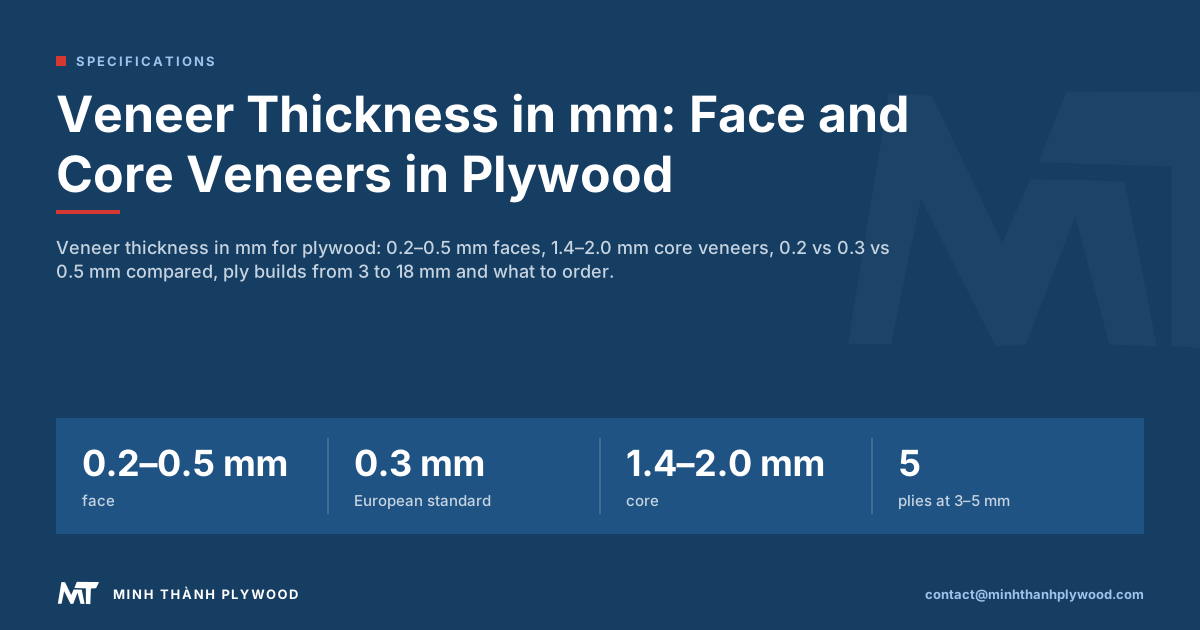
Face veneers on furniture plywood are 0.2–0.5 mm thick, with 0.3 mm the usual figure on European orders, and core veneers are 1.4–2.0 mm. The face figure decides how much sanding a sheet can take, how a routed edge looks and part of the price; the core figure decides how many plies a panel has. Minh Thanh Plywood writes both on the order.
What is the wood veneer thickness in mm on plywood?
On furniture plywood, face veneers are 0.2–0.5 mm thick and core veneers are 1.4–2.0 mm; European furniture orders usually specify a 0.3 mm face. Those two figures describe most panels from 3 to 40 mm. What changes between panels is how many core veneers are stacked and which face goes on top.
| Veneer | Veneer thickness in mm | What it does |
|---|---|---|
| Face veneer | 0.2–0.5 mm (0.3 mm on most European orders) | The show side: look, grade, finish |
| Back veneer | 0.2–0.5 mm, often the face’s lower-grade partner | Balances the face; hidden or semi-visible side |
| Core veneer | 1.4–2.0 mm | Builds thickness, stiffness and screw hold |
| Core veneer in thin panels | 1.3 mm in a 4 mm furniture panel | Fits five plies into a thin sheet |
Wood veneer thickness is quoted before pressing: it is the thickness the veneer was peeled or sliced to. The finished panel is a little thinner than the sum of its veneers, because the press compresses the stack and the sander takes the faces down to the ordered tolerance.
Veneer thickness in mm and inches: sheets, plywood faces, edge banding and flooring
Loose veneer sheets run from about 0.25 mm to 5 mm, plywood faces from 0.2 to 0.5 mm, edge banding from 0.3 to 3 mm and engineered flooring wear layers from about 0.6 to 6 mm.
| Veneer product | Thickness in mm | Thickness in inches | Notes |
|---|---|---|---|
| Paper-backed or flexible veneer, wood layer | 0.25–0.4 mm | about 1/100 to 1/64 in | Thin sliced wood on a 10 or 20 mil paper backing |
| Standard sheet veneer, sliced | 0.5–0.6 mm | about 1/42 in at 0.6 mm | The common thickness for 0.4, 0.5, 0.55 and 0.6 mm sheets |
| Thick sliced veneer | 1–2 mm | about 1/25 to 1/12 in | Sliced under 2 mm |
| Saw-cut thick veneer | 3–5 mm | 1/8 to 3/16 in | Cut with a saw, not sliced |
| US craft veneer | 1.6 mm and 3.2 mm | 1/16 in and 1/8 in | Hardwood sheets, 24 in long, sold by US hardwood dealers |
| Engineered veneer sheet | 0.5–0.7 mm | about 1/50 to 1/36 in | Sheet 2500 × 640 mm; 0.7 mm rough-sawn for wall cladding |
| Edge banding | 0.3, 0.45 and 0.5 mm standard; 1, 2 and 3 mm thick | about 1/85 to 1/8 in | Thick banding for solid-wood looks |
| Engineered flooring wear layer | about 0.6–6 mm | about 1/42 to 1/4 in | 2 mm or more can be sanded and refinished |
| Plywood face veneer | 0.2–0.5 mm | about 1/125 to 1/50 in | The face on furniture plywood |
| Plywood core veneer | 1.4–2.0 mm | about 1/18 to 1/13 in | Builds the thickness of the panel |
Inch conversions: 1/16 in is 1.6 mm, 1/8 in is 3.2 mm and 3/16 in is 4.8 mm.
How the veneer is cut sets its thickness range. Rotary-peeled veneer, cut from a log turning against a knife, is the economical way to make plywood core veneers. Sliced veneer, cut from a flitch with a knife, gives decorative faces and the thin and thick sheets in the table above. Sawn veneer is cut with a saw for the 3 to 5 mm range.
Our plywood sits in the bottom rows of the table. For a top that will be sanded and refinished, ask for a 0.5 mm face, the thickest face we press, so the core stays covered after sanding; panels that will be painted or overlaid need only 0.2 mm.
What is a face veneer?
A face veneer is the outer veneer on the show side of a plywood panel, chosen for its species, colour and grade rather than its strength. Face appearance classes are set out in ISO 2426-1:2020, plywood classification by surface appearance; the face veneer definition used in quotations covers three things: the species (poplar, birch, okoume, pine, engineered veneer), the grade (A/B, D+/D and similar pairs) and the thickness.
Each panel has four kinds of layer:
- Face: the show side, graded and sanded.
- Back: the other outer layer, usually a lower grade than the face.
- Cross-band: the layer under each face in some thin builds, laid across the face grain.
- Core veneers: the inner layers that make up most of the thickness.
At Minh Thanh the face and back are pressed onto a core board that was pressed and calibrated first. The face is the last veneer laid and the first one a buyer sees, so its thickness is written on the specification next to its grade.
How thick is face veneer on plywood?
Face veneer on furniture plywood is 0.2–0.5 mm thick, and 0.3 mm is the figure most European furniture plants order. The thickness is chosen for what happens to the panel after it leaves the mill: how much it is sanded, how it is finished and whether its edges are routed.
| Face thickness | Where it is ordered | Why |
|---|---|---|
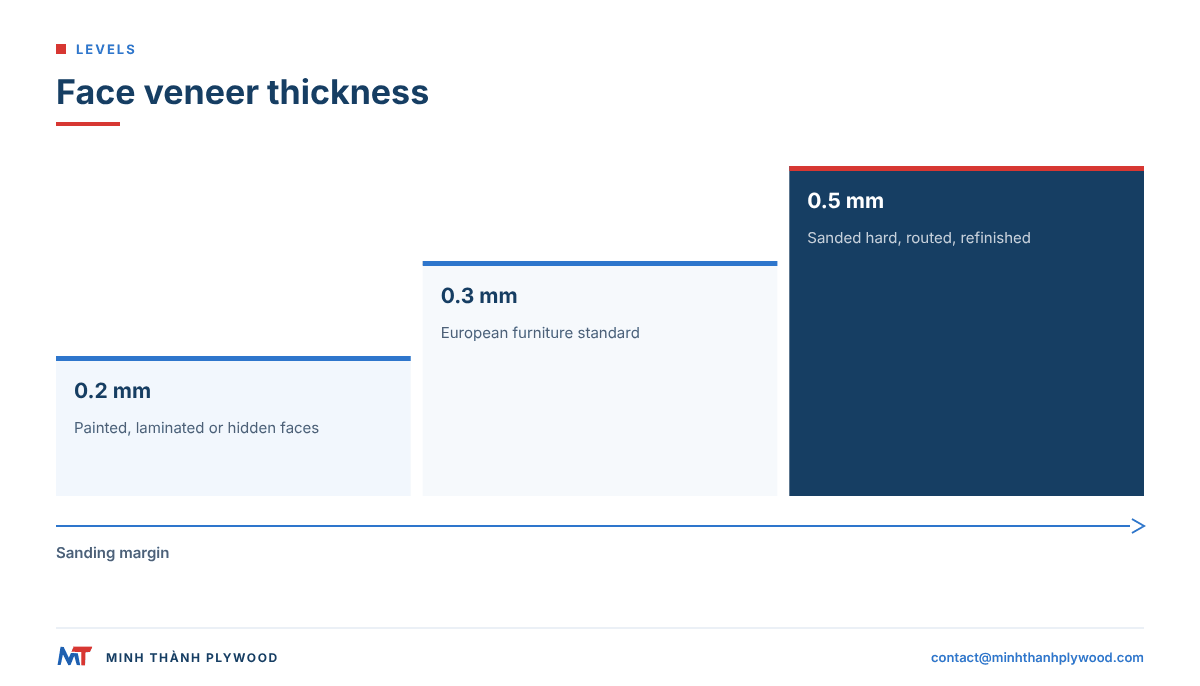
| 0.2 mm | Panels to be painted, laminated or overlaid; hidden backs | Lowest cost, enough as a smooth base |
| 0.3 mm | Standard European furniture faces | Room for a final sanding before lacquer or oil |
| 0.4–0.5 mm | Show faces that are sanded hard, routed or refinished | Most margin before the core shows |
Faces cut from imported species, such as birch or okoume, follow the same range. Minh Thanh glues them on Vietnamese cores, so a birch-faced panel has birch faces and a Styrax or Eucalyptus core, and the face thickness is what the buyer specifies for that face.
0.2 vs 0.3 vs 0.5 mm face veneer: which should you order?
Order 0.2 mm for faces that will be covered, 0.3 mm for clear-finished furniture faces, and 0.5 mm for faces that are sanded hard, routed with decorative details or meant to be refinished later.
| What you compare | 0.2 mm face | 0.3 mm face | 0.5 mm face |
|---|---|---|---|
| Sanding margin at your plant | Light scuff only | One full sanding before finish | Several sandings |
| Risk of sand-through at edges | Highest | Low with care | Lowest |
| Glue showing through pale faces | More likely on open-grain species | Rare | Very rare |
| Routed V-grooves and chamfers | Core shows quickly | Shows at deep grooves | Clean on shallow details |
| Price | Lowest | Standard | Highest |
| Typical use | Painted, laminated or hidden faces | Lacquered cabinet faces | Premium furniture, refinishable tops |
The middle column is the usual answer. A 0.3 mm face takes the plant’s own sanding before lacquer, and that is the step where thin faces fail: an aggressive pass at a sheet corner goes through 0.2 mm and leaves a patch of core showing, which cannot be repaired.
Is a 0.2mm face veneer enough?
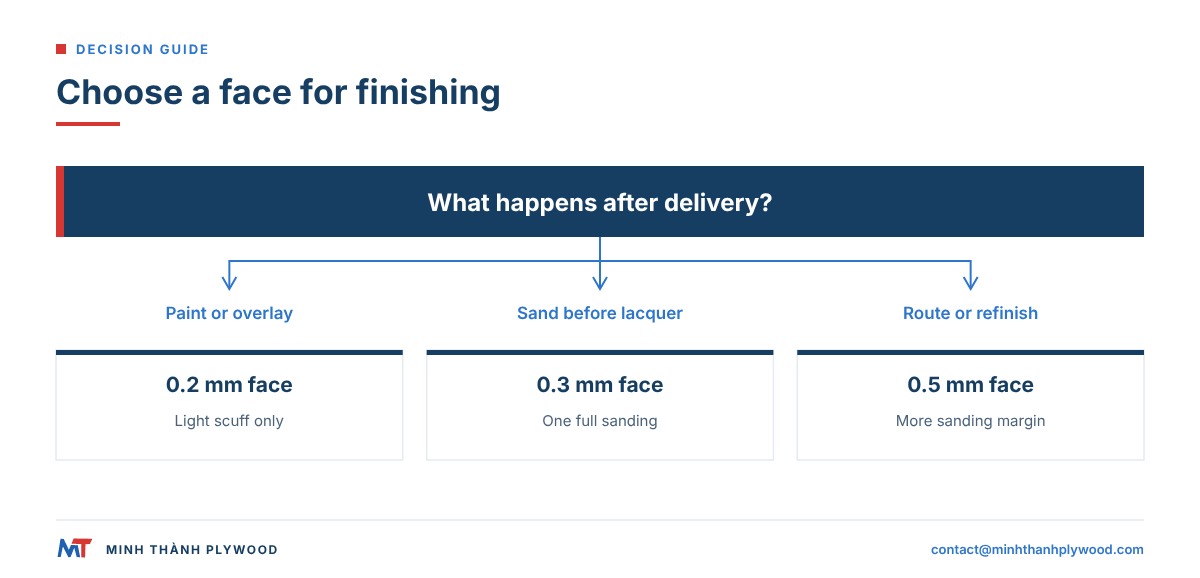
A 0.2mm face veneer is enough when the face will be covered or only lightly scuffed: paint, high-pressure laminate, melamine paper, foil or a hidden back. It is a thin margin for a clear finish that is sanded again at the furniture plant.
Three checks decide it:
- Will your plant sand the face again? If yes, with a wide-belt sander before finishing, order 0.3 mm.
- Is the face pale and open-grained? Thin pale faces show glue lines and core shadows more easily under clear lacquer.
- Are the edges routed or chamfered? A chamfer cuts through a 0.2 mm face almost at once and shows the core.
Minh Thanh sands its furniture faces at the mill and leaves them UV-ready, to the standard customers need to apply their own UV coating. Buyers who apply a UV line straight onto that face sand very little, and a 0.2 or 0.3 mm face works; buyers who sand again order the thicker face.
How thick is core veneer?
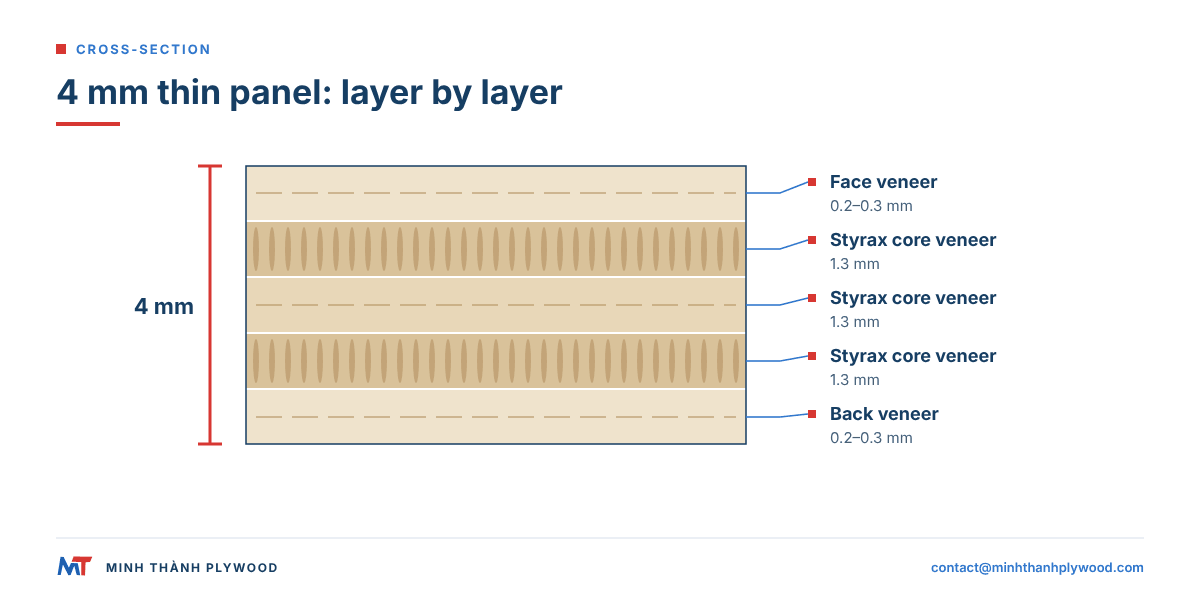
Core veneer is usually 1.4–2.0 mm thick, peeled from plantation logs and dried to 8–12 % moisture content before it is laid. Thin panels use thinner core veneers, down to 1.3 mm in a 4 mm furniture panel, so that five plies still fit in the sheet.
The core figure matters for three reasons:
- Ply count: thinner core veneers mean more plies at the same panel thickness, and more glue lines.
- Flatness: core veneers of even thickness press into an even board, which is why the core board is calibrated before the faces go on.
- Screw hold and edges: more, thinner plies give a tighter edge for banding and a better hold for screws.
Minh Thanh uses white Styrax or Eucalyptus cores as standard, with Acacia and Pine on order. Core veneers in the outer layers are stitched horizontally and vertically, so joints stay closed under the press.
How thick is each plywood layer, panel by panel?
Each plywood layer is one veneer: a face or back of 0.2–0.5 mm, and core veneers of 1.4–2.0 mm, or 1.3 mm in thin panels. The panel thickness then decides how many core veneers are stacked, and the ply count is always odd so the panel balances around its centre.
| Panel | Plies | How the plywood layer thickness adds up |
|---|---|---|
| 3 mm | 5 plies | 1 centre core veneer, 2 cross-band veneers, 2 faces |
| 4 mm | 5 plies | 3 core veneers of 1.3 mm, 2 faces |
| 5 mm | 5 plies | 3 core veneers of about 1.5 mm, 2 faces |
| 6 mm | Confirmed with the order | Ply count and lay-up stated on the proforma |
| 9 mm | 7 plies | 5 core veneers, 2 faces |
| 12 mm | 9 plies | 7 core veneers, 2 faces |
| 15 mm | 11 plies | 9 core veneers, 2 faces |
| 18 mm | 11–13 plies | 9 to 11 core veneers, 2 faces |
Every thin panel from 3 to 5 mm is 5-ply at Minh Thanh; the mill does not make 3-ply thin panels. Articles on 5 mm plywood and the thin plywood 3–5 mm range show the thin builds in full.
Why do the veneers add up to more than the panel?
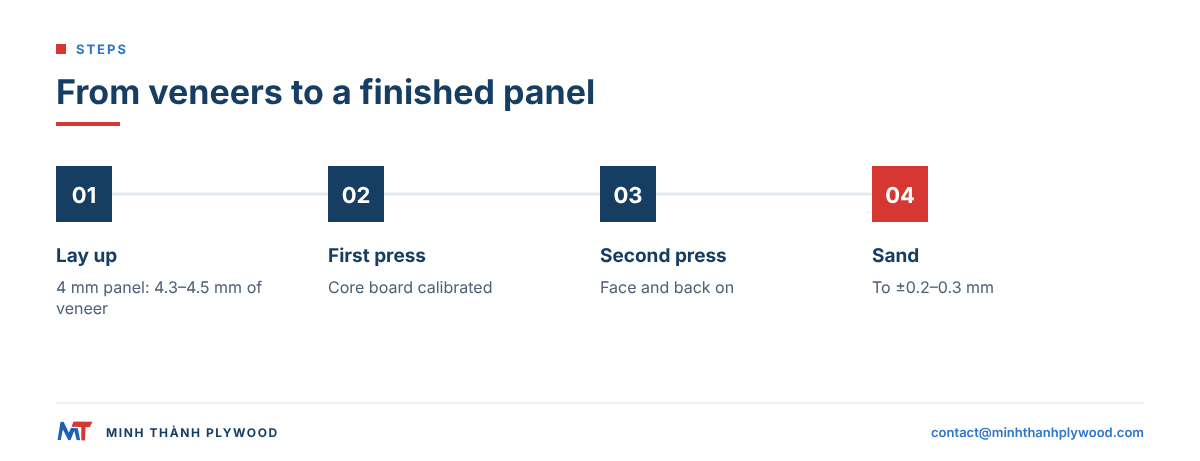
The veneers add up to more than the finished panel because veneer thickness is measured before pressing, and the panel loses thickness in the hot press and at the sander. A 4 mm furniture panel shows it clearly: three 1.3 mm core veneers and two faces of 0.2–0.3 mm add up to 4.3–4.5 mm before pressing, and the finished sheet is 4 mm.
Three steps take the thickness down:
- First pressing: the core board is pressed and calibrated to an even thickness.
- Second pressing: face and back are pressed on, with UF glue at E0 emission on furniture panels.
- Sanding: both faces are sanded to the ordered tolerance, ±0.2–0.3 mm on sanded furniture panels and down to ±0.2 mm.
This is why a mill that knows its press can hold a tight tolerance with a thin face. The core is calibrated before the face goes on, so the sander only has to level the face, not correct an uneven core, and more of the face’s thickness survives to the buyer.
How does face thickness affect sanding and finishing?
A thicker face leaves more wood to sand before the core shows, so face thickness sets how hard a furniture plant can sand and how many finishing passes the panel survives. It also affects how evenly a stain or lacquer takes.
- Sanding: each pass removes a fraction of a millimetre; a 0.2 mm face has room for a scuff, a 0.3 mm face for one full pass, a 0.5 mm face for several.
- Stains and clear lacquer: thin faces on pale species can show glue lines or a darker core beneath; thicker faces hide them.
- UV coating: Minh Thanh’s sanded faces are UV-ready on both sides, so a buyer’s UV line needs little extra sanding.
- Repairs and refinishing: a 0.5 mm face can be sanded back and refinished during the furniture’s life; a 0.2 mm face cannot.
For painted and laminated panels the face thickness matters much less: the covering hides the face, and 0.2 mm is enough.
How does face thickness affect CNC, edge banding and routing?
Face thickness affects machined parts at every cut that breaks the face: chamfers, V-grooves, routed handles and engraving go through a 0.2 mm face almost at once and show the core. A 0.3 mm face survives a light chamfer; a 0.5 mm face survives shallow decorative routing.
| CNC or edge operation | Thin face (0.2 mm) | Thicker face (0.5 mm) |
|---|---|---|
| Straight cut with edge banding | Fine; the band covers the edge | Fine |
| Light chamfer on a show edge | Core shows | Face holds |
| V-groove or routed pattern | Core shows in the groove | Shallow grooves stay in the face |
| Exposed plywood edge, lacquered | Thin face line at the edge | Thicker, cleaner face line |
For exposed-edge furniture, where the plywood edge is a design feature, the core matters as much as the face: a stitched, void-free core with even plies gives the striped edge the design shows. Write “exposed edge” on the order, and the core and face are chosen for it.
How does face thickness affect the price of plywood?
A thicker face veneer raises the price, because the face is the most expensive wood in the panel, especially an imported species. On a thin panel the effect is largest: two faces are a big share of the wood in a 4 or 5 mm sheet.
The price lines that follow from veneer choices:
- Face species: birch and okoume faces cost more than poplar or engineered veneer.
- Face thickness: 0.5 mm costs more than 0.3 mm, which costs more than 0.2 mm.
- Face grade: an A/A pair costs more than A/B or B/B.
- Core: Styrax, Eucalyptus, or Acacia on order.
In October 2026 furniture plywood from Minh Thanh started from US$350/m³ and commercial plywood from US$250/m³, FOB Hai Phong. The face line on the quotation is where an over-specified panel costs most: if the face will be painted, a 0.2 mm face does the job for less.
How thick is the veneer on walnut, oak or birch plywood?
Decorative faces on walnut, oak or birch plywood sit in the same 0.2–0.5 mm range as other furniture faces, and the thickness is set on the order rather than by the species. Ask for it in writing, because two offers with the same species can carry very different faces.
- Walnut and oak looks: available at Minh Thanh as engineered veneer (EV) faces made to a colour reference; the walnut veneer and oak veneer articles cover natural sliced faces.
- Birch: imported birch faces graded D+, D and E, quoted as pairs such as D+/D and close to European B and BB grades.
- Okoume: warm-toned faces for interior panels; okoume-faced furniture plywood is not sold as marine plywood.
Veneer sheets sold loose for hand veneering are a separate product with their own thicknesses and backings; backed veneer sheets and wood veneer sheets cover them.
How do you measure veneer thickness?
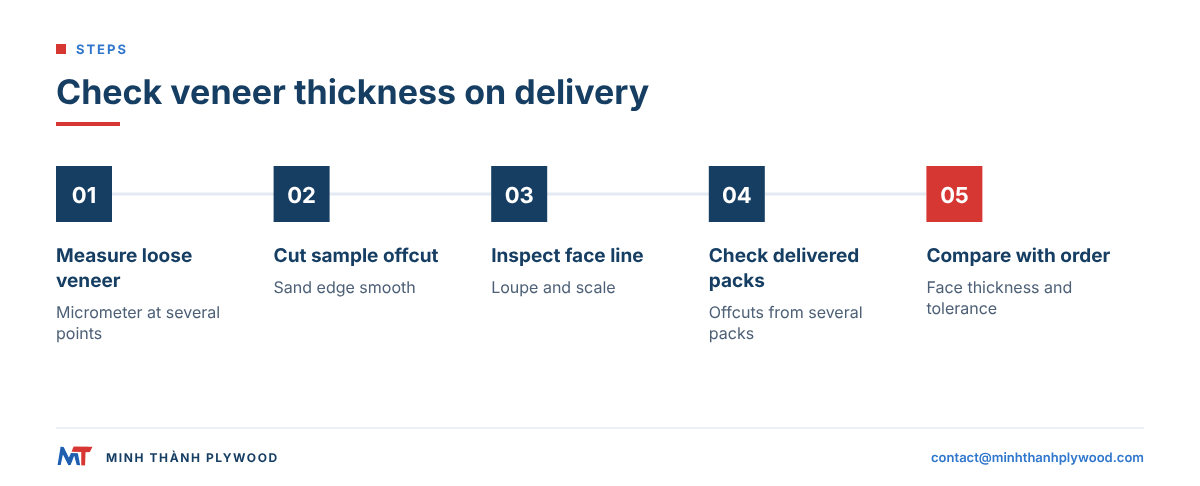
Measure loose veneer with a micrometer or a fine caliper at several points across the sheet, and measure the face on a finished panel by examining a clean cut edge under magnification. A buyer usually checks it on the approved sample, then on arrival.
- Before lay-up: veneer thickness is read across each bundle, because peeled veneer varies slightly along the log.
- On the sample: cut a small offcut, sand the edge smooth, and read the face line under a loupe against a scale.
- On arrival: repeat on offcuts from several packs, and check the panel thickness with a caliper at the four corners and the centre.
- Against the order: compare with the face thickness and tolerance written on the specification.
Minh Thanh photographs and films every container before loading, and sends free samples before the order, so the face thickness on the sample is the reference the delivery is checked against.
How do you write veneer thickness on an order?
Write the veneer thickness on the order as part of the face line, next to the species and grade, and add the core species and the panel tolerance. A complete specification looks like this:
18 mm furniture plywood for lacquered cabinet doors · white Styrax core, stitched, pressed twice · UF glue at E0 emission · birch face D+/D, 0.3 mm, sanded, UV-ready · 1220 × 2440 mm · ±0.2 mm · export packs · 1 × 40HC, FOB Hai Phong.
If the faces will be painted or laminated, say so and ask for a 0.2 mm face price beside it. Name the standards the panel is made to as well: BS EN 636:2012+A1:2015 covers plywood for dry, humid or exterior conditions, and BS EN 314-2:1993 sets the bonding-quality requirements. Send the line to contact@minhthanhplywood.com; replies come within hours, with free samples. The plywood face veneers and colours guide helps choose the species before the thickness.
Buyer questions, answered
How thick is face veneer on plywood?
Face veneer on furniture plywood is 0.2–0.5 mm thick. European furniture orders usually specify 0.3 mm, which leaves room for sanding and a clean finish without the cost of a thicker face.
How thick is core veneer in plywood?
Core veneer is usually 1.4–2.0 mm thick. Thin panels use thinner core veneers: a 4 mm furniture panel from Minh Thanh is built on three 1.3 mm Styrax core veneers.
Is 0.2 mm face veneer good enough?
Yes for panels that will be painted, laminated or overlaid, and for hidden faces. For a clear-finished show face that is sanded again at the furniture plant, order 0.3 mm or thicker.
What is the difference between 0.2, 0.3 and 0.5 mm face veneer?
Sanding margin and cost. A 0.2 mm face is the most economical but tolerates little sanding; 0.3 mm is the European furniture standard; 0.5 mm gives the most margin for sanding, routing details and refinishing.
What is a face veneer?
A face veneer is the outer layer on the show side of a plywood panel, chosen for its look and grade. The back veneer is the outer layer on the other side, and the core veneers are the layers in between.
How thick is the veneer on walnut or oak plywood?
Decorative faces sit in the same 0.2–0.5 mm range as other faces. Ask for the thickness in writing: it decides whether the face survives your sanding and finishing steps.
How many plies does plywood have for its thickness?
At Minh Thanh, panels from 3 to 5 mm have 5 plies, 9 mm has 7, 12 mm has 9, 15 mm has 11, and 18 mm has 11–13 plies. Core veneer thickness sets the count.
Why don't the veneer thicknesses add up to the panel thickness?
Veneer thickness is measured before pressing. The hot press compresses the stack and sanding removes a little from each face, so the veneers laid up are thicker in total than the finished panel.
How do you measure veneer thickness?
Measure loose veneer with a micrometer or a fine caliper at several points. On a finished panel, look at a clean cut edge under magnification, or ask the mill for the face thickness on the order and check it on the sample.
Does a thicker face veneer make plywood more expensive?
Yes. The face is the most expensive layer per cubic metre, especially imported species, so a 0.5 mm face costs more than 0.3 mm. On thin panels the face is a large share of the wood in the sheet.