
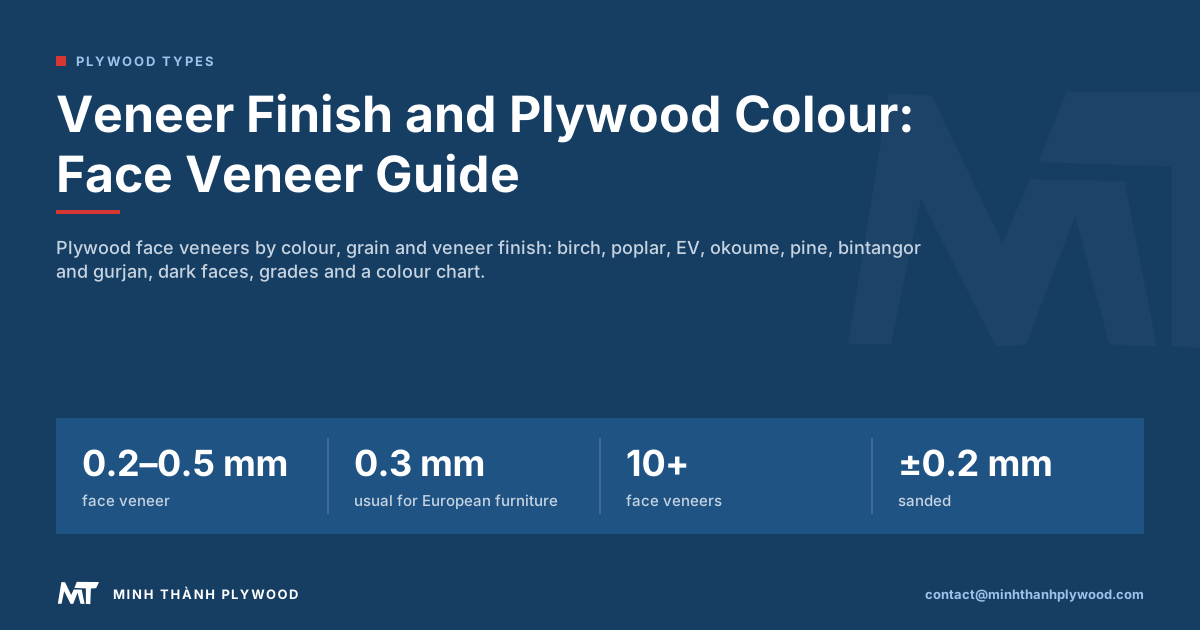
A plywood face veneer is a wood skin 0.2–0.5 mm thick that sets the colour, the grain and the veneer finish a panel will take; the core underneath sets weight and strength. Pale birch and poplar suit clear or painted work, okoume and pine give warm tones, bintangor and gurjan give red-brown, and engineered veneer gives one fixed colour on every sheet. Minh Thanh Plywood presses all of them on white Styrax or Eucalyptus cores.
What is a veneer finish, and how does it compare with laminate?
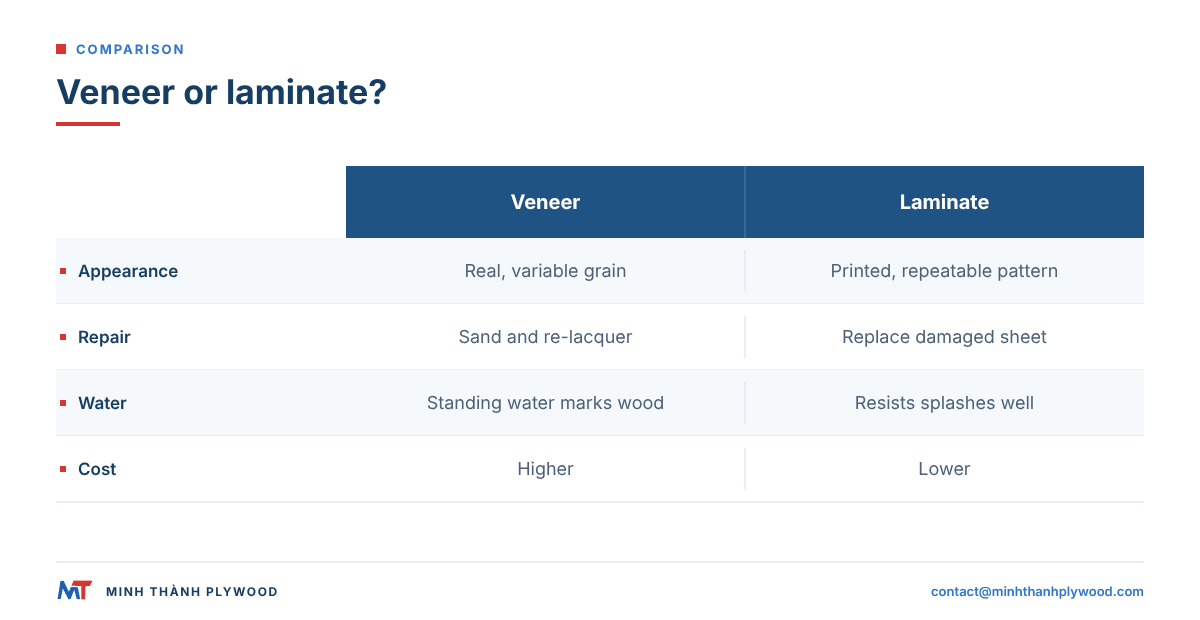
A veneer finish is a thin skin of real wood, glued over plywood or another board and sealed with lacquer, oil or stain. A laminate finish is printed paper or plastic pressed onto the board. For cabinets and wardrobes in the UAE, India and elsewhere, the choice usually comes down to these four points:
| Point | Veneer finish | Laminate finish |
|---|---|---|
| Look | Real grain, every sheet slightly different, can be stained | Printed pattern, identical sheet to sheet, wide colour range |
| Scratch and water resistance | Lacquer coat protects it; deep scratches and standing water mark the wood | Hard surface, resists scratches and splashes well |
| Repair and refinish | Can be sanded and re-lacquered, or patched with a matching veneer | Cannot be refinished; a damaged sheet is replaced |
| Cost | Higher than laminate, rising with the species and the cut | Lower, with the thicker high-pressure grades costing more |
Veneering is old: the ancient Egyptians veneered rare woods over cheaper timber, and the Romans used veneered work in large quantities (Wikipedia, wood veneer, read in October 2026).
Choose veneer when the grain is the point of the piece; choose laminate for wet, high-traffic surfaces. Our veneer vs laminate guide goes through the choice in full.
Looking after a veneer finish takes three habits:
- Dust with a soft dry or barely damp cloth, and wipe spills at once.
- Avoid harsh cleaners: bleach, ammonia and abrasive pads dull the lacquer.
- Re-polish the lacquer or oil coat every few years where the surface gets daily use, and keep it out of standing water and direct afternoon sun.
Plywood face veneers and colours: the short answer
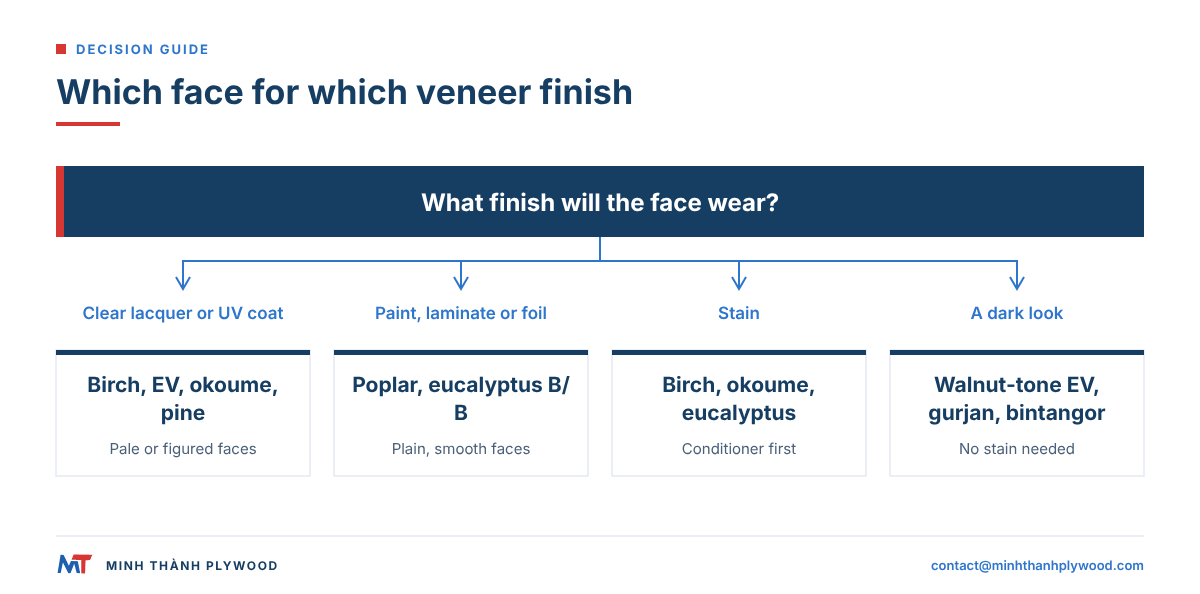
Choose the face by the finish it will wear. Pale faces (birch, poplar) suit clear coats and paint; warm faces (okoume, pine, eucalyptus) suit clear oil and lacquer; red-brown faces (bintangor, gurjan) and dark engineered veneer give a dark look without stain.
| Face veneer | Natural colour | Grain and figure | Best veneer finish |
|---|---|---|---|
| Birch | Near-white to pale yellow | Fine, gentle flowing figure | Clear lacquer, light stain, UV coat |
| Poplar | Pale cream, sometimes greenish streaks | Plain, faint straight grain | Paint, primer, laminate, foil |
| Engineered veneer (EV) | Any chosen colour: pale, white, red, walnut | Fixed pattern: straight grain, crown, oak-look | Clear lacquer or UV coat |
| Okoume | Pinkish-beige to pale salmon | Soft, wavy figure | Clear oil or lacquer, stain |
| Pine | Honey to cream | Ring grain with sound knots | Clear lacquer, oil, sealed paint |
| Eucalyptus | Pale pink-brown | Flowing grain | Clear lacquer, stain, paint on B/B |
| Bintangor | Reddish-brown | Soft, even rotary-cut figure | Clear lacquer, dark stain |
| Gurjan | Warm red-brown | Natural straight to interlocked grain | Clear lacquer, stain |
This veneer colour chart covers the faces Minh Thanh Plywood presses most: EV, poplar, birch, okoume and pine lead the list, with bintangor, eucalyptus, gurjan and sapele on request. The factory offers more than 10 face veneers in all.
Facing plywood: what does the face veneer decide?
Facing plywood with a chosen veneer decides how the panel looks and how it takes a finish; it barely changes strength or weight. The face is 0.2–0.5 mm of wood on a panel of 3–40 mm, so the core and glue do the structural work.
What the face decides:
- Colour before and after finishing, and how it ages in light.
- Grain and figure: plain, flowing, ring grain, stripe or a fixed engineered pattern.
- Finish behaviour: how evenly it takes stain, how much grain shows through paint, how smooth it sands.
- Price: imported birch and okoume faces cost more than poplar or eucalyptus.
What the face does not decide: sheet weight, stiffness, screw holding and the glue bond. Those follow the core species, the ply count and the glue line. A poplar-faced and a birch-faced sheet on the same Styrax core weigh the same, about 26.8 kg at 18 mm and 1220 × 2440 mm.
Which plywood colour does each face veneer give?
Each species brings its own plywood colour, and a clear coat deepens it by one or two shades. Judge every face wet or coated, because a sanded raw face looks paler than the finished part.
- Birch is near-white to pale yellow with a fine, gentle figure. It is the reference face for clear-finished furniture. The detailed shade question, natural against white birch, is covered in birch plywood colour.
- Poplar is pale cream with a plain, faint straight grain. Occasional greenish or grey streaks disappear under paint, which is why poplar is the standard paint-grade face.
- Engineered veneer (EV) comes in the colour you choose. Usual ranges are pale, white, red and walnut tones in straight grain, crown and oak-look patterns.
- Okoume is pinkish-beige to pale salmon with a soft, wavy figure, imported from Central Africa as face veneer.
- Pine is honey to cream with clear ring grain and sound knots. It shows its character under a clear finish.
- Eucalyptus is pale pink-brown with a flowing grain, a cost-effective face for stained or painted parts.
- Bintangor is reddish-brown with a soft, even rotary-cut figure.
- Gurjan is a warm red-brown with a natural grain that suits clear lacquer and stain.
How does plywood grain differ between rotary-cut, sliced and engineered faces?
Plywood grain depends on how the veneer was cut. Rotary-cut veneer is peeled round the log and shows a wide, flowing figure; sliced veneer is cut across the log and shows crown or straight stripes; engineered veneer is re-sliced from a glued block and shows a pattern set by design.
| Cut | How it is made | What the face shows | Faces cut this way |
|---|---|---|---|
| Rotary cut | Log turned against a knife, veneer peeled like a roll | Wide, wavy figure across the whole sheet | Birch, poplar, okoume, eucalyptus, bintangor, pine |
| Flat or crown sliced | Half log sliced front to back | Cathedral arches (crown) in the middle of the sheet | Oak, ash, walnut and other decorative species |
| Quarter or rift sliced | Log quartered, sliced across the growth rings | Straight, parallel stripes | Oak, sapele and other decorative species |
| Engineered (re-sliced) | Dyed veneers glued into a block, block sliced again | Straight grain, crown or species-look, identical sheet to sheet | EV |
Rotary faces are the most cost-effective and cover a full 1220 × 2440 mm sheet in one or two pieces. Sliced decorative faces are narrower leaves joined side by side, so the joint pattern becomes part of the look. Engineered faces give a sliced-veneer look at a rotary-veneer cost.
Natural, dyed or engineered: how is the face colour made?
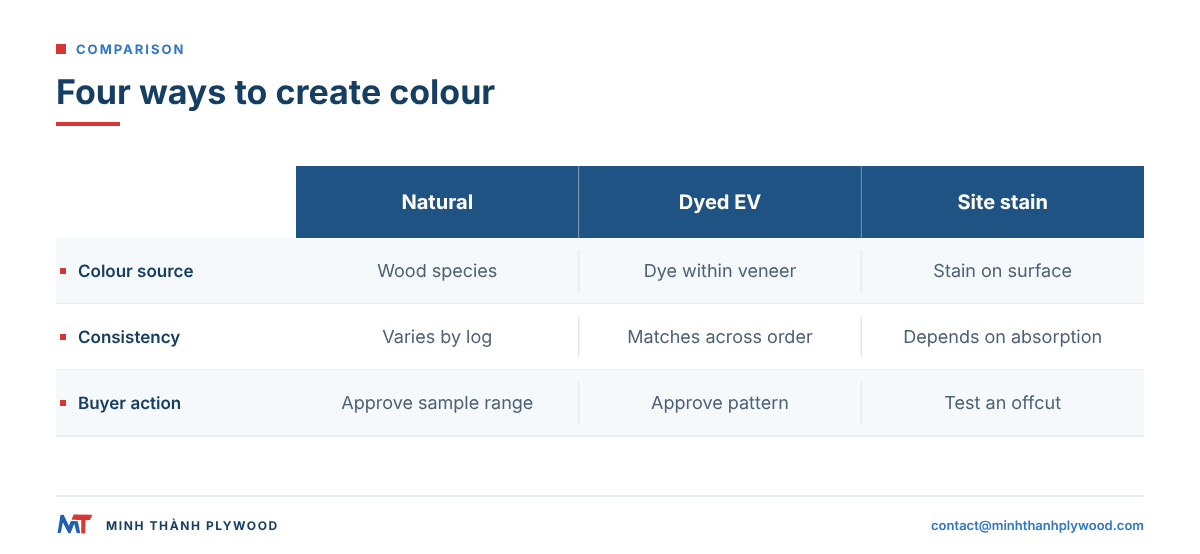
Face colour comes from one of three places: the wood itself, a dye inside the veneer, or a stain applied on the finished panel. Each one behaves differently over a long production run.
- Natural colour. The species gives the colour, so shades vary from log to log. Grading and an approved sample set the accepted range.
- Dyed, engineered veneer. The colour is dyed through the veneer before it is re-sliced, so every sheet in an order matches. A scratch shows the same colour underneath.
- Stain on site. The furniture maker stains a pale natural face. The colour sits in the surface and depends on how the face absorbs stain, so test an offcut from the same pack first.
For long runs of doors, cabinets or wall panels that must match, dyed engineered veneer saves the hand sorting that natural sheets need. Where the figure of the tree is the point of the design, choose a natural face and approve a sample sheet.
Which veneer finish suits each face?
The veneer finish should match the face: clear coats on pale and figured faces, paint on plain faces, stain on faces that absorb evenly. A good finish starts with a flat, evenly sanded face, because a 0.3 mm face cannot be sanded hard.
| Veneer finish | Faces that suit it | What to do before finishing |
|---|---|---|
| Clear lacquer or UV coat | Birch, EV, okoume, pine, gurjan | Light sanding with a fine grit; dust off |
| Oil or hard-wax oil | Okoume, pine, birch | Test colour on an offcut; oil deepens warm tones |
| Stain | Birch, okoume, eucalyptus | Pre-stain conditioner or wash coat to stop blotching |
| Paint | Poplar, eucalyptus B/B, birch E | Primer; on pine, seal knots with a shellac-based primer |
| Laminate, foil or overlay | Poplar, eucalyptus | Flat face and tight thickness tolerance matter most |
Minh Thanh panels leave the line sanded and polished, with both faces UV-ready, so a buyer with a UV coating line can coat them directly. Thickness tolerance on sanded furniture panels is ±0.2–0.3 mm, down to ±0.2 mm, which keeps roller coaters and edge banders set the same from sheet to sheet.
Dark plywood: which faces and finishes give a dark look?
Dark plywood comes from a dark engineered veneer, a naturally red-brown face, or a dark stain over a pale face. Engineered veneer in walnut tones gives the most even dark colour across a whole order.
| Route to a dark face | Example | Strength of this route | What to watch |
|---|---|---|---|
| Dyed engineered veneer | Walnut-tone EV | Same shade on every sheet; colour runs through the veneer | Choose the pattern from a sample |
| Naturally dark species | Gurjan, bintangor | Real figure; no staining step | Natural shade varies between logs |
| Stain on a pale face | Dark stain on birch or okoume | Uses stock panels | Blotching; test on an offcut first |
| Paint or overlay | Black or dark paint on poplar | Any colour | Grain disappears |
For dark kitchen fronts, wall panelling and shop fittings in long runs, walnut-tone EV is the usual choice. For a dark, real-wood figure with character, a red-brown natural face under a clear or tinted lacquer works well.
How do face grades change the look?
Face grade sets how many knots, patches and colour streaks are accepted, so it changes the look as much as the species does. Grades are quoted as face/back pairs and matched to the buyer’s approved sample. Structural plywood in the US is graded differently, under Voluntary Product Standard PS 1-22, so the pairs below apply to furniture and decorative faces.
- Poplar, pine and eucalyptus faces: A/A, A/B and B/B (B/C for pine utility parts). A is the cleanest, most even face; B allows more figure, sound knots and colour streaks.
- Birch faces: D+, D and E in Vietnamese practice, low to high E, D, D+, quoted as pairs such as D+/D or D/E. As a buying comparison, D+ is close to the European B and D close to BB.
- Okoume faces: A or B, with CC often ordered for hidden backs.
Buy by what the eye will see. A/A suits two visible faces under a clear coat, A/B suits a show face over a hidden back, and B/B suits painted or laminated parts.
How does the core change what you see?
The core shows on every cut edge, so it is part of the look whenever edges stay unbanded. White Styrax gives a pale, even edge; Eucalyptus gives a pink-brown edge.
| Core | Edge colour | Reference density | 18 mm sheet, 1220 × 2440 mm |
|---|---|---|---|
| White Styrax | Pale, near-white lines | About 500 kg/m³ | About 26.8 kg |
| Eucalyptus | Pink-brown lines | 650–750 kg/m³ | About 34.8 kg at 650 kg/m³ |
A pale birch or poplar face on a Styrax core keeps face and edge in one light tone. Many European furniture buyers choose Styrax for this clean look and the lower sheet weight. Both cores are stitched horizontally and vertically, and furniture panels are pressed twice, so the face stays flat over closed core joints.
Will plywood colour change over time?
Yes: every natural wood face changes colour in light. Okoume darkens, birch and pine turn more yellow and amber, and red-brown faces deepen. Dyed engineered veneer also shifts slowly under strong sunlight.
Three practical rules keep the change even:
- Keep packs wrapped and out of direct sun until use. An uncovered top sheet tans before the rest of the pack.
- Coat with a UV-absorbing clear finish where parts face windows or shop lighting.
- Fit parts from the same pack in one piece of furniture, so neighbouring doors age together.
A face that looks slightly lighter at delivery than the approved sample often matches it after weeks in light, because the sample has already aged. Compare in the same light, coated and uncoated.
How do you keep colour consistent across an order?
Fix the colour with an approved sample and order matching faces as one specification. Natural faces vary from log to log, so the sample sets the range the mill grades to.
At Minh Thanh Plywood the sequence is:
- Sample first. Send a reference sheet, photo or code; we send a sample sheet of the closest face and grade for approval. Samples are free.
- One face, one grade per visible part. Mixed faces in one container are fine by agreement; mixed shades on one cabinet are not.
- Grading against the approved sheet at sorting, before pressing.
- Photos and video before loading. Every shipment is photographed and filmed before the container is closed, and the buyer receives the files.
Where matching across hundreds of doors matters more than natural figure, choose engineered veneer: the dyed pattern repeats sheet to sheet.
Which face veneer for which use?
Pick the face from the part’s finish and the room it goes into. The table gives a short verdict by use.
| Use | Face veneer | Why |
|---|---|---|
| Clear-finished kitchen fronts | Birch D+/D or EV | Pale, even face that coats well |
| Painted kitchen and wardrobe carcasses | Poplar B/B or eucalyptus B/B | Plain face, cost-effective under paint |
| Dark furniture and wall panels | Walnut-tone EV, gurjan | Even dark colour or real red-brown figure |
| Warm-toned interiors and van fit-outs | Okoume | Light panel with a warm pinkish face |
| Rustic or Nordic-style furniture | Pine A/B | Ring grain and sound knots on show |
| Laminated or foiled parts | Poplar | Smooth, plain base for overlays |
| Shop fitting and commercial furniture | Bintangor, EV | Durable look and repeatable colour |
The deeper guide to decorative wood faces on a plywood core is veneered plywood. For veneer against laminate and melamine surfaces, see veneer vs laminate.
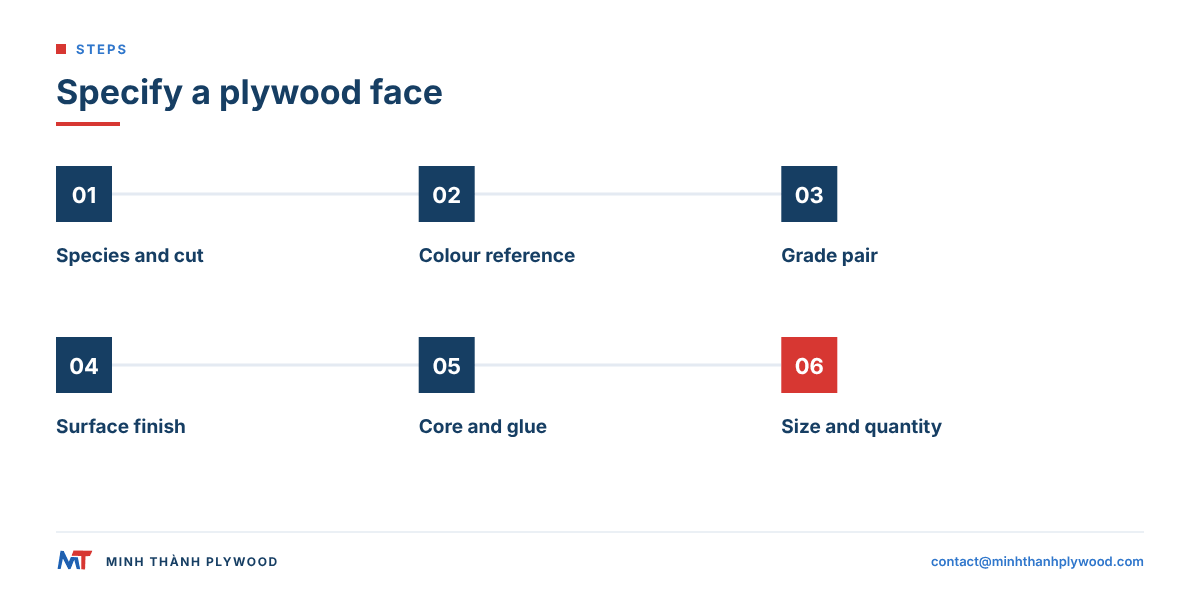
How do you specify the face veneer and finish on an order?
Write the face as its own lines on the order, separate from core and glue. Six lines leave nothing to guess:
- Face species and cut: for example birch rotary, EV straight grain, okoume.
- Colour reference: approved sample number, photo or EV pattern code.
- Grade pair: for example D+/D for birch, A/B for poplar or pine.
- Surface: sanded and polished, UV-ready on one or both faces.
- Core, glue and emission: for example Styrax core, UF glue at E0 emission.
- Sheet and quantity: thickness, size such as 1220 × 2440 or 1250 × 2500 mm, packs and m³.
Minh Thanh’s furniture panels use UF glue at E0 emission as standard and hold CARB P2 / TSCA Title VI certification (ICTT mill no. 23024); six ASTM D6007 chamber tests averaged 0.014–0.032 ppm. The US limit for veneer-core hardwood plywood is 0.05 ppm under 40 CFR 770.10. The rule is the EPA’s TSCA Title VI formaldehyde emission standard for composite wood products.
Furniture plywood starts from US$350/m³ (October 2026), and after the species the face grade moves the price most. Send your face and finish specification to contact@minhthanhplywood.com, or see okoume-faced plywood and EV plywood for two of the faces in full.
Buyer questions, answered
What is a face veneer on plywood?
The face veneer is the thin outer sheet of wood on the visible side of a plywood panel, usually 0.2–0.5 mm thick. It gives the panel its colour and grain; the back veneer sits on the other side and the core plies sit between them.
Which plywood face is the lightest in colour?
Birch and poplar are the palest natural faces: birch is near-white to pale yellow with a fine figure, poplar is cream with faint straight grain. White-coloured engineered veneer is paler and more even still.
Which plywood face is best for staining?
Birch, okoume and eucalyptus faces stain well with a pre-stain conditioner or wash coat first. Pine can blotch without a conditioner. Engineered veneer already carries its colour, so most buyers only lacquer it.
What gives plywood a dark colour?
A dark-coloured engineered veneer such as walnut-tone EV, a naturally red-brown face such as gurjan or bintangor, or a stain applied over a pale face. Dyed engineered veneer gives the most even dark colour from sheet to sheet.
Is engineered veneer real wood?
Yes. Engineered veneer is peeled plantation wood that is dyed, glued into a block with the grain aligned and re-sliced. It is real wood fibre with a colour and grain pattern fixed by design.
Does plywood colour change over time?
Yes. Natural wood faces change in light: okoume darkens, birch and pine turn more yellow and amber. A UV-absorbing clear coat slows the change; keeping packs wrapped until use stops uneven tanning of the top sheet.
Can I order plywood faces from a colour sample?
Yes. Send a sample, a photo or a reference code and the mill quotes the closest face and grade, then sends a sample sheet for your approval. That approved sheet becomes the colour standard for the order.
What is the best plywood face for painting?
Poplar is the usual choice: a plain, smooth cream face that sands evenly and takes primer and paint without grain showing through. B/B poplar or eucalyptus faces keep cost down on parts that will be painted.
Is the veneer finish applied at the factory?
Minh Thanh panels leave the line sanded and polished, with both faces UV-ready. The buyer applies the lacquer, oil, stain, paint or UV coating on their own line.
How thick is the face veneer on furniture plywood?
Face veneer is 0.2–0.5 mm before pressing, and 0.3 mm is the usual choice for European furniture plywood. A face this thin needs light sanding with a fine grit before finishing.