
BC plywood is plywood with a B grade face and a C grade back: one smooth, solid side for paint and one rougher side with knotholes that stays hidden. In the US it is an Exterior grade sanded on both sides; in Australia it is usually structural plywood. Minh Thanh Plywood explains each version and the better pick for each job.
What is B/C plywood (BC plywood)?
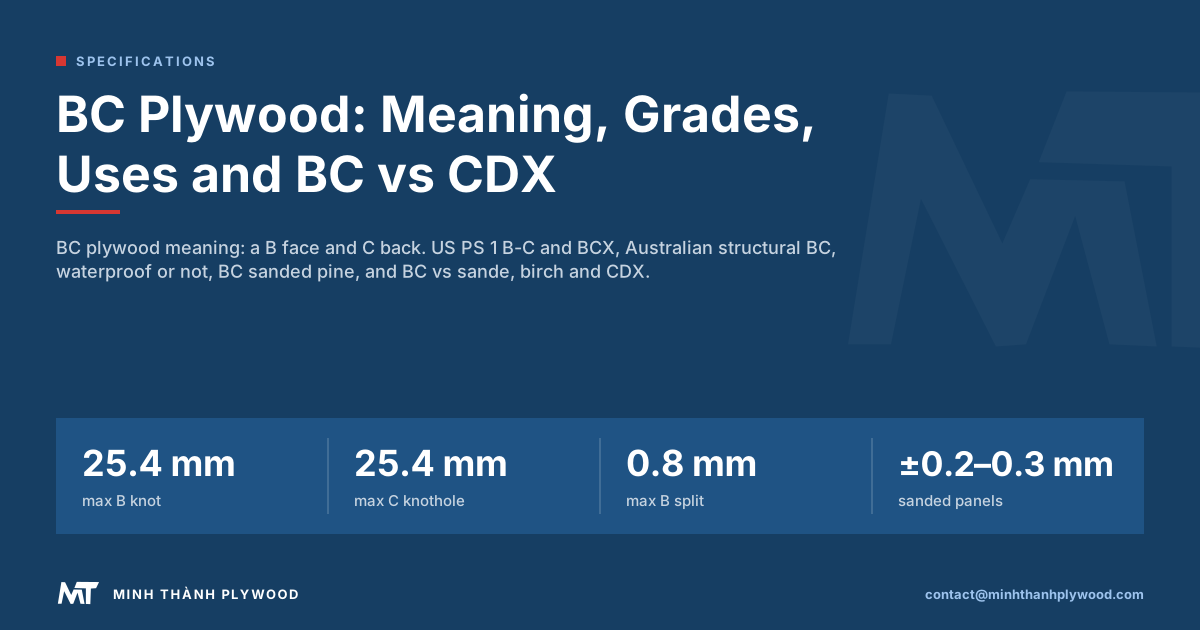
BC plywood is plywood with a B grade face and a C grade back, which makes it a paint-grade panel. The face is solid and sanded smooth, with small tight knots and neat repairs; the back has bigger knots and small open knotholes.
That one-good-side build makes BC plywood the standard paint-grade utility panel. You see the B face; the C back faces the wall, the floor or the inside of a box.
Three things to know before ordering:
- The letters are appearance only. BC says nothing about the glue or the strength.
- The meaning changes by country. A US B-C panel and an Australian BC panel are made to different standards.
- It is usually softwood. Most BC plywood is pine or Douglas-fir faced, so it carries knots and a strong grain.
BC plywood meaning in the US: PS 1 grade B-C and BCX
In the US, BC plywood means the B-C grade of PS 1-22, the voluntary product standard for structural plywood published by NIST on 2 October 2023. PS 1 lists B-C in its Exterior table, which does not permit D grade veneer anywhere in the panel.
| Point | PS 1-22 B-C |
|---|---|
| Bond classification | Exterior |
| Face | B grade |
| Back | C grade |
| Inner plies | C grade minimum |
| Surface | Sanded two sides |
| Other versions | Structural I, concrete form B-C |
BCX is the trade name for the same idea: B face, C back, X for exterior glue. Interior-use sanded grades in PS 1 pair a B face with a D back instead (B-D), so a true B-C panel already sits in the better bond class. US rules exempt structural plywood made to PS 1 from the TSCA Title VI emission limits (EPA’s TSCA Title VI exemptions). For how BCX compares with ACX and CDX, see our guide to CDX vs ACX and BCX plywood.
What sizes and thicknesses does BC plywood come in?
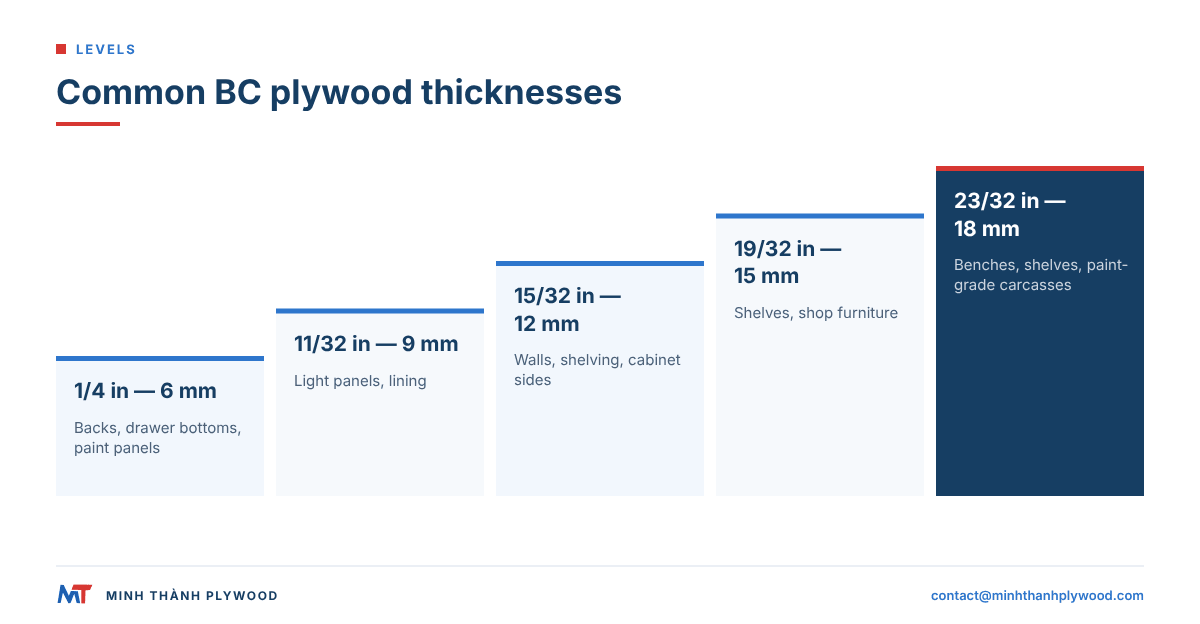
BC plywood is sold in 4 × 8 ft sheets (1220 × 2440 mm) in five common thicknesses: 1/4, 11/32, 15/32, 19/32 and 23/32 inch. That is the Plytanium range at Home Depot, and 23/32 inch (the “3/4 inch” sheet) is the one Plywood Company lists in Southern Yellow Pine.
| Nominal thickness | Metric equivalent | Typical use |
|---|---|---|
| 1/4 inch | 6 mm | Backs, drawer bottoms, paint panels |
| 11/32 inch | 9 mm | Light panels, lining |
| 15/32 inch | 12 mm | Walls, shelving, cabinet sides |
| 19/32 inch | 15 mm | Shelves, shop furniture |
| 23/32 inch | 18 mm | Shelves, benches, sub-floor underlayment, paint-grade carcasses |
The face species is usually Southern Yellow Pine in the US South, Douglas fir on the West Coast and radiata pine in Australia and New Zealand. The Plywood Company page cites APA certification to PS 1-09. Home Depot’s Plytanium plywood price filters run in bands of $20 to $50 per sheet.
For an importer’s comparison, 18 mm 1220 × 2440 mm is 0.0536 m³. At the raw FOB starting price for commercial plywood of US$250/m³, one sheet is 0.0536 × 250 = about US$13.4 before freight, duty and margin. That is an arithmetic example, not a quoted sheet price; a BC-grade pine panel quotes by face grade and sample.
What do the B and C grades allow?
The B face is solid with small knots; the C back can have small holes. These are the PS 1-22 limits for a 1220 × 2440 mm sheet.
| Feature | B grade (face) | C grade (back) |
|---|---|---|
| Knots | Sound and tight, up to 25.4 mm (1 in) across the grain | Tight, up to 38.1 mm (1-1/2 in) |
| Knotholes | None open | Up to 25.4 mm (1 in), occasional up to 38.1 mm |
| Splits | Not wider than 0.8 mm (1/32 in) | Up to 12.7 mm wide by half the panel length |
| Repairs | Wood or synthetic, shims without limit | Wood or synthetic, shims without limit |
| Sanding marks | Minor, not over 5% of the panel area | Must not weaken the panel |
| Colour | Any discoloration allowed | Any discoloration allowed |
So a B face is paintable straight away after a light sand and filler on repairs. A C back is sound but visibly open, which is fine on a hidden side.
BC plywood in Australia: structural BC grade
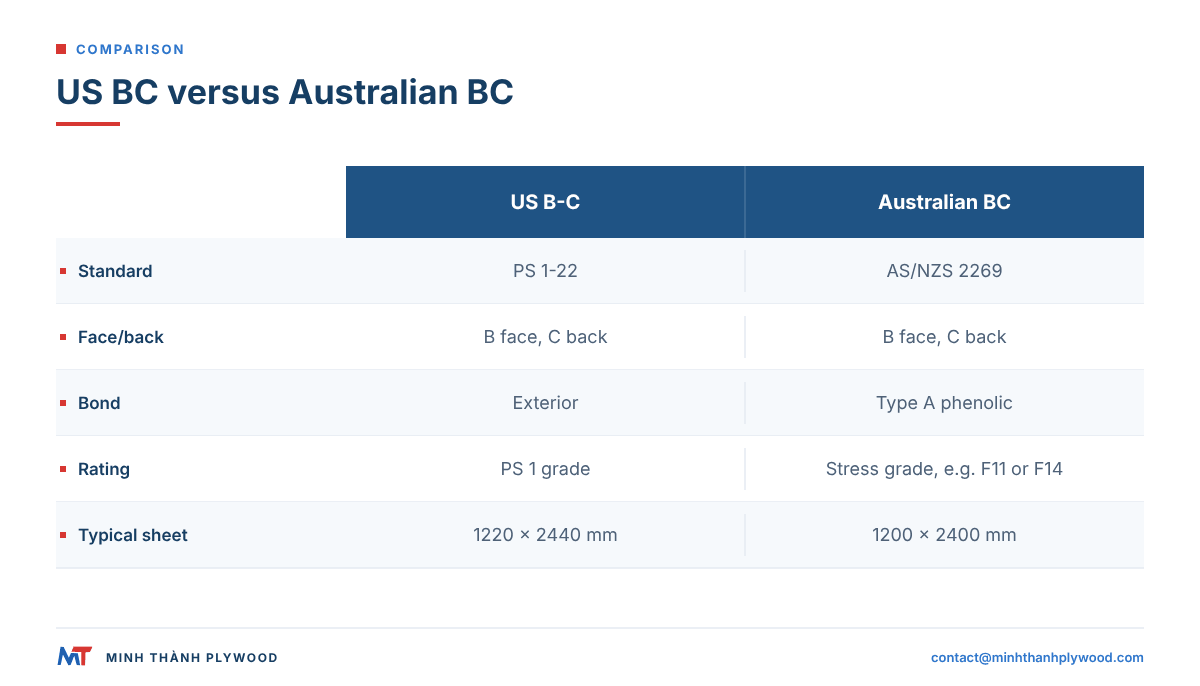
In Australia and New Zealand, BC plywood usually means structural plywood made to AS/NZS 2269 with a B grade face and a C grade back. It is sold sanded for paint and stress-graded for load.
- Standard: AS/NZS 2269, the structural plywood standard, with a stress grade such as F11 or F14 on the brand.
- Bond: Type A phenolic, the permanent structural bond in that standard.
- Face grades: the AS/NZS ladder runs A, S, B, C, D; B is a paint-quality face.
- Uses: bracing, flooring, shelving and joinery that is both loaded and painted.
An Australian BC sheet is therefore a structural, exterior-bond panel with a paintable face. When an Australian drawing calls for BC plywood, check whether the stress grade is part of the specification.
Two differences from the US panel matter on an order. First, the Australian sheet carries a stress grade, so the engineer may have chosen it for load as well as looks; a non-structural BC sheet is not a substitute. Second, Australian sizes and thicknesses follow metric sheets, commonly 1200 × 2400 mm, so a US 4 × 8 ft sheet and an Australian sheet do not swap one for one on a cutting list.
BC plywood vs AC, CDX, sande and birch: comparison
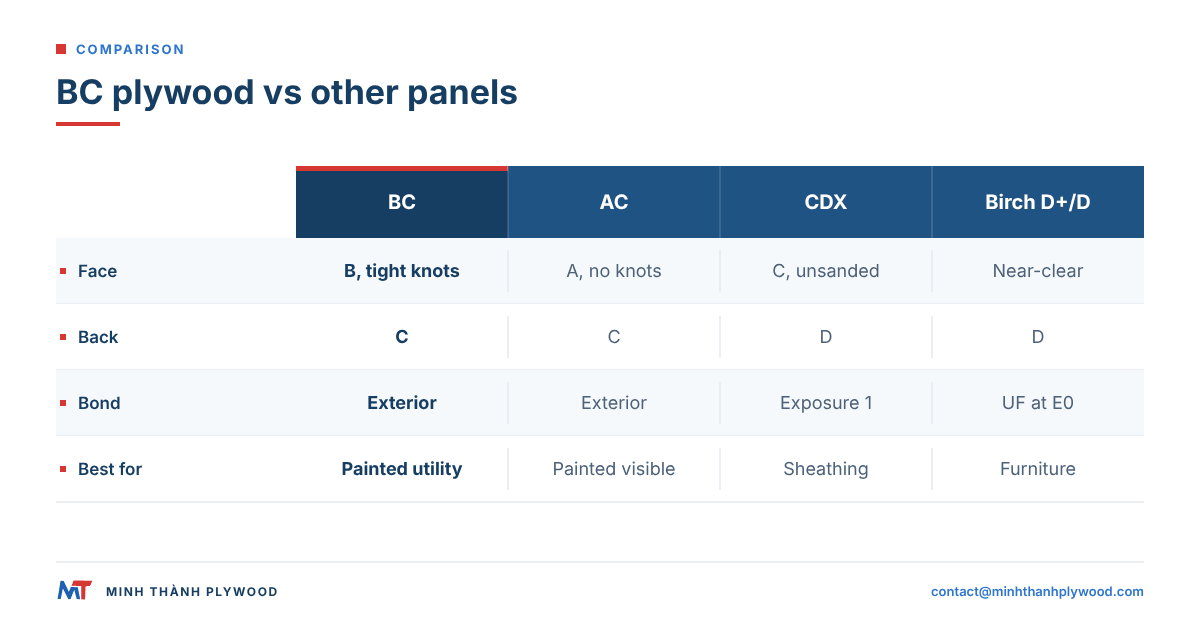
BC sits in the middle of the common panels: a better face than CDX, a cheaper face than AC or birch. Compare them metric by metric.
| Metric | BC (B-C) | AC (A-C) | CDX | Sande | Birch-faced D+/D |
|---|---|---|---|---|---|
| Face | B: small tight knots, repairs | A: no knots, smooth | C: knotholes, unsanded | Sande hardwood, knot-free | Birch, near-clear |
| Back | C | C | D | Usually B or C | Birch D |
| Sanding | Two sides | Two sides | None | Two sides | Two sides, polished |
| Bond (US norm) | Exterior | Exterior | Exposure 1 | Interior or MR | UF at E0 emission, others on order |
| Best for | Painted utility work | Painted visible work | Hidden sheathing | Low-cost paint grade | Furniture, clear finish |
| Not for | Clear finish | Structural rating if none | Visible faces | Wet use | Outdoor use |
Verdict by use:
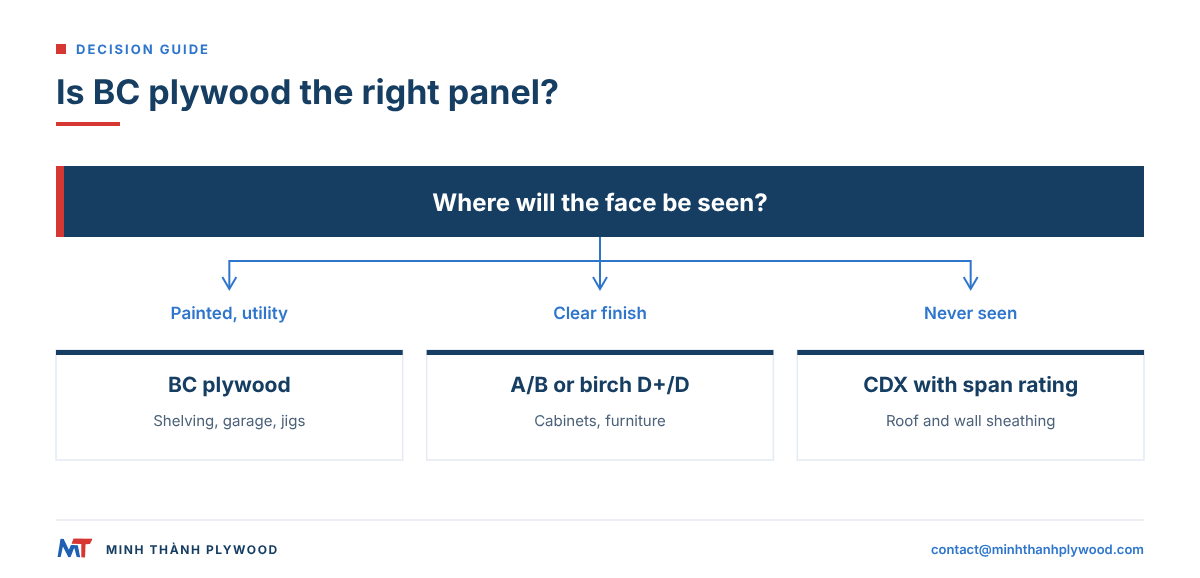
- Painted shop furniture and garage walls: BC.
- Painted doors, signs and visible panels: AC.
- Roof and wall sheathing: CDX with a span rating.
- Low-cost interior paint grade: sande.
- Cabinets and clear-coated furniture: birch-faced or poplar A/B.
BC plywood vs sande plywood
BC plywood is a grade pair; sande plywood is a face species. They compete on the same shelf as paint-grade sheets, but they behave differently.
| Point | BC plywood | Sande plywood |
|---|---|---|
| Face | Pine or fir, B grade, visible knots and grain | Sande hardwood, plain grain, few knots |
| Paint finish | Grain can telegraph through thin paint | Smooth after one coat |
| Bond | Usually exterior | Usually interior |
| Weight | Lighter softwood | Medium hardwood |
| Use | Utility, outdoor-painted parts | Interior painted furniture and fixtures |
Choose sande when the painted face must look smooth indoors; choose BC when it must take weather or load. Our sande plywood vs birch guide shows the next step up.
BC plywood vs birch for cabinets
For kitchen and furniture cabinets, birch-faced or poplar A/B plywood beats BC on face, core and tolerance. BC fits painted shop and garage cabinets.
- Face: a B pine face shows knots and grain under paint; a birch D+ face is near-clear, comparable to the Baltic B grade.
- Core: furniture plywood uses a closed, stitched core; BC structural cores are made for strength and allow C grade inner plies.
- Thickness: our sanded furniture panels hold ±0.2–0.3 mm, so hinge holes and edge banding line up; sheathing-type panels follow wider limits.
- Emission: cabinets indoors need the emission class on paper; our furniture panels use UF glue at E0 emission with CARB P2 / TSCA Title VI certification under EPA’s formaldehyde standards.
See the best plywood for furniture for the full cabinet choice.
Is BC plywood waterproof or treated?
BC plywood made to the US Exterior class has a waterproof glue line, but the wood is not waterproof and it is not treated unless the tag says so.
- Glue: an Exterior bond survives repeated wetting and drying. That keeps the plies together; it does not stop the wood taking up water.
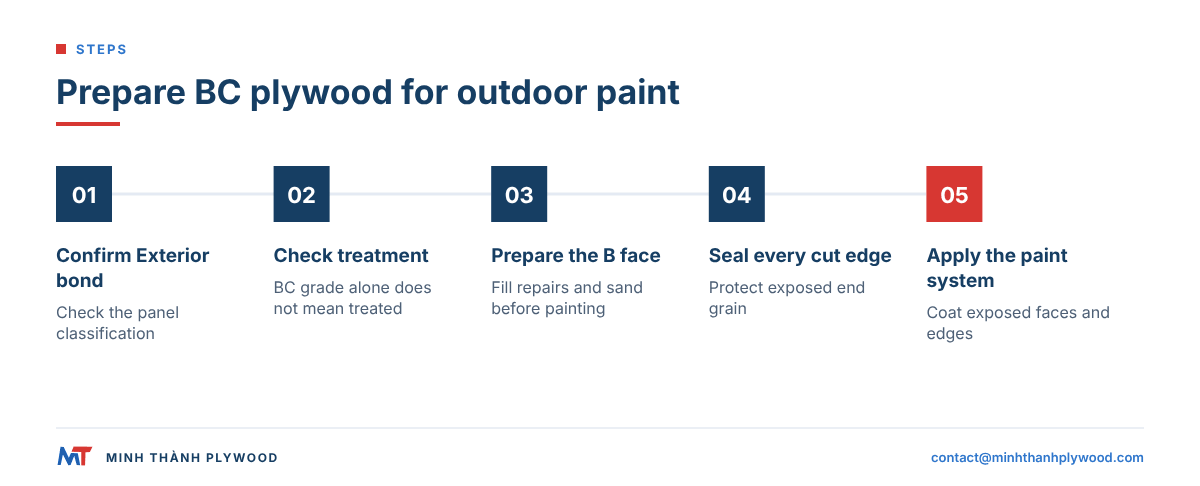
- Wood: bare faces and edges absorb water, swell and grey outdoors. Paint the faces and seal every cut edge.
- Treatment: BC is a grade, not a treatment. Pressure-treated plywood is sold as its own product, with the preservative and use class on its tag.
For outdoor parts that stay wet, use an exterior panel with a phenolic (WBP) bond and a full paint system. Our guide on whether plywood is waterproof covers every bond type.
What is BC plywood used for?
BC plywood is used wherever one side is seen and painted and the other is hidden. Typical jobs:
| Job | Why BC fits |
|---|---|
| Painted shelving and storage | Smooth B face takes paint |
| Garage, shed and workshop walls | Exterior bond, one good side |
| Workbenches and jigs | Sound face, cheaper than A grades |
| Soffits and outdoor trim, painted | Exterior bond, paintable face |
| Signs and hoarding | Smooth face for paint or print |
| Crates with a printed side | Good face where the print goes |
For floors and roofs, choose a span-rated sheathing grade instead; for furniture with a clear finish, choose an A or birch face.
Three practical tips for BC work:
- Put the B face where it is seen. Mark the face side on the cutting list so the C back ends up against the wall or inside the box.
- Fill repairs before painting. A B face carries patches and small knots; a light filler and one sanding pass give a clean paint surface.
- Seal all edges outdoors. Exterior glue keeps the plies together, but the end grain at the edges takes up water fastest.
BC sanded pine plywood and Vietnamese pine grades
BC sanded pine plywood is a pine-faced panel with a B face and C back, sanded both sides. It is the common shelf panel in North America and the usual paint-grade pine sheet in export trade.
Our pine plywood is quoted as A/A, A/B and B/B face/back pairs, with B/C for utility parts, matched to the buyer’s approved sample. The ladder is comparable to the European softwood classes I to IV and the US A to D grades, so a B/C pine panel from us is the same idea as a BC sanded pine sheet.
What we add as a furniture mill:
- Core: white Styrax or Eucalyptus as standard, stitched both ways.
- Pressing: furniture-grade panels pressed twice: core first, then face and back.
- Surface: sanded and polished, both faces UV-ready.
- Bond: UF glue at E0 emission as standard; MR, melamine-fortified and phenolic (WBP) bonds to specification.
We do not stamp panels to PS 1 or AS/NZS 2269. For a structural BC panel with a grade stamp, buy it to that standard.
How do Vietnamese grades BB, CC and BC map to BC plywood?
In Vietnamese and Chinese trade, BC is a face/back pair on the A/B/C ladder: a B face over a C back. It means the same idea as a US B-C sheet but is graded to the agreed sample, not to PS 1.
| Asian trade pair | Face | Back | Nearest US pair |
|---|---|---|---|
| AA | Clean | Clean | A-A |
| AB | Clean | Sound | A-B |
| BB | Sound, small knots | Sound, small knots | B-B |
| BC | Sound, small knots | Open features allowed | B-C |
| CC | Open features | Open features | C-C |
Because these letters have no written standard behind them, the approved sample is the specification. Our plywood grades guide maps every system, including the Chinese codes B/BB, BB/CC and CP.
How to order BC plywood
Order BC plywood by naming the system, the face species, the bond and the sanding, so two suppliers quote the same sheet. A complete BC order line reads:
[Pine] plywood, face/back [B/C] to signed sample, sanded [S2S], core [Eucalyptus, stitched], bond [phenolic WBP / UF at E0], [18] mm ± [0.3] mm, [1220 × 2440] mm, [quantity] sheets, [port].
For a US structural panel, add the PS 1 grade and span rating; for Australia, the AS/NZS 2269 stress grade. Send the line through our pine plywood page and we answer within hours, with free samples.
Buyer questions, answered
What is BC plywood?
BC plywood has a B grade face and a C grade back. The B face is solid with small tight knots and repairs; the C back allows knotholes up to 25.4 mm. It is used where one side is painted and the other hidden.
What does BC mean on plywood?
B is the face grade and C the back grade, read face first. The letters describe the appearance of the two outer veneers, not the glue or the strength.
Is BC plywood waterproof?
Its glue line is, when it is made as an Exterior or X panel; the wood is not. Under PS 1-22, B-C is an Exterior grade, but outdoors it still needs paint or sealer and sealed edges.
Is BC plywood treated?
Not as standard. BC describes the face grades only; pressure-treated BC plywood is a separate product sold with its treatment named on the tag.
What is BC plywood used for?
Painted shelving, utility cabinets, workshop benches, garage and shed walls, soffits, signs and crates where one face is seen. For clear-finished furniture, choose A/B or birch instead.
What is the difference between AC and BC plywood?
The face. AC has an A face, smooth with no knots and paintable with a clean look; BC has a B face that allows small tight knots and more repairs. The C back is the same.
Is BC plywood better than CDX?
For anything seen, yes: BC has a sanded B face, CDX an unsanded C face and D back. For hidden sheathing, CDX with a span rating is the right and cheaper panel.
What is the difference between BC plywood and sande plywood?
BC is a grade pair, usually on pine or fir; sande is a tropical hardwood face species. Sande gives a smoother, knot-free paint face; BC is stronger-grained and often carries an exterior bond.
Is BC plywood good for cabinets?
For painted shop or garage cabinets, yes. For kitchen cabinets, use a hardwood-faced panel with a closed core and tight thickness tolerance, such as poplar A/B or birch D+/D.