
Plywood grades are letters that describe how the outer veneers look, written as a face/back pair such as A/B or B/BB. They do not describe the glue, the core or the strength. Those have their own grades. This guide maps every system a buyer meets in one chart, with what each grade means on the sheet, from Minh Thanh Plywood's grading line.
What are plywood grades?
Plywood grades are letter codes that describe the appearance of the outer veneers of a sheet. Every grading system ranks the face from cleanest to roughest, then names the face and the back together, so A/C means an A face and a C back.
Three points save most buyers money:
- Grade is appearance, not strength. The letters count knots, splits, repairs and colour, not load capacity.
- Grade is not glue. An A/A sheet can have an interior glue line. The bond has its own grade (MR, WBP, Exposure 1, Exterior, EN 314 class).
- Each region has its own ladder. A US “B”, a Baltic “B” and a Chinese “B” are three different faces.
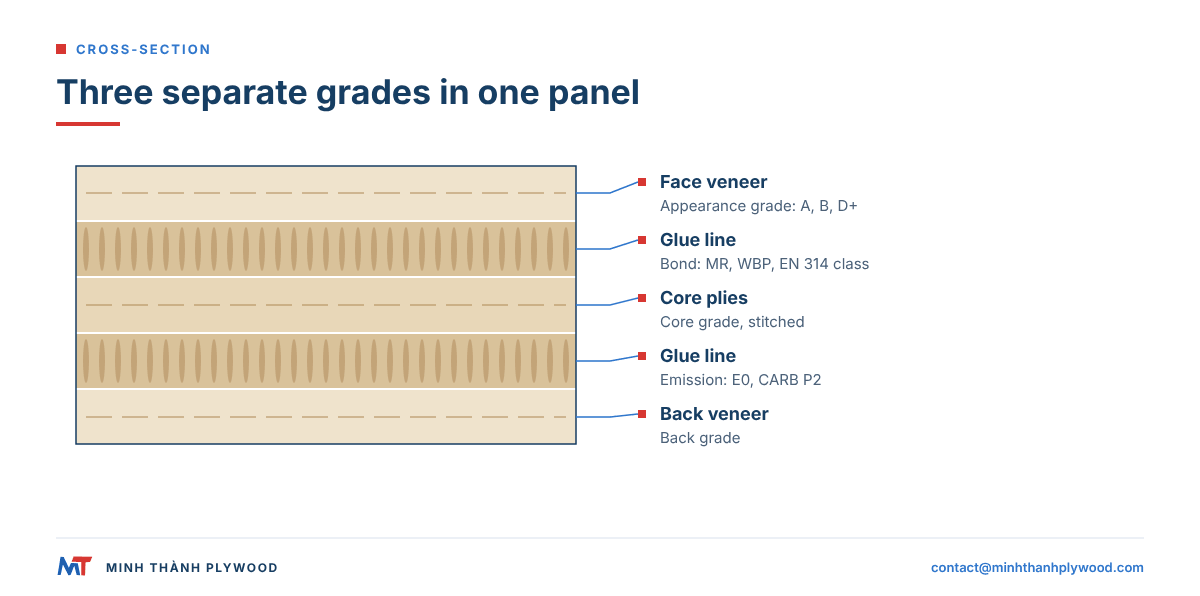
That is why one grade letter is never enough on an order. Write the system, the face/back pair, the bond and the emission class on separate lines.
How do face and back grades work?
The face is the better side of the panel; the back is the other outer veneer. The grade pair is always written face first, back second.
| Written as | Face | Back | Typical reason to order it |
|---|---|---|---|
| A/A or AA | A | A | Both sides seen, such as shelves and open cabinets |
| A/B or AB | A | B | One side seen, the back hidden but sound |
| B/B or BB | B | B | Painted, laminated or veneered both sides |
| B/C | B | C | One painted face, rough back to a wall |
| C/D | C | D | Sheathing and structural work, no visible face |
The grade of the inner plies is set by the grading system, not by the pair. Under the US standard PS 1-22, for example, sanded A-A and B-B panels for interior use allow D grade inner plies, while the same pairs for exterior use need C grade inner plies. Two A/A sheets can therefore have very different cores.
What are the 4 grades of plywood: A, B, C and D?
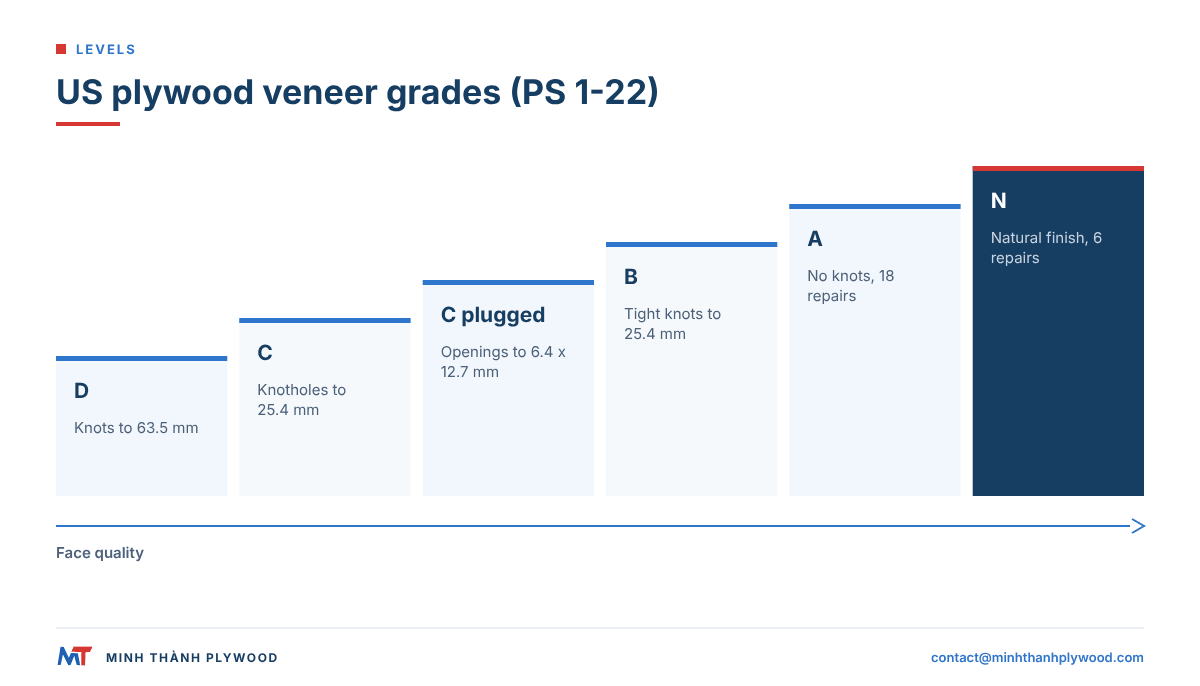
The four common grades come from the US softwood standard, PS 1-22, published by NIST on 2 October 2023. Grade N sits above them as a fifth, natural-finish grade. The standard’s own limits per 1220 × 2440 mm sheet are:
| Grade | Knots and holes | Repairs | Use |
|---|---|---|---|
| N | No knots or open defects, 100% heartwood or 100% sapwood, matched colour | Up to 6 wood repairs | Natural or clear finish |
| A | No knots, smooth, firm | Up to 18 repairs, neatly made | Paint grade, visible work |
| B | Sound tight knots up to 25.4 mm (1 in); splits no wider than 0.8 mm | Repairs and shims allowed | Painted surfaces, solid backs |
| C plugged | Openings up to 6.4 × 12.7 mm (1/4 × 1/2 in); tight knots up to 38.1 mm | Plugs and patches allowed | Underlayment, base for flooring |
| C | Tight knots up to 38.1 mm (1-1/2 in); knotholes up to 25.4 mm (1 in) | Synthetic and wood repairs | Sheathing, backs, utility |
| D | Tight knots up to 63.5 mm (2-1/2 in), larger holes allowed | Any number if strength holds | Hidden backs, Exposure 1 sheathing |
Grade A is the cleanest face most buyers order. N is made to order and rare in import trade. D is not allowed in PS 1 Exterior panels at all: those must be C or better on every ply.
What do ACX, BCX and CDX mean?
ACX, BCX and CDX are US trade names built from the face grade, the back grade and an X for exterior glue. ACX has an A face and C back, BCX a B face and C back, CDX a C face and D back.
The X is the part buyers misread. PS 1-22 has two bond classifications:
- Exposure 1: for uses not permanently exposed to the weather, built to resist moisture during construction.
- Exterior: for repeated wetting and drying or long-term exposure.
CDX is usually Exposure 1, because it has a D back and D is not allowed in Exterior panels. ACX and BCX can be Exterior, since A, B and C veneers are all allowed. For the full comparison, see our guide to CDX vs ACX and BCX plywood, and for the B/C pair on its own, BC plywood.
US hardwood plywood grades: the letter and number system
Hardwood plywood for cabinets and furniture in the US uses a separate ladder from softwood. Faces are graded AA, A, B, C, D and E; backs are graded 1, 2, 3 and 4; so a common cabinet sheet is written A-1 or B-2.
| Face grade | What it shows | Back grade | What it shows |
|---|---|---|---|
| AA | Best, matched veneer for fine furniture | 1 | Sound, few defects, same species as face |
| A | Matched, few small features | 2 | Sound, small repairs |
| B | Good, some colour change and small knots | 3 | Open defects allowed within limits |
| C, D, E | Rising numbers of knots, repairs and colour streaks | 4 | Open knots and splits, strength kept |
A-1 maple, B-2 birch and C-2 utility are the grades buyers meet most. These grades come from the hardwood plywood standard published by the Decorative Hardwoods Association (ANSI/HP-1). Like softwood letters, they say nothing about the glue or the formaldehyde class.
European and Baltic birch grades: B, BB, CP, C
All-birch plywood from the Baltic region and Northern Europe uses the B, BB, CP, C ladder, written as pairs such as B/BB or BB/CP.
- B: almost clear, a few small sound knots and tiny repairs, even colour. Used for clear-finished furniture.
- BB: sound face with plugs (football-shaped patches) and some colour change. The workhorse cabinet grade.
- CP: more knots and plugs, sound and smooth enough for paint or overlay.
- C: open knots and splits within limits. Used where the face is hidden.
The European standard for appearance classes, EN 635, names its classes E, I, II, III and IV instead of letters. The trade still quotes Baltic panels as B/BB, BB/BB and BB/CP.
Our birch faces are imported veneers on Vietnamese cores and are graded on the Vietnamese ladder D+, D and E, low to high E, D, D+. For buying, D+ is comparable to B, D to BB and E to CP/C, so a D+/D pair is comparable to B/BB and D/D to BB/BB. The approved sample fixes the look. Our birch plywood grades guide shows what each grade accepts.
Asian trade grades: AA, AB, BB, CC and the Chinese B/BB, CP
Most hardwood-faced plywood from Vietnam, China and Indonesia is sold on a simple A/B/C ladder, written as pairs, plus a set of Chinese codes for poplar faces.
| Trade grade | Face look | Typical use |
|---|---|---|
| A/A (AA) | Clean, matched, few small features | Visible furniture both sides |
| A/B (AB) | Clean face, sound back | Cabinet carcasses with one visible face |
| B/B (BB) | Sound, small knots and repairs | Painted, laminated or hidden faces |
| B/C or C/C (CC) | Open features allowed | Utility, packing, backs |
| B/BB, BB/CC (Chinese codes) | Poplar faces, best to utility | Furniture, then utility |
| CP | Paint grade with repairs | Painted or overlaid parts |
There is no single written standard behind these letters. They are agreed between buyer and mill, so the approved sample is the real specification. At Minh Thanh, poplar faces are quoted as A/A, A/B and B/B, and buyers also order them by B/BB, BB/CC and CP, which map onto the same ladder. Eucalyptus faces are quoted as A/A, A/B and B/B: A/A for two visible faces, A/B for one, B/B for paint or overlay.
Plywood grades by wood type
Each face species has its own grading habit, so the same letter means a slightly different face from one species to the next.
| Face species | How it is graded | Minh Thanh grades |
|---|---|---|
| Birch | B, BB, CP, C (Baltic); D+, D, E (Vietnam) | D+/D, D/D, D/E pairs |
| Poplar | A/A, A/B, B/B; Chinese B/BB, BB/CC, CP | A/A, A/B, B/B |
| Pine | A to D (US), classes I to IV (Europe) | A/A, A/B, B/B; B/C for utility parts |
| Eucalyptus | A/A, A/B, B/B | A/A, A/B, B/B |
| Okoume, bintangor, gurjan | A/A, A/B, B/B by sample | Graded to the approved sample |
| EV (engineered veneer) | Uniform by design; graded on defects, not knots | To the approved colour and pattern |
| Exterior and CDX type | C/D utility faces | C/D, matched to the order sample |
Pine faces at Minh Thanh are comparable to the European softwood classes I to IV and the US A to D grades. Engineered veneer has no knots at all, so its grade is about joints, colour match and surface faults. See our pine plywood and birch plywood pages for the full specifications of each face.
Plywood grading chart: one table for every system
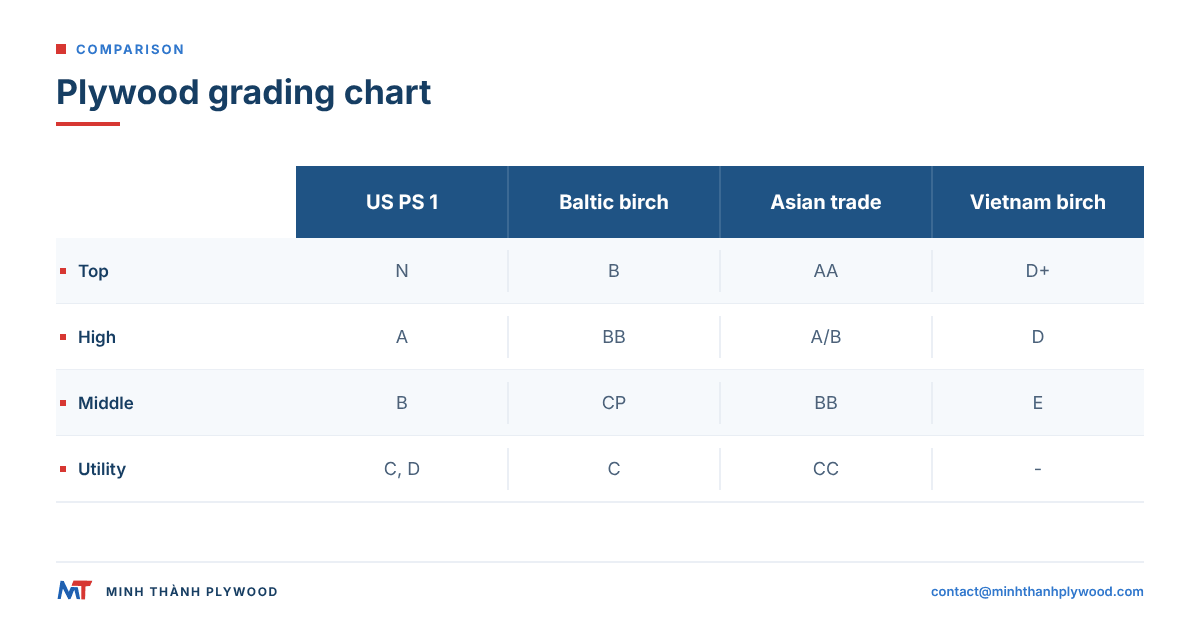
This plywood grades chart lines up the common systems from best to lowest face. Rows are comparable, not identical: always confirm with a sample.
| Level | US softwood (PS 1) | US hardwood (HP-1) | Baltic birch | Europe (EN 635) | Asian trade | Vietnam birch (MT) | Typical use |
|---|---|---|---|---|---|---|---|
| Top | N | AA | B | E or I | A (AA) | D+ | Clear-finished furniture |
| High | A | A | BB | I or II | A/B | D | Visible cabinet faces |
| Middle | B | B | CP | II or III | B (BB) | E | Painted or overlaid work |
| Utility | C plugged | C, D | C | III | BB/CC, C | — | Underlayment, hidden parts |
| Lowest | C, D | E | — | IV | CC, D | — | Sheathing, packing, backs |
Use the chart to translate a quote, then write the grade in the system your supplier uses, with a signed sample. A “B” from a US mill and a “B” from a Baltic mill are two rows apart.
Bond grades: MR, WBP, Exposure 1, Exterior and EN 314
The bond grade tells you how the glue line behaves in water, and it is separate from the face grade. Four names cover most quotes.
| Bond name | What it means | Typical glue |
|---|---|---|
| Interior (MR or UF) | Dry use; resists humidity, not wetting | Urea formaldehyde (UF) |
| MR, melamine fortified | Humid rooms and short wetting | Melamine-urea formaldehyde (MUF) |
| WBP or Exterior | Weather and boil-proof glue line | Phenol formaldehyde (PF) |
| Exposure 1 (US) | Resists moisture during construction | Exterior-type glue on lower grade plies |
In Europe the bond classes come from EN 314-2: class 1 for dry interior conditions, class 2 for humid conditions and class 3 for exterior conditions. EN 636 then ties the panel to the same three use classes as EN 636-1, EN 636-2 and EN 636-3.
At Minh Thanh, furniture and interior panels use UF glue at E0 emission as standard; MR, melamine-fortified and phenolic (WBP) bonds are made to the customer’s specification. Hot pressing runs at about 110–120 °C for MR and 130–145 °C for WBP.
Emission grades: E0, E1 and CARB Phase 2
Emission grades measure formaldehyde released by the panel, and they are again separate from the face and the bond. E1 and E0 are emission classes; they are not glue types.
- E1: the base European emission class for wood panels.
- E0: a lower emission level used in trade, quoted with its test method because no single global E0 limit exists.
- CARB Phase 2 / TSCA Title VI: the US limit of 0.05 ppm for hardwood plywood with a veneer core, under 40 CFR 770.10.
Our panels hold CARB P2 / TSCA Title VI certification as ICTT mill no. 23024. Six third-party chamber tests (ASTM D6007), April 2025 to June 2026, on 9, 15 and 18 mm panels averaged 0.014–0.032 ppm against the 0.05 ppm limit; three were run by Shanghai Hongjun and three by ICTT Vietnam. Third-party testing to the buyer’s method, such as EN 717-1, is arranged through SGS on request.
Structural rating vs appearance grade
A structural rating says what load the panel carries; an appearance grade says what it looks like. Sheathing and flooring are bought on the first, furniture on the second.
- US: PS 1 panels carry a span rating, such as 32/16 (32 in roof span, 16 in floor span), a Performance Category such as 15/32, and Structural I where design properties matter.
- Australia and New Zealand: structural plywood is graded under AS/NZS 2269 with a stress grade and face grades A, S, B, C and D.
- Europe: construction plywood is declared under EN 13986 with EN 636 use classes.
A C-D sheet with a 32/16 span rating can be a better roof deck than an A/A furniture panel, because it was tested for that job. The reverse also holds: a structural panel is graded for strength and stiffness across the grain and along it, and its face can be rough, patched and unsanded without failing its grade. When a job needs both, such as a painted structural floor, order a structural grade with a better face, for example a sanded Exterior A-C or B-C panel with the span rating on the stamp. Our guide to construction plywood grades and grade stamps decodes each mark.
Plywood finish grades: sanded, touch-sanded, unsanded and overlaid
Plywood finish grades describe the surface treatment, and they sit next to the face grade on the order. PS 1-22 links them: its sanded grades (N, A and B faces) are sanded on two sides, its underlayment and C plugged grades are touch-sanded, and its C-D and C-C sheathing grades are unsanded.
| Finish grade | What it means | Usual face grades | Thickness tolerance in PS 1-22 |
|---|---|---|---|
| Sanded (S2S) | Face and back sanded smooth | N, A, B | ±0.4 mm up to the 3/4 category |
| Sanded one side (S1S) | Face sanded, back as pressed | A/C, B/C | Agreed on the order |
| Touch-sanded | Light pass to size, skips allowed | C plugged | ±0.8 mm up to the 13/16 category |
| Unsanded | As pressed | C, D | ±0.8 mm up to the 13/16 category |
| Overlaid (HDO, MDO, film) | Resin paper or film pressed on | B or C under the overlay | ±0.8 mm up to the 13/16 category |
The finish grade decides how much work the panel needs before paint or lacquer. Our furniture panels are sanded and polished on both faces, UV-ready, so the customer’s coating line can apply its own UV finish. The full sanding comparison is in our guide to sanded vs unsanded plywood.
Plywood grades in India and Australia
India and Australia grade plywood by bond and use first, then by face, so their grade names look different from the US and Baltic letters.
- India, commercial plywood: IS 303 sorts general-purpose plywood by bond into MR (moisture resistant), BWR (boiling water resistant) and BWP (boiling water proof). Buyers often say “BWR grade” or “BWP grade” when they mean the bond.
- India, marine plywood: IS 710 covers marine plywood with a BWP bond and a 72-hour boil test.
- Australia and New Zealand: structural plywood is made to AS/NZS 2269 with a stress grade (such as F11 or F14), a Type A phenolic bond and face grades A, S, B, C and D; marine plywood to AS/NZS 2272.
When a buyer in India asks for “Vietnamese plywood, BWR grade”, the order still needs a face pair, a core and a thickness tolerance. Our MR and melamine-fortified bonds cover moisture-resistant use, and phenolic (WBP) bonds cover boiling-water-proof use, made to the customer’s specification.
Marine plywood grades and why marine is not always the top grade
Marine plywood is a standard, not a face grade, so it is not automatically the highest grade. BS 1088 is the British Standard for marine plywood. AS/NZS 2272, IS 710 and the PS 1 Marine grade also set rules for the bond and the inner plies; the face can still be B/B.
Under PS 1-22, Marine panels allow only A or B faces, need B grade or better inner plies and limit crossband gaps to 3.2 mm, four per 2440 mm. A fine A/A furniture panel with a UF glue line is a higher appearance grade but not a marine panel. Our article on the grades of marine plywood covers the marine standards in full.
Which plywood grade is best for furniture and cabinets?
For furniture, choose the face by the finish and the core by the machining, then add the emission class. This chart covers the common jobs.
| Job | Face/back | Core and bond | Why |
|---|---|---|---|
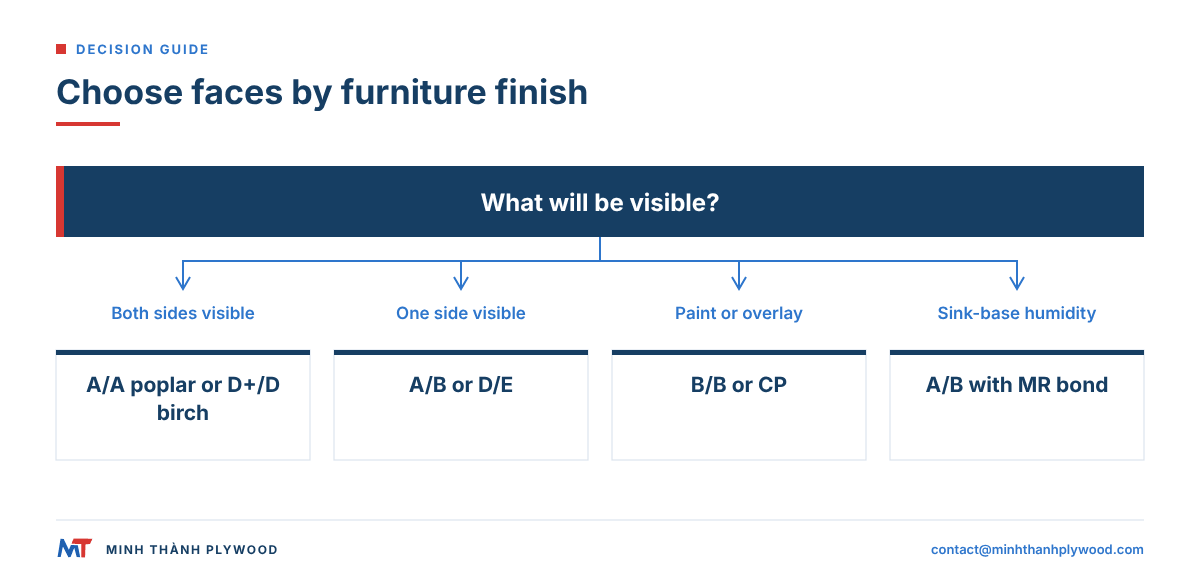
| Clear-coated cabinet, visible both sides | A/A poplar, D+/D birch | Stitched Styrax or Eucalyptus, UF at E0 | No repairs show under clear finish |
| Cabinet carcass, one visible side | A/B, D/E | Same | Pay for one good face only |
| Painted doors and furniture | B/B | Same, sanded both sides | Paint hides knots and colour |
| HPL, melamine or veneer overlay | B/B or CP | Calibrated, flat core | Overlay needs flatness, not looks |
| Kitchen sink base | A/B | MR or melamine-fortified bond | Humid area |
| Drawer boxes, edges visible | D+/D birch | Void-free core | Exposed edges show the core |
Thickness tolerance matters as much as the face for furniture. Our sanded furniture panels hold ±0.2–0.3 mm, down to ±0.2 mm, so hinges, grooves and edge banding line up. For the full furniture picture, see the best plywood for furniture.
How does a factory assign plywood grades?
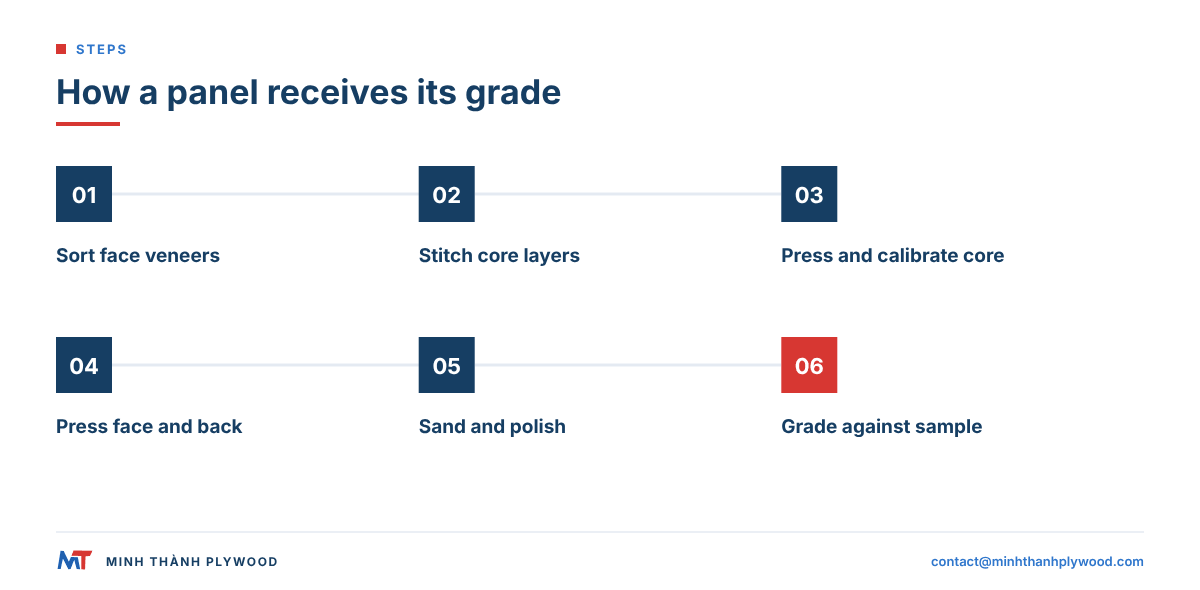
A mill grades twice: it sorts the veneer before pressing, then grades the finished panel against the approved sample. Here is how it works at our factory in Ha Hoa, Phu Tho.
- Veneer sorting. Face veneers are sorted by knots, splits, colour and grain before lay-up. Only veneer that meets the ordered face grade goes on the face.
- Core lay-up. Core layers are stitched both horizontally and vertically, so the core stays closed under the face.
- First pressing. The core board is pressed and calibrated to an even thickness.
- Second pressing. Face and back are pressed on. Double pressing is standard on furniture-grade panels, and it is why the faces stay flat.
- Sanding and polishing. Faces are sanded and polished to thickness.
- Panel grading. Each panel is checked against the signed sample of the order and stacked by grade.
Grading against a sample, not a letter, is what keeps repeat containers alike. A mill that cannot show you the sample it grades to has no fixed grade.
What does a higher grade cost you?
A higher face grade costs more because fewer veneer sheets qualify for it. The price gap comes from the face, not from the core or the glue.
- Face yield: an A or D+ face uses only the cleanest veneer; the rest goes to lower grades or backs.
- Two faces: A/A costs more than A/B because both outer veneers must be top grade.
- Indicative prices: as of October 2026, commercial plywood starts from US$250/m³ and furniture and interior plywood from US$350/m³; the final price depends on face, core, glue, thickness, size, quantity and delivery term.
The saving is in matching the grade to the finish. A painted cabinet on A/A faces pays for beauty nobody will see.
Three ways buyers cut cost without losing quality:
- Order A/B instead of A/A when the back faces a wall or the inside of a carcass.
- Order B/B or CP under paint, laminate or veneer, where the overlay hides knots and colour.
- Choose the core for the job: a white Styrax core is lighter, at about 500 kg/m³, than Eucalyptus at about 650 kg/m³, which puts more sheets in a container before it reaches its weight limit.
A higher face grade does not raise the price of the core, the glue or the emission certificate, so the gap between grades stays the same whichever bond you order.
Common mistakes when choosing plywood grades
Most grade disputes start with a mismatch between the letter on the order and the sheet the buyer pictured.
- Using one letter across systems. A US B, a Baltic B and a Chinese B are different faces.
- Leaving out the back. “Grade A” without the back grade lets the mill choose it.
- Reading face grade as strength. A/A is not stronger than C/D.
- Ignoring the core. Two A/A sheets can have closed or gappy cores.
- Mixing bond and emission. “E1 glue” or “WBP E0” in one field hides two specifications.
- No sample. Without a signed sample, the grade is whatever the mill thinks it means.
- Ordering a structural grade for furniture. A C-D sheathing panel with a span rating is a strong roof deck and a poor cabinet side: unsanded, wider tolerance, open knotholes.
- Ordering a furniture grade for structure. An A/A furniture panel has no span rating or structural mark, so a building inspector cannot accept it as sheathing.
- Checking only the top sheet. Grades are judged across packs; pull sheets from the middle and bottom of several packs before accepting a lot.
Each mistake is fixed on paper before production, at no cost.
How to write plywood grades on your order
Write the grade in the supplier’s system, then add the other grades on their own lines. Copy this specification and fill it in:
[Furniture plywood], face/back [poplar A/B] graded to signed sample [ref], core [Styrax, stitched], bond [UF], emission [E0, CARB P2 / TSCA Title VI], [18] mm, tolerance [±0.2–0.3 mm], [1220 × 2440] mm, sanded [both sides], [quantity], [port].
We answer within hours, with free samples graded to your spec. Send the line through our furniture plywood page.
Buyer questions, answered
What are plywood grades?
Plywood grades are letter codes for the appearance of the face and back veneers, such as A, B, C and D, written as a pair like A/C. Glue, emission and strength are graded separately.
What are the 5 grades of plywood?
In the US softwood system they are N, A, B, C and D, from best to lowest, with C-plugged between C and B. N is a natural-finish grade made to order; most buyers use A to D.
What do plywood grade letters mean?
The first letter is the face, the second the back. A is smooth and paintable with few repairs, B is solid with small tight knots, C allows knotholes up to 25.4 mm, D allows larger knots and holes.
Which plywood grade is best for furniture?
A sanded face that takes your finish: A/B or B/BB for clear-coated cabinets, B/B for painted work. Pair it with a stitched, void-free core and UF glue at E0 emission.
Is marine plywood always the highest grade?
No. Marine is a standard for bond and core, not a face grade. A marine sheet can have B/B faces, while an interior furniture panel can have a finer A/A face.
What is the difference between birch and Baltic birch plywood grades?
Baltic birch uses the B, BB, CP, C ladder on all-birch panels. Birch-faced plywood from other origins puts a birch face on another core; in Vietnam the faces are graded D+, D and E, comparable to B, BB and CP/C.
What does the X mean in CDX or BCX?
The X stands for exterior glue: the panel's bond can take moisture during construction. In US terms CDX is usually an Exposure 1 panel, not one made for permanent outdoor exposure.
Is a higher plywood grade stronger?
Not necessarily. Face grade measures appearance. Strength comes from species, ply count, thickness and the structural rating, such as Structural I or a span rating.
What do the Chinese grades B/BB, BB/CC and CP mean?
They are face/back appearance grades used on poplar and other hardwood faces. B/BB is the best common pair for visible furniture, BB/CC a utility pair and CP a paint grade with repairs.
How do I check the grade when the plywood arrives?
Compare a sheet from several packs with the approved sample under the same light, count knots and repairs on the face, check the back, then measure thickness at four points.