
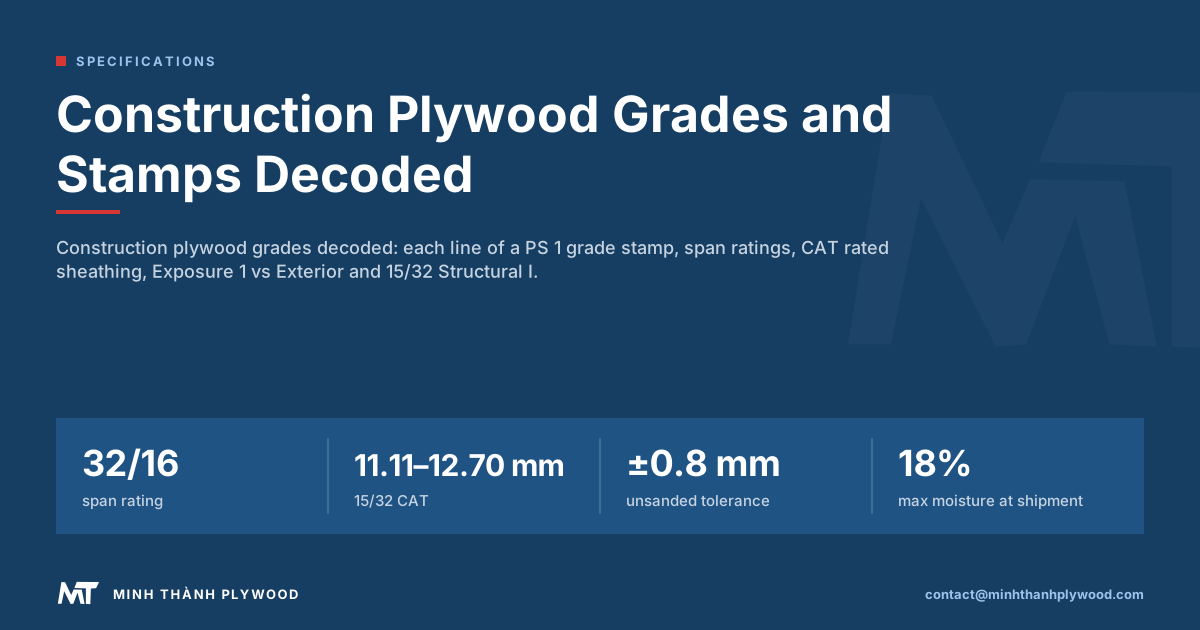
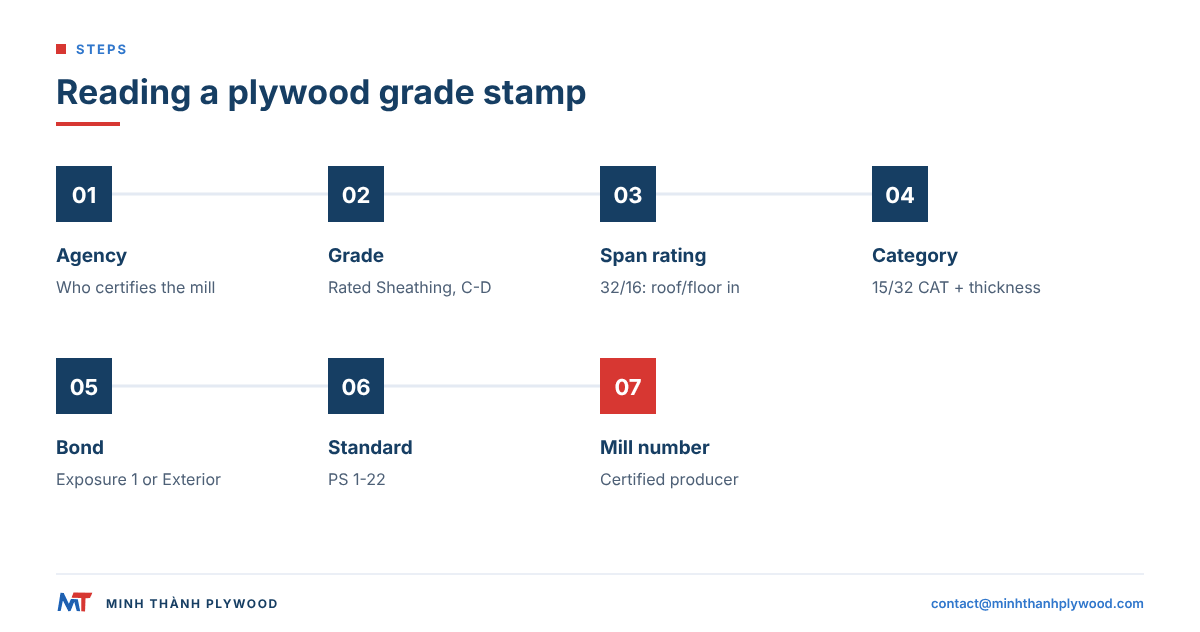
Construction plywood grades are printed on the sheet as a grade stamp: the grade name, a span rating such as 32/16, a Performance Category such as 15/32, the bond class (Exposure 1 or Exterior), the standard (PS 1-22) and the certifying agency with the mill number. Read those six lines and you know what the panel may carry. Minh Thanh Plywood decodes each one.
What are construction plywood grades?
Construction plywood grades identify a structural panel’s intended use, span rating, thickness category and moisture exposure class. The grade stamp also identifies the product standard, certification agency and mill. Buyers should match all of these fields to the project specification before accepting a panel for construction.
PS 1-22, published by NIST on 2 October 2023, is the voluntary US product standard for structural plywood.
PS 1-22 classifies structural plywood by four things:
- Bond classification: Exposure 1 or Exterior.
- Span rating: the support spacing the panel is rated for.
- Performance Category: the nominal thickness group.
- Grade: the veneer grades and construction, such as C-D, Structural I or Underlayment.
Face appearance comes last. A construction grade with an unsanded C face is often the right panel, because nobody sees it once the roof or floor is finished.
What do A, B, C and D veneer grades mean?
The four veneer letters run from A, a smooth paintable face, to D, a utility face with open knots. The first letter of a two-letter code is the face and the second is the back, so C-D is a C face over a D back.
| Veneer grade | What it allows | Typical use |
|---|---|---|
| A | Smooth, paintable, repairs allowed | Visible faces, cabinets, paint grade |
| B | Solid surface, tight knots up to 1 in, small repairs | Painted faces, shop furniture |
| C | Sound but flawed, knotholes up to 1.5 in | Structural faces and hidden backs |
| D | Knots and holes up to 2.5 in, Exposure 1 only | Sheathing backs, underlayment, covered work |
CDX is the C-D code with an Exposure 1 bond. Hardwood plywood adds a back number: 1 is the best back and 4 the worst, so A1 is the premium cabinet grade and D4 the cheapest.
Grade changes the price. On a 3/4 inch 4 × 8 ft sheet at big-box stores in 2026, CDX runs about $30 to $50, and sanded AC or BC about $50 to $80. A buyer who needs structure but not looks stops paying for the A face.
How to read a plywood grade stamp, line by line
Section 7.5 of PS 1-22 lists what every conforming panel must be marked with. A typical sheathing stamp carries these lines; the table decodes each.
| Stamp line | Example | What it tells you |
|---|---|---|
| Agency mark | Name or logo of the certification agency | Who audits the mill; the product specification is available from that agency |
| Grade | RATED SHEATHING, C-D, STRUCTURAL I | The panel grade and veneer grades |
| Span rating | 32/16 | Roof span 32 in, floor span 16 in |
| Performance Category | 15/32 CATEGORY | Nominal thickness group |
| Thickness | 0.451 IN. | Actual thickness in thousandths of an inch, within the category tolerance |
| Bond class | EXPOSURE 1 or EXTERIOR | How the glue line handles moisture |
| Standard | PS 1-22 | The standard and edition the panel meets |
| Mill number | 000 | The certified mill that pressed the panel |
| Optional | SIZED FOR SPACING | Panel made undersize for installation gaps |
The bond class must be in the stamp itself. PS 1-22 requires any further wording about glue, such as premium claims or brand names, to sit apart from the agency’s mark. If you see “waterproof glue” inside the stamp area, it is not part of the grade.
What does a span rating like 32/16 or 24/16 mean?
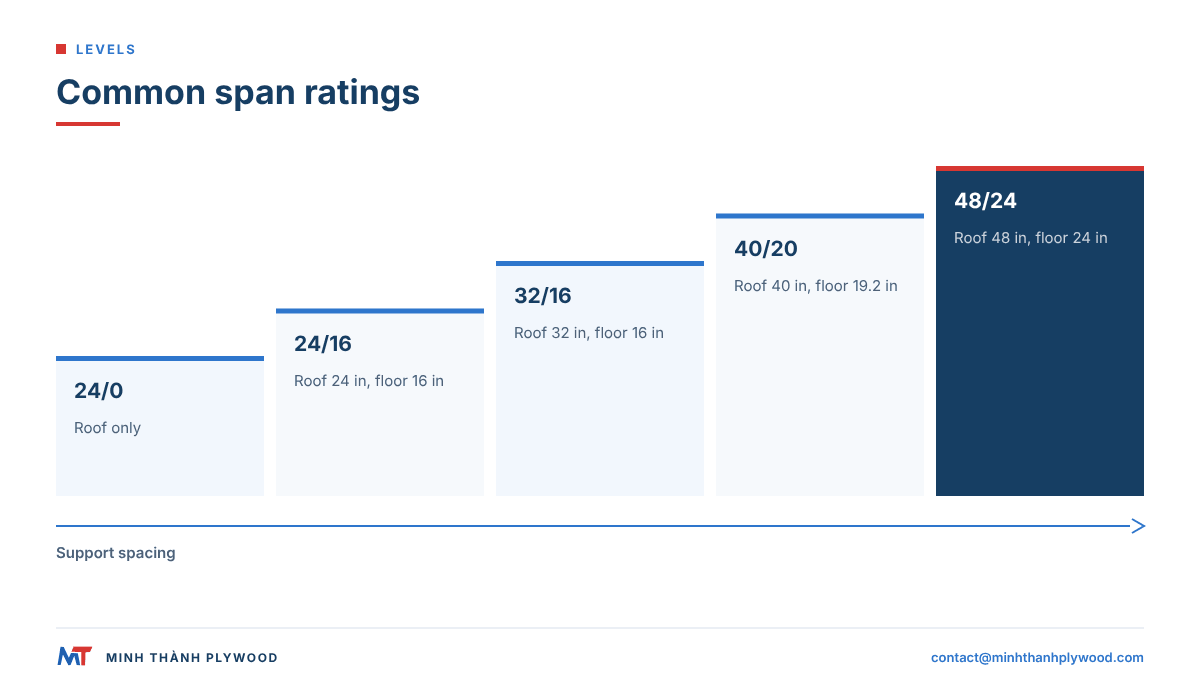
The span rating is the maximum centre-to-centre spacing of supports, in inches, that the panel is rated for under normal loads. Sheathing carries two numbers: roof span over floor span.
| Span rating | Roof supports | Floor supports | Typical use |
|---|---|---|---|
| 24/0 | 24 in | Not for floors | Roof sheathing, wall sheathing |
| 24/16 | 24 in | 16 in | Roof and subfloor |
| 32/16 | 32 in | 16 in | Roof and subfloor, the common workhorse |
| 40/20 | 40 in | 20 in (19.2 in) | Wider roof spacing, subfloor |
| 48/24 | 48 in | 24 in | Heavy roof and floor |
| Floor 20 o.c., Floor 24 o.c. | — | 20 or 24 in | Single-layer floors (Sturd-I-Floor) |
By convention, a span of 20 stands for 19.2 inches. PS 1-22 assigns span ratings either by prescriptive rules on species, grade and thickness or by performance tests at an accredited testing laboratory. The local building code still sets the actual maximum span, so the rating is the panel’s limit, not a design.
What is CAT rated sheathing? Performance Category explained
CAT rated sheathing is sheathing labelled with its Performance Category, the nominal thickness group used by the US building codes. PS 1-22 allows the label as Performance Category, PERF CAT, CAT or Category, and requires the actual thickness in thousandths of an inch beside it.
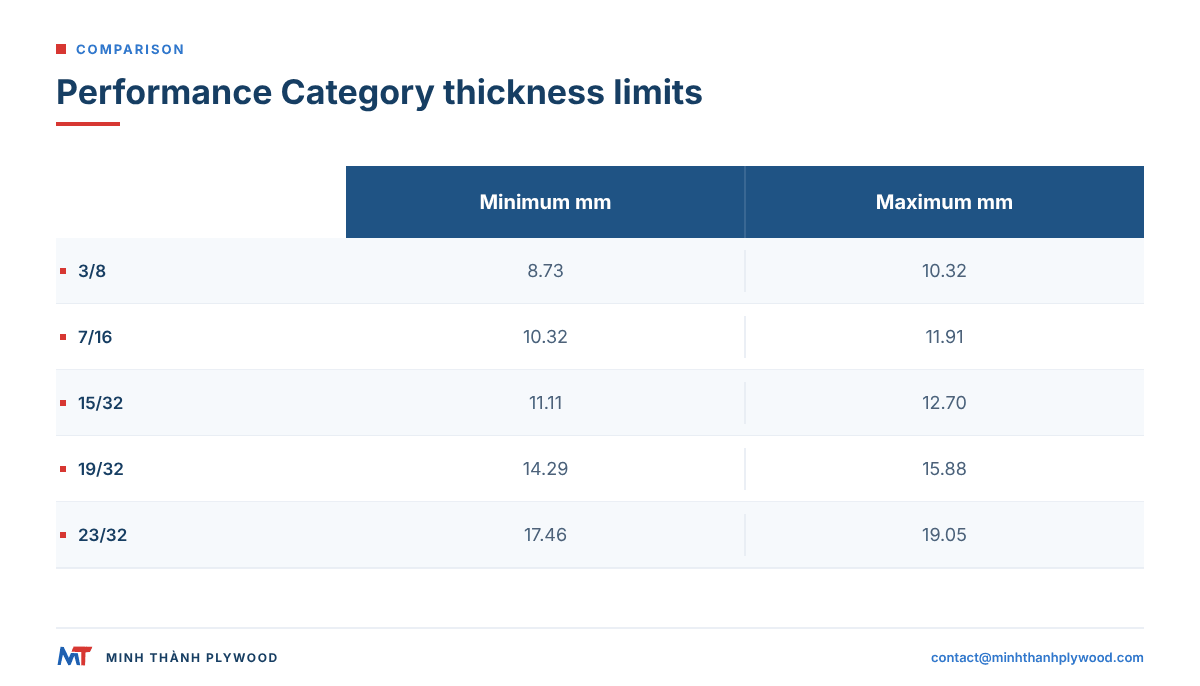
Each category has a range. These are the PS 1-22 limits for unsanded and touch-sanded panels, based on a tolerance of ±0.8 mm (1/32 in):
| Performance Category | Minimum | Maximum | Nearest metric panel |
|---|---|---|---|
| 3/8 | 8.73 mm | 10.32 mm | 9 mm |
| 7/16 | 10.32 mm | 11.91 mm | 11 mm |
| 15/32 | 11.11 mm | 12.70 mm | 12 mm |
| 19/32 | 14.29 mm | 15.88 mm | 15 mm |
| 23/32 | 17.46 mm | 19.05 mm | 18 mm |
Categories exist because panels are slightly thinner than their nominal inch size. A 15/32 panel is sold where a “half inch” is called for. The codes’ advisory minimum for wall sheathing is the 3/8 Performance Category.
Exposure 1 plywood meaning, and how it differs from Exterior
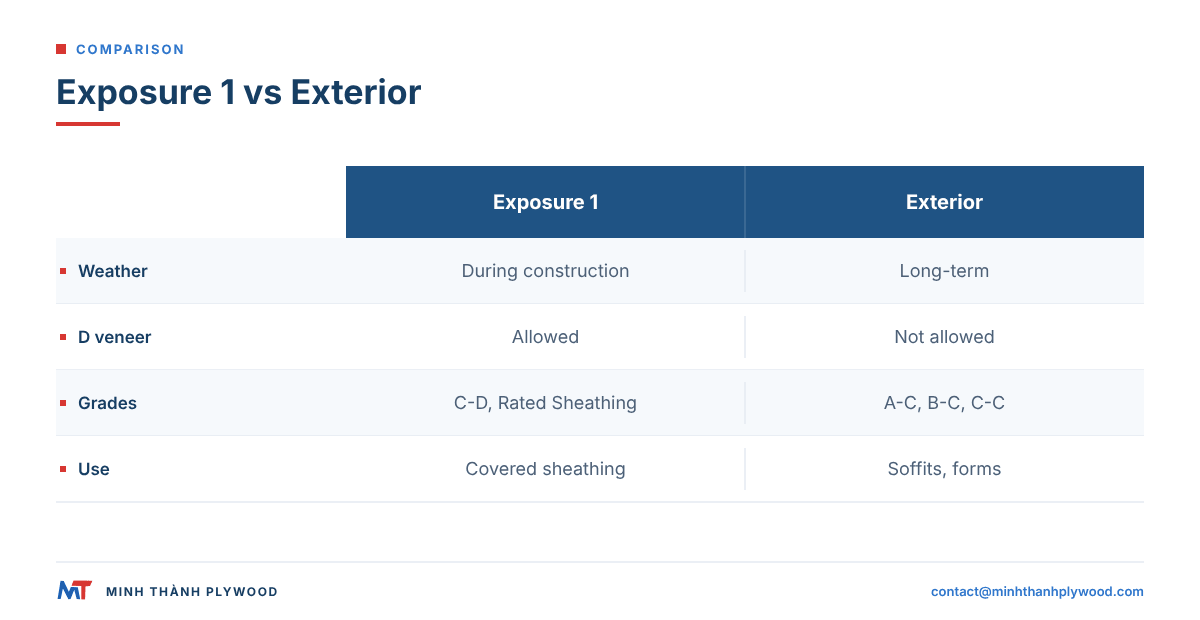
Exposure 1 means the panel’s bond resists moisture during construction but the panel is not made for permanent weather. Exterior means the panel takes repeated wetting and drying or long-term exposure.
| Point | Exposure 1 | Exterior |
|---|---|---|
| PS 1-22 definition | Not permanently exposed to the weather; resists moisture during construction | Repeated wetting and redrying or long-term weather exposure |
| D grade veneer | Allowed | Not allowed in any ply |
| Typical grades | C-D, C-D Plugged, Underlayment, Structural I C-D, Rated Sheathing | A-C, B-C, C-C, C-C Plugged, Marine, HDO, MDO |
| Typical use | Roof and wall sheathing, subfloor, covered once closed in | Soffits, exposed decks under coating, signs, concrete forms |
Exposure 2 is an older interior-only bond classification with limited moisture resistance; it is not used for construction panels that may get wet on site, so choose Exposure 1 or Exterior.
CDX is the familiar trade name for a C-D panel with an Exposure 1 bond. The X tells you the glue is moisture-resistant, not that the panel can stay outdoors uncovered. Our guide to CDX vs ACX and BCX plywood goes through each trade name.
What does Structural I mean, and what is 15/32 Structural 1 plywood?
Structural I is the PS 1 grade for engineered uses where design properties matter: shear walls, diaphragms, structural components. All face, back and inner plies must be Group 1 species, the strongest species group in the standard.
PS 1-22 allows Structural I in C-D, C-D Plugged, Underlayment and any Exterior grade, with extra limits: no white pocket in D veneers beyond set sizes, sound tight knots in D grade no larger than 63.5 mm (2-1/2 in), and plugs no wider than 102 mm (4 in).
So “15/32 Structural 1 plywood” is a panel in the 15/32 Performance Category, about 11.1–12.7 mm thick unsanded, graded Structural I, usually with a 32/16 span rating and an Exposure 1 bond. Engineers specify it for braced and shear walls because its design values are higher than ordinary rated sheathing.
Construction plywood ratings chart: which grade for which job
Use this plywood ratings chart to match the stamp to the job. It lists the common US construction grades.
| Grade on the stamp | Faces | Bond | Surface | Use |
|---|---|---|---|---|
| Rated Sheathing (C-D) | C face, D back | Exposure 1 | Unsanded | Roof and wall sheathing, subfloor |
| Structural I Rated Sheathing | C/D, Group 1 species | Exposure 1 or Exterior | Unsanded | Shear walls, diaphragms |
| Rated Sturd-I-Floor | C plugged face | Exposure 1 | Touch-sanded, often tongue-and-groove | Single-layer floor |
| Underlayment | C plugged face, D back | Exposure 1 | Touch-sanded | Under vinyl, tile, carpet |
| C-C Plugged | C plugged, C | Exterior | Touch-sanded | Exterior underlayment, decks under coating |
| C-C | C, C | Exterior | Unsanded | Exposed structural use |
| B-B Plyform | B, B | Exterior | Sanded, oiled | Concrete forms |
| HDO / MDO | Resin overlay | Exterior | Overlaid | Forms, signs, painted exterior |
| A-C, B-C | A or B face, C back | Exterior | Sanded | Soffits, painted exterior panels |
Appearance grades such as A-A or B-B also exist under PS 1, but builders rarely pay for them on structure. For a full guide to the letters themselves, see plywood grades explained.
What are plywood species groups?
Species groups rank the timbers allowed in PS 1 plywood by strength and stiffness, from Group 1 (strongest) to Group 5. The group number appears on panels without a span rating.
- Group 1: dense species such as Douglas-fir from the coast and southern pines.
- Groups 2 to 4: progressively lighter species.
- Group 5: the lightest listed species.
Span-rated sheathing usually shows the span rating instead of a group number. Marine and Structural I panels are restricted to Group 1 species, and PS 1-22 Marine further limits faces and plies to Douglas-fir and Western Larch.
Plywood markings beyond the US: CE, EN 636 and AS/NZS 2269
Other markets mark construction plywood under their own systems, and a PS 1 stamp means nothing to a European or Australian inspector.
| Market | Standard | What the marking shows |
|---|---|---|
| USA, Canada | PS 1-22 (plywood), PS 2 (performance panels) | Span rating, Performance Category, bond class, agency and mill |
| European Union | EN 13986 with EN 636 | CE marking, EN 636-1, -2 or -3 use class, formaldehyde class |
| Australia, New Zealand | AS/NZS 2269 | Stress grade (such as F14), bond type, face grades, brand |
EN 13986 covers wood-based panels used in construction in Europe; CE marking itself comes from the EU Construction Products Regulation. Its plywood classes come from EN 636: EN 636-1 for dry conditions, EN 636-2 for humid conditions and EN 636-3 for exterior conditions. Ask your supplier which system the job’s inspector uses before you compare quotes.
What can an imported construction panel carry?
An imported panel can carry a PS 1 grade stamp only if its mill is certified for that product by an accredited certification agency. Without that, the honest marking is the panel’s own specification, not a copied stamp.
When a quote mentions a grade stamp, ask for three things:
- The agency that certifies the mill for PS 1.
- The mill number that will appear in the stamp.
- The product specification the agency holds for that panel.
PS 1-22 also says that panels that fail must lose the stamp: rejected panels get a “REJECT – All other agency marks void” mark, and shop-cutting panels a 102 × 127 mm mark reading “Shop-cutting panel — all other agency marks void”. A sheet with a full grade stamp and visible faults outside its grade has missed that step.
Minh Thanh Plywood does not stamp panels to PS 1. We make construction and exterior plywood to the buyer’s written specification, and the order papers say exactly what the panel is.
Construction plywood from Vietnam: film-faced, anti-slip and exterior
In Vietnam, “construction plywood” means three main products: film-faced formwork panels, anti-slip platform panels and exterior or CDX-type sheathing panels. They are specified by bond, core, face and tolerance rather than by a US grade stamp.
| Product | Core | Bond | Face | Tolerance | Use |
|---|---|---|---|---|---|
| Film-faced plywood | Acacia or Eucalyptus | Melamine-fortified or phenolic | Phenolic film | ±0.5 mm | Concrete formwork |
| Anti-slip plywood | Acacia or Eucalyptus | Melamine-fortified or phenolic | Textured film | To order | Scaffold decks, truck and trailer floors |
| Exterior plywood | Plantation hardwood, stitched | Melamine-fortified or phenolic (WBP) | Utility C/D | Commercial ±0.5 mm | Sheathing, stair treads, temporary works |
Film weight is the main grade line for formwork panels: about 120–135 g/m² for standard film, from 135 g/m² for premium, and about 220 g/m² for anti-slip film with a wire-mesh or hexagon pattern. Our anti-slip plywood is made on order. For formwork pricing, see film-faced plywood price, and for all three lines, our construction plywood range.
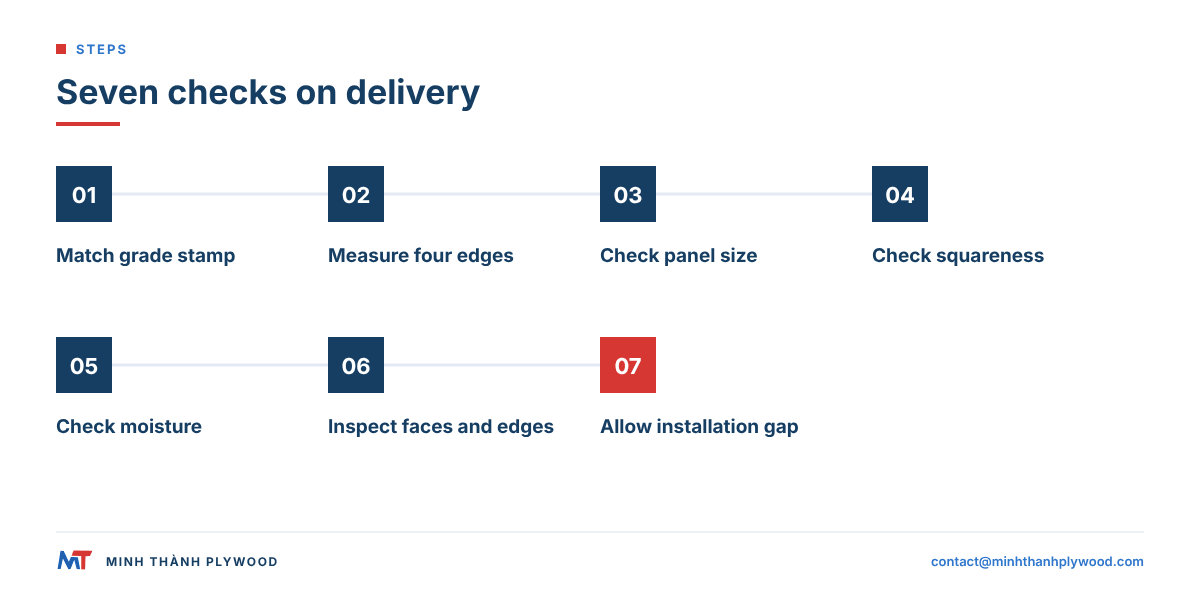
How to check construction plywood on arrival
Check stamps, thickness and moisture on a sample of sheets from several packs before the panels go to site.
- Stamp: every sheet carries the same grade, span rating, category, bond class, standard and mill number as the order.
- Thickness: measure mid-length on all four edges and average the readings; compare with the Performance Category range.
- Size: under PS 1-22, length and width may be up to 1.6 mm under the stated size, or 3.2 mm when marked sized for spacing, and never over.
- Squareness: within 1.3 mm per metre of the longest edge, measured on the diagonals.
- Moisture: PS 1-22 allows up to 18% at the time of shipment.
- Faces and edges: knotholes, splits and edge voids within the grade.
- Installation gap: tell the site to leave 1/8 inch between panels so they do not buckle as they take up moisture; APA publishes this as a builder tip, with design capacities in Forms D510 and Q225.
Photograph any sheet that fails with its stamp in the frame, and keep it apart from the rest.
How to order construction plywood
Order construction plywood by the stamp lines if you need a stamp, or by the full specification if you do not. Copy the line that fits:
PS 1-22 [Rated Sheathing], span rating [32/16], [15/32] Performance Category, [Exposure 1], [Structural I if required], agency mark and mill number on each sheet, [quantity], [port].
Exterior plywood, phenolic (WBP) bond, face/back C/D, core [Eucalyptus, stitched], [12] mm ± [0.5] mm, [1220 × 2440] mm, [quantity] sheets, [port].
For the second line, send it through our exterior plywood page. We reply within hours and send free samples.
Buyer questions, answered
What is construction grade plywood?
Construction grade plywood is plywood made and rated for structural jobs such as roof and wall sheathing, subfloors and concrete forms. It is bought on its span rating, thickness category and bond class rather than on face appearance.
What does Exposure 1 mean on plywood?
Exposure 1 is a bond classification for panels not permanently exposed to the weather. Under PS 1-22, the panel resists moisture during construction, but it should be covered by roofing or cladding once the building is closed in.
What is CAT rated sheathing?
CAT is short for Performance Category, the nominal thickness label on structural panels, such as 15/32 CAT or 7/16 PERF CAT. Each category has a minimum and maximum actual thickness set in PS 1-22.
What does 15/32 Structural 1 plywood mean?
It is a sheathing panel in the 15/32 Performance Category, about 11.1–12.7 mm thick unsanded, graded Structural I: all plies are Group 1 species and the panel is made for shear walls and engineered uses.
What does 32/16 mean on plywood?
It is the span rating: the panel may span 32 inches between roof supports and 16 inches between floor joists under normal loads. Local building codes set the actual maximum spans.
What is the difference between Exposure 1 and Exterior plywood?
Exterior panels resist repeated wetting and drying and long-term weather; Exposure 1 panels resist moisture only during construction. Exterior grades allow no D grade veneer; Exposure 1 grades do.
What is the thickness tolerance of construction plywood?
Under PS 1-22, unsanded and touch-sanded panels in Performance Categories up to 13/16 are ±0.8 mm; sanded panels up to 3/4 are ±0.4 mm.
Does imported plywood carry a PS 1 grade stamp?
Only if the mill is certified by an accredited certification agency for that product. A stamp printed without that certification is not a PS 1 mark, so ask for the agency and the mill number.
What does 'sized for spacing' mean on plywood?
It means the panel is made slightly undersize, up to 3.2 mm short of the stated length or width, so the recommended gap between panels can be left during installation.