
Our 4mm plywood is a five-ply sheet: a face, three core veneers and a back, pressed and sanded to 4 mm. At 1220 × 2440 mm it weighs about 6.0 kg on a white Styrax core and 7.7 kg on Eucalyptus. Minh Thanh Plywood makes it for drawer bottoms, cabinet backs and furniture skins that need more stiffness than 3 mm.
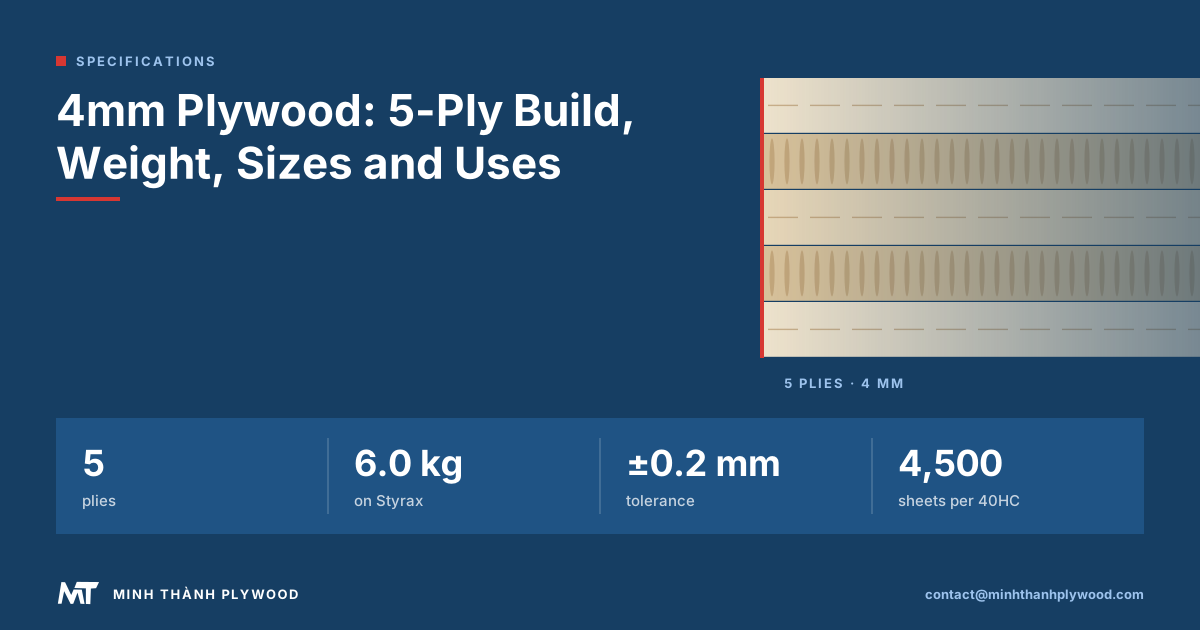
4mm plywood at a glance
4mm plywood is a thin plywood sheet with a nominal thickness of 4 mm, used where a part must be light and flat but stiffer than 3 mm. At our mill it is always five-ply, sanded on both faces, and made on a white Styrax or a Eucalyptus core.
| Line | Minh Thanh 4 mm furniture plywood |
|---|---|
| Build | 5 plies: face, three core veneers, back |
| Core | White Styrax (500 kg/m³) or Eucalyptus (650 kg/m³) |
| Sheet size | 1220 × 2440 mm or 1250 × 2500 mm; custom parent sizes; cut into 4, 6 or 8 pieces |
| Weight, 1220 × 2440 mm | about 6.0 kg Styrax, about 7.7 kg Eucalyptus |
| Thickness tolerance | ±0.2–0.3 mm sanded, down to ±0.2 mm |
| Length and width | ±2 mm |
| Glue and emission | UF glue at E0 emission; MR or WBP bond to order |
| UK and EU labels | EN 636-2 with an EN 314-2 Class 2 bond and E1 emission on the order; FSC on request |
| Raw FOB panel per 1220 × 2440 mm sheet | US$4.17 at US$350/m³ (October 2026) |
| Moisture at dispatch | 8–12 % |
UK DIY chains such as Wickes sell thin plywood in 3.6 and 5.5 mm, not 4 mm, in sheets of 2440 × 1220 mm and in handy panels of 606 × 1220 and 607 × 1829 mm cut from the parent sheet (Wickes, checked on 21 October 2026). A 4 mm order from us sits between them: pressed to 4 mm, in the same parent sheet, with the handy sizes cut to order.
Keighley Timber sells a 4 mm hardwood sheet (Keighley Timber, checked on 21 October 2026). A UK buyer compares against a spec line of that kind; write EN 636-2, EN 314-2 Class 2 and E1 on the order and we press to the bond class it names, with SGS testing to EN 717-1 on request. Our 3.6 mm guide covers the UK thickness.
The rest of this guide explains each line and what to write on the order. Buyers also search for “plywood 4 mm”, “4mm ply sheet”, “4mm plyboard” or the Swedish “plywood skiva 4mm”; they all mean the same panel.
How is 4mm plywood built?
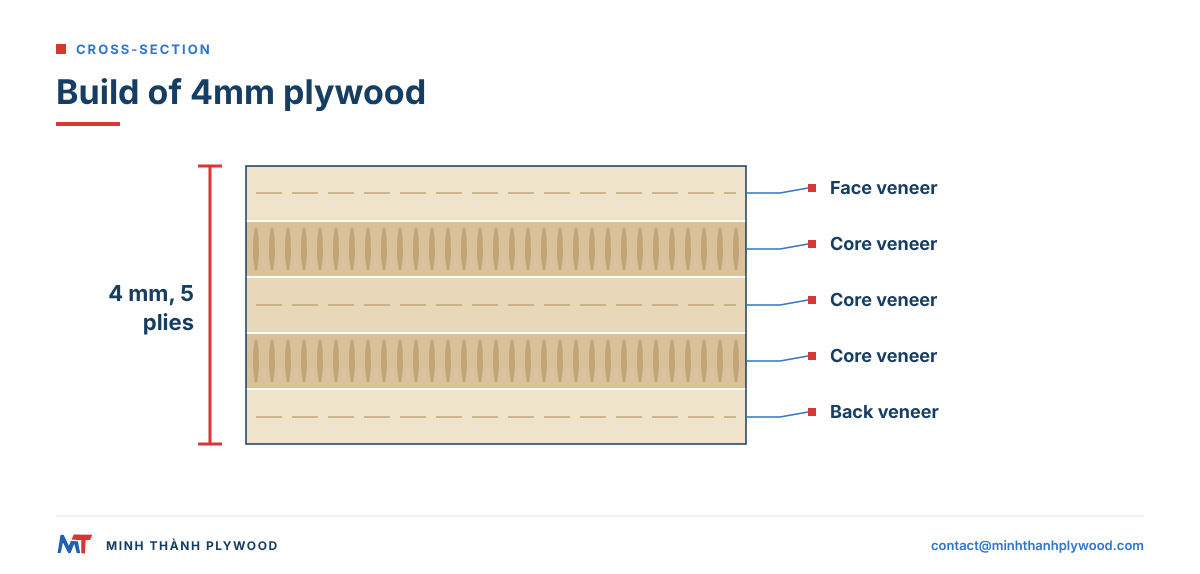
A 4 mm sheet from Minh Thanh has a face veneer, three core veneers and a back veneer, with each layer’s grain crossed to the next. One 4 mm furniture build uses three Styrax core veneers of about 1.3 mm before pressing; the press and the sander then bring the stack to the finished 4 mm.
The order of the grain is face along the length, first core across, centre core along, third core across, back along. That mirror-image build is what keeps the sheet flat when it is cut into parts. The 3 mm panel uses thinner cross-bands around one centre veneer instead; at 4 mm there is room for three full core veneers, which gives a stiffer centre.
Note that the 1.3 mm figure is an input veneer thickness, not a layer of the finished panel. The glue lines compress in the press, and calibration sanding takes the panel to its final caliper reading.
3-ply or 5-ply 4mm plywood: which should you buy?
Buy 5-ply when the sheet will be grooved, cut into narrow parts or coated on one face; 3-ply is a lower-cost option for packing inserts and hidden parts. Both are sold as “4mm plywood”, which is why the ply count belongs on the order.
| Point | 3-ply 4 mm | 5-ply 4 mm |
|---|---|---|
| Veneers | Three thicker veneers | Five thinner veneers |
| Flatness after cutting into parts | Lower: each veneer pulls harder | Higher: more balanced layers |
| Splitting along a groove | More likely | Less likely, two crossed layers hold it |
| Effect of one core defect | Shows through to the face | Bridged by the layers around it |
| Typical use | Packing inserts, hidden parts | Drawer bottoms, backs, visible furniture parts |
All our 4 mm furniture sheets are five-ply; we do not offer a 3-ply 4 mm furniture panel.
How much does a 4mm ply sheet weigh?
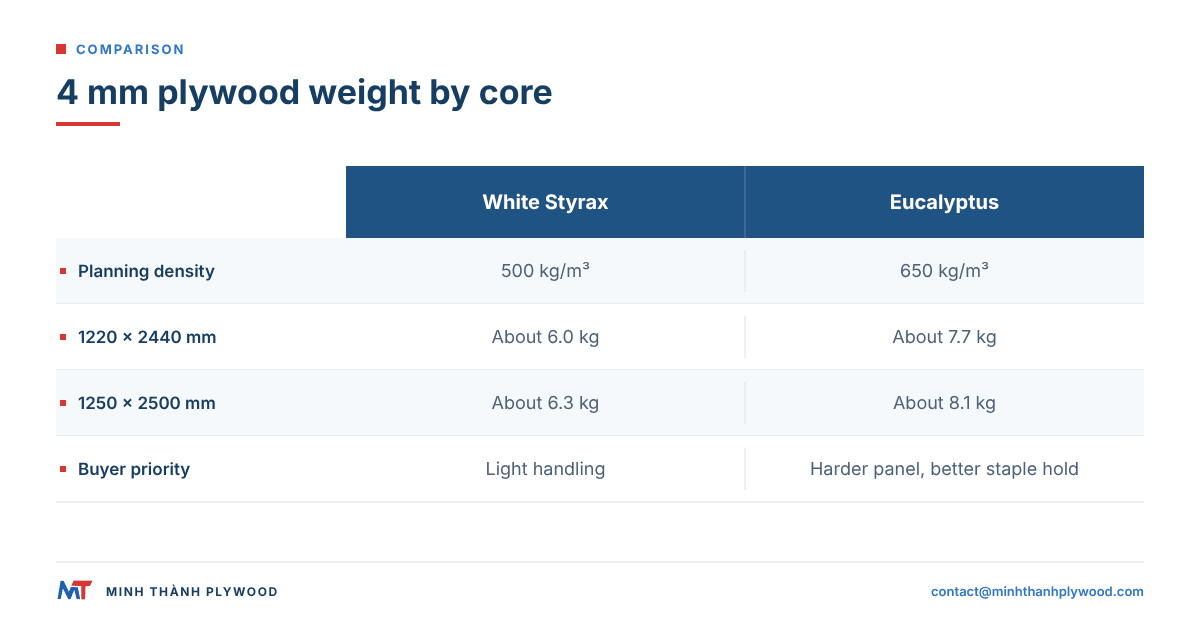
A 1220 × 2440 mm 4mm ply sheet weighs about 6.0 kg on a white Styrax core and about 7.7 kg on Eucalyptus. The sheet holds 0.0119072 m³ of wood (1.22 × 2.44 × 0.004 m), so one cubic metre is 83 whole sheets.
| Core | Planning density | Weight per sheet, 1220 × 2440 × 4 mm | Weight per 1250 × 2500 × 4 mm sheet |
|---|---|---|---|
| White Styrax | 500 kg/m³ | about 6.0 kg | about 6.3 kg |
| Eucalyptus | 650 kg/m³ | about 7.7 kg | about 8.1 kg |
The 1250 × 2500 mm weights follow the same rule: 1.25 × 2.5 × 0.004 = 0.0125 m³, times the density. Styrax suits flat-pack furniture and hand handling; Eucalyptus gives a harder panel with better hold for staples and small screws. Weighed packs, not the planning density, set the final loading figure.
Which faces and grades are made on 4mm plywood?
We lay more than ten face veneers. On 4 mm sheets buyers mostly order engineered veneer (EV), poplar, birch, okoume and pine; bintangor, eucalyptus, gurjan and sapele are made on request.
Birch faces use the Vietnamese grades D+, D and E (E the lowest, D+ the highest), quoted as pairs like D+/D. As a buying comparison, D+ is close to European grade B, D to BB and E to CP/C. Poplar and eucalyptus faces are quoted A/A, A/B or B/B. For a cabinet back seen only from inside, A/B or D/E is enough; for a door panel seen from both sides, order A/A or D+/D.
The 4 mm sheet is where face veneer supply is tightest. Good face veneer thin enough for a five-ply 4 mm build is scarce, so a 4 mm order can take longer than the usual production window. We source that veneer to the agreed grade rather than lowering the face to save time, and we ask for your delivery date with the first enquiry so veneer buying, sampling and the vessel can be planned together.
Which parts should be made from 4mm plywood?
Choose 4 mm when 3 mm flexes too much in the part but 6 mm adds weight and cost you do not need. Typical parts:
- Drawer bottoms for small and medium drawers, captured in grooves on all four sides. Clothing, linen and office drawers sit well on 4 mm.
- Cabinet and wardrobe backs on taller units, where a 3 mm back bows between fixings.
- Frame-and-panel door inserts, floating in a groove so the panel can move with the seasons.
- Interior skins over light frames for furniture fronts, partitions and display fittings.
- Laser and CNC parts: boxes, templates, signage and model kits that need a rigid, flat sheet.
- Furniture components cut to size, such as drawer dividers or shelf backs, supplied as finished rectangles.
For heavier drawers (tools, cutlery) or wider spans, move to 6 mm or add a centre rail; the 6 mm plywood guide covers that panel.
4mm vs 3mm vs 6mm plywood: how do you choose?
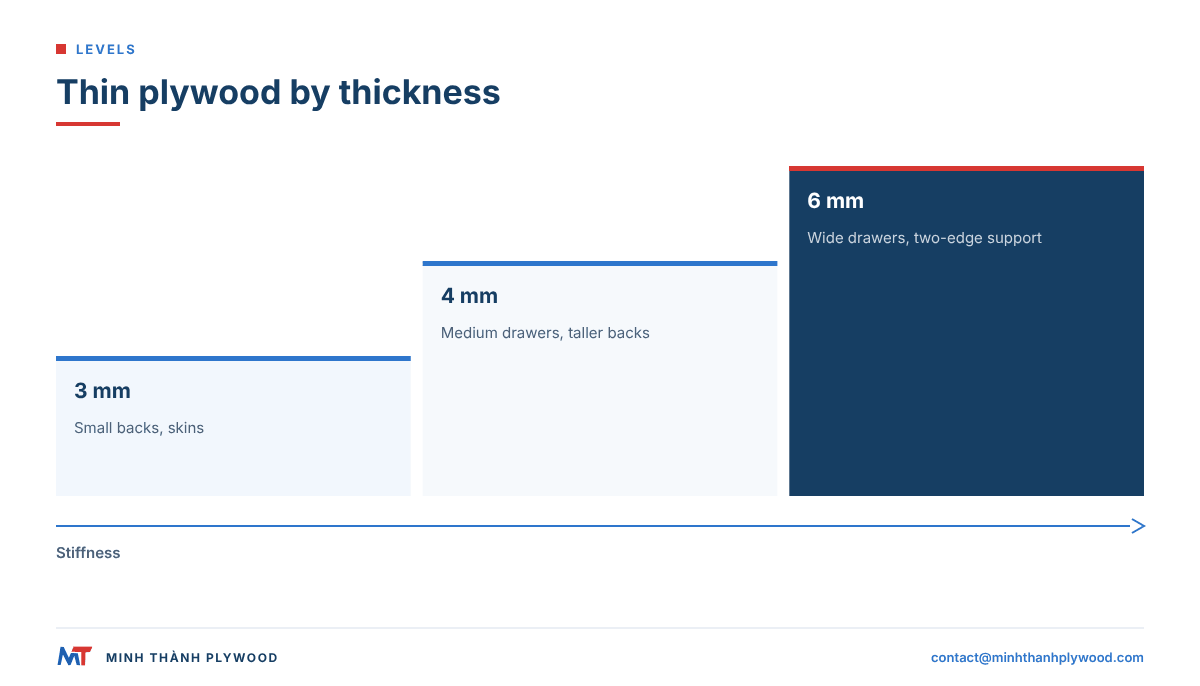
Start from how the part is supported. A part held on all four edges and carrying little load can be 3 mm; a taller back or a medium drawer needs 4 mm; a wide drawer or a part that spans on two edges only needs 6 mm.
| Thickness | Build at our mill | Weight, 1220 × 2440 mm on Styrax | Where it fits |
|---|---|---|---|
| 3 mm | Face, 2 cross-bands, 1 centre veneer, back | about 4.5 kg | Small backs and bottoms, skins |
| 4 mm | Face, 3 core veneers, back | about 6.0 kg | Medium drawers, taller backs, door inserts |
| 6 mm | Ply count confirmed with the order | about 8.9 kg | Wide drawers, parts supported on two edges |
The step from 3 to 4 mm adds a third of the wood and makes the sheet noticeably stiffer, because stiffness rises faster than thickness. Our 3 mm plywood guide covers the thinner sheet and its uses.
What tolerance should you order on 4mm plywood?
Order ±0.2 mm on thickness for parts that go into grooves, and ±0.2–0.3 mm for backs fixed into rebates. Length and width are held to ±2 mm. On a 4 mm sheet, ±0.2 mm means every reading falls between 3.8 and 4.2 mm.
The tolerance matters more on thin panels than on thick ones, because the groove is cut once for the whole run. We calibrate and sand both faces after pressing, then check thickness across each sheet before packing. A caliper reading on a sample sheet, such as 4.02 mm, is the number to compare with your groove cutter.
On receipt, measure five or six sheets per pack at the corners and mid-edges. If the readings sit inside the ordered tolerance, the groove setting can stay fixed for the whole delivery.
Is 4mm plywood safe for indoor furniture?
Yes. Our 4 mm furniture panels use UF glue at E0 emission and meet the emission and quality requirements European and US furniture buyers ask for. The proof is our CARB P2 / TSCA Title VI certification, ICTT mill no. 23024, for hardwood plywood with a veneer core from 3 to 50 mm.
Six third-party chamber tests to ASTM D6007, made between April 2025 and June 2026 on 9, 15 and 18 mm panels by Shanghai Hongjun and ICTT Vietnam, averaged 0.014–0.032 ppm. The limit for veneer-core hardwood plywood is 0.05 ppm under the California Air Resources Board composite wood rule and the US EPA formaldehyde standard for composite wood. The thin range uses the same resin, and E0 testing runs every three months.
For a European buyer who wants a test on the ordered thickness, SGS tests it to EN 717-1 on request. Glue type and emission class stay on separate lines of the order: UF, MR or WBP for the bond; E0 or CARB P2 for emission.
How many 4mm sheets fit in a 40HC container?
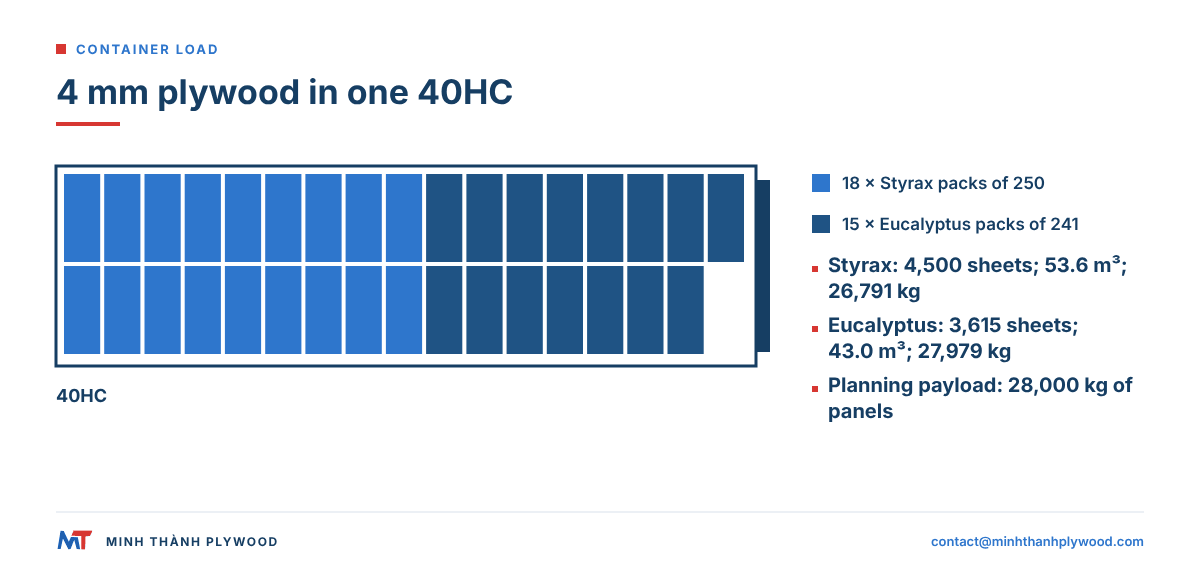
On our standard 40HC plan, 4,500 sheets of 1220 × 2440 × 4 mm fit on a Styrax core: 18 packs of 250, about 53.6 m³ and 26,791 kg of panels. On Eucalyptus the plan is 15 packs of 241, or 3,615 sheets, about 43.0 m³ and 27,979 kg, because the weight limit comes before the space limit.
| Core | Packs | Sheets per pack | Total sheets | Volume | Panel weight |
|---|---|---|---|---|---|
| White Styrax | 18 | 250 | 4,500 | about 53.6 m³ | 26,791 kg |
| Eucalyptus | 15 | 241 | 3,615 | about 43.0 m³ | 27,979 kg |
Each pack is about 1,000 mm of sheets, so a full pack holds 1,000 ÷ 4 = 250 sheets; the Eucalyptus packs are trimmed to stay inside a planning payload of 28,000 kg of panels. Packaging is added for the booking check, and a lower booking limit lowers the count. One container can mix 3, 4 and 6 mm packs by agreement; test your own mix with the packing calculator.
How much does 4mm plywood cost?
Furniture and interior plywood from Minh Thanh starts from US$350/m³ (October 2026), and one cubic metre is 83 sheets of 1220 × 2440 × 4 mm. The quote moves with the face species and grade, the core, the glue and emission class, the size, the quantity and the Incoterm.
| 4 mm sheet | Volume | Raw FOB panel at US$350/m³ | In pounds |
|---|---|---|---|
| 1220 × 2440 mm | 0.01191 m³ | US$4.17 | about £3.12 |
| 1250 × 2500 mm | 0.0125 m³ | US$4.38 | about £3.28 |
| 606 × 1220 mm | 0.00296 m³ | US$1.04 | about £0.78 |
| 607 × 1829 mm | 0.00444 m³ | US$1.55 | about £1.16 |
These are raw panel values per sheet, before freight, duty and margin; the pound figures use US$1.3345 to £1 (exchangerates.org.uk, 20 October 2026). UK importers pay 0% duty on Vietnamese plywood (UK Trade Tariff 4412339090, checked on 21 October 2026). VAT is 20%.
A cubic metre of 4 mm sheets carries far more face veneer, glue lines and sanding than a cubic metre of 18 mm, so the price per cubic metre of thin plywood is higher than that of thick panels. Compare offers per sheet as well as per cubic metre, and line up the ply count, face grade and tolerance before comparing totals.
Can 4mm plywood be cut to size, and to what tolerance?
Yes. We cut 4 mm sheets into 4, 6 or 8 pieces or to the part sizes you send, with length and width held to ±2 mm on the sheet. UK cut-to-size shops such as Cutmy hold a CNC tolerance of ±1 mm, accept parts down to 100 × 50 mm, and leave a 1.5 mm inside radius from their 3 mm router bit (Cutmy, checked on 21 October 2026). For a container order, cut at the mill when the same part repeats, and send a drawing with the part sizes, the grain direction and the radius of any inside corner.
How should 4mm plywood be stored and handled?
Keep 4 mm packs flat on level bearers spaced closely enough that the sheets do not sag, and leave the wrapping on until the pack is used. A thin sheet stood on edge or laid over two distant supports takes a bow that may not come out.
Our packs leave the mill on a pallet base with top and bottom covers, corner protection and steel straps, at 8–12 % moisture content. Every shipment is photographed and filmed before loading, and you receive the photos and video. On arrival, let the packs settle in the workshop before cutting, and coat both faces evenly so the panel stays balanced.
What to write on a 4mm plywood order
Send these seven lines with your enquiry, and the quote will describe exactly the panel you will receive.
- Application: “drawer bottom, captured in grooves, 450 mm wide drawer”.
- Build and core: “4 mm, 5-ply, white Styrax core”.
- Glue and emission: “UF glue at E0 emission, CARB P2 / TSCA Title VI”.
- Face and back: “poplar A/B” or “birch D/E”, matched to the approved sample.
- Size and tolerance: “1220 × 2440 mm, ±0.2 mm, sanded both sides”, or the cut size.
- Packing and quantity: sheets per pack, total sheets, mixed thicknesses.
- Port and Incoterm: FOB Hai Phong, CFR or CIF to your port.
The minimum order is one 40HC, mixed specifications by agreement. Production is 15–45 days after the 30 % deposit, and longer on 4 mm when premium face veneer has to be sourced. The balance of 70 % is paid against the scanned B/L, or by irrevocable L/C at sight. Free samples are sent before the order.
Buyer questions, answered
How many layers does 4mm plywood have?
Our 4mm plywood has five layers: a face veneer, three core veneers and a back veneer, with the grain of each layer crossed to the next. 3-ply 4 mm sheets also exist in the market, so ask for the ply count in writing.
How much does a 4mm plywood sheet weigh?
A 1220 × 2440 × 4 mm sheet holds 0.0119 m³ of wood. It weighs about 6.0 kg on a white Styrax core (500 kg/m³) and about 7.7 kg on a Eucalyptus core (650 kg/m³).
What is 4mm plywood used for?
Drawer bottoms, cabinet and wardrobe backs, door panels in frames, interior skins, display parts and laser or CNC parts. It suits parts held by a groove, rebate or frame that need more stiffness than 3 mm.
Is 4mm plywood the same as 5/32 inch?
Near enough: 5/32 inch is 3.97 mm. Sheets sold in North America as 1/4 inch are usually thicker, about 5.2–6 mm, so order by millimetres and tolerance.
What size is a 4mm plywood sheet?
Standard sheets are 1220 × 2440 mm (8 x 4 ft) and 1250 × 2500 mm. A 2440 × 1220 mm order is the same sheet; custom parent sizes and cutting into 4, 6 or 8 pieces are available.
Is 4mm plywood strong enough for drawer bottoms?
Yes for small and medium drawers with the bottom captured in grooves on all four sides. For wide drawers or heavy contents choose 6 mm, or add a centre rail.
Why does 4mm plywood take longer to produce?
Good face veneer thin enough for a 4 mm five-ply build is scarce. We buy that veneer to the agreed grade rather than lowering the face standard, so tell us the delivery date with the first enquiry.
How many 4mm plywood sheets fit in a 40HC?
On our 40HC plan, 4,500 sheets of 1220 × 2440 × 4 mm on Styrax (18 packs of 250), about 53.6 m³ and 26,791 kg of panels. On Eucalyptus the plan is 3,615 sheets in 15 packs of 241.
What is 4mm plyboard?
In South Asian and Middle Eastern trade, plyboard often means plywood. A 4mm plyboard order is a 4 mm plywood sheet; check whether the seller means veneer plywood or a blockboard with a solid-wood core.
What glue is in 4mm furniture plywood?
UF glue at E0 emission is our standard for furniture and interior 4 mm panels; melamine-fortified and phenolic (WBP) bonds are made to order for humid uses.