
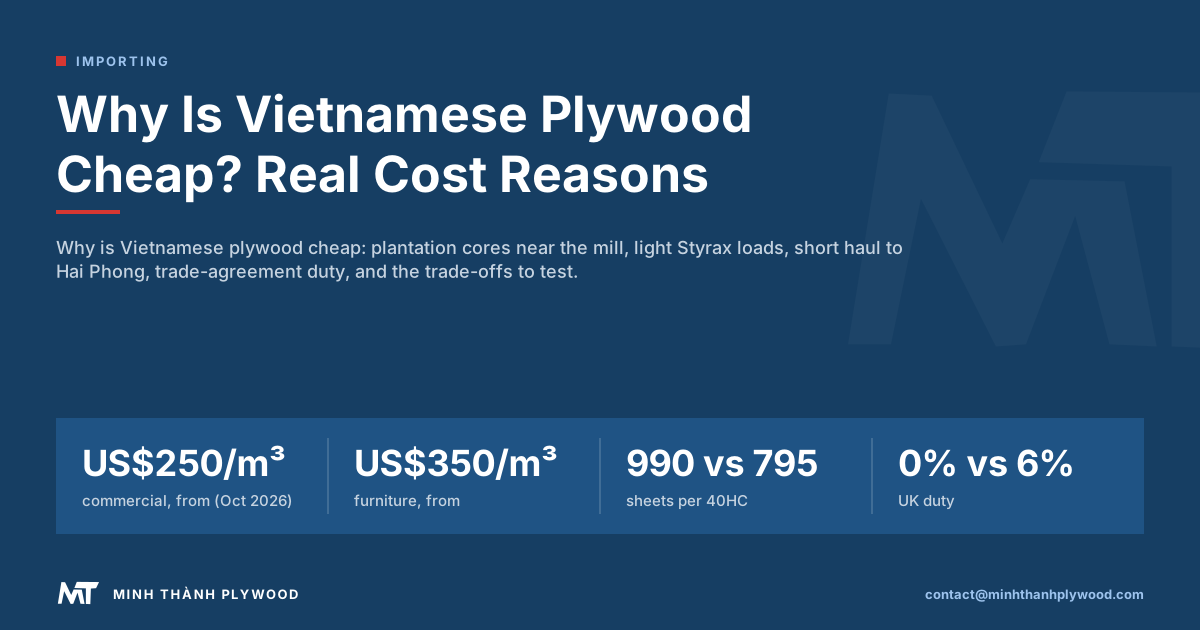
Vietnamese plywood costs less because its cores are peeled from plantation acacia, eucalyptus and Styrax grown near the mills, labour and mill overheads are lower than in Europe, light cores fit more sheets into a container, and trade agreements cut the duty in markets such as the UK. Minh Thanh Plywood quotes furniture plywood from US$350/m³ FOB; the lower price is real, as long as core, glue and tolerance are written into the order.
Why is Vietnamese plywood cheap?
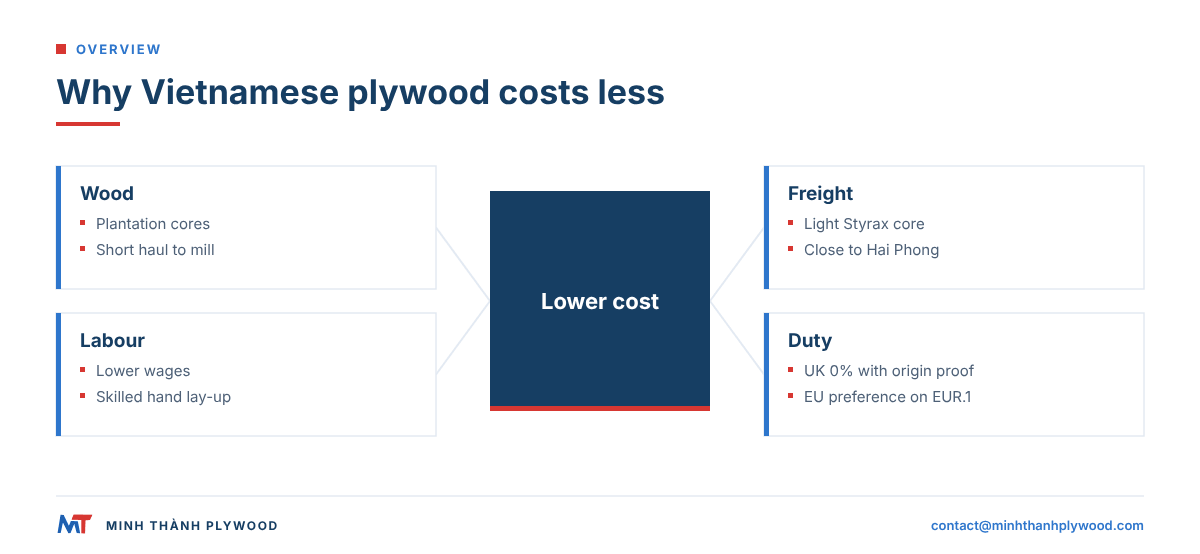
Vietnamese plywood is cheap because plantation wood, labour and overheads, freight per sheet, port access and duty are all lower at once, and none of them needs a weaker panel. The risk is an order that leaves core, glue or tolerance unwritten, so a low price can be met with a lower specification.
The five costs are:
- Wood: core veneer is peeled from plantation acacia, eucalyptus and white Styrax grown close to the mills.
- Labour and overheads: wages, land and energy cost less than in Europe, and lay-up is still done by skilled hands.
- Freight per sheet: light Styrax cores fit more sheets into a 40HC before the payload is reached.
- Port access: northern mills truck their containers to Hai Phong, one of Vietnam’s main deep-water ports.
- Duty: trade agreements with the UK, the EU and Asian partners lower or remove duty with origin proof.
The sections below take each cost reason, then the trade-offs to test.
How do plantation cores lower the cost of Vietnamese plywood?
Plantation cores lower the cost because the timber grows in the same provinces as the mills, so veneer reaches the lay-up line after a short truck ride instead of an ocean crossing. Core veneer makes up most of a panel’s volume, so its price sets most of the panel’s price.
Northern Vietnam’s plywood belt, around Phu Tho, Yen Bai and Tuyen Quang, is surrounded by acacia, eucalyptus and Styrax plantations. Smallholders and forestry companies grow the trees in short rotations, then sell logs to peeling workshops that turn them into core veneer.
The scale is real: Vietnam has roughly 4.74 million hectares of plantation forest, and its plywood exports were worth an estimated US$1.1–1.2 billion in 2024 (Vietnam Plywood industry overview). A supply base that size is why mills can buy core veneer by the truckload instead of by the import.
Minh Thanh’s factory in Ha Hoa, Phu Tho, sits inside that supply: our cores come from plantation timber grown around Ha Hoa. Core veneer is dried, measured and sorted on arrival; splits, holes, soft wood and damp sheets are taken out before lay-up. We supply the EUDR compliance dossier, with origin records and geolocation files, so the short supply chain is documented too.
Do labour and mill costs make Vietnamese plywood cheaper?
Yes. Wages, land and energy in rural northern Vietnam cost less than in European or North American plywood regions, and that lowers the cost of every step that needs people.
Plywood still needs many hands. Cores are laid by hand on the lay-up line, gaps and overlaps are fixed before the glue, open face defects are filled before sanding, and every pack is graded by eye. A skilled workforce doing these steps well is part of what the price buys.
The trade-off: labour cost only lowers the price if the steps are still done. A mill that skips the second pressing or the gap repair saves money in a way that shows up later in your workshop. Our furniture panels are pressed twice, with the core board pressed and calibrated before the face and back go on.
How does a light Styrax core cut freight per sheet?
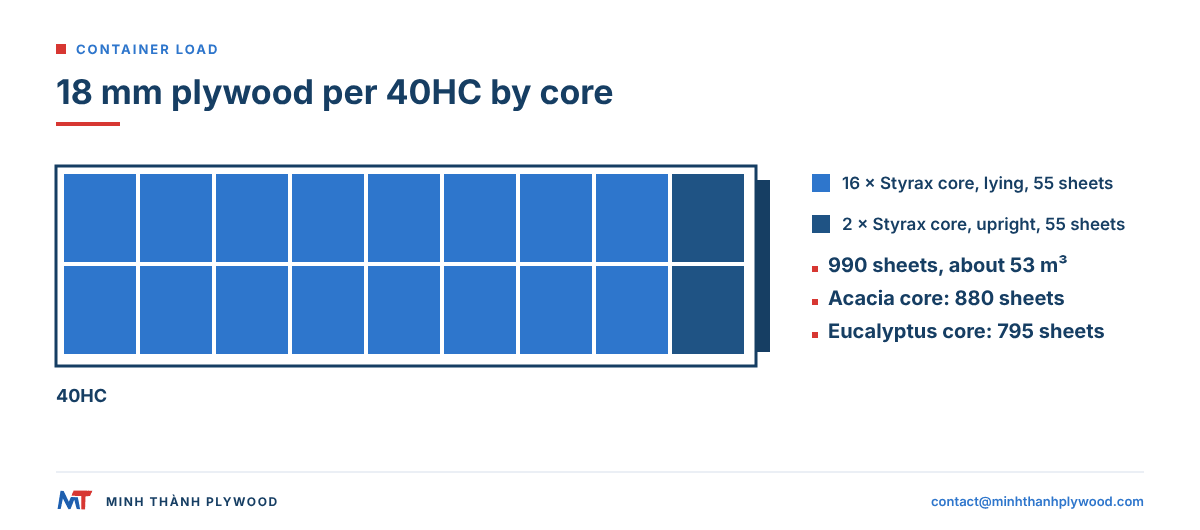
A light core cuts freight per sheet because a 40HC reaches its weight limit later, so the same container fare is shared by more sheets. This is a cost reason few buyers count, and it can be worth more than a few dollars off the FOB price.
| 18 mm, 1220 × 2440 mm | Core density | Sheets per 40HC | Volume | Sheet weight |
|---|---|---|---|---|
| White Styrax core | 500 kg/m³ | 990 | about 53 m³ | 26.8 kg |
| Acacia core | 580 kg/m³ | 880 | about 47 m³ | 31.1 kg |
| Eucalyptus core | 650 kg/m³ | 795 | about 43 m³ | 34.8 kg |
With a white Styrax core, one 40HC carries 990 sheets instead of 795 on Eucalyptus: 195 more sheets on the same freight bill. The plan uses packs about one metre high, capped by weight at a planning payload of 28,000 kg unless the booking is lower. Our packing calculator gives the count for other thicknesses.
Styrax and Eucalyptus are our two standard furniture cores; Acacia and Pine cores are made on order. Choose the core for the use: Styrax for light cabinet and furniture panels, Eucalyptus where a denser, harder core is wanted.
How do Hai Phong and sea transit affect the price?
Northern mills ship through Hai Phong, so inland haulage is short and the container goes straight onto the main shipping routes. That keeps the cost between the mill gate and the vessel low.
Typical days at sea from Hai Phong, by carrier and route:
| Destination | Days at sea |
|---|---|
| South-East Asia | 5–12 |
| Japan and Korea | about 2–3 weeks |
| Middle East | 15–25 |
| US West Coast | 20–30 |
| Mediterranean | 25–35 |
| Northern Europe | 30–40 |
| US East Coast | 35–45 |
| West Africa | 35–50 |
Transit time is money tied up in stock. A buyer in Northern Europe pays for about five weeks at sea on top of production, so regular mixed containers usually cost less than occasional rush orders. We quote FOB Hai Phong, CFR or CIF; the trade terms page shows what each includes.
How do trade agreements lower the duty on Vietnamese plywood?
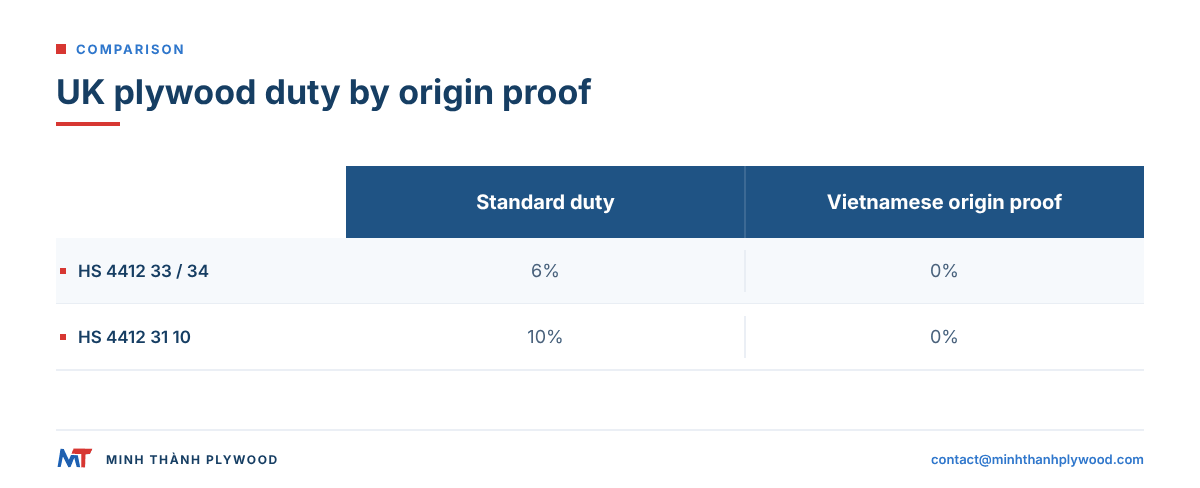
Trade agreements lower the duty because they give Vietnamese-origin plywood a preferential rate, often 0%, when the importer presents valid origin proof. The UK shows the effect clearly.
| Market | Standard plywood duty | Vietnamese origin with origin proof |
|---|---|---|
| United Kingdom, most lines (HS 4412 33, 4412 34) | 6% | 0% from 1 January 2025 |
| United Kingdom, some tropical-faced lines (4412 31 10) | 10% | 0% from 1 January 2025 |
Rates from the UK Trade Tariff, checked 20 October 2026. The EU-Vietnam Free Trade Agreement gives a preferential rate on an EUR.1 certificate of origin, and Vietnam’s agreements with Asian partners, including CPTPP and RCEP, do the same where plywood is covered.
Duty is never the reason to choose a panel; the panel has to suit the job first. But on a like-for-like specification, a 6% duty difference is part of the price. Minh Thanh supplies the EUR.1 for EU orders, and the certificate of origin for other markets, with the shipping documents. The import duty on plywood from Vietnam guide lists more destinations.
Does the price edge hold for the United States?
Not on hardwood and decorative plywood, and a buyer shipping to the US should price that in before comparing quotes. On July 16, 2026, Commerce announced its final determinations: a Vietnam-wide antidumping margin of 90.12 percent (cash deposit 84.95 percent after subsidy offsets) on Vietnamese hardwood and decorative plywood, and countervailing duty of 47.68 percent for most Vietnamese producers (Commerce announcement), after which the ITC voted that the US industry was injured (Wiley). Structural panels, phenolic film-faced formwork, flooring and ready-to-assemble furniture sit outside the scope, so check your product against the written scope.
The cost reasons above hold in the markets where Vietnamese origin still carries a preferential rate: the UK at 0% with origin proof, and the EU with an EUR.1 certificate. Europe is our main market for that reason, and it is where a Vietnamese furniture panel costs least on a landed basis.
What does Vietnamese plywood cost in 2026?
Minh Thanh’s indicative starting prices in October 2026 are from US$250/m³ for commercial plywood and from US$350/m³ for furniture and interior plywood, FOB Hai Phong.
Per sheet, that is about US$13.40 for an 18 mm commercial sheet of 1220 × 2440 mm and about US$18.75 for an 18 mm furniture sheet, at the port of loading. The final price depends on face, core, glue, thickness, size, quantity and delivery term, so these are starting points, not a price list.
The Vietnam plywood price guide sets out FOB ranges in more detail, and the plywood price guide converts m³ prices into sheet prices for any thickness.
Which specification fields move the price of Vietnamese plywood?
Seven fields move the price: face, core, glue, thickness, size, quantity and delivery term. Vietnam’s cost advantage sits mainly in the core and the freight; the faces and glue cost much the same anywhere.
| Field | Where Vietnam’s cost advantage shows | What to fix in the order |
|---|---|---|
| Face | Little: imported birch or okoume costs the same anywhere; EV and eucalyptus faces cost less | Species and grade pair, matched to the approved sample |
| Core | Large: plantation acacia, eucalyptus and Styrax near the mills | Core species, stitched layers, no open gaps |
| Glue and emission | Little: resin prices follow world markets | Glue type and emission class, named separately |
| Thickness and tolerance | Some: skilled sanding at lower cost | Thickness and tolerance in mm |
| Size | Little | 1220 × 2440 mm or the custom size |
| Quantity | Some: container loads and mixed specifications | One 40HC; specifications per container |
| Delivery term | Some: short haul to Hai Phong | FOB, CFR or CIF and the port |
Fix each field in writing, and two Vietnamese quotes become comparable. Leave one open, and the lower quote may be the lower specification.
What trade-offs should a buyer test in low-priced plywood?
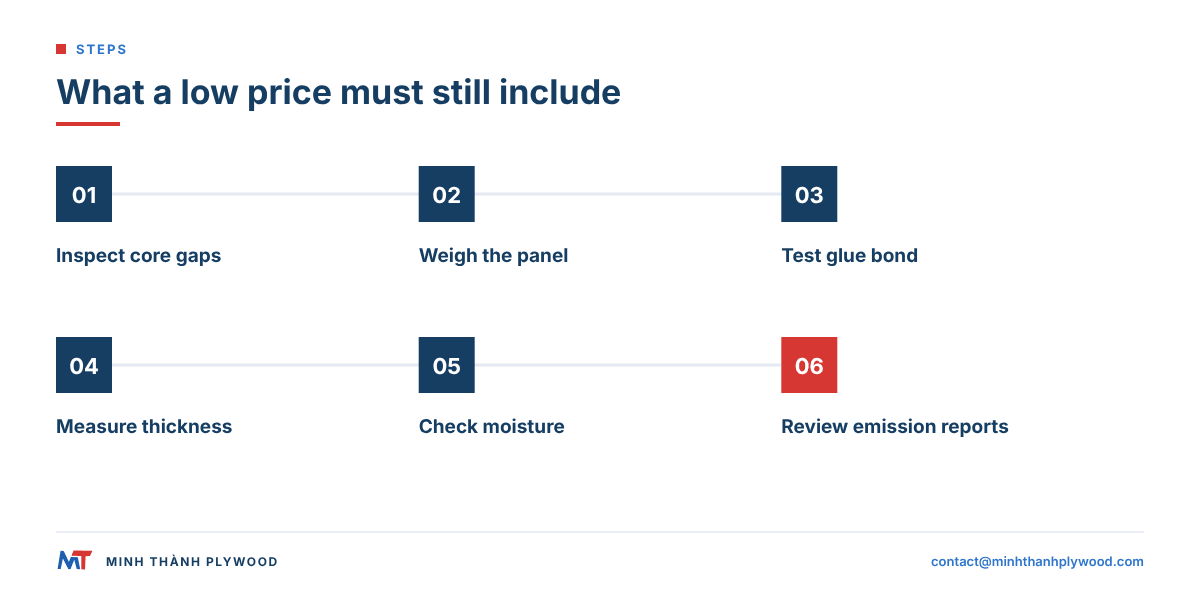
Test the fields a low price can hide: core, glue, tolerance, moisture and emission. Each one is cheap to cut and expensive to discover after delivery.
- Core gaps and overlaps: cut a sample sheet across and look at the edge.
- Mixed or heavy core: weigh a sheet; at 18 mm, a Styrax-core sheet weighs about 26.8 kg and a Eucalyptus-core sheet about 34.8 kg.
- Glue: boil-test a piece; UF glue at E0 emission holds about 6 hours, melamine-fortified about 12.
- Thickness tolerance: caliper several sheets; furniture panels should sit within ±0.2–0.3 mm.
- Moisture: 8–12% at dispatch for furniture plywood.
- Emission: a certificate and chamber test reports with laboratory, method and date.
Our quality control page shows how each of these is checked at the plant, and the pre-shipment checklist gives a pass limit for each.
Is plywood cheaper in Vietnam or China, or in Indonesia?
At FOB level, similar grades from Vietnam and China are priced close together; the landed price usually differs more than the FOB price, because duties differ by market. Indonesia is known for tropical hardwood plywood, with its own cost structure.
| Origin | Typical core | What moves the landed price |
|---|---|---|
| Vietnam | Plantation acacia, eucalyptus, white Styrax | Preferential duty with origin proof in the UK and EU; light Styrax loads |
| China | Poplar in the north, eucalyptus in the south | EU anti-dumping duty on hardwood plywood; US duty orders |
| Indonesia | Tropical hardwoods, plus plantation species | Denser cores, heavier sheets per container |
In the EU, Regulation (EU) 2025/2333 sets anti-dumping duty on hardwood plywood from China of up to 86.8%. The Vietnam vs China plywood and Vietnam vs Indonesia plywood guides compare the three line by line.
Is plywood cheaper than OSB, MDF or drywall?
Usually not: OSB, MDF and drywall generally cost less per sheet than plywood of the same thickness. Plywood earns its price where strength, low weight, screw holding and edge stability matter.
| Material | Price against plywood | Where plywood is the better choice |
|---|---|---|
| OSB | Usually lower | Furniture, visible surfaces, screwing near edges |
| MDF | Usually lower than furniture plywood | Light carcasses, shelves under load, humid rooms |
| Drywall | Lower for wall lining | Walls that carry shelves, cabinets or fixings |
| Particleboard | Lower | Long spans, repeated assembly, edge screws |
For packing, plywood often wins on the job’s total cost: a thinner plywood panel replaces a thicker board, and crates weigh less to ship. That is where cost-effective plywood from Vietnam competes best.
Who buys cost-effective packing plywood from Vietnam?
Industrial packaging makers, crate and pallet builders and export packers buy packing plywood from Vietnam by the container. They use it for crates, pallet decks, boxes and protective covers, where thickness tolerance and weight matter more than face appearance.
Minh Thanh makes packing plywood held to ±0.5–1.0 mm and commercial plywood to ±0.5 mm, with faces graded for packing use, and quotes commercial plywood from US$250/m³ FOB. For a packaging plant in the Netherlands or elsewhere in Northern Europe, a mixed container of two or three thicknesses fits one order, with about 30–40 days at sea from Hai Phong.
The packing plywood page lists thicknesses and grades.
How do you get the lowest price on Vietnamese plywood without losing quality?
Get the lowest price by setting each field to what the use needs, no more and no less. Six moves keep the price down and the panel right:
- Grade the back to its use: A/B instead of A/A, or D+/D instead of D+/D+, when the back is hidden.
- Pick the light core where weight and freight count: white Styrax loads 990 sheets of 18 mm per 40HC.
- Set the tolerance by use: ±0.2 mm for CNC furniture, ±0.5 mm for commercial work.
- Order full containers and combine specifications in one load.
- Use the trade-agreement rate: ask for the right origin proof with the order.
- Keep the approved sample so repeat orders need no new trials.
What not to cut: the stitched core, the second pressing and the emission proof. They cost little per sheet and decide whether the panel works.
What should you send to get a quote from a Vietnamese mill?
A quote is only as precise as the request, so write the seven price fields into one line per item, with the quantity and the port of discharge:
18 mm furniture plywood, 1220 × 2440 mm, eucalyptus face A/B, white Styrax core, UF glue at E0 emission, sanded ±0.2 mm, export packing, one 40HC, CIF Rotterdam.
Mention what the panels are for and any second item for a mixed container; free samples come with the quote on request. Send it to contact@minhthanhplywood.com or through the quotation form; we reply within hours. The furniture plywood from Vietnam page shows the faces, cores and grades.
Buyer questions, answered
Why is Vietnamese plywood cheap?
Its cores come from plantation acacia, eucalyptus and Styrax grown near the mills, wages and mill overheads are lower than in Europe, light cores load more sheets per container, and trade agreements lower the duty in markets such as the UK and the EU.
Is Vietnamese plywood good quality?
It can be top grade or packing grade; the price follows the specification. A furniture panel with a stitched core, UF glue at E0 emission and ±0.2 mm sanding is a different product from a packing board at ±1.0 mm, even from the same country.
How much does plywood cost in Vietnam?
Minh Thanh's indicative starting prices in October 2026 are from US$250/m³ for commercial plywood and from US$350/m³ for furniture and interior plywood, FOB Hai Phong. The final price depends on face, core, glue, thickness, size, quantity and delivery term.
Is plywood cheaper in Vietnam or China?
FOB prices for similar grades sit close together. The landed price often differs more than the FOB price, because duties on Chinese plywood are higher in some markets, such as the EU's anti-dumping duty on Chinese hardwood plywood.
Is plywood cheap?
Per square metre, commercial plywood is one of the lower-cost sheet materials for its strength, and packing plywood costs less still. Furniture plywood with selected faces and tight tolerance costs more, because faces, core and sanding add value.
Is OSB cheaper than plywood?
Usually, yes, for the same thickness: OSB is made from wood strands rather than peeled veneer. Plywood holds screws near edges better and keeps a smoother face, which is why furniture and cabinet makers use plywood.
Is MDF cheaper than plywood?
MDF usually costs less per sheet than furniture plywood of the same thickness. It is heavier, weaker in screw holding and swells when wet; plywood is chosen where strength, weight and edge stability matter.
Who supplies cost-effective packing plywood from Vietnam?
Minh Thanh makes packing plywood for crates, pallets and industrial packaging, held to ±0.5–1.0 mm, from one 40HC with mixed specifications by agreement, and quotes commercial plywood from US$250/m³ FOB.
Does cheaper plywood mean higher formaldehyde emission?
Not necessarily; emission follows the glue and the test, not the price. Ask for the certificate and chamber test reports. Minh Thanh's six ASTM D6007 tests averaged 0.014–0.032 ppm against the 0.05 ppm CARB Phase 2 limit.
How long does Vietnamese plywood take to arrive?
Production takes 15–45 days after the deposit. Days at sea from Hai Phong run from 5–12 for South-East Asia to 30–40 for Northern Europe and 35–45 for the US East Coast, by carrier and route.