
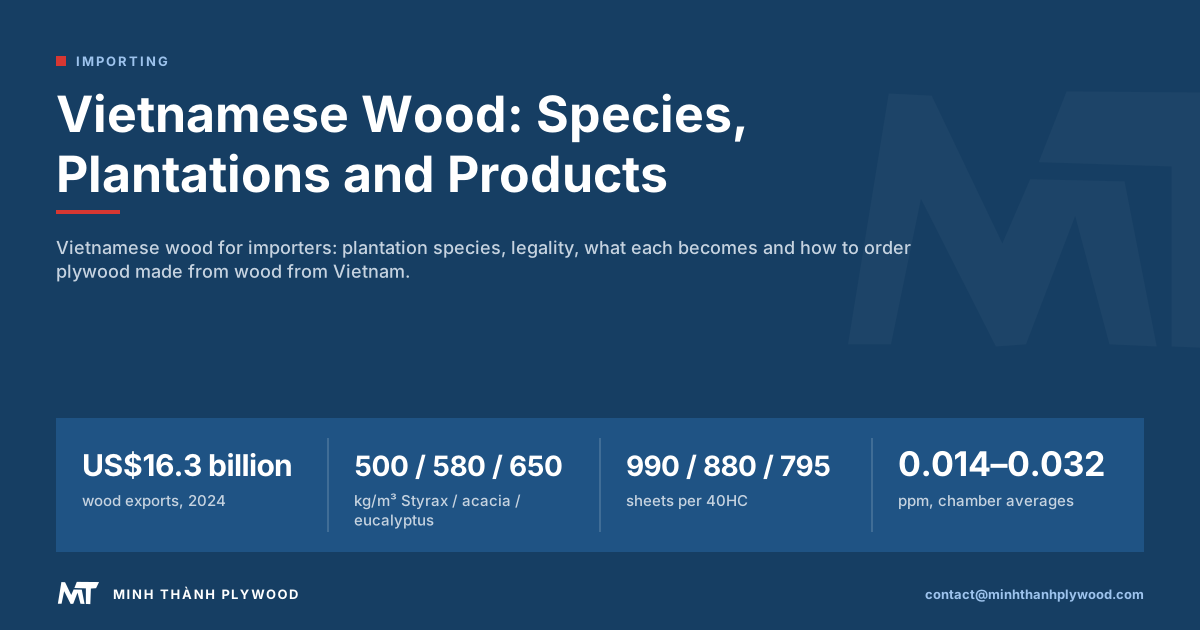
Most Vietnamese wood sold abroad today is plantation timber: acacia, eucalyptus, Styrax, rubberwood and pine, peeled into veneer, sawn for furniture or chipped for pulp. Vietnam's wood and wood products exports reached about US$16.3 billion in 2024. Minh Thanh Plywood, a furniture plywood factory in Phu Tho, explains each species, what it becomes, how legality is proved and how to order panels built from it.
What kind of wood comes from Vietnam?
Vietnamese wood sold abroad is mostly plantation timber. Five species groups carry the export trade: acacia, eucalyptus, Styrax, rubberwood and pine. They are grown on short rotations by households, cooperatives and companies, then peeled into veneer, sawn into furniture parts or chipped for pulp.
A second stream is imported wood. Vietnamese furniture factories buy oak, ash, walnut, pine and other timbers from abroad, machine them in Vietnam and export them as finished furniture. That furniture is “made in Vietnam”, but the wood is not Vietnamese.
For a buyer, the distinction is practical:
- Plantation wood from Vietnam goes into plywood cores, LVL, packing, pallets, chips, pellets and lower-cost furniture parts.
- Imported wood in Vietnam goes mainly into higher-end solid-wood furniture.
- Imported face veneers such as birch, okoume and some poplar are glued onto Vietnamese cores to make faced plywood.
So when someone asks what wood in Vietnam is used for plywood, the answer is narrow: acacia, eucalyptus and Styrax cores, with rubberwood as a niche core in the south and pine on order. Everything else on the face is a choice of veneer.
How big is the Vietnamese wood industry?
The Vietnamese wood industry is one of the country’s largest export sectors. Forestry exports set a record of US$17.3 billion in 2024, up 19.4 per cent on 2023, and wood and wood products made up about US$16.3 billion of that (Vietnam News, December 2024).
Three figures from the same 2024 government report frame the scale:
| Indicator, 2024 | Figure | Source |
|---|---|---|
| Forestry exports | US$17.3 billion, up 19.4% | Government news portal |
| Wood and wood products exports | About US$16.3 billion | Vietnam News |
| Share of the United States in exports | Over 55% | Vietnam News |
| Newly planted forest | Over 270,000 ha | Government news portal |
Behind the totals sit thousands of companies, from large furniture exporters in the south to veneer and plywood mills near the plantations in the north and centre. Plywood is a smaller line than furniture, but it uses the same plantation wood and feeds many of the same furniture factories at home and abroad.
What drives the growth is plain from the mills: plantation wood that can be replanted after each harvest, a large workforce skilled in veneer and furniture work, ports such as Hai Phong close to the northern plantations, and trade agreements that give Vietnamese wood products access to the EU and other markets. For an importer, the size of the industry also means choice. There are mills for every grade, from cost-effective packing panels to sanded furniture plywood built for Europe.
Where does wood in Vietnam grow?
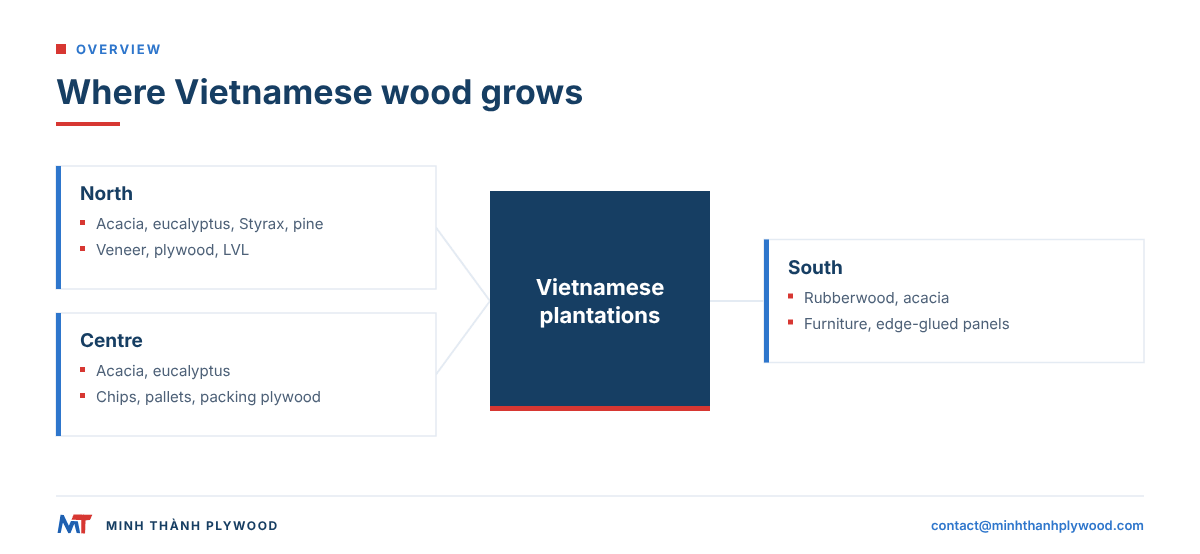
Wood in Vietnam grows in three broad plantation belts, and each feeds a different kind of mill. Knowing the belt tells you which species a supplier can source locally and which it must buy in.
| Region | Main plantation species | Typical mills | What they make for export |
|---|---|---|---|
| Northern midlands and uplands (Phu Tho, Yen Bai, Tuyen Quang and neighbours) | Acacia, eucalyptus, Styrax, pine | Veneer peelers, plywood and LVL mills | Furniture plywood, commercial and film-faced plywood, LVL, veneer |
| Central coast and highlands (around Binh Dinh and Quang Ngai) | Acacia, eucalyptus | Chip mills, sawmills, plywood and pallet plants | Chips, pallets, commercial and packing plywood, furniture parts |
| South and south-east (Binh Duong, Dong Nai and neighbours) | Rubberwood, acacia | Furniture factories, edge-glued panel plants | Furniture, rubberwood panels, some plywood |
The north is where Styrax grows, which is why white-core furniture plywood comes from northern mills. The hills around Ha Hoa in Phu Tho, where our factory stands, are planted with Styrax and eucalyptus, so our core veneer travels a short distance from plantation to press.
The centre grows large volumes of acacia and eucalyptus close to deep-water ports, and much of its wood leaves as chips or pallets. Its plywood mills tend to make commercial and packing grades.
The south holds the big furniture clusters. Many of them work with imported timber or rubberwood rather than plantation veneer, and they buy plywood from northern and central mills for carcasses and backs.
For a plywood buyer, the practical rule is simple: buy each core from the region that grows it. A mill that peels its own local veneer controls moisture, grading and lead time better than one that trucks veneer across the country.
Vietnamese wood species at a glance
This table lists the main species of Vietnamese wood, where they grow, how they are sourced and what they become. It is the reference the rest of this guide builds on.
| Species (scientific name) | Where it grows | Source | What it becomes | In our plywood |
|---|---|---|---|---|
| Acacia (Acacia mangium, A. auriculiformis and their hybrid) | Nationwide, strongest in the north and centre | Plantation | Veneer, plywood and LVL cores, chips, pallets, furniture parts | Core on order |
| Eucalyptus (mainly Eucalyptus urophylla) | North and centre | Plantation | Veneer, dense plywood cores, film-faced and packing panels, chips | Standard core; also a face veneer |
| Styrax (Styrax tonkinensis) | Northern midlands only | Plantation | White, light veneer for furniture plywood cores | Standard core |
| Rubberwood (Hevea brasiliensis) | South and south-east | Plantation, after latex tapping ends | Furniture, edge-glued panels, a niche plywood core | Not used |
| Pine (Pinus species) | Northern and central uplands | Plantation | Sawn timber, pine veneer and panels | Core on order; pine faces |
| Imported hardwoods and softwoods | Abroad | Imported logs and sawn timber | Solid-wood furniture | Not used as Vietnamese wood |
Two points surprise many importers. Vietnam has no poplar or birch cores: those are face veneers only. And Styrax grows only in the north, so a mill selling “white Styrax core” from elsewhere is buying in its veneer.
Imported wood in Vietnamese furniture
Imported wood is the other half of the Vietnamese wood story, and buyers of furniture meet it more often than plywood buyers do. Vietnam’s furniture factories buy logs and sawn timber of oak, ash, walnut, white pine, beech and other species from North America, Europe, Africa and elsewhere, then machine, assemble and finish them in Vietnam.
For a buyer, three things follow:
- Origin on the label is not origin of the wood. A chair made in Vietnam from American white oak is Vietnamese furniture of US-grown wood; the EUDR and Lacey Act declarations follow the tree, not the factory.
- Documents come from two countries. The furniture maker needs its supplier’s harvest and export documents as well as its own production records.
- Plywood inside the furniture is often Vietnamese. Carcasses, backs, drawer bottoms and frames of imported-wood furniture are frequently plantation-core plywood made in Vietnam.
Plywood made entirely from Vietnamese plantation wood, with a Vietnamese face such as eucalyptus, keeps every commodity inside one country, which is the simplest case for paperwork.
Vietnamese furniture wood compared: acacia, rubberwood, eucalyptus, teak, mango and bamboo
For solid-wood furniture, the Vietnamese woods buyers meet most are acacia, rubberwood and eucalyptus (low cost), mango wood and bamboo (low to mid), and teak (high); imported oak, walnut and ash sit at the top of the price range. Acacia leads: it makes up roughly 70 to 80 percent of Vietnam’s 3.5 million hectares of planted production forest (Cosmo Sourcing).
| Wood | Density or hardness | Best use | Relative cost |
|---|---|---|---|
| Acacia | 360–690 kg/m³; Janka 1,360 to 1,820 lbf; denser with age | Outdoor and indoor furniture, flooring, kitchen items | Low |
| Eucalyptus | About 650–750 kg/m³ in plywood veneer | Budget furniture, outdoor pieces, plywood cores and faces | Low |
| Rubberwood | Medium; pale and fine-grained | Indoor furniture, shelves, cabinets | Low |
| Mango wood | Medium | Decorative furniture, bowls, cutting boards | Low to mid |
| Bamboo | Grass, not timber | Furniture, flooring, decor, household goods | Low to mid |
| Teak | 610–750 kg/m³ at 12% moisture | Premium outdoor furniture, boat parts | High |
| Imported oak, walnut, ash | Hardwoods from the US and Europe | High-end furniture, flooring, cabinetry | Mid to high |
Sources: Rockhill Asia for acacia and teak density and acacia hardness, citing Dang et al. (2020) and the CABI Compendium; Cosmo Sourcing for use and relative cost.
Three points help a buyer read the table:
- Acacia gets denser as it ages. Vietnamese Acacia auriculiformis is about 0.54 g/cm³ at 5.5 years and 0.69 g/cm³ at 11 years, so a mill that cuts older stems makes a harder, heavier panel.
- Teak is a premium species, not the plywood wood. It is heavier than acacia and eucalyptus and costs more; furniture plywood is made on plantation Styrax, eucalyptus or acacia cores.
- Plywood draws on the low-cost end of the table. The plantation acacia, eucalyptus and Styrax that make low-cost solid furniture are the same woods peeled into veneer.
Vietnam also has more than 6,000 wood processing and trading companies serving buyers in over 120 countries, and it exported over US$325 million of bamboo products in 2024 (Cosmo Sourcing). For panels rather than solid wood, Vietnamese plywood from our factory is the product the rest of this guide covers.
Acacia: the workhorse of wood from Vietnam
Acacia is the most widely planted species of Vietnamese wood and the backbone of the country’s plywood, chip and pallet trade. Plantation acacia (Acacia mangium, Acacia auriculiformis and the hybrid of the two) grows quickly on hill land and is harvested on short cycles.
How it is used. Acacia logs are peeled into core veneer on spindleless lathes, sawn for pallets and furniture parts, or chipped for pulp. Longer-rotation acacia gives larger logs and better sawn timber.
What it gives a plywood panel. Acacia veneer is medium-dense and strong. It makes a firm core for commercial plywood, packing plywood and film-faced formwork panels. Its colour runs from light brown to darker heartwood, so it is less suited to panels where a white edge matters.
Weight. Our reference density for acacia-core panels is 580 kg/m³. An 18 mm sheet of 1220 × 2440 mm weighs about 31.1 kg.
In our factory. We make acacia cores on order. Buyers who choose acacia usually want a firm, cost-effective panel for packing, construction or painted parts.
Hybrid acacia. The hybrid of Acacia mangium and Acacia auriculiformis is planted widely because it grows straight and fast, with good stem form on many sites. For the veneer peeler, straighter stems mean fewer short pieces and a higher share of full-length core veneer.
A detail only a mill sees: acacia veneer from different hillsides varies in colour more than Styrax, so a furniture panel with a visible edge needs its core veneer sorted by colour before lay-up.
Eucalyptus: dense, strong cores and faces
Eucalyptus is Vietnam’s second big plantation hardwood, grown mainly in the north and centre. Its logs are dense and straight, which makes strong veneer.
What it gives a plywood panel. Eucalyptus cores are heavier and harder than Styrax or acacia. They hold screws well and resist denting, which suits furniture carcasses under load, flooring bases and film-faced formwork. Phenolic film-faced panels in Vietnam are made on acacia or eucalyptus cores only.
Weight. Our reference density for eucalyptus-core panels is 650 kg/m³; in practice eucalyptus runs 650–750 kg/m³. An 18 mm sheet of 1220 × 2440 mm weighs about 34.8 kg at the reference density.
As a face. Eucalyptus is also peeled as a face veneer. Our eucalyptus-faced panels are quoted as face/back grades A/A, A/B and B/B, matched to the approved sample.
In our factory. Eucalyptus is one of our two standard furniture cores, beside white Styrax. Buyers pick it when strength and screw holding matter more than weight.
Eucalyptus has one habit buyers should know: it is harder to dry evenly than Styrax, and veneer that leaves the dryer too wet can cause blisters or warping later. Mills that make good eucalyptus panels watch veneer moisture closely before lay-up, and dry finished panels to the 8–12 % range at dispatch.
Styrax: the white, light core of northern Vietnam
Styrax (Styrax tonkinensis, called bồ đề in Vietnamese) is a light, pale plantation hardwood that grows only in northern Vietnam. It is the species European furniture buyers ask for most once they have tried it.
Why buyers choose it. Styrax veneer is white, even and light. A Styrax core gives a pale edge that looks clean on visible furniture edges, a light panel for flat-pack furniture, and a smooth base for thin face veneers.
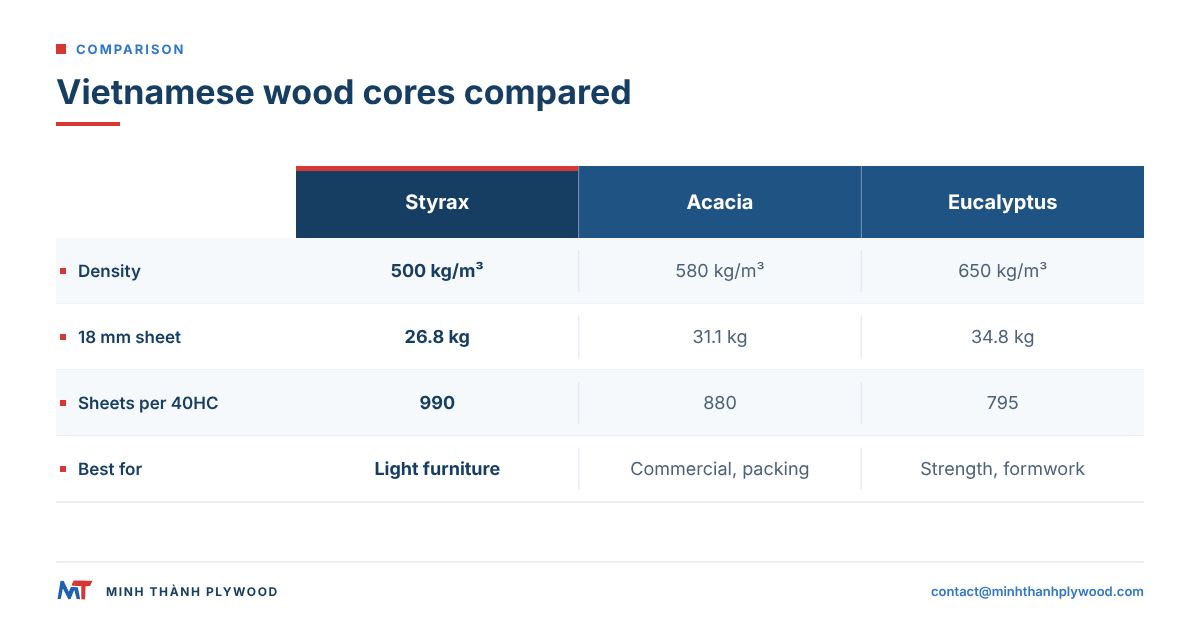
Weight. Our reference density for Styrax-core panels is 500 kg/m³. An 18 mm sheet of 1220 × 2440 mm weighs about 26.8 kg, the lightest of the three common cores.
What lightness does for freight. Because the sheet is lighter, more cubic metres fit under the container’s weight limit. On our 40HC plan, 18 mm panels on a Styrax core load 990 sheets, about 53 m³, against 795 sheets, about 43 m³, on eucalyptus.
In our factory. Ha Hoa sits in Phu Tho province, in the Styrax and eucalyptus growing area of the northern midlands. Locally grown plantation timber for cores is one reason the region makes high-grade panels at a better price than comparable mills.
Rubberwood and pine: two niche Vietnamese woods
Rubberwood and pine complete the list of plantation Vietnamese wood, but neither is a mainstream plywood core.
Rubberwood (Hevea brasiliensis) comes from rubber plantations in the south and south-east, cut when the trees stop giving latex. It is a pale, fine-grained hardwood used widely for furniture, kitchenware and edge-glued panels. As a plywood core it is a niche, higher-cost choice made in the south. We do not use it.
Pine grows in plantations in the northern and central uplands. It is sawn for joinery and packing and peeled for pine veneer. We make pine cores on order, and pine-faced panels are quoted as face/back grade pairs A/A, A/B and B/B (B/C for utility parts), matched to the approved sample. That ladder is comparable to the European softwood face classes I to IV and the US A to D grades.
| Species | Best known for | Plywood role in Vietnam |
|---|---|---|
| Rubberwood | Furniture and edge-glued panels | Niche core, mainly in the south |
| Pine | Joinery, packing, pine veneer | Pine faces; core on order |
Which Vietnamese woods are legal and plantation-grown?
The legal, plantation-grown Vietnamese woods for export are acacia, eucalyptus, Styrax, rubberwood and plantation pine. Natural forests supply no wood to the export plywood trade.
Vietnam’s legality rules come from two instruments:
- The Voluntary Partnership Agreement with the EU on Forest Law Enforcement, Governance and Trade (FLEGT), signed in 2018 and in force since 1 June 2019 (European Commission, EU–Vietnam VPA).
- Decree 102/2020/ND-CP on the Vietnam Timber Legality Assurance System (VNTLAS), which sets how timber origin is documented from plantation to exporter.
Under these rules, plantation timber moves with harvest and transport records, and exporters classify themselves and their suppliers. For an importer, the practical proof is the origin file the mill supplies: species, plantation location, harvest records and the chain to the factory.
What that file looks like in practice:
- Species list for core, face and back, with common and scientific names.
- Plantation records for the core wood: the plots it came from and when it was harvested.
- Transport and purchase records from the plantation or the log trader to the mill.
- Mill records that tie the veneer lots to the production run of your order.
- Import records for any face veneer bought abroad, with its country of harvest.
A buyer who reads this list will see why plantation wood is easier to document than mixed or imported timber. A hill of acacia or Styrax has an owner, a location and a harvest date, and the trucks that carry its logs to a nearby mill leave a short paper trail.
A legality check on a first order
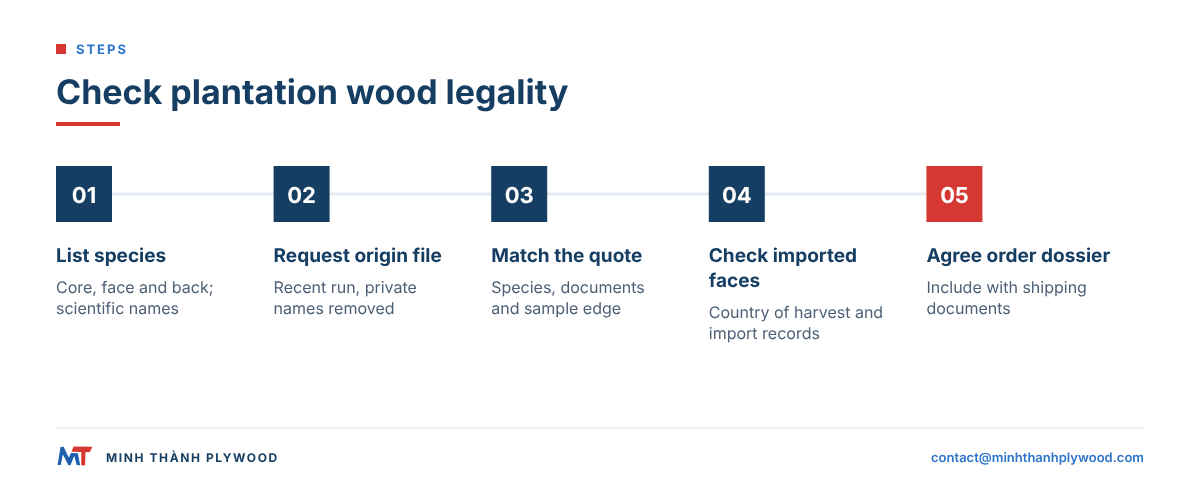
On a first order from a new mill, a buyer can check legality in five steps without leaving the office:
- Ask for the species list of core, face and back, with scientific names, before the quote.
- Ask for a sample origin file from a recent production run, with private names removed.
- Match the species in the file with the species on the quote and on the sample’s edge.
- Ask how imported faces are documented, if the face is birch, okoume or another imported veneer.
- Agree in the contract that the origin dossier for your own order comes with the shipping documents.
A mill that keeps these records answers each step in a day or two. A seller who cannot name the core species or send any example file is not ready for a European or US order, however good the price looks.
Rosewoods (Dalbergia species) and other CITES-listed timbers are a separate world: they are traded only under CITES permits and have no place in plywood. If a supplier offers “Vietnamese rosewood plywood”, walk away.
Vietnamese wood and the EU Deforestation Regulation
Vietnam is classed as a low-risk country under the EU Deforestation Regulation (EUDR), in Implementing Regulation (EU) 2025/1093. Simplified due diligence under Article 13 of Regulation (EU) 2023/1115 applies only when every commodity in the product comes from low-risk countries.
The EUDR applies from 30 December 2026 to large and medium operators, and to micro and small operators already covered by the EU Timber Regulation, which includes plywood importers. Other micro and small operators follow on 30 June 2027. The cutoff date for deforestation is 31 December 2020.
What the regulation asks for, in its own words, includes “the geolocation of all plots of land where the relevant commodities that the relevant product contains, or has been made using, were produced” (Article 9(1)(d)). For plywood that covers core, face and back veneers.
What we supply: the EUDR compliance dossier (origin records and geolocation files) with orders. A buyer whose faces are imported birch or okoume needs the face veneer’s origin too, which is one reason plantation-core panels with Vietnamese faces are simpler to document.
There is no “EUDR certificate”. The importer files a due diligence statement; the mill’s dossier is what makes that statement possible.
Two roles in the regulation matter to furniture buyers. The company that imports plywood into the EU is the operator and files the due diligence statement. A furniture maker in the EU that turns that plywood into cabinets is a downstream operator under the 2025 amendment, Regulation (EU) 2025/2650: it does not file a new statement, but the first downstream operator collects and keeps the reference number of the statement it relies on. Ask your importer for that reference with each delivery.
Lacey Act, TSCA and documents for the United States
For the United States, Vietnamese wood products need a species and origin declaration under the Lacey Act and, for hardwood plywood, TSCA Title VI emission compliance.
Lacey Act. The US importer declares the genus, species and country of harvest of the wood in the product (USDA APHIS Lacey Act). We supply the face and core species and the Vietnamese harvest origin for that declaration.
TSCA Title VI. Hardwood plywood sold in the US must meet the formaldehyde emission standards of TSCA Title VI. Our panels for US orders carry the TSCA Title VI label with producer, lot, certifier number TPC-43 and the words “TSCA Title VI compliant”; the commercial invoice and B/L state compliance. Our CARB P2 / TSCA Title VI certification is under ICTT mill no. 23024.
Emission results. Six ASTM D6007 chamber tests between April 2025 and June 2026 on 9, 15 and 18 mm panels averaged 0.014–0.032 ppm, against the 0.05 ppm limit for veneer-core hardwood plywood. Three were run by Shanghai Hongjun and three by ICTT Vietnam.
The United States takes more than half of Vietnam’s wood product exports by value, so most Vietnamese exporters know this paperwork well. Ask for it before the deposit, not at loading.
Which wood products does Vietnam export?
Vietnam exports wood in almost every processed form. Furniture leads by value; chips and pellets lead by volume; panels and veneer sit between.
| Product | Main wood | Main buyers | Notes |
|---|---|---|---|
| Indoor and outdoor furniture | Imported hardwoods, rubberwood, acacia | United States, Japan, Europe | The largest category by value; wooden-frame chairs led in 2024 |
| Wood chips | Acacia, eucalyptus | Pulp mills in Asia | High volume, low value per tonne |
| Wood pellets | Sawmill and plantation residues | Japan, Korea | Fuel for power plants |
| Plywood | Acacia, eucalyptus, Styrax cores | Asia, Europe, the Americas | Furniture, packing and formwork grades |
| Veneer | Acacia, eucalyptus, Styrax | Panel mills at home and abroad | Core veneer and face veneer |
| LVL | Acacia, eucalyptus | Packing, furniture frames, Japan | Veneers all in one grain direction |
| Sawn timber and pallets | Acacia, pine, rubberwood | Asia, packing users | Often kiln-dried |
For plywood buyers, the panel is where Vietnamese wood adds the most value at home: the logs, the peeling, the drying, the core and the press are all local.
LVL deserves a note of its own. Laminated veneer lumber uses the same plantation veneer as plywood, but every layer runs in one grain direction, so the product behaves like a beam rather than a sheet. It is used for furniture frames, door frames, shelving and packing structures, and much of it goes to Japan through trading companies. We make LVL too, though our focus stays on furniture plywood. Our guide to Vietnam vs China plywood compares the two largest Asian panel origins.
From plantation to panel: how Vietnamese wood becomes plywood
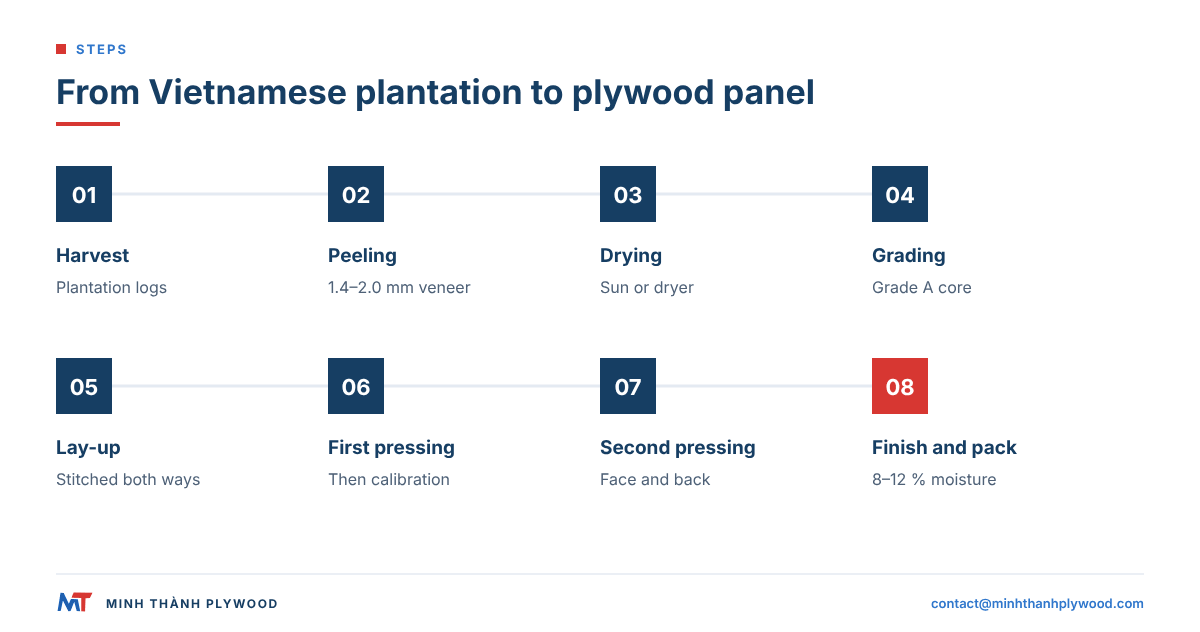
Vietnamese wood becomes plywood in nine steps, most of them within a short drive of the plantation.
- Harvest. Plantation acacia, eucalyptus or Styrax is felled and cut into short peeler logs.
- Peeling. Logs are peeled on spindleless lathes into core veneer, usually 1.4–2.0 mm thick.
- Drying. Veneer is dried in the sun or in dryers to the moisture the press needs.
- Grading. Core veneer is sorted by quality; furniture panels use grade A core veneer.
- Lay-up and stitching. Core veneers are laid up with the grain crossed; our cores are stitched both horizontally and vertically.
- First pressing. The core board is pressed, then calibrated by sanding to an even thickness.
- Second pressing. Face and back veneers are pressed onto the calibrated core.
- Finishing. Panels are trimmed, sanded, polished and graded against the approved sample.
- Packing. Panels are dried to 8–12 % moisture content at dispatch, counted, strapped and packed for the container.
The double pressing in steps 6 and 7 is standard for our furniture-grade panels. It is what gives a flat panel with thickness tolerance of ±0.2–0.3 mm, down to ±0.2 mm.
Which Vietnamese wood core should you choose?
Choose the core by the use: Styrax for light, white furniture panels; eucalyptus for strength and screw holding; acacia for firm, cost-effective commercial and packing panels; pine when you want a softwood core.
| Core | Reference density | 18 mm sheet weight | Edge colour | Best for |
|---|---|---|---|---|
| Styrax | 500 kg/m³ | About 26.8 kg | White, even | Visible-edge furniture, flat-pack, light panels |
| Acacia | 580 kg/m³ | About 31.1 kg | Light to mid brown | Commercial, packing, painted parts |
| Eucalyptus | 650 kg/m³ | About 34.8 kg | Pinkish to light brown | Carcasses under load, flooring base, film-faced |
Sheet weights are for 1220 × 2440 × 18 mm at the reference densities. Real eucalyptus runs 650–750 kg/m³, so weigh a sample before you plan a container.
A common mistake is to compare two quotes for “18 mm plywood” without asking the core species. The two offers are not the same construction: the difference comes from core grade, joining method, face preparation, adhesive system and tolerance. A furniture buyer moving from an acacia core to a Styrax core often gets a better-looking panel that is lighter and loads more cubic metres per container.
How core species changes a container load
Core species changes how many sheets fit in a container, because heavier wood reaches the weight limit before the container is full.
Our 40HC plan for 1220 × 2440 mm panels uses packs about 1,000 mm high, with sheets per pack equal to 1,000 ÷ thickness, rounded down, then capped by weight. The planning payload is 28,000 kg unless the booking is lower.
| 18 mm panels, 40HC | Packs | Sheets per pack | Sheets | Volume | Sheet weight |
|---|---|---|---|---|---|
| Styrax core | 18 (16 lying + 2 upright) | 55 | 990 | About 53 m³ | 26.8 kg |
| Acacia core | 16 | 55 | 880 | About 47 m³ | 31.1 kg |
| Eucalyptus core | 15 | 53 | 795 | About 43 m³ | 34.8 kg |
Check these against your own booking. Some importers cap a 40HC at 26,000 kg; with a lower cap, the heavier cores lose more sheets. Never ask a mill to load more packs than the plan: overloaded packs crush their bearers and have to be unloaded by hand.
Thickness changes the picture as well. Thinner panels hold more sheets per pack, because sheets per pack is 1,000 ÷ thickness, so the weight limit bites at different points for each core and thickness. Ask the mill for the plan of your exact mix before you book the container, and compare the plan’s total weight with your booking. A mixed container of several thicknesses, which we load by agreement, is planned the same way, pack by pack, against the same payload.
What face veneers go on Vietnamese wood cores?
Vietnamese cores take almost any face veneer. The face names the product: a “birch plywood” from Vietnam is birch-faced plywood on a Vietnamese core, not all-birch plywood.
We offer 10+ face veneers. The most produced are engineered veneer (EV), poplar, birch, okoume and pine; bintangor, eucalyptus, gurjan and others are available, and sapele on request.
| Face | Grades we quote | Notes |
|---|---|---|
| Birch | D+, D and E, as pairs such as D+/D or D/E | Comparable to the European birch ladder: D+ ≈ B, D ≈ BB, E ≈ CP/C |
| Poplar | A/A, A/B, B/B; also the codes B/BB, BB/CC and CP | Matched to the buyer’s approved sample |
| Eucalyptus | A/A, A/B, B/B | A/A for two visible faces, B/B for paint or overlay |
| Pine | A/A, A/B, B/B; B/C for utility parts | Comparable to European classes I to IV |
| Engineered veneer, okoume and others | To the approved sample | Colour and figure fixed by sample |
Face veneers are thin, usually 0.2–0.5 mm, and 0.3 mm is common for Europe. Both our faces are UV-ready: sanded and polished to the standard customers need to apply their own UV coating.
Thin panels show how far a Vietnamese core can go. Our thin plywood from 3–5 mm is always 5-ply. A 3 mm panel is one core veneer, two cross-band veneers and two faces; 4 and 5 mm panels are three core veneers and two faces, with the core veneer thickness adjusted to the panel. A 4 mm furniture panel, for example, uses three 1.3 mm Styrax core veneers. Premium thin veneer is scarce, so 4 mm can take longer to make; we do not lower the standard to go faster.
At the other end, an 18 mm furniture panel is usually 11–13 plies, most often 11. More plies of thinner veneer give a more stable panel and a cleaner edge, which is what buyers of visible-edge furniture look for when they compare a Vietnamese panel with Baltic birch.
How to check Vietnamese wood panels on arrival
Check five things when a container of plywood from Vietnamese wood arrives: thickness, flatness, face grade, core and moisture.
- Thickness. Measure with a caliper at the four corners and the centre of several sheets per pack. Sanded furniture panels should sit within ±0.2–0.3 mm of nominal; length and width within ±2 mm.
- Flatness. Lay sheets on a flat table and look for bow or twist, especially on thin panels.
- Face grade. Compare faces with the approved sample, in daylight.
- Core. Look at the edges: species colour, gaps, overlaps and the stitching of the outer core layers.
- Moisture. A moisture meter should read in the 8–12 % range of furniture plywood at dispatch, allowing for the climate on the way.
Every shipment we make is photographed and filmed before loading, and the buyer receives the photos and video. Compare them with what you unload: the pack labels, counts and wrapping should match.
When a check does not match
If a check on arrival does not match the order, record it before you move the packs further:
- Photograph the pack label, the wrapping and the faulty sheets, with a caliper or tape in the frame.
- Measure enough sheets to show whether the problem is one pack or the whole load.
- Keep the faulty sheets apart, unused, so the mill can see what you saw.
- Send the photos and measurements to the mill with the order and pack numbers.
Most problems trace to one cause: a moisture change on the voyage, a mixed pack, or a sample that was never fixed as the reference. Clear records let the mill find the cause quickly and fix the next run.
How to order plywood made from Vietnamese wood
To order plywood made from Vietnamese wood, send the specification in the order a mill builds the panel, then approve a sample and agree the terms.
- Application: furniture, cabinets, interior fit-out, packing, formwork; indoor or outdoor.
- Core: Styrax, eucalyptus, acacia or pine; stitched or not.
- Glue and emission: UF glue at E0 emission for furniture; CARB P2 / TSCA Title VI if your market needs it; melamine-fortified or phenolic (WBP) for humid or exterior use.
- Face: species, face and back grade, sanded or polished, UV-ready.
- Panel: thickness from 3–40 mm, size 1220 × 2440 mm or 1250 × 2500 mm or custom, tolerance, cut-to-size.
- Packing and quantity: pack type, labels, sheets per container, destination port.
Our terms are short: one 40HC minimum with mixed specifications by agreement; production in 15–45 days after the 30% deposit; balance of 70% against the scanned B/L, or irrevocable L/C at sight; FOB Hai Phong, CFR or CIF; free samples. Typical days at sea from Hai Phong are 30–40 to Northern Europe and 20–30 to the US West Coast, by carrier and route.
A complete specification line for a furniture buyer reads like this:
Kitchen cabinet carcasses, indoor. Styrax core, stitched both ways. UF glue at E0 emission, CARB P2 / TSCA Title VI. Poplar face A/B, sanded and polished, UV-ready. 18 mm, 1220 × 2440 mm, ±0.2–0.3 mm. Export packs, our labels, one 40HC, CIF your port.
With that line, a mill can quote the build in writing on the first reply, and two mills’ quotes become comparable. Without the core species and the glue line, you are comparing two different panels under one name.
Samples before the first container
Free samples are the cheapest test of a Vietnamese wood panel. Ask for samples of the exact build you will order, not a showroom piece, and run them through the same checks you will use on arrival:
- Weigh and measure each piece and compare with the quoted core and density.
- Check the edge: core species colour, ply count and any gaps or overlaps.
- Machine and finish a test part in your own workshop: cut, edge-band, drill, lacquer or UV-coat.
- Keep one sample as the reference for face grade and colour on the purchase order.
Buyers in Europe often test emission on the sample too. We arrange third-party testing to the buyer’s method, such as EN 717-1, through SGS on request. Once the sample is approved, it becomes the standard the production run is graded against.
Shipping documents for wood from Vietnam
Each plywood shipment from Vietnam travels with a standard set of documents, and certificate files are added for the market.
| Document | What it proves | When you get it |
|---|---|---|
| Commercial invoice and packing list | Goods, quantities, values, pack contents | Draft after loading |
| Bill of lading (B/L) | Goods on board; title to the cargo | After sailing; balance paid against the scan |
| Certificate of origin (EUR.1 for the EU) | Vietnamese origin for tariff purposes | With the shipping set |
| Phytosanitary and fumigation certificates | Plant health of the shipment and its packing | With the shipping set |
| Insurance certificate | Cover in transit, with CIF | With the shipping set |
| Certificate files: CARB P2 / TSCA Title VI, test reports, EUDR dossier, PPWR test | Emission, origin and packaging compliance | On order, before the deposit |
Plywood itself is processed wood and is not subject to ISPM 15, the international standard for wood packaging. Solid-wood pallet parts are. That matters for buyers in Japan, Australia and other strict markets, who should still ask for the phytosanitary certificate their customs expects.
For packaging, our materials were independently tested by SGS in September 2026 under Regulation (EU) 2025/40: lead, cadmium, mercury and hexavalent chromium were not detected in all four packaging materials, a pass against the 100 mg/kg limit.
Common misconceptions about Vietnamese wood
Buyers new to Vietnamese wood often arrive with five misconceptions. Each has a short answer.
| What buyers hear | What is true |
|---|---|
| “Vietnamese plywood is made from rainforest timber.” | Export plywood cores are plantation acacia, eucalyptus and Styrax. |
| “Vietnam makes birch and poplar plywood from its own forests.” | Birch and poplar are imported or peeled face veneers on Vietnamese cores. |
| “Plantation wood is weak.” | Plantation hardwood veneer, crossed and pressed, makes strong panels; strength depends on the build. |
| “Vietnamese panels cannot meet European emission rules.” | Our chamber tests averaged 0.014–0.032 ppm against the 0.05 ppm CARB Phase 2 limit; SGS tests to the buyer’s method, such as EN 717-1, on request. |
| “All Vietnamese mills are the same.” | Mills differ in core grade, joining, pressing, glue and tolerance; the same name can hide two constructions. |
Our guide is Vietnamese plywood good quality? goes deeper into the last two points.
Who buys plywood made from Vietnamese wood, and where does Minh Thanh fit?
Furniture and cabinet factories, importers and distributors in Europe, the Americas, Asia and Africa buy plywood made from Vietnamese wood. Each market asks for something slightly different.
- Europe usually wants light, white cores, good faces, tight tolerance, low emission and traceable origin.
- The United States needs panels within CARB / TSCA scope, labelled, with Lacey Act species data.
- Asian buyers often prefer heavier, firmer panels or a sharp price, and should state their emission class.
- Japan and Korea buyers take LVL and panels and are about 2–3 weeks by sea from Hai Phong.
- Africa buyers often want cost-effective commercial and packing panels and are 35–50 days by sea to West Africa.
Across all of them, the first question we ask is the same: what will the panel become? The answer decides the core, the glue, the face and the tolerance, and it is the fastest way from a first email to a written quote. Buyers who start from a product name alone, such as “18 mm plywood”, get quotes that cannot be compared.
Europe is our strongest market, with regular shipments to European buyers and repeat orders into Italy, including cut-to-size panels where one sheet is cut into 4, 6 or 8 pieces. We also export across the Americas, Asia and Africa.
Where Minh Thanh Plywood fits
Minh Thanh Plywood turns Vietnamese plantation wood into furniture and interior plywood in Ha Hoa, Phu Tho. We make 50,000+ m³ a year, with Europe as our main market, and we also produce commercial, packing and film-faced plywood.
| Choice | Our standard | On order |
|---|---|---|
| Core | White Styrax or eucalyptus | Acacia, pine |
| Build | Cores stitched both ways; double pressing | All core layers stitched on request |
| Glue and emission | UF glue at E0 emission | Melamine-fortified or phenolic (WBP) bond |
| Tolerance | ±0.2–0.3 mm on sanded furniture panels | Down to ±0.2 mm |
| Sizes | 1220 × 2440 mm, 1250 × 2500 mm | 1220 × 2500 mm, 1220 × 2280 mm, cut-to-size |
| Proof | CARB P2 / TSCA Title VI (ICTT mill no. 23024), ISO 9001:2015, TCVN 11902:2017 | SGS testing to your method |
Send us your specification through the furniture plywood page: application, core, glue and emission class, face, size, packing and quantity, and your destination port. We reply within hours and send free samples.
Buyer questions, answered
What kind of wood comes from Vietnam?
Vietnam exports mostly plantation hardwood: acacia, eucalyptus, Styrax and rubberwood, plus plantation pine. It also re-exports imported timber as furniture. The wood leaves Vietnam as furniture, veneer, plywood, LVL, sawn timber, chips and pellets.
Is Vietnamese wood good quality?
Plantation acacia, eucalyptus and Styrax are uniform, fast-growing woods well suited to veneer and engineered panels. Quality depends on how the mill grades veneer, builds the core and presses the panel, so judge the mill as well as the species.
Which Vietnamese woods are legal and plantation-grown?
Acacia, eucalyptus, Styrax, rubberwood and plantation pine are the main legal plantation woods. Vietnam's timber legality system under Decree 102/2020/ND-CP and its FLEGT agreement with the EU set the rules for proving origin.
Is wood from Vietnam EUDR compliant?
Vietnam is classed as low risk under the EU Deforestation Regulation, which allows simplified due diligence when every commodity in the product comes from low-risk countries. For our plywood we supply the EUDR compliance dossier, with origin records and geolocation files, with orders.
What is Styrax wood?
Styrax (Styrax tonkinensis) is a light, pale plantation hardwood grown in northern Vietnam. Peeled into veneer, it makes white, light plywood cores that many European furniture buyers prefer.
Which Vietnamese wood makes the lightest plywood?
Styrax makes the lightest common core. At our reference density of 500 kg/m³, an 18 mm sheet of 1220 × 2440 mm weighs about 26.8 kg, against about 34.8 kg on a eucalyptus core at 650 kg/m³.
Does Vietnam export rosewood or natural-forest timber?
The export wood industry runs on plantation species and imported timber. Rosewoods are CITES-listed and traded only under permit; they play no part in plywood, and we use only plantation species in our panels.
Which wood products does Vietnam export?
Furniture is the largest category, followed by wood chips, pellets, plywood and other panels, veneer, sawn timber and LVL. The United States takes more than half of Vietnam's wood product exports by value.
Can Vietnamese plywood have a birch or poplar core?
No. Vietnamese plywood cores are acacia, eucalyptus, Styrax or mixed, with rubberwood as a niche core in the south. Birch, poplar and okoume are face veneers glued on a Vietnamese core.
Is wood from Vietnam treated for export?
Plywood is processed wood and is not itself subject to ISPM 15. Solid-wood pallets and blocks used for packing are heat-treated or fumigated, and shipments carry phytosanitary and fumigation certificates.
Do you supply species and origin for the US Lacey Act?
Yes. We supply the face and core species and the Vietnamese harvest origin for the importer's Lacey Act declaration, and US orders carry the TSCA Title VI label.
Which Vietnamese wood is best for furniture?
Acacia is the most used Vietnamese furniture wood: low cost, dense (360–690 kg/m³) and hard (Janka 1,360 to 1,820 lbf). Rubberwood and eucalyptus are also low cost, mango wood and bamboo low to mid, and teak is the premium choice. For panels, plantation Styrax, eucalyptus and acacia cores give furniture plywood.
What is the minimum order for plywood made from Vietnamese wood?
Our minimum order is one 40HC, and several thicknesses or grades can share it by agreement. Production takes 15–45 days after the 30% deposit.