
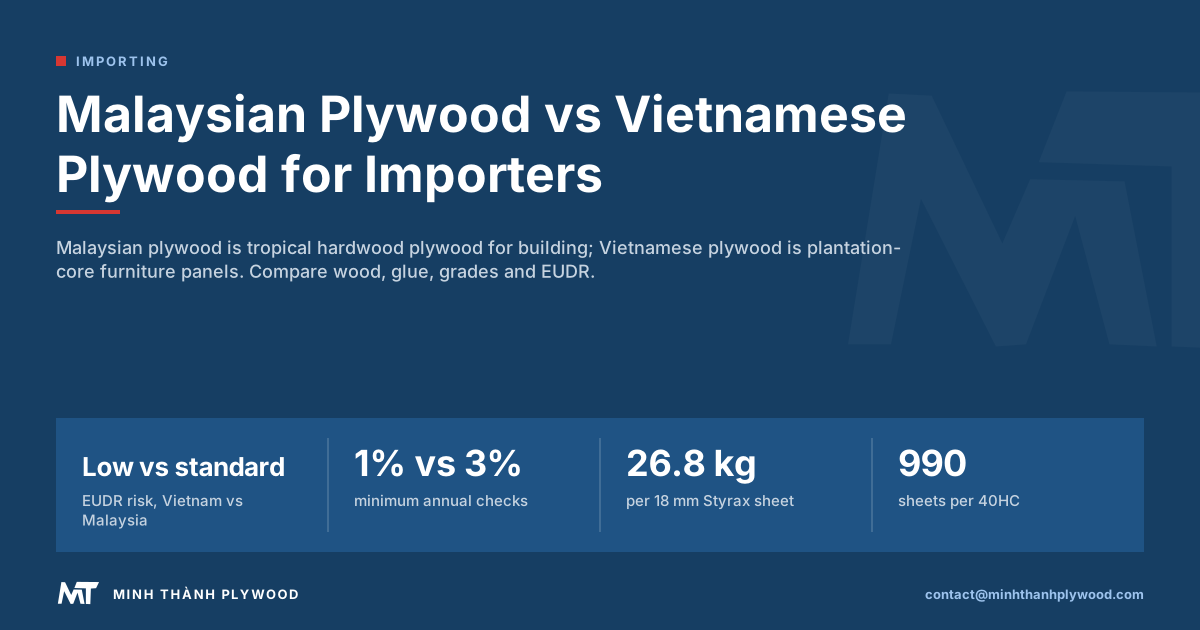
Malaysian plywood is hardwood plywood peeled from tropical species such as meranti and keruing, sold in UK and European yards mostly as a durable building and joinery panel to EN 636. Vietnamese plywood is built on plantation acacia, eucalyptus or Styrax cores, mostly for furniture and interiors. Minh Thanh Plywood, a Vietnamese furniture plywood factory, compares the two by use, metric and paperwork.
Malaysian plywood vs Vietnamese plywood: the short answer
Malaysian plywood and Vietnamese plywood serve different jobs. Malaysian plywood is dense tropical hardwood plywood, sold in UK and European yards mainly for building, joinery and humid or exterior use. Vietnamese plywood is mostly plantation-core plywood made for furniture, cabinets and interiors, with commercial, packing and film-faced grades beside it.
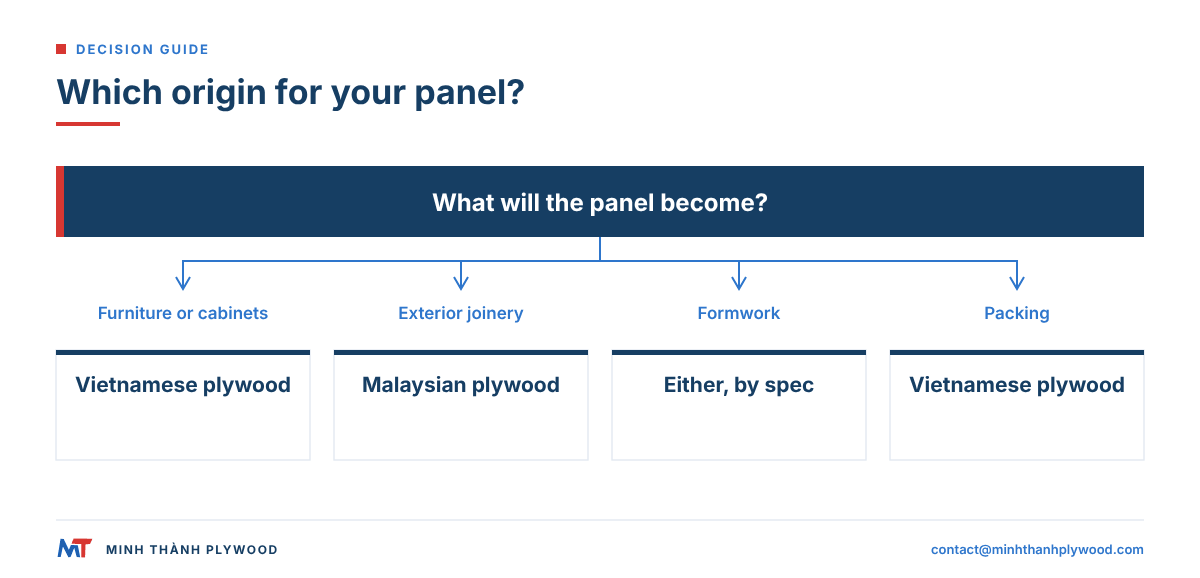
Verdict by use:
| Your use | Usually the better fit | Why |
|---|---|---|
| Sanded furniture and cabinet panels | Vietnamese plywood | Light, pale plantation cores, chosen faces, calibrated thickness |
| Visible-edge, flat-pack furniture | Vietnamese plywood on a Styrax core | White edge, light sheet |
| Exterior joinery, sheds, humid building work | Malaysian plywood | Dense tropical veneers with exterior-type bonds |
| Concrete formwork | Either, by spec | Both make film-faced panels; compare film, glue and core |
| Packing and crates | Vietnamese plywood | Cost-effective acacia and eucalyptus cores |
| Shortest EUDR paperwork for an EU importer | Vietnamese plywood | Vietnam is low risk; Malaysia is standard risk |
The rest of this guide explains each line, then shows how to specify a Vietnamese panel that does the job a Malaysian panel did.
What is Malaysian plywood?
Malaysian plywood is hardwood plywood manufactured in Malaysia from tropical species, mainly the light and medium hardwoods traded as meranti (Shorea species) and keruing (Dipterocarpus species), peeled into veneer and pressed with the grain of each layer crossed.
In UK and Irish builders’ merchants the name “Malaysian plywood” has become almost a product type. It usually means:
- A reddish-brown hardwood face, plain rather than decorative.
- A dense hardwood core of the same or similar tropical species.
- An exterior-type or humid-condition bond, sold to EN 636-2 or EN 636-3 classes.
- Standard 2440 × 1220 mm sheets in common building thicknesses.
Most mills are in Sarawak and Sabah on Borneo, with a smaller share in Peninsular Malaysia. The older name “Malayan plywood” refers to the same family of panels from the peninsula.
Malaysian plywood quality: what to expect
Malaysian plywood quality is generally consistent for building use: dense veneers, good bond strength and a hard-wearing face. Its weak points for furniture are colour variation between sheets, a plainer face and a darker edge.
What decides quality on a given sheet:
- Bond class. Check the EN 636 class and the bond test on the stamp: EN 636-2 for humid conditions, EN 636-3 for exterior use (EN 636 is published by the European Committee for Standardization).
- Face grade. Faces are graded by the mill or by the importer’s own grade names; ask for photographs of the actual face.
- Core build. Look at the edge for gaps and overlaps in the core veneers.
- Thickness. Measure several sheets; building panels are often looser than sanded furniture panels.
A sound Malaysian panel and a sound Vietnamese panel can both be good quality. They are simply good at different things, which is why the comparison should start from the use.
Malaysian plywood sizes, thicknesses and UK shelf prices
UK merchants sell Malaysian plywood as BB/CC hardwood plywood in 2440 × 1220 mm sheets from 3.6 to 25 mm thick. Latham Timber lists the range as 3.6, 4, 5.5, 6, 9, 12, 15, 18, 22 and 25 mm, with 3050 × 1220 mm and 3050 × 1525 mm sheets also available (Latham Timber). It gives the class as EN 636-2S with glue to EN 314-2 Class 3. Its marine line is a separate product made to BS 1088 and EN 636-3.
Murdock Builders Merchants sells a CE2, E1 panel in 5.5, 9, 12, 18 and 25 mm (Murdock). The panel is described as EN 636-3 with glue to EN 314-2 Class 3.
Shelf prices show the margin an importer works against. One UK wholesaler lists Malaysian BB/CC external-grade plywood, 2440 × 1220 mm, per sheet in October 2026 (Sheet Materials Wholesale):
| Thickness | Pack | Per sheet, ex VAT | Per sheet, inc VAT |
|---|---|---|---|
| 5.5 mm | 165 sheets | £11.84 | £14.21 |
| 9 mm | 100 sheets | £16.01 | £19.21 |
| 12 mm | 75 sheets | £20.76 | £24.91 |
| 18 mm | 50 sheets | £32.03 | £38.44 |
| 25 mm | 36 sheets | £45.25 | £54.30 |
For scale, our indicative furniture plywood price from US$350/m³ comes to about US$18.8 for one 18 mm 1220 × 2440 mm sheet (0.0536 m³ × US$350). That is a raw FOB Hai Phong example, not a sheet price: freight, duty, VAT and the importer’s margin come on top, and the Malaysian shelf panel is a different build with BB/CC faces and a dense hardwood core. The point is the gap: a sanded, calibrated furniture panel can be landed and still leave a UK or EU buyer room to resell.
Comparison table: Malaysian plywood vs Vietnamese plywood
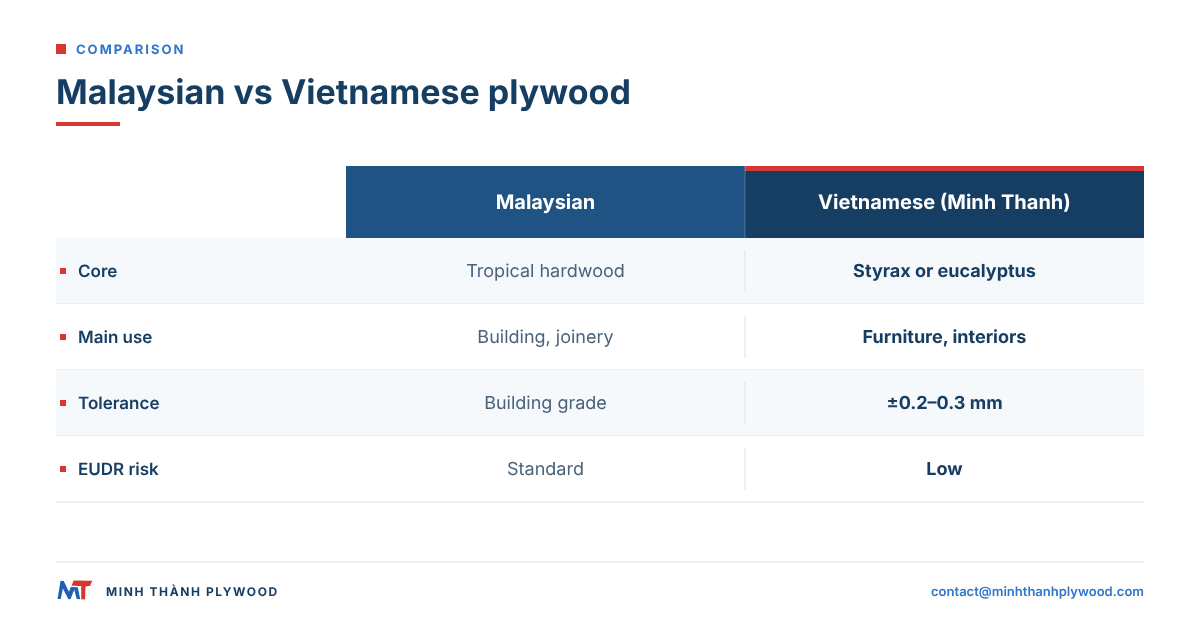
This table compares the typical panels each origin exports to Europe, one metric per row. “Vietnamese plywood” here means furniture-grade panels from a mill such as ours.
| Metric | Typical Malaysian plywood | Vietnamese furniture plywood (Minh Thanh) |
|---|---|---|
| Core wood | Tropical hardwoods (meranti, keruing and similar) | Plantation Styrax or eucalyptus; acacia and pine on order |
| Wood source | Natural forest and plantation, by mill | Plantation |
| Face | Plain tropical hardwood | 10+ faces: engineered veneer, poplar, birch, okoume, pine and more |
| Core colour at the edge | Reddish-brown | White (Styrax) or light (eucalyptus) |
| Main glue | Exterior-type or melamine-fortified bonds | UF glue at E0 emission for furniture; melamine-fortified or phenolic (WBP) to order |
| Emission proof | Varies by mill | CARB P2 / TSCA Title VI, ICTT mill no. 23024 |
| Bond and use class | BB/CC faces; EN 636-2S (humid) or EN 636-3 (exterior); glue to EN 314-2 Class 3 | Chosen per order: UF at E0 indoors, melamine-fortified or phenolic (WBP) where wet |
| Thickness tolerance | Building-grade, by mill | ±0.2–0.3 mm on sanded panels, down to ±0.2 mm |
| Panel build | By mill and grade | Double pressing as standard on furniture panels |
| Sheet weight, 18 mm, 1220 × 2440 mm | Heavier, dense hardwood | About 26.8 kg on Styrax at 500 kg/m³ |
| Sizes and thickness | 2440 × 1220 mm; 3050 × 1220 mm and 3050 × 1525 mm; 3.6–25 mm | 1220 × 2440 mm and 1250 × 2500 mm; 3–40 mm; custom and cut-to-size |
| EUDR country risk | Standard | Low |
| Main use in Europe | Building, joinery, humid or exterior work | Furniture, cabinets, interiors |
Where Malaysian plywood is the better choice
Malaysian plywood is the better choice when the job needs a dense, darker hardwood panel with an exterior-type bond and the look of the face does not matter much.
Typical cases:
- Exterior joinery and outbuildings, such as sheds, stables and hoardings, where a hardwood panel to EN 636-3 is expected.
- Humid interiors, such as utility rooms and site cabins, built to EN 636-2.
- Exposed building work where a hard face resists knocks better than a soft core.
- Customers who already know the product and expect the colour and weight of a Malaysian panel.
For these uses, a yard’s established Malaysian line may be the simplest buy. We would not suggest changing a working exterior specification only to change origin.
Where Vietnamese plywood is the better choice
Vietnamese plywood is the better choice when the panel becomes furniture, cabinets or interior fittings, and the face, the edge, the flatness and the weight all matter.
- Furniture and kitchen carcasses. Sanded, calibrated panels with UF glue at E0 emission, built for top-grade furniture and interior use.
- Visible edges. A white Styrax core gives a clean, pale edge.
- Chosen faces. Poplar, birch, okoume, pine, eucalyptus or engineered veneer, graded to the buyer’s approved sample.
- Light panels. An 18 mm Styrax-core sheet weighs about 26.8 kg, which helps flat-pack furniture and container loads.
- Cut-to-size. One panel cut into 4, 6 or 8 pieces, shipped regularly to Italy and other European markets.
Our factory presses furniture-grade panels twice as standard: the core board is pressed and calibrated, then face and back are pressed on. That is how sanded panels hold ±0.2–0.3 mm.
Vietnam vs Malaysia plywood for European buyers: EUDR and documents
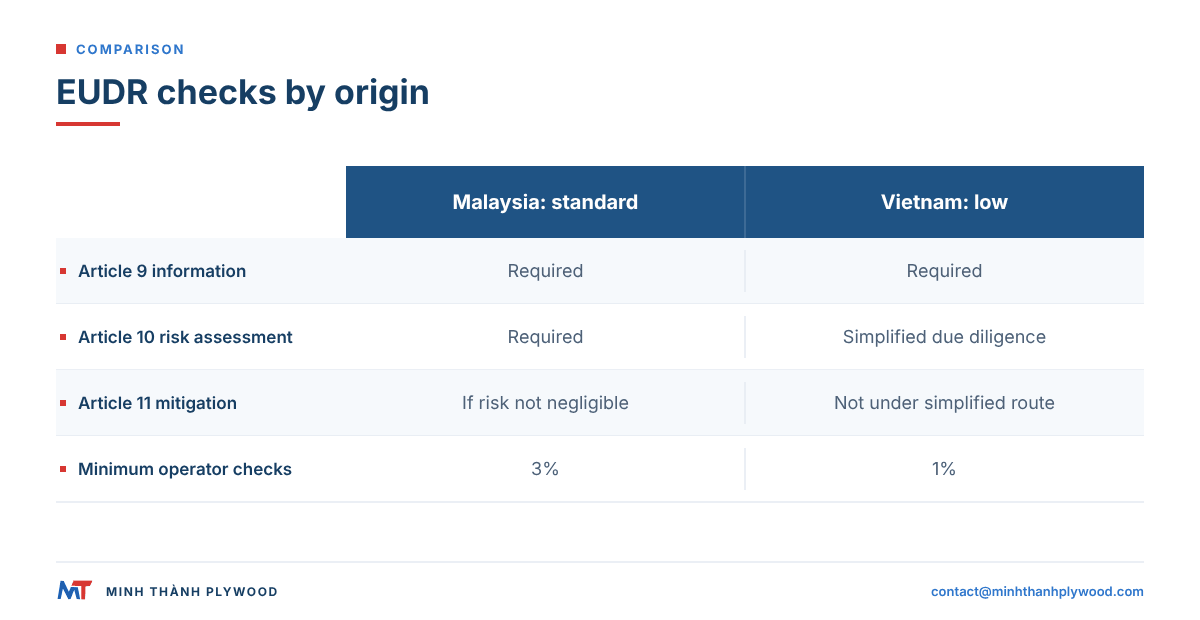
For European buyers, the biggest difference between Vietnam and Malaysia plywood is the EU Deforestation Regulation (EUDR) risk class. Implementing Regulation (EU) 2025/1093 classes Vietnam as low risk and Malaysia as standard risk.
What that means for the importer, the operator under Regulation (EU) 2023/1115:
| Step | Malaysian plywood (standard risk) | Vietnamese plywood (low risk) |
|---|---|---|
| Information collection (Article 9) | Required | Required |
| Risk assessment (Article 10) | Required | Not required under simplified due diligence (Article 13), when every commodity comes from low-risk countries |
| Risk mitigation (Article 11) | Required when risk is not negligible | Not required under simplified due diligence |
| Minimum annual competent-authority checks | 3% of operators | 1% of operators |
The EUDR applies from 30 December 2026 to large and medium operators and to micro and small operators already covered by the EU Timber Regulation, which includes plywood importers; other micro and small operators follow on 30 June 2027. With our panels we supply the EUDR compliance dossier (origin records and geolocation files) with orders.
A note on faces: a Vietnamese panel with an imported face, such as birch or okoume, also needs the face veneer’s origin. A panel whose face, back and core all use Vietnamese-grown wood keeps every commodity inside one low-risk country.
Malaysian plywood certification: MTCS, PEFC and FSC
Malaysian plywood is often sold with forest certification under the Malaysian Timber Certification Scheme (MTCS), which is endorsed by PEFC, or under FSC (Malaysian Timber Certification Council). Certification covers the forest and the chain of custody; it does not set the bond class or emission level of the panel.
When you compare certified panels from two origins, check three separate things:
- Forest certification: PEFC, MTCS or FSC claim on the invoice, with the holder’s certificate number.
- Bond and use class: EN 636 class and the bond test.
- Emission: E1 to EN 13986, or CARB P2 / TSCA Title VI, with the test method.
For Minh Thanh Plywood: CARB P2 / TSCA Title VI is held (ICTT mill no. 23024), as are ISO 9001:2015 and TCVN 11902:2017; FSC and CE are available*. Six ASTM D6007 chamber tests between April 2025 and June 2026 on 9, 15 and 18 mm panels averaged 0.014–0.032 ppm against the 0.05 ppm CARB Phase 2 limit.
*Supplied directly or through qualified partner mills.
Malaysian plywood manufacturers: where they are and how they sell
Plywood manufacturers in Malaysia are concentrated in Sarawak and Sabah, close to the forests and log ponds that feed them, with a smaller group in Peninsular Malaysia. Many belong to integrated timber groups that also log, saw and export veneer.
How plywood manufacturers in Malaysia sell to Europe
Malaysian plywood reaches European buyers by three routes:
- Through UK and EU importers and builders’ merchants, who stock standard sheets under their own grade names.
- Direct from the mill for container buyers, usually through the group’s export office.
- Through traders in Singapore and elsewhere who consolidate several mills.
Japan has long been the main market for Malaysian plywood. The ITTO Biennial Review reported that Malaysian plywood exports fell to a historic low in 2024, citing chronic log supply shortages, rising raw material and manufacturing costs, and weak demand in Japan. For buyers, a tighter supply base is one more reason to qualify a second origin.
Price: why Malaysian and Vietnamese plywood are hard to compare
Price comparisons between Malaysian and Vietnamese plywood only work when the two panels have the same construction. A dense tropical building panel and a sanded furniture panel with a Styrax core are different products, even at the same thickness.
What moves the price on either side:
- Core species and grade, and whether the core is stitched.
- Face species and grade.
- Glue system and emission class.
- Thickness tolerance and sanding.
- Size, quantity and delivery term.
Our indicative starting prices in October 2026 are from US$250/m³ for commercial plywood and from US$350/m³ for furniture and interior plywood. The final price depends on face, core, glue, thickness, size, quantity and delivery term, and we quote each build in writing.
When you compare quotes, ask each mill to fill in the same specification lines. “The two offers are not the same construction” is the explanation behind most price gaps.
Vietnamese plywood vs Malaysian plywood for importers in the Middle East and Asia
For importers in the UAE, Saudi Arabia, Oman, Singapore, the Philippines and Japan, the comparison follows the same rule: building and joinery panels from Malaysia, furniture and interior panels from Vietnam, and a choice by specification for formwork and packing.
| Market | What buyers often ask for | Typical days at sea from Hai Phong |
|---|---|---|
| South-East Asia (Singapore, Philippines, Indonesia) | Cost-effective commercial and furniture panels | 5–12 |
| Middle East (UAE, Saudi Arabia, Oman) | Furniture panels, film-faced and commercial plywood | 15–25 |
| Japan and Korea | Furniture panels, LVL, consistent grading | About 2–3 weeks |
Malaysian mills sit closer to some of these markets and have long-standing buyers in Japan. Vietnamese mills offer a wider choice of plantation cores and decorative faces, with CARB P2 / TSCA Title VI panels for buyers who sell on to the United States or Europe.
How to specify a Vietnamese panel to replace a Malaysian one
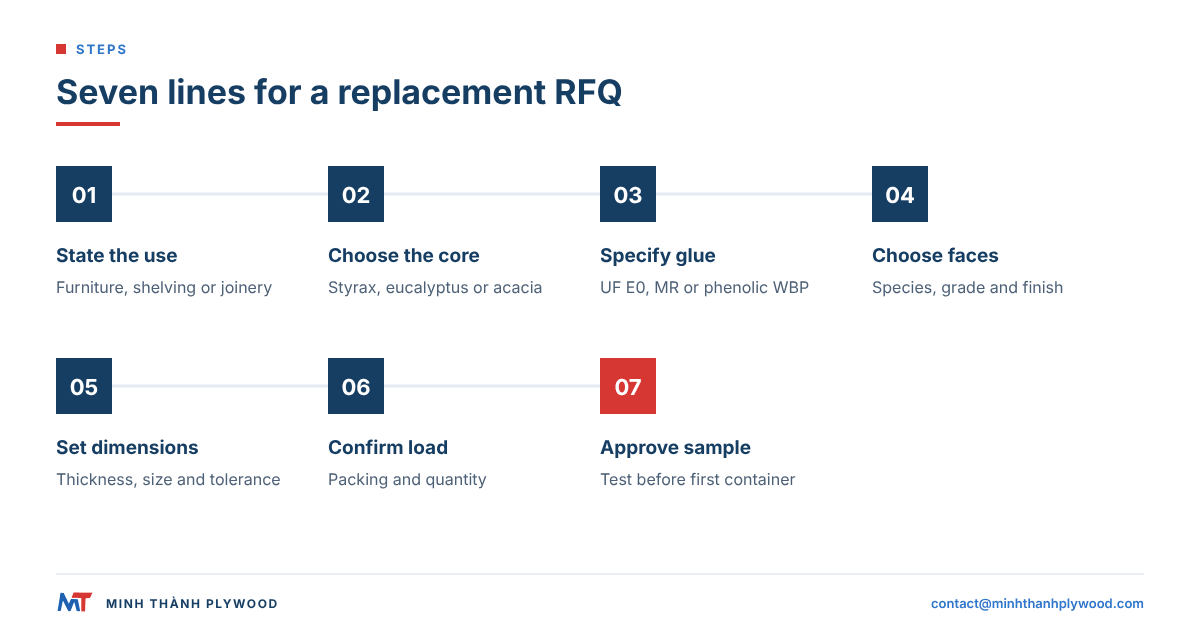
To move a product from Malaysian plywood to Vietnamese plywood, rewrite the specification from the use, not from the old product name.
- State the use: furniture carcass, door, shelving, wall lining, exterior joinery.
- Choose the core: Styrax for light, pale panels; eucalyptus for density and screw holding; acacia for cost-effective firmness.
- Choose the glue and emission: UF glue at E0 emission indoors; melamine-fortified or phenolic (WBP) bond where moisture or exterior exposure is expected.
- Choose the face: species, face and back grade, sanded or polished, UV-ready.
- Fix thickness, size and tolerance: for example 18 mm, 1220 × 2440 mm, ±0.2–0.3 mm.
- Fix packing and quantity: one 40HC minimum, with mixed specifications by agreement.
- Approve a free sample and test it in your own process before the first container.
A sample specification line:
Furniture carcass, indoor. Eucalyptus core, stitched. UF glue at E0 emission, CARB P2 / TSCA Title VI. Eucalyptus face A/B, sanded. 18 mm, 1220 × 2440 mm, ±0.2–0.3 mm. One 40HC, CIF Felixstowe.
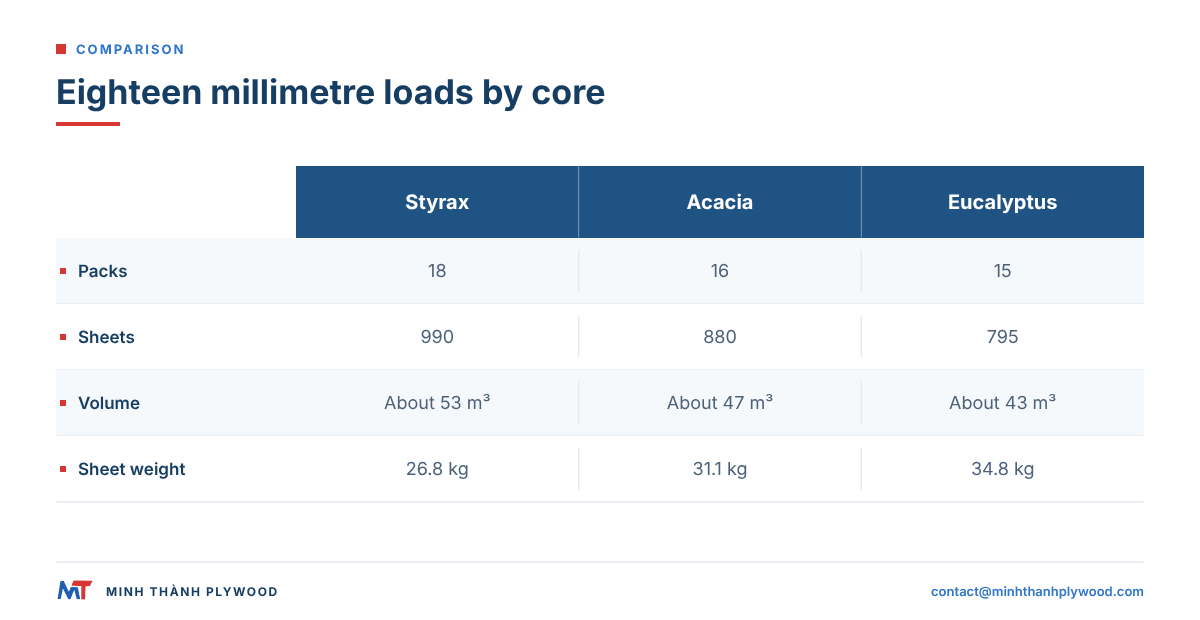
Container loads: what one 40HC of Vietnamese plywood holds
One 40HC of 18 mm Vietnamese furniture plywood at 1220 × 2440 mm holds 990 sheets on a Styrax core, 880 on acacia and 795 on eucalyptus. Heavier cores reach the weight limit first.
| 18 mm, 40HC | Packs | Sheets | Volume | Sheet weight |
|---|---|---|---|---|
| Styrax core, 500 kg/m³ | 18 | 990 | About 53 m³ | 26.8 kg |
| Acacia core, 580 kg/m³ | 16 | 880 | About 47 m³ | 31.1 kg |
| Eucalyptus core, 650 kg/m³ | 15 | 795 | About 43 m³ | 34.8 kg |
The plan uses packs about 1,000 mm high and a planning payload of 28,000 kg unless the booking is lower. A dense tropical hardwood panel loads fewer cubic metres per container for the same reason, which affects the landed cost per cubic metre.
Production takes 15–45 days after the 30% deposit; the balance of 70% is paid against the scanned B/L, or by irrevocable L/C at sight. Typical days at sea from Hai Phong to Northern Europe are 30–40, by carrier and route.
Where Minh Thanh Plywood fits
Minh Thanh Plywood is a Vietnamese manufacturer in Ha Hoa, Phu Tho, built for top-grade furniture and interior plywood with Europe as its main market. Our capacity is 50,000+ m³ per year, and we also produce commercial, packing and film-faced plywood.
If your Malaysian panel goes into furniture, cabinets or interiors, we can quote a Vietnamese build for the same job, with a free sample to test. If it goes into exterior building work, keep the spec you have, or ask us for an exterior panel with a phenolic (WBP) bond and utility faces.
Send your specification through the furniture plywood page: application, core, glue and emission class, face, size, packing and quantity, and destination port. We reply within hours.
Buyer questions, answered
What is Malaysian plywood?
Malaysian plywood is hardwood plywood made in Malaysia from tropical species such as meranti and keruing. In UK and European yards it is sold mainly as a general-purpose building and joinery panel, often to EN 636-2 for humid conditions.
Is Malaysian plywood good quality?
Good Malaysian plywood is dense, strong and well bonded, which suits building and joinery. Quality varies by mill and grade, so check the EN 636 class, the bond test and the face grade on the actual panels.
Is Malaysian plywood the same as marine plywood?
No. Most Malaysian plywood in builders' merchants is general hardwood plywood for humid or exterior conditions. Marine plywood is made to BS 1088, with specific species, glue and void limits, and is sold as a separate product.
What is the difference between Malaysian and Vietnamese plywood?
Malaysian plywood uses tropical hardwood veneers and is sold mostly for building and joinery. Vietnamese plywood uses plantation acacia, eucalyptus or Styrax cores and is made largely for furniture, interiors, packing and formwork.
Which is better for furniture, Malaysian or Vietnamese plywood?
For sanded furniture panels with a pale core and a chosen face, Vietnamese plywood is the more common choice. For a dense, darker hardwood panel used in joinery or exposed building work, Malaysian plywood is a long-standing option.
Is Malaysian plywood EUDR compliant?
Malaysia is classed as standard risk under the EUDR, so the importer runs full due diligence. Vietnam is classed as low risk, which allows simplified due diligence when every commodity in the product comes from low-risk countries.
Who are the major plywood manufacturers in Malaysia?
Malaysian plywood mills are concentrated in Sarawak and Sabah on Borneo, with some in Peninsular Malaysia. Many belong to timber groups that also log, saw and export veneer; check each mill's certification and bond class rather than the group name.
What sizes and thicknesses does Malaysian plywood come in?
UK merchants stock Malaysian plywood in 2440 × 1220 mm sheets, with 3050 × 1220 mm and 3050 × 1525 mm also listed, in thicknesses from 3.6 to 25 mm. Vietnamese mills such as ours make 1220 × 2440 mm and 1250 × 2500 mm sheets from 3–40 mm thick.
Where is most Malaysian plywood exported?
Japan has long been the main market for Malaysian plywood. ITTO reported that Malaysian plywood exports fell to a historic low in 2024 on log shortages, higher costs and weak Japanese demand.
What should a European buyer write on an RFQ for Vietnamese plywood?
Write the application, core species, glue and emission class, face species and grade, thickness, size and tolerance, packing and quantity, and the destination port. With those lines a mill can quote the build in writing.