
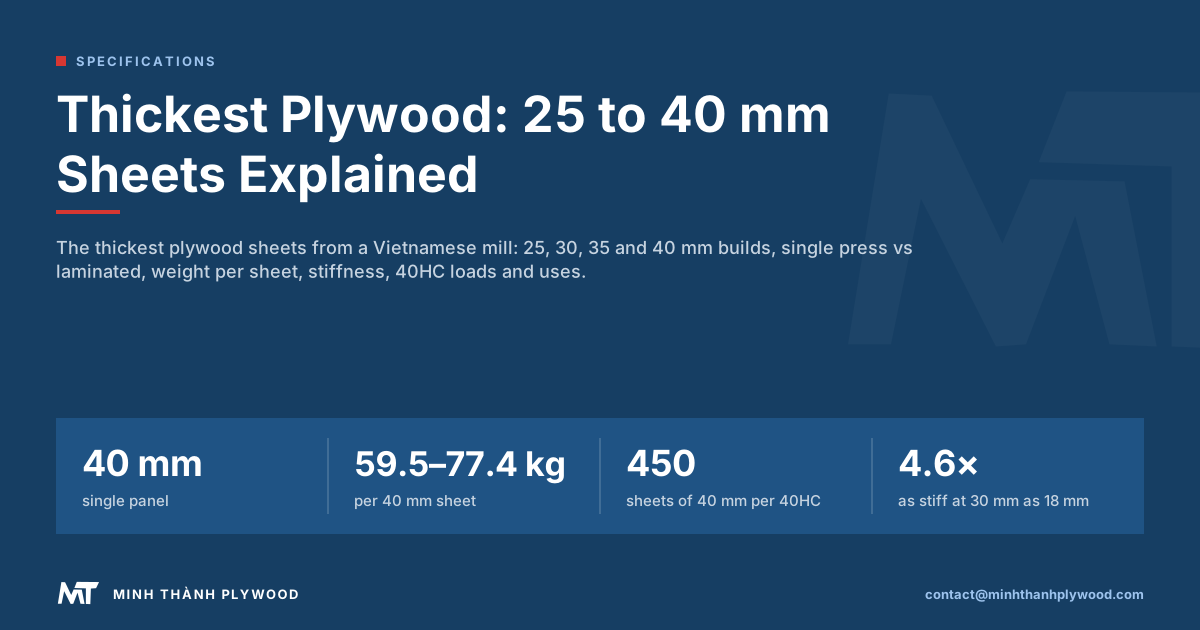
Pressed as one panel, the thickest plywood in regular production is 40 mm; anything thicker is two or more panels glued together. Minh Thanh Plywood makes 3 to 40 mm, and its thick range of 25, 30, 35 and 40 mm serves workbenches, stage decks, truck floors and stair treads. A 40 mm sheet weighs 59.5–77.4 kg by core.
What is the thickest plywood you can buy?
The thickest plywood pressed as a single panel in regular production is about 40 mm. Minh Thanh Plywood makes every thickness from 3 to 40 mm, and its certification for veneer-core hardwood plywood, CARB P2 / TSCA Title VI, covers 3–50 mm.
Sheets thicker than that do exist. UK merchants list 44 mm and 54 mm plywood, for example. Those are built by gluing two or more pressed panels together face to face and pressing the stack again, so a 54 mm sheet is a laminate of thinner panels. The section on single press and laminated sheets below explains the difference and when it matters.
Some sellers quote single panels up to 45 mm. Minh Thanh presses single panels to 40 mm and holds its CARB P2 / TSCA Title VI certification to 50 mm, so a 45 mm requirement is met by gluing a 40 mm and a thinner panel and pressing the pair, with the glue line stated on the order.
For most buyers asking for “thickest plywood”, the useful answer is the thick range from 25 to 40 mm: panels for workbenches, decks, floors and treads, where 18 mm is not stiff enough.
How thick is plywood? Common thicknesses in mm and inches
Plywood is made from about 3 mm to 40 mm in one panel, with the common sizes at 3, 6, 9, 12, 15, 18, 24 and 25 mm. Each thickness has a family of uses, and the imperial sizes sold in North America have metric equivalents that are close but not equal:
| Metric | Nearest imperial | Actual imperial size | Main uses |
|---|---|---|---|
| 3–6 mm | 1/8–1/4 inch | 3.2–6.4 mm | Backs, drawer bottoms, door skins (5-ply (3–5 mm) from 3 to 5 mm at Minh Thanh) |
| 9 mm | 3/8 inch | 9.5 mm (sold as 11/32, 8.7 mm) | Linings, backs on battens |
| 12 mm | 1/2 inch | 12.7 mm (sold as 15/32, 11.9 mm) | Drawer sides, short shelves |
| 15 mm | 5/8 inch | 15.9 mm (sold as 19/32, 15.1 mm) | Shelves, partitions, sheathing |
| 18 mm | 3/4 inch | 19.05 mm (sold as 23/32, 18.3 mm) | Carcasses, doors, tops |
| 21 mm | 13/16 inch | 20.6 mm | Formwork, floors |
| 24 mm | 15/16 inch | 23.8 mm | Formwork decks, floors, worktop substrates |
| 25 mm | 1 inch | 25.4 mm | Workbenches, platforms |
| 27 mm | 1-1/16 inch | 27.0 mm | Heavy shelves, trailer floors |
| 30–40 mm | 1-1/4 to 1-1/2 inch | 31.8–38.1 mm | Heavy decks, truck floors, thick tops |
Inch sizes convert at exactly 25.4 mm to the inch (NIST). North American panels are usually sold by a nominal size and sanded slightly under it; 3/4 inch plywood actually measures 23/32 inch. The 23/32 plywood guide covers that gap. Metric panels from Asia are made to the stated millimetre size within a tolerance.
Which thicknesses count as thick ply wood, and what is thk plywood?
In the trade, thick plywood means 25 mm and above: the sizes past the 18–21 mm furniture and formwork range. On price lists, “thk” is short for thickness, so a “thk plywood” row gives the panel thickness in millimetres. Minh Thanh’s thick range is 25, 30, 35 and 40 mm, and any size between them can be made on order, for example 28 mm for a table edge or 32 mm for a matching worktop.
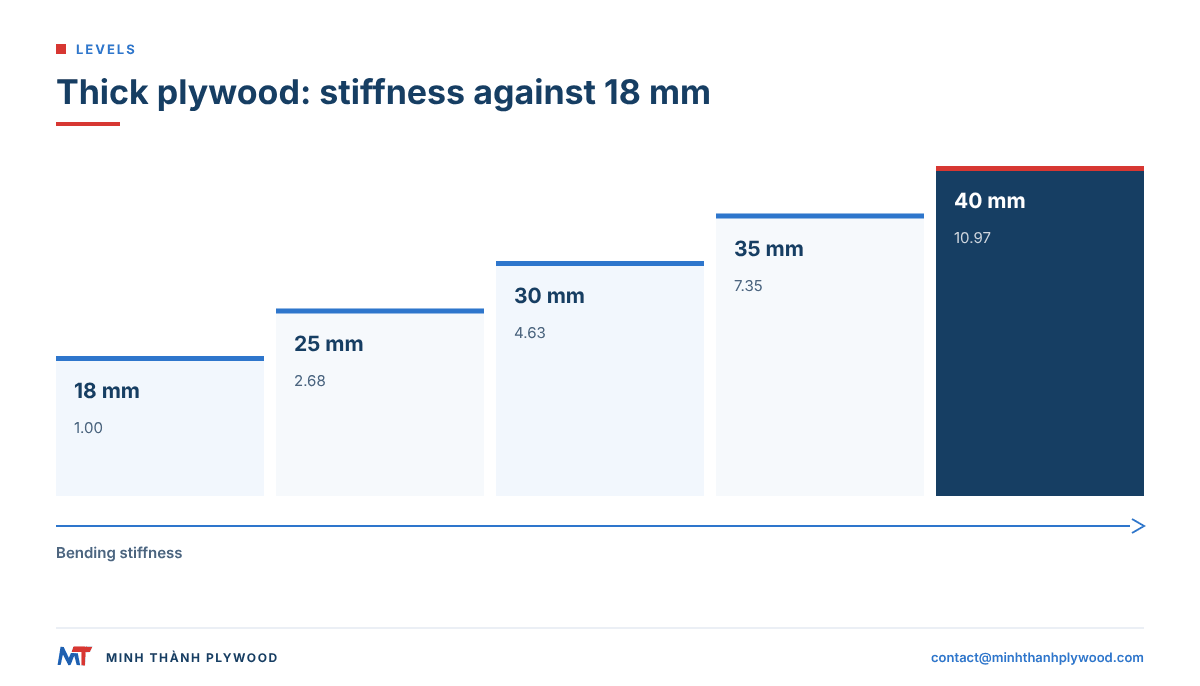
Thick plywood ply board is bought for one reason: stiffness. Bending stiffness rises with the cube of thickness, so 30 mm is about 4.6 times as stiff as 18 mm and 40 mm about 11 times. Thick ply wood is also heavier and costs more per sheet, which is why buyers pick the thinnest panel that meets the span.
How is a thick plywood panel built?
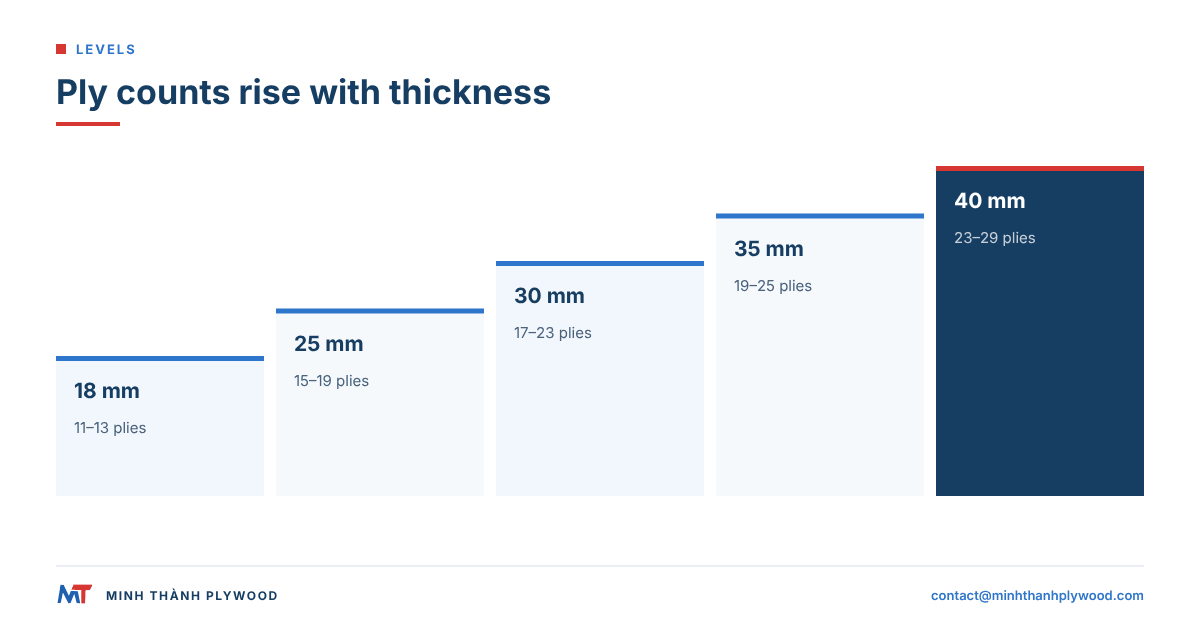
A thick panel is the same cross-laminated build as an 18 mm board, with more layers. Face veneers are 0.2–0.5 mm and core veneers 1.4–2.0 mm, and the number of layers is always odd so the panel stays balanced about its centre veneer.
| Thickness | Core veneers | Total plies |
|---|---|---|
| 18 mm (reference) | 9–11 | 11–13 |
| 25 mm | 13–17 | 15–19 |
| 30 mm | 15–21 | 17–23 |
| 35 mm | 17–23 | 19–25 |
| 40 mm | 21–27 | 23–29 |
The ranges come from the veneer thicknesses: thicker core veneers mean fewer plies, thinner ones more. A 40 mm panel with 1.9 mm core veneers has 23 plies; with 1.45 mm core veneers it has 29.
Furniture-grade panels are pressed twice as standard. The stitched core veneers are laid up and pressed into a core board, which is calibrated to thickness; the face and back are then pressed on. For a thick panel the first press does most of the work, and calibrating the core before the faces go on is what lets a 30 or 40 mm sheet hold ±0.2–0.3 mm.
Hot pressing runs at about 110–120 °C for MR bonds and 130–145 °C for phenolic (WBP) bonds. Heat travels slowly through wood, so the thicker the panel, the longer it stays in the press.
Single press or laminated: how are sheets above 40 mm made?
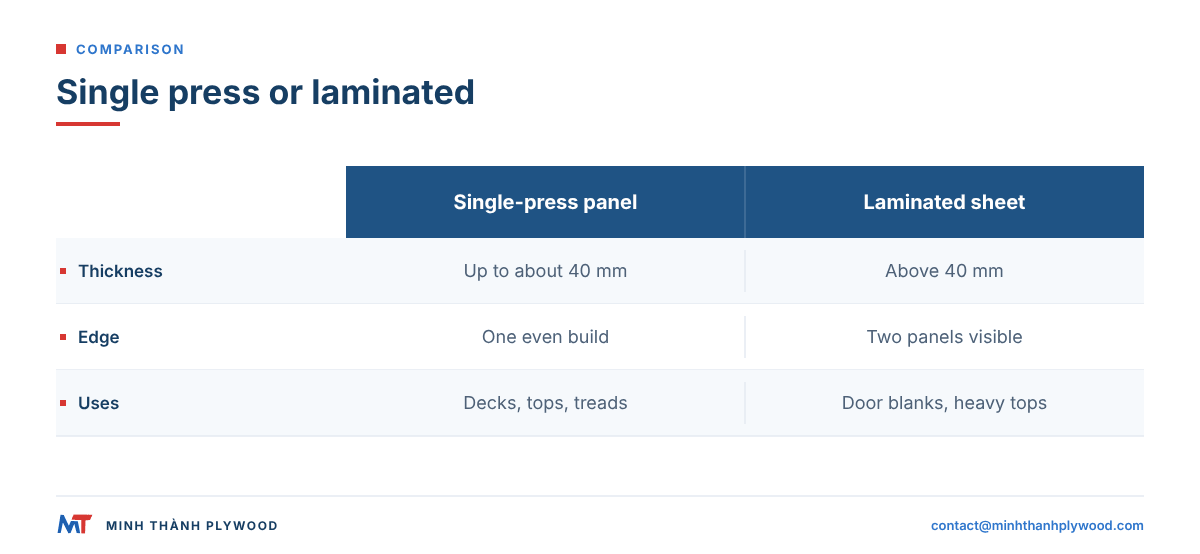
A single-press panel is laid up veneer by veneer and pressed once into its full thickness, or, at Minh Thanh, pressed as a core board and then faced. A laminated sheet is two or more finished panels glued together and pressed again.
| Single-press panel | Laminated sheet | |
|---|---|---|
| Thickness range | Up to about 40 mm | Above 40 mm, for example 44 or 54 mm |
| Glue lines | One between every pair of veneers | The same, plus one thick glue line between panels |
| Face look | One continuous build on the edge | Two panels visible on the edge |
| Typical use | Decks, floors, tops, treads, jigs | Door blanks, very heavy worktops, special structural parts |
For an edge that is seen, a single-press panel looks better, because the layers run evenly through the full thickness. For parts thicker than 40 mm, a laminate of two Minh Thanh panels, for example 2 × 25 mm, gives a 50 mm sheet with the same face, core and glue throughout. Lamination of finished panels is done by the buyer or a converter.
How much does thick plywood weigh?
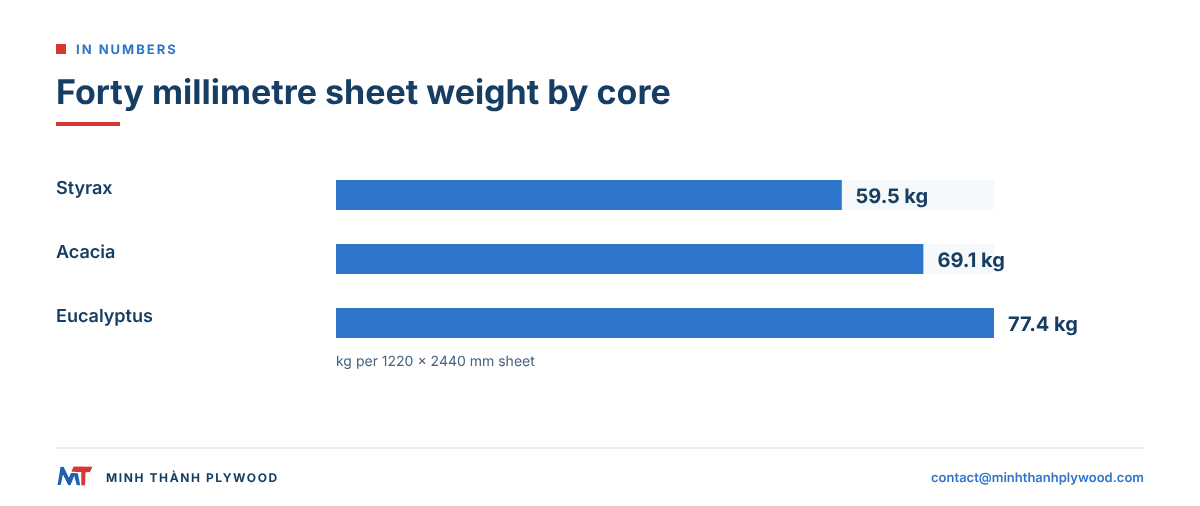
Weight is the first practical limit on thick plywood. A sheet’s weight is its volume times the core density:
| Thickness (1220 × 2440 mm) | Volume per sheet | Styrax 500 kg/m³ | Acacia 580 kg/m³ | Eucalyptus 650 kg/m³ |
|---|---|---|---|---|
| 24 mm | 0.0714 m³ | about 35.7 kg | about 41.4 kg | about 46.4 kg |
| 25 mm | 0.0744 m³ | about 37.2 kg | about 43.2 kg | about 48.4 kg |
| 27 mm | 0.0804 m³ | about 40.2 kg | about 46.6 kg | about 52.2 kg |
| 30 mm | 0.0893 m³ | about 44.7 kg | about 51.8 kg | about 58.0 kg |
| 35 mm | 0.1042 m³ | about 52.1 kg | about 60.4 kg | about 67.7 kg |
| 40 mm | 0.1191 m³ | about 59.5 kg | about 69.1 kg | about 77.4 kg |
A 25 mm Styrax sheet is a two-person lift. A 40 mm Eucalyptus sheet, at about 77 kg, needs a vacuum lifter, a panel cart or a forklift. Real Eucalyptus panels can reach 750 kg/m³ when the veneer is denser, so weigh one sheet before planning a lift or a payload. The Styrax core takes about 18 kg off every 40 mm sheet compared with Eucalyptus, which is why European furniture buyers who need thick tops often choose it.
How many thick sheets fit in a 40HC?
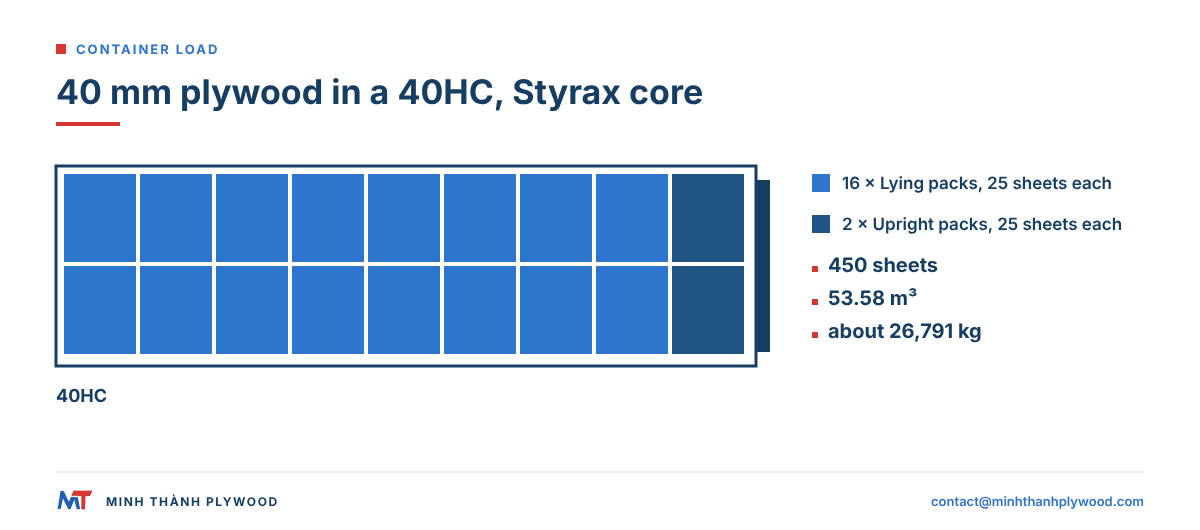
A 40HC of 1220 × 2440 mm sheets is loaded in packs about 1,000 mm high, so a pack holds 40 sheets of 25 mm or 25 sheets of 40 mm. Styrax loads 18 packs (16 lying and 2 upright), Acacia 16 and Eucalyptus 15, within a planning payload of 28,000 kg.
| Thickness and core | Packs × sheets | Sheets per 40HC | Volume | Cargo weight |
|---|---|---|---|---|
| 24 mm Styrax | 18 × 41 | 738 | 52.73 m³ | about 26,363 kg |
| 25 mm Styrax | 18 × 40 | 720 | 53.58 m³ | about 26,791 kg |
| 25 mm Eucalyptus | 15 × 38 | 570 | 42.42 m³ | about 27,573 kg |
| 27 mm Styrax | 18 × 37 | 666 | 53.53 m³ | about 26,764 kg |
| 30 mm Styrax | 18 × 33 | 594 | 53.05 m³ | about 26,523 kg |
| 30 mm Acacia | 16 × 33 | 528 | 47.15 m³ | about 27,348 kg |
| 30 mm Eucalyptus | 15 × 32 | 480 | 42.87 m³ | about 27,863 kg |
| 35 mm Styrax | 18 × 28 | 504 | 52.51 m³ | about 26,255 kg |
| 40 mm Styrax | 18 × 25 | 450 | 53.58 m³ | about 26,791 kg |
| 40 mm Acacia | 16 × 25 | 400 | 47.63 m³ | about 27,625 kg |
| 40 mm Eucalyptus | 15 × 24 | 360 | 42.87 m³ | about 27,863 kg |
On Eucalyptus the weight sets the load, so packs are cut below the height limit: 32 sheets of 30 mm instead of 33, 24 sheets of 40 mm instead of 25. With a booking below 28,000 kg, give the figure and the plan is recalculated; the container packing calculator runs other payloads.
How much stiffer is thick plywood than 18 mm?
Bending stiffness rises with the cube of thickness, so each step up in the thick range buys a large gain for a moderate rise in weight:
| Thickness | Stiffness, 18 mm = 1.00 | Weight, 18 mm = 1.00 | Stiffness per kg, 18 mm = 1.00 |
|---|---|---|---|
| 18 mm | 1.00 | 1.00 | 1.00 |
| 25 mm | about 2.68 | about 1.39 | about 1.93 |
| 30 mm | about 4.63 | about 1.67 | about 2.78 |
| 35 mm | about 7.35 | about 1.94 | about 3.78 |
| 40 mm | about 10.97 | about 2.22 | about 4.94 |
Read the table this way: a 30 mm deck is 4.6 times as stiff as an 18 mm deck on the same supports, for 1.7 times the weight. If an 18 mm shelf bends too much on a long span, moving to 25 mm cuts the deflection to less than half before you add a single support. The same stiffness can also come from two layers of 18 mm screwed and glued, at 36 mm, which some workbench builders prefer for the double face.
What is thick plywood used for?
Thick plywood is chosen where a panel spans, carries a load or takes impact:
- Workbenches and assembly tables. 30–40 mm tops stay flat under clamps and hammering; a sanded furniture face gives a smooth work surface.
- Stage and exhibition decks. 25–30 mm decks on frames carry people and equipment; anti-slip film faces are used where the deck is walked on wet.
- Truck and trailer floors. 25–35 mm floors in a phenolic or anti-slip build take forklift wheels and pallets.
- Stair treads. Exterior or CDX-type panels with water-resistant melamine-fortified or phenolic glue for outdoor and service stairs.
- CNC spoilboards and jigs. A calibrated 25–40 mm sheet held to ±0.2–0.3 mm is a flat reference for routers and assembly jigs.
- Heavy shelving and racking. Archive, warehouse and retail shelving on long spans.
- Furniture tops. Thick tables, desks and counters with the layered edge on show.
Formwork reuse and cost per pour. Film-faced formwork panels are bought by the number of pours, not by the sheet. A European formwork guide puts an 18 mm film-faced panel at about 10 to 20 pours, and heavier 24 to 30 mm panels with a thicker film and a phenolic bond at more, which lowers the cost per pour even though the sheet costs more.
The cost per pour is the sheet price divided by the pours it gives, so a 24 mm panel that outlasts an 18 mm panel by half again is the cheaper panel on a long job. The film-faced plywood page covers the range.
For each use the core, glue and face follow the job: Styrax for light furniture tops, Eucalyptus for wear and screw-holding, a phenolic bond and film face for floors and decks exposed to water.
Thick plywood or LVL: which one for your part?
Choose thick plywood for panels that span in two directions, and LVL (laminated veneer lumber) for long parts that carry load along their length. Both are made from veneers; the difference is the grain direction.
| Thick plywood | LVL | |
|---|---|---|
| Grain | Turned 90° at each layer | All veneers in one direction |
| Stiffness | In both directions across the sheet | Highest along the length |
| Shape | Wide sheets, 1220 × 2440 mm and similar | Beams, rails, studs, frames |
| Typical parts | Decks, floors, tops, treads, spoilboards | Bed rails, door frames, shelf rails, packaging beams, headers |
Minh Thanh makes both, and the LVL page lists the sections. A furniture order that needs thick tops and long rails can carry both in one container by agreement.
What thickness tolerance should you expect from Vietnamese furniture plywood?
Sanded furniture plywood from Minh Thanh is held to ±0.2–0.3 mm, down to ±0.2 mm, and that applies to thick sheets as well as thin ones. Tolerances by product line:
- Sanded furniture panels: ±0.2–0.3 mm, down to ±0.2 mm on request.
- Commercial and film-faced panels: ±0.5 mm.
- Packing plywood: ±0.5–1.0 mm.
- Length and width: ±2 mm.
For thick panels the tolerance is held by calibrating the core board before the faces are pressed on, then sanding both faces. On a 40 mm workbench top joined from two sheets, ±0.2 mm means a step of 0.4 mm at most between them, small enough to flush with one pass of a plane. Measure five sheets from different packs with a digital caliper at four points, 50 mm in from the edges, to check a delivery.
Which glue should thick plywood have for indoor and outdoor use?
Choose the glue for where the panel will live; the thickness does not change the rule. Glue and emission class are two separate lines on the order:
- Indoor furniture and fit-out: UF glue at E0 emission, the standard for furniture and interior panels.
- Humid rooms, vehicle interiors and covered decks: melamine-fortified (MR) bond.
- Outdoor, wet and floor uses: phenolic (WBP) bond, as used for exterior, film-faced and anti-slip panels.
For the emission side, Minh Thanh holds CARB P2 / TSCA Title VI certification for veneer-core hardwood plywood (ICTT mill no. 23024), and six ASTM D6007 chamber tests between April 2025 and June 2026 on 9, 15 and 18 mm panels averaged 0.014–0.032 ppm. The limit for veneer-core hardwood plywood is 0.05 ppm under 40 CFR 770.10. For bond classes, BS EN 636:2012+A1:2015 covers plywood for general-purpose use in dry, humid or exterior conditions. E0 is tested every three months, and third-party testing to EN 717-1 or another method is arranged through SGS on request.
Which core and face suit 30mm ply board?
For 30mm ply board, pick the core for weight and wear, and the face for the finish. Minh Thanh uses white Styrax and Eucalyptus cores as standard and makes Acacia and Pine cores on order.
| Core | Reference density | 30 mm sheet weight | Best thick use |
|---|---|---|---|
| Styrax | 500 kg/m³ | about 44.7 kg | Furniture tops, shelving, exposed pale edges, lightest handling |
| Acacia | 580 kg/m³ | about 51.8 kg | Middle choice for decks and benches |
| Eucalyptus | 650 kg/m³ | about 58.0 kg | Floors, treads, workbench tops that take impact, screw-heavy parts |
Faces: birch (grades D+/D, D/D, D/E; D+/D is close to B/BB), poplar, pine and eucalyptus (A/A, A/B, B/B), engineered veneer and okoume are the most produced, with bintangor, gurjan and sapele on request. For floors and decks, a phenolic film or anti-slip film replaces the veneer face. The approved sample fixes the appearance.
What does thick plywood cost per sheet?
In October 2026 Minh Thanh’s furniture and interior plywood started from US$350/m³ and commercial plywood from US$250/m³, FOB Hai Phong. The sheet price is the volume times the rate. These are raw FOB examples per 1220 × 2440 mm sheet, not delivered prices.
| Thickness | Volume per sheet | Commercial, US$250/m³ | Furniture, US$350/m³ |
|---|---|---|---|
| 24 mm | 0.0714 m³ | about US$18 | about US$25 |
| 25 mm | 0.0744 m³ | about US$19 | about US$26 |
| 27 mm | 0.0804 m³ | about US$20 | about US$28 |
| 30 mm | 0.0893 m³ | about US$22 | about US$31 |
| 35 mm | 0.1042 m³ | about US$26 | about US$37 |
| 40 mm | 0.1191 m³ | about US$30 | about US$42 |
UK merchants price thick panels by the sheet and by the pack. Wickes lists 18 mm non-structural hardwood plywood at £35.80, and Sheet Materials Wholesale prices 279 plywood lines by thickness, with 24 mm birch BB/CP sold in packs of 25. A container buyer compares landed cost per sheet: FOB plus sea freight, duty and delivery, divided by the sheets in the 40HC table above.
Can you order custom thicknesses, sizes and a mixed container?
Yes. Minh Thanh makes any thickness from 3 to 40 mm, so a 28 or 32 mm panel is a normal order line. Sizes:
- Standard: 1220 × 2440 mm (8 × 4 ft) and 1250 × 2500 mm. The 1250 × 2500 mm sheet is 3.13 m², 5 % more area than the 2.98 m² of 1220 × 2440 mm, which leaves a trimming margin where a full 4 × 8 ft (1220 × 2440 mm) part is cut.
- Custom: 1220 × 2500 and 1220 × 2280 mm, and other sizes up to 1250 × 2500 mm on order.
- Cut-to-size: one panel cut into 4, 6 or 8 pieces, shipped regularly to Italy and other European markets.
A container can carry more than one specification by agreement: usually one or two, three to six when the volumes justify it. Thick sheets travel well with thinner stock, because a few packs of 40 mm add weight without filling the container. A plan of 18 mm carcass panels plus a few packs of 30 mm tops is one example; the packing calculator shows how each pack changes the payload.
How should thick plywood be handled and stored?
Thick sheets arrive dried to 8–12 % moisture content, the normal range for furniture plywood, and keep their flatness if they are stored the way they were packed. Four rules keep them that way:
- Store flat on evenly spaced bearers, never on edge against a wall for long.
- Keep the pack wrapped until the sheets are cut, so faces do not take up moisture unevenly.
- Let sheets acclimatise in the workshop for a few days before machining a precision top.
- Seal cut edges on panels for floors and outdoor treads.
Lift heavy sheets with a vacuum lifter or a panel cart: a 40 mm Eucalyptus sheet weighs about 77.4 kg. Every Minh Thanh shipment is photographed and filmed before loading, and the buyer receives the files, so the pack condition at loading is on record.
How do you write a thick plywood line on a quotation request?
A complete line names the thickness, the tolerance and every element that changes price:
30 mm furniture plywood, birch face D+/D, Eucalyptus core, UF glue at E0, CARB P2 / TSCA Title VI, sanded both sides, 1220 × 2440 mm, ±0.3 mm, 8–12 % moisture, export packing, 1×40HC (about 480 sheets), FOB Hai Phong.
Then the order runs in five steps:
- Free sample of the face, core and grade; the approved sample is the reference.
- 30% deposit, then production in 15–45 days.
- Inspection and loading, photographed and filmed, files sent to you.
- Balance of 70% against the scanned B/L, or irrevocable L/C at sight; FOB Hai Phong, CFR or CIF.
- Documents: invoice, packing list, B/L, certificate of origin (EUR.1 for the EU), phytosanitary and fumigation certificates, insurance with CIF, and the CARB P2 / TSCA files, test reports and EUDR compliance dossier on order.
Indicative starting prices, October 2026: furniture and interior plywood from US$350/m³ and commercial plywood from US$250/m³. Typical days at sea from Hai Phong are 25–35 to the Mediterranean, 30–40 to Northern Europe and 35–45 to the US East Coast. The plywood thickness guide compares every thickness, and the 20 mm guide covers the step below the thick range.
Buyer questions, answered
What is the thickest plywood sheet you can buy?
Single pressed panels run to about 40 mm in regular production, and Minh Thanh makes 3 to 40 mm. Thicker sheets, such as 44 or 54 mm, are two or more panels glued and pressed together.
How thick is plywood?
Plywood runs from about 3 mm to 40 mm in one panel. The common furniture thicknesses are 6, 9, 12, 15 and 18 mm; 21 mm is the formwork size and 25–40 mm is the thick range.
How thick is 3/4 plywood?
3/4 inch is 19.05 mm nominal, but most North American 3/4 sheets are sanded to 23/32 inch, about 18.3 mm. The metric equivalent ordered from Asian mills is 18 mm.
How thick is 23/32 plywood?
23/32 inch is 18.26 mm, often rounded to 18.3 mm. It is the actual thickness of most sheets sold as 3/4 inch in North America.
How much does a 40 mm plywood sheet weigh?
A 1220 × 2440 × 40 mm sheet holds 0.1191 m³ of wood, so it weighs about 59.5 kg on a Styrax core, 69.1 kg on Acacia and 77.4 kg on Eucalyptus.
How many plies does 30 mm plywood have?
Usually 17 to 23. Two face veneers and fifteen to twenty-one core veneers of 1.4–2.0 mm make up the 30 mm, with the grain turned at each layer.
What thickness tolerance should I expect from Vietnamese furniture plywood?
Sanded furniture plywood from Minh Thanh is held to ±0.2–0.3 mm and down to ±0.2 mm, including thick sheets. Commercial and film-faced panels are held to ±0.5 mm and packing plywood to ±0.5–1.0 mm.
Can Vietnamese plywood factories produce custom sizes and thicknesses?
Yes. Minh Thanh makes any thickness from 3 to 40 mm, standard sizes 1220 × 2440 and 1250 × 2500 mm, custom sizes such as 1220 × 2500 and 1220 × 2280 mm, and cut-to-size pieces.
Can I order a mixed container with different plywood thicknesses?
Yes, by agreement. A 40HC usually carries one or two specifications, and three to six when the volumes justify it, so thick sheets can travel with 18 mm or thinner stock.
What is thick plywood used for?
Workbench and assembly tops, stage and exhibition decks, truck and trailer floors, stair treads, CNC spoilboards and jigs, heavy shelving and thick furniture tops.
Is thick plywood stronger than LVL?
They do different jobs. Plywood turns the grain at each layer and is stiff in both directions, which suits decks and tops; LVL keeps every veneer in one direction and suits beams, rails and headers.
What thickness plywood for a roof?
Roof sheathing in North America is usually 1/2 to 5/8 inch, about 12–16 mm, depending on rafter spacing and the local building code. Exterior or CDX-type panels with a water-resistant bond are used.