
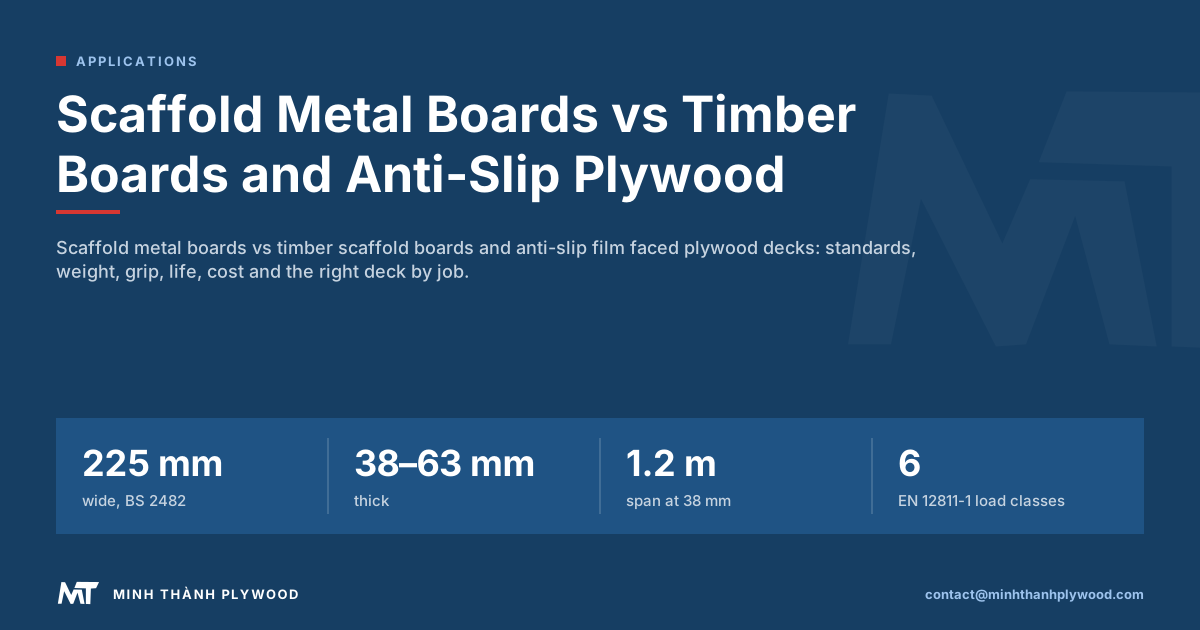
Scaffold metal boards last longest and do not burn, timber scaffold boards are the cheapest and easiest to cut, and anti-slip plywood decks give the widest, grippiest surface in system scaffolds and work platforms. The right board depends on the scaffold type and the job. Minh Thanh Plywood makes anti-slip film faced plywood to order; this comparison covers standards, weight, grip, life and cost.
Scaffold metal boards vs timber vs anti-slip plywood: the short answer
Scaffold metal boards are the long-life choice, timber scaffold boards are the low-cost standard on tube-and-fitting scaffolds, and anti-slip plywood is the deck material for system decks, fixed platforms and walkways. Each serves a different scaffold, so the question is less which board is best than which deck the job needs.
- Choose steel boards for system scaffolds that hire out for years, for hot work and for sites where boards are lost to damage and theft.
- Choose timber boards for tube-and-fitting scaffolds, short jobs and decks that must be cut to fit round obstacles.
- Choose anti-slip plywood for framed system decks, mobile towers, fixed work platforms, loading ramps and walkways that must grip when wet.
The comparison below sets the three side by side on standards, sizes, weight, slip resistance, life and cost.
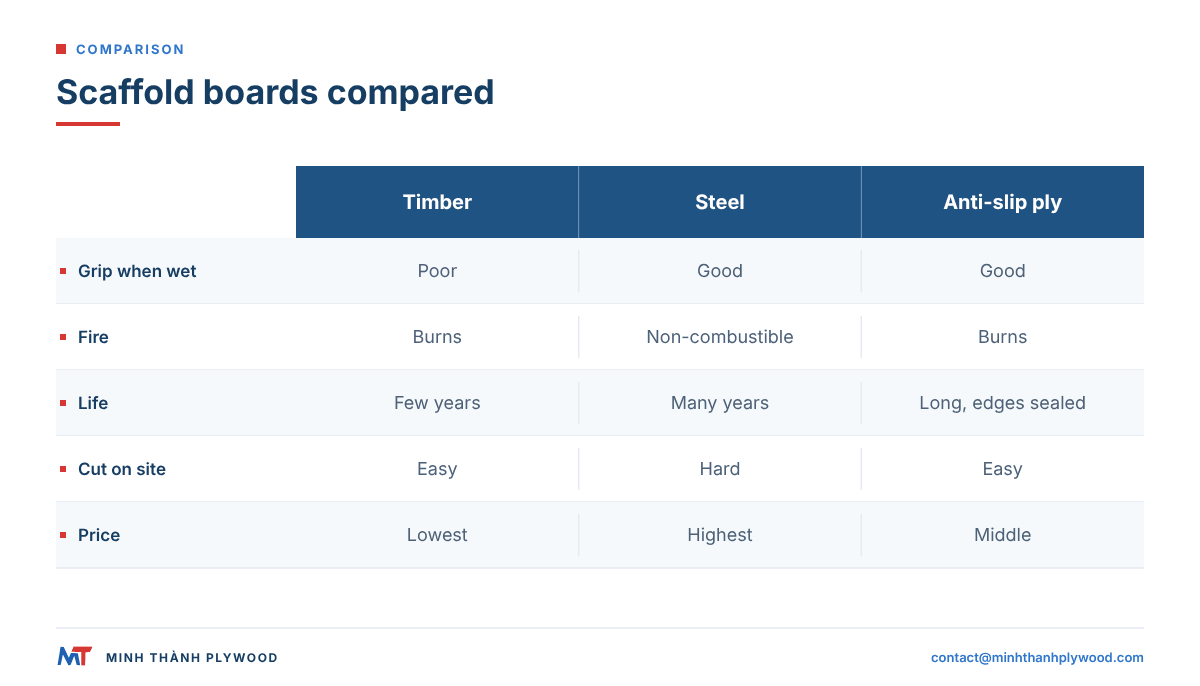
Comparison table: timber, steel and anti-slip plywood
The table compares the three deck materials metric by metric, so you can read your project’s deciding row first.
| Metric | Timber scaffold board | Steel scaffold board | Plastic or composite board | Anti-slip plywood deck |
|---|---|---|---|---|
| Typical standard | BS 2482 (UK) | EN 12811-1 load classes, maker’s rating | Maker’s rating, no BS 2482 grading | EN 12811-1 when part of a system deck |
| Format | Plank 225 mm wide, 38 to 63 mm thick | Plank with punched surface, often hooked ends | Plank, lengths 2 to 13 ft | Sheet 1220 × 2440 mm or cut to deck size, 12 to 21 mm |
| Weight | Moderate, absorbs water | Heavier per board in most designs | Lightest per board, about 16 kg at 13 ft | Light for its area: about 11.7 kg/m² at 18 mm on Eucalyptus core |
| Grip | Fair dry, slippery when wet or icy | Good through raised perforations | Moulded grip pattern | Good wet and dry from the mesh film |
| Fire | Combustible | Non-combustible | Combustible, melts | Combustible |
| Life | A few years | Many years | Many years, rot-proof | Long while film and edges are intact |
| Cut to fit on site | Easy | Hard | Easy, but check the maker allows it | Easy, then seal the cut edge |
| Inspection | Splits, knots, rot, end bands | Dents, corrosion, hooks | Cracks, UV damage | Film wear, edge damage, delamination |
| Purchase price | Lowest | Highest | Similar to steel, £11 to £40 a board | Between the two per square metre |
| Verdict | Tube-and-fitting, short jobs | Long-term system hire | Light, rot-proof hire stock | Framed decks, platforms, walkways |
Whatever the board, the scaffold design sets the span and load. Boards are only as safe as the spacing of the supports beneath them.
Timber scaffold boards and BS 2482
Timber scaffold boards in the UK are made to BS 2482, which sets the size, the strength grading and the marking of each board. They are solid softwood planks, usually spruce, fir or pine.
What the standard and common practice give a buyer:
- Size: 225 mm wide; 38, 50 or 63 mm thick.
- Grading: each board is visually or machine strength graded and marked with the standard, the grade and the supplier.
- End bands: galvanised steel bands nailed round each end stop splits from running.
- Span: a 38 mm board is commonly supported at spans of up to 1.2 m on standard access scaffolds; thicker boards span further.
The UK Health and Safety Executive’s scaffolding guidance puts responsibility for board choice and inspection with the scaffold contractor. Timber boards are cheap and easy to replace, but they split, warp and rot, and a wet or icy timber deck is slippery.
Metal scaffolding board types: steel scaffolding boards and aluminium
Scaffold metal boards are galvanised steel or aluminium planks with punched, raised perforations, made for system scaffolds and long hire fleets. Steel scaffolding boards are the most common type of metal scaffolding board.
Why contractors buy them:
- Life: galvanised steel does not rot or split and survives years of hire.
- Fire: non-combustible, so they suit hot work and fire-sensitive sites.
- Grip and drainage: raised perforations give grip and let water and dust through.
- Fixing: many system boards have hooks or end plates that lock onto the transoms, so boards do not slide.
The drawbacks: metal scaffolding boards cost more, are heavier per board in most designs, are hard to cut round obstacles and can corrode where the coating is damaged. Aluminium boards save weight but cost more again.
Steel scaffold board sizes and load class
Steel scaffold boards are made to the timber board’s footprint so they fit the same fittings. UK retailers list them as follows:
| Property | Steel board |
|---|---|
| Material | Galvanised steel, 2 mm thick body |
| Section | 38 mm deep × 225 mm wide, same as a timber board |
| Standard lengths | 3, 4, 5, 6, 8, 10 and 13 ft (0.9, 1.2, 1.5, 1.8, 2.4, 3.0 and 3.9 m) |
| Load class | Load Class 6 under EN 12811-1 (one of the highest ratings for temporary works) |
| Lifting braces | 1 brace on boards up to 1220 mm, 2 on longer boards |
| Weight | 5.1 kg at 3 ft to 22.88 kg at 13 ft |
Timber boards come in the same seven lengths, and a plastic board adds a 2 ft (0.6 m) length. Timber is sold in packs of 50 at 13 ft, cut to length by the merchant with a tolerance of about ±5 mm for the saw cut.
Which proof do UK buyers check on scaffold boards?
UK scaffold board buyers look for four marks: BS 2482 (the standard for timber scaffold boards, in its 2009 edition), grading by BM TRADA or a Kitemark audit, NASC approved-product status under the NASC code of practice, and an ISO 9001 quality system (TRAD UK, for example, is audited by BSI to ISO 9001:2015).
Steel boards are rated by load class to EN 12811-1 instead. Minh Thanh’s anti-slip plywood is a deck panel, not a BS 2482 board: it is sold as a sheet deck on framed platforms, with its film, glue and core given on the quotation, and not as a plank substitute on a tube-and-fitting scaffold.
What is anti-slip film faced plywood?
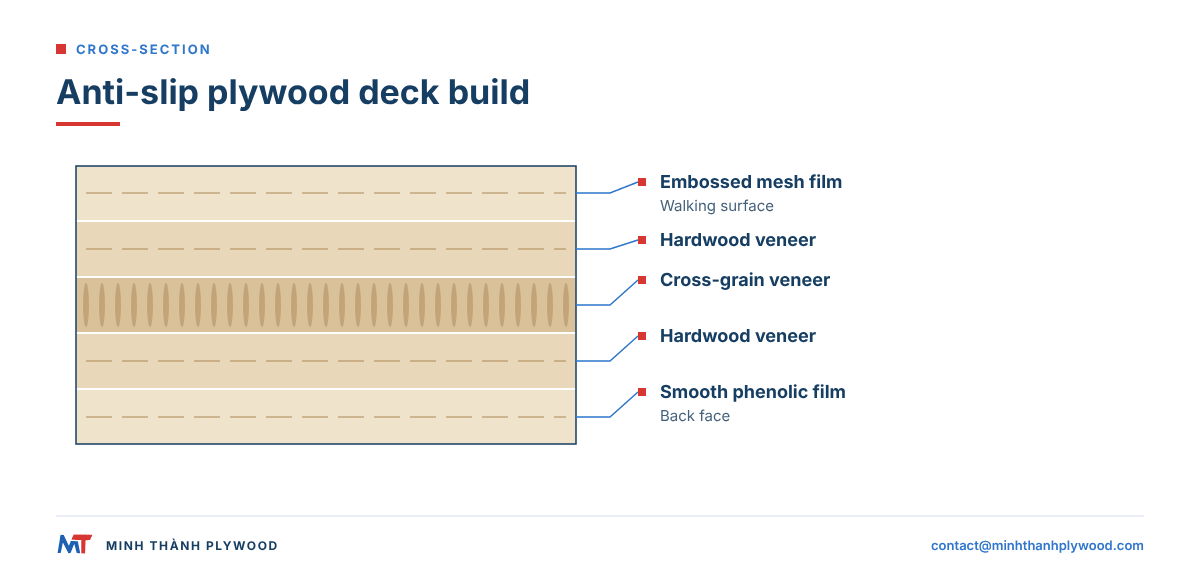
Anti-slip film faced plywood is plywood with a phenolic film pressed onto the face in a raised wire-mesh or hexagonal pattern, giving a hard-wearing surface that grips underfoot even when wet. It is used for scaffold and platform decks, walkways, trailer floors and stages. The back is usually smooth film.
The build of an anti-slip panel:
- Core: hardwood veneers laid cross-grain and pressed with water-resistant phenolic (WBP) or melamine-fortified glue.
- Face: phenolic film embossed with a mesh pattern during pressing.
- Back: smooth phenolic film to balance the panel.
- Edges: sealed with paint so water stays out of the core.
Panels come in 1220 × 2440 mm sheets in thicknesses such as 12, 15, 18 and 21 mm, or are cut to deck sizes. Minh Thanh makes anti-slip plywood on order, with film-faced panels held to a thickness tolerance of ±0.5 mm and length and width to ±2 mm, so deck panels drop into their frames without trimming.
Where anti-slip plywood fits in scaffolding
Anti-slip film faced plywood is used in scaffolding as the deck panel inside aluminium-framed system decks, on mobile tower platforms and on fixed work platforms, not as a loose plank in place of a timber board. The frame takes the span; the plywood gives the walking surface.
Typical uses in formwork and scaffolding:
- System decks: aluminium frames with plywood infill panels, light enough for one person to lift.
- Mobile towers: platform decks with a trapdoor.
- Fixed platforms and stair landings: sheets screwed to bearers.
- Formwork access: walkways and working decks on wall and slab formwork.
- Loading bays and ramps: heavy foot and trolley traffic.
Beyond the site, the same panels floor trailers, trucks, stages and industrial mezzanines. Because they are sheets, they cover a deck without the gaps between planks, so tools and debris do not fall through.
Weight per square metre and handling
Anti-slip plywood is light for the area it covers: an 18 mm sheet on Eucalyptus core of 1220 × 2440 mm weighs about 34.8 kg, which works out at about 11.7 kg per square metre (34.8 kg ÷ 2.98 m²). A Styrax-core sheet of the same size weighs about 26.8 kg.
Why weight per square metre matters on a deck:
- Handling: a light deck panel can be carried up a tower or passed hand to hand.
- Load on the frame: a lighter deck leaves more of the scaffold’s rated capacity for people and materials.
- Transport: more area per truck or container.
Timber boards absorb water and grow heavier on a wet site; steel boards keep their weight but are usually the heaviest per square metre of deck. When comparing quotes, compare kilograms per square metre of deck, not per board.
Slip resistance: how each surface grips
Anti-slip plywood and perforated scaffold metal boards grip better than plain timber, especially when wet, because both have a raised texture that the sole bites into. Plain timber relies on its sawn surface, which smooths and fouls with use.
How buyers specify grip:
- Surface pattern: mesh or hexagonal embossing on plywood; raised punched holes on metal boards.
- Test method: slip resistance is measured with methods such as the pendulum test or the ramp test, and the buyer names the method and the target in the order.
- Wear: the film pattern wears in traffic lanes; plan to turn or replace panels in the busiest routes.
Smooth film-faced plywood, made for concrete forms, is slippery underfoot when wet and should not be used as a deck. Order the anti-slip face for anything people walk on.
Life, maintenance and inspection
Steel boards last longest, anti-slip plywood lasts well when its film and edges are kept intact, and timber boards wear out fastest. Each needs inspection before use, and each fails in its own way.
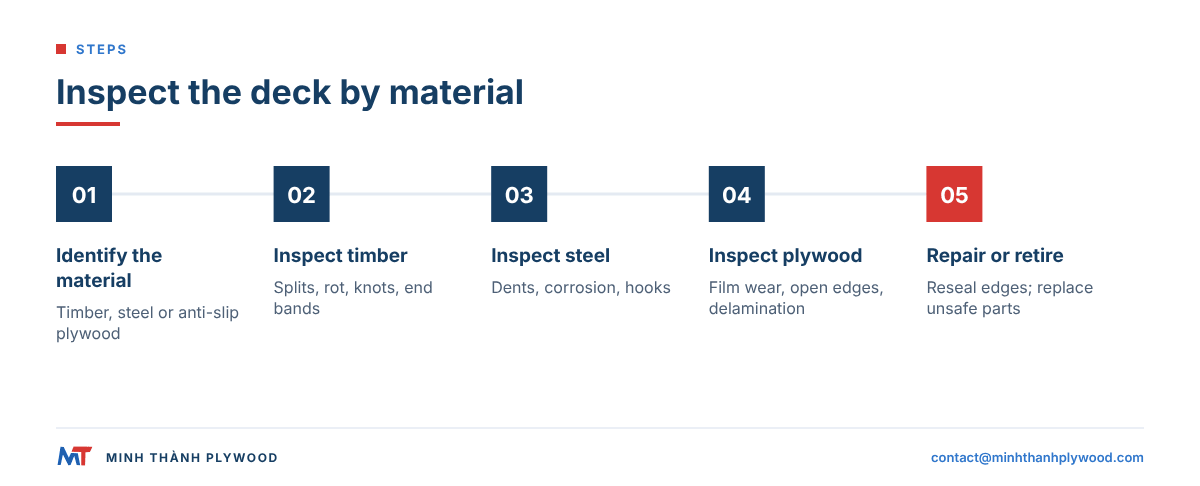
| Material | Inspect for | Maintenance |
|---|---|---|
| Timber board | Splits, large knots, rot, missing end bands, warping | Store flat and dry, replace damaged boards |
| Steel board | Dents, bent hooks, corrosion, sharp edges | Clean, check hooks, retire bent boards |
| Anti-slip plywood | Worn film, open edges, delamination, soft spots | Reseal cut and damaged edges, store flat under cover |
Plywood panels last longest when every cut edge is sealed on site and the panels are stored flat and off the ground. Damage usually starts at an unsealed edge, where water reaches the core.
Cost: purchase price against service life
Timber boards are cheapest to buy, steel boards cost the most, and anti-slip plywood sits between them per square metre of deck. The fair comparison is cost per year of service, not price per board.
UK retail prices ex VAT show the gap. At one national merchant, a 13 ft timber board is £25.50, a 13 ft steel board £35 and a 13 ft plastic board £40; a 8 ft board is £19 in timber, £31 in steel and £29 in plastic. Plywood decks are priced per sheet and compared per square metre.
What drives the real cost:
- Service life: a steel board that outlasts several timber boards can be cheaper over a hire fleet’s life.
- Losses: boards cut, damaged or lost on site; timber boards are often written off after one job.
- Coverage: a plywood sheet covers more deck than a plank with fewer joints.
- Labour: hooked metal boards and framed decks go down faster than loose planks.
For anti-slip plywood bought by the container, the price follows the core, glue, film and thickness. Minh Thanh’s minimum order is one 40HC, and production takes 15–45 days after the deposit.
Safety rules that apply to every board
Every scaffold deck, whatever the board, must be designed for its load class, fully boarded and fixed against sliding, and inspected before use. The material does not replace the design.
The rules buyers meet most often:
- Load classes: EN 12811-1 groups working areas into six load classes, from 0.75 kN/m² for inspection work up to 6.0 kN/m² for heavy masonry and storage.
- Capacity: in the US, OSHA standard 1926.451 requires each scaffold to support its own weight and at least four times the maximum intended load.
- Overhang: OSHA requires a platform end to extend at least 6 inches past its support unless cleated, and no more than 12 inches on platforms of 10 feet or less; UK practice keeps the overhang between 50 mm and four times the board thickness.
- Gaps: platforms are fully planked or decked, with only small gaps between units.
Which board for which job
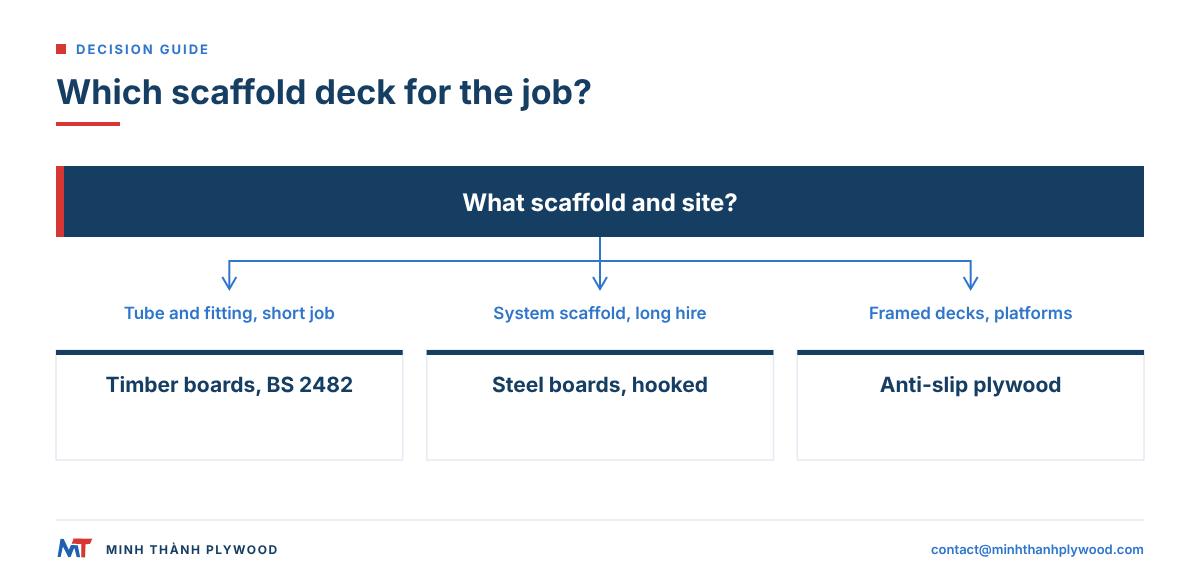
Pick the deck by the scaffold type first and the site conditions second. The verdict by use:
- Tube-and-fitting access scaffold, short job: timber boards to BS 2482.
- System scaffold on a long hire: steel scaffolding boards with hooked ends.
- Hot work or fire-sensitive site: metal boards.
- Aluminium system decks and mobile towers: anti-slip plywood infill panels.
- Fixed work platforms, walkways and ramps: anti-slip film faced plywood screwed to bearers.
- Formwork access decks: anti-slip plywood on the walkway, smooth film-faced plywood on the form face.
The falsework vs formwork guide explains how temporary works fit together on site, and what formwork is covers the system the decks serve.
What this means for your anti-slip plywood order
For anti-slip plywood decks, send a specification that fixes the grip, the build and the deck size, so panels arrive ready to fit.
A typical anti-slip plywood specification:
- Application: aluminium system deck infill, walkways and platforms
- Core: hardwood, closed
- Glue: phenolic (WBP), water-resistant
- Face and back: anti-slip mesh film on the face, smooth film on the back, edges sealed
- Thickness and size: 18 mm, 1220 × 2440 mm or cut to deck size, tolerance ±0.5 mm
- Packing and quantity: export pallets, one 40HC, destination port
Minh Thanh sends free samples with the quotation, and our quality and certificates page shows how panels are checked. See anti-slip plywood and film-faced plywood, then send your specification to contact@minhthanhplywood.com.
Buyer questions, answered
What are scaffold metal boards?
Scaffold metal boards are galvanised steel or aluminium planks with punched, raised perforations for grip and drainage, used as the working deck of tube-and-fitting and system scaffolds. Many system boards have hooks at the ends that lock onto the transoms.
Are steel scaffold boards better than timber?
Steel boards last much longer, do not rot or burn and need little maintenance, but they cost more and are harder to cut to fit. Timber boards are cheaper, lighter to cut and repair, and remain the default on UK tube-and-fitting scaffolds.
What is the British Standard for timber scaffold boards?
BS 2482 specifies timber scaffold boards: 225 mm wide and 38, 50 or 63 mm thick, strength graded and marked, with metal end bands. A 38 mm board is commonly supported at spans of up to 1.2 m.
What is anti-slip film faced plywood?
Anti-slip film faced plywood is plywood with a phenolic film pressed on with a wire-mesh or hexagonal pattern, giving a textured, grippy surface that stays usable when wet. It is used for scaffold and platform decks, walkways, trailer floors and stages.
Can plywood be used as a scaffold board?
Plywood is not used as a loose plank in place of a BS 2482 board. It is used as the deck panel in aluminium-framed system decks, on fixed work platforms and on mobile tower platforms, where the frame carries the span.
How much does a scaffold board weigh?
It depends on length and material; a board's weight is marked or listed by the maker. For anti-slip plywood, an 18 mm sheet on Eucalyptus core of 1220 × 2440 mm weighs about 34.8 kg, or about 11.7 kg per square metre.
How long do scaffold boards last?
Timber boards last a few years before splits, rot or damage take them out of service; steel and aluminium boards last many years. Anti-slip plywood decks last as long as the film and sealed edges are kept intact.
How far can a scaffold board overhang?
Under US OSHA rules, a platform end must extend at least 6 inches past its support unless cleated, and for platforms of 10 feet or less no more than 12 inches. UK practice limits the overhang to between 50 mm and four times the board thickness.
What thickness of anti-slip plywood is used for platforms?
12, 15, 18 and 21 mm are the common thicknesses. 18 mm is the usual choice for walk-on decks and platforms; thinner panels suit framed decks with close supports.
Why choose Vietnamese anti-slip plywood?
Vietnamese mills press anti-slip film on hardwood plantation cores at a cost-effective price and ship full containers to Europe, the Middle East and Asia. Minh Thanh makes anti-slip plywood on order, with film-faced panels held to ±0.5 mm.