
A plywood importer buys plywood by the container from mills abroad, clears it under the destination's rules and sells it on to distributors, dealers, merchants and manufacturers. The job is to buy the right build, prove its origin and emission class, and land it at a cost the market accepts. This guide, from Minh Thanh Plywood, covers mill checks, documents by market and the first container.
What does a plywood importer do?
A plywood importer buys plywood by the container from foreign mills and is the company of record when it crosses the border. It pays the mill, books or accepts the freight, clears customs, pays duty and tax, holds the stock and sells to the next link in the chain.
The work sits between two very different businesses. A mill sells full containers of a fixed specification, weeks after the order, against a deposit. A merchant or furniture plant wants a few packs of many specifications, now, on credit. The importer bridges that gap with money, warehouse space and knowledge of both ends.
Five jobs make up the role:
- Choosing the build. The importer decides which core, face, glue, emission class and tolerance its customers need, and writes them down for the mill.
- Qualifying mills. It checks that the mill is real, that its certificates and test reports are valid, and that its samples match its quotes.
- Carrying compliance. In most markets the importer is the operator under timber-legality law and the party the authorities hold responsible for emission rules.
- Financing the stock. It pays the deposit weeks before the goods arrive and sells over months.
- Handling claims. When a pack arrives damaged or out of tolerance, the importer settles with its customer first and with the mill after.
Our guide to how to import plywood from Vietnam follows a single order step by step. This article is about the importer’s business as a whole.
Importer, distributor and wholesale plywood dealers: who does what?
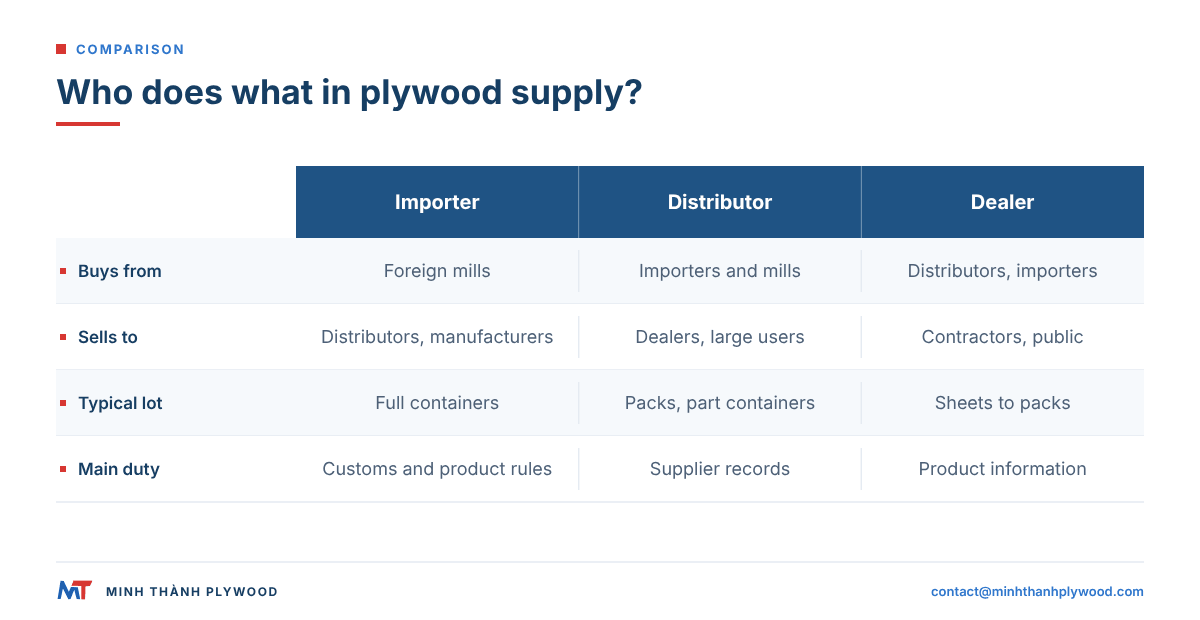
Importers, distributors, wholesale plywood dealers and retail plywood dealers are links in the same chain; what separates them is who they buy from, who they sell to and which legal duties they carry.
| Role | Buys from | Sells to | Typical lot | Main legal duty |
|---|---|---|---|---|
| Plywood importer | Foreign mills | Distributors, dealers, manufacturers | Full containers | Customs, timber-legality due diligence, product rules |
| Distributor or wholesaler | Importers and mills | Dealers, merchants, large users | Packs and part containers | Records of who supplied them |
| Plywood dealer or merchant | Distributors and importers | Contractors, joiners, the public | Single sheets to packs | Product information to the buyer |
| Manufacturer that imports | Foreign mills | Its own production | Full containers | Same as an importer |
Many companies hold two roles. A large wholesale plywood dealer may import its core range directly and buy fill-in specifications from other importers. A furniture or cabinet plant that buys a container a month is an importer for its own use and carries the same duties at the border.
A plywood distributorship is usually an agreement between a mill or brand and a distributor for a territory or product line. It sets the specifications, the price basis, the minimum volume and who handles claims.
Where does an importer’s margin come from, and what are the risks?
An importer’s margin comes from buying in containers at a factory price and selling in packs at a merchant price, after paying every cost in between. The gap is real money only when the stock sells at the planned price and nothing goes wrong on the way.
The costs between the mill’s FOB price and the importer’s selling price:
- sea freight and insurance (unless the mill sells CFR or CIF);
- customs duty and import tax under the destination’s tariff;
- port handling, the clearing agent and trucking to the warehouse;
- warehouse rent and handling, sheet by sheet;
- finance on the deposit and the balance, paid weeks or months before the sale;
- losses: damaged packs, rejected sheets and unsold specifications.
The risks the importer carries:
| Risk | Where it comes from | How importers reduce it |
|---|---|---|
| Wrong build | Quote and sample do not match the delivery | Written specification, approved sample, pre-loading photos and video |
| Thickness or flatness out of tolerance | Uncalibrated cores, single pressing | Tolerance on the contract, caliper check on arrival |
| Compliance failure | Missing origin records or emission proof | Certificate numbers checked before ordering, dossier per shipment |
| Price and freight swings | Veneer, resin and freight costs move between quote and loading | Validity date on the quote, price fixed on the proforma |
| Payment fraud | Bank details changed by email | Verify any account change by phone, pay only the account on the contract |
| Slow stock | Too many specifications, wrong thicknesses for the market | Start with 1–2 specifications that sell |
The importers that last treat the mill relationship as part of the margin: a mill that ships the same build every time saves the cost of checking, sorting and arguing on every container.
Which plywood do importers buy, and for whom?
Importers buy the plywood their customers use most, and most import ranges are built around four or five product lines. The customer decides the build.
| Customer | What they buy | What matters most |
|---|---|---|
| Furniture and cabinet plants | Furniture plywood, 9–18 mm, poplar, birch, EV or eucalyptus faces | Flat, even thickness, clean faces, E0 emission |
| Shopfitters and joiners | Furniture plywood, cut-to-size panels | Face match to the sample, tolerance |
| Van converters and caravan builders | Thin and light plywood, 3–12 mm | Weight per sheet, flatness, screw holding |
| Packaging and pallet makers | Packing plywood, 6–18 mm | Price per cubic metre, thickness tolerance |
| Contractors | Film-faced, anti-slip and exterior plywood | Bond, film weight, reuse count |
| Merchants and DIY chains | Commercial plywood, standard sizes | Price per sheet, face appearance, labels |
Minh Thanh Plywood is built for top-grade furniture and interior plywood, with Europe as its main market, and also makes commercial, packing and film-faced plywood. Its 10+ face veneers are mostly EV (engineered veneer), poplar, birch, okoume and pine, with bintangor, eucalyptus, gurjan and sapele on request.
Thin plywood from 3 to 5 mm, which van converters and furniture plants buy for backs and drawers, is always 5-ply at Minh Thanh: 3 mm is one core veneer, two cross-band veneers and two faces; 4 and 5 mm are three core veneers and two faces.
Most importers start with two or three of these customer groups and add lines when the first ones turn over. Furniture panels and commercial plywood share containers easily; film-faced panels for contractors often travel in their own containers, because contractors buy in larger lots and want the stock at one time. Packing plywood is priced per cubic metre and sold to a small number of large buyers, so it suits importers with warehouse space close to packaging plants.
Why importers source plywood from Vietnam
Importers source plywood from Vietnam for plantation hardwood cores, a wide choice of faces, compliance files that European and US buyers accept, and mills that take mixed and custom orders.
- Plantation cores. Vietnamese plywood is built on plantation acacia, eucalyptus and white Styrax cores. Styrax gives a light, pale core that many European furniture buyers prefer; acacia and eucalyptus give heavier, stiffer panels for commercial and film-faced use.
- Faces. Mills lay imported and local faces on Vietnamese cores: birch, poplar, okoume, pine, EV and others, quoted to the buyer’s approved sample.
- Compliance. Mills supply CARB P2 / TSCA Title VI certification for the US, emission test reports, and origin records and geolocation files for EUDR. Vietnam is on the EU’s low-risk country list under Implementing Regulation (EU) 2025/1093.
- Flexibility. Custom sizes such as 1220 × 2500 and 1220 × 2280 mm, cut-to-size panels, mixed containers and private labels are normal requests.
Sea transit from Hai Phong is typically:
| Destination | Days at sea from Hai Phong |
|---|---|
| South-East Asia | 5–12 |
| Middle East | 15–25 |
| US West Coast | 20–30 |
| Mediterranean | 25–35 |
| Northern Europe | 30–40 |
| US East Coast | 35–45 |
| West Africa | 35–50 |
Times vary by carrier and route. For the full case, see why source plywood from Vietnam.
How do importers qualify a Vietnam plywood mill?
Importers qualify a Vietnam plywood mill in seven steps, before any deposit is paid. Each step either confirms what the mill has said or shows where it differs.
- Confirm the company and the factory. Check the business registration, the factory address and that the company selling is the company producing. Ask for a live video call walking the press line, the core-laying area and the packing area.
- Check certificates by number. A CARB P2 / TSCA Title VI certificate names the third-party certifier and the mill number; check that the number appears on the certifier’s list. Do the same for ISO 9001 and any product certificate.
- Read the test reports. Emission reports should name the laboratory, the method, the panel thickness and the date. One report is a sample; several reports over months show a pattern.
- Get samples of the exact build. Ask for samples with the core, ply count, glue, face and thickness on the quote, and keep one signed sample as the reference for every order.
- Measure the samples. Calipers on corners and mid-edges, ply count at the edge, face thickness, moisture, flatness.
- Compare the quote line by line. A quote should state core, plies, glue and emission, thickness and tolerance, face and grade, sanding, packing, quantity, price, Incoterm, payment and validity.
- Place a trial container. One or two specifications, checked on loading through photos and video, and again on arrival.
At Minh Thanh Plywood, buyers can check the CARB P2 / TSCA Title VI certification (ICTT mill no. 23024), the ISO 9001:2015 certificate KAC25/0185 and the TCVN 11902:2017 veneer-faced plywood certificate VietCert 141.1-VNC-HC. Our checklist on how to choose a plywood supplier in Vietnam goes deeper into the visit and the red flags.
Red flags that should stop a deposit:
| Red flag | What it often means | What to ask |
|---|---|---|
| No factory video, only stock photos | A trader, or a mill hiding its floor | A live call on the press line today |
| Certificate number not on the certifier’s list | Expired, borrowed or invented certificate | The certifier’s listing, then a call to the certifier |
| Test report without laboratory, method or date | A report that proves nothing | The full report, with the panel thickness tested |
| Price far below every other quote | A lower-cost core, fewer plies or a thinner panel | The full build in writing |
| Full payment before production | Risk moved to the buyer | 30% deposit and 70% against B/L, or an L/C |
| Bank account in another company’s name | Possible fraud | Stop and verify by phone with a known contact |
A mill that answers each of these questions quickly, with documents, is worth a trial container.
Samples and test reports: what importers should ask for
Importers should ask for samples of the exact build they will order and for test reports that name the laboratory, method, thickness and date. A sample of the mill’s best panel says nothing about the panel on the quote.
Samples. Ask for two or three samples of each specification, cut from full sheets so the edges show the core. Write the build on each sample, sign one copy and keep it as the approved reference. Minh Thanh sends free samples.
Emission reports. For furniture plywood, the useful reports are chamber tests to a recognised method. Our six ASTM D6007 chamber tests between April 2025 and June 2026, on 9, 15 and 18 mm panels, averaged 0.014–0.032 ppm against the 0.05 ppm CARB Phase 2 / TSCA Title VI limit for veneer-core hardwood plywood. Three were run by Shanghai Hongjun (HJ-QAT-250597, HJ-QAT-251303, HJ-QAT-261036) and three by ICTT Vietnam (ICTTVN-QAT-250841, ICTTVN-QAT-251173, ICTTVN-QAT-260272).
Buyer-method tests. European buyers often ask for EN 717-1 or another method. Third-party testing to the buyer’s method is arranged through SGS on request.
Packaging tests. EU importers placing packed goods on the market now ask about packaging. Our packaging materials were tested by SGS in September 2026 under Regulation (EU) 2025/40: lead, cadmium, mercury and hexavalent chromium were not detected in all four materials (cardboard, plywood and pallet blocks, strapping band, wrapping film), a pass against the 100 mg/kg limit.
What should a first container hold?
A first container should hold one or two specifications that the importer already knows will sell, packed so each pack can be checked on arrival. A trial container proves the mill, the build and the logistics; it is not the place to test ten new products.
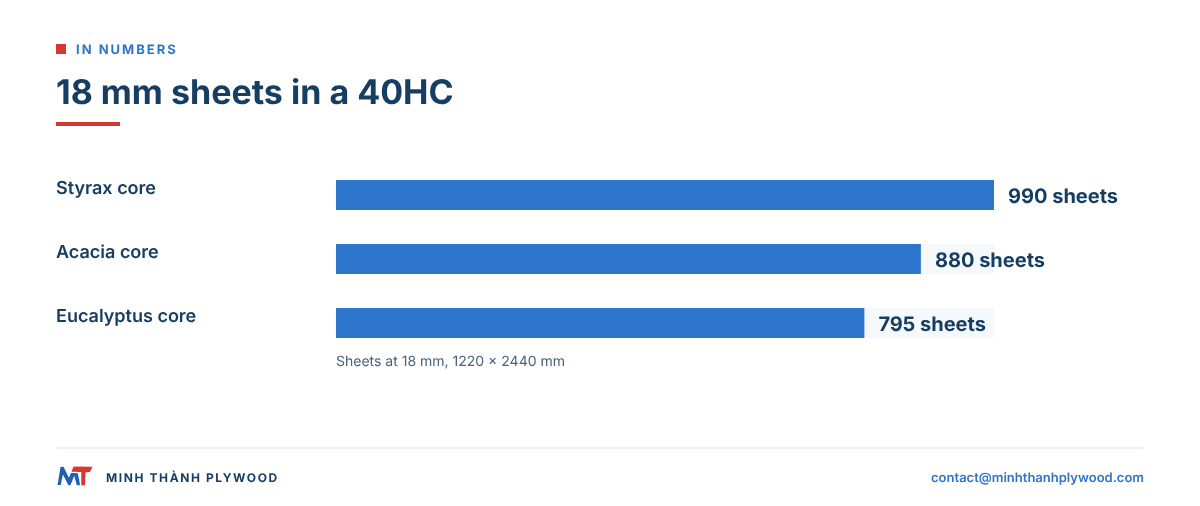
How much fits. At 18 mm and 1220 × 2440 mm, a 40HC carries 990 sheets on a Styrax core (55 sheets × 18 packs, about 53 m³), 880 on acacia (55 × 16, about 47 m³) and 795 on eucalyptus (53 × 15, about 43 m³). The counts are capped by weight within a 28,000 kg planning payload, and lower when the booking sets a lower limit.
How packs are built. Packs are about 1,000 mm high; sheets per pack are 1,000 ÷ thickness, rounded down, then capped by weight. On a Styrax core, 18 packs fit: 16 lying and 2 standing at the door end.
How many specifications. One 40HC usually carries 1–2 specifications and 3–6 by agreement. Each specification should fill whole packs, so the importer can sell or check it pack by pack.
| First-container plan | Good choice | Why |
|---|---|---|
| Specifications | 1–2 that already sell | Easy to check and to sell through |
| Thickness | The best-selling one, usually 18 mm | Fastest turnover |
| Core | Matched to the customers’ weight and finish needs | Sets sheets per container and freight per sheet |
| Packs | Whole packs per specification, labelled | Pack-by-pack inspection and sale |
| Documents | Agreed before the deposit | No surprises at customs |
Plan your own mix with the packing calculator.
Weight decides more than volume on most plywood containers. A Styrax-core load of 18 mm sheets reaches about 53 m³ before the weight limit; the same container on a eucalyptus core stops at about 43 m³. An importer that sells by the cubic metre and pays freight by the container should price that difference into the choice of core.
Documents an importer needs for every shipment
An importer needs a standard set of shipping documents for every container, plus the certificate files its market and product require. Agree the list before the deposit, and ask for drafts before the ship sails.
| Document | Who issues it | What it does |
|---|---|---|
| Commercial invoice | Mill | Value, Incoterm and product description for customs |
| Packing list | Mill | Packs, sheets, cubic metres and weights per specification |
| Bill of lading (B/L) | Carrier | Title to the goods and proof of shipment |
| Certificate of origin (EUR.1 for the EU) | Issuing authority in Vietnam | Origin, and preference where an agreement applies |
| Phytosanitary and fumigation certificates | Authorities and fumigation company | Where the destination or the wooden packing requires them |
| Insurance certificate | Insurer, under CIF | Cover for loss or damage at sea |
| Emission certificate and test reports | Certifier and laboratories | CARB P2 / TSCA Title VI, chamber tests, buyer-method tests |
| EUDR compliance dossier | Mill | Origin records and geolocation files for the importer’s due diligence |
| Other certificate files | Mill or partner mills | FSC*, CE* or packaging tests where the order needs them |
*Supplied directly or through qualified partner mills.
Plywood itself is processed wood and falls outside ISPM 15; solid-wood pallets, battens and dunnage shipped with it fall inside. Every Minh Thanh shipment is photographed and filmed before loading, and buyers get the photos and video. Our plywood import documents guide covers each document in detail.
EU plywood importers: EUDR, emission rules and CE
An EU plywood importer is the operator under the EU Deforestation Regulation and the party responsible for emission and product rules when the plywood is placed on the market. Three sets of rules matter most in 2026.
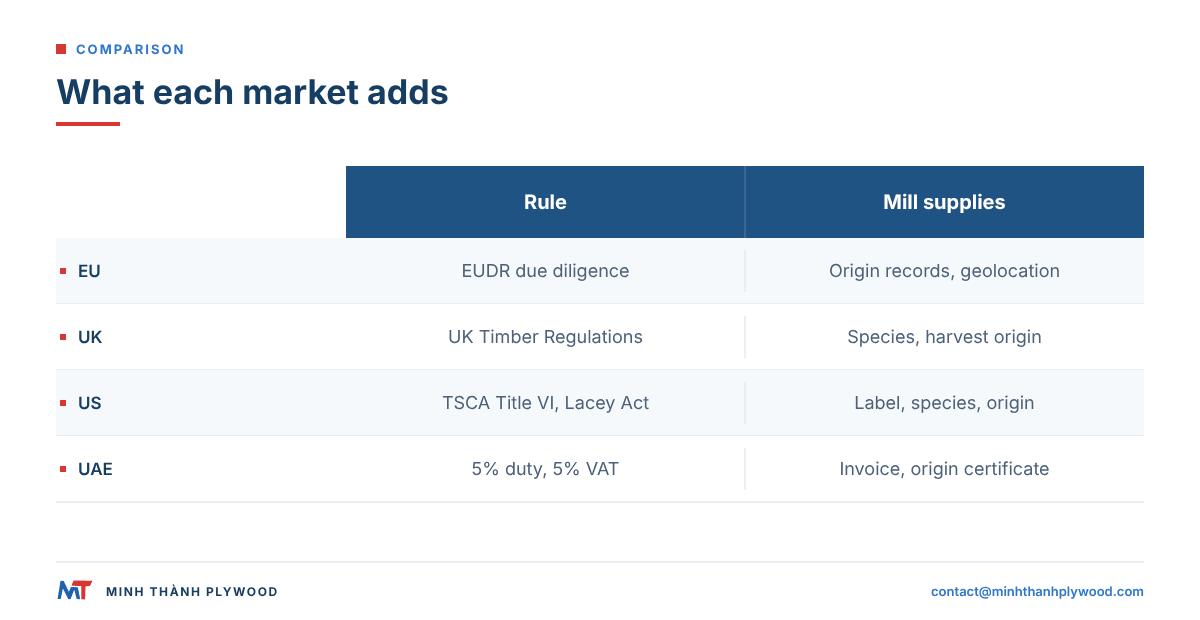
EUDR. Regulation (EU) 2023/1115, as amended by Regulation (EU) 2025/2650, applies from 30 December 2026 to large and medium operators and to micro and small operators already covered by the old EU Timber Regulation; other micro and small operators follow on 30 June 2027 (European Commission, 13 July 2026). The importer collects the origin information, assesses and reduces risk, and submits a due diligence statement whose reference must exist before the customs declaration. One statement can cover several shipments within the scope and quantity declared.
Article 9 of the regulation lists what the information must include: the product and its species (common and scientific names), the quantity, the country of production and the geolocation of every plot with the production date or range. Coordinates use at least six decimal digits, and plots over 4 ha are mapped as polygons. Vietnam is a low-risk country, so simplified due diligence applies when every commodity in the product comes from a low-risk country. The cut-off date is 31 December 2020.
The EU Timber Regulation (995/2010) keeps applying until 31 December 2029 to timber produced before 29 June 2023 and placed on the market from 30 December 2026. There is no official “EUDR certificate”: we supply the EUDR compliance dossier (origin records and geolocation files) with orders.
The amended regulation also separates the importer from its customers. A furniture maker in the EU that makes furniture from plywood already covered by a due diligence statement is a downstream operator: it does not submit its own statement, but the first downstream operator collects and keeps the statement reference for five years, and non-SMEs register in the information system. The company that imports the plywood into the EU is still the operator and submits the statement. Due diligence records are kept for five years, and the system is reviewed at least once a year.
For an importer, that means three things in practice: ask the mill for the dossier before the goods sail, file the statement before the customs declaration, and pass the reference number to every business customer.
Formaldehyde. Under Regulation (EU) 2023/1464, from 6 August 2026 furniture and wood-based articles may not be placed on the EU market if they emit more than 0.062 mg/m³ under the test conditions of its Appendix 14; articles for outdoor use only are exempt. Our furniture panels are made for the European market and meet the emission requirements European buyers ask for; CARB P2 / TSCA Title VI certification and our chamber tests are the proof, and SGS testing to the buyer’s method is arranged on request.
CE and FSC. Plywood for construction use is CE-marked under EN 13986. CE* and FSC* are available for orders that need them.
*Supplied directly or through qualified partner mills.
UK plywood importers: UK Timber Regulations and customs
A UK plywood importer that first places plywood on the Great Britain market is the operator under the UK Timber Regulations and must run due diligence: gather information on species, quantity, supplier, country of harvest and legal compliance, assess the risk of illegal harvest, and reduce any risk to negligible. Companies that only buy and sell plywood already on the GB market are traders and keep records of who they bought from and sold to.
To import plywood from Vietnam to the UK, an importer:
- qualifies the mill and agrees the build, terms and documents;
- collects the species, origin and supply-chain records for due diligence before the goods are placed on the market;
- finds the plywood commodity code and duty in the UK Trade Tariff;
- holds the certificate of origin needed for any preference claim;
- clears customs through its broker with the commercial invoice, packing list and B/L;
- checks the delivery against the approved sample on arrival.
The origin records Minh Thanh supplies for EUDR, with species and Vietnamese harvest origin, serve the UK due diligence file too. UK furniture makers usually ask for the same low-emission build as EU buyers.
Which US plywood importers and distributors stock Vietnamese plywood?
Most US plywood importers are distributors that hold imported hardwood plywood in regional yards and sell to cabinet shops, millworks and dealers. Three public examples show what a Vietnamese mill is selling into: a stock-and-ship importer, a multi-species distributor and a jumbo-format specialist.
| US importer or distributor | What it lists (retrieved 21 October 2026) | Lesson for a mill |
|---|---|---|
| The Plywood Company | 15 imported birch lines, 4 × 8 ft. Vietnamese birch 15 mm at US$58.51 and 18 mm at US$63.54 a sheet; Cambodian birch 15 mm at US$60.57; 300 sheets in stock per line; packs of 50 to 58 sheets | Import birch sells in full packs at a set price per sheet |
| Hood Distribution | About 24 species and panel types, from Baltic and Chinese birch to okoume, sapele and eucalyptus; FSC Chain of Custody; 23 locations in 16 states | Breadth of faces matters; a yard buys one core and many faces |
| Chesapeake Plywood | White birch plywood from 5.2 mm to 25 mm in 4 × 8, 4 × 10, 5 × 8, 5 × 10 and 5 × 12 ft., plus 19 mm countertop blanks 30.25 or 30.75 in. wide | Jumbo formats and cut blanks are a product line of their own |
Three points follow for a mill that wants to sell to such importers.
- Price per sheet. A US importer thinks in dollars per 4 × 8 ft sheet and per pack. Convert your FOB price per cubic metre to a landed price per sheet, as in the landed-cost section below, and quote the pack count: at 18 mm a 40HC carries 880 to 990 sheets, which is 16 to 18 packs of 55 sheets.
- Formats. US imperial formats map to metric as 4 × 8 ft = 1220 × 2440 mm, 4 × 10 ft = 1220 × 3050 mm, 5 × 5 ft = 1525 × 1525 mm, 5 × 8 ft = 1525 × 2440 mm, 5 × 10 ft = 1525 × 3050 mm and 5 × 12 ft = 1525 × 3660 mm. Our standard sheets are 1220 × 2440 and 1250 × 2500 mm, and we cut and build other formats to the importer’s specification.
- Compliance first. A US yard asks for the TSCA Title VI label, the species and the country of harvest before it asks for a price; the next section covers all three.
Minh Thanh Plywood does not publish its customers. If you import into the US and want a Vietnam source for birch-faced, poplar-faced or EV furniture panels, send the format, thickness, face grade and pack plan, and we reply with a written quote.
US plywood importers: TSCA Title VI, Lacey Act and trade cases
A US plywood importer must make sure that hardwood plywood meets the formaldehyde standard of TSCA Title VI (40 CFR Part 770), declare the species and country of harvest under the Lacey Act, and check whether trade-remedy duties apply.
For US orders, Minh Thanh panels carry the TSCA Title VI label with the producer, lot, certifier number TPC-43 and the words “TSCA Title VI compliant”. The commercial invoice and B/L state TSCA Title VI compliance, and we supply the face and core species and the Vietnamese harvest origin for the importer’s Lacey Act declaration. The limit for veneer-core hardwood plywood is 0.05 ppm; our six chamber tests averaged 0.014–0.032 ppm.
Trade cases need a check before every order. In July 2026 the US Department of Commerce issued final anti-dumping and countervailing duty determinations on hardwood and decorative plywood from Vietnam (cases A-552-851 and C-552-852); structural PS 1 panels and phenolic film-faced plyform are among the products outside the scope. A 2023 circumvention finding (A-570-051 and C-570-052) means Vietnamese panels with Chinese core components (core platforms or core veneers, with or without Chinese faces) pay the China duties, and other Vietnamese panels need importer and exporter certifications. Check the current status and scope of your product with your customs broker.
Our comparison of CARB P2 and TSCA Title VI explains the label and certificate in detail.
Gulf, Saudi Arabia, Australia and other markets
Importers outside Europe and the US face fewer timber-legality rules and more attention to customs duty, standards and biosecurity. Three markets show the range.
UAE and the Gulf. Most goods, plywood included, pay 5% customs duty on the CIF value under the GCC Common Customs Tariff, and the UAE adds 5% import VAT on the CIF value plus duty. Jebel Ali free-zone storage lets an importer hold stock and re-export to Oman, Kuwait, Bahrain, Qatar and Saudi Arabia. To import plywood from Vietnam to the UAE, order CFR or CIF to Jebel Ali with the standard shipping documents; transit from Hai Phong is typically 15–25 days. Our plywood price in the UAE guide covers local prices and landed cost.
Saudi Arabia. Saudi importers register regulated products on the SABER conformity platform, and the importer should agree the documents and any product certificate with the mill before shipment. See our GCC plywood import requirements.
Australia. Australian importers carry due-diligence duties under the Illegal Logging Prohibition Act 2012 and must meet biosecurity import conditions for timber products; structural plywood is specified to AS/NZS 2269. See plywood import requirements in Australia.
In every market, the same mill documents do most of the work: species and origin records, emission certificates and test reports, the certificate of origin and a packing list that matches the containers.
Plywood importers by country: Italy, Poland, Greece, the UK and Finland
Plywood importers in each European country buy for their own customers, and the build they ask for follows the industry they serve and the rules of their market. We never name customers or importers; the patterns below come from the orders mills receive.
- Italy. Furniture and kitchen makers dominate, and they buy flat, light, thin-faced panels and cut-to-size pieces. Minh Thanh ships regularly to European buyers, with repeat orders into Italy, and cut-to-size panels (one sheet cut into 4, 6 or 8 pieces) go there and to other European markets regularly.
- Poland. Polish importers ask the most detailed questions of any market: plies per thickness, veneer thickness before pressing, core density, film brand and weight, bending strength and stiffness to EN 310, slip resistance, CE under EN 13986 and edge sealing. Some set a container weight cap, for example 26 tonnes per 40HC.
- Greece. Importers serve construction, joinery and furniture; film-faced and commercial plywood sit next to furniture panels in most ranges.
- The UK. Importers supply merchants, shopfitters and furniture makers; the largest buy many specifications and hold stock across several depots. Due diligence under the UK Timber Regulations applies to every importer.
- Finland. Finland is a birch plywood producer, and its importers buy what the home mills do not make: furniture panels with other faces, thin plywood and specification-built panels.
Every company importing plywood into the EU runs EUDR due diligence from 30 December 2026 (30 June 2027 for other micro and small operators), and Vietnamese plywood fits that work as a low-risk origin.
Payment terms, Incoterms and lead time
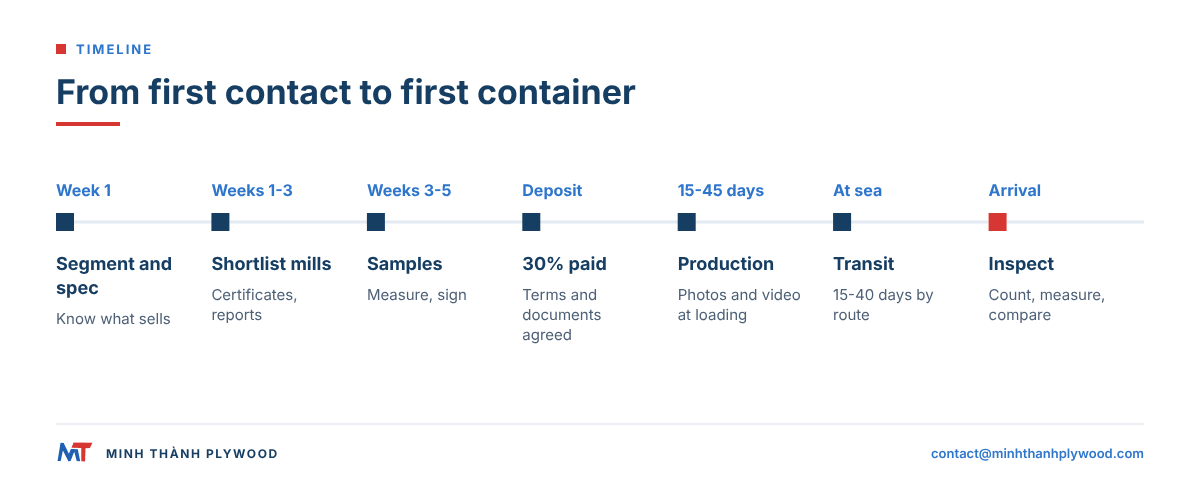
The normal terms between a Vietnamese mill and an importer are a 30% deposit with the order, 70% against the scanned bill of lading, or an irrevocable letter of credit at sight; the price is FOB Hai Phong, CFR or CIF; production takes 15–45 days after the deposit.
| Term | Minh Thanh standard | What the importer should check |
|---|---|---|
| Minimum order | One 40HC, mixed specifications by agreement | Whole packs per specification |
| Deposit | 30% with the order | Paid to the account on the contract only |
| Balance | 70% against the scanned B/L | B/L details match the contract |
| Letter of credit | Irrevocable L/C at sight | Documents listed exactly as the mill can issue them |
| Incoterms | FOB Hai Phong, CFR or CIF | Who books freight and insurance |
| Production | 15–45 days after the deposit | Shipment window on the proforma |
| Samples | Free samples | Approved sample signed and kept |
Under FOB the importer books the ship and insures the cargo; under CFR the mill books the freight; under CIF the mill also insures it. Risk passes at loading under all three, so pre-loading photos and video matter.
How to become a plywood importer: first-container checklist
To become a plywood importer, follow these ten steps in order. Each one is cheaper to do before the deposit than after.
- Choose the segment. Furniture plants, packaging, construction or merchants; one segment first.
- Know the customers’ specification. Thickness, core, face, glue and emission class, tolerance, sizes and pack size they already buy.
- Register and learn the rules. Importer registration, customs broker, and the timber-legality and emission rules of your market.
- Price the landed cost. FOB price, freight, insurance, duty, tax, port, trucking, storage and losses, per cubic metre and per sheet.
- Shortlist two or three mills. Company and factory checks, certificates by number, test reports.
- Approve samples. Exact build, measured, signed, kept.
- Agree terms and documents. Incoterm, payment, shipment window, document list and drafts before sailing.
- Place the trial container. One or two specifications in whole, labelled packs.
- Check the loading. Photos and video of each pack, the container and the seal before departure.
- Inspect on arrival. Count, measure, compare with the sample, and report any issue with photos within the agreed time.
After a clean first container, a second one can carry 3–6 specifications by agreement, and a regular programme can follow. Our guide to moving from a trial order to long-term supply covers that step.
What should an importer check when the container arrives?
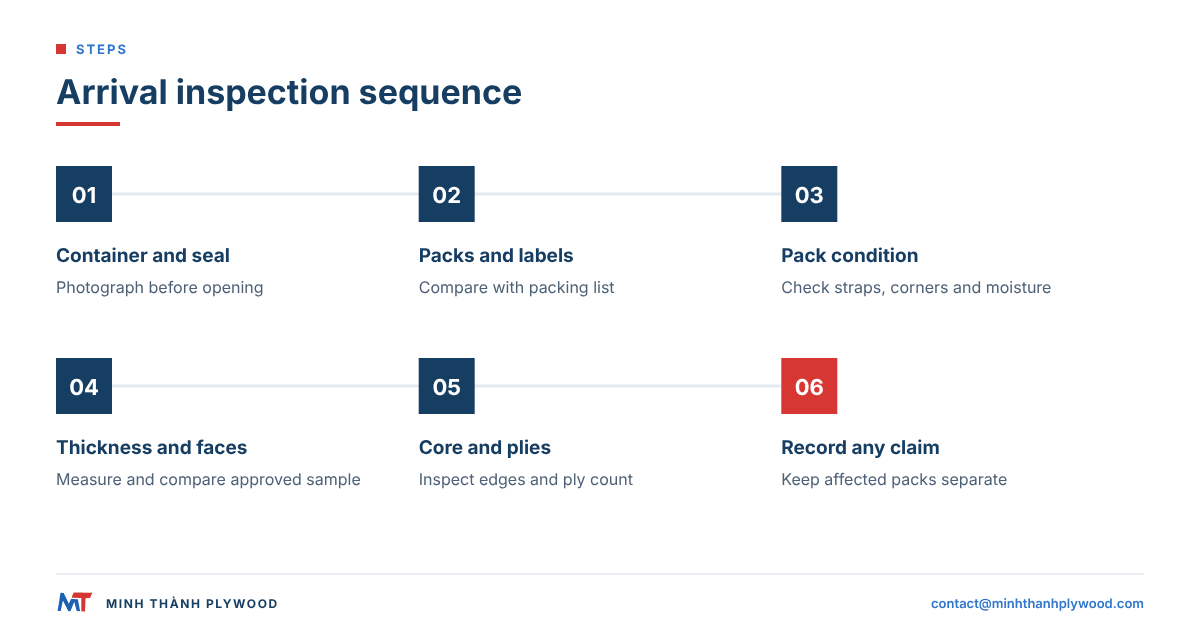
On arrival, an importer should check the container, the packs and a sample of sheets from each specification before any pack goes to a customer. Photos of each step are the importer’s evidence if anything is wrong.
- Container and seal. Photograph the seal number and the doors before opening; compare with the B/L.
- Pack count and labels. Count packs per specification against the packing list; check labels and marks.
- Pack condition. Look for broken straps, crushed corners, wet covers and broken pack feet.
- Thickness. Measure sheets from the top, middle and bottom of each pack with a caliper, at the corners and mid-edges.
- Flatness and faces. Lay sample sheets flat; check face grade against the approved sample.
- Core and plies. Check edges for gaps and count plies.
- Moisture. Measure moisture content; Minh Thanh dries veneers and finished panels to 8–12% at dispatch.
Thickness tolerances to check against at Minh Thanh: sanded furniture panels ±0.2–0.3 mm (down to ±0.2 mm), commercial and film-faced ±0.5 mm, packing ±0.5–1.0 mm, and ±2 mm on length and width. Our guide to plywood quality claims explains how to document and settle a problem.
When something is wrong, the order of work matters. Photograph the problem with the pack label and a caliper or ruler in the frame, keep the affected packs apart, write to the mill with the photos and the packing-list line, and agree the remedy in writing: replacement in the next container, a credit note, or a price adjustment. A mill that films each pack before loading and keeps the approved sample can match the claim to the loading record quickly, which shortens the argument for both sides.
Private label, mixed containers and importer programmes
Mills that work with importers offer three things that a single order does not need: private labels, mixed containers and a repeat build that does not change between orders.
- Private label. Packs can carry the importer’s own labels and edge printing, on the importer’s choice of export pallet, so the importer sells under its own brand.
- Mixed containers. One 40HC carries 1–2 specifications as normal and 3–6 by agreement, so an importer can keep a wide range without ordering a container of each.
- Repeat build. The approved sample fixes the face grade; the core, plies, glue and tolerance are written on every proforma, so the second and the tenth container match the first.
- Custom sizes. Besides 1220 × 2440 and 1250 × 2500 mm, sizes such as 1220 × 2500 and 1220 × 2280 mm, and cut-to-size panels.
- Fast answers. A named contact who replies within hours during the order and after delivery.
At Minh Thanh, core layers are stitched both horizontally and vertically, furniture panels are pressed twice (the core board is pressed and calibrated, then face and back are pressed on), and both faces can be supplied UV-ready for the buyer’s own coating. Those steps keep the build the same from one container to the next.
How do importers work out landed cost and resale price?
Importers work out landed cost per cubic metre first and per sheet second, because mills sell by the cubic metre and customers buy by the sheet. The calculation has the same lines in every market.
- FOB price per m³ from the mill’s proforma.
- Freight and insurance per m³: the container freight divided by the cubic metres actually loaded, which depends on the core and the thickness.
- Duty and import tax: the destination’s rate on the customs value; in the UAE, 5% duty on CIF and 5% VAT on CIF plus duty add 10.25% to the CIF value.
- Port, clearance and trucking per m³.
- Storage, handling and losses per m³ over the time the stock takes to sell.
- Landed cost per sheet: landed cost per m³ multiplied by the sheet volume. An 18 mm 1220 × 2440 mm sheet holds 0.0536 m³, so one cubic metre is about 18.7 sheets.
- Resale price: landed cost per sheet plus the importer’s margin, set against what the local market pays.
| Line | Moves with | How to reduce it |
|---|---|---|
| FOB price | Face, core, glue, thickness, quantity | Buy the build the use needs, by the container |
| Freight per m³ | Core weight, thickness, booking weight cap | Lighter cores, full containers |
| Duty and tax | Tariff, origin, preference | Correct commodity code, valid certificate of origin |
| Storage and losses | Range width, sales speed | Fewer specifications, whole packs, good packing |
Indicative starting prices at Minh Thanh in October 2026 are commercial plywood from US$250/m³ and furniture/interior plywood from US$350/m³, FOB. The plywood price guide shows how mill prices are built from face, core, glue, thickness, size, quantity and delivery term.
What to send Minh Thanh Plywood as an importer
Send the six lines your customers care about, plus the destination port and the documents your market needs, and we reply within hours with a written quote and a sample offer.
- Application: furniture, cabinets, shopfitting, van conversion, packaging, formwork or merchant stock.
- Core: Styrax or eucalyptus as standard, acacia and pine on order; stitched layers.
- Glue and emission: UF glue at E0 emission, or melamine-fortified or phenolic WBP; CARB P2 / TSCA Title VI if needed.
- Face and back: species and grade pair, sanded or polished, UV-ready if needed.
- Size and thickness: 3–40 mm; 1220 × 2440, 1250 × 2500 mm or custom; tolerance; cut-to-size.
- Packing and quantity: pack type, labels, containers per month, specifications per container, destination port, FOB, CFR or CIF, and documents (EUDR dossier, certificates, test reports).
Indicative starting prices in October 2026 are commercial plywood from US$250/m³ and furniture/interior plywood from US$350/m³; the final price depends on face, core, glue, thickness, size, quantity and delivery term. Write to contact@minhthanhplywood.com or WhatsApp +84 988 586 601 (Lisa), Monday–Friday, 08:00–17:00 Vietnam time, or start from our furniture plywood range. Where to buy plywood compares buying from a merchant, an importer or the mill.
Buyer questions, answered
What does a plywood importer do?
A plywood importer buys plywood by the container from foreign mills, pays freight and duty, clears customs under the destination's timber and emission rules, holds stock and sells to distributors, dealers, merchants and manufacturers. The importer carries the price, quality, compliance and payment risk between mill and market.
What is the difference between a plywood importer, distributor and dealer?
The importer brings plywood into the country and is legally responsible for it at the border. A distributor or wholesaler buys from importers or mills and supplies dealers across a region. A dealer or merchant sells sheets to trade and retail buyers.
Who are the main plywood importers in the United States?
US importers are mostly regional distributors. Public examples are The Plywood Company, which lists 15 imported birch lines in 4 × 8 ft sheets, Hood Distribution with 23 locations in 16 states, and Chesapeake Plywood, which sells jumbo 5 × 12 ft sheets and countertop blanks. A Vietnam mill sells to them against the TSCA Title VI label, species records and a price per sheet.
How do I become a plywood importer?
Pick a segment and its customers, register as an importer and learn the timber and emission rules of your market, qualify one or two mills with samples and test reports, agree terms and documents, then place a trial container of one or two specifications and check it on arrival.
Is there a standard MOQ for plywood imports from Vietnam?
One 40HC container is the usual minimum order. At Minh Thanh Plywood one 40HC can carry 1–2 specifications as normal and 3–6 by agreement, so a first order can mix thicknesses or faces.
How do I import plywood from Vietnam to the UK?
Qualify the mill, agree FOB, CFR or CIF terms and the documents, and run due diligence under the UK Timber Regulations as the operator placing the timber on the GB market. Clear the goods under the plywood commodity code with the certificate of origin your preference claim needs.
What does EUDR compliance require for plywood importers?
The EU importer is the operator: it must collect the origin information, assess and reduce risk, and submit a due diligence statement before the customs declaration. It applies from 30 December 2026 for large and medium operators. The mill supplies the origin records and geolocation files.
How do I import plywood from Vietnam to the UAE?
Order FOB Hai Phong, CFR or CIF to Jebel Ali or another UAE port, with commercial invoice, packing list, B/L and certificate of origin. Most goods pay 5% customs duty on the CIF value under the GCC tariff, plus 5% import VAT; typical sea transit from Hai Phong is 15–25 days.
Can I import plywood from China?
Yes, into most markets, under the same timber and emission rules as other origins. The EU applies anti-dumping duties on certain hardwood plywood from China under Regulation (EU) 2025/2333, so check your product's scope before ordering.
Which documents should an importer get from a plywood mill?
Per shipment: commercial invoice, packing list, bill of lading, certificate of origin, phytosanitary and fumigation certificates where needed, and insurance under CIF. On order: emission certificates and test reports, the EUDR dossier, and other certificate files your market needs.
How long does it take to import a container of plywood from Vietnam?
At Minh Thanh Plywood, production takes 15–45 days after the deposit. Typical days at sea from Hai Phong are 15–25 to the Middle East, 25–35 to the Mediterranean, 30–40 to Northern Europe and 20–30 to the US West Coast.
What payment terms do plywood mills offer importers?
The usual terms are a 30% deposit with the order and 70% against the scanned bill of lading, or an irrevocable letter of credit at sight. Avoid full payment before production with a new supplier.
Can an importer get private label plywood?
Yes. Mills mark packs with the importer's own labels, edge printing and pallet type on order, and a container can carry several specifications for one importer's range.