
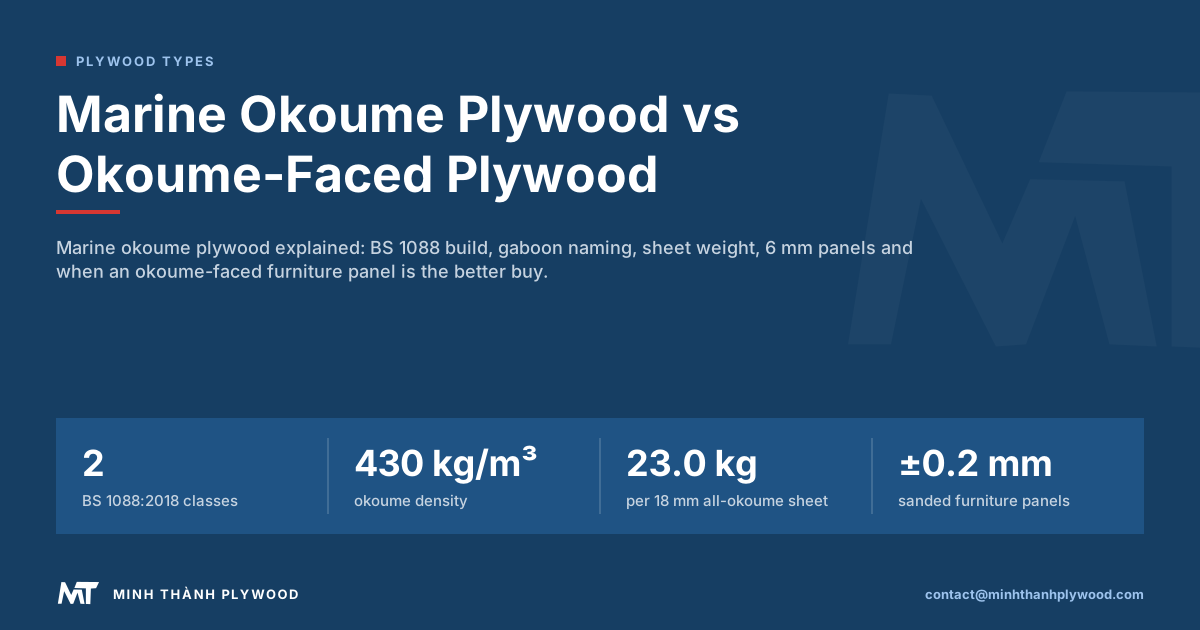
Marine okoume plywood is an all-okoume panel built and bonded to a marine standard, usually BS 1088, for boat hulls, decks and other wet structures. Okoume-faced plywood puts the same pinkish okoume veneer on the outside of a different core and is made for furniture and interiors. Minh Thanh Plywood makes the okoume-faced kind in Vietnam; this guide shows how to tell the two apart and which one your job needs.
Marine okoume plywood: what separates it from okoume-faced plywood?
Marine okoume plywood is okoume through every ply, glued with a boil-proof bond and built to a marine standard. Okoume-faced plywood has okoume only on the two outside veneers, over a core of another species. Both look alike from the face; the edge, the stamp and the paperwork tell them apart.
The two panels answer different questions. A boat builder needs a light panel that keeps its glue lines and its strength after years of wetting and drying. A furniture maker needs a warm, even face on a flat, calibrated board that machines cleanly. Okoume serves both buyers because its veneer is light, pale pink to salmon in colour and easy to finish.
What the buyer pays for is different too. In a marine panel, every veneer is selected and joined to the rules of the standard. In an okoume-faced panel, the money goes into the face, while the core is chosen for flatness, weight and cost.
At Minh Thanh Plywood we make the second kind: imported okoume face and back veneers pressed over white Styrax or Eucalyptus cores in Vietnam. We do not sell it as marine plywood, and this article explains where that line sits.
Marine okoume plywood sizes and formats in inches and millimetres
Marine okoume plywood is sold in 2 to 25 mm thicknesses, and US boat builders order it in inch fractions on 4 x 8 ft sheets, with 4 x 4 ft half sheets and 2 x 4 ft quarter sheets for kit builders. The table converts the thicknesses a BS 1088 okoume range lists.
| Metric | US fraction | Common use |
|---|---|---|
| 2 mm | 1/16 in | Scale models, laminating |
| 3 mm | 1/8 in | Decks and bulkhead skins, curves |
| 4 mm | 5/32 in | Hull skins on small boats |
| 5 mm | 3/16 in | Hull skins, decks |
| 6 mm | 1/4 in | Hull panels, bulkheads |
| 9 mm | 3/8 in | Bulkheads, bottoms |
| 12 mm | 1/2 in | Bulkheads, structure |
| 15 mm | 19/32 in | Structure, decks |
| 18 mm | 3/4 in | Bulkheads, floors |
| 25 mm | 1 in | Heavy structure |
In the US the full 4 x 8 ft sheet is 1220 × 2440 mm. One kit-boat supplier ships a full sheet by freight carrier from about US$175 and a half sheet from about US$120 (October 2026), so a small order often costs more to move than to make. A container load is a different calculation: it brings the freight per sheet down, which is where a 40HC buyer saves.
Which makers and marks do boat builders trust for marine okoume?
Boat builders trust okoume marine plywood by maker and by mark: Joubert and Bruynzeel (Hydrotek) are the two names US and European yards quote, and the BS 1088 stamp, with a Lloyd’s Register approval where the yard asks for it, is the proof on the sheet. A maker’s name does not replace the stamp; it tells you whose quality control stands behind it.
- Joubert peels its okoume in Gabon. By Gabon law no okoume logs may leave the country, so the veneer mill has to be there, and Joubert reports taking no more than 7 percent of its okoume forest each year.
- Bruynzeel sells Hydrotek marine okoume, which US lumber merchants such as J. Gibson McIlvain stock beside Douglas fir and sapele marine grades.
- BS 1088:2018 is the standard behind both: it sets the glue, the veneer species allowed, the core without gaps and the sheet markings.
Gabon has banned raw log exports since 2010, so every marine okoume sheet starts as veneer peeled in-country; that fact also sits behind the price. For the standard in full, see what BS 1088 requires.
Douglas fir marine plywood or okoume BS 1088: which does a US buyer pick?
A US buyer picks okoume BS 1088 for a light, fair boat that will be finished bright or painted smooth, and Douglas fir marine grade for a heavier, cheaper hull or dock part where grain checks are tolerated. Both are exterior-glued; they differ in weight, face and cost.
| Point | Douglas fir marine grade (US) | Okoume to BS 1088 |
|---|---|---|
| Species | Douglas fir softwood veneers | Okoume, an African hardwood |
| Weight | Heavier | Light, about 430 kg/m³ |
| Face | Coarse, grain checks possible | Fine, smooth under paint and epoxy |
| Core | Limited voids allowed | Void-free to the standard |
| Price | Lower | Higher |
| Fits | Docks, workboats, utility | Dinghies, sailboats, kit boats, bright finish |
Minh Thanh does not sell either as marine plywood. Our okoume is the face of furniture and interior panels, and the next sections say where that line sits.
What is gaboon marine plywood?
Gaboon marine plywood is okoume marine plywood under its British trade name. Gaboon, okoume and Aucoumea klaineana all name the same tree, which grows in Central Africa and mainly in Gabon. Timber merchants in the UK and Ireland list “gaboon plywood”; boat plans from North America and Europe usually say okoume.
The names do not change the specification. A sheet sold as gaboon plywood may be a marine panel to BS 1088 or a plain okoume-faced interior board, just as with okoume. Ask the same three questions whatever the label says: which standard, which glue, and which species are inside.
The ATIBT okoume profile, checked on 20 October 2026, lists okoume as a main plywood timber of the Congo Basin. Its light weight and long, straight logs peel into large, clean veneer sheets, which is why it is a classic timber for light marine plywood.
How do the builds of marine okoume and okoume-faced plywood compare?
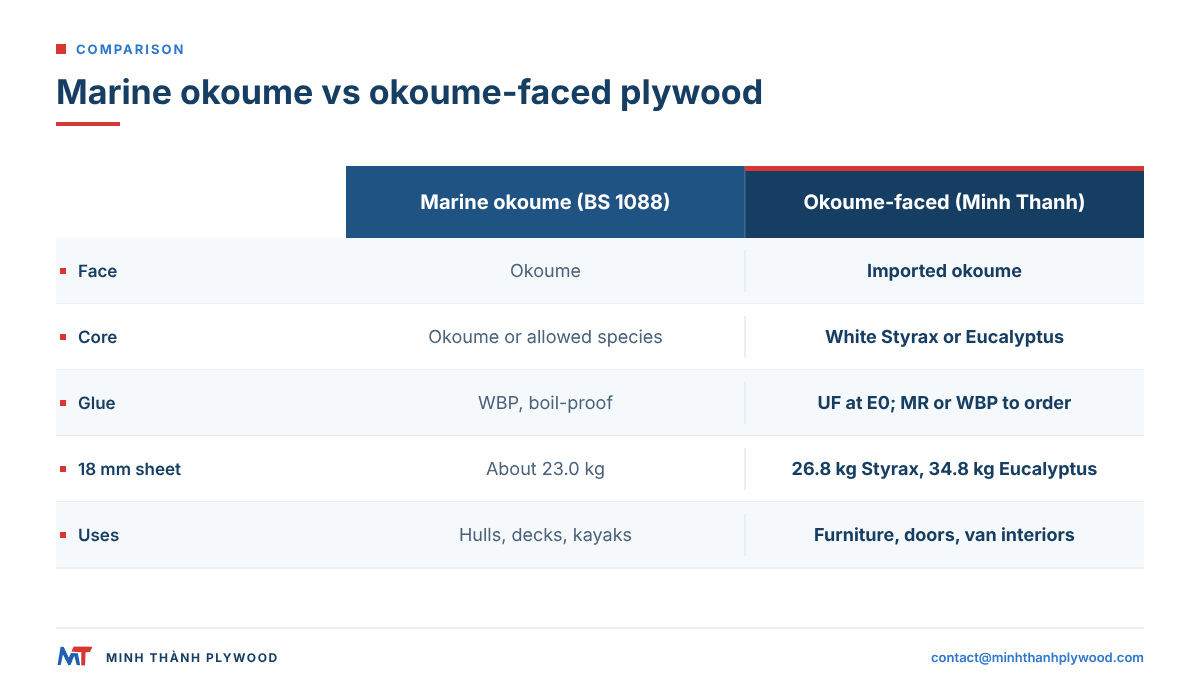
The builds differ in the core, the glue and the proof, not in the face. This table puts the two panels side by side, one property per row.
| Property | Marine okoume plywood (BS 1088) | Okoume-faced plywood (Minh Thanh) |
|---|---|---|
| Face and back | Okoume veneer | Imported okoume veneer, graded to the approved sample |
| Core | Okoume or other species allowed by the standard | White Styrax or Eucalyptus plantation core |
| Glue | Weather- and boil-proof (WBP) bond | UF glue at E0 emission as standard; melamine-fortified or phenolic WBP to order |
| Standard and marking | BS 1088 class stated on each sheet | Furniture plywood; no marine claim |
| Weight, 18 mm, 1220 × 2440 mm | About 23.0 kg from okoume wood density | About 26.8 kg on Styrax, about 34.8 kg on Eucalyptus |
| Core construction | Veneers selected and joined to the standard’s rules | Core veneers stitched horizontally and vertically, core pressed and calibrated before the faces |
| Thickness tolerance | Set by the standard | Down to ±0.2 mm on sanded furniture panels |
| Typical uses | Hulls, decks, transoms, kayaks, wet structures | Cabinets, wall panels, doors, cabin furniture, van and caravan interiors |
The core is the main cost and weight difference. A marine panel uses selected tropical veneers in every layer; our panels use Vietnamese plantation timber, which keeps the board flat and the price within reach for furniture lines.
What does BS 1088 require of marine okoume plywood?
BS 1088 sets the rules a panel must meet before it can be sold as marine plywood in the British system. The current edition is BS 1088:2018. The BSI listing, checked on 20 October 2026, says it specifies two classes of marine plywood, standard and lightweight, made from untreated tropical hardwood veneers.
The same listing explains how species are placed: “the choice of veneer species is based only on density and resistance to bio-deterioration.” Okoume is a light, poorly durable wood, so its class and its finishing needs follow from that rule rather than from its name.
In practice a BS 1088 buyer checks four things:
- The class on the sheet. Each panel is marked with the standard and the class it claims.
- The bond. Plies are glued with a weather- and boil-proof bond that survives boiling water and wet-dry cycling. Bond quality is tested under BS EN 314-2.
- The veneer quality. Faces present a solid surface without open defects, and inner plies follow the standard’s limits on gaps and joints.
- The evidence. A conformity record or third-party test for the supplied product, not a general brochure claim.
A panel that meets only some of these is not BS 1088 plywood, whatever its face. Our marine plywood buying guide covers the standard’s classes and approval steps in more detail.
Is okoume face plywood suitable for marine applications?
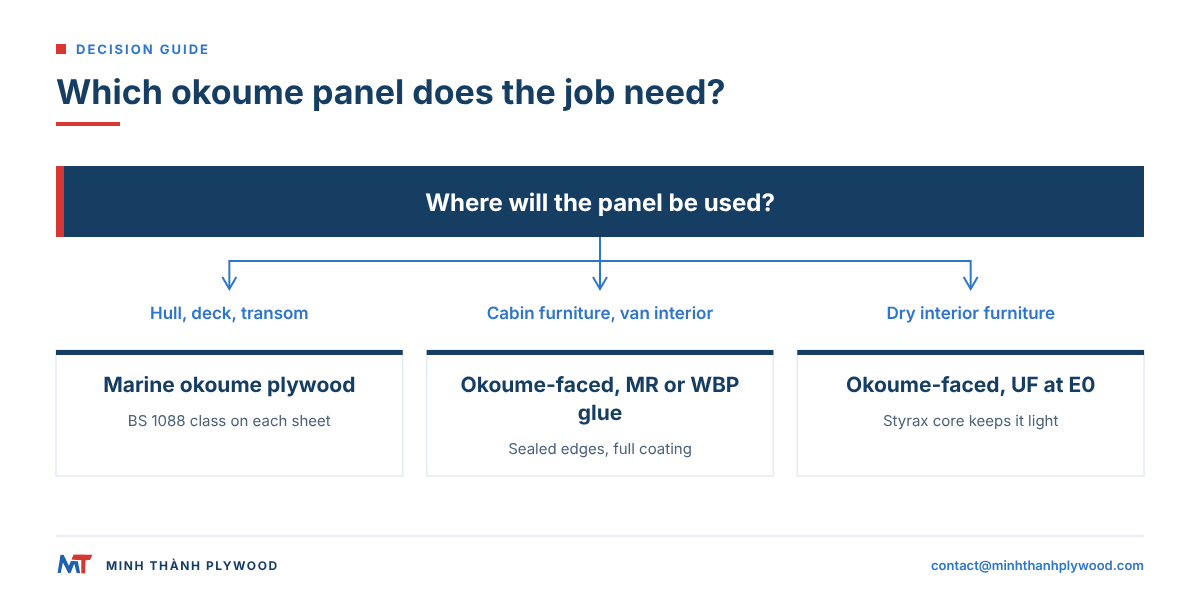
Okoume face plywood is not suitable for boat hulls, decks or structural marine parts. Those parts need a marine-standard panel through every ply. An okoume-faced panel is suitable for protected uses on board and around water, if the glue matches the exposure.
The reason is the core. In an okoume-faced panel, the inner plies are a different species, chosen for flatness and cost. A marine standard controls every veneer, every joint and every gap; a furniture panel controls the flatness, the thickness and the face. Water that reaches the core through a cut edge meets plies that were never selected for marine service.
Okoume-faced plywood works well in these places:
- Cabin furniture and linings above the waterline, finished and with sealed edges, with melamine-fortified or phenolic WBP glue.
- Van, camper and caravan interiors, where light weight and a warm face both matter.
- Bathroom and kitchen furniture with a melamine-fortified bond and a full coating.
- Wall panels, doors and display furniture in dry interiors, with UF glue at E0 emission.
For the hull, the deck and anything that sits in water, buy a marine panel. For the furniture inside the boat, an okoume-faced board often gives the same look at a lower cost.
Is okoume plywood marine grade, and is the wood naturally durable?
Okoume plywood is marine grade only when the whole panel is made and marked to a marine standard. The wood itself is not durable against decay. The ATIBT okoume profile rates its natural durability as poor, class 4, so even a marine okoume panel relies on its glue and its finish.
That is why boat builders coat okoume with epoxy or marine paint and seal every cut edge and hole. The okoume does its job by being light and stable while the coating keeps water out. An uncoated sheet left wet will rot, whatever the standard on the stamp.
The same logic applies to okoume-faced plywood. Its face takes stain, oil and paint well, and the coating protects it. Our guide to waterproof plywood explains how glue, core and finish share the job.
How much does marine okoume plywood weigh?
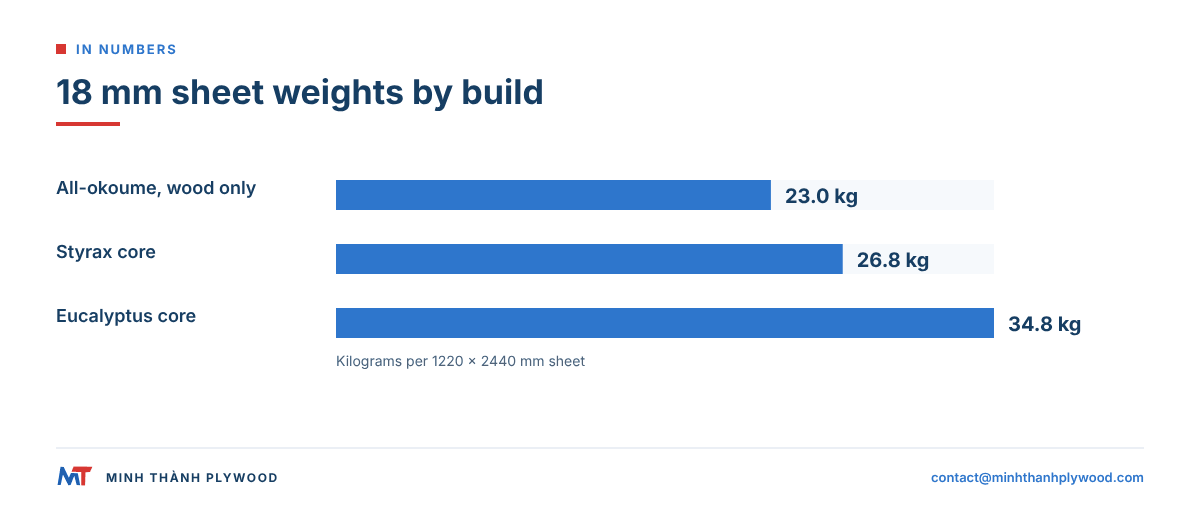
An 18 mm sheet of okoume marine plywood, 1220 × 2440 mm, weighs about 23.0 kg from the wood density of okoume alone, about 430 kg/m³. Glue lines add some weight to every real panel. An okoume-faced sheet weighs what its core weighs, because the two faces are thin.
Sheet weight is length × width × thickness × density. At 1220 × 2440 mm, the sheet volume is 0.0536 m³ at 18 mm and 0.0179 m³ at 6 mm. The table uses the okoume density from the Wood Database okoume entry. It uses our planning densities for Styrax (500 kg/m³) and Eucalyptus (650 kg/m³).
| Panel, 1220 × 2440 mm | Density used | 6 mm sheet | 18 mm sheet |
|---|---|---|---|
| All-okoume (wood only) | 430 kg/m³ | About 7.7 kg | About 23.0 kg |
| Okoume face on white Styrax core | 500 kg/m³ | About 8.9 kg | About 26.8 kg |
| Okoume face on Eucalyptus core | 650 kg/m³ | About 11.6 kg | About 34.8 kg |
For a boat, the lighter all-okoume panel saves weight high in the hull, where it counts most. For a kitchen or a caravan, the Styrax core comes close to that weight at a lower price, with a flat, calibrated board. The Eucalyptus core is heavier and harder, and holds screws well in carcass parts.
6mm okoume marine plywood: what is thin okoume used for?
6mm okoume marine plywood is used for curved hull skins, kayak and canoe kits, bulkheads and cabin linings. Light okoume bends to a tighter radius than dense hardwoods at the same thickness, which is why stitch-and-glue boat kits often specify it. Thin panels from 4 mm also cover lockers and lining work.
For a hull, the thin panel has to be marine plywood: it carries the load, and every glue line is wet on one side. For a lining, a cupboard back or a drawer bottom, a thin okoume-faced panel does the same visible job for less.
Our thin plywood from 3 to 5 mm is always 5-ply. At 3 mm the build is one core veneer, two cross-band veneers and two faces; at 4 and 5 mm it is three core veneers and two faces, with core veneer thickness matched to the panel. Premium thin face veneer is scarce, so 4 mm can take longer to make; we do not lower the standard to go faster.
Okoume vs birch marine plywood: which is better?
Okoume marine plywood is the better choice where weight and bending matter; birch marine plywood is better where stiffness, hardness and wear matter. Okoume is one of the lightest plywood timbers, while birch is a dense northern hardwood. Builders often use both in one boat.
| Need | Okoume marine plywood | Birch marine plywood |
|---|---|---|
| Light hull and topsides | Better: light, bends well | Heavier for the same thickness |
| Floors, soles and wear surfaces | Softer face, dents more easily | Better: hard, stiff, holds fixings |
| Clear or natural finish | Warm pink to salmon face | Pale, even face |
| Curved panels and kits | Better at tight radii | Stiffer to bend |
| Natural durability | Poor; relies on coating | Poor; relies on coating |
Neither species is durable without protection, so the coating and the edge sealing decide the life of the part in both cases. For interiors, the same logic holds: our birch plywood suits hard-wearing furniture, and okoume-faced plywood suits warm, light panels.
Where is okoume-faced plywood the right choice?
Okoume-faced plywood is the right choice for furniture, wall panels, doors and vehicle interiors where you want the okoume look on a flat, calibrated board. It gives the warm face of okoume without paying for selected tropical veneer in every ply. Most buyers asking for “okoume plywood” for interiors need this panel, not a marine one.
Our okoume-faced panels are pressed twice as standard: the core board is pressed and calibrated first, then face and back are pressed on. That gives a flat board with thickness held down to ±0.2 mm, which suits CNC lines and edge banding. Both faces are sanded, polished and UV-ready for the customer’s own coating.
Typical orders include:
- Cabinets and wall units with a clear or tinted finish on the okoume face.
- Wall and ceiling panelling in hotels, shops and offices.
- Interior doors and door skins where an even, pale face takes stain well.
- Camper and caravan interiors, where a Styrax core keeps sheets light.
The full specification, cores and sizes are on our okoume plywood product page. For how okoume compares with other red and brown faces, see our comparison of bintangor, okoume and gurjan faces.
Which glue should okoume-faced plywood have?
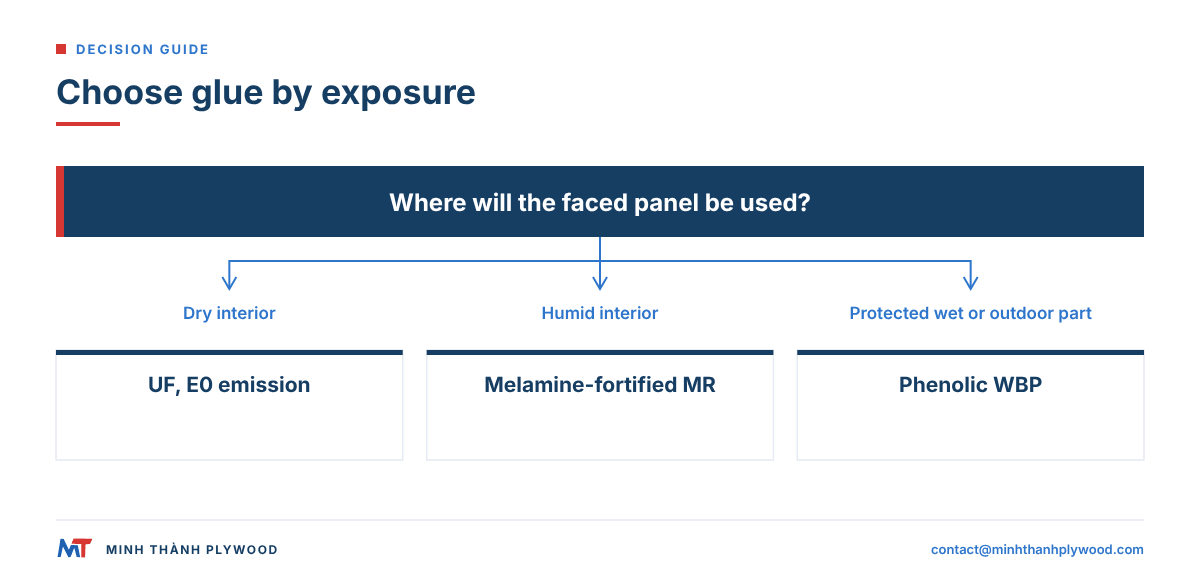
Choose the glue by exposure: UF glue at E0 emission for dry interiors, melamine-fortified (MR) glue for humid rooms, and phenolic WBP glue for parts that see water or weather. The glue decides water resistance; the okoume face does not. Glue and emission class are two separate lines on the order.
| Exposure | Glue | Typical okoume-faced use |
|---|---|---|
| Dry interior | UF glue at E0 emission | Cabinets, wall panels, doors |
| Humid interior | Melamine-fortified (MR) | Kitchens, bathrooms, van and caravan interiors |
| Wet or outdoor parts | Phenolic WBP | Protected outdoor parts, boat interiors above the waterline |
UF glue at E0 emission is our standard for furniture panels. Six ASTM D6007 chamber tests between April 2025 and June 2026 on 9, 15 and 18 mm panels averaged 0.014–0.032 ppm, against the 0.05 ppm CARB Phase 2 / TSCA Title VI limit. The 0.05 ppm limit for veneer-core hardwood plywood is set in 40 CFR 770.10. We hold CARB P2 / TSCA Title VI certification as ICTT mill no. 23024.
Is marine plywood waterproof, and how does it compare with MDF?
Marine plywood is water-resistant in its glue lines, not waterproof as a material. Its boil-proof bond does not let go when wet, but the wood still takes up water and rots if left uncoated. MDF is a fibre board that swells badly at cut edges once wet, so it is no substitute in damp places.
For furniture in humid rooms, plywood with a melamine-fortified bond and a full coating holds screws and stays flat far better than standard MDF. For anything on a boat that gets wet, a marine panel with sealed edges is the right material. Okoume-faced plywood sits between the two: a real plywood with a choice of bond, made for interiors.
What does marine okoume plywood cost?
Marine okoume plywood costs the most of the common plywoods per sheet, and the price rises with thickness, with the brand and with the grade of the face. No two suppliers sell the same sheet at the same price, so compare on thickness, standard, maker and face grade.
| Variable | Effect on price |
|---|---|
| Thickness | Rises step by step from 2 mm to 25 mm; 15 mm and 25 mm are often full-sheet items only |
| Brand | Named BS 1088 okoume from Joubert or Bruynzeel sits at the top of the range; unbranded Asian BS 1088 panels sit below |
| Face grade | A bright-finish face costs more than a painted-grade face |
| Sheet format | Half and quarter sheets cost more per square metre than full sheets |
| Delivery | A single full sheet by freight carrier can cost as much to move as a thin sheet costs to buy |
Okoume-faced plywood for furniture costs well below a true BS 1088 sheet because the core is not okoume and the standard is not applied. Our furniture and interior plywood starts from US$350/m³ (October 2026), FOB Hai Phong.
Okoume marine plywood suppliers: what should you check?
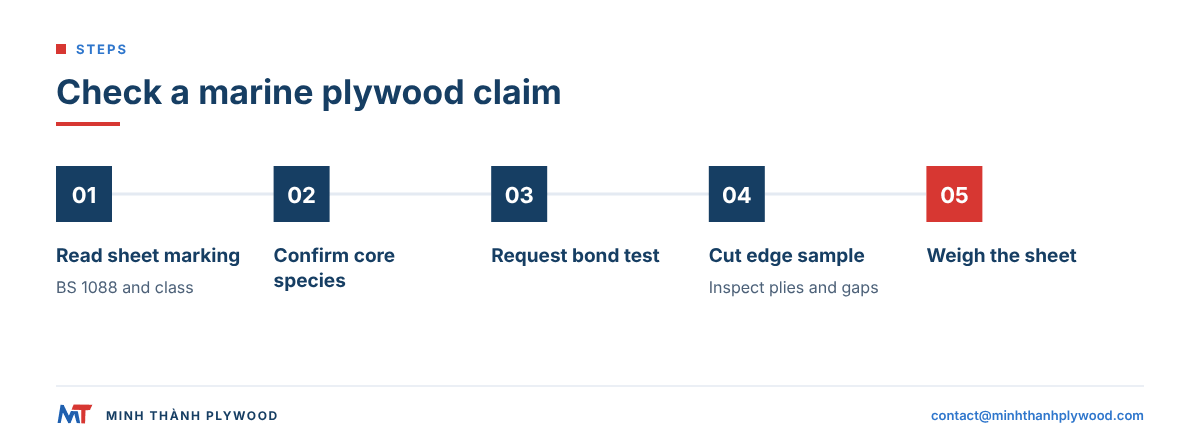
Check that a supplier of okoume marine plywood can show the standard, the class and the evidence for the panel you will receive. A marine claim should be printed on the sheet and backed by a conformity record or a third-party test. A face photograph and the word “marine” in a price list do not prove a marine build.
- Ask for the marking. Each BS 1088 sheet shows the standard and class.
- Ask which species are inside. A marine okoume panel names okoume, or another allowed species, for the core.
- Ask for the bond test. A WBP or boil test report for the supplied product.
- Cut a sample. The edge shows the number of plies, their thickness and any core gaps.
- Weigh a sheet. An 18 mm all-okoume sheet should come close to the weight in the table above; a much heavier sheet has a different core.
If the same supplier offers okoume-faced panels, the quotation should name the core species and the glue on separate lines. We name face, core, glue and emission class on every quote, so the buyer can see which panel is being offered.
What should you write on an okoume plywood order?
Write the use first, then the standard or grade, the core, the glue, the face and back grade, thickness, size and quantity. For an okoume-faced furniture panel from Minh Thanh Plywood, a complete line looks like this:
Okoume-faced plywood, 18 mm, 1220 × 2440 mm, white Styrax core, UF glue at E0 emission, okoume face and back graded to approved sample, sanded both sides, thickness ±0.2 mm, for kitchen cabinet doors and carcasses, one 40HC, CIF destination port.
Change one line at a time for other uses: melamine-fortified glue for a humid fit-out, phenolic WBP for parts that see water, Eucalyptus core for heavier carcasses. Production takes 15–45 days after the 30% deposit, with the 70% balance against the scanned B/L or by irrevocable L/C at sight, on FOB Hai Phong, CFR or CIF terms. Our furniture and interior plywood starts from US$350/m³ (October 2026); the final price follows face, core, glue, thickness and quantity.
Free samples of the okoume face are available. Send your specification through the okoume plywood page, or browse the plywood catalogue first; we reply within hours.
Buyer questions, answered
What is marine okoume plywood?
Marine okoume plywood is plywood made of okoume (Aucoumea klaineana) veneers throughout, bonded with weather- and boil-proof glue and built to a marine standard such as BS 1088. It is used for boat hulls, decks and other parts that stay wet.
Is gaboon plywood the same as okoume plywood?
Yes. Gaboon is the British trade name for okoume, Aucoumea klaineana, the light hardwood from Gabon. Gaboon marine plywood and okoume marine plywood describe the same kind of panel.
Is okoume face plywood suitable for marine applications?
Not for hulls, decks or structural boat parts. An okoume face over a Styrax or Eucalyptus core is a furniture panel; with melamine-fortified or phenolic glue it suits protected interiors such as cabin furniture and van fit-outs, but a marine structure needs a marine-standard panel.
Is okoume plywood marine grade?
Only when the whole panel is made to a marine standard and marked as such. The okoume name describes the wood, not the grade. Most okoume-faced plywood on the market is furniture or commercial plywood.
How much does an 18 mm sheet of okoume marine plywood weigh?
From the wood density of okoume, about 430 kg/m³, an 18 mm sheet of 1220 × 2440 mm weighs about 23.0 kg before glue. An okoume-faced sheet on white Styrax weighs about 26.8 kg and on Eucalyptus about 34.8 kg.
Is okoume wood naturally durable?
No. Okoume is rated poorly durable against decay, so marine okoume plywood depends on its glue, sealing and finish. Boat builders coat it with epoxy or paint and seal every cut edge.
Does Minh Thanh Plywood sell BS 1088 marine plywood?
No. Minh Thanh Plywood makes okoume-faced plywood on white Styrax or Eucalyptus cores for furniture and interiors, with UF glue at E0 emission as standard and melamine-fortified or phenolic WBP bonds to order.
What is 6mm okoume marine plywood used for?
Thin okoume marine plywood is used for curved hull skins, kayak and canoe kits, bulkheads and cabin linings, because light okoume bends well. For interior linings, 6 mm okoume-faced plywood is a lower-cost choice.
Is okoume lighter than birch marine plywood?
Yes. Okoume is one of the lightest plywood timbers, while birch is a dense hardwood. Builders pick okoume where weight matters, such as hulls and small craft, and birch where stiffness and wear matter, such as floors.
What should I send for an okoume-faced plywood quote?
Send the use, the core (Styrax or Eucalyptus), the glue (UF at E0, melamine-fortified or phenolic WBP), the face and back grade, thickness, sheet size, quantity and destination port. We reply within hours.