
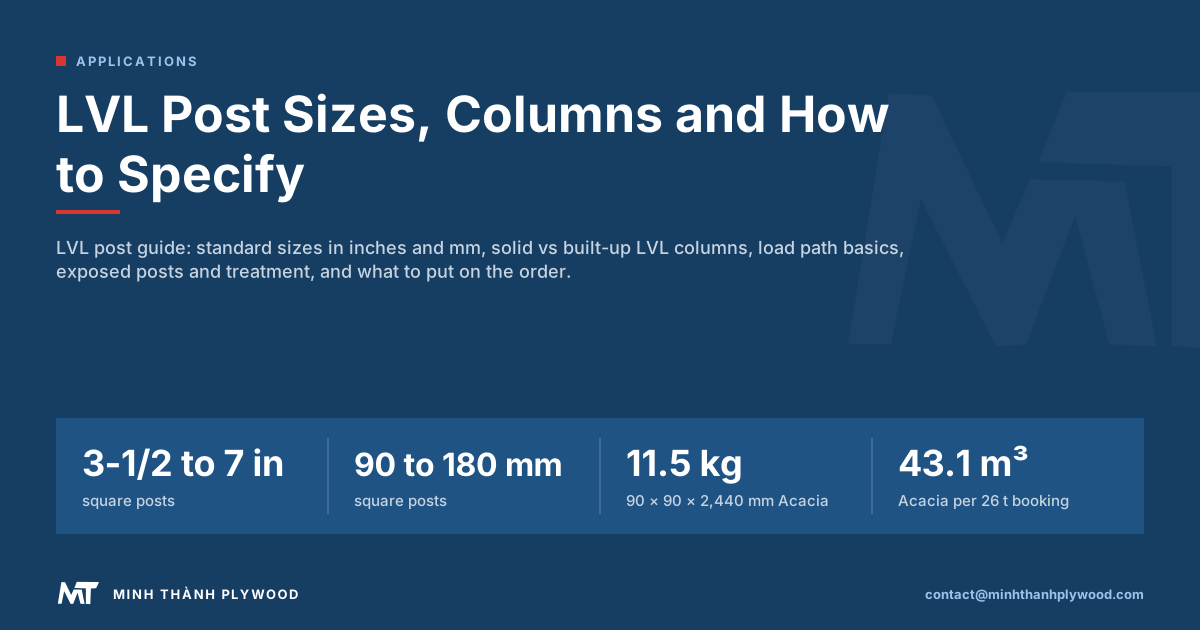
An LVL post is a column of laminated veneer lumber that carries a beam or floor load down to the foundation. Common LVL post sizes are 3-1/2 × 3-1/2 to 7 × 7 inches, or 90 × 90 to 180 × 180 mm, made solid or built up from plies. Minh Thanh Plywood makes LVL members for furniture, joinery and packaging posts.
What is an LVL post?
An LVL post is a vertical member of laminated veneer lumber that carries a load from a beam, floor or roof down to the foundation. LVL posts and LVL columns are the same thing: the name changes by market, not by product.
Laminated veneer lumber (LVL) is made of thin veneers, usually about 3 mm thick, glued with their grain running along the member. For a post, that means the grain runs vertically from top to bottom, which is the direction a column carries its load.
LVL posts are used:
- Under beams in open-plan floors where a wall has been removed.
- In garages, carports and porches to carry a header or ridge.
- Inside walls as point-load columns under a girder.
- In furniture, shopfitting, display and packaging as non-structural posts.
LVL post sizes in inches and millimetres
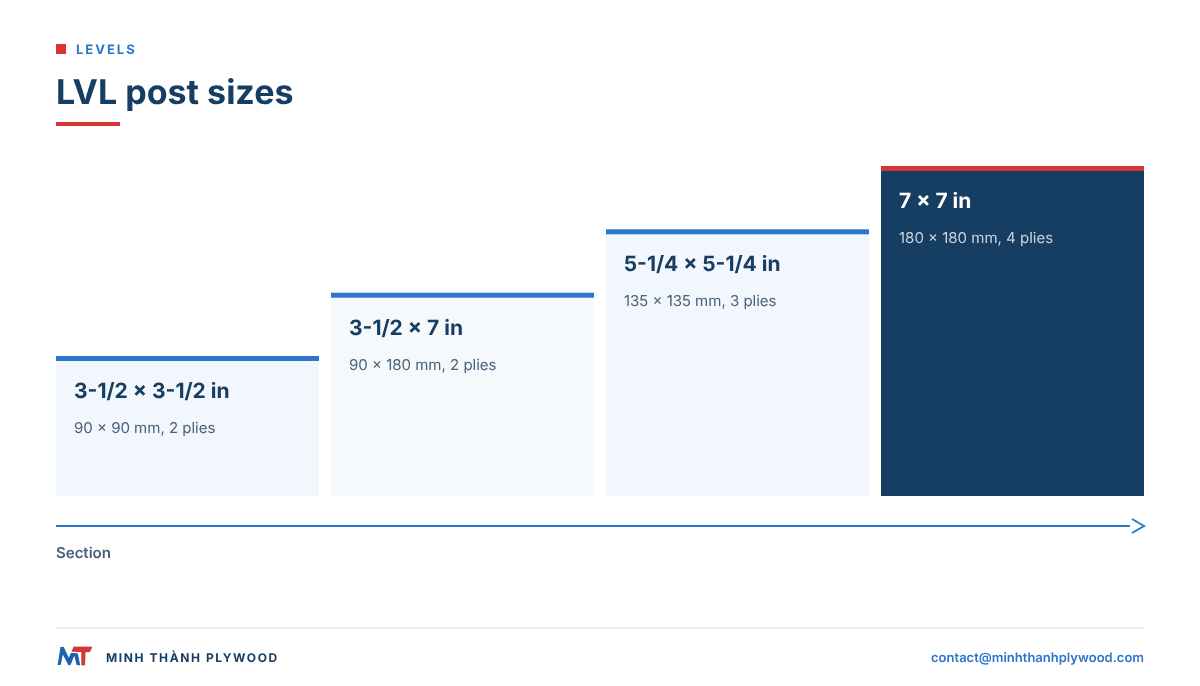
LVL post sizes follow the thickness of the LVL plies they are made from. In North America the standard ply is 1-3/4 inches thick, so post widths come in steps of 1-3/4 inches; metric posts follow the local LVL thicknesses, often 45 mm.
| Post size (inches) | Built from | Post size (mm, typical metric) | Built from |
|---|---|---|---|
| 3-1/2 × 3-1/2 | 2 plies of 1-3/4 | 90 × 90 | 2 plies of 45 mm |
| 3-1/2 × 5-1/4 | 2 plies × 5-1/4 depth | 90 × 135 | 2 plies × 135 mm |
| 3-1/2 × 7 | 2 plies × 7 depth | 90 × 180 | 2 plies × 180 mm |
| 5-1/4 × 5-1/4 | 3 plies of 1-3/4 | 135 × 135 | 3 plies of 45 mm |
| 5-1/4 × 7 | 3 plies × 7 depth | 135 × 180 | 3 plies × 180 mm |
| 7 × 7 | 4 plies of 1-3/4 | 180 × 180 | 4 plies of 45 mm |
Each width is the ply count multiplied by the ply thickness: 2 × 1-3/4 = 3-1/2 inches, 3 × 45 = 135 mm. Solid LVL columns are also made directly in these sizes. Lengths for structural posts are made to the storey height.
Can LVL be used as a post?
Yes. Structural LVL is made for columns as well as beams, and makers publish column load tables for each size and height. The post must be a certified structural product, sized by an engineer or from those tables.
What makes LVL work as a post:
- Straightness: LVL is pressed from dried veneers, so it stays straight and does not twist like a drying sawn post.
- Consistent strength: knots and splits are spread across many thin veneers, so no single defect weakens the column.
- Long lengths: LVL is made in long billets, so a post can run a full storey or more in one piece.
- Matching beams: an LVL post under an LVL beam gives the same width, which simplifies the connection.
Solid LVL column or built-up LVL post?
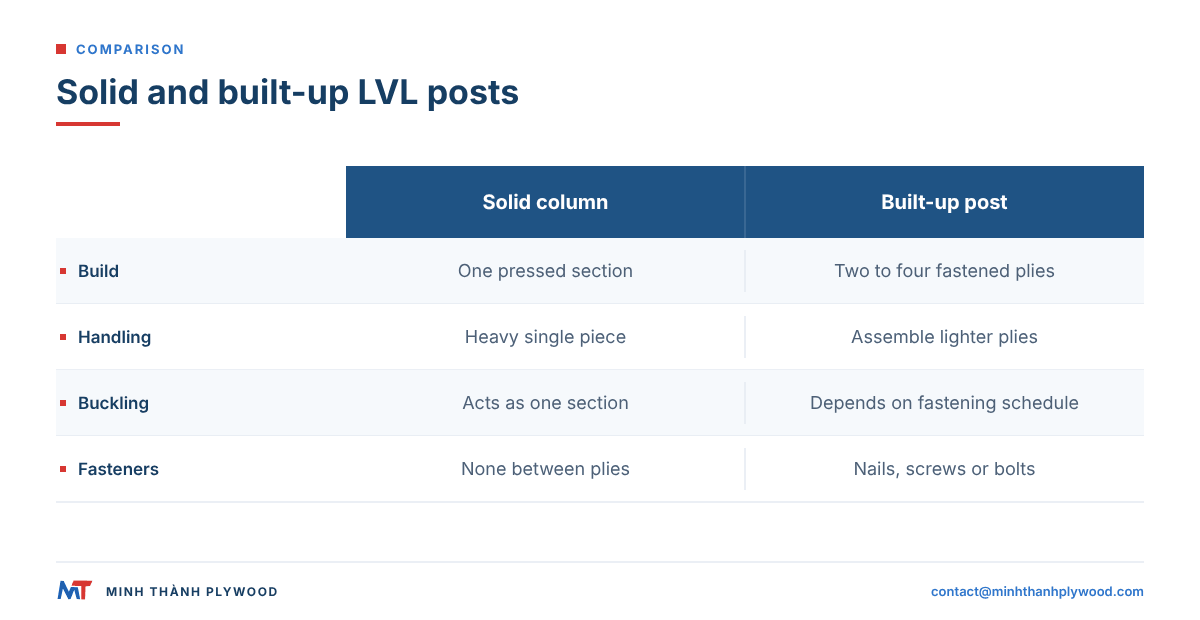
A solid LVL column acts as one section and is the stronger choice at a given size. A built-up post of nailed, screwed or bolted LVL plies is easier to carry and fit on site, but it only acts as one member when fastened to the maker’s schedule.
| Point | Solid LVL column | Built-up LVL post |
|---|---|---|
| Construction | One pressed section | 2–4 plies fastened together |
| Buckling resistance | Highest at the size | Lower unless fastened as specified |
| Handling | Heavy, one piece | Light plies, assembled in place |
| Fitting in walls | Must be fed in | Plies fit through openings |
| Matching a multi-ply beam | Separate member | Same plies as the beam |
| Fastening | None | Nails, screws or bolts to a schedule |
Built-up posts are common in house framing because the same 1-3/4 inch plies used for a beam can be nailed together on site as its post. In each case, use the maker’s fastening schedule for the post, not a beam schedule.
How does a post carry load? Load path basics
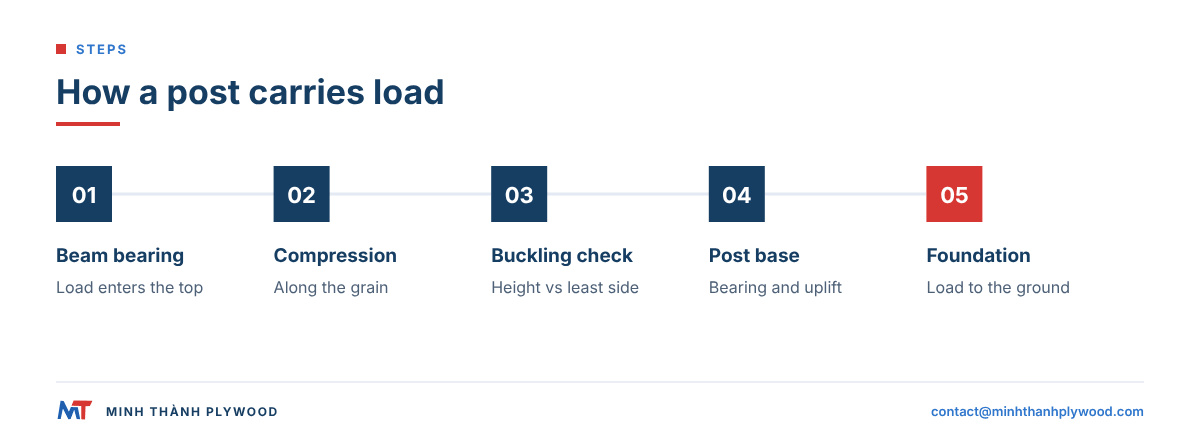
A post carries load in compression along its grain, from the beam bearing at the top to the foundation at the bottom. It fails in one of three ways, and the design checks all three.
- Crushing at the bearing: the beam presses into the top of the post, and the post presses into its base. Bearing area must be large enough.
- Buckling: a tall, slender post bows sideways long before the wood crushes. This is why allowable load falls quickly as height rises.
- Connection failure: the top or base connection pulls out under wind uplift or slides under side load.
The key number for buckling is slenderness: the effective height divided by the smaller side of the post. A 7 × 7 inch post at the same height is far less slender than a 3-1/2 × 3-1/2, so it carries much more than four times the load. Blocking or a wall that braces the post along its height shortens the effective height.
How much load does an LVL post carry? An example from a published table
A solid 3-1/2 × 3-1/2 inch LVL post 8 ft tall carries about 7,300 lb of allowable axial load, a 5-1/4 × 5-1/4 inch post about 27,100 lb, and the load falls by 12 to 16% for every extra foot of height. The figures below are from the Boise Cascade Versa-Lam 1.8 2750 column table at 100% load duration, for solid one-piece columns in dry service, braced at the ends only (Boise Cascade column table, checked October 2026).
| Post size (inches) | 8 ft | 9 ft | 10 ft |
|---|---|---|---|
| 3-1/2 × 3-1/2 | 7,295 lb | 6,155 lb | 5,250 lb |
| 3-1/2 × 7 | 14,610 lb | 12,330 lb | 10,520 lb |
| 5-1/4 × 5-1/4 | 27,095 lb | 23,815 lb | 20,950 lb |
| 5-1/4 × 7 | 36,160 lb | 31,770 lb | 27,950 lb |
This is an example from one maker’s table for one grade, not a design value for any other product. Use your product’s own column guide, and have a design professional check the load path.
Who sizes an LVL post?
A structural engineer, or the maker’s published column tables. In the United States, LVL design values come from an ICC Evaluation Service report. In Canada they come from CSA O86 design values; in Australia and New Zealand, from products certified to AS/NZS 4357.0 and designed to AS 1720.1; in Europe, from LVL to EN 14374. A post is never sized from a beam table.
Structural LVL sold in the EU carries CE marking under the Construction Products Regulation, Regulation (EU) No 305/2011.
In Canada, the proof route has three parts: a CCMC evaluation report from the Canadian Construction Materials Centre, design values to CSA O86, and a stamped, evaluated product. Boise Cascade, for example, publishes Canadian Versa-Lam guides under CCMC 12472-R in grades from 1.8E to 2.3E, with bending values of 2400 to 3100 psi in the guide titles (Boise Cascade Versa-Lam, checked October 2026). A Canadian builder who needs a structural post should buy a stamped, evaluated product with a column guide, not a member supplied only with a mill statement.
Is an LVL post stronger than a solid timber post?
At the same size, a structural LVL post usually carries more load than a sawn timber post. LVL spreads the natural defects of the wood across many veneers, so its design values are higher and more consistent.
| Post type | Strength consistency | Straightness | Sizes and lengths | Typical use |
|---|---|---|---|---|
| LVL post | High | Very straight | Made to size and length | Columns under beams, framing |
| PSL post | High | Very straight | Made to size and length | Exposed columns, heavy loads |
| Glulam post | High | Straight | Large sections | Exposed timber structures |
| Sawn timber post | Varies with knots | Can twist as it dries | Limited by the log | Decks, fences, light framing |
| Steel post | Very high | Straight | Standard sections | Basements, heavy point loads |
Parallel strand lumber (PSL) is a close cousin of LVL. LVL is made of whole veneer sheets glued in layers; PSL is made of long veneer strands. Both are engineered wood columns.
Can LVL posts be used outside?
Yes, when the post is treated for its exposure, sits on a stand-off base and has its top and cut ends protected. Untreated LVL posts belong inside the building envelope.
- Treat it: H3 or Use Class 3 for above-ground outdoor posts; H4 or Use Class 4 for posts set in soil.
- Lift it: fit a post base with a stand-off, so the end grain never sits in water on concrete.
- Cap it: protect the top end grain with a cap or the beam bearing plate.
- Seal it: brush preservative and end sealer on every site cut.
- Coat it: a breathable exterior stain slows wetting and greying.
Our guide can LVL be used outside? explains glue types, hazard classes and site storage in full.
LVL posts in furniture, shopfitting and packaging
Outside building structure, LVL posts are used wherever a straight, strong, stable square section is needed. These posts carry no building load, so they do not need a structural grade, but they still need the right bond and moisture content.
| Use | Why LVL | Usual bond |
|---|---|---|
| Table and bed legs, frame posts | Straight, takes screws, no twist | UF glue at E0 emission |
| Shop and display stand uprights | Stable, machines cleanly | UF glue at E0 emission |
| Door frame posts and jambs | Straight over full height | UF or MR bond |
| Crate and pallet posts | Strong, consistent, no splitting | MR or phenolic bond |
| Sheltered outdoor screens | Straight, paintable | Phenolic WBP, treated |
This is where Minh Thanh LVL fits. Our LVL laminated veneer lumber is made for furniture-frame components, door-frame members, industrial packaging members and engineered members specified by the project.
Minh Thanh LVL members: species, sizes and bonds
Minh Thanh Plywood makes LVL from Acacia or Eucalyptus plantation veneers in Ha Hoa, Phu Tho, in billet formats of 1220 × 2440 and 1250 × 2500 mm, cut to the member sizes on your drawing.
| Specification | Minh Thanh LVL |
|---|---|
| Veneers | Acacia or Eucalyptus plantation timber |
| Density | Acacia about 580 kg/m³; Eucalyptus 650–750 kg/m³ |
| Moisture | 8–12% |
| Billet formats | 1220 × 2440 or 1250 × 2500 mm |
| Interior bond | UF glue at E0 emission; E1 as an option |
| Water-resistant bonds | MR / melamine-fortified or phenolic WBP |
| Documents | EUDR compliance dossier with origin records and geolocation files, Regulation (EU) 2023/1115 |
For EU buyers, the European Commission gives the EUDR application dates as 30 December 2026 for large and medium operators, and 30 June 2027 for other micro and small operators.
Because members are cut from our billets, post lengths run up to 2,440 or 2,500 mm, which covers furniture, joinery, display and packaging posts. The denser Eucalyptus option holds screws hardest in leg and post joints. For structural building columns, use a certified structural LVL with published column tables.
Connecting an LVL post: the top and the base
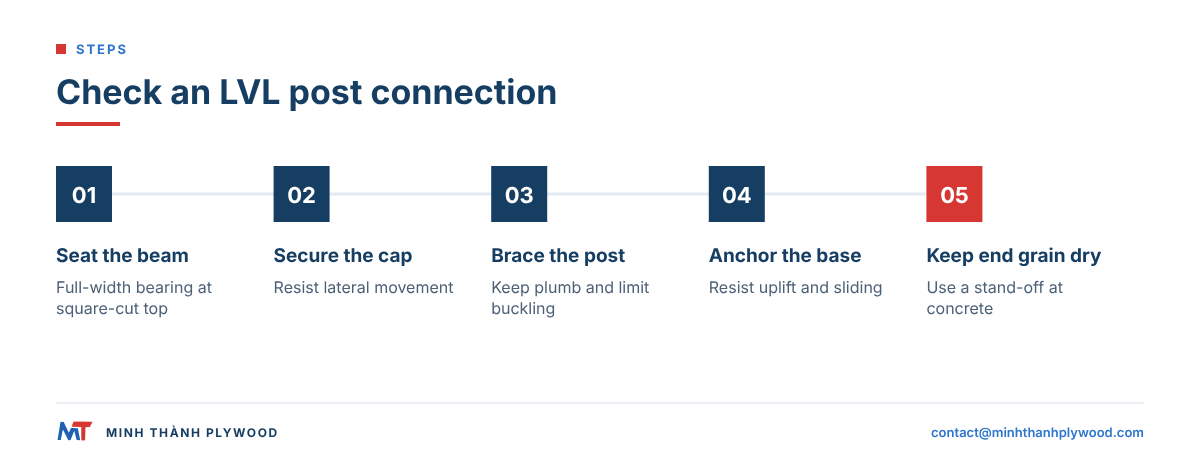
An LVL post is only as strong as its connections. The top must hold the beam in place and spread its load; the base must hold the post down and keep its end grain dry.
| Connection | What it does | Typical detail |
|---|---|---|
| Post cap or beam seat | Holds the beam on the post, resists side movement | Metal cap screwed to post and beam |
| Bearing area | Spreads the beam load into the post end | Full-width bearing, ends cut square |
| Post base | Fixes the post to the slab, resists uplift | Anchored metal base with a stand-off |
| Stand-off | Keeps end grain out of water | Gap between post end and concrete |
| Bracing | Holds the post plumb, shortens its effective height | Walls, blocking or knee braces |
Cut post ends square so the load bears on the full section. A post that bears on one corner crushes there long before its design load.
Can an LVL post be notched or drilled?
Only within the limits the maker publishes. A notch or a large hole at mid-height cuts through the veneers that carry the load and makes the post more likely to buckle. Run services beside the post, not through it.
LVL post weight and how many fit in a container
An LVL post’s weight is its volume times the density of the species. A 90 × 90 mm post 2,440 mm long holds about 0.0198 m³ of wood, so it weighs about 11.5 kg in Acacia at 580 kg/m³.
For a 40HC booking capped at 26 t, with 25 t allocated to wood and 1 t to packaging, the material plan allows about 43.1 m³ of Acacia LVL, or 33.3–38.4 m³ of Eucalyptus at 650–750 kg/m³. That is roughly 2,180 Acacia posts of 90 × 90 × 2,440 mm, which is 8 ft long, before the stowage plan. This is the order a furniture, display or joinery buyer in Canada or the US can place direct from Vietnam by the 40HC. The final piece count follows your section and length schedule and the weighed bundles.
LVL post price: what moves it
LVL post price moves with species, section, length, bond, treatment and quantity. A structural post with an evaluated grade and a stamp costs more than a non-structural member of the same size, because of the testing and certification behind it.
For reference, a Canadian cost guide puts 1-3/4 × 9-1/2 inch LVL at C$8 to C$12 per lineal foot and 1-3/4 × 16 inch at C$16 to C$22 (Konstruction, 2024-2025 material costs). A built-up post multiplies the per-ply price by the number of plies, and a solid evaluated column costs more per foot than the same plies.
For a non-structural post, the useful number is cost per cubic metre of member, plus cutting. Our LVL price guide explains each factor, and quotations list the member sizes, bond and packing together.
What to write on an LVL post order
An LVL post order is complete when it names the use, section, length, species, bond, treatment, moisture and quantity. For a non-structural post, this is a typical line:
| Field | Example for a furniture or display post |
|---|---|
| Use | Table legs and display uprights, interior |
| Section | 90 × 90 mm, square edges |
| Length | 2,440 mm, or cut lengths per schedule |
| Species | Eucalyptus LVL |
| Bond and emission | UF glue at E0 emission |
| Treatment | None, interior |
| Moisture | 8–12% |
| Surfaces | Sanded, visible faces marked on the drawing |
| Packing and quantity | Strapped, wrapped bundles; 1×40HC |
For a structural building post, add the structural grade, the design standard of your market and the column table or engineer’s design, and buy from a mill whose LVL is certified for that market.
LVL posts: send us the member schedule
Our quality and certificates page lists the test reports and certifications behind our panels. Send the post sizes, lengths, quantities, use and bond, with your destination port. We reply within hours with a quotation and can send free samples of Acacia and Eucalyptus LVL. For horizontal members, read LVL beams: uses and sizes; for wall framing, LVL framing timber and LVL 10.
Buyer questions, answered
What is an LVL post?
An LVL post is a vertical member of laminated veneer lumber that carries a load down to the foundation, used as a column under beams, in porches, garages and open-plan floors.
What sizes do LVL posts come in?
Common LVL post sizes are 3-1/2 × 3-1/2, 3-1/2 × 5-1/4, 3-1/2 × 7, 5-1/4 × 5-1/4, 5-1/4 × 7 and 7 × 7 inches; in metric, 90 × 90, 90 × 135 and 135 × 135 mm.
Can LVL be used as a post?
Yes. Structural LVL is made and evaluated for columns as well as beams. The post must be a certified structural product sized by an engineer or from the maker's column tables.
Is a solid LVL post better than a built-up post?
A solid post acts as one section and buckles less at the same size. A built-up post of nailed or bolted plies is easier to handle and fit, but it must be fastened to the maker's schedule to count as one member.
Can LVL posts be used outside?
Yes, when the post is treated for the exposure, sits on a stand-off base above concrete and has its top and cut ends protected. Untreated LVL posts should stay inside the building envelope.
How tall can an LVL post be?
Height is limited by buckling: the taller and thinner the post, the less load it carries. An engineer or the maker's column table gives the allowable load for each size and height.
Is an LVL post stronger than a solid timber post?
At the same size, a structural LVL post usually carries more load than a sawn timber post because its strength is more consistent and it has no large knots or splits.
What is the difference between an LVL post and a PSL post?
LVL is made of full veneer sheets glued in layers; parallel strand lumber (PSL) is made of long veneer strands. Both are engineered wood used for columns and beams.
Do LVL posts need a post base?
Yes. A post base fixes the post to the foundation, resists uplift and lifts the end grain off the concrete so it cannot draw up moisture.
Where can LVL posts be used without a structural grade?
In furniture, shopfitting, display stands, packaging and crating, where the post carries no building load. These uses still need the right bond and moisture content.