
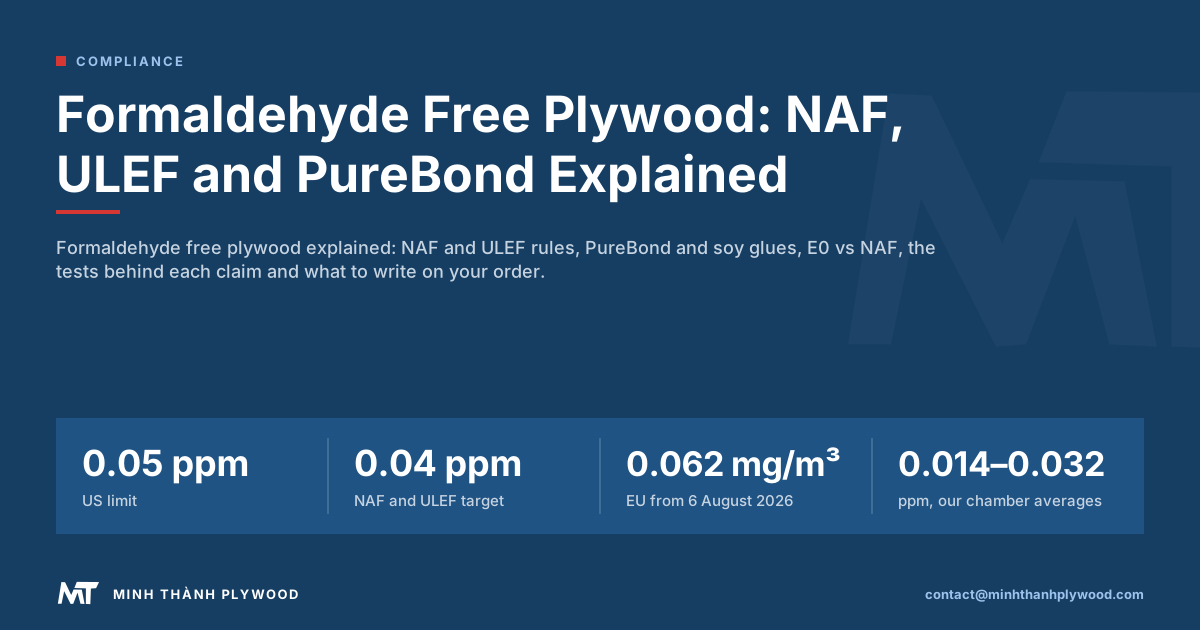
No plywood is free of formaldehyde, because wood itself releases a trace of it. What buyers can get is plywood made with no added formaldehyde (NAF), plywood made with ultra-low-emitting formaldehyde resins (ULEF), or certified low-formaldehyde plywood such as CARB P2 / TSCA Title VI panels. Minh Thanh Plywood makes the third: UF glue at E0 emission, with six chamber tests averaging 0.014–0.032 ppm. This guide sets out the ladder and the proof each step needs.
Is any plywood truly formaldehyde free?
No plywood is truly formaldehyde free, because wood itself releases a small amount of formaldehyde as it ages, even with no glue at all. “Formaldehyde free plywood” in practice means one of two regulated claims: the panel is made with a resin that has no added formaldehyde (NAF), or with an ultra-low-emitting formaldehyde resin (ULEF).
The US rules set the terms. Under 40 CFR Part 770, a no-added formaldehyde-based resin is “a resin formulated with no added formaldehyde as part of the resin crosslinking structure”, and it must still meet a measured emission standard. So even a NAF panel is tested; its approval rests on chamber numbers.
For a buyer, three labels matter in this order:
- NAF: no formaldehyde in the resin, approved by CARB or a TSCA Title VI third-party certifier.
- ULEF: a formaldehyde-based resin that emits so little it earns reduced testing or an exemption.
- Certified low-formaldehyde: panels that meet the CARB Phase 2 / TSCA Title VI limit of 0.05 ppm for hardwood plywood, with routine third-party testing.
A seller who writes “formaldehyde-free” without one of the first two approvals is describing the panel loosely. Ask which of the three it is.
Where does the formaldehyde in plywood come from?
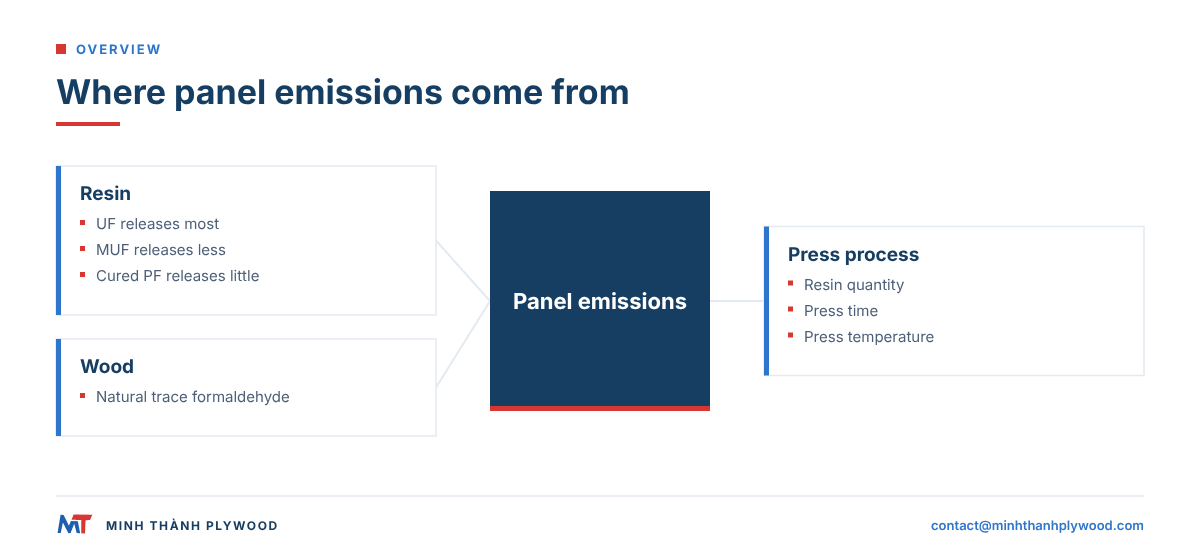
Most of the formaldehyde in plywood comes from the glue line, not the wood. Standard interior plywood is bonded with urea-formaldehyde (UF) resin; moisture and heat slowly break part of the cured UF bond, and the panel releases formaldehyde gas, most in its first months.
Three sources add up:
- The resin. UF releases the most; melamine-urea-formaldehyde (MUF) less; cured phenol-formaldehyde (PF) very little.
- The wood. All timber contains a trace of natural formaldehyde, which is why no test reads zero.
- The process. Too much resin, a short press cycle or a low press temperature leaves unreacted formaldehyde in the panel.
At Minh Thanh, furniture panels are pressed twice as standard: the core board is pressed and calibrated, then face and back are pressed on. Veneers and panels are dried to 8–12 % moisture content. Each of these settings affects the emission figure as much as the resin name does.
Formaldehyde emission classes, from E2 to NAF
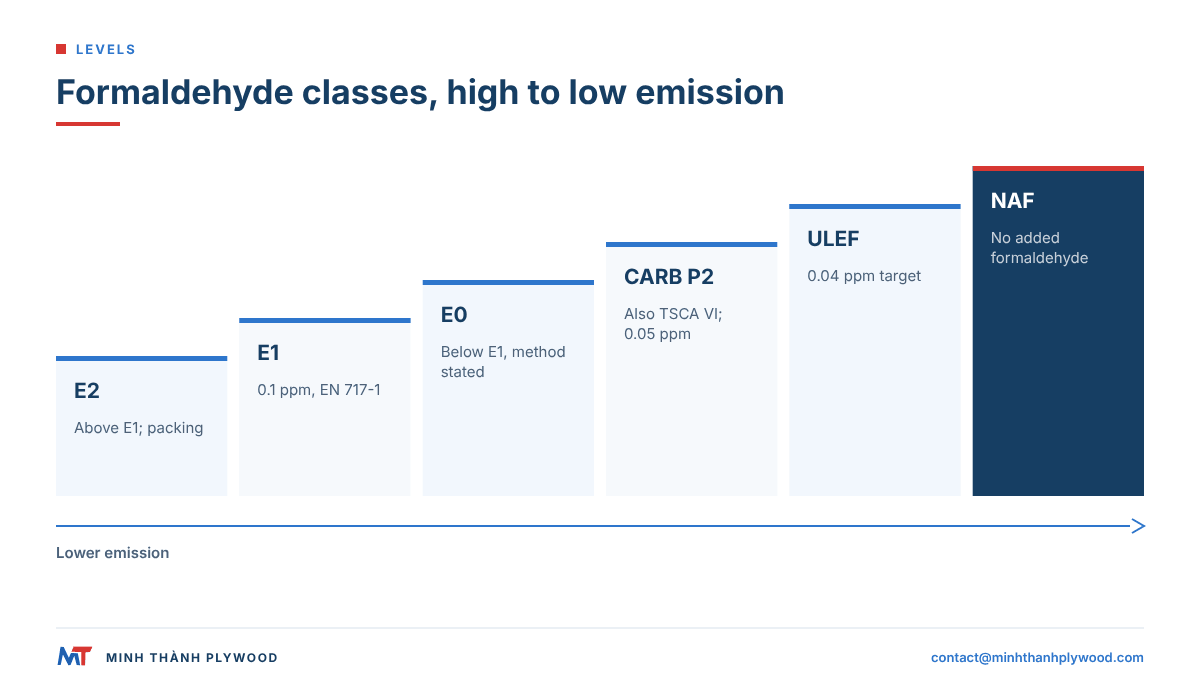
Formaldehyde emission classes form a ladder from E2, the highest emitting, to NAF, the lowest. Each step down needs a different proof, and the class is separate from the glue’s water resistance.
| Class | Usual resin | Where the limit comes from | Typical use |
|---|---|---|---|
| E2 | UF | Above the E1 limit of EN 13986 | Packing, crates, temporary works |
| E1 | UF, MUF | EN 13986 Annex B: 0.1 ppm in the EN 717-1 chamber | General interior panels in Europe |
| E0 | UF at E0 emission, MUF | Trade class below E1; method stated in the test report | Furniture and cabinets |
| CARB P2 / TSCA Title VI | UF at E0 emission, MUF, PF | 0.05 ppm for hardwood plywood, ASTM E1333 or D6007 | Furniture sold in the United States |
| ULEF | Low-emitting UF or MUF | 0.05 ppm maximum, 0.04 ppm target, CARB or TSCA exemption | US furniture brands, LEED projects |
| NAF | Soy, MDI, PVAc and other non-formaldehyde resins | 0.05 ppm maximum, 0.04 ppm target, no formaldehyde in the resin | Healthcare, schools, LEED projects |
E0 has no single global threshold, so an E0 claim is only as good as the test method written beside it. A chamber result in ppm, a desiccator result in mg/L and a perforator result in mg/100 g are not interchangeable figures.
NAF plywood: what no added formaldehyde means
NAF plywood is plywood bonded with a resin that contains no formaldehyde in its cross-linking structure and approved under the NAF exemption of CARB or TSCA Title VI. The approval, not the resin brochure, is what lets a mill label panels as made with no-added formaldehyde-based resins.
The application to a TSCA Title VI third-party certifier or to CARB needs:
- The product and its resin system, named.
- At least one test under certifier supervision, by ASTM E1333 or ASTM D6007.
- Three months of routine quality-control tests, not fewer than thirteen.
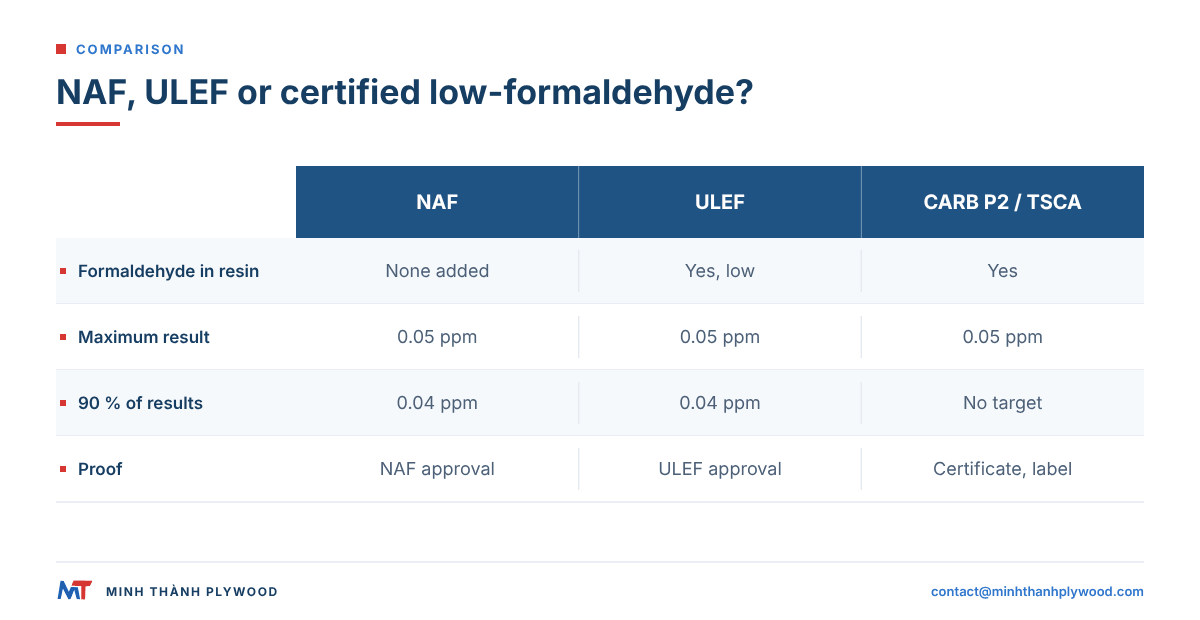
The panel must then meet two numbers for hardwood plywood: no test result above 0.05 ppm, and 90 percent of the quality-control data at or below 0.04 ppm (40 CFR 770.17). The exemption runs two years and must be renewed with a new test; a change of resin system voids it.
That last rule matters to importers. A NAF approval covers one product made with one resin system at one mill. If the mill switches glue for a cheaper batch, the panels in that batch are no longer NAF, whatever the bundle label says.
ULEF plywood: ultra-low-emitting formaldehyde resins
ULEF plywood is made with a formaldehyde-based resin, usually a modified UF or MUF, that emits so little it qualifies for reduced testing or a two-year exemption. ULEF is a step above NAF: the resin contains formaldehyde, but the panel tests close to the NAF level.
For hardwood plywood the ULEF exemption uses the same two numbers as NAF, 0.05 ppm maximum and a 0.04 ppm ULEF target for 90 % of results, but asks for more proof: two supervised tests and six months of quality-control data, at least twenty-six tests (40 CFR 770.18).
| Point | NAF | ULEF |
|---|---|---|
| Formaldehyde in the resin | None added | Yes, at low emission |
| Maximum single result, hardwood plywood | 0.05 ppm | 0.05 ppm |
| Target for 90 % of results | 0.04 ppm | 0.04 ppm |
| Supervised primary or secondary tests to apply | At least 1 | At least 2 |
| Quality-control data to apply | 3 months, 13+ tests | 6 months, 26+ tests |
| Exemption length | 2 years, renewable | 2 years, renewable |
| Label wording allowed | “Made with no-added formaldehyde-based resins” | “Made with ultra low-emitting formaldehyde resins” |
For a furniture buyer the practical difference is small in the air of a room and large in the marketing. Only a NAF panel can carry the no-added formaldehyde wording; a ULEF panel cannot be sold as formaldehyde free.
PureBond plywood and soy-based adhesives
PureBond plywood is a US trade name for hardwood plywood bonded with a soy-protein adhesive and sold as made with no added formaldehyde. It made soy glue the best-known route to NAF hardwood plywood in North America, and buyers now use “PureBond” loosely for any soy-bonded panel.
Soy adhesives are made from soy flour cross-linked with a non-formaldehyde curing agent. They press at similar temperatures to UF glue, bond hardwood veneers well for interior use, and give no formaldehyde from the glue line. The trade-offs are cost, a narrower press window and lower water resistance than phenolic glue, so soy-bonded panels are interior products.
When a spec says “PureBond or equal”, read it as three requirements:
- A no-added formaldehyde resin, soy-based or another type.
- A NAF approval for that product under CARB or TSCA Title VI.
- Interior bond performance equal to the named panel, usually an interior or Type II bond.
A Vietnamese or any other mill can meet “or equal” only with all three on paper.
Glue systems compared: UF, MUF, phenolic, soy, MDI and lignin
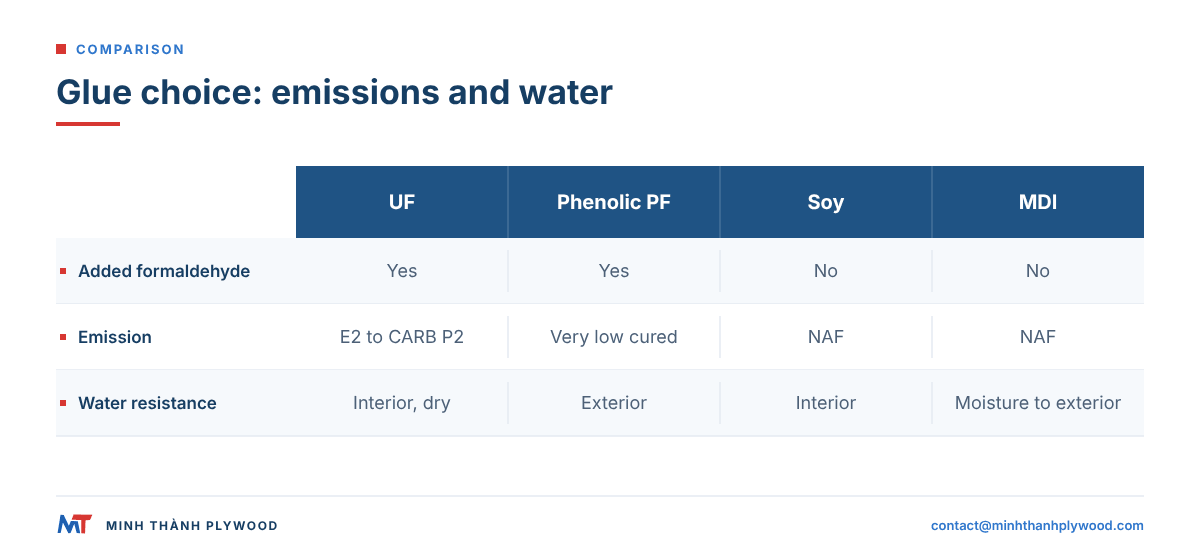
The glue decides both how much formaldehyde a panel can release and how well it resists water. These are two separate specifications, and a plywood order should name both.
| Glue system | Formaldehyde in the resin | Emission level reached | Water resistance | Common use |
|---|---|---|---|---|
| UF (urea-formaldehyde) | Yes | E2 to CARB P2 / TSCA, by formulation and press control | Interior, dry | Furniture, cabinets |
| MUF (melamine-urea-formaldehyde) | Yes | E1 to CARB P2 / TSCA | Moisture-resistant | Kitchen and bathroom furniture, MR panels |
| PF (phenolic, WBP) | Yes | Very low once cured | Exterior, boil-resistant | Exterior, film-faced, marine |
| Soy-based | No added | NAF | Interior | NAF hardwood plywood |
| MDI / pMDI (isocyanate) | No added | NAF | Moisture-resistant to exterior | NAF panels, OSB |
| Lignin-based | Partial or none, by formulation | Low to NAF | By formulation | Development and niche products |
Phenolic glue shows why “low formaldehyde” and “no added formaldehyde” differ. Cured PF releases very little, so exterior and film-faced panels often test in the lowest classes; but PF is a formaldehyde-based resin, so it is never NAF. Under the US rules, laminated products with a phenol-formaldehyde glue line on a compliant platform are even treated separately from UF products.
Minh Thanh uses UF glue at E0 emission as standard for furniture and interior panels; MR/melamine-fortified and phenolic (WBP) bonds are made to the customer’s specification. The bond and the emission class sit on two lines of the order.
E0, CARB P2 and NAF: which one does your market ask for?
Each market asks for a different proof, and most furniture buyers need certified low-formaldehyde plywood rather than NAF. NAF is a project or brand requirement more often than a legal one.
| Market | What the law or buyer asks for plywood | Proof to request |
|---|---|---|
| United States | 0.05 ppm for hardwood plywood, TSCA Title VI | TSCA Title VI label with certifier number; certificate |
| California | CARB ATCM Phase 2, same 0.05 ppm | CARB P2 certification number |
| European Union | Furniture and wood-based articles at or below 0.062 mg/m³ from 6 August 2026 (REACH Annex XVII, entry 77) | Test to the Appendix 14 chamber conditions, or EN 717-1 by agreement |
| Japan | F☆☆☆☆ for unrestricted interior use | JAS F☆☆☆☆ grade or desiccator test, see JAS F four star plywood |
| LEED v4 projects | NAF or ULEF composite wood | NAF or ULEF approval letter |
| Hospitals, schools, US brands with NAF policies | NAF | NAF approval letter and resin statement |
The EU limit applies to furniture and wood-based articles placed on the EU market from 6 August 2026, under Regulation (EU) 2023/1464 (checked 20 October 2026). A chamber result in ppm under ASTM D6007 is not converted into mg/m³ for this rule; the EU test conditions are their own.
How formaldehyde emissions are measured
Formaldehyde emission is measured by one of four methods, and each gives a number in its own unit. A claim without the method is unreadable.
| Method | What it measures | Unit | Where it is used |
|---|---|---|---|
| ASTM E1333 (large chamber) | Air concentration in a chamber with the panel | ppm | US primary method, CARB and TSCA |
| ASTM D6007 (small chamber) | Air concentration in a smaller chamber, correlated to E1333 | ppm | US secondary method, routine third-party tests |
| EN 717-1 (chamber) | Steady-state air concentration | mg/m³ or ppm | European E1 class |
| JIS A 1460 (desiccator) | Formaldehyde absorbed in water over 24 hours | mg/L | Japan F-star grades |
Two warnings help buyers. First, the same panel gives different figures under each method, and published “conversion tables” are not accepted by any regulator. Second, a test report describes the samples tested: the lab, the date, the thickness and the method should all match the product on your order.
Formaldehyde free plywood from Vietnam: what is available
Formaldehyde free plywood from Vietnam is available only from mills that hold a NAF approval for a specific product and resin; most Vietnamese furniture plywood for Europe and the US is certified low-formaldehyde plywood with UF or MUF glue. That is the honest map of supply.
Vietnamese mills export three emission levels:
- Certified low-formaldehyde furniture plywood (CARB P2 / TSCA Title VI, E0): the largest share of furniture exports to Europe and the US.
- E1 and E2 commercial and packing plywood: interior and packing grades.
- Phenolic-bonded panels: film-faced and exterior plywood, very low emission by chemistry, not NAF.
A NAF panel from any origin carries the same paperwork: the approval letter naming the mill and product, the resin system and a current test. If a quote says “formaldehyde-free” and cannot attach those, treat the panel as low-formaldehyde and price it that way.
What Minh Thanh supplies: certified low-formaldehyde plywood
Minh Thanh Plywood supplies certified low-formaldehyde furniture plywood: UF glue at E0 emission as standard, CARB P2 / TSCA Title VI certified, and tested by third-party laboratories. Six chamber tests averaged 0.014–0.032 ppm, which is 28–64 % of the 0.05 ppm US limit. It is not sold as NAF or formaldehyde-free.
| Evidence | Detail |
|---|---|
| Certification | CARB P2 / TSCA Title VI, ICTT mill no. 23024, hardwood plywood veneer core, 3–50 mm |
| Chamber tests | Six ASTM D6007 tests, April 2025 to June 2026, on 9, 15 and 18 mm panels |
| Results | Averages of 0.014–0.032 ppm against the 0.05 ppm limit |
| Laboratories | Shanghai Hongjun (HJ-QAT-250597, HJ-QAT-251303, HJ-QAT-261036); ICTT Vietnam (ICTTVN-QAT-250841, ICTTVN-QAT-251173, ICTTVN-QAT-260272) |
| E0 testing | Every 3 months |
| Buyer’s own method | Third-party testing to the buyer’s method, for example EN 717-1, arranged through SGS on request |
| US panels | TSCA Title VI label with producer, lot and certifier number TPC-43 |
These are results of the tested samples, each tied to its method and laboratory. For most furniture, cabinet and interior programmes in Europe and the US, they are the proof the buyer’s compliance team asks for. The CARB P2 and TSCA Title VI page and the E0 and E1 emission evidence show the documents.
How to verify a supplier’s formaldehyde-free claim
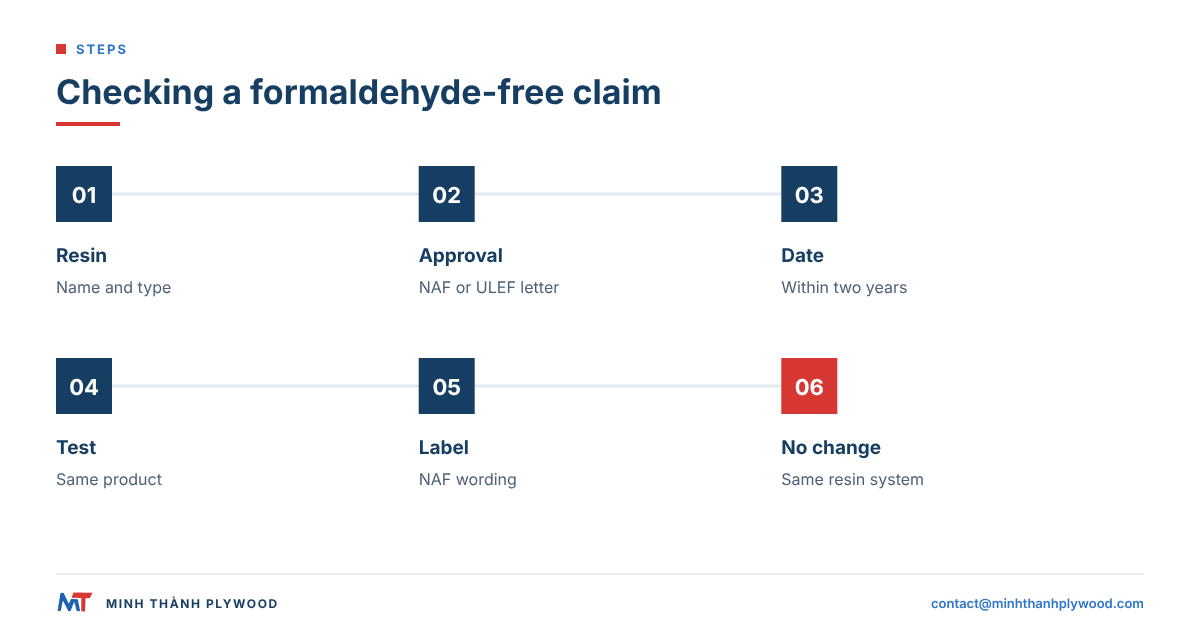
A formaldehyde-free claim is verified with documents, not with a sample’s smell. Ask for these six items, in this order:
- The resin name and type, for example soy-based or pMDI, written on the quote.
- The NAF or ULEF approval letter, issued by CARB or a TSCA Title VI third-party certifier, naming the mill and the product.
- The approval date, within the last two years, since exemptions run two years.
- A recent chamber test on the same product, with method, lab, date and thickness.
- The bundle label wording: “made with no-added formaldehyde-based resins” appears only on panels made under the NAF rule.
- A statement that the resin system will not change during the order, since a resin change voids the exemption.
If any item is missing, the panel may still be good low-formaldehyde plywood. It is just not formaldehyde free in the sense your customer will read.
Low formaldehyde plywood vs NAF: cost and lead time
Low formaldehyde plywood costs less and ships faster than NAF plywood, because UF glue at E0 emission is the standard press setup of furniture mills while NAF resins are a special run. The premium for NAF comes from three places: dearer resin, slower or narrower press cycles, and the testing that keeps the exemption alive.
For a Minh Thanh order, the reference point is the standard build: furniture/interior plywood from US$350/m³ and commercial plywood from US$250/m³ (indicative starting prices, October 2026), with production 15–45 days after the 30 % deposit. The final price depends on face, core, glue, thickness, size, quantity and delivery term.
For a US reader the retail reference is a PureBond NAF panel: Home Depot lists the Columbia Forest Products 1/2 in × 2 ft × 8 ft PureBond maple project panel at about US$28 in October 2026. That panel is 0.019 m³, so the retail price works out to about US$1,490/m³. It is a cut, retailed, maple-faced NAF panel, and a factory FOB price per m³ for a container of furniture plywood is a different thing, which is why the two numbers are not a like-for-like quote. A factory buyer compares on the same face, thickness and glue.
A buyer weighing the two should ask what the end customer actually requires. If the requirement is the US 0.05 ppm limit, the EU 0.062 mg/m³ limit or a European E1 figure, certified low-formaldehyde plywood meets it. If the requirement is a NAF label, a LEED credit or a brand’s no-added policy, only NAF plywood does.
Does sealing or coating make plywood formaldehyde free?
No, sealing or coating lowers what a panel releases into the room but does not change its resin, so it never turns plywood into NAF plywood. Lacquer, paint, HPL, melamine paper and edge banding all reduce emission from the surfaces they cover.
Off-gassing also falls with age, and the numbers help a home buyer plan. A UF-bonded panel releases 15–60 % of its formaldehyde in the first 30 days, depending on the resin formula (a building biologist’s summary, mychemicalfreehouse.net, November 2021). Phenol-formaldehyde plywood glue typically carries under 1 % free formaldehyde (about 0.7 % in a standard plywood resin) and, once cured, emits close to nothing. Fresh panels start below 0.1 ppm and emissions fall toward zero as the panels age.
A sensible air-out schedule for a sensitive household is to test or smell the panels when new, after a few weeks and after 2–3 months of airing, with windows open and the furniture unpacked in a ventilated room.
Two points follow for furniture makers:
- A finished-product test measures the finished cabinet or board, coating included. The EU limit for furniture applies to the article placed on the market, so a coated component can be tested as such.
- Uncoated edges and cut-outs release the most. Seal edges and the backs of carcass panels when the product’s own test matters.
Minh Thanh’s furniture panels are sanded and polished, with both faces UV-ready to the standard customers need to apply their own UV coating. The coating step belongs to the furniture maker; the emission evidence for the bare panel comes from the mill.
What to write on your order
Write the emission requirement as a measurable line, separate from the glue line, and attach the proof you need to receive. A complete specification for certified low-formaldehyde plywood reads:
18 mm × 1220 × 2440 mm; face/back: birch D+/D; core: Styrax, stitched; glue: UF at E0 emission; emission: CARB P2 / TSCA Title VI, 0.05 ppm (ASTM E1333 or D6007), TSCA label on each panel; test report on the order product; 1×40HC CIF your port.
For a NAF requirement, replace the glue and emission lines with the resin type, “NAF approval under CARB or TSCA Title VI, letter attached” and “no change of resin system during the order”.
Minh Thanh sends free samples, replies within hours and quotes certified low-formaldehyde plywood on one 40HC, with mixed specifications by agreement. Send your specification to contact@minhthanhplywood.com or WhatsApp +84 988 586 601. For panels that touch water as well, read is plywood waterproof?, and for the wider health question, is plywood toxic?.
Buyer questions, answered
What plywood does not have formaldehyde?
No plywood is completely free of formaldehyde, because wood releases a trace naturally. The closest is NAF plywood, bonded with a resin that has no added formaldehyde, such as soy-based or MDI adhesives, and approved under the CARB or TSCA Title VI NAF exemption.
What is NAF plywood?
NAF plywood is made with a no-added-formaldehyde resin and approved under the US NAF exemption: no test above 0.05 ppm and 90 % of three months of quality-control tests at or below 0.04 ppm.
What's the difference between NAF and ULEF?
NAF resin has no formaldehyde in its cross-linking structure; ULEF resin contains some but emits very little. For hardwood plywood both exemptions use the same numbers, 0.05 ppm maximum and a 0.04 ppm target, but ULEF needs six months of data and two tests instead of three months and one.
Is PureBond plywood formaldehyde free?
PureBond is a trade name for hardwood plywood bonded with a soy-based adhesive and sold as made with no added formaldehyde. Like any NAF panel it still emits a natural trace from the wood, so the accurate claim is no added formaldehyde.
Is E0 plywood formaldehyde free?
No. E0 is a low-emission class for panels usually bonded with UF or MUF glue; NAF describes the resin. An E0 panel can test lower than many limits and still not qualify as NAF.
Can I get E0 emission with phenolic WBP glue?
Yes. Cured phenolic (WBP) glue releases very little formaldehyde, so phenolic plywood usually tests in the low classes. It is still a formaldehyde-based resin, so it is low-formaldehyde plywood, not NAF.
Are LEED credits available for low-formaldehyde plywood?
The LEED v4 low-emitting materials credit asks for composite wood documented as NAF or ULEF under the CARB rules. A panel that only meets the CARB Phase 2 or TSCA Title VI limit does not count toward that part of the credit.
Is formaldehyde-free plywood more expensive?
Yes, NAF adhesives such as soy-based or MDI systems cost more than UF glue and slow some presses, so NAF panels carry a premium over certified low-emission panels of the same face and core. The quote should show the adhesive on its own line.
Where can I buy formaldehyde-free plywood in the UK?
UK timber merchants stock imported NAF hardwood plywood and low-emission birch and poplar panels. For a container order, buy from a mill that names the resin and supplies the test report or NAF approval with the shipment.
Does Minh Thanh make formaldehyde-free plywood?
Minh Thanh makes certified low-formaldehyde furniture plywood with UF glue at E0 emission, CARB P2 / TSCA Title VI certified (ICTT mill no. 23024), and six ASTM D6007 chamber tests averaging 0.014–0.032 ppm against the 0.05 ppm limit. It is not sold as NAF.
How do I check a formaldehyde-free claim from a supplier?
Ask for three things: the resin name and type, the NAF or ULEF approval letter from CARB or a TSCA Title VI third-party certifier, and a recent chamber test on the same product. A claim without all three is marketing.
Is low formaldehyde plywood safe for cabinets and furniture?
Yes. Panels that meet CARB Phase 2 or TSCA Title VI, or the EU limit of 0.062 mg/m³ for furniture from 6 August 2026, are the standard for kitchen cabinets, wardrobes and children's furniture in those markets.