
Commercial ply price is useful when the quotation names the core, face/back appearance, bond, measured thickness and delivery basis. Minh Thanh Plywood's October 2026 starting reference is commercial plywood from US$250/m³. For bulk purchasing, compare accepted components per sheet and delivered cost before selecting the lowest rate.

What does a commercial ply price actually buy?
A commercial ply price buys a defined panel construction, rather than a single industry-wide grade. Commercial plywood is a buying category used for interior components, utility panels and packing, with different faces and bonds inside that category. The first purchasing task is to describe the part the panel must become.
A distributor selling hidden cabinet backs has a different acceptance standard from a joinery factory cutting exposed shelves. Both can ask for commercial plywood, yet one prioritises a serviceable covered face and the other needs a finish that its customer will see. Putting both enquiries into the same rate comparison produces a misleading saving.
Minh Thanh’s commercial plywood range uses specified face and core combinations. White Styrax and Eucalyptus are the principal core choices; a face photograph does not identify the core beneath it. Name both on the quotation line, then match that line to the approved sample.
Write the operating environment beside the component. Dry interior, intermittent humidity and weather exposure need different buying decisions. An inexpensive dry-use panel becomes an expensive choice when installed in an application its bond was never ordered to serve. Start with application and construction before sorting quotations by currency amount.
Which starting price is useful in October 2026?
Minh Thanh’s dated starting reference is commercial plywood from US$250/m³, October 2026. This identifies the entry point to a product category for a buyer who is sizing a budget. It does not price every face species, bond, nominal thickness or custom size at the same rate.
Use that reference to decide whether a factory enquiry fits the budget tier. Obtain a complete specification quotation before approving stock purchases. The commercial and furniture categories involve different preparation and acceptance requirements, so a furniture starting reference cannot be used as a fixed surcharge for upgrading an unspecified commercial sheet.
| Quote field | Record on every offer | Why a missing field changes the comparison |
|---|---|---|
| Face/back | Veneer and paired appearance grade | Repairs and visible defects affect finished use |
| Core | Named species and veneer construction | Changes mass and machined-edge behaviour |
| Bond | Resin system and required bond performance | Matches the service environment |
| Emission | Requirement, method and relevant documents | Separate from moisture resistance |
| Dimensions | Length, width, thickness and tolerance | Determines purchased volume and assembly fit |
| Delivery | Named term and named place | Separates goods cost from transport and clearance |
Keep quotation validity and intended shipment period beside the offer. A public starting reference and an executable purchase quotation serve different jobs. When a production schedule changes, update the goods specification and logistics together so the purchasing team is comparing the order it actually intends to place.
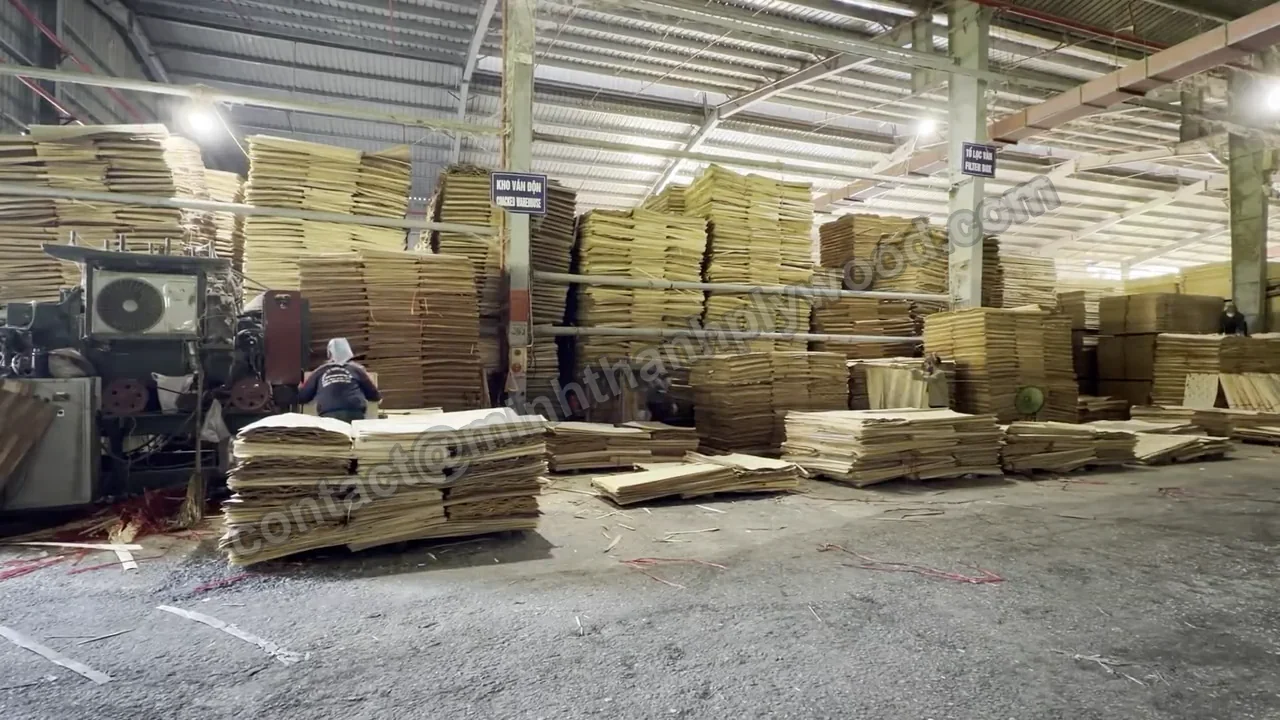 Core veneer stacks show the material stage behind the finished commercial panel.
How should buyers compare MR commercial plywood?
Compare MR commercial plywood by its agreed bond performance and the component’s environment. MR means moisture resistant; it is not a face appearance grade, an emission class or a promise that untreated wood will remain unchanged in water.
A cabinet manufacturer should state where the component sits and how its surfaces and edges are protected. A covered partition in a dry interior and a sink-adjacent component receive different moisture exposure. Giving the factory that information is more useful than requesting the most expensive adhesive name without an application.
At the mill, bonding depends on veneer preparation, adhesive spreading and pressing as well as resin selection. A quotation should therefore connect the ordered bond to the sample and the agreed test method. A photograph of glue on a sheet documents an operation; the bond requirement belongs in the written specification.
Minh Thanh makes MR/melamine-fortified and phenolic bonds to the customer’s specification. Choose the necessary construction for the service environment, then compare matching offers. BS EN 314-2 is the standard for plywood bonding quality, so the quotation can name the standard and edition against which the bond is tested. Do not infer marine suitability from a commercial label or a resin colour. The water-exposure guide explains why the wood, bond and finished installation need separate consideration.
How do face grades change a commercial price list?
Face grades change how much of each sheet is acceptable for its intended visible or covered use. A quoted appearance pair defines the front and back separately. That distinction matters when only one face is seen after assembly.
A buyer who orders a clean appearance on both sides for a hidden cabinet side can pay for a face that never adds value. Conversely, specifying only “good face” leaves repairs, knots and colour variation unresolved on a display panel. Match a physical sample to the component and photograph both sides under useful lighting.
Record acceptable repairs, open defects and sanding finish in plain terms. The agreed sample should show a representative face, rather than a tiny flawless corner. During cutting, a defect located at an important fixing or visible edge can remove an otherwise usable component. An appearance grade therefore affects cutting yield as well as the sheet’s initial look.
Separate the face’s decorative value from the core’s performance. A more attractive veneer over the same core changes appearance; a different core behind the same veneer changes construction. Ask suppliers to price those alternatives as separate lines. Purchasing can then decide whether the visible upgrade earns its cost in the product being sold.
Why do Styrax and Eucalyptus cores affect the rate?
Core selection affects the panel’s mass, machining response and the quantity a weight-limited shipment can carry. The useful choice is the core that passes the component trial and fits the shipping plan, rather than a species name selected from a price list alone.
Minh Thanh uses white Styrax and Eucalyptus cores. In procurement, compare a freshly machined edge, the fastener position and the surface after the next workshop operation. A veneered face can hide internal joints until the board is cut. Keep edge inspection in the approval process even when the eventual part receives edge banding.
Core mass also affects landed cost. Two equal-area sheets of the same thickness can contribute different cargo weights. A container planned only from cubic volume can run out of permitted weight before it runs out of space. The factory and forwarder need the booked cargo limit and packing mass for the chosen construction.
Put core selection into the purchase order code so a reorder preserves it. Replacing one core with another while keeping the face name and nominal thickness is a product change. Evaluate that change on the component drawing, machining trial and loading plan before accepting it as an equivalent price substitution.
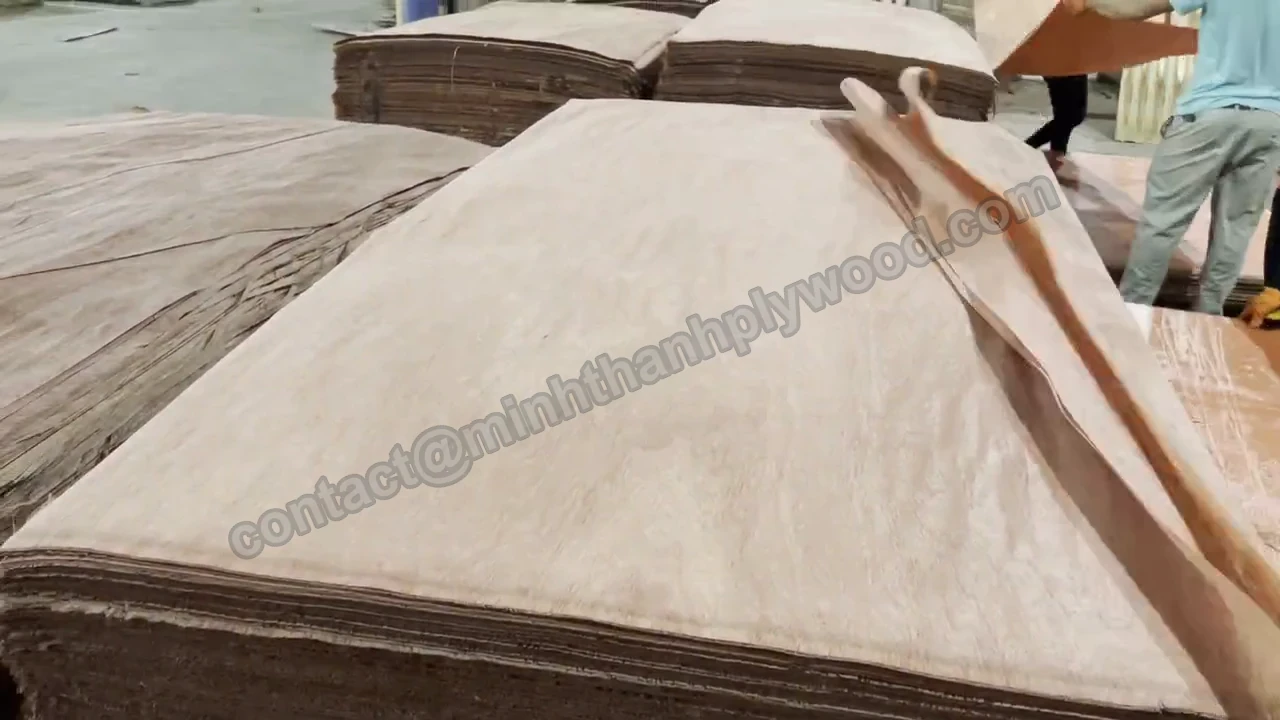 Veneer handling precedes core assembly; the ordered core remains a written specification.
How should you compare 16 mm and 18 mm commercial plywood prices?
Compare 16 mm and 18 mm prices after fixing the component thickness requirement and the rest of the construction. At equal area and the same m³ rate, a thicker panel contains more purchased volume. Actual quotations also reflect layup, faces and processing.
For a drawing with a fixed groove or hardware fit, selecting the thinner sheet merely to lower the invoice can move work into the factory. Recutting grooves, adjusting tools or changing the assembly drawing carries a cost. Ask production engineering which thickness and tolerance work with the existing line before requesting alternatives.
Use actual dimensions on the quotation. A nominal label describes the product line; a receiving inspection measures what arrives. Commercial panels have a broader tolerance than precision furniture panels, and the distinction should be visible before price selection. Minh Thanh’s commercial thickness reference is ±0.5 mm; tighter sanded furniture tolerances are a separate specification.
For repeat production, measure several positions across the sample and include edge positions used by the component. A single central measurement cannot describe the whole sheet. Keep the measurement method the same at approval and receipt so a commercial plywood rate comparison does not hide a later argument about which thickness was purchased.
What is different about 19 mm commercial plywood prices?
A 19 mm commercial plywood enquiry needs a veneer-core construction stated explicitly, because search results and catalogues can mix plywood with blockboard. Blockboard uses wood strips in its core; plywood uses veneer layers. Their shared nominal thickness does not make them equivalent material offers.
For long furniture components, the core arrangement and grain direction influence how the part behaves. A procurement team should attach the drawing and planned fixing pattern instead of choosing a 19 mm item from a mixed sheet-material catalogue. Examine the sample’s cut edge to verify the core type before negotiating a repeat-order rate.
Request “19 mm veneer-core plywood” if that is what the drawing requires. State the face/back, core species, bond and tolerance after the thickness. A retailer’s entry saying “commercial 19 mm” can be useful for identifying a local alternative, but the product description must still resolve its construction.
Avoid converting a blockboard listing into a plywood price benchmark. Its manufacturing method and use case can differ substantially. If the workshop is genuinely considering both materials, compare the completed component through a separate trial and cost calculation. That is a material substitution decision, rather than a cheaper quotation for the same commercial plywood.
How do you compare price per sheet, m³ and square foot?
Convert every offer to a common unit while retaining its stated physical dimensions and thickness. Sheet cost = m³ rate × length × width × thickness, with all dimensions expressed in metres. Area rate = sheet cost ÷ stated sheet area.
For the 1220 × 2440 mm format, area is 1.220 × 2.440 = 2.9768 m², approximately 32.042 ft², using 1 ft = 0.3048 m. The following quantities are calculated physical volumes, with no currency rate applied.
| Ordered thickness | Calculated sheet volume | Calculation in metres |
|---|---|---|
| 16 mm | 0.0476288 m³ | 1.220 × 2.440 × 0.016 |
| 18 mm | 0.0535824 m³ | 1.220 × 2.440 × 0.018 |
| 19 mm | 0.0565592 m³ | 1.220 × 2.440 × 0.019 |
Multiply the applicable volume by the actual quoted m³ rate to obtain sheet cost. Divide that sheet cost by 32.042 for its square-foot rate on this specific format. This lets a buyer compare 16 mm commercial plywood price, 18 mm commercial plywood price and 19 mm commercial plywood price without borrowing a retailer’s price for a different construction.
Those equations compare units; they do not establish a new product price. Use the executable quotation for the intended construction as the rate input. Keep sufficient precision through the calculation and round the displayed currency at the end. Purchasing and invoicing should agree on the measurement basis before payment.
A commercial plywood price per sq ft is useful for local budgeting when sheet size, thickness, tax and delivery are visible. A rate without thickness is incomplete. An area price for a thin lining cannot be compared directly with an area price for a cabinet carcass side.
A metric format described casually as an 8 × 4 sheet should retain its metric measurements in the calculation. Minh Thanh supplies 1220 × 2440 mm and 1250 × 2500 mm, with custom formats. These formats provide different area and cutting layouts. Use the general plywood price guide for worked unit conversions and landed-cost calculations; keep this comparison focused on the ordered commercial construction.
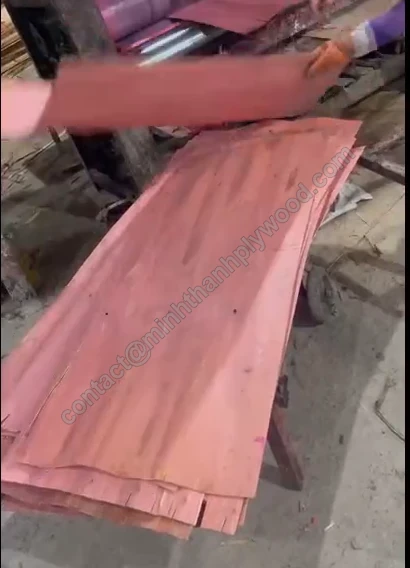 The roller operation applies adhesive before pressing. Resin and bond requirements are specified separately.
Where does a lower commercial rate lose its saving?
A lower rate loses its saving when it produces fewer accepted components or adds workshop operations. Measure that through the actual cutting and assembly route. The useful metric is accepted output, rather than sheets processed.
Choose a representative component with demanding edges, holes or face requirements. Cut the candidate sheet using the normal tool path, then record rejected pieces, repair time and finishing work. Compare against the workshop’s current material under the same conditions. A perfectly straight test strip can miss the features that create real production losses.
Use panel cost per accepted part = sheet cost ÷ accepted parts per sheet, then add the operations that differ between candidates. Keep labour observations separate from measured material yield so the source of a saving is clear. No fixed percentage saving belongs in the comparison before the trial supplies the evidence.
Minh Thanh’s furniture construction includes stitched cores and two pressing stages, with core calibration before face pressing. Those operations are relevant when the commercial alternative needs additional surface or thickness work. Price the construction that reaches the required component quality, rather than assuming every nominally equal sheet carries the same production effort.
Which emission documents belong beside the bond specification?
Emission documents address indoor air requirements, while a bond specification addresses adhesion under the ordered conditions. E0 names an emission grade; it is not the name of an adhesive. Keep these fields separate on the enquiry and the purchase order.
For furniture/interior panels, Minh Thanh’s standard terminology is UF glue at E0 emission. The factory holds CARB P2 / TSCA Title VI certification, ICTT mill no. 23024, for veneer-core hardwood plywood within its documented scope. The quality-control page connects manufacturing checks and product evidence.
The US EPA’s composite-wood rule summary, reviewed 8 October 2026, lists hardwood plywood, MDF and particleboard among covered products and describes testing, certification and labelling. For veneer-core hardwood plywood, the formaldehyde limit is 0.05 ppm under 40 CFR 770.10. Match the documents to the product and destination being purchased.
A commercial panel for packing and a furniture panel for an indoor component can have different buyer requirements. State those requirements before quotation rather than adding an unspecified “certified” premium afterward. A chamber report should identify the tested construction and method; a resin description alone does not supply that information. Purchasing can then compare both the goods and the evidence required for the intended sale.
What belongs in a landed commercial plywood rate?
Landed commercial plywood cost includes the agreed goods, transport, import charges and delivery to the location used in the comparison. An export factory quote and a local delivered warehouse quote need those costs aligned before purchasing can choose between them.
Separate the worksheet into goods, origin costs covered by the chosen term, main freight, insurance, destination charges, clearance, applicable taxes and inland transport. Put currency conversion and financing on their own lines. That structure makes it possible to revise freight without obscuring a change in panel construction.
Minh Thanh quotes FOB Hai Phong, CFR or CIF. Name the port and term in full, then use the forwarder’s actual charges for the shipment route. A CIF figure is a port-based offer and does not automatically become the cost delivered inside the buyer’s warehouse. The trade terms page sets out the quotation basis.
Divide common shipment expenses across the actual accepted quantity, using the appropriate basis for each charge. Core mass, mixed thicknesses and pack layout affect that quantity. A fixed “sheets per container” assumption can distort both cost and stock planning. Align the packing list, loading plan and forwarder booking before finalising the landed commercial plywood rate.
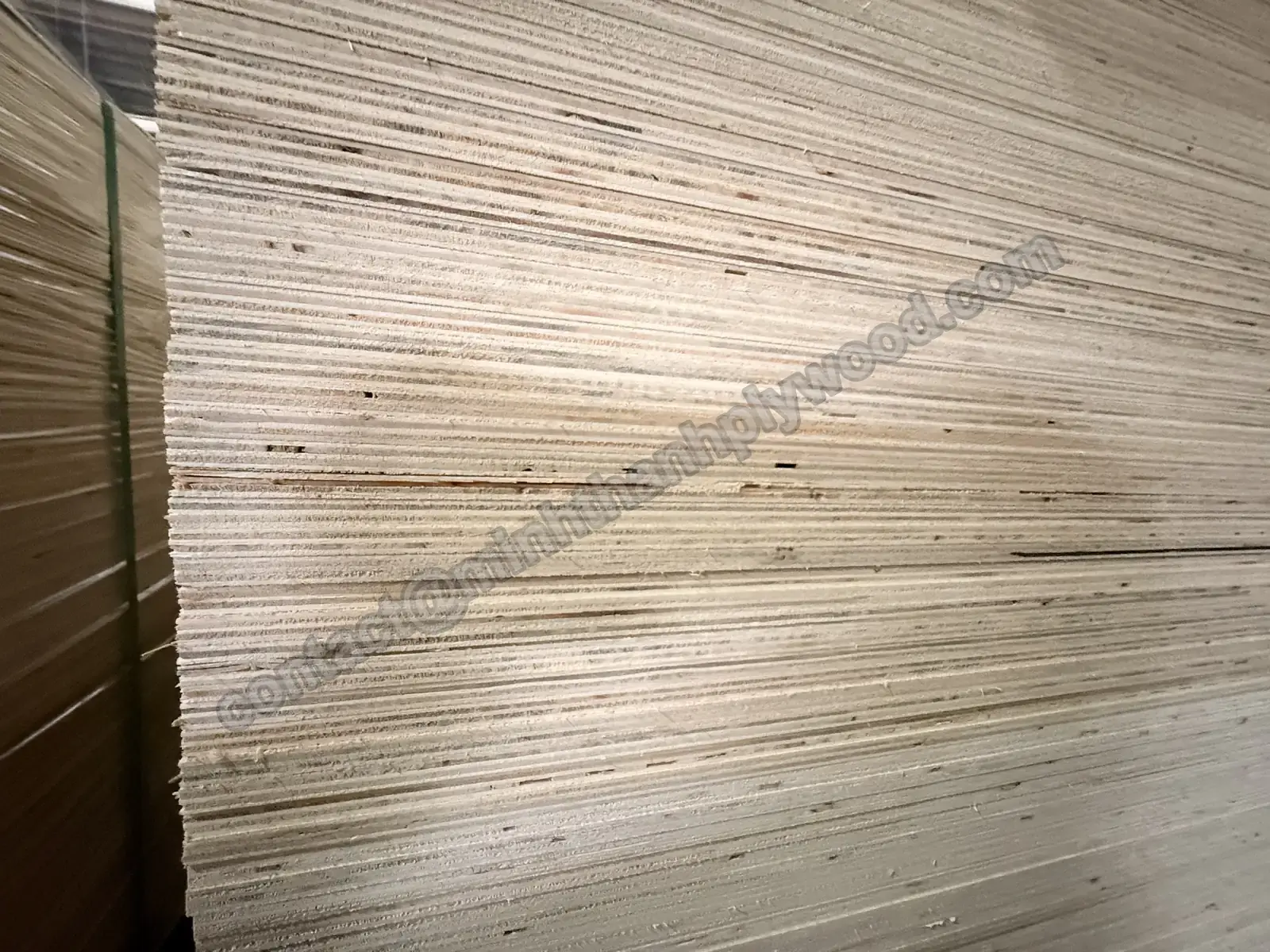 Edge inspection exposes veneer layers that a face-only comparison misses.
Does a full container automatically mean a bulk discount?
A full container supports factory-scale ordering, but the saving comes from the agreed construction, production run and shipping plan. A universal discount percentage does not describe those conditions. Request the order quantity you can use and compare the executable offer.
Minh Thanh’s MOQ is one 40HC. Mixed specifications are arranged with the factory. A distributor building a first stock range should select a manageable set of construction lines and quantities instead of spreading demand across many slow-moving combinations solely to fill space.
Keep the sample code, purchase order line and pack identification connected. Several thicknesses using the same face can look alike from above. Visible pack separation and a precise packing list help receiving staff avoid picking the wrong panel for a customer or production run.
The production reference is 15–45 days after deposit. That is factory production time, followed by transport and clearance. Compare the working-capital requirement with the local delivered alternative as well as the sheet price. Buying more stock earns a saving only when the volume is sold or consumed without creating avoidable storage damage or cash tied up in the wrong specification.
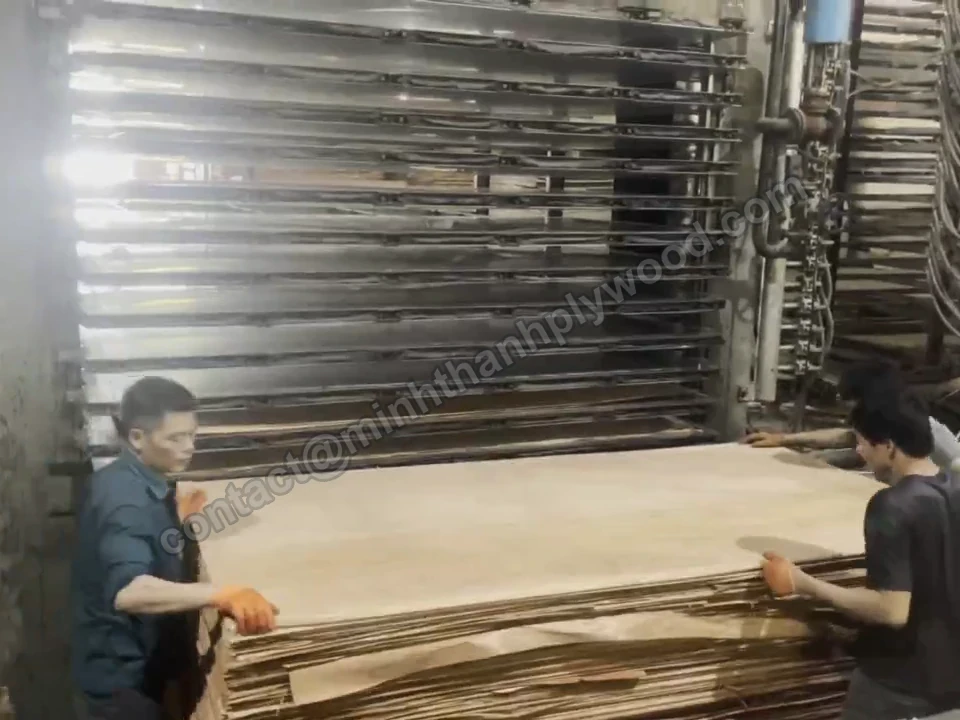 The press operation follows the specified veneer layup and bond preparation.
How should incoming inspection protect the price decision?
Incoming inspection should check the same attributes that justified choosing the quotation. A price comparison becomes repeatable when sample approval, order wording and receiving checks use one construction description.
Agree which measurements and appearance checks matter before shipment. Include thickness at defined locations, length and width, face/back acceptance, flatness under the agreed method, cut-edge quality and pack condition. Keep the tools and procedure consistent with the approval trial.
Photograph the pack before removing protection, then record any visible damage separately from panel acceptance. A strap mark, damaged bearer or wet cover belongs in the handling record; it should not disappear into a general comment that the material was “poor quality.” Clear observations help both teams locate the affected stage.
Minh Thanh photographs and films shipments before loading and supplies the media to buyers. Use that evidence alongside pack identification and receiving photographs. For repeat buying, record accepted parts and workshop issues against the specification line. A supplier comparison improves when the next purchasing decision has measured production results rather than a remembered headline rate.
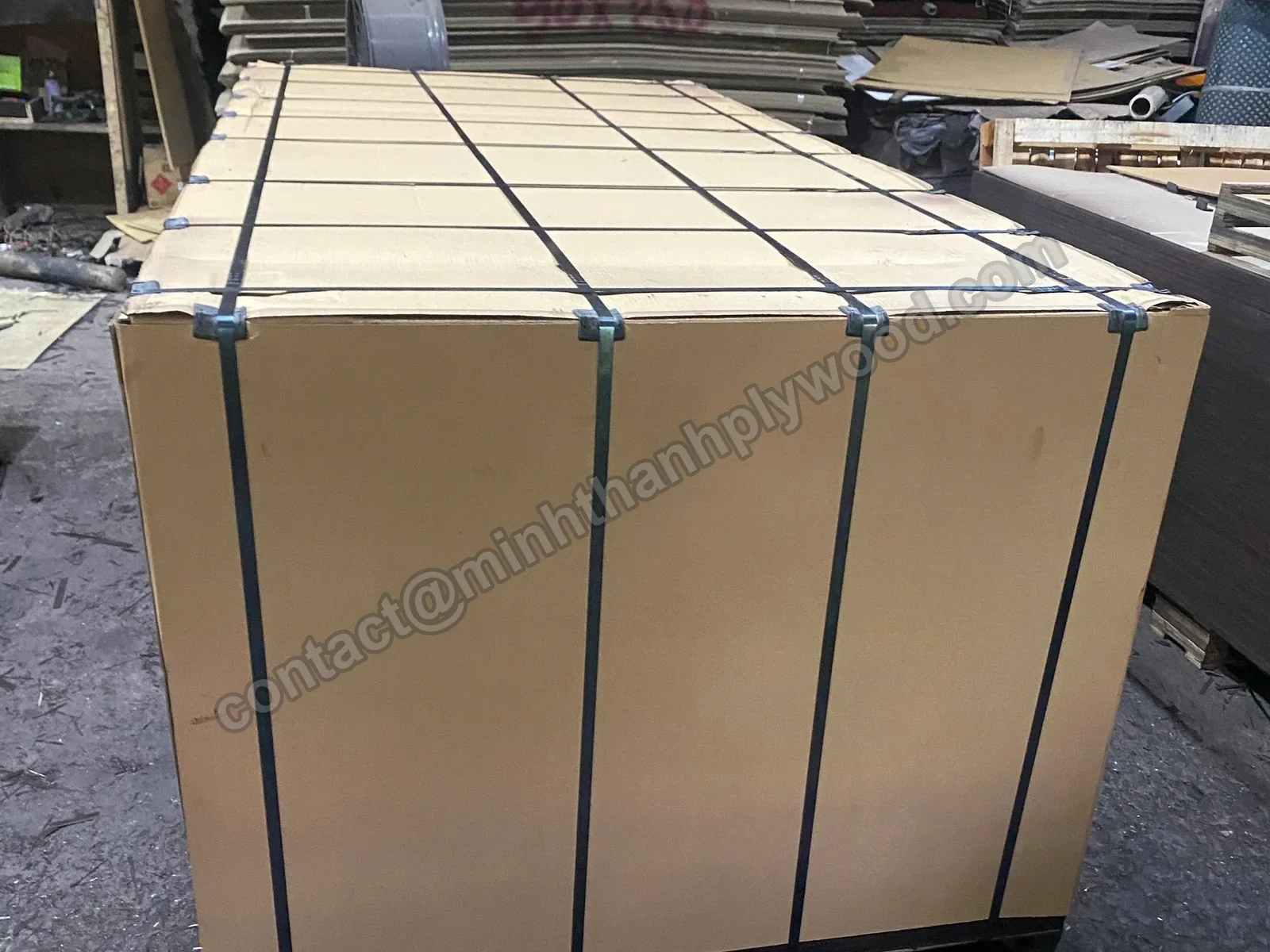 Covered faces, straps and pallet support protect the purchased panel through handling.
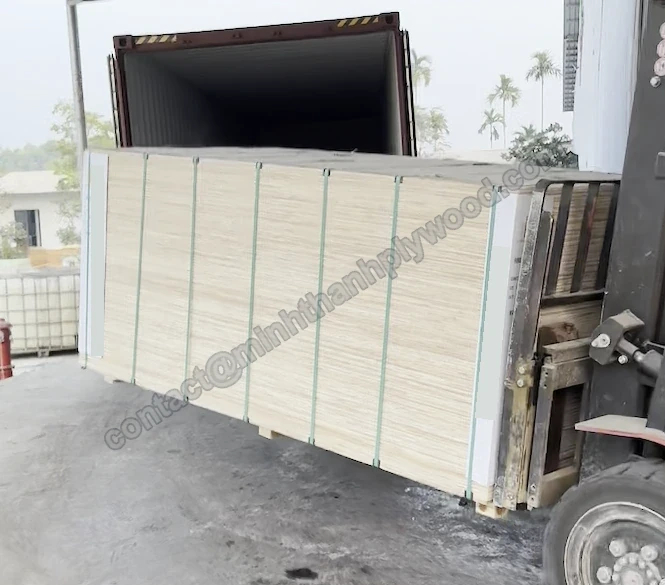 The loading stage connects the pack schedule to the shipment plan.
What should your commercial plywood RFQ contain?
A useful RFQ contains the component, construction and delivery schedule needed to price the order. Start with the application or drawing, then state veneer-core plywood, face/back appearance, core, bond, emission requirement, size, actual thickness and tolerance.
Add the quantities by specification and the packing requirements for your receiving operation. Tell the factory which surfaces remain visible, which edges are machined and which hardware the component carries. These details distinguish a cost-effective utility panel from a panel that needs furniture preparation.
Request the quotation, matching sample and document schedule together. Keep FOB, CFR or CIF with its named place, and state the destination used for your landed-cost worksheet. The comparison should answer one purchasing question: which ordered construction delivers the required accepted output at the best complete cost?
Send the schedule through Contact or to contact@minhthanhplywood.com. Minh Thanh provides free samples, with production from the approved specification. For commercial plywood, the next step is to price the panel your workshop can use, test its important features, and carry that same construction into the container order.
Buyer questions, answered
What is Minh Thanh's commercial plywood price?
Minh Thanh's October 2026 starting reference is commercial plywood from US$250/m³. A purchase quotation specifies the face/back, core, bond, thickness, dimensions, quantity, packing and delivery term. A starting m³ rate is separate from a local delivered sheet price.
How do I compare commercial plywood price per square foot?
Divide the sheet quotation by its stated area in square feet and keep thickness, grade and taxes beside the result. Use physical dimensions instead of assuming every 4 × 8 trade label means identical metric dimensions. Compare the same delivered location.
Why is 18 mm commercial plywood priced differently from 16 mm?
The thicker sheet uses more panel volume at the same face area. Core construction, face grade, bond, sanding and order quantity also affect the quotation. Compare the same construction before attributing a price difference to thickness alone.
Is 19 mm commercial plywood the same as 19 mm blockboard?
No. Plywood has a veneer-layer core; blockboard has a core of wood strips between outer layers. A 19 mm trade label does not make their constructions or component performance equivalent.
Does MR mean commercial plywood is waterproof?
MR means moisture resistant and describes a bond requirement for the ordered panel. It does not make exposed wood immune to water or establish exterior suitability. Specify the service environment and the corresponding bond test separately.
Is E0 a plywood glue type?
E0 describes an emission grade, while UF, melamine-fortified and phenolic name resin systems. Minh Thanh's furniture/interior standard is UF glue at E0 emission. A commercial order names both its bond requirement and its emission requirement.
Should I buy the lowest commercial plywood rate?
Choose the lowest cost per accepted component after accounting for face acceptance, machining, usable yield and delivery. A cheaper sheet that needs more repairs or loses parts during cutting can cost more in production. Trial the actual component before a repeat order.
Can I mix commercial plywood thicknesses in a container?
Minh Thanh's MOQ is one 40HC, with mixed specifications by agreement. List the quantity and pack identification for every thickness and construction. The loading plan uses sheet mass, packing mass and the cargo limit on the booking.
What tolerance does Minh Thanh use for commercial plywood?
The commercial plywood thickness reference is ±0.5 mm. Sanded furniture panels use a tighter specification, down to ±0.2 mm. Choose the tolerance that fits the component drawing and workshop process.
What should I send to obtain a comparable commercial plywood quote?
Send the component use, face/back grade, core, bond, emission requirement, dimensions, thickness tolerance, quantity, packing and delivery point. Include a drawing when machining or assembly fit matters. Minh Thanh supplies free samples for approval.