
CDX plywood vs OSB is a choice between veneer and strand-based panels, followed by a comparison of the actual rating, exposure and assembly. Both rated products can serve roofs, walls and subfloors. Choose on the specification and construction programme rather than a fixed claim that one is stronger. Minh Thanh Plywood supplies exterior/CDX-type plywood against the ordered construction and sample.
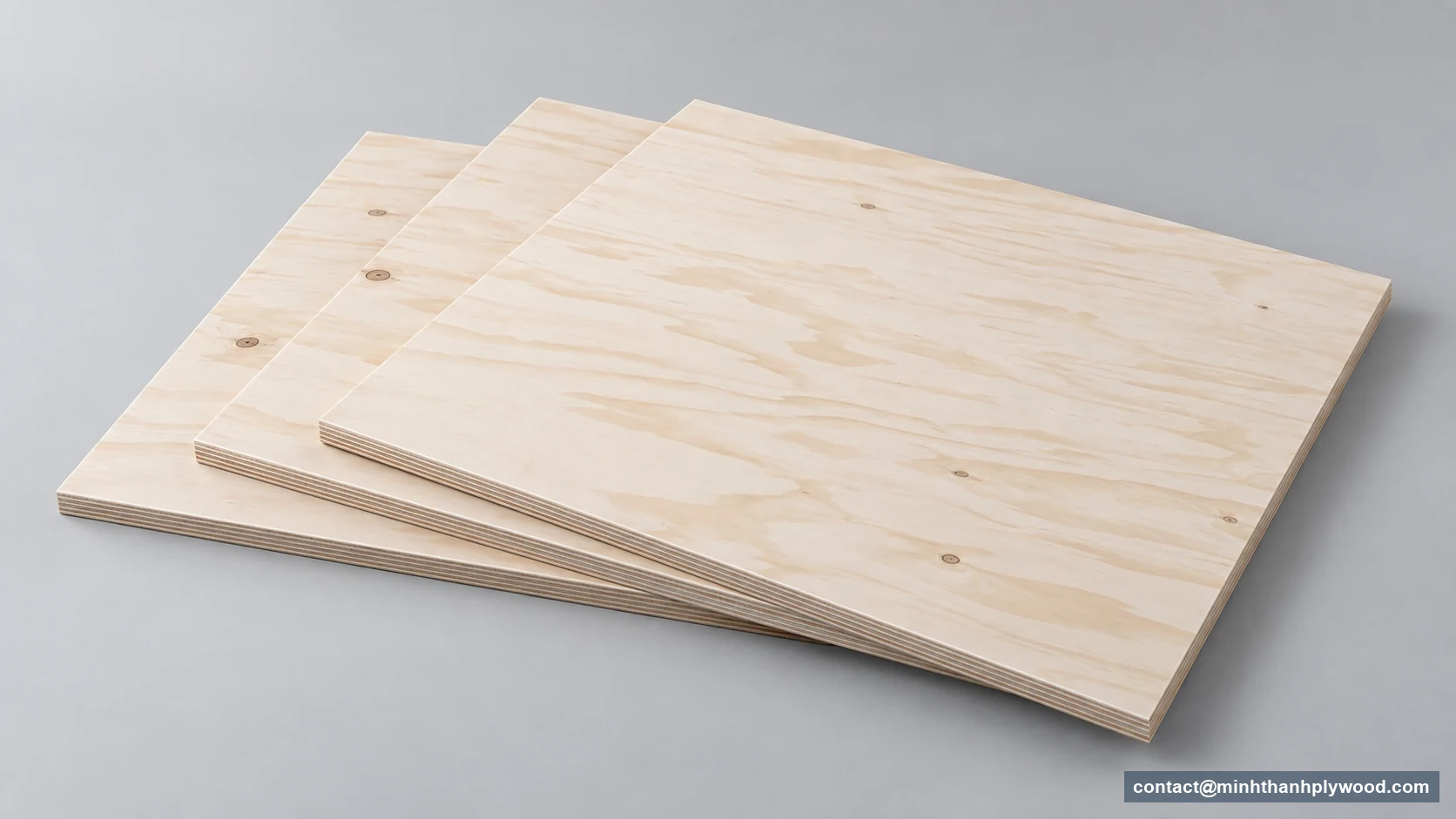
CDX plywood vs OSB: what is the buying decision?
Buy the rated panel that meets the component’s design and service requirements, then compare procurement cost and construction handling. CDX plywood and oriented strand board, or OSB, use different wood constructions. Either can be purchased as an appropriate rated product for concealed building applications.
The search phrase “OSB plywood vs CDX” often combines two different material names. OSB is a strand-based board rather than plywood. CDX is a plywood trade description for C/D utility veneers, commonly associated with Exposure 1 sheathing. The CDX grade guide covers the veneer terminology; this article compares the two procurement options for the same roof, wall or floor component.
Start with a schedule that names the component, required rating, actual thickness or performance category, exposure and edge arrangement. Ask suppliers to quote against that schedule. A price for generic plywood and a price for premium tongue-and-groove OSB compare different purchases even if both quotations show the same nominal thickness.
How do veneer and strand construction differ?
Plywood bonds sheets of veneer in a cross-laminated layup, while OSB bonds oriented wood strands into a pressed panel. The construction explains the visible layered plywood edge and the strand texture of OSB. The product rating establishes performance for the intended role.
At a plywood factory, dried veneers are selected and assembled to the ordered layup. At Minh Thanh, core layers are stitched in both directions. Furniture-grade production also uses a separate calibrated core press before the face press. Those are manufacturing choices for the offered plywood line; they do not assign a sheathing rating to every plywood product made in the factory.
OSB manufacturing distributes strands in oriented layers and bonds them under pressure. It lacks the peeled-veneer knot pattern seen on plywood faces. Product quality still depends on its manufacturing specification and verification. Avoid describing every OSB panel as defect-free or inferring equal performance from a uniformly textured surface.

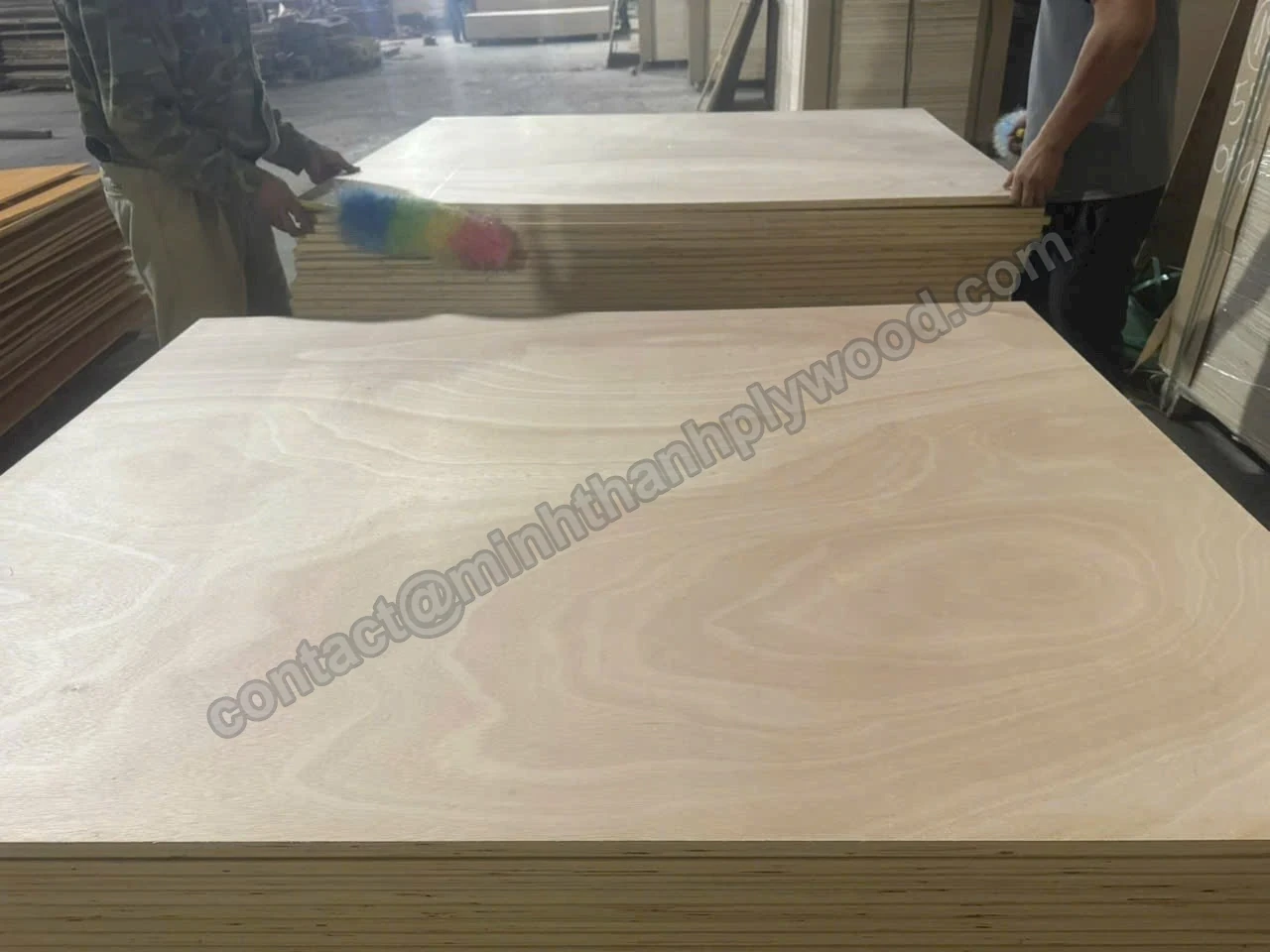
The photograph shows veneer assembly at the plywood factory. It illustrates the plywood manufacturing route rather than the manufacture of OSB.
What should the side-by-side specification contain?
Compare the product attributes that determine acceptance in the same component. A material-family comparison is useful for screening; a completed specification is needed to place an order.
| Procurement attribute | CDX plywood option | OSB option |
|---|---|---|
| Wood construction | Cross-laminated veneer sheets | Bonded oriented wood strands |
| Surface for concealed work | Utility veneer faces with permitted defects | Strand-textured surface |
| Relevant product framework | Required plywood standard and rated grade | Required structural-panel standard and rated grade |
| Exposure | Marked Exposure 1 or specified Exterior product | Actual marked exposure classification |
| Load-bearing acceptance | Rating and construction matched to design | Rating and construction matched to design |
| Wetting inspection | Layer separation, deformation and surface condition | Edge/thickness swell, strand lifting and deformation |
| Floor finishing interface | Surface condition and suitable underlayment | Surface condition and suitable underlayment |
| Sheet mass | Product-specific dimensions, density and moisture | Product-specific dimensions, density and moisture |
| Cost comparison | Landed cost per accepted installed area | Landed cost per accepted installed area |
| Traceability | Product mark, lot and producer evidence | Product mark, lot and producer evidence |
Compare square-edge with square-edge, or the required interlocking profile with its specified alternative. Include panel dimensions and usable area. A different edge profile can change installation work and joint support; it should not disappear inside a comparison labelled only “CDX vs OSB.”
Is CDX stronger or stiffer than OSB?
Strength and stiffness must be compared for the identified panels and load case. “CDX is stronger” and “OSB has uniform strength” do not provide the design values needed to approve a substitution.
Strength addresses resistance to failure; stiffness addresses deflection. A roof panel under a distributed load and a subfloor under a concentrated load need different checks. Keep the panel direction, support spacing and edge support with the design. Procurement can then obtain the required grade and rating without turning a broad material preference into an assumed structural calculation.
APA’s OSB product guidance, consulted on 8 October 2026, identifies OSB as a structural panel with application-specific selection and rating information. Its plywood guidance likewise identifies rated plywood products. The useful comparison is between those products in the same role, with the required evidence attached.
A structurally required panel should arrive with the ordered identification. Counting plywood veneers, seeing dense strands or measuring sheet mass gives useful receiving information, but none of those observations creates a missing third-party rating. Keep appearance inspection and structural acceptance as separate checks.
Does the X mean CDX can stay outdoors permanently?
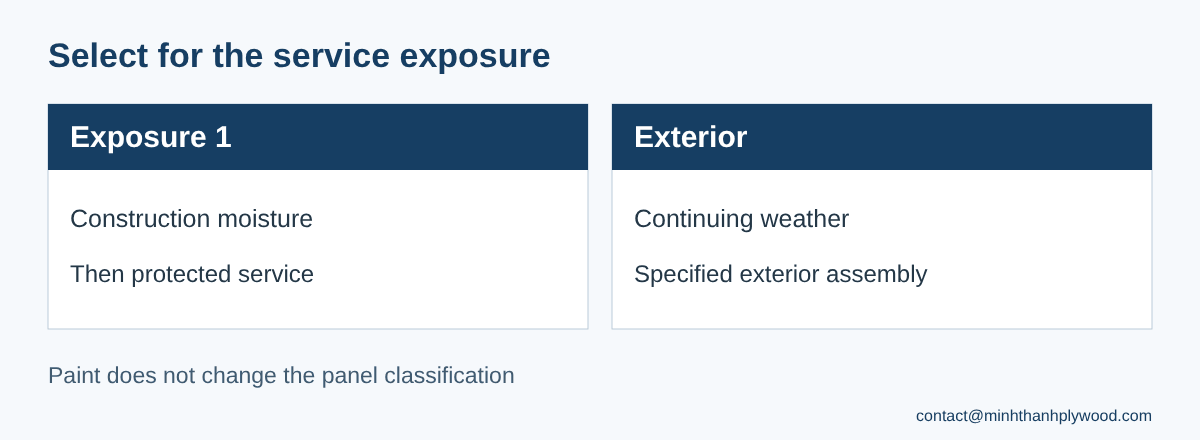
Common CDX is Exposure 1 sheathing for temporary construction moisture and subsequent protected service. X is trade shorthand associated with exterior-type adhesive, rather than a complete long-term exposure designation.
APA’s moisture-exposure guidance, TT-002, revised December 2017 and consulted on 8 October 2026, separates construction exposure from intended in-service conditions. Apply the required classification to each component. Painting a board does not convert its product classification.
An exterior wall can contain a protected sheathing layer behind a weather barrier and cladding. A panel left directly exposed has a different service condition. Avoid deciding from the words “exterior wall” alone. Identify the location of the panel in the assembly, water-management layers, drying route and exposed edges before choosing the product.
What happens when plywood and OSB get wet?
Both materials change dimensions with moisture, and the condition after drying matters to the next construction step. Plywood exposes veneer layers and bondlines; OSB exposes a compressed strand structure. Inspect the actual product after wetting rather than assigning a fixed recovery advantage to every member of either family.
Ordinary OSB can develop edge swell and surface unevenness, with some thickness change remaining after drying. Product-specific edge treatments and moisture-performance systems need their own data. A premium OSB product should be compared with its declared performance rather than treated as identical to an unspecified commodity sheet.
Plywood also requires inspection for raised grain, distortion and layer separation. A water-resistant adhesive does not prevent wood from taking up moisture. A sawn edge or routed opening can expose more of the construction. Store and protect panels as the product instructions require, particularly when the building programme leaves them awaiting enclosure.
APA’s OSB FAQs, TT-133, issued December 2023 and consulted on 8 October 2026, address edge swelling and surface changes. Use that guidance with the supplied panel instructions when assessing whether the next assembly step is appropriate.
How do you plan drying and assess weathered panels?
Plan the enclosure sequence and assess moisture condition before covering wet panels with finishes or impermeable layers. Drying time follows the actual wetting, temperature, ventilation and assembly. A fixed number of days for plywood versus OSB would give the project a false acceptance rule.
Distinguish a dry-looking surface from the moisture condition within the assembly. Use the appropriate measurement method and acceptance requirements for the product and finishing system. Record where readings were taken and the condition of adjacent framing. The site team needs a repeatable decision before trapping moisture beneath roofing or flooring layers.
APA’s excessive-moisture FAQs, X501, revised May 2021 and consulted on 8 October 2026, discuss re-drying, rough surfaces and panel condition. Use the relevant assessment route for the observed problem. Levelling a raised seam addresses surface profile; it does not by itself assess an altered structural panel.
Record wetting events and panel identification with the site inspection. That lets the responsible project team compare its observed condition with the supplied product’s requirements. Procurement should include moisture-management instructions in the delivery pack, rather than leaving the installer only a material name.
Which should you buy for a roof deck?
Choose rated plywood or rated OSB that satisfies the roof specification and roof-covering requirements. The panel’s rating, thickness, strength-axis orientation and edge arrangement must match the design. Rainfall at the destination alone does not select the material.
The construction programme affects how the panel will be handled before protection. Include delivery staging, temporary storage and enclosure sequencing. A covered, ventilated storage plan and prompt roof protection can be more consequential than a generic claim that one material always recovers better from soaking.
Check the roof covering’s approved deck requirements, particularly with thin or sensitive finishing systems. A raised joint or damaged surface can affect the finished roof even when the panel remains structurally serviceable. The receiving and pre-cover inspections should therefore include both product identity and surface condition.
Use the roof sheathing guide for the plywood buying schedule. Send the roof specification with the enquiry for construction plywood. These are procurement inputs; the building designer retains the structural and fastening design.
Which should you buy for wall sheathing?
Wall sheathing selection follows the required structural role, fastening design and protected-service details. Both rated plywood and rated OSB can be specified for appropriate wall assemblies. A strand surface does not restrict OSB to dry climates, and a veneer surface does not make plywood a weather barrier.
Separate the panel’s racking or shear function from the cladding support and water-management functions. The project specification identifies what the panel must do. A substitute needs approval against that same role, including grade, thickness and fixing requirements. Buying the nearest available nominal thickness is insufficient where the design names another panel specification.
Include how edges and penetrations will be treated in the assembly. Water entering a joint needs the designed drainage path, regardless of the sheathing material. Retain the accepted panel identification in the delivery documents so replacements and additional orders use the intended product.
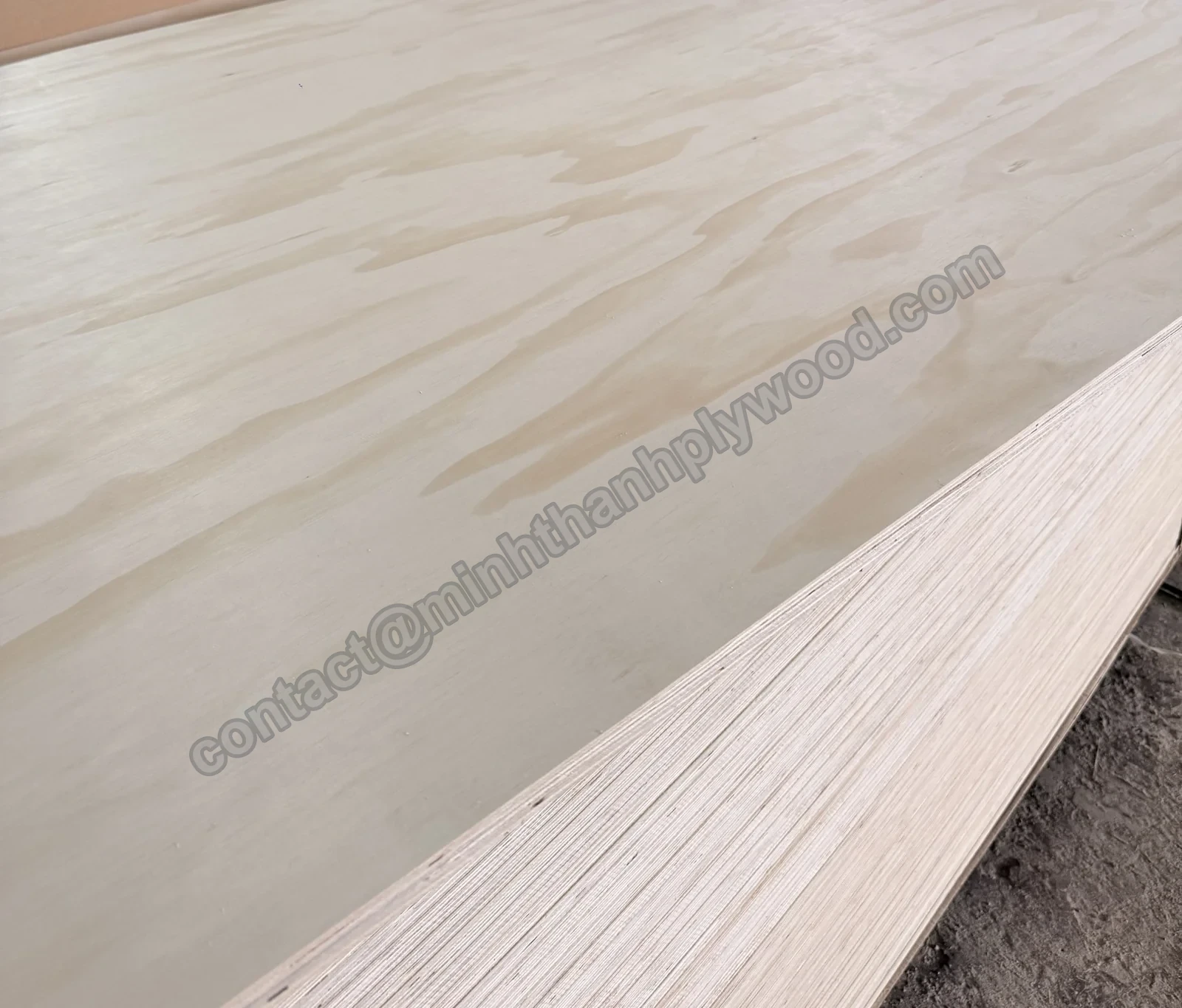
The photographed plywood pack provides a face-and-edge inspection reference. Structural acceptance comes from the ordered product identification and evidence.
Which should you buy for subfloors and finished flooring?
Buy the required rated subfloor product, then qualify the substrate immediately beneath the flooring finish. Structural subflooring and finish underlayment are separate roles. A panel that carries the design load can still need another layer for the floor covering.
Match tongue-and-groove requirements, joint support and panel rating to the floor specification. An OSB single-floor product and square-edge plywood sheathing should not be treated as interchangeable stock descriptions. The designer and flooring system determine the acceptable assembly, while procurement buys the documented components.
A resilient floor can reveal roughness or raised joints. A tile system has its own substrate and movement requirements. Carpet and wood flooring create different interfaces again. Use the finish manufacturer’s instructions and the accepted condition of the substrate rather than a rule that CDX or OSB works directly under every finish.
The subfloor plywood guide explains these purchase distinctions. Record surface acceptance after construction moisture, not only at factory dispatch. This puts responsibility for storage, inspection and readiness at the point where the next layer is installed.
How should fasteners and machined edges be compared?
Fastener performance follows the actual panel, fastener, connection geometry and design. Specify the required fastening system rather than assuming plywood always holds every screw or nail better than OSB.
A face fastener and an edge fastener engage different material arrangements. Thin plywood face veneers, underlying voids and strand orientation can affect individual connections. The rated assembly or qualified industrial joint supplies the relevant acceptance basis. Test the actual component and hardware when the purchase is a manufactured crate, access panel or cabinet rather than a standard building detail.
Machining exposes internal construction. Inspect routed slots, sawn edges and profile fit in a sample trial. Keep cutting direction and face orientation with the drawing. For a decorative or repeatedly handled component, a furniture panel can be more appropriate than either utility sheathing option; the product range separates those purchase families.
How do you compare thickness, weight and freight?
Compare measured dimensions and product-specific mass on the same basis. Thickness categories, actual thickness and tolerance perform different jobs in a purchase specification. Sheet mass also reflects construction and moisture condition.
Minh Thanh’s commercial plywood tolerance is ±0.5 mm, while sanded furniture panels use ±0.2–0.3 mm, down to ±0.2 mm. Choose the appropriate product line for the part. When a structural category is required, keep that category and its matching evidence alongside the metric dimensional requirements.
For freight planning, obtain sheet or pack mass and packaging allowance for the offered construction. Compare usable delivered area rather than assuming every plywood sheet is lighter than every OSB sheet. A core change or thickness change can alter both handling and container loading. Use the booking’s payload limit as well as pack volume.
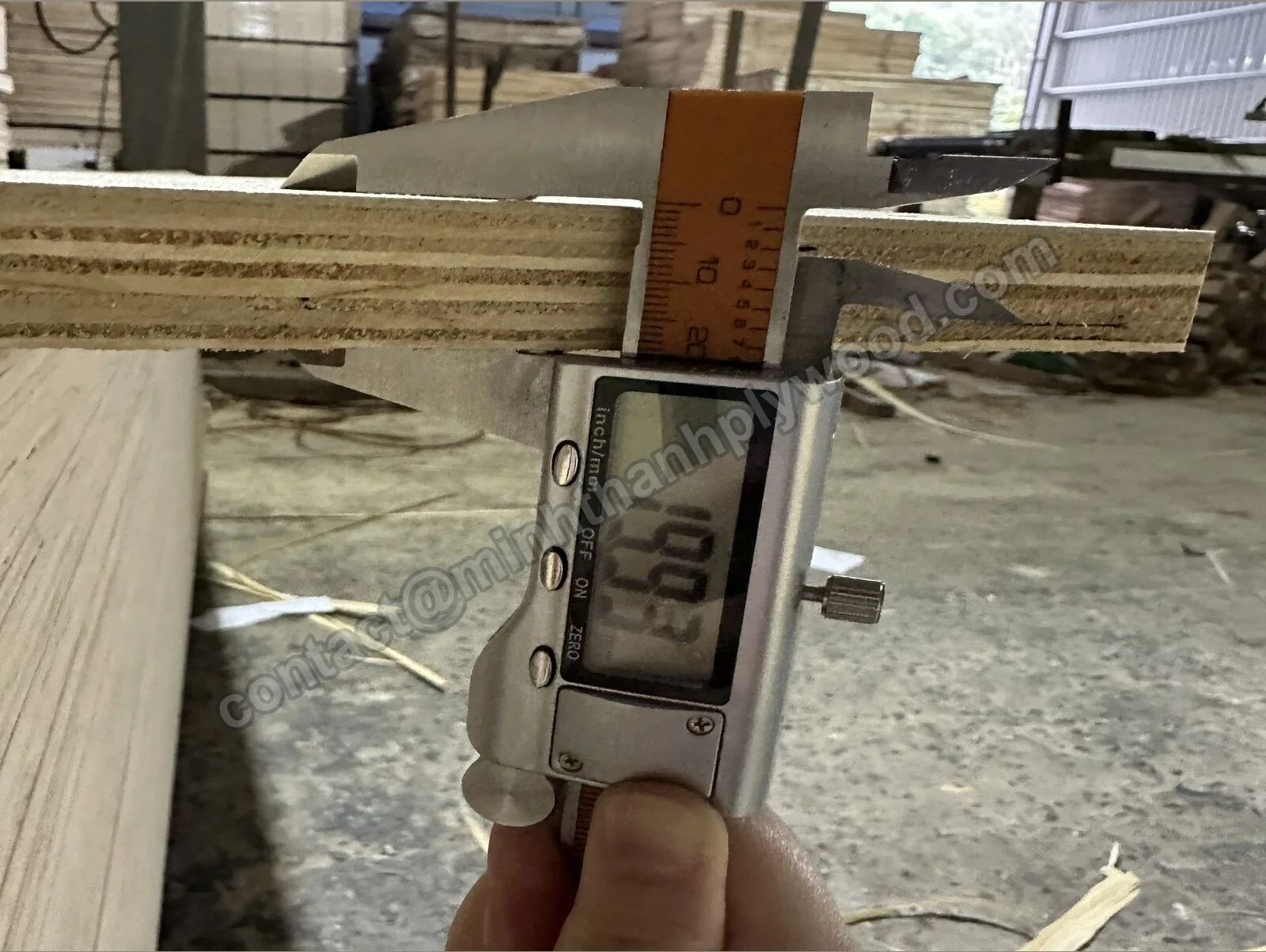
Standard Minh Thanh formats include 1220 × 2440 mm and 1250 × 2500 mm. The sheet size guide helps connect dimensions to cutting yield and pack planning. Put actual dimensions on both quotations so the apparent saving is compared on equal area.
Which quotation gives the lower installed cost?
The lower installed cost comes from the accepted delivered product plus the work needed to use it. Compare live material prices, yield, freight and preparation for the actual project. An assumed discount percentage can conceal differences in rating, profile or moisture-performance specification.
Record additional costs that differ between the options: joint preparation, handling equipment, sorting, damaged-sheet replacement and finish-substrate preparation. Assign each operation to the relevant product and construction stage. A premium panel with a higher sheet price can be economical if it removes a measured operation; a utility product can be economical when that operation is unnecessary.
Keep environmental claims tied to specific sourcing evidence. Both product families can use different species and supply chains. For EU-bound plywood, Regulation (EU) 2023/1115 includes plywood under heading 4412 in its relevant-product scope. A blanket statement that one is greener because it uses strands or veneers does not describe the quoted order. Minh Thanh supplies origin records and geolocation files in its EUDR compliance dossier; use the applicable project documentation requirement in the procurement schedule.
What evidence should approve a proposed substitution?
Approve the offered product against the original component specification, with every changed attribute visible. A familiar material name can hide a different performance category, exposure classification or edge profile.
- Identify the original grade, standard, rating and marking requirements.
- Compare actual dimensions, category, edge profile and panel orientation.
- Match the exposure requirement and supplied handling instructions.
- Obtain the offered product’s identification and required performance evidence.
- Assess compatibility with fasteners, coverings and the construction sequence.
- Record project approval of the complete replacement specification.
NIST PS 1-22, consulted on 8 October 2026, is the structural-plywood standard reference. The panel standard required by the project and the actual product evidence remain part of the acceptance. An interior hardwood panel with formaldehyde documentation answers a different requirement from a rated roof-sheathing product. For example, 40 CFR 770.10 specifies a 0.05 ppm formaldehyde emission limit for regulated hardwood plywood.
What should a Vietnam plywood enquiry include?
Send the panel schedule, component application and required evidence with the request for quotation. Include face/back sample, core and layup, bond and exposure, emission requirements, actual thickness and tolerance, sheet size, profile, quantity, pack labelling and delivery destination.
For structural panels, attach the design’s standard, rating and required product mark. Minh Thanh’s exterior/CDX-type plywood uses utility C/D faces with melamine-fortified or phenolic water-resistant bonding specified for the order. The quotation should identify the offered construction and evidence rather than assign structural approval through the CDX-type name.
Minh Thanh provides free samples, with a minimum order of one 40HC and mixed specifications by agreement. Production is 15–45 days after the deposit. Send the specification through the contact page for FOB Hai Phong, CFR or CIF terms. The quality page and plywood water-resistance guide support the next purchasing step.
Buyer questions, answered
Is OSB plywood the same as CDX?
OSB is oriented strand board, made from bonded wood strands; CDX describes utility-faced plywood made from veneers. They are distinct panel materials. Compare their complete product rating and exposure classification for the intended component.
Is CDX plywood stronger than OSB?
Compare the rated products for the actual load case, thickness, direction and supports. A fixed percentage advantage for all CDX over all OSB is not a purchasing specification. Both plywood and OSB are made as rated structural panels.
Can OSB be used for roof sheathing?
Rated OSB can be used when its grade, rating, thickness, exposure classification and installation satisfy the roof design. Match the roof-covering instructions and construction moisture plan as well as the panel label.
Does OSB swell when wet?
OSB can swell in thickness, particularly at wet edges, and some swelling can remain after drying. Protect the panels and assess their condition against the application and product guidance before installing finishes.
Is CDX waterproof?
Common CDX sheathing is Exposure 1 for construction moisture followed by protected service. Its bond classification does not create a waterproof assembly. The roof or wall needs the specified water-management layers and detailing.
Can a swollen OSB floor simply be sanded flat?
Assess the panel condition and product requirements before selecting a repair. Surface levelling addresses the finishing interface, while structural suitability and remaining panel thickness require their own assessment. Use the panel and flooring manufacturers' instructions for the proposed work.
Is CDX always lighter than OSB?
Sheet mass depends on the actual dimensions, core or strand construction and moisture condition. Obtain product mass data on the same basis for both quotations. Use measured or declared pack mass in the freight plan.
Can CDX replace OSB in a structural wall?
Approve the offered plywood against the wall design's required grade, thickness, shear performance and fastening schedule. The same nominal thickness alone does not approve the substitution. Keep the accepted product evidence with the project specification.
Is OSB always cheaper than plywood?
Compare live quotations for the same rated application, quantity and delivery basis. Add cutting yield, handling, pack mass, site preparation and moisture-related work to the material cost. A fixed discount across markets and grades does not describe the actual order.
Does a CDX-type Vietnam panel come with an APA mark?
A CDX-type description identifies an offered panel style, while an APA mark belongs to the corresponding certified product and producer. Specify the required standard, rating and marking explicitly in the enquiry.