
The best plywood for woodworking is flat, has a closed core without voids and a calibrated thickness, and its face suits the project: birch for jigs and visible edges, a stiff dense core for workbench tops, poplar or pine for painted shop furniture. Minh Thanh Plywood makes furniture-grade panels for European plants; this guide matches the plywood to each project and shows how to inspect a sheet.
What makes plywood good for woodworking?
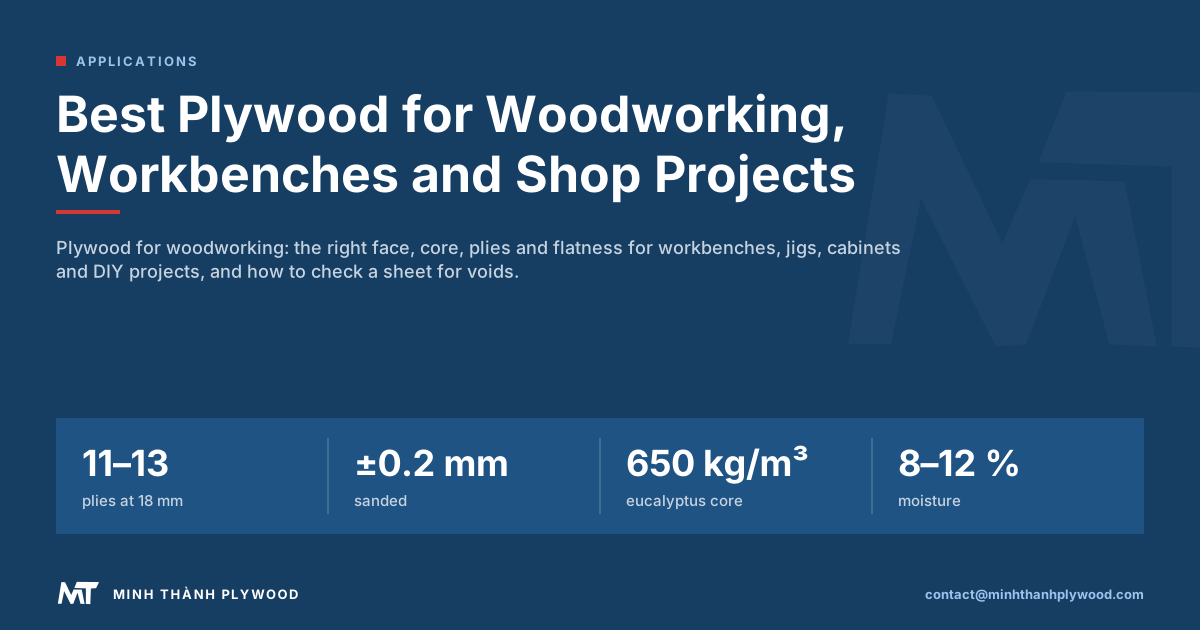
Plywood is good for woodworking when it is flat, its core is closed without voids, its thickness is calibrated, and its face is sanded smooth. Those four properties decide whether joints fit, edges look clean and a jig stays true.
Why each property matters in the workshop:
- Flatness: a bowed sheet makes a twisted cabinet and an inaccurate jig. Panels pressed twice, core first and then face and back, stay flatter; Minh Thanh presses its furniture-grade panels this way as standard.
- Closed core: a void in the core shows on a cut edge, lets a screw spin and breaks a router cut.
- Calibrated thickness: dadoes and CNC slots are cut to a size; sanded furniture panels held to ±0.2–0.3 mm, down to ±0.2 mm, fit them.
- Sanded face: less sanding before finishing and an even surface for clear finishes.
Beyond those four, the face species and the core density decide which project the sheet suits. The rest of this guide maps them to the projects woodworkers build most.
The best plywood for each woodworking project
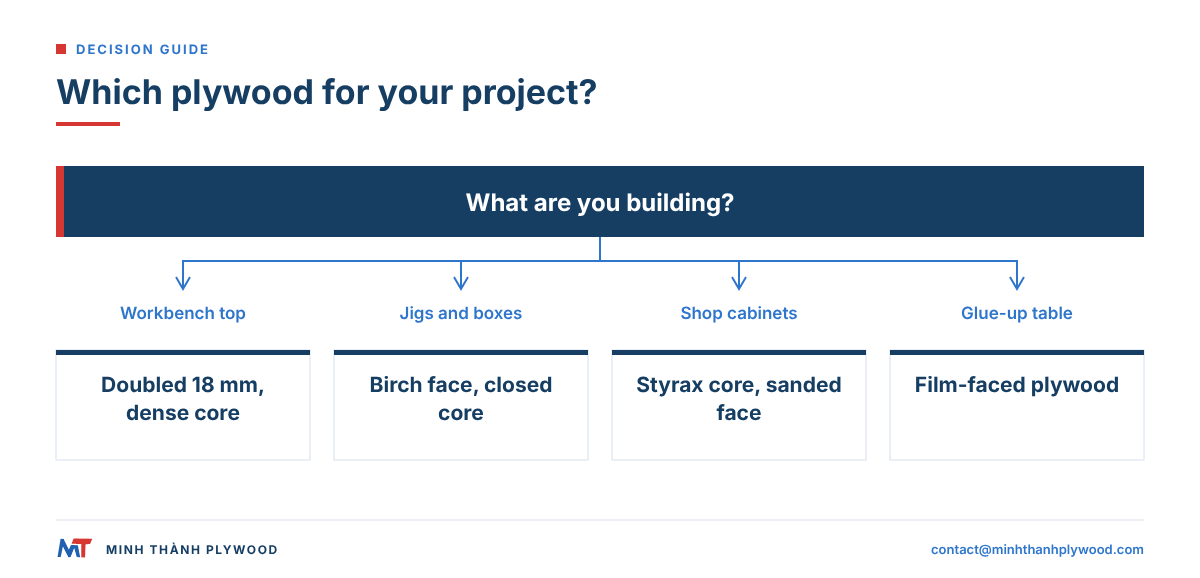
The right plywood for woodworking depends on the project, because a workbench top needs weight and stiffness while a jig needs flatness and a fine edge. The decision table sets out face, core, plies and flatness for each project.
| Project | Face | Core | Plies at 18 mm (23/32 in) | Flatness and tolerance | Why |
|---|---|---|---|---|---|
| Workbench top | Birch or eucalyptus | Dense eucalyptus | 11–13, doubled to 36 mm (about 1-7/16 in) | Very flat, calibrated | Weight, stiffness, a true surface |
| Workbench base and shop furniture | Poplar, pine or utility | Styrax or eucalyptus | 11–13 | Flat | Strength at a lower cost |
| Jigs and fixtures | Birch | Closed, stitched | 11–13, thin even plies | ±0.2 mm | Accuracy, clean edges, screw holding |
| Router and sled bases | Birch, sanded both sides | Closed | 11–13 | Very flat | Smooth sliding, no rocking |
| Cabinets and storage | Birch, EV or poplar | Styrax for light weight | 11–13 | Calibrated | Dadoes fit, light carcasses |
| Drawers and boxes | Birch | Closed | Thin plies at 12 mm (1/2 in) | Calibrated | Finger joints and a visible edge |
| Painted projects | Poplar | Styrax | 11–13 | Flat | Smooth paint surface |
| Assembly and glue-up table | Film-faced | Hardwood | 11–13 | Flat | Glue and paint wipe off |
Two rules come out of the table: spend on the face where the edge or surface shows, and spend on the core where flatness and weight matter. A workbench base can use a plain face; a jig cannot use a gappy core.
Plywood grades woodworkers see in US stores
US stores label plywood with the ANSI/HPVA HP-1 hardwood plywood standard, with a Baltic birch scheme beside it. Read a grade as face, then back: “A-1” is an A face with a grade 1 back. “G1S” and “G2S” are shop terms for good one side and good two sides. What you pay for is the face, so match the grade to what shows.
| Store label | What it means | Minh Thanh equivalent |
|---|---|---|
| HPVA AA or A face | Best-looking face, no open defects, matched grain | Birch D+, poplar A |
| HPVA A-1, A-2 | A face with a sound back | Birch D+/D, poplar A/A or A/B |
| HPVA B-2 | B face, sound back; minor repaired defects show | Birch D/D, poplar B/B |
| G1S / G2S | Good one side, or two sides, sanded for finish | Pairs with an approved sample |
| Baltic birch B/BB | Clean face, a few repairs on the back | Birch D+/D |
| Baltic birch BB/BB | Repairs allowed on both faces | Birch D/D |
| CP / C | Plugged defects, paint or hidden use | Birch E |
Factory birch faces are D+, D and E, with D+ about B, D about BB and E about CP or C, and poplar faces are A/A, A/B and B/B. The face is matched to the approved sample, so ask for it. Odd ply counts (3, 5, 7 plies in 1/4 to 3/4 in cabinet sheets) keep a panel balanced and resist warping; Minh Thanh’s 18 mm panels run 11–13 plies.
What plywood to use for a workbench
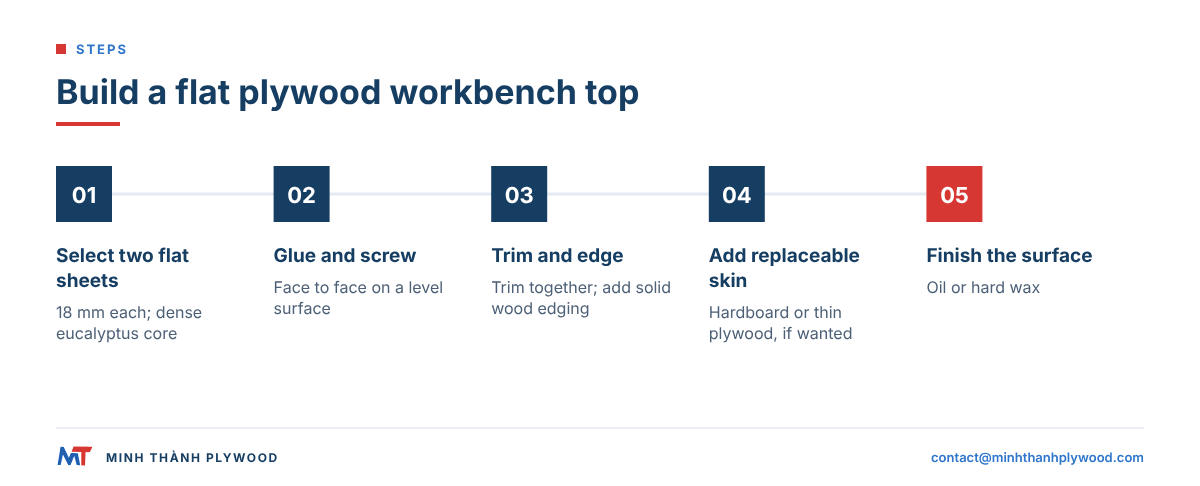
For a workbench, use two layers of 18 mm plywood glued and screwed into a 36 mm top on a base of 18 mm plywood. A dense core adds mass so the bench does not move when you plane or hammer, and a flat sheet gives a true reference surface.
How to build the top from plywood:
- Pick the two flattest sheets of 18 mm plywood; a eucalyptus core at about 650 kg/m³ adds weight and stiffness.
- Glue face to face with an even spread and screws or weights from the centre outward, keeping the sheets flat on a level surface.
- Trim the edges together and add a solid wood edge strip to protect the corners.
- Add a skin of hardboard or thin plywood if you want a replaceable surface.
- Finish with oil or a hard wax so glue drops pop off.
An 18 mm sheet of 1220 × 2440 mm on Eucalyptus core weighs about 34.8 kg, so a doubled top of a full sheet is close to 70 kg before the base, enough mass for most hand work. A Styrax core gives a lighter top, about 26.8 kg per sheet, for a mobile bench.
What is the best plywood for a workbench top?
The best plywood for a workbench top is a thick, flat, heavy panel: doubled 18 mm plywood on a dense core, with a hard, sanded face. For an assembly or finishing table, film-faced plywood is better, because glue, paint and epoxy do not stick to its phenolic surface.
Options for the work surface:
- Birch-faced plywood: a hard, fine face that stays smooth and takes oil well.
- Eucalyptus-faced or eucalyptus-core plywood: stiffer and heavier, with a warm tone.
- Film-faced plywood: dark, smooth and wipe-clean; ideal for glue-ups and spray booths.
- Hardboard skin over plywood: cheap to replace when the surface is worn.
Avoid construction sheathing grades for the top. In the US, structural panels are made to Voluntary Product Standard PS 1-22, the standard NIST lists for structural plywood. Sheathing grades are made for strength under a roof or floor, not for a flat, smooth surface, and their faces carry open knots and patches.
Birch vs hardwood plywood for woodworking
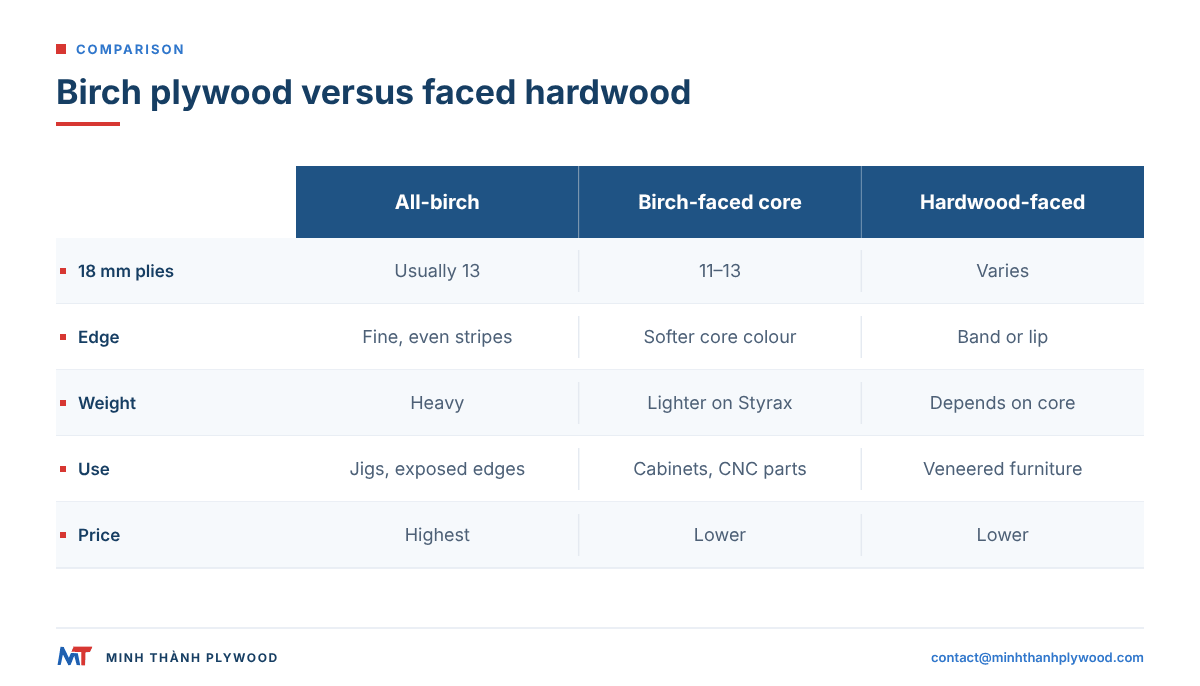
All-birch plywood is the premium choice for woodworking because its plies are thin and even through the whole thickness, giving the best edge and screw holding; hardwood-faced plywood on a lighter plantation core is the cost-effective choice for cabinets and shop furniture.
| Point | All-birch plywood | Birch-faced on Styrax or eucalyptus core | Hardwood-faced (oak, maple look, EV) |
|---|---|---|---|
| Plies at 18 mm | Usually 13 | 11–13 | Varies by build |
| Edge look | Fine, even stripes | Even stripes, softer core colour | Banded or lipped |
| Weight | Heavy | Lighter on Styrax core | Depends on core |
| Screw holding | Very good | Good | Good |
| Best for | Jigs, boxes, exposed edges | Cabinets, CNC parts, shop furniture | Veneered cabinets and furniture |
| Price | Highest | Lower | Lower |
Minh Thanh grades birch faces as D+, D and E and quotes them as face/back pairs such as D+/D, close to European B/BB as a buying comparison. For jigs and visible edges, order D+/D on a closed core; for shop cabinets, D/E is enough. See birch plywood.
How to inspect a plywood sheet before you buy
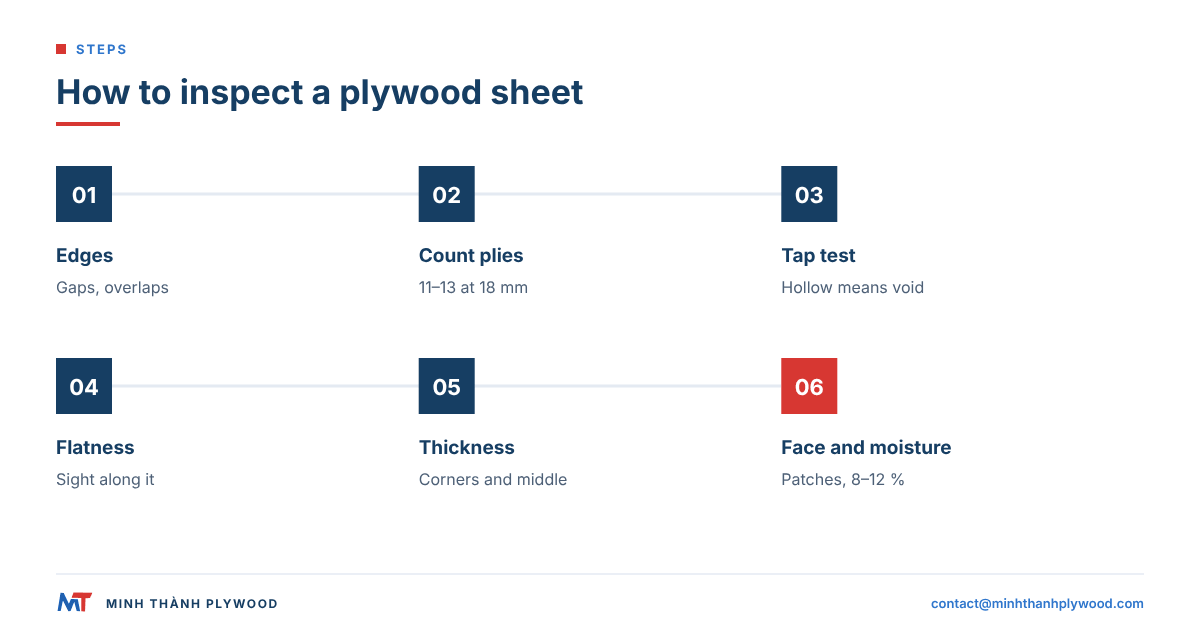
To inspect a plywood sheet in the yard, check the four edges for voids, count the plies, tap the face for hollow spots, sight down the sheet for flatness, and measure thickness at the corners. Seven checks take a few minutes per sheet.
- Edges: look along all four edges for gaps between core veneers, overlaps and filled patches.
- Plies: count them; at 18 mm, expect 11–13 on a quality build.
- Tap test: knock across the face with a knuckle; a dull, hollow sound means a void or a loose bond under the face.
- Flatness: stand the sheet on end or lay it on a flat floor and sight along it; reject a twist.
- Thickness: measure at the four corners and near the middle with a caliper.
- Face: look for patches, splits, sanding-through and glue bleed under a raking light.
- Moisture: a meter reading of 8–12 % is the normal range for furniture plywood.
Pull a sheet from the middle of the pack as well as the top. The top sheet has often been handled more, and the middle sheets show how the pack was made.
How to spot void-free plywood
Void-free plywood shows solid, even plies on every edge with no gaps, overlaps or dark lines in the core, and it sounds solid when tapped. The edges are the only place you can see the core, so read them before you buy.
What a void-free core looks like:
- Even plies: every layer the same thickness, without wavy or doubled veneers.
- No gaps: no dark slots where two core veneers did not meet.
- No overlaps: no thickened spots where veneers overlap, which show as bumps under the face.
- Tight glue lines: thin, continuous lines between plies.
How mills prevent voids: Minh Thanh stitches core layers both horizontally and vertically, presses the core board, calibrates it, then presses the face and back on. Stitching holds the veneers together during lay-up, and calibrating the core removes high spots before the face goes on.
The best plywood for DIY projects
The best plywood for DIY projects is birch-faced plywood for anything with a visible edge, poplar for painted pieces, pine faces for a rustic look and film-faced plywood for outdoor or wet-area jigs. The table gives a quick reference.
| DIY project | Plywood | Thickness |
|---|---|---|
| Boxes, toys, trays | Birch-faced | 6 to 12 mm |
| Bookshelves and shelving | Birch, poplar or EV | 18 mm |
| Painted furniture and wall panels | Poplar | 12 to 18 mm |
| Rustic shelves and signs | Pine-faced, A/B | 12 to 18 mm |
| Pegboard and tool walls | Birch or poplar | 6 to 12 mm |
| Outdoor jigs, potting benches | Film-faced or exterior | 12 to 18 mm |
| Bent and curved parts | Thin plywood in layers | 3 mm |
For tool walls, see plywood pegboard and slatwall. For furniture styles and builds, see plywood furniture design, and for curves, how to build a plywood arch.
Thickness for shop cabinets, jigs and furniture
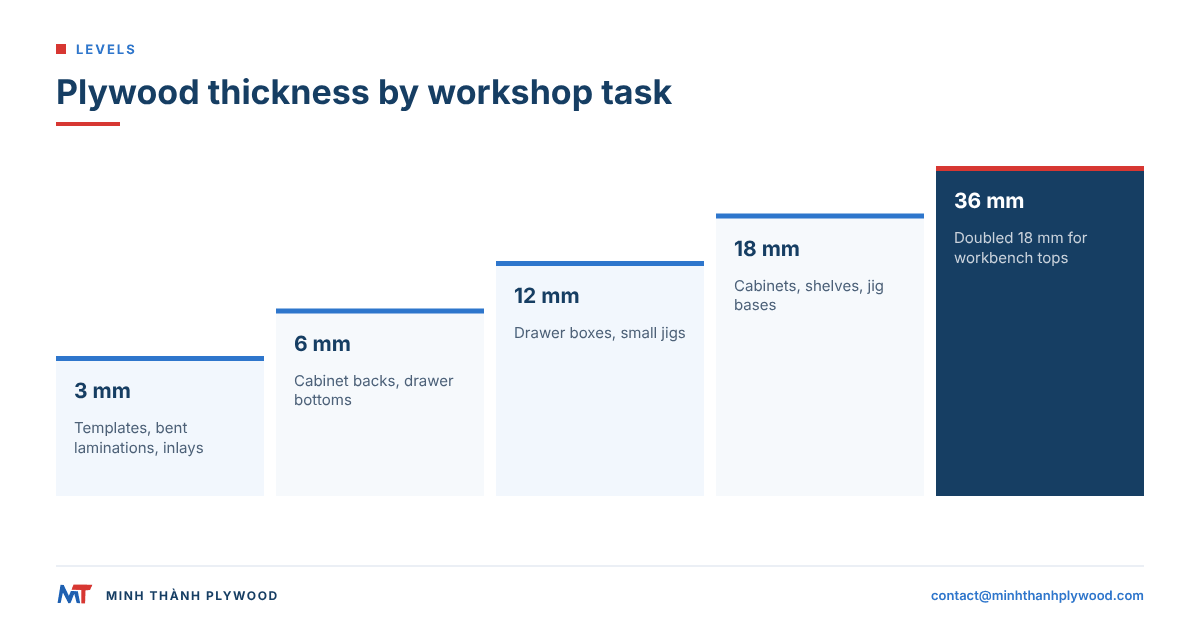
18 mm is the main thickness for woodworking projects, with 6 mm for backs, 12 mm for drawers and doubled 18 mm for tops. Order the measured thickness, so your dadoes and slots fit the sheet.
- 18 mm (3/4 in category, 23/32 in actual): cabinet sides, shelves, workbench bases, jig bases, the “gold standard” for carcasses.
- 12 mm (1/2 in category): drawer boxes, small jigs, light shelves.
- 6 mm (1/4 in): cabinet backs, drawer bottoms, templates.
- 3 mm (1/8 in): templates, bent laminations, inlays.
- Doubled 18 mm (36 mm, about 1-7/16 in): workbench and assembly table tops.
US stores sell by the inch category, and the real sheet is a little under: a 3/4 in sheet measures 23/32 in, about 18.3 mm, and a metric 18 mm sheet measures 0.709 in. Set dado widths to the measured thickness, not the label.
For small jobs, buy 2 × 4 ft project panels (24 × 48 in, about 610 × 1220 mm) in 1/4, 1/2 and 3/4 in; for cabinets, jigs and a bench, a full 4 × 8 ft sheet (1220 × 2440 mm) costs less per square foot and gives a matched grain across parts.
Nominal and actual thickness differ: a sheet sold as 18 mm with a loose tolerance can measure 17.3 mm. Our plywood thickness guide explains how mills calibrate and what to write on the order.
Why plywood bows and how to keep it flat
Plywood bows when its build is unbalanced, when it is stored on edge or on uneven supports, or when one face takes up more moisture than the other. A balanced, flat-pressed sheet stored flat stays flat.
How to keep sheets flat in the shop:
- Store flat on three or more level bearers, not leaning on a wall.
- Acclimatise sheets in the shop for a few days before cutting.
- Finish both faces of a panel, so moisture moves in and out evenly.
- Cut parts and use them soon; long thin offcuts stored on edge bend.
The Wood Handbook of the USDA Forest Products Laboratory (2010) explains how wood moves with moisture and why plywood is laid up with balanced, cross-grained plies. At the mill, balance comes from the build: matching face and back, cross-banding at right angles and drying veneers to the same moisture. Minh Thanh dries veneers and finished panels to 8–12 % moisture at dispatch.
Is Vietnamese plywood good for woodworking?
Furniture-grade Vietnamese plywood is good for woodworking because it is built for European furniture plants: a sanded face, a closed Styrax or eucalyptus core, two pressings and a calibrated thickness. Woodworkers should inspect it the same way as any sheet.
What the build gives a woodworker:
- Styrax core: light and even, about 500 kg/m³ for planning, for cabinets and mobile shop furniture.
- Eucalyptus core: denser, about 650 kg/m³, for stiff tops and shelves.
- Faces: birch, poplar, EV, pine, eucalyptus and others, quoted as face/back pairs.
- Glue: UF glue at E0 emission for indoor work. In the US, hardwood plywood with a veneer core is limited to 0.05 ppm formaldehyde under 40 CFR 770.10.
Quality differs between mills and grades, so judge a panel by its edges, flatness and thickness rather than by its origin. The furniture plywood page shows the builds.
Buying plywood for woodworking: by the sheet or by the container
Woodworkers buy plywood by the sheet from timber merchants, while workshops, cabinet makers and distributors that use plywood by the pack buy containers direct from a manufacturer. In Ireland, the UK and across Europe, merchants stock birch and hardwood plywood by the sheet.
Buying direct makes sense when:
- you use several packs a month of the same build;
- you need a specific face, core and tolerance that merchants do not stock;
- you want cut-to-size parts, for example one sheet cut into 4, 6 or 8 pieces;
- you supply other workshops as a distributor.
Minh Thanh’s minimum order is one 40HC with mixed specifications by agreement, production takes 15–45 days after the deposit, and furniture and interior plywood started from US$350/m³ in October 2026. More builds are collected in plywood projects.
What this means for your plywood order
To order plywood for woodworking by the container, send one specification per build, written in the order a mill builds the panel.
A specification for workshop and cabinet plywood:
- Application: cabinets, jigs and shop furniture
- Core: white Styrax, closed and stitched; Eucalyptus for workbench tops
- Glue and emission: UF glue at E0 emission
- Face and back: birch D+/D, sanded both sides
- Thickness and size: 18 mm and 12 mm, 1220 × 2440 mm, tolerance ±0.2 mm
- Packing and quantity: export pallets, one 40HC with mixed specifications, destination port
Minh Thanh sends free samples with the quotation, so you can cut, check the edges and run a sample through your own jigs first. Certificates and chamber test results are on our quality page. Send your specification to contact@minhthanhplywood.com.
Buyer questions, answered
What is the best plywood for woodworking?
A flat, calibrated panel with a closed core and a sanded hardwood face. Birch-faced plywood is the all-round choice for jigs, boxes and visible edges; a dense eucalyptus-core panel suits workbench tops; poplar or pine suits painted shop furniture.
What type of plywood should I use for a workbench?
For the top, two layers of 18 mm plywood glued and screwed into a 36 mm slab, ideally on a dense eucalyptus core for weight and stiffness. For the base, 18 mm plywood with any sound face is enough.
What is the best plywood for a workbench top?
A thick, flat, heavy top: doubled 18 mm birch-faced or eucalyptus-core plywood, sometimes with a replaceable hardboard skin. Film-faced plywood makes a good assembly table top because glue does not stick to it.
Birch vs hardwood plywood for woodworking: which is better?
All-birch plywood has thin, even plies all the way through, so its edges look best and it holds screws well, at a higher weight and price. Hardwood-faced plywood on a lighter core costs less and is flat enough for cabinets and shop furniture.
How do you spot void-free plywood?
Look along all four edges for gaps or overlapping core veneers, count the plies, tap the face and listen for hollow spots, and sight down the sheet for flatness. A void-free sheet shows solid, even plies on every edge.
How many plies should 18 mm plywood have?
All-birch 18 mm plywood usually has 13 plies. Hardwood-faced 18 mm panels on a plantation core are built with 11–13 plies; more, thinner plies give a stiffer, more stable panel and a finer edge.
What is the best plywood for DIY projects?
Birch-faced plywood for boxes, toys and anything with a visible edge, poplar for painted projects, pine faces for a rustic look and film-faced plywood for outdoor jigs and work surfaces.
Is Vietnamese plywood good for woodworking?
Furniture-grade Vietnamese plywood, with a sanded face, a closed Styrax or eucalyptus core and calibrated thickness, is built for European furniture plants and works well for cabinets, jigs and CNC parts. Inspect any sheet the same way, whatever its origin.
Why is my plywood not flat?
Plywood bows when it is unbalanced, stored on edge or uneven supports, or takes up moisture on one face. Store sheets flat on level bearers, let them acclimatise and finish both faces.
What thickness of plywood is best for shop cabinets?
18 mm for sides, tops and shelves, 6 mm for backs and drawer bottoms, and 12 mm for drawer boxes. Order the measured thickness so dadoes fit.
Where should I buy plywood for woodworking?
Single sheets come from timber merchants, which in Ireland, the UK and elsewhere stock birch and hardwood plywood by the sheet. Workshops and distributors that use plywood by the pack buy containers direct from a manufacturer.