
A good plywood project starts with the sheet: 18 mm for bookcases, benches and tables, 12 mm for boxes and drawers, 6 mm for backs, trays and wall art. One 1220 × 2440 mm sheet builds a bookcase, a storage bench or a set of crates. Minh Thanh Plywood, a Vietnamese plywood manufacturer, gives the cut plans, the right panel and the finish for each face.
Plywood project basics: start from the sheet
Every plywood project starts from a sheet, usually 1220 × 2440 mm, and the thickness you choose decides what it can carry. Pick the thickness for the job first, then the face for the finish, then plan the cuts so the parts fit on as few sheets as possible.
Four decisions make a project easy or hard:
- Thickness: set by the load and the span of each part.
- Face: set by the finish, clear, stained or painted.
- Bond: UF glue at E0 emission for indoor furniture, phenolic (WBP) for outdoors.
- Cut plan: set by the sheet size; a good plan uses most of the sheet and keeps the best face where it shows.
A 1220 × 2440 mm sheet is the standard size in most markets; 1250 × 2500 mm sheets are common in Europe and give a little more length. Our plywood thickness guide lists the standard thicknesses and their uses.
Which plywood for DIY projects?
For DIY projects indoors, choose a sanded hardwood plywood with a good face, such as birch, poplar or eucalyptus, bonded with UF glue at E0 emission. For outdoor projects, choose exterior plywood with a phenolic (WBP) bond.
| Plywood | Face look | Best for | Notes |
|---|---|---|---|
| Birch-faced | Pale, fine grain, neat edges | Furniture with exposed edges, clear finish | Hard face; graded D+, D and E |
| Poplar-faced | Pale, plain | Painted furniture, boxes, toys | Light and easy to cut |
| EV (engineered veneer) | Even, repeatable decor | Cabinet doors and matching sets | Same look from sheet to sheet |
| Eucalyptus-faced | Light brown, dense | Benches, workbenches, stained pieces | Harder face; graded A/A, A/B, B/B |
| Pine-faced | Yellow, knots | Rustic, painted pieces | Softer face |
| Okoume-faced | Pink-brown, even | Painted pieces, light builds | Light weight |
| Exterior WBP | Utility to good faces | Planters, sandpits, sheds, playhouses | Seal every edge |
The type of plywood that is best for DIY projects is the one whose face matches the finish. Clear and stained finishes need a high face grade; painted pieces can use a lower grade with filled knots. See our guide to the best plywood for furniture for grades in more detail.
Projects by sheet thickness
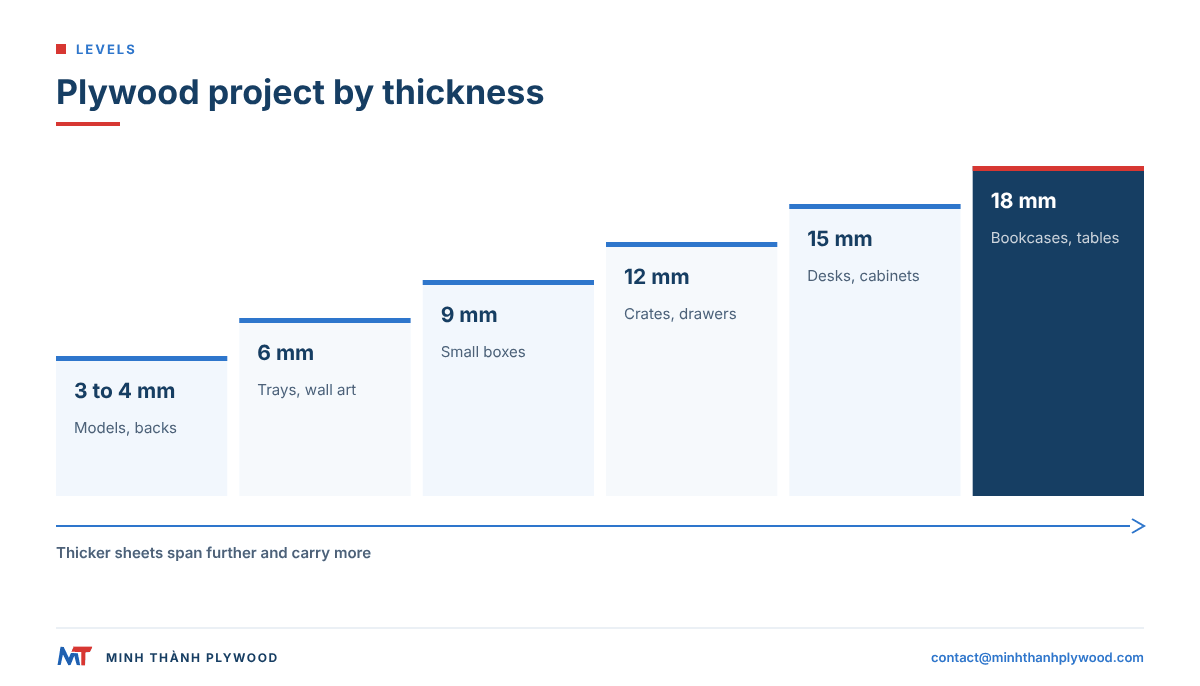
Thickness is the first choice in every plywood project, because it sets the span, the screw holding and the weight. The table groups common projects by the thickness they need.
| Thickness | Typical projects | Why this thickness |
|---|---|---|
| 3 to 4 mm (1/8 in) | Laser-cut models, templates, drawer bottoms, cabinet backs | Thin, light, cuts with a knife or a laser |
| 6 mm (1/4 in) | Trays, box lids, wall art, cabinet backs, signs | Light, stiff enough for small panels |
| 9 mm (11/32 in) | Small boxes, birdhouses, drawer sides, light wall shelves | Holds small screws and pins |
| 12 mm (15/32 to 1/2 in) | Crates, toy boxes, drawer boxes, shoe racks, kids’ furniture | Good balance of weight and strength |
| 15 mm (5/8 in) | Small cabinets, desks, bedside tables | Stiff panels, good screw holding |
| 18 mm (23/32 to 3/4 in) | Bookcases, benches, tables, beds, workbench tops, kitchen carcasses | Spans and carries heavy loads |
A simple test for shelves: if the shelf will hold books or tools, use 18 mm. Thinner shelves sag slowly under constant load, even if they look stiff on the first day.
Our thickness range runs from 3 to 40 mm. For 3 to 5 mm projects, our thin plywood is always 5-ply, which keeps thin panels flat and less likely to split at the edge.
What can you build with one sheet of plywood?
One sheet of plywood builds a bookcase, a desk, a storage bench or a workbench top when the parts are planned to fit the sheet. These 1 sheet of plywood projects all fit a 1220 × 2440 mm sheet, and the table gives the thickness each one needs.
1 sheet of plywood projects by thickness
| Project | Thickness | What the sheet makes |
|---|---|---|
| Bookcase | 18 mm | Two sides, top, bottom and four shelves |
| Storage bench | 18 mm | Box, lid and divider |
| Desk | 18 mm | Top, two side panels and a modesty panel |
| Media console | 18 mm | Carcass, shelves and doors |
| Workbench top | 18 mm | Double-layer top with a shelf |
| Closet organiser | 18 mm | Tower with shelves for one wardrobe bay |
| Set of storage crates | 12 mm | Several open crates for shelving |
| Toy box | 12 mm | Box, lid and handles cut in the sides |
| Kids’ table and two stools | 15 mm | Small table top, legs panels and stool parts |
| Planter boxes | 18 mm WBP | Two or three long planters for a balcony |
Single sheet plywood projects reward careful planning. Draw the parts on a scale drawing of the sheet before cutting, and keep the best face on the side that shows.
Cut plan: a one-sheet bookcase in 18 mm
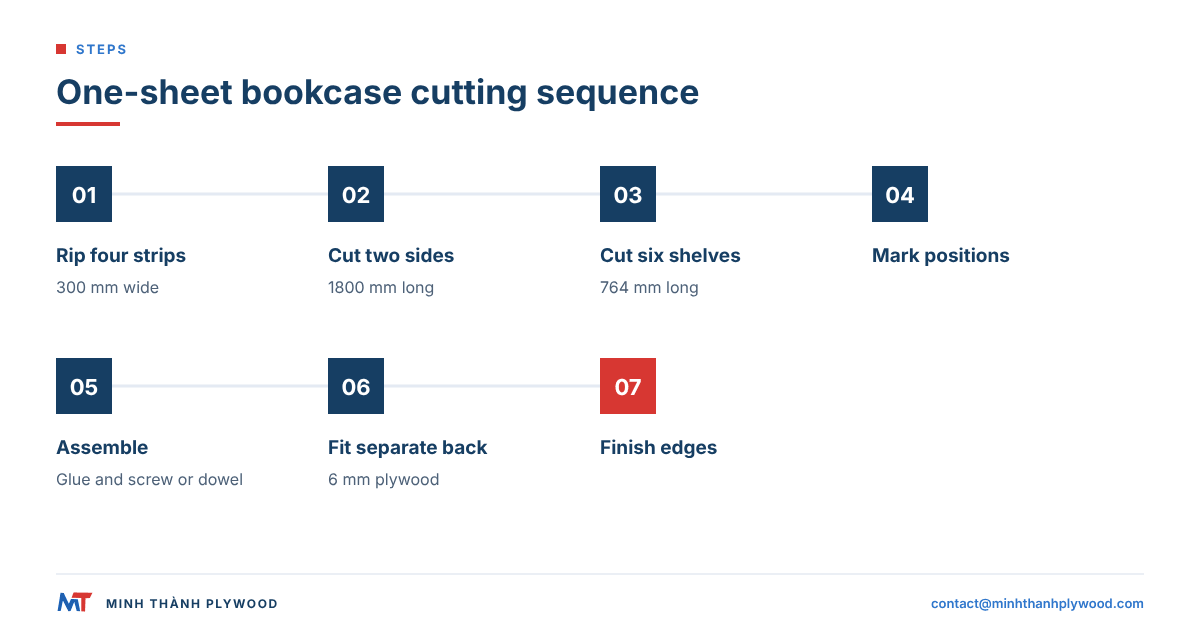
The bookcase carcass uses one 18 mm plywood sheet, ripped into four long strips and cross-cut into two sides and six shelves; the 6 mm back needs separate material. The finished case is 1800 mm high, 800 mm wide and 300 mm deep.
- Rip four strips. Cut the 1220 × 2440 mm sheet lengthwise into four strips 300 mm wide; the last few millimetres go to saw kerfs.
- Cut the sides. Cross-cut two strips to 1800 mm for the two sides; keep the two offcuts for small parts.
- Cut the shelves. Cross-cut each of the other two strips into three pieces 764 mm long, for a top, a bottom and four shelves.
- Mark the shelf positions. Clamp the sides together and mark the shelves across both at once.
- Assemble. Glue and screw, or use dowels or pocket screws, through the sides into the shelves.
- Add a back. Fit a thin back panel of 6 mm plywood, which squares the case and stops it racking.
- Finish the edges and the faces as described below.
The shelf length of 764 mm is the 800 mm width minus two 18 mm sides. If you change the width, change the shelves to match.
Cut plans for smaller pieces from one sheet
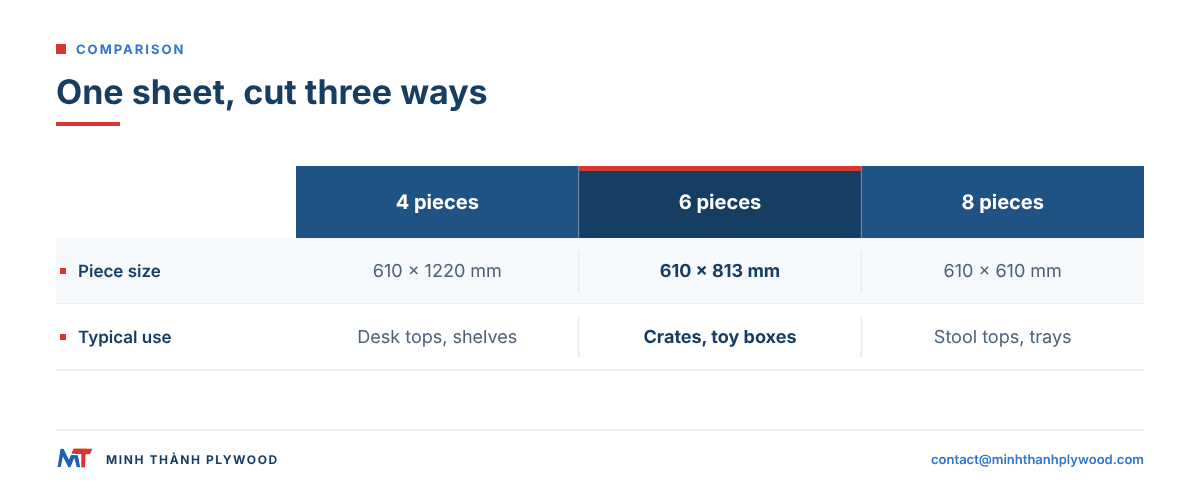
Many plywood projects need only part of a sheet, and a sheet cut into equal pieces gives the parts for several small builds. Cutting a 1220 × 2440 mm sheet in a grid gives three useful sizes.
| Pieces per sheet | Nominal piece size before saw kerf | Typical use |
|---|---|---|
| 4 | 610 × 1220 mm | Desk tops, shelves, bench seats, cabinet sides |
| 6 | 610 × 813 mm | Bedside tables, crates, toy boxes, small cabinets |
| 8 | 610 × 610 mm | Stool tops, wall art panels, trays, planters |
Minh Thanh cuts one panel into 4, 6 or 8 pieces before packing. Specify the finished part sizes and allow for saw kerf in the cutting plan. Workshops that make the same small product every week save cutting time by ordering cut-to-size plywood in their part size.
A tip from cut plans: lay out the largest parts first, then nest the small ones in the offcuts. Keep the grain of visible parts running the same way.
DIY projects with plywood for beginners
The easiest DIY projects with plywood are boxes, wall shelves and crates: straight cuts, simple glued and screwed joints, and a finish you can do in a day. Each teaches the skills that bigger pieces need.
- Wall shelf: one 18 mm board with two brackets or a hidden cleat.
- Storage crate: five panels of 12 mm, glued and screwed, with hand holes in the ends.
- Shoe rack: two 12 mm sides and three slatted shelves.
- Plant stand: a slotted cross of two 18 mm panels, with no screws at all.
- Desk organiser: 6 mm and 9 mm parts for pen holders, trays and a phone stand.
- Birdhouse: 9 to 12 mm exterior plywood, with a hinged roof for cleaning.
Plywood DIY is easier than solid wood DIY because the sheet is already flat, wide and stable. You do not need to plane boards or glue up panels, and plywood moves little with the seasons.
Plywood ideas for bigger builds
Bigger plywood ideas, such as beds, wardrobes, kitchen units and built-in seating, use several sheets and benefit from planning every part on a drawing first. Plywood suits them because it is stiff for its weight and holds screws close to the edge.
- Platform bed: 18 mm frame and slats or a solid 18 mm deck, with storage drawers underneath.
- Wardrobe: 18 mm carcass, 6 mm back, 18 mm doors with concealed hinges.
- Kitchen or utility units: 18 mm carcasses, see plywood for kitchen cabinets.
- Built-in window seat: 18 mm box with a hinged lid for storage.
- Wall panelling: 9 to 12 mm panels with a clear or painted finish, see plywood wall panels.
- Workshop wall: 18 mm sheets as a fixing wall for tools and shelves.
Weight matters when you move the parts. A 1220 × 2440 × 18 mm sheet weighs about 26.8 kg on a white Styrax core and about 34.8 kg on a Eucalyptus core, so lighter cores make large projects easier to handle alone.
Plywood projects that sell
Plywood projects that sell are small, useful pieces with a clean visible plywood edge, made in repeatable batches and shipped flat. Makers who sell online or at markets choose designs they can cut many times from the same sheet layout.
Popular product types for small makers:
- Plant stands and shelves with slotted joints that ship flat.
- Kids’ furniture: stools, low tables, bookcases and play kitchens in painted or birch plywood.
- Storage: crates, wall pockets, desk organisers and shoe racks.
- Laser-cut decor: wall art, lamps, signs and puzzles in 3 to 6 mm plywood.
- Pet furniture: cat houses, dog beds and feeding stations.
What do plywood pieces sell for? Handmade plywood furniture on the Wescover marketplace lists from US$105 for a small wooden stool to US$4,307 for a three-piece home-office bookcase set (Plywood Project on Wescover).
The brand Plywood Project, selling since 2016 to a community of 30,000 followers, builds mid-century pieces in the same material: bookcases from 97 to 190 cm, a 143 cm credenza, a 180 cm desk and entry benches of 120 to 150 cm (plywoodproject.com). A maker who cuts one sheet layout many times prices from the cut plan and the sheet cost, and the sheet cost is the part a steady supplier holds still.
What keeps a product profitable is a repeatable cut plan and consistent panels. Sheets of the same thickness, flatness and face in every delivery keep slots and joints fitting without adjustment. Our sanded furniture panels are made to ±0.2–0.3 mm, down to ±0.2 mm.
Finish advice for each face
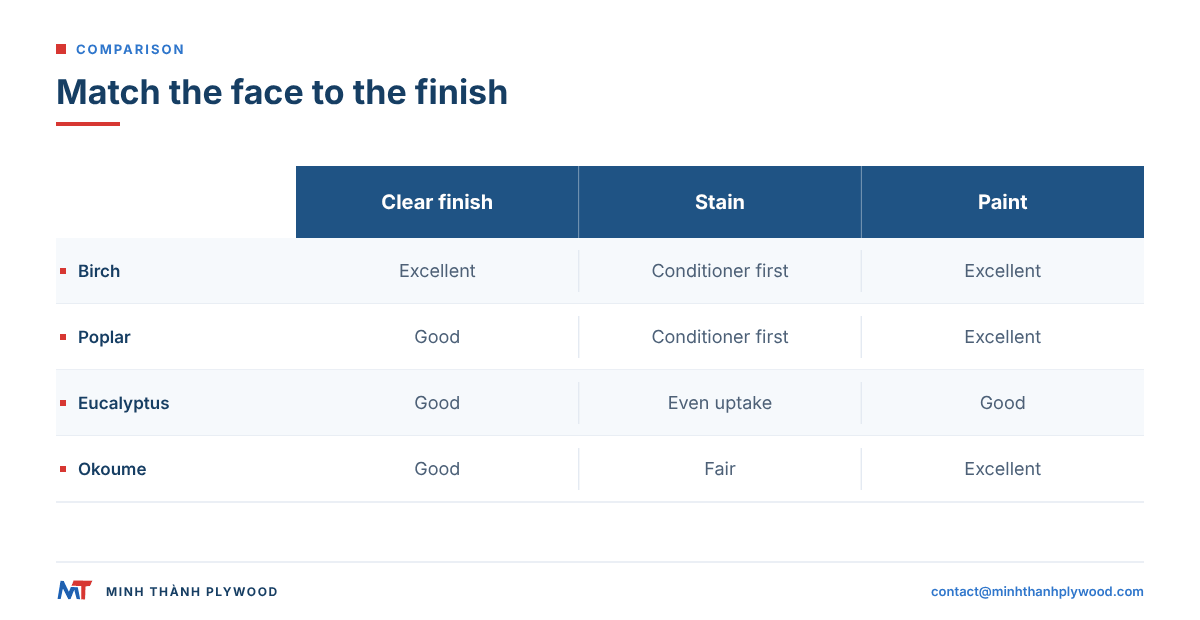
Choose the finish for the face: clear finishes on birch and eucalyptus, paint on poplar, okoume and pine, and a conditioner before stain on pale, soft faces. Sand to a fine grit before any finish, and never sand through the thin face veneer.
| Face | Clear finish | Stain | Paint |
|---|---|---|---|
| Birch | Excellent: water-based lacquer or hardwax oil | Blotches without a pre-stain conditioner | Excellent |
| Poplar | Good, pale and plain | Blotches without a conditioner | Excellent, smooth |
| EV | Good, keeps the decor look | Usually not needed | Good |
| Eucalyptus | Good, warm brown | Takes stain evenly | Good |
| Pine | Good, shows knots | Blotches without a conditioner | Good, prime knots first |
| Okoume | Good | Fair | Excellent |
Edges are part of the finish. You can show the layers under a clear coat, cover them with iron-on edge banding, or glue on a thin strip of solid wood. Our guide on how to finish plywood covers the coating steps, and how to cut plywood covers clean, splinter-free edges.
Our furniture panels have sanded and polished faces, and both faces are UV-ready for buyers who apply their own UV coating.
What is project panel plywood?
Project panel plywood is a small, pre-cut piece of plywood sold in hardware stores for DIY work, often a quarter or half of a full sheet. It saves cutting a full sheet at home and fits in a car.
In the US the same panels are sold by nominal inch thickness and foot size. The Home Depot project-panel range (Home Depot plywood) runs in 2 × 2, 2 × 4 and 4 × 4 ft sizes and thicknesses from 1/4 to 3/4 in:
| Project panel | Metric size | Thickness (nominal) | Types sold | Fits |
|---|---|---|---|---|
| 2 × 2 ft | 610 × 610 mm | 3/4 in (18 mm) | Fir B/C sanded | Stool seats, small shelves, box lids |
| 2 × 4 ft | 610 × 1220 mm | 1/4 in (6 mm), 11/32 in (9 mm) | B/C sanded, BCX sanded, pine soffit | Cabinet backs, drawer bottoms, signs |
| 4 × 4 ft | 1220 × 1220 mm | 3/4 in (18 mm) | B/C | Bench tops, desk tops, one-sheet bookcase parts |
| 4 × 8 ft sheet | 1220 × 2440 mm | 15/32 (12 mm), 23/32 (18 mm) | CCX ground-contact pressure-treated pine, sheathing | Outdoor and structural jobs |
B/C is a sanded face over a plain back for painted work, and BCX has an exterior-type glue; pressure-treated CCX is for ground contact and not for indoor furniture.
When project panels make sense:
- Small builds that need one or two parts.
- No space to break down a full sheet.
- Try-outs of a face or a finish before buying full sheets.
When a full sheet is better:
- Several parts of the same thickness: a full sheet costs less per square metre.
- Long parts such as bookcase sides and bench seats.
- Matching faces across all parts of one piece.
For workshops, the trade version of a project panel is cut-to-size plywood: panels cut to the part size at the mill, packed and shipped in quantity.
Indoor or outdoor: which bond?
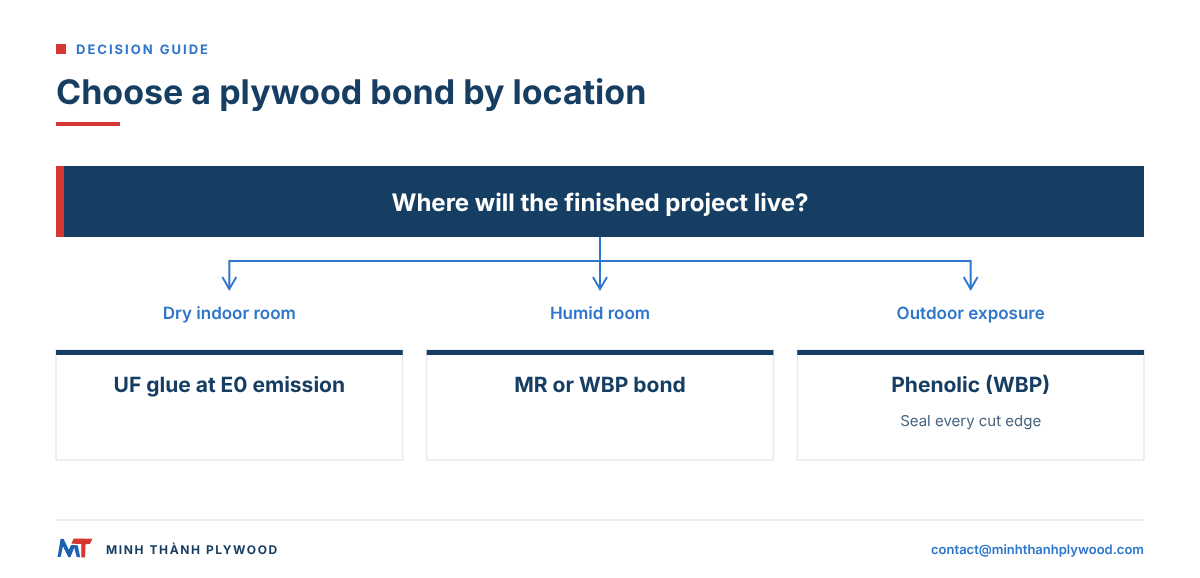
Indoor plywood projects use UF glue at E0 emission; outdoor projects need a phenolic (WBP) bond, sealed edges and an exterior finish. The bond, not the face, decides whether a project survives rain.
- Indoor furniture, toys and decor: UF glue at E0 emission. The chamber test method is ASTM D6007. Six tests between April 2025 and June 2026 on 9, 15 and 18 mm panels averaged 0.014–0.032 ppm. The limit for veneer-core hardwood plywood is 0.05 ppm under 40 CFR 770.10; see our CARB P2 / TSCA Title VI certificate.
- Bathrooms and humid rooms: MR (melamine-fortified) or WBP bond.
- Garden furniture, planters, sandpits, sheds: WBP bond with every edge sealed, see plywood for outdoor furniture.
Glue-line quality for plywood is tested under BS EN 314-2. A sandpit or planter that holds wet soil needs the same treatment as a boat part: phenolic bond, sealed edges, and a liner or drainage.
What this means for your order
Workshops, makers and retailers who sell plywood for projects can order panels by the project they serve. Minh Thanh Plywood supplies full sheets and cut-to-size panels in container loads.
- Use: furniture, kids’ products, laser-cut decor, outdoor pieces or retail project panels.
- Thickness: for example 6, 12 and 18 mm; our range is 3 to 40 mm.
- Size: 1220 × 2440 mm, 1250 × 2500 mm, or cut-to-size pieces of 4, 6 or 8 per sheet.
- Face and grade: birch, poplar, EV, eucalyptus, pine or okoume, matched to an approved sample.
- Core: white Styrax for light weight, Eucalyptus for stiffness and screw holding.
- Bond and emission: UF glue at E0 emission indoors, WBP outdoors.
- Packing and quantity: sheets per pack, number of 40HC containers and the destination port.
Our minimum order is one 40HC with mixed specifications by agreement; production takes 15–45 days after deposit. Free samples are available. See our furniture plywood or send your specification to contact@minhthanhplywood.com; we reply within hours.
Buyer questions, answered
What can you build with one sheet of plywood?
From one 1220 × 2440 mm sheet of 18 mm plywood you can build a bookcase, a storage bench, a desk, a workbench top or a media console. From 12 mm you can build a set of crates, a toy box or drawer boxes.
Which plywood is best for DIY projects?
A sanded hardwood plywood with a good face, such as birch, poplar or eucalyptus, bonded with UF glue at E0 emission for indoor furniture. Use WBP-bonded exterior plywood for anything that stays outside.
What thickness plywood for a bookshelf?
Use 18 mm for bookcases and shelves that span more than about two hand widths, and 12 mm only for short, lightly loaded shelves. Book loads sag thin shelves over time.
What is project panel plywood?
Project panels are small, pre-cut plywood pieces sold in hardware stores for DIY work, often a quarter or half of a full sheet. They save cutting but cost more per square metre than a full sheet.
What plywood projects sell well?
Small furniture with a clean plywood edge sells well: plant stands, wall shelves, kids' furniture, storage crates, desk organisers and laser-cut decor. Pieces that ship flat cost less to send.
Is plywood good for DIY furniture?
Yes. Plywood is stable, strong for its weight, holds screws well and comes in wide flat sheets, so it is easier to build with than solid wood and does not need gluing up into panels.
What is the easiest plywood project for beginners?
A simple box, a wall shelf or a storage crate: straight cuts, butt joints with glue and screws, and a finish you can do in a day. These teach cutting, assembly and edge finishing.
How do you finish plywood edges on a DIY project?
Sand the edges smooth and either show the layers under a clear finish, cover them with iron-on edge banding, or glue on a thin strip of solid wood.
Can I use plywood for outdoor DIY projects?
Yes, with an exterior plywood bonded with phenolic (WBP) glue, every edge sealed, and an exterior paint or varnish. Interior plywood delaminates outside.
How much does a sheet of plywood weigh?
A 1220 × 2440 × 18 mm sheet weighs about 26.8 kg on a white Styrax core and about 34.8 kg on a Eucalyptus core. A 6 mm Styrax core sheet weighs about 8.9 kg.