
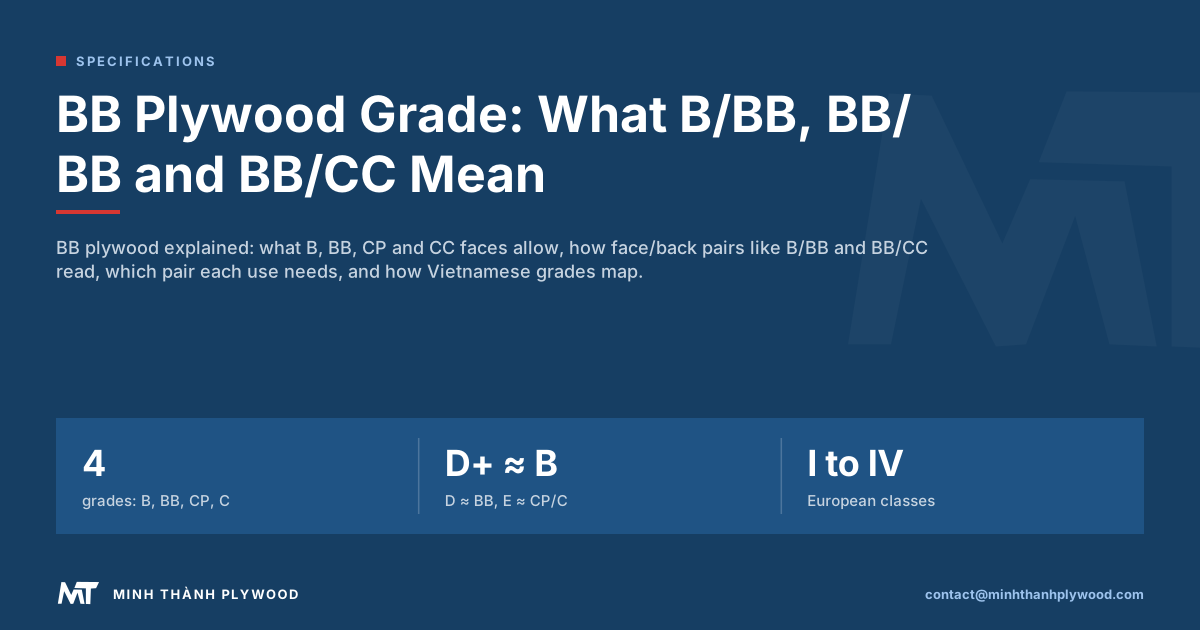
BB plywood has a BB-grade face: a sound, sanded veneer with neat colour-matched patches and small pin knots allowed. A pair such as B/BB names the face first and the back second, so B/BB has a near-clear face on a BB back. Minh Thanh Plywood decodes the B, BB, CP and CC grades, each pair's use and how Vietnamese D+, D and E map onto them.
What is BB plywood?
BB plywood is plywood with a BB-grade face: a sound, sanded veneer that allows neat colour-matched patches, small pin knots and some variation in colour. BB is the second step on most hardwood and birch grade ladders, below the near-clear B grade.
What a BB face shows:
- Patches. Football-shaped veneer patches or round plugs, glued in and sanded level, matched in colour to the face.
- Knots. Small sound pin knots; open knots are repaired.
- Colour. Natural variation within one sheet, more than on a B face.
- Surface. Sanded smooth with no open splits or holes.
The grade describes the look of one face, not the panel. Two BB sheets can differ widely in core, glue and flatness, which is why the grade is only one line of the specification.
BB plywood in the US: Baltic birch BB/BB and BB Plyform
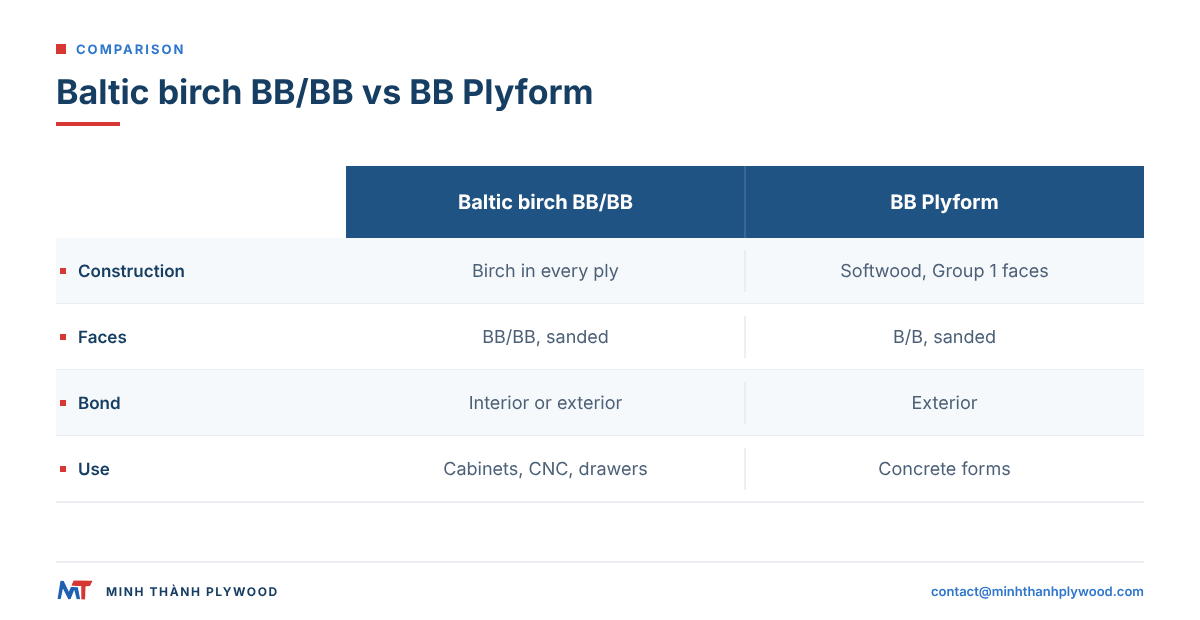
In the US, “BB plywood” means one of two products: Baltic birch BB/BB, an all-birch sanded sheet for furniture and CNC work, or BB Plyform, a sanded concrete-form panel. The grade letters are the same; the wood, glue and use are not.
| Point | Baltic birch BB/BB | BB Plyform (B-B Class I) |
|---|---|---|
| Wood | Birch in every ply | Softwood, strong Group 1 species faces |
| Face and back | BB and BB, sanded | B and B, sanded both sides |
| Made for | Cabinets, drawers, jigs, laser and CNC | Concrete forms, reused |
| Glue | Interior or exterior by maker | Exterior glue |
| Retail example | US$99.90 per 4 × 8 ft sheet, 1 to 9 sheets | 3/4 in 4 × 8 ft, sold at home centres |
Plyform is made to the PS 1 standard (NIST lists PS 1-22 as the current structural plywood standard) and sold under APA’s B-B Plyform Class 1 listing (APA Europe, B-B Plyform Class 1, read 21 October 2026); the non-overlaid panel is mill-oiled, and an overlaid HDO or MDO panel is the choice for higher reuse counts. The Home Depot 3/4 in BB Plyform listing is the BB panel most US buyers meet first.
Baltic birch sizes and plies
| Thickness | Plies | Typical sheet |
|---|---|---|
| 3/16 in (5 mm) | 3 to 5 | 4 × 8 ft (1220 × 2440 mm) |
| 1/2 in (12 mm) | 9 | 4 × 8 ft |
| 3/4 in (18 mm) | 13 | 4 × 8 ft |
| 7/8 in (21 mm) | 15 | 4 × 8 ft |
Berta Store lists 4 × 8 ft BB/BB Baltic birch in these four thicknesses, sanded both sides, at US$99.90 per sheet for 1 to 9 sheets and US$79.92 per sheet from 50 sheets (Berta Store, read in October 2026). Baltic birch is also sold in 5 × 5 ft sheets.
An importer’s comparison. A raw FOB example for a Minh Thanh furniture panel: one 18 mm 1220 × 2440 mm sheet is 0.0536 m³, and at US$350/m³ (October 2026) that is about US$18.8 before freight, duty and margin. That is a raw FOB example, not a sheet price, and it is for a birch-faced build; all-birch costs more. A US container buyer sees why importers ask for BB-grade faces from Vietnam: the sheet cost leaves room for freight and a retail margin well below the US$99.90 shelf price.
What do B/BB, BB/BB and BB/CC mean? Reading face/back pairs
A pair such as B/BB names the face first and the back second: B/BB is a B face on a BB back. Every plywood offer graded by letters uses this order.
| Pair | Face | Back | Typical use |
|---|---|---|---|
| B/BB | Near clear, very few repairs | Patched, sound | Furniture with one show face, clear finish |
| BB/BB | Patched, sound | Patched, sound | Both faces visible, small repairs accepted |
| BB/CP | Patched, sound | More repairs, colour varies | One visible face, back hidden or painted |
| BB/CC | Patched, sound | Repairs and closed defects | One visible face, painted work, packaging |
| CP/CP | More repairs | More repairs | Overlay, laminate, paint |
| C/C | Utility | Utility | Hidden parts, crates, sheathing |
Read the pair before the price. A B/BB and a BB/CC sheet of the same thickness are different panels: the first is chosen for a clear-finished face, the second for paint or a hidden back.
Some suppliers write the pair with a space or a hyphen, “B BB” or “BB-CC”. The meaning is the same: face, then back.
The plywood face grade ladder: B, BB, CP and C
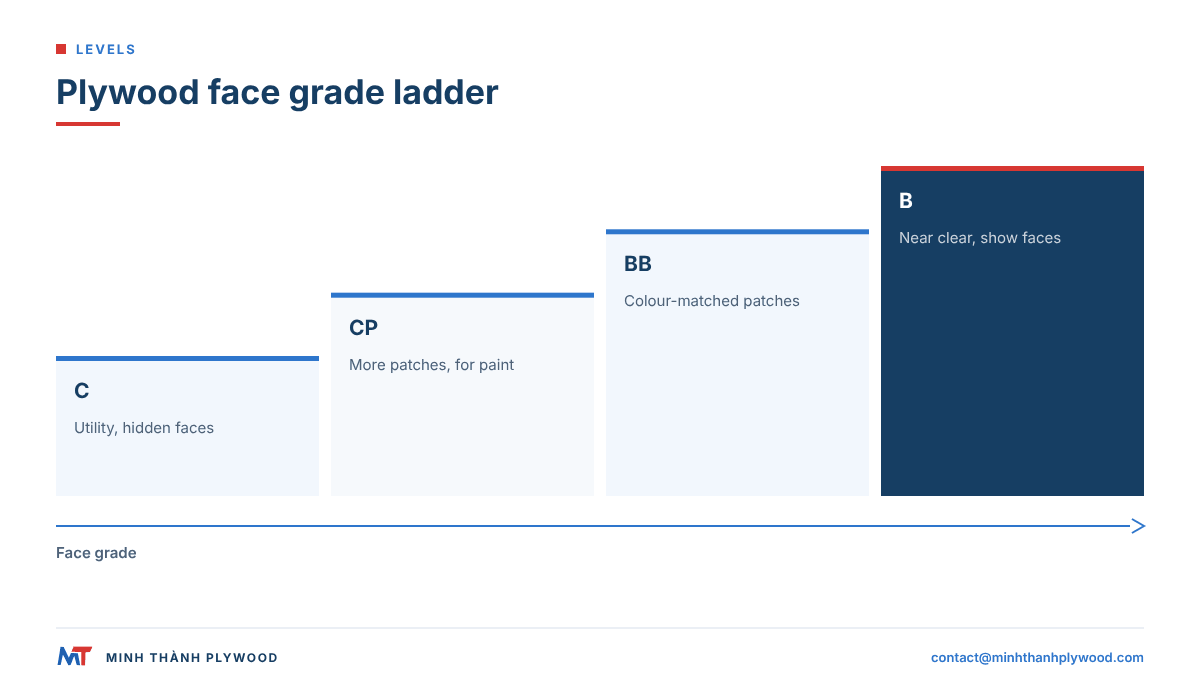
The plywood face grade ladder runs from B at the top through BB and CP to C, each step allowing more repairs and colour variation. Some ladders add a clear grade above B and a D grade below C.
| Grade | What the face allows | How it is used |
|---|---|---|
| B | Near clear: pin knots, very few small repairs, even colour | Clear lacquer, oil, show faces |
| BB | Colour-matched patches and plugs, pin knots, some colour variation | Furniture, cabinets, shelving |
| CP | More and larger patches, stronger colour variation, small closed splits | Paint, laminate, overlay |
| C / CC | Repairs, closed knots, discolouration, small splits filled | Hidden faces, packaging, utility |
| D | Open defects allowed within limits | Backs that never show, rough utility |
Grades are words, not measurements: two mills can draw the line between BB and CP in slightly different places. That is why every graded order is fixed by an approved sample, and the sample, not the letters, settles any dispute.
The plywood grades guide sets the letter grades beside the US A to D system and the European classes.
B/BB vs BB/BB plywood: which one do you need?
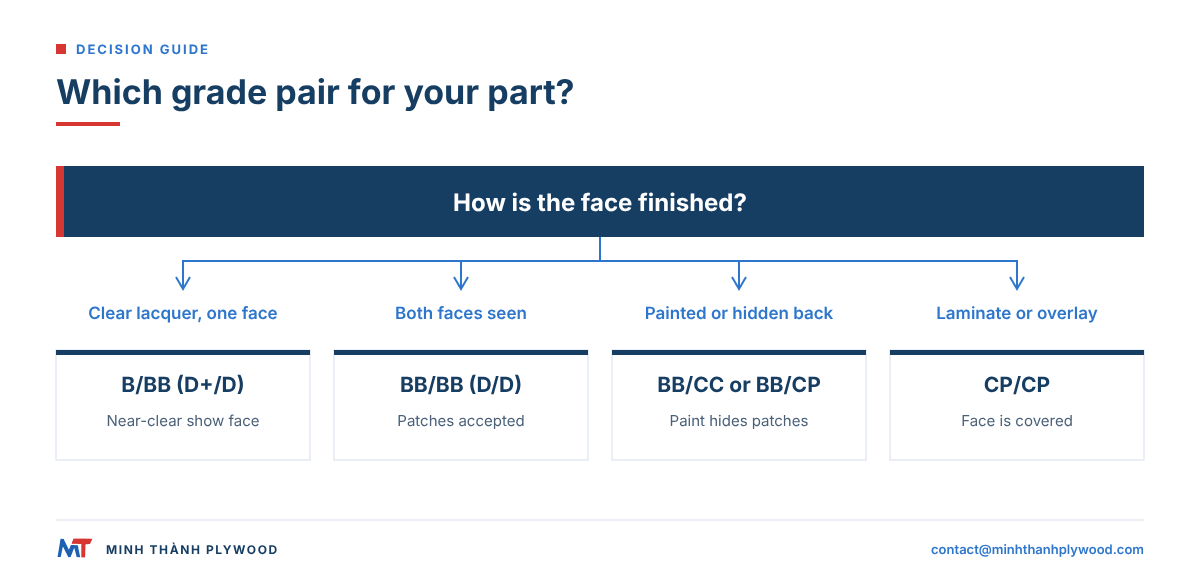
Choose B/BB when one face is finished clear and must look nearly uniform, and BB/BB when both faces show but neat patches are acceptable. The difference is the face, not the back.
- B/BB for a clear-finished show face. Cabinet doors in lacquered birch, visible shelf faces, furniture sides finished in oil. The B face has very few repairs, so the grain reads as one surface.
- BB/BB for two visible faces. Open shelving, partitions and furniture where both sides are seen. Patches are allowed on both faces, colour-matched.
- BB/CP when the back is hidden. Carcass sides that meet a wall, drawer boxes, cabinet backs.
B faces cost more because fewer veneers meet the grade. Paying for a B face on a part that will be painted, laminated or turned to a wall adds cost without a visible gain.
BB/CC plywood: what it is and where it is used
BB/CC plywood has a BB face and a CC back: one sound, patched face for show or paint, and a utility back with more repairs and colour difference. It is one of the most ordered pairs in the Asian plywood trade.
Where BB/CC fits:
- Painted furniture and joinery, where the face is primed and the back is hidden.
- Cabinet and wardrobe parts with one visible side.
- Packaging plywood, where a sound face takes printing or a label and the back carries the load.
- Overlaid panels, as a base for laminate or veneer on one side.
For packaging, BB/CC is a common grade pair because the panel needs a sound face and a reliable core more than a clear look. A packing panel is judged on thickness and core, not on face figure; the packing plywood range covers crates and pallets.
BB grade on birch plywood and the European classes
On birch plywood, BB is the grade that most furniture buyers order: it sits second on the European birch ladder, B, BB, CP and C, which corresponds to the face classes I, II, III and IV of EN 635-2.
| Birch grade | European class | Face |
|---|---|---|
| B | I | Near clear, few small repairs |
| BB | II | Colour-matched patches and plugs allowed |
| CP | III | More patches, colour variation, for paint or overlay |
| C | IV | Open defects within limits, hidden use |
Birch BB faces are usually patched with birch plugs sanded level. On a clear lacquer the plugs remain visible as small ovals; under a stain they show more. Buyers who need an unbroken birch figure order B on the show face.
Birch plywood graded BB/BB is the reference panel for many European cabinet makers. When comparing offers, check the core as well as the face grade: a birch-faced panel on a non-birch core shows that core at the edge.
How Vietnamese plywood grades map to B/BB
Vietnamese birch faces are graded D+, D and E, low to high E, D, D+; as a buying comparison D+ is close to B, D close to BB and E close to CP or C. A D+/D pair is close to B/BB, and D/D close to BB/BB.
| Vietnamese grade | Close to | Pair example | Close to pair |
|---|---|---|---|
| D+ | B | D+/D | B/BB |
| D | BB | D/D | BB/BB |
| E | CP / C | D/E | BB/CP |
Other faces use letter pairs of their own:
- Poplar faces are quoted as A/A, A/B and B/B, matched to the buyer’s approved sample. Buyers also order them by the Chinese codes B/BB, BB/CC and CP, which map onto the same ladder.
- Eucalyptus faces are quoted as A/A, A/B and B/B: A/A for two visible faces, A/B for one, B/B for paint or overlay.
- Pine faces are quoted as A/A, A/B and B/B, with B/C for utility parts; the ladder compares with the European softwood classes I to IV and the US A to D grades.
At Minh Thanh the face is chosen for the look the buyer orders, including imported birch and okoume. Whatever the letters, the approved sample fixes the appearance of the order. See the birch-faced plywood and poplar plywood pages for each line.
Which grade pair does each use need?
Each use needs the lowest grade pair that still looks right where it is seen: a B face only where a clear finish shows, BB for visible patched faces, and CC or CP where paint, laminate or a wall hides the panel.
| Use | Face/back pair | Vietnamese birch equivalent | Why |
|---|---|---|---|
| Clear-lacquered cabinet doors | B/BB | D+/D | One show face, near clear |
| Open shelving, both faces seen | BB/BB | D/D | Two visible faces, patches accepted |
| Cabinet carcass sides | BB/CP | D/E | Back faces a wall or another cabinet |
| Painted furniture and doors | BB/CC or CP/CP | D/E | Paint hides patches |
| Laminate or HPL overlay base | CP/CP | E/E | Face is covered |
| Crates and pallets | BB/CC or C/C | Not birch | Sound core, low cost |
The most expensive mistake is a higher grade than the part needs on every sheet of a container. Split the order into two grade pairs, show parts and hidden parts, where the bill of materials allows it.
Does BB mean waterproof, marine or low emission?
No. BB is an appearance grade of the face; water resistance comes from the glue, marine performance from a separate marine build, and emission from the glue and its class. A “B/BB marine” label puts two different specifications in one name.
Three specifications that travel next to the grade:
- Glue bond. UF for dry interiors, MR or melamine-fortified for humid use, phenolic (WBP) for exterior. At Minh Thanh, furniture panels use UF glue at E0 emission; MR, melamine-fortified and phenolic bonds are made to the customer’s specification.
- Emission class. A separate line from the glue. The US limit for veneer-core hardwood plywood is 0.05 ppm under 40 CFR 770.10. Minh Thanh holds CARB P2 / TSCA Title VI certification as ICTT mill no. 23024.
- Marine build. Marine plywood is made to its own standard for species, core and bond, such as BS 1088:2018 in Britain. Okoume-faced interior plywood is a furniture and interior panel, not marine plywood, whatever its face grade.
Write all three on the order next to the grade pair. A quotation that gives only “BB/CC 18 mm” leaves the glue and emission to the supplier.
What the core adds to a BB plywood panel
The face grade says nothing about the core, and the core decides whether a BB panel stays flat, holds its thickness and machines cleanly. A perfect BB face on a gapped core is a poor panel.
What to specify for the core:
- Species. White Styrax or Eucalyptus are the standard furniture cores at Minh Thanh; Acacia and Pine on order.
- Closed joints. Core layers stitched both horizontally and vertically, so there are no gaps under the face.
- Pressing. Furniture panels pressed twice: the core board is pressed and calibrated, then face and back are pressed on.
- Tolerance. Sanded furniture panels held to ±0.2–0.3 mm, down to ±0.2 mm.
A core gap under a BB face often shows later as a dip in the finish or a weak spot at a hinge. Read the edge of the sample and the plywood quality checks before approving it.
How to specify BB plywood on an order
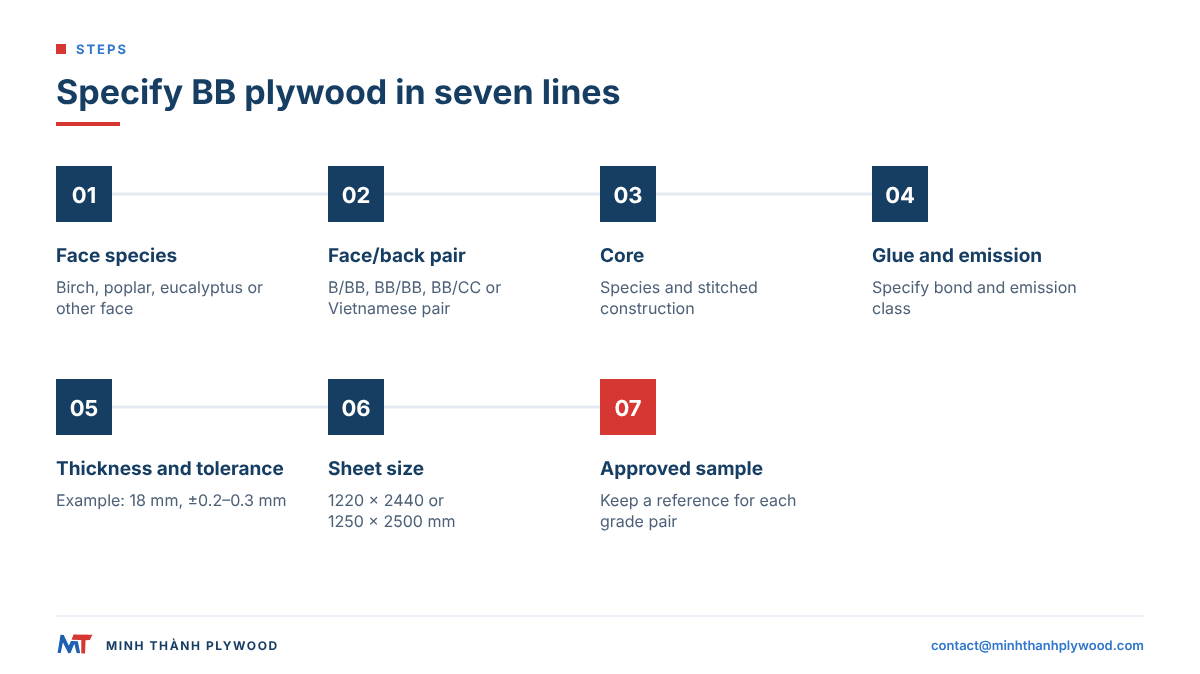
Specify BB plywood in seven lines, face grade first and approved sample last, so the mill and your inspector work to the same panel.
- Face species. Birch, poplar, eucalyptus, okoume, pine or engineered veneer.
- Face/back pair. B/BB, BB/BB, BB/CC, or the Vietnamese pair such as D+/D.
- Core. Species and construction, such as white Styrax, stitched.
- Glue and emission. For example UF glue at E0 emission, or phenolic (WBP) for exterior use.
- Thickness and tolerance. Such as 18 mm, ±0.2–0.3 mm.
- Size. 1220 × 2440 mm, 1250 × 2500 mm or a custom size.
- Approved sample. Reference number of the sample both sides hold.
Free samples come first: approve one sheet per grade pair and keep it as the reference. The approved sample settles any question about the grade on arrival.
How to check BB faces on arrival
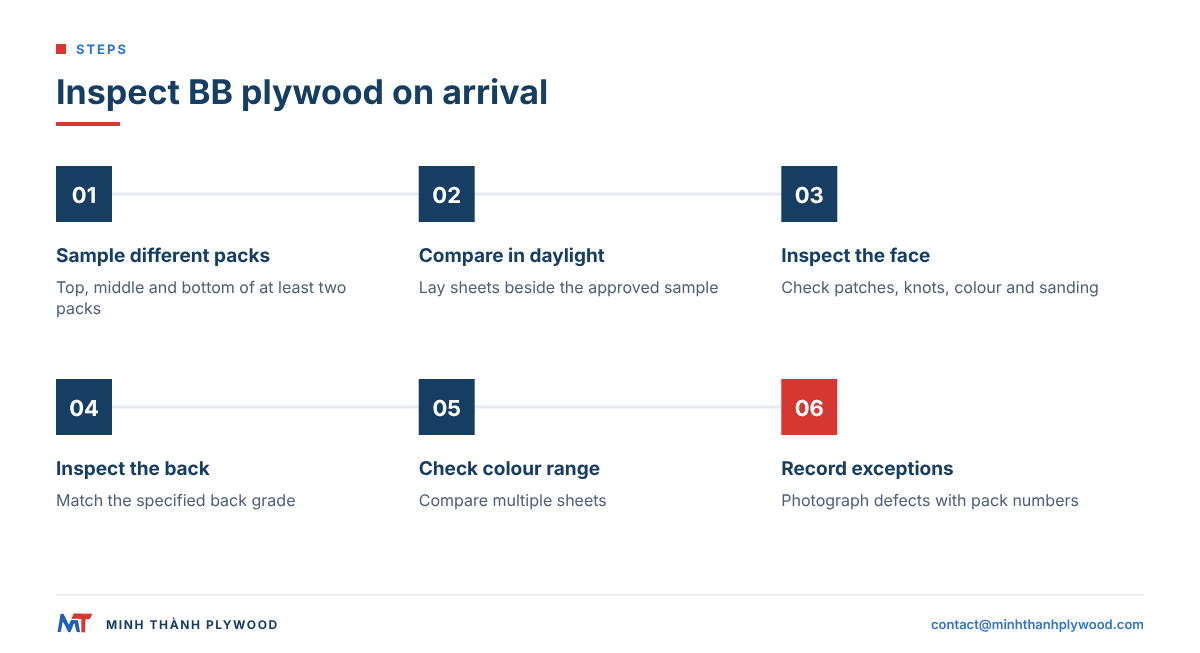
Check BB faces on arrival by laying sheets from different packs beside the approved sample in daylight and reading patches, knots, colour and sanding against it. The sample is the measure, the letters only the name.
- Pull sheets from the top, middle and bottom of at least two packs.
- Lay them beside the sample in daylight or under even light.
- Read the face: patches tight and level, matched in colour; pin knots only; no open splits.
- Read the back against the back grade of the pair.
- Check colour range across sheets, not only within one.
- Photograph any sheet below the sample with the pack number.
Mixed grades in one pack are the most common grade complaint. Sort and count them before you raise a claim; the exterior plywood acceptance guide shows acceptance criteria set out in the same way.
What this means for your plywood order
Order BB plywood by the pair your parts need, with the core, glue and sample on the same line. A birch-faced furniture line reads:
18 mm birch-faced plywood, D/D (close to BB/BB) to approved sample, white Styrax core stitched, pressed twice, UF glue at E0 emission, 1220 × 2440 mm, ±0.2–0.3 mm.
Minh Thanh supplies one 40HC as the minimum, with mixed specifications by agreement, so show and hidden grade pairs can share a container. Send your parts and finishes, and we propose the grade pair for each, with free samples to approve. See our furniture plywood for the builds behind the faces.
Buyer questions, answered
What is BB plywood?
BB plywood has a BB-grade face: sound, sanded veneer with neat colour-matched patches and small pin knots allowed, and some colour variation. It is the second grade on most hardwood and birch ladders, below B.
What does B/BB mean in plywood?
B/BB names the face and the back: a B-grade face, nearly clear with very few repairs, on a BB-grade back with patches allowed. It is the pair for furniture with one show face.
What does BB/BB plywood mean?
Both faces are BB grade: patched, sound and sanded, with the same look on both sides. It suits furniture and shelving where both faces show but small repairs are acceptable.
What is BB/CC plywood?
A BB-grade face on a CC-grade back. The back allows more repairs, colour difference and small closed defects, so BB/CC suits panels with one visible face, painted work and packaging.
Is BB plywood good quality?
Yes for most furniture and joinery. BB is a sound face that is patched rather than clear; the panel's quality also depends on the core, the glue and the thickness tolerance, which the face grade does not describe.
Is B/BB plywood waterproof or marine plywood?
No. B/BB is an appearance grade. Water resistance comes from the glue, such as phenolic (WBP), and marine plywood is a separate build to its own standard.
How do Vietnamese birch grades compare with B/BB?
Vietnamese birch faces are graded D+, D and E. As a buying comparison D+ is close to B, D close to BB and E close to CP or C, so D+/D is close to B/BB and D/D close to BB/BB.
What is the difference between BB and CP grade?
BB allows neat colour-matched patches and pin knots on a uniform face. CP allows more and larger patches and stronger colour variation, and is meant to be painted or overlaid.
Which plywood grade is best for painting?
BB/CC or CP/CP. Patches do not show under paint, so a clearer and dearer B face adds cost without a visible gain.
Does the grade on poplar plywood work the same way?
Yes in principle. Poplar faces are quoted as A/A, A/B and B/B, and buyers also order them by the Chinese codes B/BB, BB/CC and CP, which map onto the same ladder; the approved sample fixes the look.