
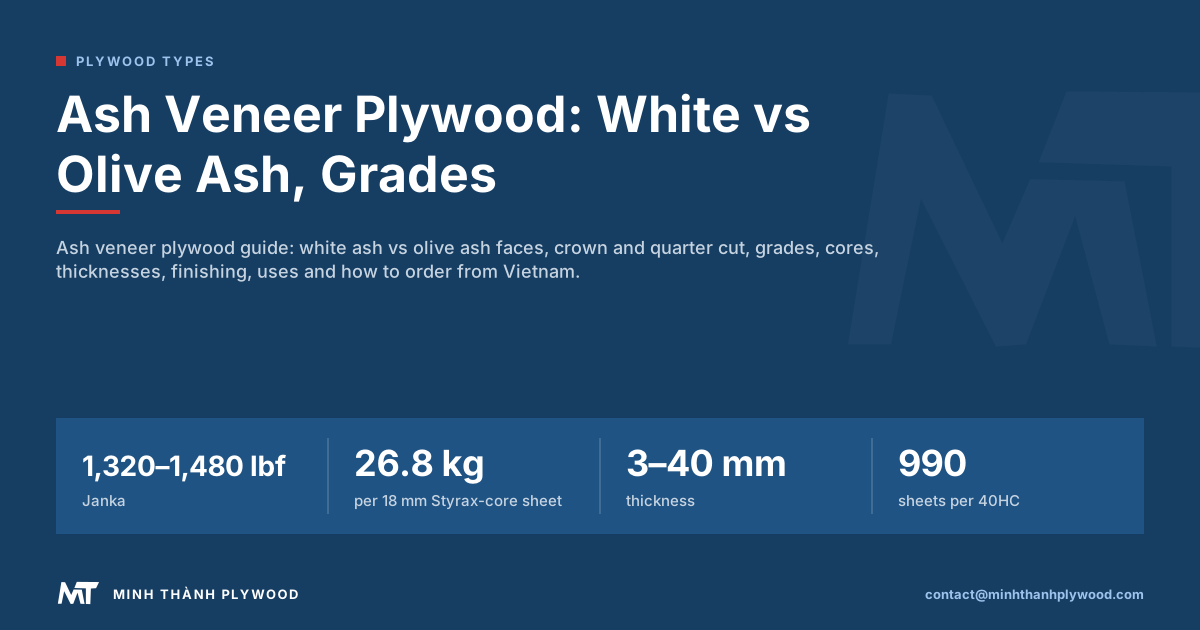
Ash veneer plywood is plywood with a thin ash face over a lighter core. White ash gives a pale, straight, open grain; olive ash adds dark streaks for a bolder look. Choose the cut and grade pair for the look, the core for weight and flatness. Minh Thanh Plywood presses ash and ash-pattern EV faces on request, on stitched Styrax or Eucalyptus cores.
What is ash veneer plywood?
Ash veneer plywood is plywood with a thin ash veneer on the face, and usually the back, pressed over a core of lighter, cheaper hardwood. It gives the look of solid ash in flat, stable sheets at a lower weight and price.
Buyers order it under several names: ash plywood, ash veneered ply, ash faced ply or white ash plywood. They all describe the same build:
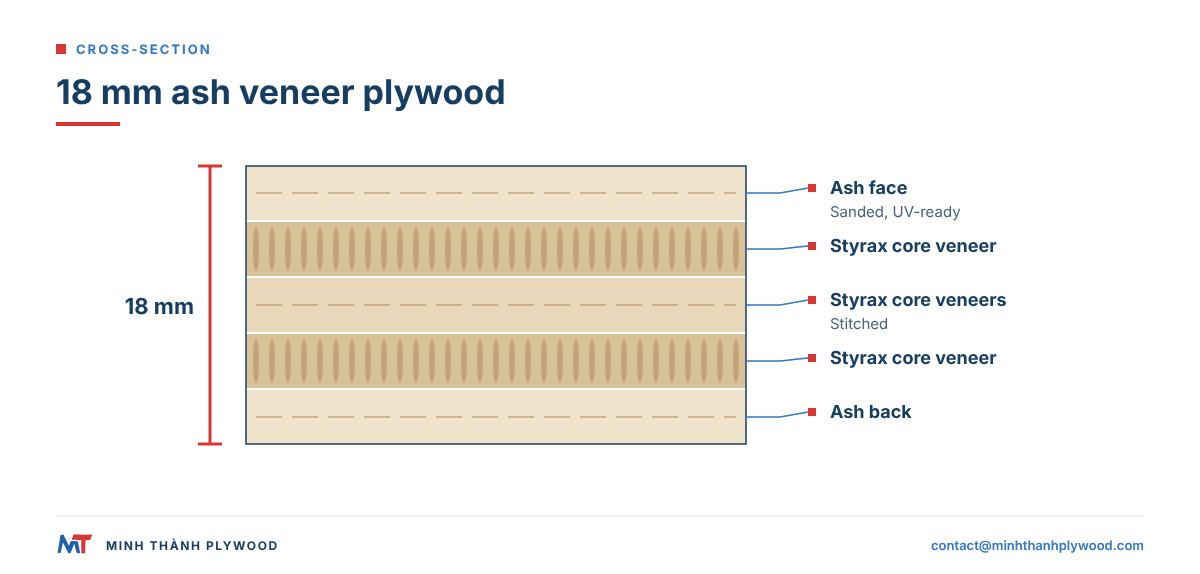
- Face and back: ash veneer, typically a few tenths of a millimetre thick, crown-cut, quarter-cut or rotary-cut.
- Core: cross-laminated hardwood veneers; at Minh Thanh, white Styrax or Eucalyptus, stitched horizontally and vertically.
- Glue: UF glue at E0 emission for furniture; other bonds on order.
The ash face is the visible part; the core decides weight, stiffness and flatness.
White ash vs olive ash: what is the difference?
White ash and olive ash are the same group of trees, cut from different parts of the log. White ash is the pale, even sapwood-rich wood; olive ash is ash with dark, streaky heartwood that resembles olive wood.
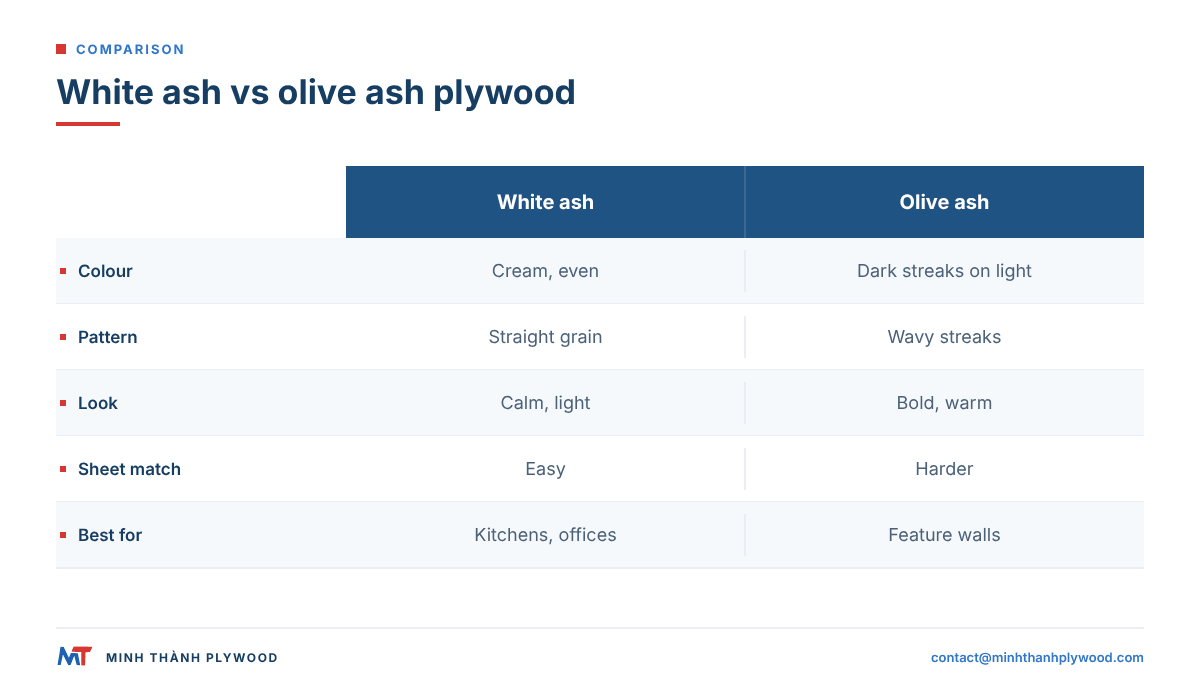
| White ash | Olive ash | |
|---|---|---|
| Species | American white ash (Fraxinus americana) or European ash (Fraxinus excelsior) | Mostly European ash (Fraxinus excelsior) |
| Colour | Cream to light brown, even | Light background with dark brown streaks |
| Pattern | Straight, regular grain | Wavy streaks independent of growth rings |
| Look in a room | Calm, Scandinavian, light | Bold, warm, statement |
| Best uses | Kitchens, wardrobes, offices, panelling | Feature walls, hotel and retail fit-out, statement furniture |
| Colour match across sheets | Easy | Harder; every log differs |
Both have a hard, open-pored face. Solid American white ash averages about 675 kg/m³ and 1,320 lbf Janka; European ash about 680 kg/m³ and 1,480 lbf (Wood Database, accessed October 2026).
How do ash colour and grain change with the cut?
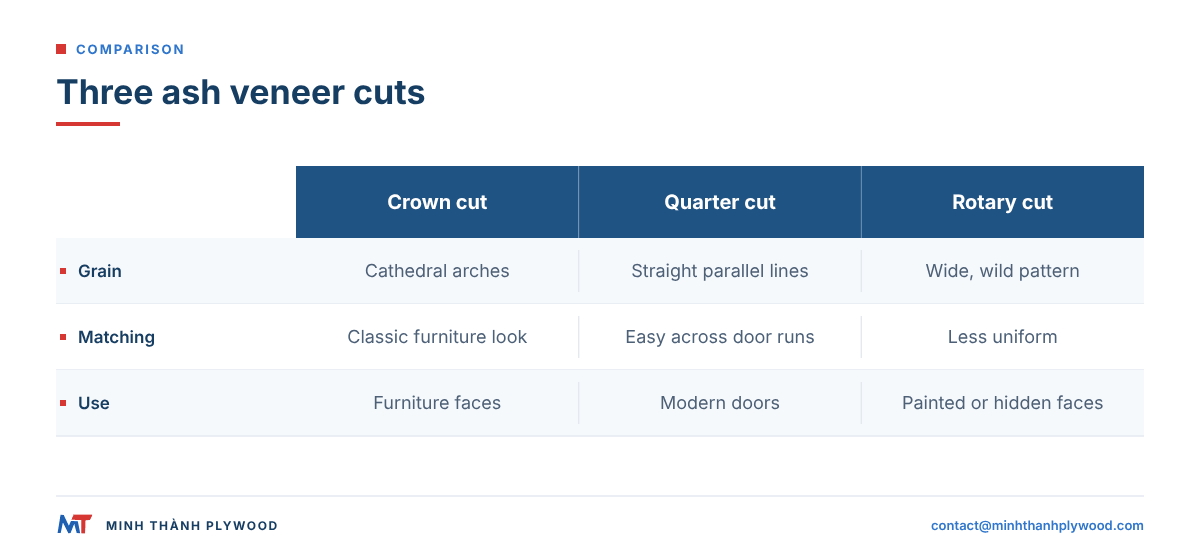
The cut of the veneer changes the face more than the species name does. Three cuts are common for ash veneer plywood.
- Crown cut (flat sliced): arched “cathedral” figures down the middle of each leaf; the classic ash furniture look.
- Quarter cut: straight, parallel lines; calm and modern, and the easiest to match across a run of doors.
- Rotary cut: peeled around the log; a wide, wild grain at the lowest price, used for painted or hidden faces.
How the leaves are joined also matters. Book-matched leaves mirror each other; slip-matched leaves repeat the same figure side by side. Put the cut and the match on the order, next to the grade.
What grades does ash veneered ply come in?
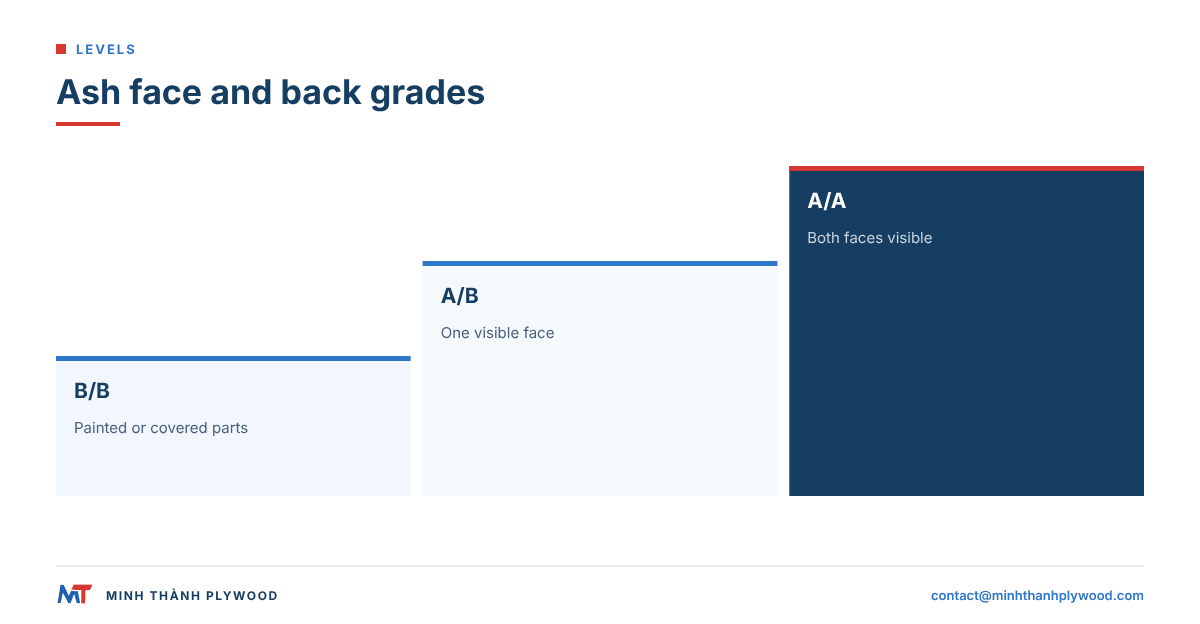
Ash faces are quoted as face/back grade pairs, such as A/A, A/B and B/B, and the approved sample fixes the look. A/A suits two visible faces, A/B one visible face, B/B paint or hidden parts.
| Grade pair | Face | Back | Typical part |
|---|---|---|---|
| A/A | Even colour, tight joints, very few features | Same as face | Doors, open shelves, two-sided panels |
| A/B | Even colour, tight joints | More colour variation, small features | Cabinet sides, wardrobe panels |
| B/B | Colour variation, small knots and repairs allowed | Same as face | Painted, dark-stained or covered parts |
US and Canadian shops quote the back of a hardwood panel as a number, set by the HPVA hardwood plywood standard (HP-1), next to the face letter. Put the back number on the order beside the face grade so both sides agree.
| Back grade | What the back may contain | Use |
|---|---|---|
| 1 | The cleanest back: small sound knots and natural colour variation | Visible back: shelf undersides, open cabinets |
| 2 | Larger sound knots and neat repairs | Semi-visible: carcass insides |
| 3 and 4 | Reject back: open defects allowed | Concealed parts, most common on 1/4 in panels |
Olive ash is graded more on the pattern than on clarity, because the streaks are the point. For white ash, ask the grader how much dark heartwood colour is allowed on an A face: that single rule decides most disputes on arrival.
Which core suits ash veneer plywood?
A light, calibrated core suits most ash-faced furniture panels. At Minh Thanh, ash and other natural faces go on white Styrax or Eucalyptus cores, built like every furniture panel.
| Core | Reference density | 18 mm sheet weight | Choose it for |
|---|---|---|---|
| White Styrax | 500 kg/m³ | About 26.8 kg | Light doors, wardrobes, panelling |
| Eucalyptus | 650 kg/m³ | About 34.8 kg | Stiff shelves, worktop substrates, heavy use |
Weights are for 1220 × 2440 mm sheets. The build behind them:
- Stitched core: layers stitched horizontally and vertically, so no gap or overlap telegraphs through a thin ash face.
- Two pressings: the core board is pressed and calibrated, then face and back are pressed on.
- Tolerance: sanded furniture panels ±0.2–0.3 mm, down to ±0.2 mm.
- Moisture: veneers and finished panels dried to 8–12%.
Ash-veneered MDF is the other common substrate. It has a smoother face for high gloss but is heavier and holds screws worse at the edge; see plywood vs MDF.
What do ash plywood sheets cost, and which stock sizes exist?
Ash plywood on the 1220 × 2440 mm (4 × 8 ft) sheet is stocked with ash on one side in 4, 6, 9 and 12 mm and on both sides in 18 mm, and US retail shows US$90.75 to US$99.25 per 4 × 8 ft sheet in 1/4 and 3/4 in. A factory buyer compares that shelf price with the raw FOB price of the plywood under the face, which is where a container order saves money.
| Stock size 1220 × 2440 mm | Ash sides | Volume per sheet | Raw FOB at US$350/m³ | Retail stock |
|---|---|---|---|---|
| 4 mm | one | 0.0119 m³ | about US$4.2 | UK: Chiltern Timber, ash one side |
| 6 mm (1/4 in) | one | 0.0179 m³ | about US$6.3 | US: Cherokee Wood Products, 1/4 in |
| 9 mm | one | 0.0268 m³ | about US$9.4 | UK: Chiltern Timber, ash one side |
| 12 mm | one | 0.0357 m³ | about US$12.5 | UK: Chiltern Timber, ash one side |
| 18 mm | two | 0.0536 m³ | about US$18.8 | UK: Chiltern Timber, ash two sides; US: Cherokee, 3/4 in |
The FOB column is a raw example at the furniture plywood starting price of US$350/m³ (October 2026), not a sheet price: the ash face, the grade and the core change the quote, and freight, duty and the importer’s margin come on top. Sizes and the core are set per order, as in the sections below.
Which thicknesses and sizes are available?
Minh Thanh makes faced plywood from 3 to 40 mm, in 1220 × 2440 and 1250 × 2500 mm, with custom sizes such as 1220 × 2500 and 1220 × 2280 mm.
| Thickness | Build | Typical ash part |
|---|---|---|
| 3–6 mm | Always 5-ply (3–5 mm) | Wall panelling, curved cladding, door skins |
| 9–12 mm | Balanced face and back | Drawer fronts, cabinet backs, ceiling panels |
| 15–18 mm | 18 mm usually 11–13 plies | Doors, carcasses, shelves |
| 25–40 mm | Thick core, two pressings | Table tops, counters, stair cladding |
On a Styrax core, a 40HC carries 990 sheets of 18 mm at 1220 × 2440 mm, about 53 m³. Panels can also be cut to size, one sheet into 4, 6 or 8 pieces, a service shipped regularly to Italy and other European markets.
How does ash compare with oak, birch and maple faces?
Ash looks closest to oak, at a lower price, and is harder and more open-grained than birch or maple. Choose by the grain the design wants.
| Face | Grain and pores | Colour | Hardness note | Feel in a room |
|---|---|---|---|---|
| Ash | Bold, open pores | Cream to light brown | 1,320–1,480 lbf | Light, natural, lively |
| White oak | Bold, open pores, ray flecks on quarter cut | Light to mid brown | Close to ash | Classic, warm |
| Birch | Fine, closed, even | Pale cream | 1,210 lbf | Calm, Scandinavian |
| Maple | Very fine, closed | Pale cream to white | Hard | Clean, modern |
Ash and oak are often used together, because their grain reads alike. Birch-faced plywood is the cost-effective pale panel for carcasses; at Minh Thanh birch faces are graded D+, D and E. Compare with white oak plywood and maple plywood.
How do you finish ash-faced plywood?
Ash takes almost every wood finish well, because its open pores absorb stain and lacquer evenly. The finish decides how much grain shows.
- Clear matt lacquer or oil: the natural pale look; the most ordered finish for Scandinavian-style furniture.
- Stain: ash stains deeply, from light grey to near black; black-stained ash is a common oak alternative.
- Lime wax or white wash: fills the open pores with white for a pale, textured face.
- High gloss: needs a grain filler first, or the pores show through the gloss.
- UV lacquer: on a factory line; Minh Thanh’s faces are sanded and UV-ready on both sides for buyers who coat.
Test the finish on the approved sample, because white ash can show the dark heartwood more strongly once lacquered.
What is ash plywood used for?
Ash plywood is used for furniture, joinery and interiors where a light, lively wood face is part of the design.
| Use | Face and grade | Build |
|---|---|---|
| Kitchen doors and carcasses | White ash crown or quarter cut, A/B | 18 mm, Styrax core |
| Wardrobes and bedroom furniture | White ash, A/B | 15–18 mm, Styrax core |
| Office desks and storage | White ash quarter cut, A/A | 18–25 mm, Eucalyptus core |
| Hotel and retail feature walls | Olive ash, book-matched | 6–12 mm |
| Stair cladding and risers | White ash, A/B | 18–40 mm, Eucalyptus core |
| Painted or black-stained joinery | Rotary-cut ash, B/B | 12–18 mm |
For damp areas such as bathrooms, add a melamine-fortified bond and seal every edge.
Natural ash or ash-pattern EV: which should you buy?
Buy natural ash for the real variation of the wood; buy ash-pattern EV (engineered veneer) for an identical pattern across a large project. EV is made from plantation veneer, dyed and re-sliced into an ash grain.
| Natural ash veneer | Ash-pattern EV | |
|---|---|---|
| Look | Real variation, every leaf differs | Same pattern on every sheet |
| Colour match across a large order | Harder | Easy |
| Defects to grade out | Knots, colour bands, mineral | Almost none |
| Supply | Depends on ash logs | Steady |
| Best for | Furniture that sells on natural wood | Hotels, offices, chains, repeat orders |
EV is one of Minh Thanh’s most produced faces. See EV plywood for the patterns.
Is ash supply at risk?
Ash supply is under pressure on both continents. In North America the emerald ash borer, first detected in Michigan in 2002, has killed hundreds of millions of ash trees; in Europe the fungal disease ash dieback has spread through ash woods since the 1990s.
What that means for buyers:
- Price and lead time move with log supply, more than for oak or birch.
- Olive ash and wide clear white ash are the hardest faces to source.
- Ash-pattern EV is the fallback when a project needs thousands of matched sheets.
Order samples from the actual veneer lot for large projects, and book the face veneer early. For repeat orders, keep the approved sample and quote its reference on every new order, so the grader matches the next lot to the same colour range.
Which emission and origin documents come with ash plywood?
Ash veneer plywood for furniture ships with the same evidence as every Minh Thanh furniture panel. The face species does not change the emission or origin proof.
- Emission: UF glue at E0 emission; CARB P2 / TSCA Title VI certification (ICTT mill no. 23024). Six ASTM D6007 chamber tests between April 2025 and June 2026 averaged 0.014–0.032 ppm. The TSCA Title VI limit for veneer-core hardwood plywood is 0.05 ppm under 40 CFR 770.10.
- European buyers: panels meet the emission and quality requirements European furniture buyers ask for; testing to EN 717-1 or another method is arranged through SGS on request.
- EUDR: the EUDR compliance dossier with origin records and geolocation files. The European Commission’s EUDR page explains what the importer must file under Regulation (EU) 2023/1115.
- US orders: TSCA Title VI label, and face and core species with harvest origin for the Lacey Act declaration.
- Quality: TCVN 11902:2017 certificate for veneer-faced plywood (VietCert 141.1-VNC-HC).
How do you order ash veneer plywood?
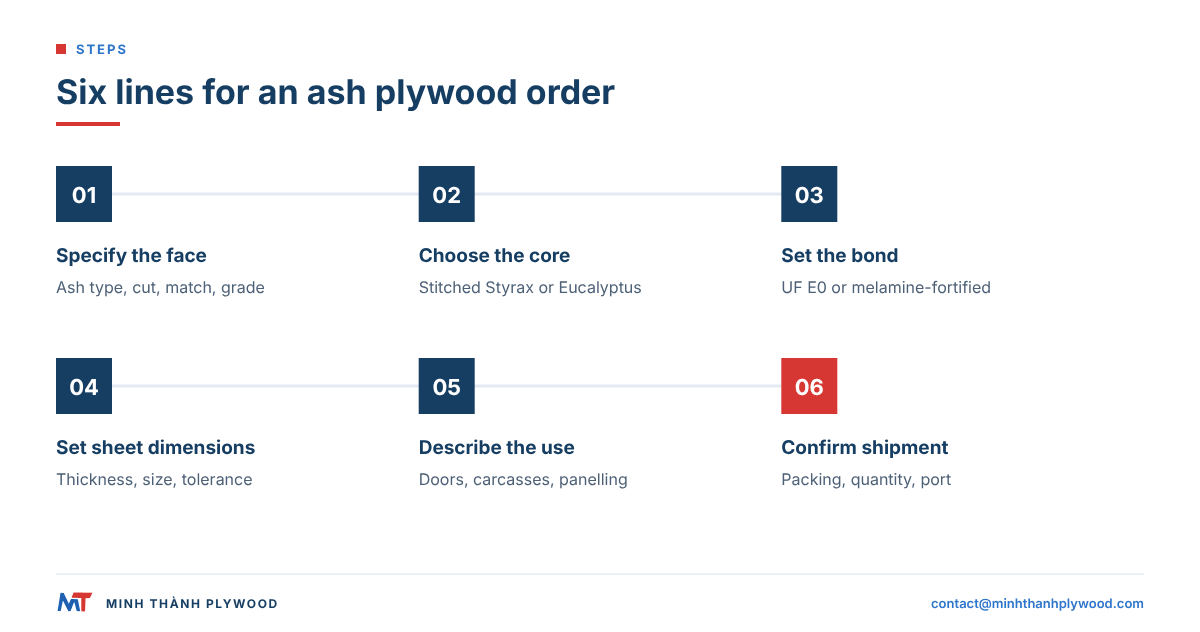
Write the face first, then the panel. Six lines make a complete order:
- Face: white ash or olive ash, cut (crown, quarter or rotary), match (book or slip), grade pair such as A/B.
- Core: white Styrax or Eucalyptus, stitched.
- Glue and emission: UF glue at E0 emission; melamine-fortified for damp areas.
- Sheet: thickness, size, tolerance, sanded and UV-ready or not.
- Use: doors, carcasses, panelling, so the mill can advise on the grade.
- Packing and quantity: packs, marks, sheets or m³, destination port.
Furniture plywood from Minh Thanh starts from US$350/m³ (October 2026), with a minimum of one 40HC and production 15–45 days after the 30% deposit. Free samples go out with the quotation. Send the six lines to contact@minhthanhplywood.com.
Buyer questions, answered
What is ash veneer plywood?
Plywood with a thin ash veneer pressed on the face, and usually the back, over a core of another hardwood. It gives the look of solid ash at lower weight and cost, in flat, stable sheets.
What is the difference between white ash and olive ash plywood?
White ash plywood has a pale, even cream face with straight grain. Olive ash is ash with dark brown streaks in the heartwood that look like olive wood, used for statement furniture and panelling.
Is ash plywood strong?
Yes. Ash is a hard wood, 1,320 lbf Janka for American white ash and 1,480 lbf for European ash, so the face resists dents. Panel strength depends mostly on the core build.
Is ash plywood good for kitchen cabinets?
Yes. An ash face takes clear, stained and lime-washed finishes well, and an A/B ash-faced panel on a stitched core suits doors, carcasses and shelves.
Can you stain ash veneer plywood?
Yes. Ash has an open grain that takes stain evenly and deeply. For a smooth high-gloss face, fill the pores with a grain filler first.
What is ash veneered ply used for?
Kitchen and bedroom furniture, wardrobe doors, wall panelling, shop fittings, office furniture and stair cladding.
Is ash plywood cheaper than oak plywood?
Usually yes, at the same grade and thickness, though prices move with log supply. Ash supply is under pressure from ash dieback in Europe and the emerald ash borer in North America.
What thickness does ash plywood come in?
Minh Thanh makes faced plywood from 3 to 40 mm. The most ordered ash-faced thicknesses for furniture are 12, 15 and 18 mm in 1220 × 2440 or 1250 × 2500 mm.
What grades does ash faced ply come in?
Ash faces are quoted as face/back pairs such as A/A, A/B and B/B, matched to an approved sample. A/A suits two visible faces, A/B one visible face, B/B paint or hidden parts.
Is there ash-look plywood that costs less?
Yes. Engineered veneer (EV) can reproduce white ash or olive ash grain from plantation veneer, with an even pattern across every sheet in the order.