
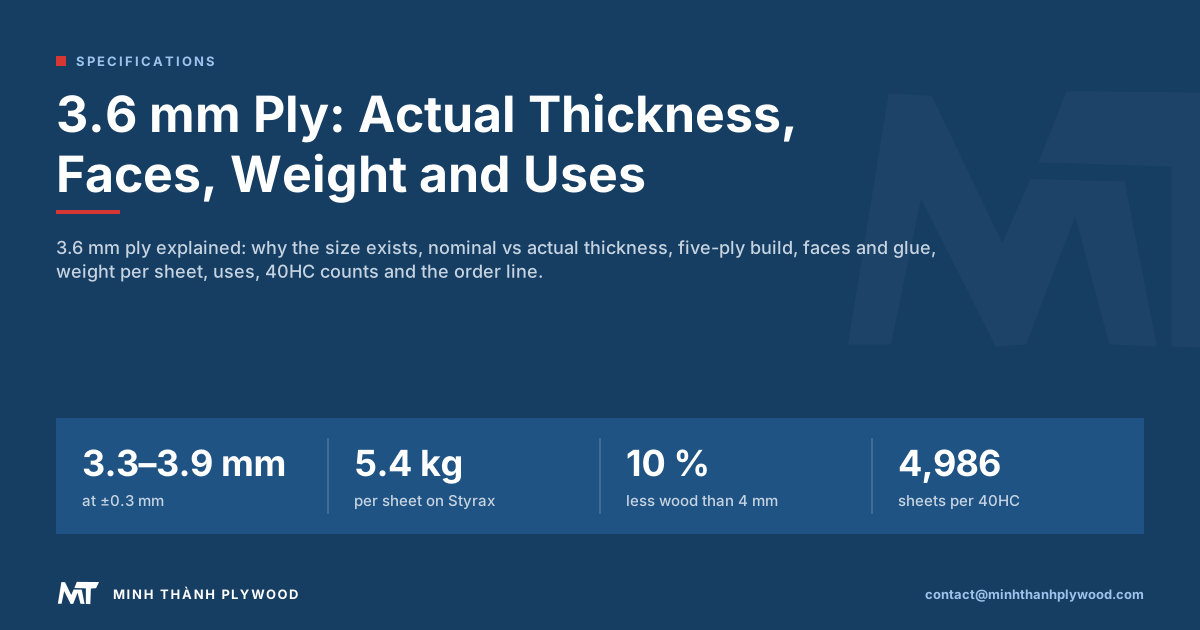
3.6 mm ply is a thin hardwood plywood sheet sold in the UK and Ireland between 3 mm and 5.5 mm, used for cabinet backs, drawer bottoms, door skins and linings. A 1220 × 2440 mm sheet weighs about 5.4 kg on a Styrax core. Minh Thanh Plywood presses it as a five-ply sanded panel, ±0.2–0.3 mm.
What is 3.6 mm ply?
3.6 mm ply is a thin plywood sheet with a nominal thickness of 3.6 mm, made from thin wood veneers glued with their grain crossing. In the UK and Ireland it is the thin hardwood sheet merchants list between 3 mm and 5.5 mm, most often in 2440 × 1220 mm (8 × 4 ft).
The thickness is a trade size, not a law or a standard. One merchant sells a 3.6 mm sheet with a tropical hardwood face. Another sells a eucalyptus-throughout panel, a third a combi core sheet with an exterior bond. All three are called 3.6 mm ply, and they behave differently. The face, the core, the glue and the tolerance make the product.
3.6mm plywood, 3.6 mm plywood sheets and 3.6mm ply all name the same thickness. The decimal point matters: “3–6 mm plywood” is a range of thin panels, “3.6 mm” is one size.
Why does a 3.6 mm size exist?
3.6 mm sits where a 3 mm sheet is too floppy and a 4 mm sheet is heavier and dearer than the part needs. A wardrobe back or a drawer bottom in 3.6 mm sits in a groove without drumming. It also saves 10 % of the wood of a 4 mm sheet.
The size comes from the thin hardwood sheets UK merchants stock for joinery and shop fitting, where price lists carry a short ladder of thin sheets: 3.6, 5.5 and 9 mm sit next to 4 mm and 6 mm in many price lists. For a buyer outside the UK, it is an ordinary thin panel: any mill that presses 3–6 mm can make it, as long as the order states the finished thickness.
Nominal vs actual: how thick is a 3.6 mm sheet?
A 3.6 mm sheet should measure 3.6 mm within the tolerance written on the order. Minh Thanh sands thin furniture panels to ±0.2–0.3 mm, so a 3.6 mm order arrives between 3.3 and 3.9 mm, or between 3.4 and 3.8 mm where the order asks for ±0.2 mm.
“Nominal” thickness means the size on the label; “actual” is what the caliper reads. Merchant sheets are often a little under the label. That matters in two places. A groove cut for 3.6 mm leaves a loose back if the sheet comes in at 3.2 mm. A stack of 50 parts in a press jig adds up any difference.
| Written as | Millimetres | Inches |
|---|---|---|
| 1/8 inch | 3.175 | 0.125 |
| 3.6 mm | 3.6 | 0.142 |
| 4 mm | 4.0 | 0.157 |
| 5/32 inch | 3.97 | 0.156 |
The table shows why 3.6 mm is not a drop-in swap for 1/8 inch sheet: the metric sheet is 0.4 mm thicker. The 1/8 inch plywood guide covers the imperial size.
How is a 3.6 mm sheet built?
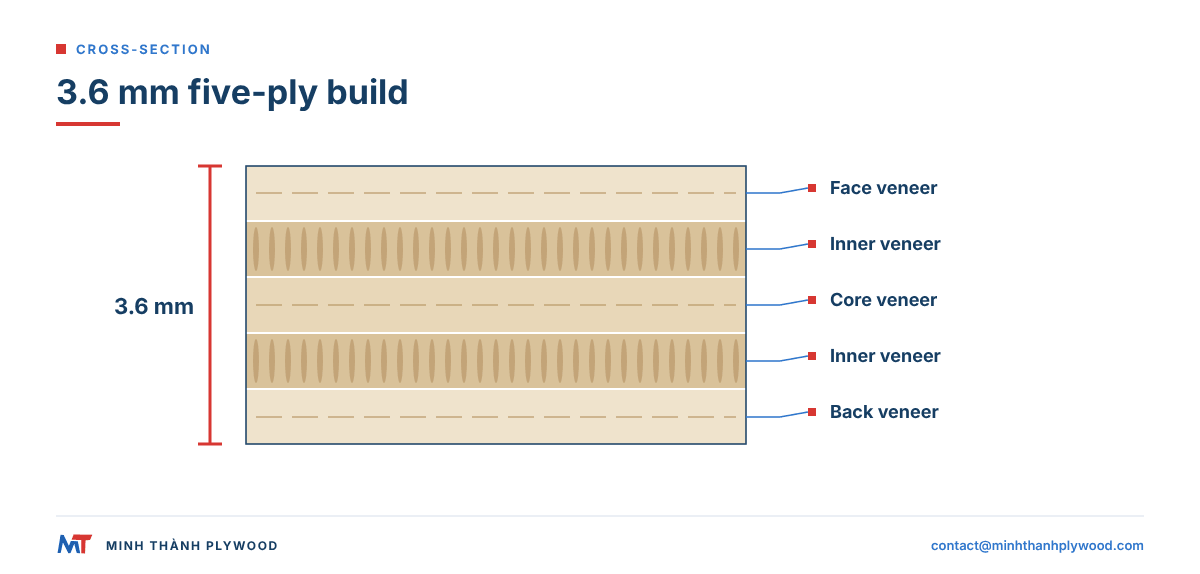
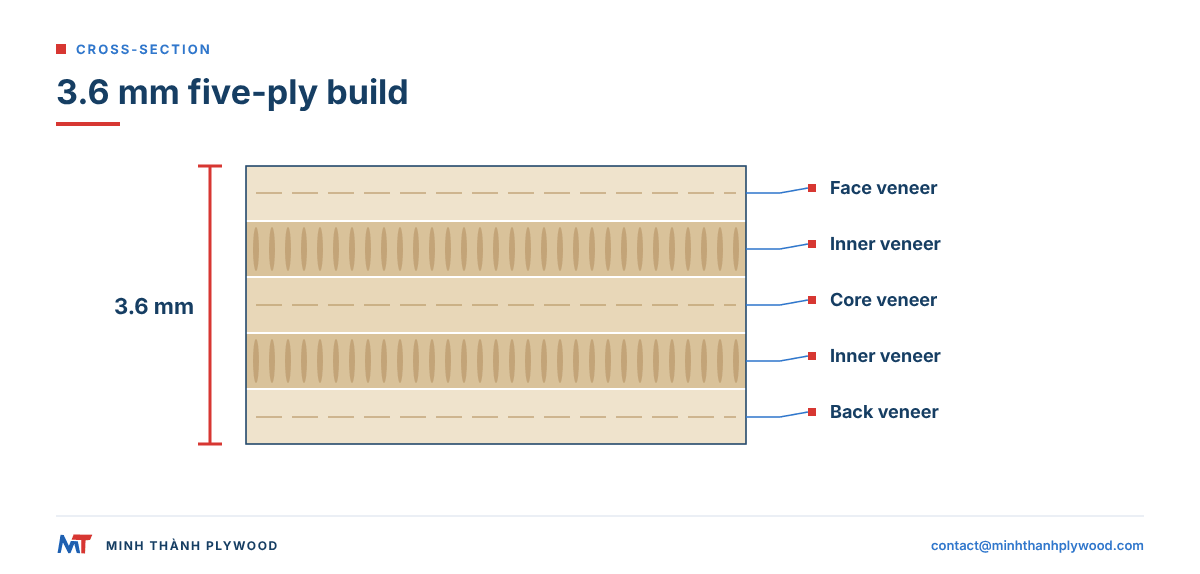
Minh Thanh presses every thin panel from 3 to 5 mm with five plies: two face veneers and three inner veneers, each laid with its grain across the one below. That build keeps a 3.6 mm sheet flat. It also stops the sheet splitting along the grain when it is pinned or stapled at the edge.
Many thin sheets on the market at this thickness are three-ply: one thick core between two faces. A three-ply sheet bends more easily along one direction and shows the core through a thin face when it is painted. Five plies at 3.6 mm need very thin, even veneers, which is the skill in this size.
The thickness of each inner veneer is chosen for the panel so the faces sit on a level bed. Premium thin veneer is scarce, and the mill does not lower the face standard to go faster. Thin orders such as 4 mm can take longer for that reason. Put the delivery date on the first enquiry.
Which faces and cores can 3.6 mm ply have?
Thin panels take the same faces as thick ones. Minh Thanh offers 10+ face veneers; the most ordered on thin panels are Poplar, Birch, EV (engineered veneer), Okoume and Pine.
- Poplar: a quiet cream face for paint, foil or laminate; graded A/A, A/B or B/B.
- Birch: a fine pale grain under clear lacquer; graded D+/D or D/E (D+ is comparable to European B).
- EV: an even grain pattern repeated across many parts, for furniture series.
- Okoume: a warm pink tone for door skins and linings.
- Pine: a stronger grain for rustic finishes.
The core is white Styrax or Eucalyptus as standard. Styrax keeps the sheet light and pale at the edge; Eucalyptus gives a denser, harder sheet that holds pins better. The grade is matched to the sample you approve, and both faces are sanded and polished.
Which glue does 3.6 mm ply need?
For backs, drawer bottoms and linings in dry rooms, 3.6 mm ply is glued with UF glue at E0 emission, the standard bond for interior furniture panels. Panels meet the emission requirements European and US furniture buyers ask for, with CARB P2 / TSCA Title VI certification (ICTT mill no. 23024) as the proof.
Six ASTM D6007 chamber tests between April 2025 and June 2026, on 9, 15 and 18 mm panels from the mill, averaged 0.014–0.032 ppm against the 0.05 ppm CARB Phase 2 limit, three by Shanghai Hongjun and three by ICTT Vietnam. The limits are published by the California Air Resources Board and in the EPA guidance under TSCA Title VI.
Where the sheet sees humidity, order MR (melamine-fortified) bond; for outdoor parts, phenolic (WBP). “Exterior grade” on a thin sheet means the glue line resists water. An outdoor 3.6 mm part still needs paint or varnish on both faces and the edges.
UK merchants print several labels on a 3.6 mm sheet. Record the use class, bonding class, emission class and certification separately on the order. The International Timber standards summary explains the EN 636 use classes and EN 314 bonding classes. Adhesive type alone does not establish the finished panel’s EN 636 classification.
| UK label | What it states | Order specification to check |
|---|---|---|
| EN 636-1 | Dry interior use | UF glue at E0 emission |
| EN 636-2 (Use Class 2) | Humid interior and covered exterior use | MR (melamine-fortified) |
| EN 636-3 | Unprotected exterior | Phenolic (WBP) |
| EN 314-2 Class 1 or 2 | Bonding-quality requirements for the specified class | Test report for the required class |
| E1 / E0 | Formaldehyde emission class | UF glue at E0 emission |
| FSC | Certified chain of custody | Asked for on the order |
DIY Building Supplies, checked on 3 November 2026, lists a 3.6 mm poplar-core sheet to EN 636-2 with an EN 314-2 bond for humid interiors.
Jewson, checked on 3 November 2026, lists an FSC eucalyptus 3.6 mm sheet. Name the label you need on the quote request so the test report and the glue match it; for permanent exterior exposure, seal every edge.
How much do 3.6 mm plywood sheets weigh?
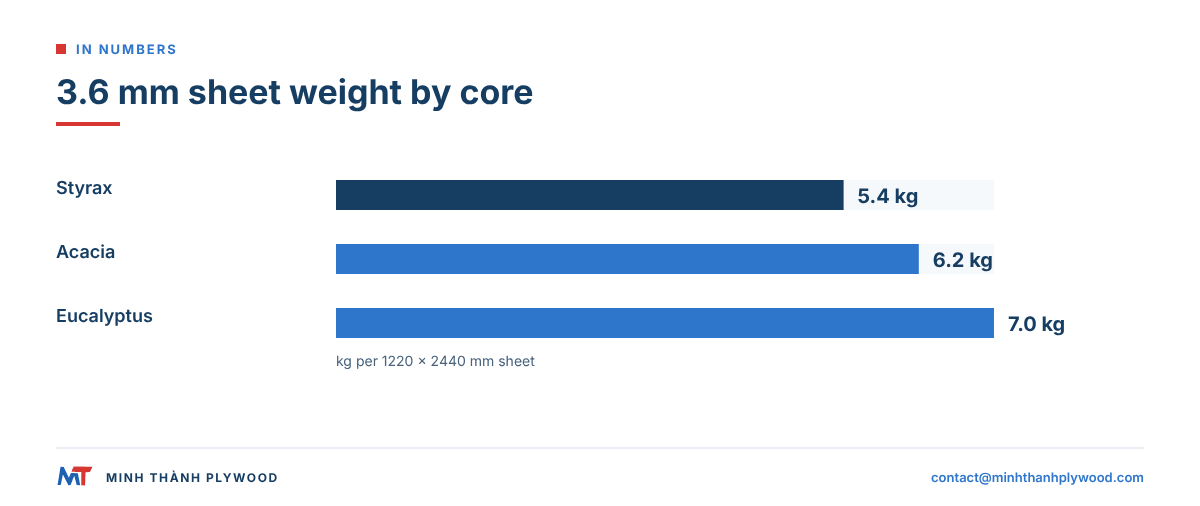
A 1220 × 2440 × 3.6 mm sheet holds 0.0107 m³ of wood and weighs about 5.4 kg on a Styrax core, 6.2 kg on Acacia and 7.0 kg on Eucalyptus.
| Core species | Density used | Sheet weight, 1220 × 2440 × 3.6 mm | Sheets in one m³ |
|---|---|---|---|
| Styrax | 500 kg/m³ | 5.4 kg | 93 |
| Acacia | 580 kg/m³ | 6.2 kg | 93 |
| Eucalyptus | 650 kg/m³ | 7.0 kg | 93 |
Weight is volume multiplied by density. One person carries a 3.6 mm sheet easily. A pack of 277 sheets on a Styrax core weighs about 1,484 kg, which sets the forklift you need at the warehouse.
What is 3.6 mm ply used for?
3.6 mm ply is used for cabinet and wardrobe backs, drawer bottoms, door skins, linings and display backs. It suits thin parts held in a frame, groove or against a supporting surface. Choose the face for the required finish and the bond for the moisture exposure. Common uses include:
- Cabinet and wardrobe backs, slid into a groove or pinned into a rebate.
- Drawer bottoms in small and medium drawers.
- Door skins over a frame, for flush interior doors and cupboard doors.
- Wall and ceiling linings in caravans, vans and cabins, fixed to battens.
- Display and sign backs, often printed or laminated.
- Templates and jigs in workshops, cut once and reused.
- Craft, model and laser-cut parts, where the five-ply build gives a clean edge.
- Packaging inserts and dividers inside boxes and crates.
For a back panel, the choice between plywood, hardboard and MDF comes down to weight, edge strength and moisture: the cabinet back panels guide compares the three.
3.6 mm vs 3 mm, 4 mm and 5.5 mm: which should you order?
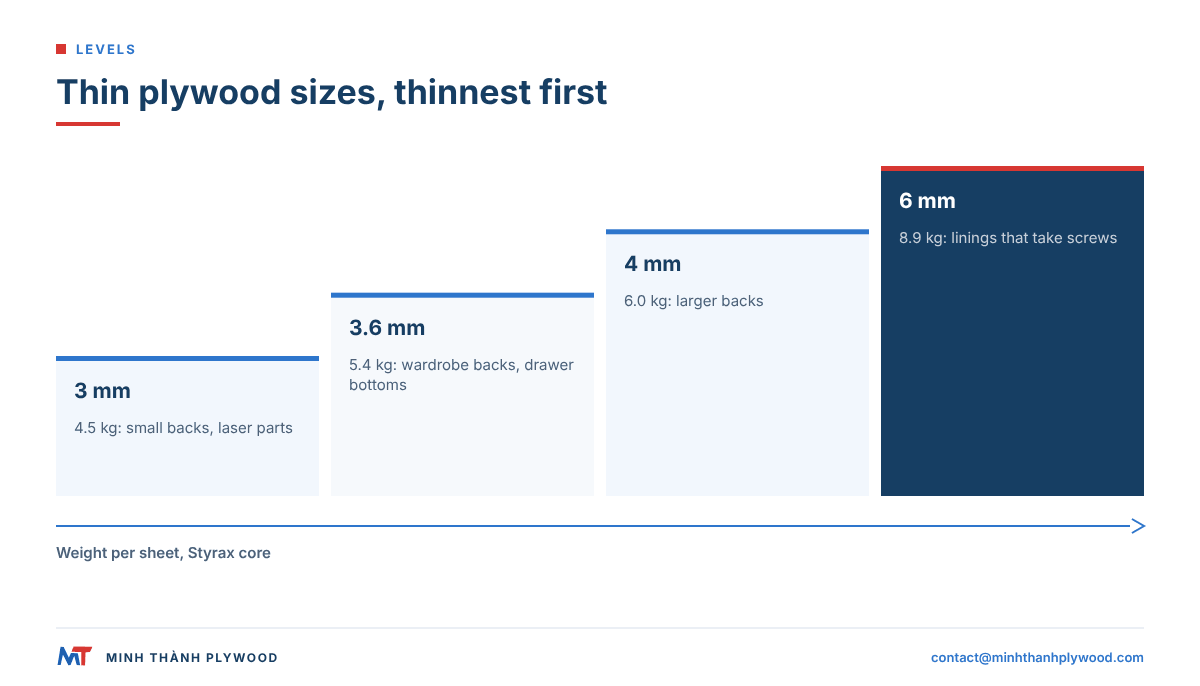
Order 3.6 mm when a 3 mm back drums or bows in its groove, and stay below 4 mm when weight and cost per part count. Move to 5.5 or 6 mm when the panel spans further or takes screws.
| Thickness | Weight per 1220 × 2440 mm sheet, Styrax core | Typical part |
|---|---|---|
| 3 mm | 4.5 kg | Small backs, craft and laser parts |
| 3.6 mm | 5.4 kg | Wardrobe backs, drawer bottoms, door skins |
| 4 mm | 6.0 kg | Larger backs and drawer bottoms |
| 6 mm | 8.9 kg | Linings that take screws, deep drawer bottoms |
At the same density, a 3.6 mm sheet uses 10 % less wood than 4 mm and 20 % more than 3 mm. The 3 mm plywood, 4 mm plywood and 5 mm and 5.5 mm plywood guides give the build of each.
How do you check thin plywood on arrival?
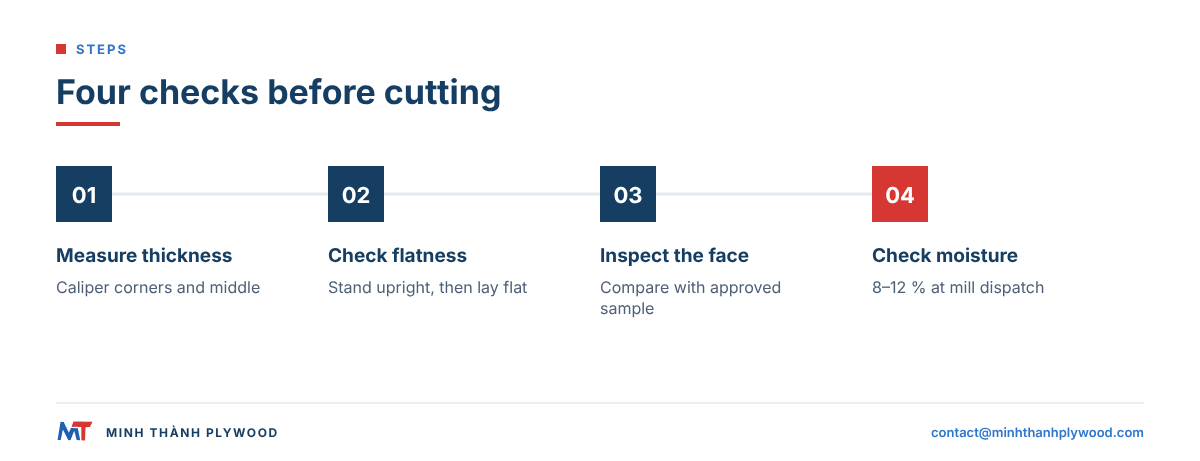
Check four things on a sample of sheets from every pack before the parts are cut:
- Thickness: caliper each corner and the middle; thin sheets show tolerance problems first at the edges.
- Flatness: stand a sheet against a wall, then lay it on a flat bench; a five-ply sheet should lie flat without a cup.
- Face: look for core shadows showing through under raking light, and compare the grade with the approved sample.
- Moisture: 8–12 %, the range panels leave the mill at; store packs flat and wrapped until use.
Every shipment is photographed and filmed before loading, so the packs you open can be traced to the loading pictures.
How many 3.6 mm sheets fit in a 40HC container?
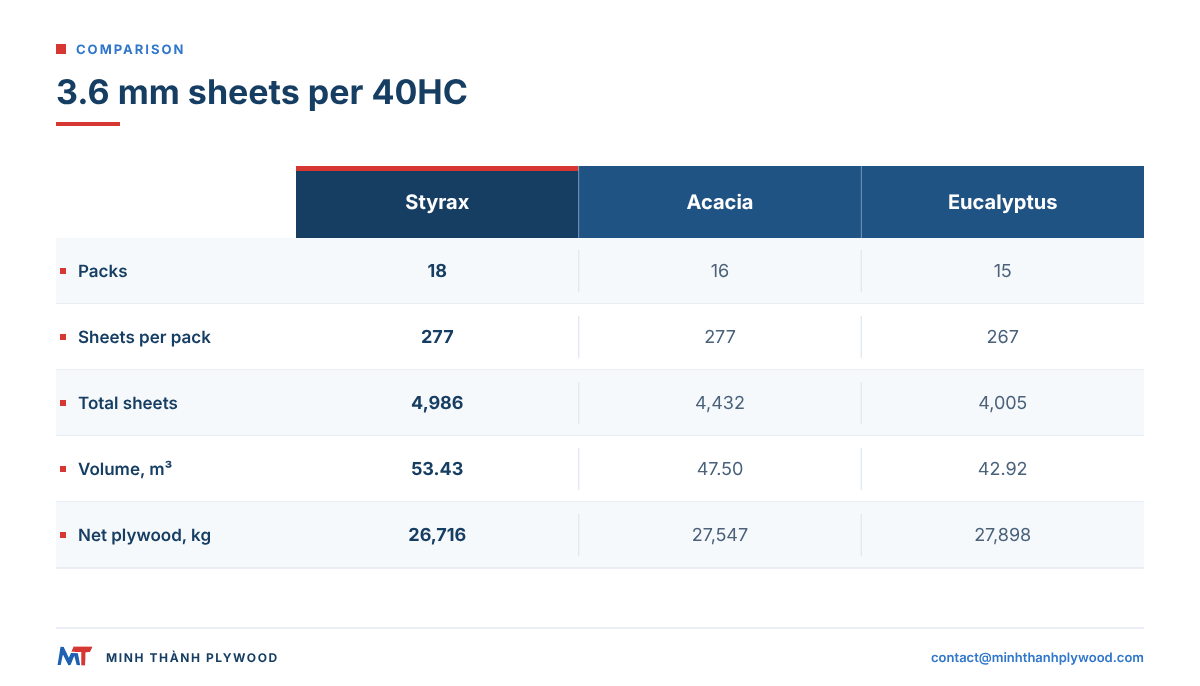
A 40HC holds about 4,986 sheets of 1220 × 2440 × 3.6 mm plywood on a Styrax core: 18 packs of 277 sheets, about 53.43 m³ and 26,716 kg of plywood.
| Core species | Packs in the box | Sheets each | Total sheets | m³ loaded | Net plywood kg |
|---|---|---|---|---|---|
| Styrax | 18 | 277 | 4,986 | 53.43 m³ | 26,716 kg |
| Acacia | 16 | 277 | 4,432 | 47.50 m³ | 27,547 kg |
| Eucalyptus | 15 | 267 | 4,005 | 42.92 m³ | 27,898 kg |
Packs are about 1,000 mm high, so 1,000 ÷ 3.6 = 277 sheets a pack; on the heavier Eucalyptus core the pack drops to 267 to stay within a 28,000 kg planning payload. Packing materials come on top, and a lower booking limit lowers the count again. Most buyers mix 3.6 mm backs with the 15 or 18 mm carcass panels of the same furniture in one container, by agreement.
How do you order 3.6 mm plywood from Vietnam?
The minimum order is one 40HC, mixed by agreement. Production runs 15–45 days after the 30% deposit; the 70% balance is paid against the scanned bill of lading, or by irrevocable L/C at sight, on FOB Hai Phong, CFR or CIF terms. Free samples come first.
In October 2026, Minh Thanh furniture plywood starts from US$350/m³ FOB Hai Phong; a 3.6 mm sheet is 0.0107 m³, so 93 sheets make a cubic metre. Thin panels need more veneers and more pressing time per cubic metre than thick ones. Compare thin quotes per sheet as well as per m³.
3.6 mm plywood price per sheet in the UK
Three UK retail listings for a 1220 × 2440 × 3.6 mm sheet span about £12.52–£15.53 including VAT, checked on 3 November 2026. Match the VAT basis and delivery charge when comparing merchant prices; a factory quote also needs freight, import taxes and local handling added.
- Materials Market lists £10.43 ex VAT, equivalent to about £12.52 inc VAT at the standard rate.
- Selco lists £14.45 inc VAT.
- Beesley & Fildes lists £15.53 inc VAT.
The B&Q 3.6 mm range lists 2440 × 1220 mm sheets in packs of 2, 5 and 12, each showing free home delivery when checked on 3 November 2026.
At US$350/m³, one 0.0107 m³ sheet is a raw FOB example of about US$3.7, or about £2.8 at the 20 October 2026 ECB rate of US$1 = £0.74925 (Frankfurter). It is not a delivered sheet price: freight, import taxes, storage and the merchant’s margin come on top. The UK standard VAT rate is 20%. Confirm the panel’s commodity code and applicable duty in the UK Trade Tariff. Claim a preferential rate only after checking the rules of origin and required proof. A container of thin sheets suits a merchant or cut-to-size shop buying by the thousand, not a single job.
UK handy panels are cut from the 1220 × 2440 mm sheet: 607 × 1220 mm, 610 × 1220 mm, 607 × 1829 mm and 1220 × 1220 mm, the sizes B&Q and Jewson list. Cut-to-size is available on those lines.
Typical days at sea from Hai Phong are 30–40 to Northern Europe and the UK, and 25–35 to the Mediterranean. EU orders come with the EUDR compliance dossier (origin records and geolocation files).
The 3.6 mm order line, ready to copy
One line per item gives the mill everything it needs:
3.6 mm × 1220 × 2440 mm, five-ply, poplar face B/B, Styrax core, UF glue at E0 emission, sanded both faces, tolerance ±0.2 mm, for wardrobe backs; 1×40HC mixed with 18 mm carcass panels; CIF your port.
Change the face to birch D+/D for lacquered backs or the bond to WBP for outdoor linings. Send the line to contact@minhthanhplywood.com or WhatsApp +84 988 586 601 for a quote and free samples; replies come within hours on Vietnamese working days.
Buyer questions, answered
What is 3.6 mm ply used for?
3.6 mm ply is used for cabinet and wardrobe backs, drawer bottoms, door skins, wall and van linings, display backs, templates and craft or laser-cut parts: any part that is held in a frame or groove and does not carry load on its own.
Is 3.6 mm plywood the same as 1/8 inch?
Close but not equal. 1/8 inch is 3.175 mm, so 3.6 mm ply is 0.4 mm thicker. 3.6 mm is 0.142 inch, about 9/64 inch; check the groove size before swapping one for the other.
How many plies does 3.6 mm plywood have?
Minh Thanh presses every thin panel from 3 to 5 mm with five plies, so a 3.6 mm sheet is five-ply: two face veneers and three inner veneers with the grain crossing. Some merchant sheets at this thickness are three-ply with thicker veneers.
How much does a sheet of 3.6 mm ply weigh?
A 1220 × 2440 × 3.6 mm sheet holds 0.0107 m³ of wood. It weighs about 5.4 kg on a Styrax core (500 kg/m³), 6.2 kg on Acacia (580 kg/m³) and 7.0 kg on Eucalyptus (650 kg/m³).
Is 3.6 mm plywood waterproof?
Standard interior 3.6 mm ply is glued with UF glue at E0 emission for dry rooms. For humid parts or outdoor use, order a melamine-fortified (MR) or phenolic (WBP) bond; the face still needs a coating outdoors.
What thickness will a 3.6 mm sheet actually measure?
At Minh Thanh's sanded tolerance of ±0.2–0.3 mm, a 3.6 mm sheet measures 3.3–3.9 mm, or 3.4–3.8 mm where the order asks for ±0.2 mm. Write the tolerance on the order next to the thickness.
Can 3.6 mm ply be bent?
It bends to a gentle curve across a frame, more easily along the face grain than across it. For tight radii, flexible plywood made for bending is the better panel.
Can I laser-cut 3.6 mm plywood?
Yes. Thin plywood is cut on laser machines for signs, models and display parts; a trial sheet on the ordered glue and core sets the machine speed and power for clean edges.
How many 3.6 mm sheets fit in a 40HC container?
About 4,986 sheets of 1220 × 2440 mm on a Styrax core (18 packs of 277), 4,432 on Acacia and 4,005 on Eucalyptus, where the 28,000 kg planning payload caps the packs at 267 sheets.
Can Minh Thanh press 3.6 mm plywood?
Yes. 3.6 mm sits inside the 3–5 mm thin range, pressed as a five-ply sanded panel with your choice of face and a Styrax or Eucalyptus core, in 1220 × 2440 or 1250 × 2500 mm.