
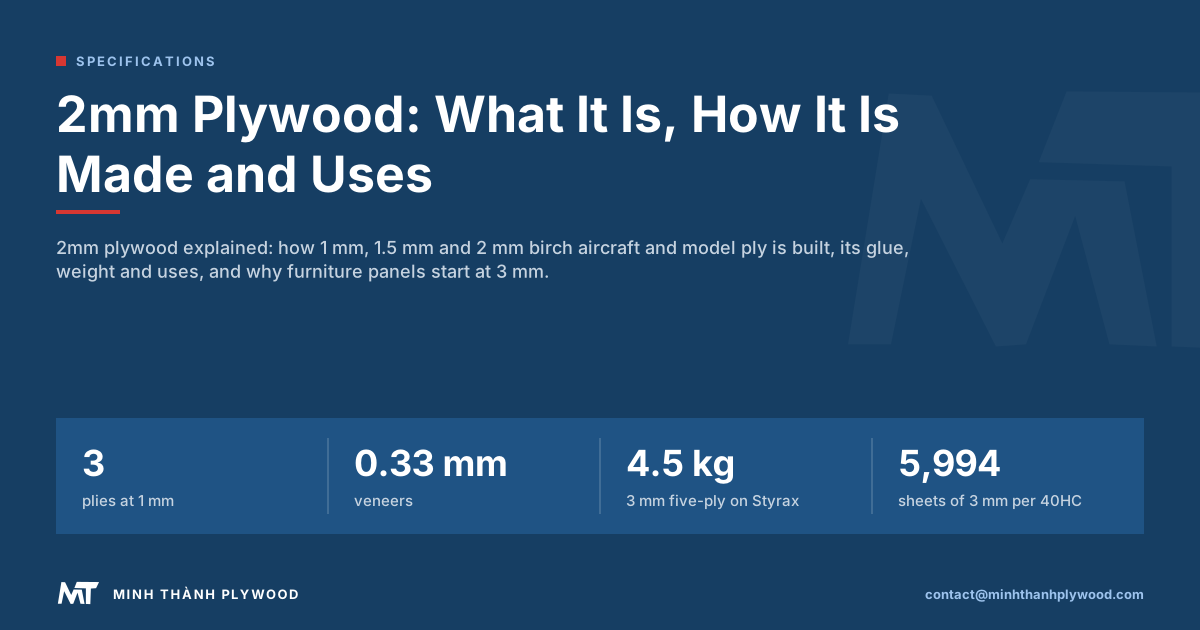
2mm plywood is a specialist sheet of three or more birch veneers, each a fraction of a millimetre thick, bonded with phenolic film glue. It is made for model aircraft, laser-cut crafts, instrument parts and curved laminations. Furniture backs and drawer bottoms start at 3 mm, the thinnest five-ply panel Minh Thanh Plywood presses.
What is 2mm plywood?
2mm plywood is a thin sheet of wood made from three or more veneers, each a fraction of a millimetre thick, glued with the grain of each layer crossing the next. Most 2 mm sheets on the market are birch, bonded with phenolic film glue, and sold as model plywood or aircraft plywood.
It sits at the thin end of the plywood range, below the 3 mm sheets used in furniture. At 2 mm, a sheet bends easily, cuts with a knife or a desktop laser and weighs about 4 kg in a full 1220 × 2440 mm size. Those properties make it a material for model makers, craft workshops and laminators, not for furniture lines.
Buyers search for it as 2mm plywood, 2mm plywood sheet, plywood 2 mm or, in Sweden and Norway, tunn plywood 2mm. All mean the same specialist thin sheet.
Where to buy 2mm plywood in the UK: sizes, prices and laser grades
Most UK buyers of 2mm plywood want a small laser-cut sheet, not a 8 × 4 ft board. Big merchants do not stock it: the Wickes all-sheet range (checked on 21 October 2026) starts at 3 mm hardboard and 3.6 mm plywood, and the B&Q plywood range (checked on 21 October 2026) also starts at 3.6 mm. 2mm sheets come from laser-ply specialists.
| UK seller | 2 mm product | Price (read 21 October 2026) |
|---|---|---|
| Laserply | 2mm ceiba, BR/B grade, laser quality, interior glue | £0.95–£3.55 by size |
| Kitronik | 2mm BR grade birch, 600 × 300 mm | £9.75 (400 × 300 mm £6.50, 600 × 400 mm £12.75) |
| Kitronik | 2mm ceiba, 600 × 400 mm | £3.95 |
Laserply sells these sizes: 200 × 300, 300 × 400, 300 × 600, 400 × 600 and 600 × 800 mm. What to check before ordering:
- Species and grade: birch, ceiba and poplar are the usual laser faces; BR/B is the laser grade, with a clean face and few core gaps.
- Glue: EN 314-2 Class 1 interior glue (dry conditions) is the usual laser choice; phenolic glue is for models that meet water.
- Real thickness: 2mm plywood is a natural product, and Laserply states it can run from 1.7 to 2.4 mm with humidity; Kitronik quotes 1.8 to 2.2 mm. Measure with a caliper and set tab-and-slot joints to the sheet, not the label.
- Laser type: Laserply sells it for CO2 lasers and leaves diode-laser suitability to the buyer; glue lines and core density change how a low-power diode cuts.
Our mill does not press 2 mm. The nearest panel it makes is 3 mm five-ply, cut to size. One 1220 × 2440 × 3 mm sheet is 0.0089 m³, so at US$350/m³ it is a raw FOB example of about US$3.1 per sheet: that sheet yields 12 pieces of 600 × 400 mm, about US$0.26 each (about £0.20), against the £3.95–£12.75 retail prices above for one small 2mm sheet.
This is a container price (pack, freight and duty come on top), so it fits makers, cut-to-size shops and distributors buying by the pallet or the 40HC, not a hobbyist buying one sheet.
How are plywood 1mm, 1.5mm and 2mm sheets built?
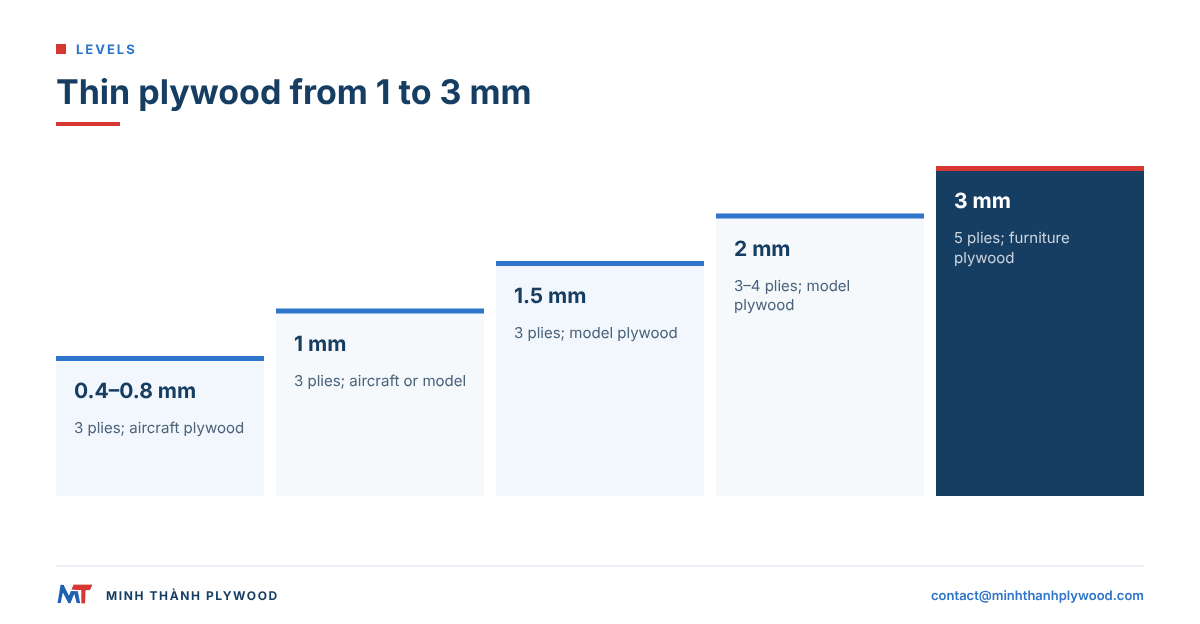
Thin birch plywood is built from very thin rotary-cut veneers, usually three for 1 mm and 1.5 mm sheets and three or four for 2 mm. Each veneer in a 1 mm sheet is about 0.33 mm thick; in a 2 mm sheet, about 0.5–0.7 mm.
| Thickness | Typical plies | Veneer thickness (approx.) | Usual name |
|---|---|---|---|
| 0.4–0.8 mm | 3 | 0.13–0.27 mm | Aircraft plywood |
| 1 mm | 3 | 0.33 mm | Aircraft or model plywood |
| 1.5 mm | 3 | 0.5 mm | Model plywood |
| 2 mm | 3–4 | 0.5–0.7 mm | Model plywood, thin plywood |
| 3 mm (furniture) | 5 | 0.6 mm average | Thin plywood |
The veneers are bonded with a dry phenolic resin film rather than liquid glue, because a liquid glue would soak through veneers this thin and show on the face. Birch is used because its fine, even grain peels into thin sheets without tearing.
Aircraft plywood was historically made to aviation specifications such as the British BS V3 and the German LN 29011, both now withdrawn. Today the name describes a grade of very thin birch ply, not a certified aircraft part.
Why do furniture panels start at 3 mm?
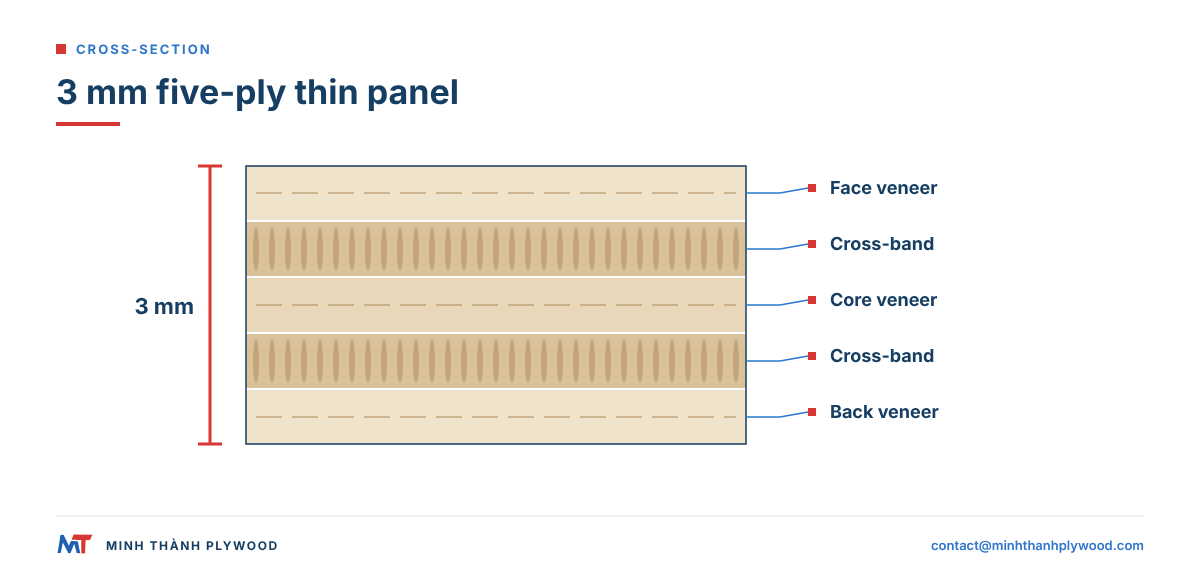
Furniture mills start at 3 mm because 3 mm is the thinnest sheet that can be built as a five-ply panel from veneers a furniture line can peel, dry and lay up at speed. Below 3 mm, the sheet has to drop to three plies, and three-ply panels behave differently in furniture.
Four reasons decide it:
- Veneer handling. Five plies at 2 mm would need veneers of about 0.4 mm. Plantation hardwood cores such as Styrax and Eucalyptus peel cleanly at furniture thicknesses; at 0.4 mm they tear and split in the dryer.
- Balance and flatness. A five-ply sheet has its grain crossing four times and stays flat in a groove. A three-ply sheet has a thick middle veneer and bows more readily when one face is painted.
- Calibration. Furniture panels are pressed and then sanded to a tight tolerance. On a 2 mm sheet there is almost nothing left to sand without cutting through the face.
- Glue. Interior furniture panels use UF glue at E0 emission. In very thin veneers, liquid glue bleeds through to the face, which is why thin model ply uses phenolic film instead.
Minh Thanh’s thin range is 3–6 mm; the 3–5 mm panels are always five-ply, for exactly these reasons. Premium thin veneer is scarce, and the mill does not lower the standard to press thinner or faster.
What is 2mm plywood used for?
2mm plywood is used where a thin, light sheet has to be cut into small shapes or bent to a curve. The common uses:
- Model aircraft and RC models: ribs, formers, fuselage sides and wing skins.
- Architectural and display models: walls, floors and terrain layers cut on a laser.
- Laser-cut crafts and signs: ornaments, puzzles, lettering and gift tags.
- Small boxes: jewellery and gift boxes with finger joints.
- Curved laminations: several 1–2 mm sheets glued over a former to make a chair back or a lamp shade.
- Instrument parts: linings, bracing and decorative inlays.
- Veneer backers: a thin balancing layer behind a decorative veneer on a lightweight part.
Furniture uses (cabinet backs, drawer bottoms, door skins) usually start at 3 mm, where the five-ply build costs less per square metre and stays flat.
How much does a 2mm plywood sheet weigh?
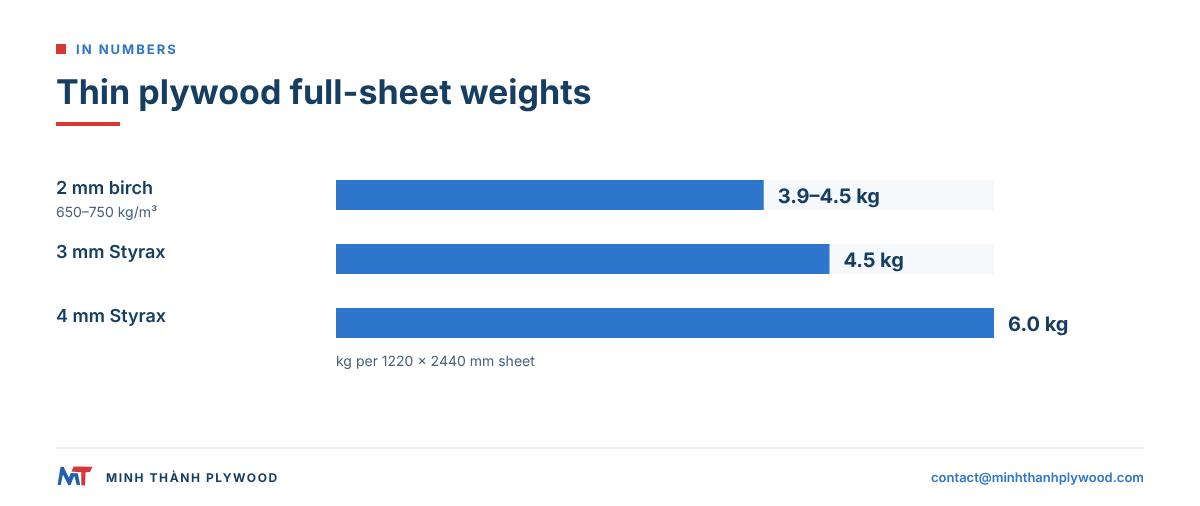
A 1220 × 2440 × 2 mm sheet holds 0.0060 m³ of wood. In birch at 650–750 kg/m³, it weighs about 3.9–4.5 kg; a 1220 × 2440 × 3 mm five-ply sheet on a white Styrax core (500 kg/m³) weighs about 4.5 kg.
| Sheet | Volume | Density | Weight |
|---|---|---|---|
| 2 mm birch, 1220 × 2440 mm | 0.0060 m³ | 650–750 kg/m³ | 3.9–4.5 kg |
| 3 mm, Styrax core, 1220 × 2440 mm | 0.0089 m³ | 500 kg/m³ | 4.5 kg |
| 4 mm, Styrax core, 1220 × 2440 mm | 0.0119 m³ | 500 kg/m³ | 6.0 kg |
The table shows a point buyers often miss: a 3 mm sheet on a light Styrax core weighs about the same as a 2 mm birch sheet. Where the 2 mm sheet was chosen to save weight in a furniture part, 3 mm on Styrax does the same job and is stiffer.
Which glue and faces does thin plywood use?
Thin birch model ply uses phenolic film glue, which resists water and gives darker glue lines. Furniture thin plywood from 3 mm uses UF glue at E0 emission for dry interiors, with a melamine-fortified (MR) or phenolic (WBP) bond to order.
Minh Thanh’s 3–6 mm panels are made with the faces furniture makers order: Poplar, Birch, EV (engineered veneer), Okoume and Pine, among 10+ veneers, over a white Styrax or Eucalyptus core. Faces are graded in face/back pairs (A/A, A/B, B/B for Poplar and Pine; D+/D or D/E for Birch) and matched to the approved sample. Both faces are sanded and polished.
The panels meet the emission requirements European and US furniture buyers ask for, with CARB P2 / TSCA Title VI certification (ICTT mill no. 23024) as the proof. Six ASTM D6007 chamber tests between April 2025 and June 2026, on 9, 15 and 18 mm panels, averaged 0.014–0.032 ppm against the 0.05 ppm CARB Phase 2 limit. The US limit for veneer-core hardwood plywood is 0.05 ppm under 40 CFR 770.10, and the California Air Resources Board runs the Phase 2 programme.
2 mm vs 3 mm plywood: which should you buy?
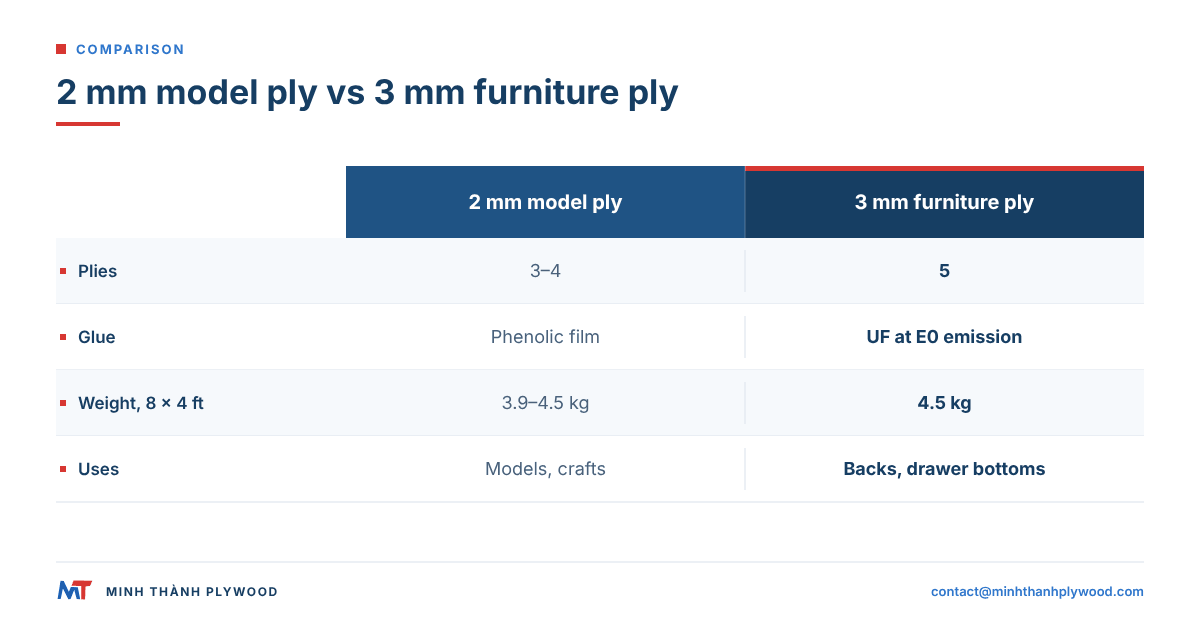
Buy 2 mm when the part must bend tightly, be cut on a small laser or weigh as little as possible in a model. Buy 3 mm for anything that goes into furniture, packaging or a fit-out, where a flat, calibrated sheet at a lower price per square metre matters more.
| Measure | 2 mm model plywood | 3 mm furniture plywood |
|---|---|---|
| Plies | 3–4 | 5 |
| Usual face | Birch | Poplar, Birch, EV, Okoume, Pine |
| Glue | Phenolic film | UF glue at E0 emission (MR or WBP on order) |
| Weight, 1220 × 2440 mm | 3.9–4.5 kg (birch) | 4.5 kg (Styrax core) |
| Bending | Tight curves | Gentle curves |
| Typical order | Packs or single sheets | One 40HC, mixed by agreement |
| Uses | Models, crafts, laminations | Cabinet backs, drawer bottoms, door skins |
The 3 mm plywood guide covers the five-ply layup in detail, and the 1/8 inch plywood article covers 2.7–3 mm sheets sold in imperial sizes.
What other thin sheets replace 2 mm plywood?
When 2 mm plywood is hard to source or too dear, four other sheets do some of its jobs:
- 3 mm five-ply plywood: the standard replacement for backs, drawer bottoms and laser parts that do not need tight bends.
- 3.6 mm ply: a UK trade size for wardrobe backs and door skins, covered in the 3.6 mm ply guide.
- 2–3 mm MDF or hardboard: cheaper for painted backs in dry rooms, but weaker at the edge and less tolerant of moisture.
- Flexible plywood: made to bend to tight radii, for curved furniture and shop fronts.
For cabinets, the cabinet back panels comparison sets plywood against hardboard and MDF on weight, edge strength and cost.
How is thickness checked on thin sheets?
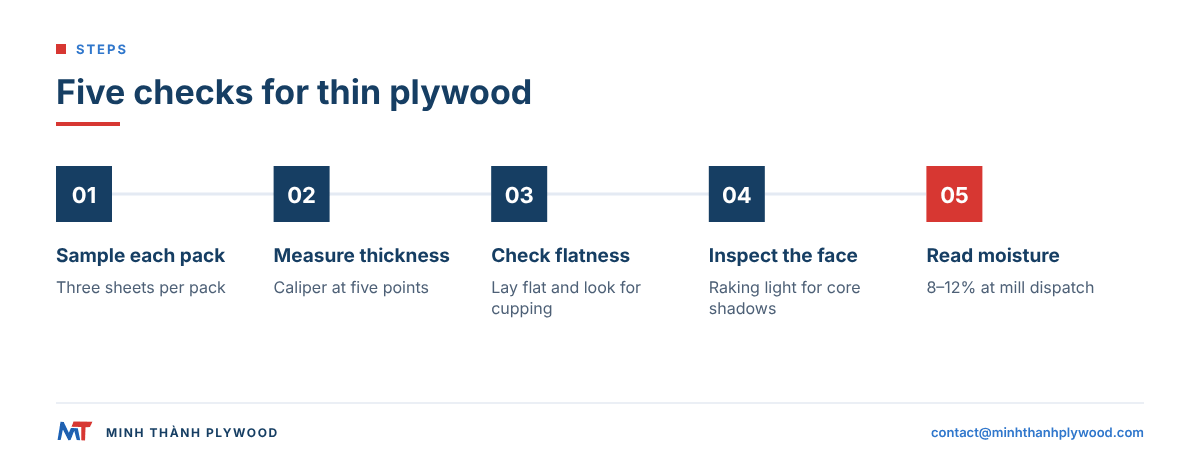
On a thin sheet, thickness is checked with a caliper at the four corners and the middle, because a thin panel shows uneven sanding first at the edges. Minh Thanh sands thin furniture panels to ±0.2–0.3 mm, down to ±0.2 mm on order, so a 3 mm sheet measures 2.8–3.2 mm at ±0.2 mm.
A tolerance written as a range is what an importer should check on arrival:
- Caliper five points on three sheets from each pack.
- Lay the sheet flat on a bench and look for cupping.
- Check the face under raking light for core shadows.
- Read moisture: 8–12 %, the range panels leave the mill at.
What does 3 mm plywood from Vietnam cost, and how does it ship?
In October 2026, Minh Thanh furniture plywood starts from US$350/m³ FOB Hai Phong. A 1220 × 2440 × 3 mm sheet is 0.0089 m³, so about 112 sheets make one cubic metre; the face, core, glue and quantity set the final price.
A 40HC holds about 5,994 sheets of 3 mm on a Styrax core: 18 packs of 333 sheets, about 53.5 m³ and 26,764 kg of plywood, within a 28,000 kg planning payload. Packing materials come on top. Most buyers mix 3 mm backs with thicker carcass panels in one container by agreement.
The minimum order is one 40HC; production takes 15–45 days after the 30% deposit, with the 70% balance against the scanned bill of lading. Typical days at sea from Hai Phong are 30–40 to Northern Europe. Free samples come first. UK guidance on wood packaging material says its rules do not apply to processed, non solid packaging like plywood.
How do you cut and finish 2 mm plywood?
A 2 mm sheet cuts with a sharp craft knife in two or three passes along a steel rule, on a scroll saw with a fine blade, or on a desktop laser. Score the face first when cutting across the grain, so the thin outer veneer does not tear at the end of the cut.
For finishing, sand lightly by hand with fine paper only: the face veneer is a fraction of a millimetre thick and sands through quickly. Seal both faces with the same coat, because a sheet coated on one side only can cup. For curved laminations, glue several sheets over a former with the grain of each sheet crossing the next, and clamp evenly until the glue cures.
The same care applies to 3 mm five-ply furniture panels, which arrive sanded and polished and need only light preparation before coating.
What to write when you need the thinnest furniture panel
If your part was drawn in 2 mm and it goes into furniture, ask for the 3 mm five-ply panel instead and check the groove. A complete line:
3 mm × 1220 × 2440 mm, five-ply, poplar face A/B, Styrax core, UF glue at E0 emission, sanded both faces, tolerance ±0.2 mm, for drawer bottoms; 1×40HC mixed with 15 mm panels; CIF your port.
Send it to contact@minhthanhplywood.com or WhatsApp +84 988 586 601 with the part drawing. Replies come within hours, Monday–Friday, 08:00–17:00 Vietnam time, and free samples follow.
Buyer questions, answered
Does 2mm plywood exist?
Yes. 2 mm plywood is made as a specialist thin sheet, mostly in birch, for models, crafts and laminations. It is not a standard furniture panel: furniture and cabinet makers buy thin plywood from 3 mm.
How many plies does 2mm plywood have?
Usually three or four, depending on the maker. Each veneer in a 2 mm sheet is roughly 0.5–0.7 mm thick, so five plies at 2 mm would need veneers too thin to handle in a furniture mill.
What is 1mm plywood called?
1 mm plywood is usually sold as aircraft plywood or model plywood: a three-ply birch sheet with veneers of about 0.33 mm, bonded with phenolic film glue.
What is 2mm plywood used for?
Model aircraft ribs and skins, radio-controlled models, architectural models, laser-cut crafts and signs, jewellery boxes, instrument linings and curved parts laminated from several thin sheets over a former.
How much does a 2mm plywood sheet weigh?
A 1220 × 2440 × 2 mm sheet holds 0.0060 m³ of wood. In birch at 650–750 kg/m³ it weighs about 3.9–4.5 kg; a 3 mm five-ply sheet on a Styrax core weighs about 4.5 kg.
Is 2mm plywood waterproof?
Birch aircraft and model plywood is bonded with phenolic glue, which resists water. The thin face veneers are not waterproof, so outdoor parts still need a sealer or paint.
Can 2mm plywood be laser-cut?
Yes, 1–2 mm plywood cuts quickly on a desktop laser. Phenolic glue lines leave darker edges than the UF glue used in interior panels, so test a sheet before a production run.
What is the thinnest plywood Minh Thanh makes?
3 mm. The thin range runs from 3 to 6 mm; 3–5 mm panels are always five-ply and the 6 mm ply count is set per order. A 3 mm panel is one core veneer, two cross-bands and two face veneers.
Can I use 2 mm plywood for cabinet backs?
It is possible but rarely worth it: 2 mm sheets cost more per square metre than 3 mm furniture plywood and flex in the groove. A 3 mm or 3.6 mm five-ply back is stiffer and cheaper per part.
What is tunn plywood 2mm?
Tunn plywood is the Swedish and Norwegian name for thin plywood. A 2 mm tunn plywood sheet is the same specialist birch sheet sold elsewhere as model or aircraft plywood.