
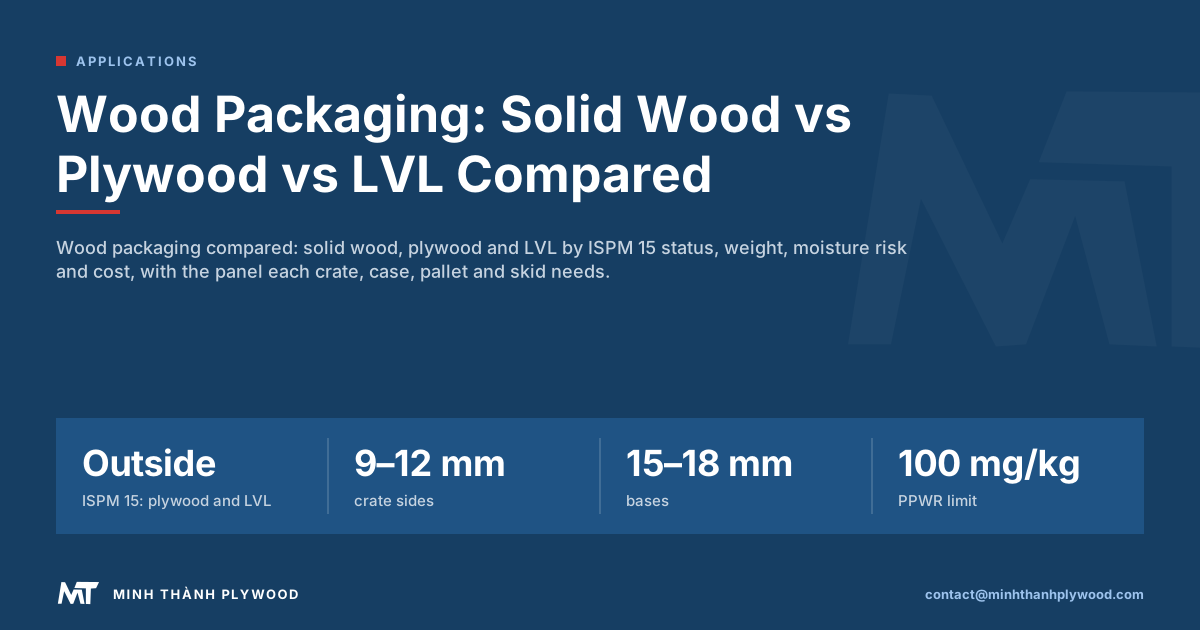
For export wood packaging, plywood suits crate and case panels, LVL suits skids, bearers and blocks, and solid wood suits frames and pallets where heat treatment is already part of the supply chain. Plywood and LVL are processed wood, so ISPM 15 does not apply to them; solid wood needs treatment and the mark. Minh Thanh Plywood makes packing plywood and LVL in Vietnam for packaging makers; this guide maps each format to the material it needs.
What is wood packaging?
Wood packaging is any packaging made of wood that carries, protects or supports goods in transport: pallets, crates, cases, boxes, pallet collars, skids and dunnage. It is made from three materials: solid wood, plywood and LVL (laminated veneer lumber).
The materials behave differently in export:
- Solid wood is sawn timber. It is strong and easy to work, but it moves with moisture and must be heat-treated or fumigated and marked under ISPM 15 to cross most borders.
- Plywood is cross-laminated veneer pressed with glue and heat. It comes as flat sheets, holds fasteners near edges and is outside ISPM 15.
- LVL is veneer laminated with the grain running one way, made as beams and boards. It is straight and stable, and outside ISPM 15 too.
Wood packaging solutions usually combine them: a plywood crate on LVL or solid skids, or a solid-wood pallet with a plywood deck. Each part gets the material that suits its job.
Wooden packaging in the UK: who regulates it and what does a crate panel cost?
Wood packaging in Great Britain is regulated through the UK Wood Packaging Material Marking Programme, which applies ISPM 15 to solid-wood pallets, crates and dunnage; wood packaging moving between Great Britain and the EU has needed ISPM 15 treatment and the mark in both directions since 1 January 2021. Plywood and LVL panels are processed wood outside it.
Who does what in the UK:
- The marking programme: set up by the Forestry Commission in Great Britain and put on a statutory footing on 6 November 2006 by the Plant Health (Wood Packaging Material Marking) (Forestry) Order 2006. TIMCON, the Timber Packaging and Pallet Confederation, administers it. The Forest Research plant health guide to the programme explains the mark.
- The trade body: TIMCON speaks for UK and Irish pallet and timber packaging makers. Its members make about 70 % of the UK’s roughly 43 million new pallets a year and use around 1 million m³ of wood.
- The industry federation: Timber Development UK lists TIMCON among its members and publishes UK guidance on timber supply and standards.
- The rule for importers: Defra has confirmed that all wood packaging material moving between Great Britain and the EU, and from Great Britain to Northern Ireland, must be treated and marked to ISPM 15.
A UK packaging maker that buys plywood panels from Vietnam for crates and cases therefore keeps the solid-wood frame and skids under the marked supply it already has, and takes the sides, lids and bases as plywood. The solid-wood parts still need the mark.
What a crate panel costs, as a dated guide (October 2026):
| Panel, 1220 × 2440 mm | UK merchant, ex VAT per sheet | Raw FOB example from Minh Thanh, per sheet |
|---|---|---|
| 12 mm | £14.85 (pine C+/C, Sheet Materials Wholesale) | US$8.93 |
| 18 mm | £20.65 (pine C+/C, Sheet Materials Wholesale) | US$13.40 |
The right-hand column is arithmetic from our commercial plywood starting price of US$250/m³ and the sheet volume, before freight; packing grade, glue and core change the quote. Duty on Vietnam-origin poplar- or eucalyptus-faced plywood is 0 % in the UK against 6 % from third countries, and VAT is 20 %.
Which wood packaging suits export: solid wood, plywood or LVL?
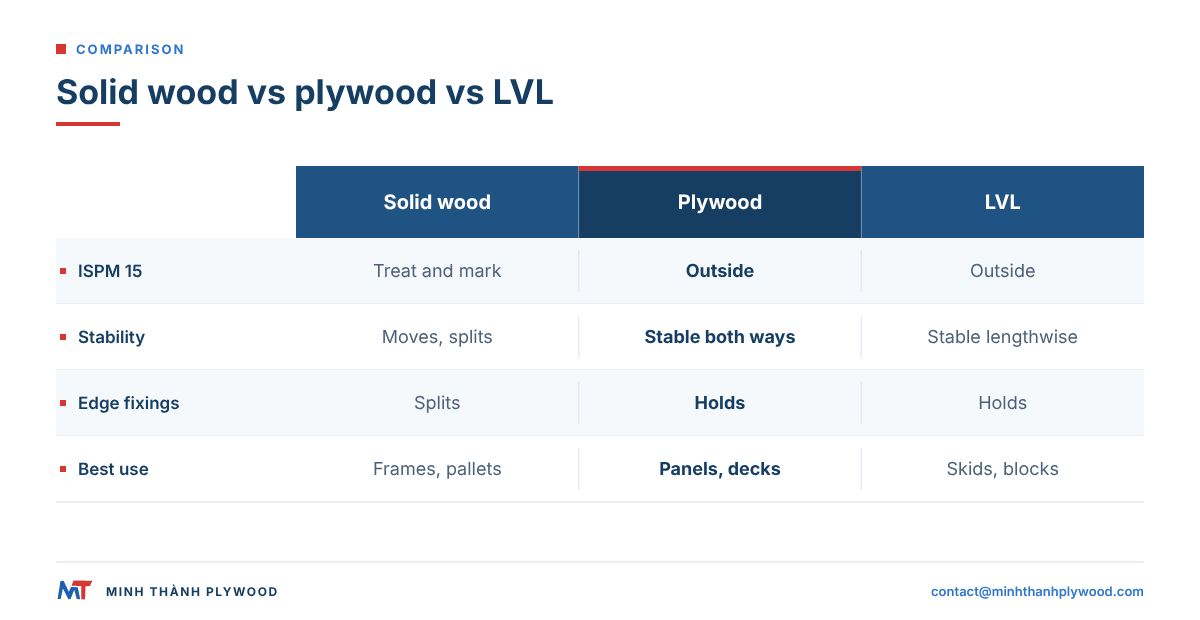
For export, plywood suits flat panels such as crate sides, lids, case walls and pallet decks; LVL suits linear parts such as skids, bearers, stringers and blocks; solid wood suits frames and standard pallets where the supplier already heat-treats and marks. The comparison below has one metric per row.
| Metric | Solid wood | Plywood | LVL |
|---|---|---|---|
| ISPM 15 status | In scope: treatment and mark needed | Outside ISPM 15 (processed wood) | Outside ISPM 15 (processed wood) |
| Form | Boards, battens, blocks | Flat sheets 3–40 mm | Beams and boards |
| Dimensional stability | Moves with moisture; can split | Stable both ways; cross-laminated | Stable along its length |
| Fixings near edges | Splits along grain | Holds; plies cross | Holds along its length |
| Moisture on arrival | Depends on drying and treatment | Pressed and dried; 8–12 % at our dispatch | Pressed and dried |
| Large flat surfaces | Several boards, joints | One sheet up to 1250 × 2500 mm | Not its use |
| Surface for printing or labels | Rough sawn | Even face; cleaner grades print well | Not its use |
| Relative material cost | Lowest per m³ of timber | Higher per m³; less material per crate | Higher per m³; replaces larger solid sections |
| Best export use | Frames, standard pallets | Crate and case panels, pallet decks, partitions | Skids, bearers, stringers, blocks |
Verdict by use:
- Machinery crates: plywood sides and lids on LVL or treated solid skids.
- Cases for electronics and instruments: light Styrax-core plywood throughout.
- Standard pallets in a heat-treated supply chain: solid wood, with a plywood top deck where loads are concentrated.
- Export pallets with no treatment facility nearby: plywood decks on LVL blocks, all outside ISPM 15.
Which panel does each packaging format need?
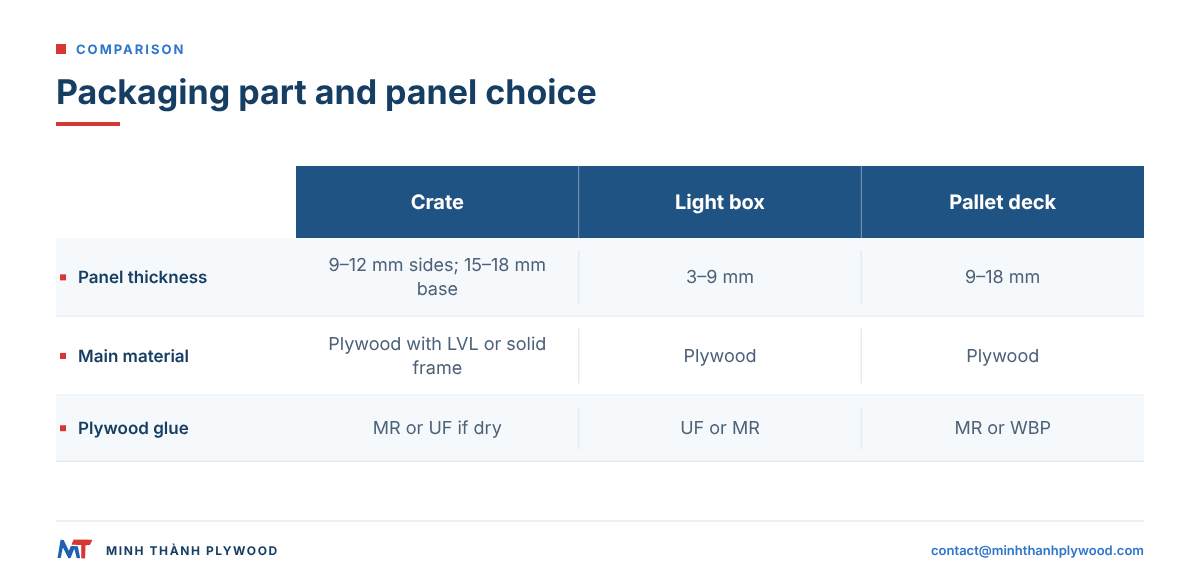
Each packaging format needs its own panel. Crates and cases need plywood sides of 9–12 mm and bases of 15–18 mm, boxes need 3–9 mm plywood and pallet decks 9–18 mm. Skids, bearers and blocks need LVL or treated solid timber; collars and dunnage are usually solid wood.
| Format | Main material | Thickness or section | Glue for plywood |
|---|---|---|---|
| Crate (framed) | Plywood sides and lid, solid or LVL frame | 9–12 mm sides; 15–18 mm base | MR for sea freight; UF if kept dry |
| Case (sheathed, closed) | Plywood throughout | 9–18 mm | MR or phenolic WBP |
| Box and light case | Plywood | 3–9 mm, five-ply in thin sizes | UF or MR |
| Pallet deck | Plywood | 9–18 mm | MR or WBP |
| Skid and bearer | LVL or treated solid timber | To the load drawing | — |
| Pallet block | LVL or treated solid timber | To the pallet design | — |
| Pallet collar | Solid wood (treated) | Collar boards | — |
| Partitions and dividers | Thin plywood | 3–6 mm | UF |
| Dunnage | Solid wood (treated) or LVL offcuts | To the load | — |
Our sibling guides cover each format: plywood for crates and packaging, packing plywood for export packing, and LVL vs plywood for linear parts.
Does ISPM 15 apply to wooden packaging material?
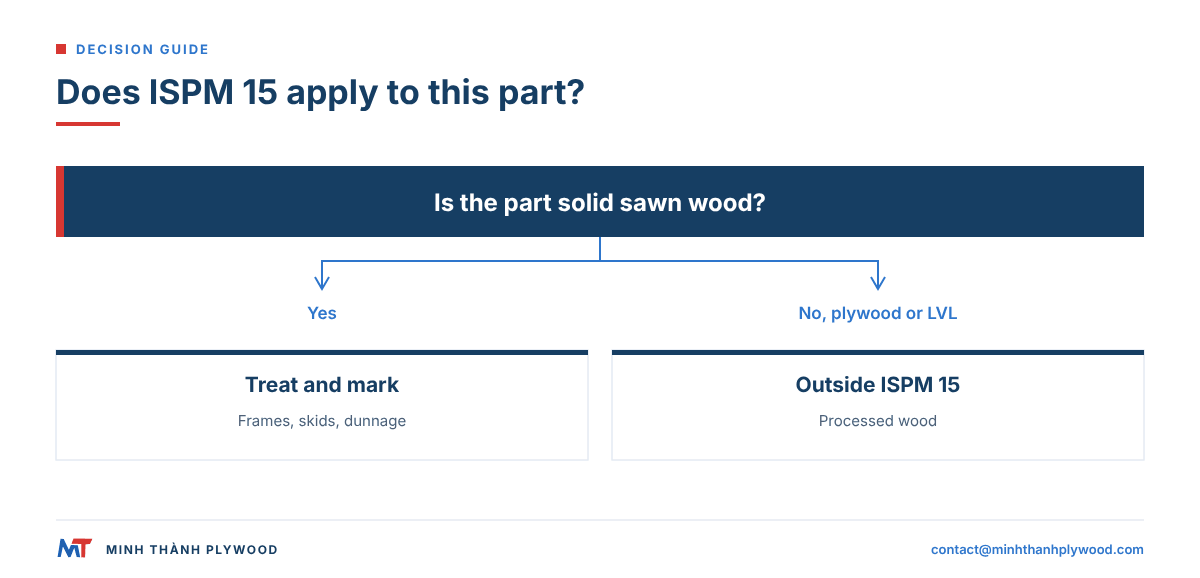
ISPM 15 applies to solid-wood packaging material, not to processed wood. The standard excludes packaging made wholly of processed wood such as plywood, OSB, particleboard and veneer products made with glue, heat or pressure, so plywood and LVL parts need no ISPM 15 treatment or mark.
What that means on a mixed crate:
- Plywood sides, lid and base: outside ISPM 15.
- LVL skids or blocks: outside ISPM 15.
- Solid-wood frame, battens, skids or dunnage: in scope. They need approved heat treatment or fumigation and the ISPM 15 mark.
- A crate with any solid-wood part is treated by its solid-wood parts: identify each component’s material instead of calling the whole crate processed wood.
The standard is published by the International Plant Protection Convention: ISPM 15, Regulation of wood packaging material in international trade. Destination countries enforce it at the border; check the importing country’s current rules for the solid parts.
Which woods suit packaging, and how much do they weigh?
The woods used in packaging are softwoods such as pine and spruce and fast-growing hardwoods for solid timber, and plantation-grown species such as Styrax, Acacia and Eucalyptus for plywood and LVL made in Vietnam. The species sets the weight, stiffness and nail holding of the finished packaging.
For Vietnamese plywood, the core species decides most of the sheet’s weight:
| Core species | Reference density | 12 mm sheet, 1220 × 2440 mm | Packaging use |
|---|---|---|---|
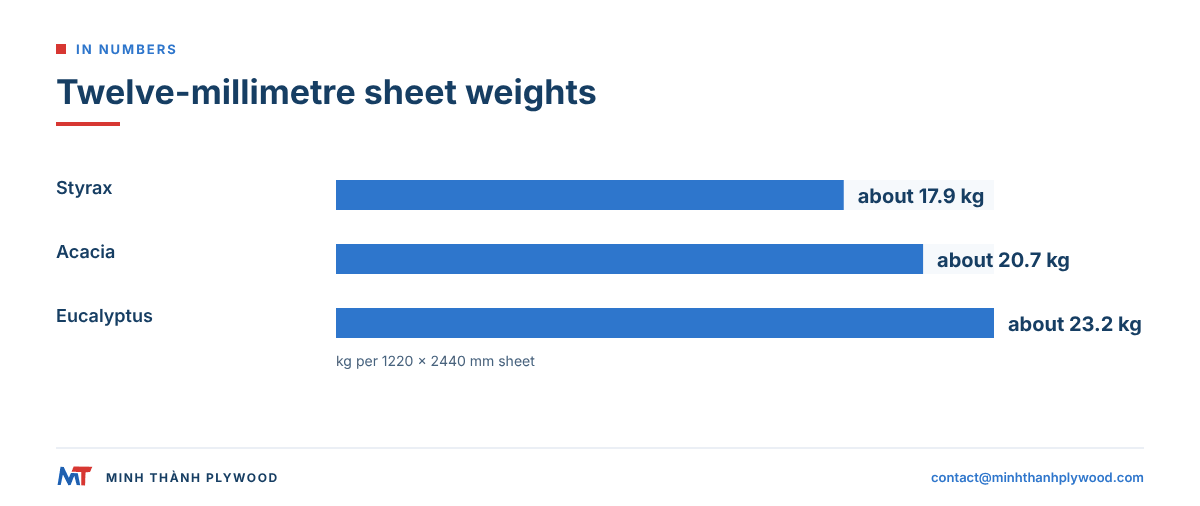
| White Styrax | About 500 kg/m³ | About 17.9 kg | Light cases, air-freight boxes, partitions |
| Acacia | About 580 kg/m³ | About 20.7 kg | General crates and decks |
| Eucalyptus | 650–750 kg/m³ | About 23.2 kg at 650 kg/m³ | Heavy bases, decks, reusable cases |
Sheet weights are density × volume. Our packing plywood is made on Styrax or Eucalyptus cores, with the face, thickness and bond matched to the part. Styrax is the lighter option; Eucalyptus is denser and holds fasteners better under heavy loads.
What grade of plywood is used for export packaging and crates?
Export packaging and crates use packing-grade plywood: panels whose faces allow patches, colour variation and small open defects, because strength, fixings and price matter more than looks. Cleaner faces are ordered for printed boxes, display cases and reusable equipment cases.
How packing faces are named on orders:
- Packing grade or utility: hidden crate parts, decks and partitions.
- BB/CC or CP (poplar-faced panels): buyers order poplar faces by these Chinese codes, which map onto the A/A, A/B and B/B ladder we quote; CP sits at the economical end.
- B/B: a sound, even face for printed or labelled boxes.
- A/B: reusable cases where one face stays visible.
Our packing-grade thickness tolerance is ±0.5–1.0 mm, against ±0.2–0.3 mm for sanded furniture panels; a crate does not need furniture tolerance. The approved face and back sample fixes what production must match, so send a sample request with the grade you intend to order.
Why does moisture matter in wooden packaging?
Moisture matters because wet packaging timber shrinks, loosens fasteners and feeds mould on the goods during weeks in a closed container. Pressed and dried panels start the voyage dry; our plywood leaves the factory at 8–12 % moisture, the normal range for dried plywood.
Three sources of moisture in a packaging container:
- The packaging itself. Solid timber that is not kilned or dried well gives off water as the container heats.
- The goods. Some cargo carries moisture of its own.
- The container. Temperature swings at sea condense water on the roof and walls.
Plywood helps on the first count: it is pressed hot and dried, so it brings little water of its own. Choose the bond to the exposure: UF glue for dry inland service, melamine-fortified MR for humid sea freight, and phenolic WBP for packaging stored outdoors or reused many times. Seal cut edges on cases that will be reused.
How do weight and freight cost compare?
Packaging weight is freight cost: every kilogram of crate travels with the goods and counts against the container’s payload. Plywood saves weight because a 9–12 mm panel replaces thicker solid boards, and a light core saves more.
On a 1220 × 2440 mm sheet at 12 mm, the core alone changes the panel weight from about 17.9 kg on white Styrax to about 23.2 kg on Eucalyptus. For a crate using six such sheets, that is about 32 kg of difference before any goods are packed.
Choose by the job:
- Air freight and courier cases: Styrax core, the thinnest panel the design allows.
- Sea-freight machinery crates: Acacia or Eucalyptus for the base, Styrax or Acacia for the sides.
- Reusable cases: Eucalyptus core with phenolic WBP glue; weight matters less than life.
How does PPWR affect wood packaging solutions in the EU?
The EU Packaging and Packaging Waste Regulation, Regulation (EU) 2025/40, applies to all packaging placed on the EU market, wood packaging included, from 12 August 2026. One of its rules limits the sum of lead, cadmium, mercury and hexavalent chromium in packaging to 100 mg/kg.
For our own export shipments, SGS tested the four packaging materials we use in September 2026 under Regulation (EU) 2025/40: cardboard, plywood and pallet blocks, strapping band and wrapping film. Lead, cadmium, mercury and hexavalent chromium were not detected in any of them, a pass against the 100 mg/kg limit. The test covers those packaging materials; our PPWR packaging page shows the report.
Wood packaging fits the regulation’s direction on reuse and recycling: crates and cases can be repaired and reused, and plywood and LVL panels are wood that can be recovered at the end of their life.
Who supplies packing plywood from Vietnam to European packaging makers?
Minh Thanh Plywood, in Ha Hoa, Phu Tho, is a Vietnamese manufacturer that supplies packing plywood and LVL to packaging makers: Styrax or Eucalyptus cores, 3–40 mm, 1220 × 2440 or 1250 × 2500 mm, with the face, thickness and bond matched to the part. We make the panels; packaging makers build the crates and pallets.
What a packaging company in the Netherlands, Germany or elsewhere in Europe gets:
- Cut-to-size: one sheet cut into 4, 6 or 8 pieces, shipped regularly to Italy and other European markets.
- Order: minimum one 40HC, usually one or two specifications and up to six by agreement.
- Timing: production 15–45 days after the 30% deposit; typical time at sea to Northern Europe 30–40 days from Hai Phong.
- Price guide: commercial plywood from US$250/m³ (October 2026); packing panels are quoted to the face and core you approve.
- Documents: commercial invoice, packing list, B/L and certificate of origin (EUR.1 for the EU); the EUDR compliance dossier with origin records and geolocation files.
Our packing plywood page lists the build options.
How should packing plywood be inspected before shipment?
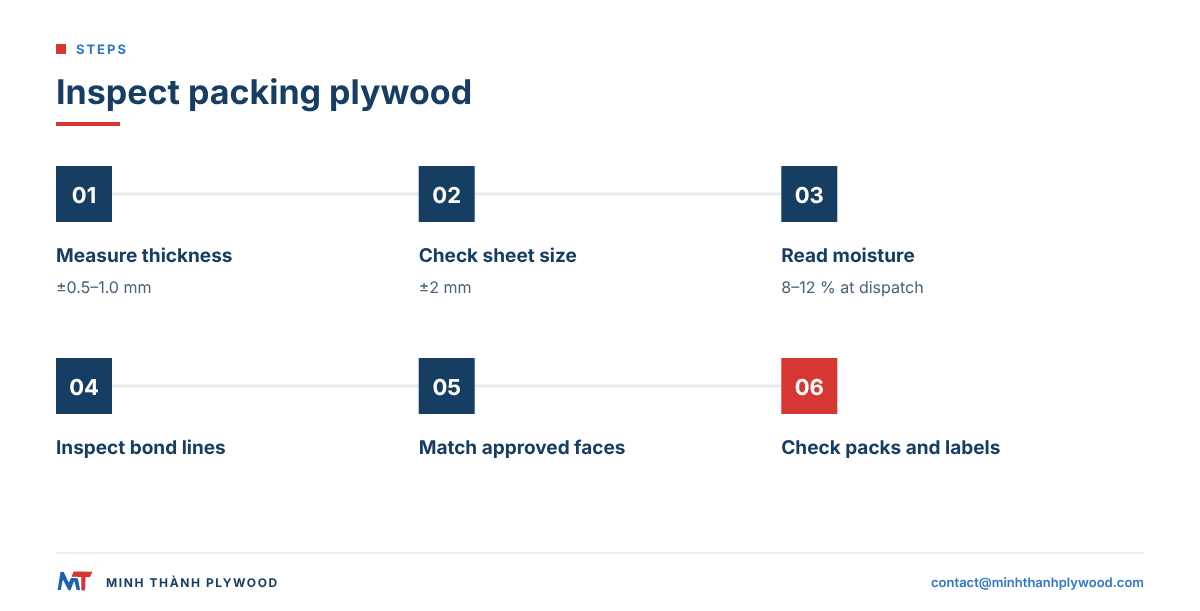
Packing plywood is inspected before shipment on thickness, sheet size, moisture, bond, face against the approved sample and pack labels. Each check takes minutes and catches the faults that would otherwise surface at the packaging plant.
- Thickness: several sheets per pack with a caliper, against ±0.5–1.0 mm for packing grade.
- Size: length and width against ±2 mm.
- Moisture: a meter reading on sheets from inside the pack; 8–12 % at dispatch.
- Bond: a cut edge checked for open glue lines.
- Face: against the approved sample, both sides.
- Packs: count, labels and strapping.
Every shipment is photographed and filmed before loading, and the buyer receives the photos and video. Third-party inspection can be booked by the buyer on top of that.
What should a packaging plywood order say?
A packaging plywood order should state the part it is for, the core, the glue, the face and back grade, the thickness and tolerance, the size or cut list, the quantity and packing and the delivery term. With those lines, every quote describes the same panel.
Crate panels: packing plywood, Styrax core, MR glue, packing-grade faces, 12 mm ±0.5–1.0 mm, 1220 × 2440 mm; plus 18 mm Eucalyptus core for bases; plus 4 mm five-ply for partitions; 1×40HC mixed; CIF Rotterdam.
Free samples are available. Send the crate drawing or cut list and the specification lines through our quotation page. The industrial plywood guide maps other industrial uses to their panels.
Buyer questions, answered
Does wood packaging need ISPM 15 marking in the UK?
Solid-wood packaging moving between Great Britain and the EU, or from Great Britain to Northern Ireland, must be heat-treated or fumigated and carry the ISPM 15 mark. Plywood and LVL parts are processed wood and sit outside the standard.
What is wood packaging material?
Wood packaging material is any wood used to carry, protect or support goods in transport: pallets, crates, cases, boxes, pallet collars, skids and dunnage. ISPM 15 uses the term for the solid-wood part of it, which needs treatment for international trade.
Is plywood packaging exempt from ISPM 15?
Yes. ISPM 15 does not apply to packaging made wholly of processed wood such as plywood, OSB or veneer products made with glue, heat or pressure. Solid-wood skids, blocks or dunnage in the same package still need treatment and the mark.
What grade of plywood is used for export crates?
Packing grade: plywood whose faces allow patches, colour variation and small open defects, chosen for strength and fixings rather than looks. Poplar-faced panels are also ordered by the codes BB/CC or CP; cleaner faces suit printed or reusable boxes.
Which is lighter for crates, plywood or solid wood?
For the same panel area, thin plywood is usually lighter, because a 9–12 mm plywood side can replace thicker solid boards. A 12 mm sheet on a white Styrax core weighs about 17.9 kg for 1220 × 2440 mm.
Is LVL good for pallets?
Yes, for blocks, stringers, skids and bearers. LVL is straight, stable and made of glued veneers, so it is processed wood outside ISPM 15, and it can be cut to the exact section the pallet design needs.
Does PPWR apply to wooden packaging?
Yes. Regulation (EU) 2025/40 applies to all packaging placed on the EU market, wood included, from 12 August 2026. One of its rules limits the sum of lead, cadmium, mercury and hexavalent chromium to 100 mg/kg.
What thickness plywood for a crate?
Use 9–12 mm for sides and lids, 15–18 mm for bases and decks and 3–6 mm for dividers and skins. Frame spacing, load and handling decide the final figure; test the assembled crate first.
Does Minh Thanh build crates or pallets?
No. We make the panels: packing plywood and LVL, cut to size if needed. Crates and pallets are built by packaging makers, who design, assemble and mark them for their customers.
How should packing plywood be inspected before shipment?
Check thickness and size on sample sheets, moisture, the bond on a cut edge, the face against the approved sample and the pack labels. We photograph and film every shipment before loading and send the buyer the photos and video.