
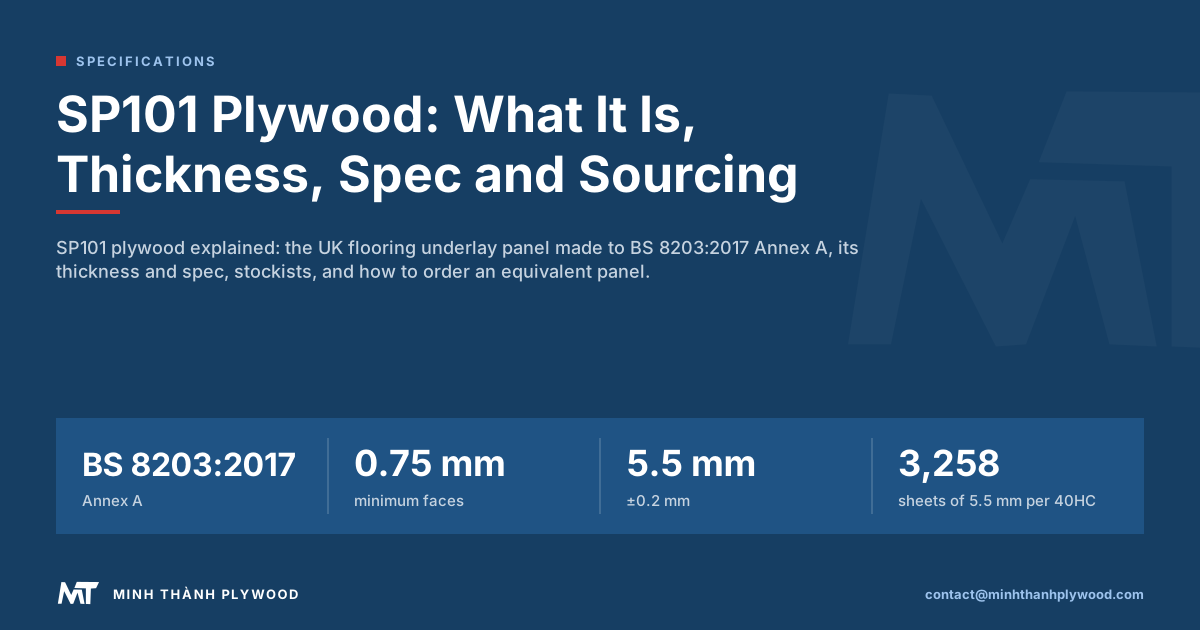
SP101 plywood is a branded UK flooring plywood, sold as an underlay for vinyl and LVT and made to BS 8203:2017 Annex A, most often in 5.5 mm. Distributors who want the same specification under their own name can order it from a mill line by line. Minh Thanh Plywood presses calibrated thin and exterior panels in Vietnam.
What is SP101 plywood?
SP101 plywood is a branded UK flooring plywood, made as an underlay for resilient floor coverings such as vinyl sheet and luxury vinyl tile (LVT). The name belongs to one UK distributor; the panel is manufactured to the plywood requirements in Annex A of BS 8203:2017 and sold through flooring wholesalers and timber merchants in the UK and Ireland.
Hanson Plywood owns the brand. Its SP101 product data sheet lists TFT Diamond Mark certification, CE marking to BS EN 13986 and FSC-certified stock availability.
MKM lists the panel and advertises more than 140 branches. Flooring King also lists SP101 and advertises free UK delivery over £500.
These seller pages were read on 3 November 2026.
In short, SP101 is a product, not a standard. What makes it different from a general-purpose hardwood sheet is the specification behind it: an exterior glue bond, thicker face veneers, a core without overlaps or gaps, tight thickness tolerance and controlled moisture. Those are the lines a flooring contractor relies on when a 2 mm vinyl tile is glued straight onto the plywood.
Buyers searching for “SP101 plywood suppliers” or “SP101 plywood stockists” are usually looking for one of two things: a merchant that sells the branded sheet, or a mill that can make a panel to the same specification for their own range. This guide covers both.
Which standard does SP101 meet?
SP101 is made to BS 8203:2017, Code of practice for installation of resilient floor coverings, and specifically its Annex A, which sets the requirements for plywood used as an underlay. Annex A grew from Contract Flooring Association (CFA) guidance on plywood, which the British Standards Institution adopted as a normative annex of the code.
BS EN 636 covers plywood for dry, humid and exterior conditions. BS EN 314-2:1993 specifies bonding-quality requirements; its test methods are specified in EN 314‑1. Keep the product specification, bonding requirements and test methods separate in the order:
- EN 636-3: the product classification listed on the SP101 data sheet.
- EN 314-2 Class 3: the exterior glue bond class, tested by boiling and soaking cycles.
- EN 635-2: appearance classes for hardwood plywood; SP101’s face is based on Class 1.
- EN 13986: the CE-marking reference stated on the SP101 product data sheet; its declaration of performance is available on request.
The panel is also third-party certified under a UK timber trade quality scheme. For a buyer sourcing an equivalent panel, the EN references are the useful part: they turn “flooring grade” into lines a mill can press to and a laboratory can test.
SP101 specification at a glance
The SP101 product data sheet, read on 3 November 2026, lists these values:
| Property | SP101 published value |
|---|---|
| Standard | BS 8203:2017 Annex A; EN 636-3 |
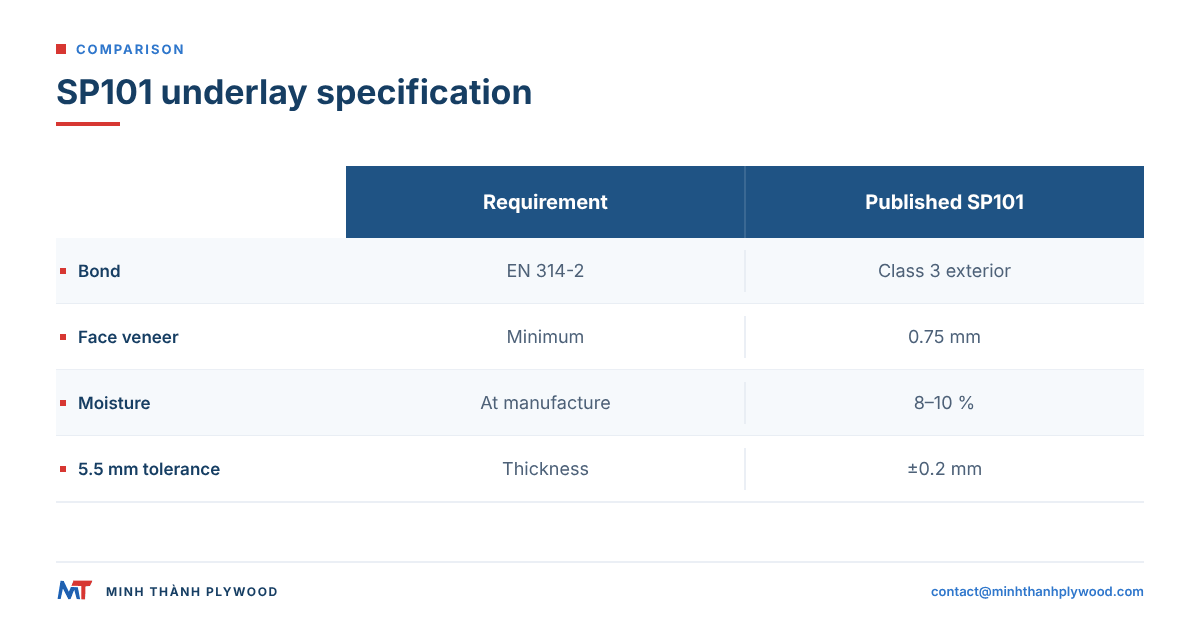
| Glue bond | EN 314-2 Class 3 (exterior) |
| Appearance | Based on Class 1 of EN 635-2 |
| Wood species | Mixed tropical hardwood |
| Face and back veneers | Minimum 0.75 mm |
| Core | Overlay quality, no core overlaps or gaps |
| Thickness tolerance | 5.5 mm: ±0.2 mm; 9 mm: ±0.3 mm |
| Moisture content | 8–10 % at manufacture |
| Average density | About 500 kg/m³ |
| Emission | E1 |
| Marking | CE to EN 13986; face stamped on 5.5 mm only |
Retailer descriptions can differ from the manufacturer sheet: Made of Wood lists EN 636-2 for its 6 mm product. Obtain the declaration of performance for the specific stock being quoted.
The minimum face veneer of 0.75 mm is the line that matters most under vinyl. Faces on general-purpose plywood can be as thin as 0.12 mm, which lets the core pattern show through a thin floor covering and lets adhesive moisture into the core.
What is the thickness of SP101 plywood?
SP101 plywood is listed from 3.6 mm to 25 mm, and 5.5 mm is the standard flooring thickness. 5.5 mm is the only thickness stamped on the face, because it is the one most flooring contractors lay over timber boards before vinyl or LVT.
| Thickness | Typical job | Sheet sizes |
|---|---|---|
| 3.6 mm | Thin overlay where floor height is tight | 2440 × 1220 mm |
| 4 mm | Backing, wall panels and light joinery | 2440 × 1220 mm |
| 5.5 mm | Standard underlay over boards for vinyl and LVT | 2440 × 1220, 1220 × 610 mm |
| 6 mm | Underlay where a little more stiffness is wanted | 2440 × 1220, 1220 × 610 mm |
| 9 mm and 12 mm | Over uneven or wide-spaced boards | 2440 × 1220 mm |
Made of Wood lists its 6 mm SP101 in 1220 × 2440 mm and 610 × 2440 mm formats. Confirm the selected size and current availability when ordering.
The quarter sheet, 1220 × 610 mm, is popular with fitters: it is light enough to carry up stairs and fits small bathrooms and corridors with fewer cuts. A full 1220 × 2440 mm sheet cut into four gives the same 1220 × 610 mm pieces, which a mill can do before packing.
Why does ordinary plywood fail under vinyl and LVT?
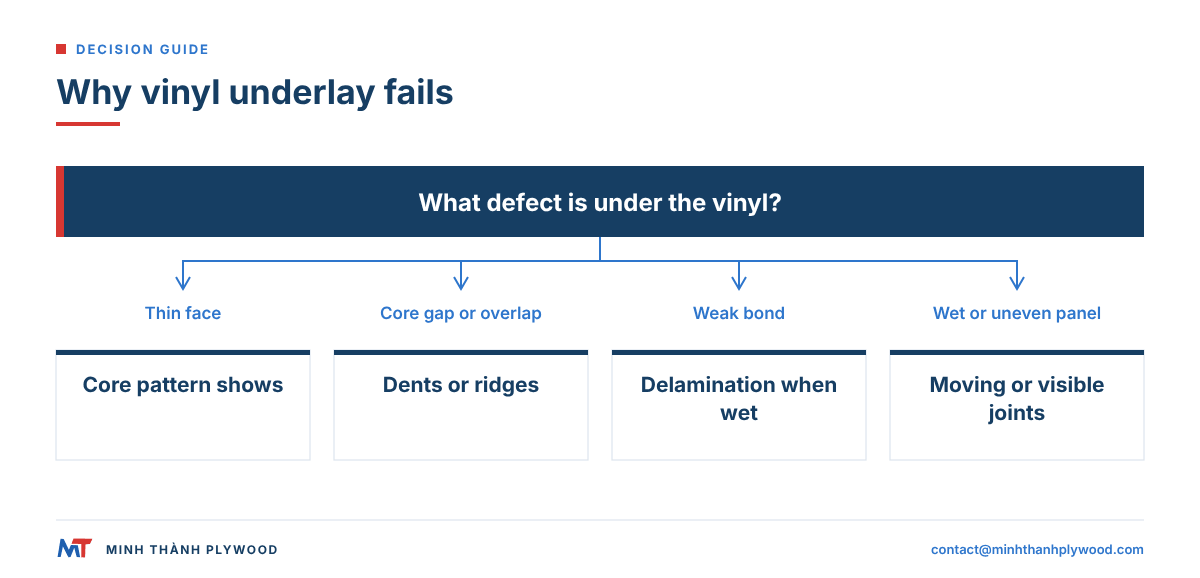
Ordinary plywood fails under vinyl because a thin floor covering shows every fault in the panel beneath it. Five faults cause most failures:
- Thin faces. A face of 0.12 mm takes up glue moisture and dents under furniture feet; the core pattern telegraphs through as lines.
- Core gaps and overlaps. A gap leaves a soft spot that dents; an overlap leaves a ridge that shows under a 2 mm tile.
- Weak glue. Interior bonds can delaminate when the floor adhesive or a spill wets the panel.
- Uneven thickness. A step between two sheets reads through the vinyl at every joint.
- Wet panels. Plywood shipped too wet moves after laying, opening the joints or growing mould under the covering.
Annex A sets a requirement against each of those faults. That is why flooring contractors ask for an Annex A panel by name, and why a distributor sourcing from a mill has to write the same lines on the order.
How does SP101 compare with exterior hardwood plywood from Vietnam?
A general exterior hardwood sheet from Vietnam shares the bond and the sizes with SP101; the face thickness, the core quality and the certification are what make a flooring underlay. A mill can press to all of those lines when the order states them.
| Line on the order | SP101 published value | Standard exterior plywood from Vietnam | What to write for an underlay panel |
|---|---|---|---|
| Bond | EN 314-2 Class 3 | Melamine-fortified or phenolic (WBP) to order | Phenolic (WBP), EN 314-2 Class 3 |
| Face veneer | Minimum 0.75 mm | Utility C/D faces on exterior/CDX-type panels | Minimum face thickness in mm, sanded |
| Core | No overlaps or gaps | Stitched both ways on Minh Thanh panels | Closed core, no overlaps or gaps |
| Thickness tolerance | ±0.2 mm at 5.5 mm | ±0.2–0.3 mm sanded, ±0.5 mm commercial | ±0.2 mm |
| Moisture | 8–10 % | 8–12 % at dispatch | Your range at dispatch |
| Species | Mixed tropical hardwood | Eucalyptus or Styrax core, 10+ faces | Core and face species |
| Proof | CE, quality scheme | Test reports on order | Bond test to EN 314 through SGS |
Minh Thanh’s core layers are stitched both horizontally and vertically before pressing, and furniture-grade panels are pressed twice: the core board is pressed and calibrated, then the faces go on. Those two steps are what keep a thin panel flat and even in thickness, which is the base an underlay panel needs.
Where to buy SP101 plywood: stockists and suppliers
SP101 is sold through flooring distributors and timber merchants in the UK and Ireland, by the sheet, the bundle or the pallet, in full and cut sheets. Fitters usually buy it from the same wholesaler that supplies their vinyl and adhesives.
For a distributor or importer, the question is different: whether to buy the branded panel through the UK supply chain, or to source a panel to the same Annex A lines for its own range from a mill. The second route makes sense when:
- you sell flooring plywood by the container, not by the pallet;
- you want your own brand and stamp on the panel;
- you need sizes or thicknesses outside the branded range, such as 1250 × 2500 mm or a cut 1220 × 610 mm piece;
- you supply markets outside the UK where the branded sheet is not stocked.
In that case the mill is your supplier, and you hold the specification, the testing and any certification for your market.
How do you source an Annex A–type underlay panel from a mill?
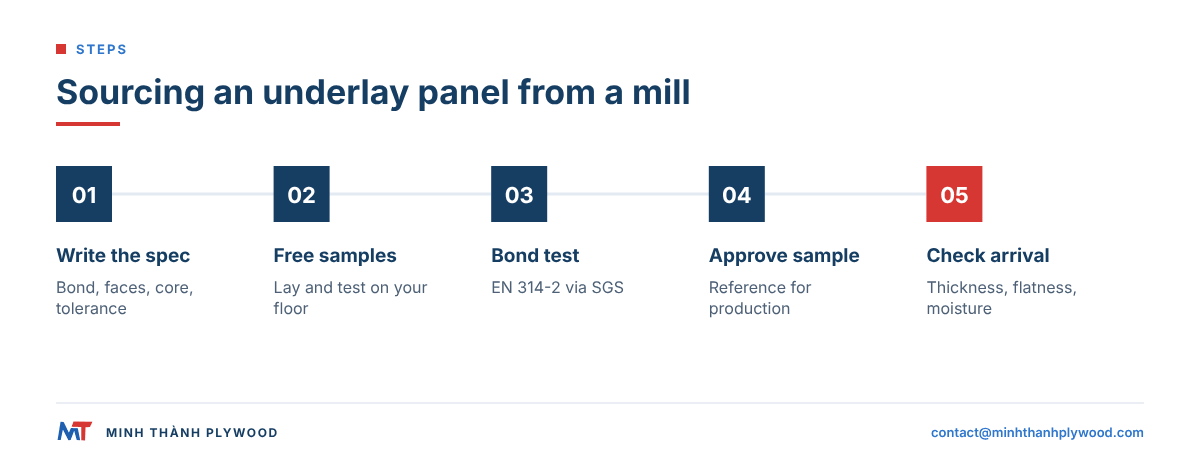
Sourcing a flooring underlay panel from a mill is a five-step job, and the specification is the first step, not the price.
- Write the specification from the Annex A lines: bond class, minimum face thickness, core quality, thickness and tolerance, moisture range, sizes and species.
- Ask for free samples in your thickness and test them on your floor: lay, fix, glue vinyl and check the joints after a week.
- Order a bond test to EN 314-2 Class 3 on the sample panels through an independent laboratory; Minh Thanh arranges third-party testing to the buyer’s method through SGS on request.
- Fix the approved sample as the reference for face, core and thickness, then place a first container.
- Check the first arrival for thickness, flatness and moisture before stock goes to fitters.
Certification under a UK or Irish quality scheme, or CE marking for construction use under EN 13986, is the distributor’s step once the panel is approved. CE marking is available* for Minh Thanh’s construction panels.
*Supplied directly or through qualified partner mills.
Which documents should come with flooring plywood?
A container of flooring plywood comes with the four shipping documents customs needs (commercial invoice, packing list, bill of lading and certificate of origin, EUR.1 for the EU) and the product files your market asks for.
- Bond test report to EN 314-2 on panels from your order, by an independent laboratory.
- What an own-brand Annex A panel needs: a bond report to EN 314-2 Class 3 and the EN 636 service classification required for the application, CE marking to EN 13986 with a declaration of performance for the UK and EU markets, a third-party quality scheme if your buyers ask for the equivalent of the TFT Diamond Mark, and an FSC chain-of-custody claim on request for the stock concerned.
- Emission evidence: Minh Thanh holds CARB P2 / TSCA Title VI certification (ICTT mill no. 23024) for veneer-core hardwood plywood from 3 to 50 mm.
- EUDR compliance dossier (origin records and geolocation files) for EU orders.
- PPWR packaging test: SGS, September 2026, lead, cadmium, mercury and hexavalent chromium not detected against the 100 mg/kg limit of Regulation (EU) 2025/40.
- Loading photos and video of your container, sent before the balance is paid.
For the UK market, the UK Timber Regulation due diligence uses the same origin records.
How is plywood underlay laid under vinyl?
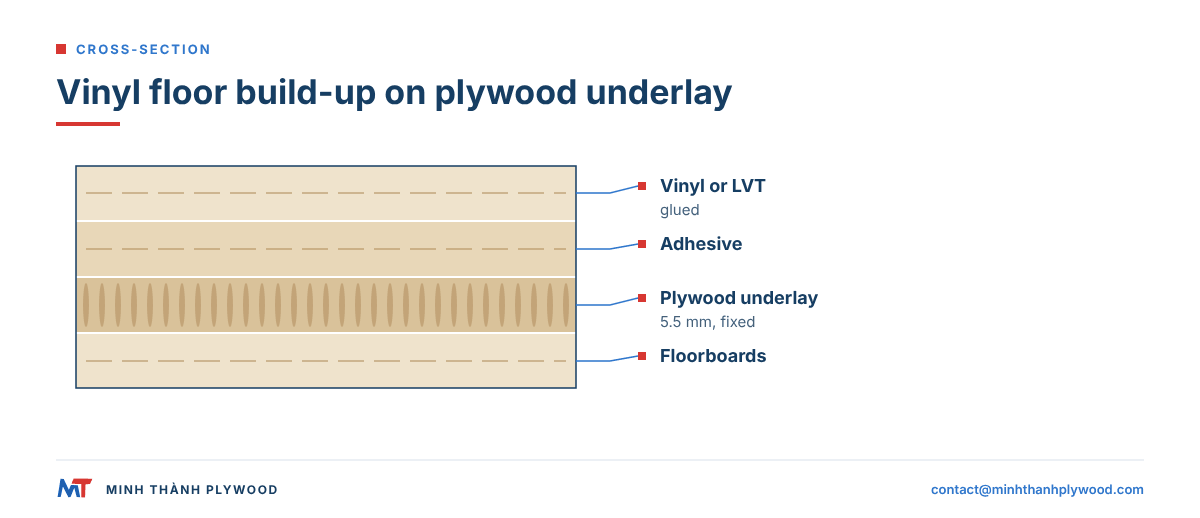
SP101 underlay is fixed to the subfloor. The Made of Wood listing specifies fixed installation and marks the product as unsuitable for floating floors. Follow the floor-covering system instructions for the finished installation.
Hanson’s SP101 application guidelines address moisture checks, acclimatisation, panel direction, staggered joints and fixings. Follow them together with the floor-covering system instructions:
- A sound base: dry, clean, stable boards. The Made of Wood installation listing specifies a maximum 3 mm gap under a 2 m rule.
- Direction: the panel’s face grain laid at 90° to the existing floorboards.
- Fixings: ring-shank nails, divergent staples or wood screws, at the spacing the floor covering maker states.
- Joints: staggered, so four corners never meet at one point.
- Acclimatisation: panels conditioned to the installation environment to reduce moisture-related movement after the covering goes down.
Moisture at dispatch is the mill’s share of point 5. Minh Thanh dries veneers and finished panels to 8–12 %, the normal range for furniture plywood, and wraps the packs for the sea voyage.
How much does a 5.5 mm underlay sheet weigh, and how many fit a container?
A 1220 × 2440 × 5.5 mm sheet holds 0.0164 m³ of wood and weighs about 8.2 kg on a Styrax core (500 kg/m³), 9.5 kg on Acacia (580 kg/m³) and 10.6 kg on Eucalyptus (650 kg/m³). A 40HC holds about 3,258 sheets on a Styrax core.
The following calculation reserves 1,000 kg for packaging within a 28,000 kg planning payload, leaving 27,000 kg for panels. The packaging allowance is an example, not a measured shipment weight.
| Core | Packs | Sheets per pack | Sheets in a 40HC | Volume (m³) | Plywood weight (kg) |
|---|---|---|---|---|---|
| Styrax | 18 | 181 | 3,258 | 53.34 | 26,671 |
| Acacia | 16 | 177 | 2,832 | 46.37 | 26,893 |
| Eucalyptus | 15 | 169 | 2,535 | 41.50 | 26,978 |
Packs have a height ceiling of about 1,000 mm: 1,000 ÷ 5.5 gives 181 whole sheets before the weight check. Each count above is the lower of that height limit and the panel-mass allowance divided by sheet volume, core density and pack count, rounded down per pack. Replace the packaging allowance with the actual packed weight and use the booking limit if lower. A container can mix 5.5 mm and 9 mm underlay with other thicknesses by agreement.
What does flooring plywood cost from Vietnam, and how long does it take?
In October 2026, Minh Thanh commercial plywood starts from US$250/m³ and furniture and interior plywood from US$350/m³. Confirm the construction and delivery term in the quotation. A 5.5 mm sheet is 0.0164 m³, so 61 sheets make one cubic metre; the bond, face, core, tolerance and quantity set the final price.
What SP101 costs in the UK and what the mill figure leaves out
In the UK, Made of Wood lists 6 mm SP101 from £10.10 ex VAT (£12.12 inc VAT) per sheet. Confirm the price for the selected size; the listing’s starting price does not identify a full-sheet quotation. For illustration, multiplying a 5.5 mm sheet volume by assumed rates of US$250/m³ and US$350/m³ gives about US$4.1 and US$5.7. These convert to about £3.1 and £4.3 at the 20 October 2026 ECB rate of US$1 = £0.74925 (Frankfurter).
Those calculated amounts are not comparable product offers. A landed-cost comparison starts with the confirmed panel quotation and includes any excluded freight, applicable import charges, storage, delivery and selling costs. The cited UK Trade Tariff line showed a 0.00 % Vietnam preference and a 6.00 % third-country rate when checked on 21 October 2026. Apply the commodity code for the actual panel and the relevant origin requirements; these rates are not universal across plywood products and origins.
The minimum order is one 40HC, with mixed specifications by agreement. Production takes 15–45 days after the 30% deposit; the 70% balance is paid against the scanned bill of lading, or by irrevocable L/C at sight, on FOB Hai Phong, CFR or CIF terms. Typical days at sea from Hai Phong are 30–40 to Northern Europe, including the UK and Ireland.
What to send for a flooring underlay quote
One line per item gives the mill everything it needs to quote and sample:
5.5 mm × 1220 × 2440 mm, ply count confirmed with the order, phenolic (WBP) bond to EN 314-2 Class 3, closed stitched core, sanded both faces, tolerance ±0.2 mm, moisture 8–12 % at dispatch, for vinyl and LVT underlay; half the packs cut to 1220 × 610 mm; 1×40HC; CIF your port.
Send it to contact@minhthanhplywood.com or WhatsApp +84 988 586 601, with the floor coverings your fitters lay. Replies come within hours, Monday–Friday, 08:00–17:00 Vietnam time, and free samples follow.
Buyer questions, answered
What is SP101 plywood?
SP101 is the trade name of a UK flooring plywood made as an underlay for resilient floor coverings such as vinyl and luxury vinyl tile (LVT). It is manufactured to BS 8203:2017 Annex A, with an exterior EN 314-2 Class 3 bond and a core free of overlaps and gaps.
What is the thickness of SP101 plywood?
The published range runs from 3.6 mm to 25 mm. 5.5 mm is the most common flooring thickness and the only one stamped on the face; 6 mm, 9 mm and 12 mm are also sold.
What sizes does SP101 plywood come in?
Full sheets of 2440 × 1220 mm (8 × 4 ft) and quarter sheets of 1220 × 610 mm, which are easier to carry and lay in small rooms.
Is SP101 a British Standard?
No. SP101 is a product name. The standard behind it is BS 8203:2017, the code of practice for installing resilient floor coverings, whose Annex A sets out the plywood underlay requirements developed from Contract Flooring Association guidance.
Where can I buy SP101 plywood?
In the UK and Ireland it is sold through flooring distributors and timber merchants, by the sheet or the pack. A distributor buying containers can order an underlay panel to the same Annex A lines directly from a plywood mill.
Why use SP101 instead of ordinary plywood under vinyl?
General-purpose plywood can have face veneers as thin as 0.12 mm, core gaps and glue that fails in wet conditions. Under thin vinyl or LVT those faults telegraph through as ridges, dents and lifting; Annex A panels set minimum face thickness, bond class and core quality.
Can SP101 plywood be used under a floating floor?
Use a fixed installation for the SP101 flooring product described here. The retailer marks it as unsuitable for floating floors; follow the specified floor-covering system and its installation instructions.
How much does a 5.5 mm sheet of flooring plywood weigh?
A 1220 × 2440 × 5.5 mm sheet holds 0.0164 m³ of wood. At 500 kg/m³ it weighs about 8.2 kg; on a denser Eucalyptus core at 650 kg/m³, about 10.6 kg.
Can Minh Thanh make a flooring underlay plywood?
Minh Thanh presses calibrated 5.5 mm and 6 mm panels, ply count agreed with the order, with a phenolic (WBP) bond and stitched cores, sanded to ±0.2 mm. Send the Annex A lines you need, and third-party testing to your method is arranged through SGS on request.
What is the minimum order for flooring plywood from Vietnam?
One 40HC container, mixed by agreement, with production 15–45 days after the 30% deposit. A 40HC holds about 3,258 sheets of 1220 × 2440 × 5.5 mm on a Styrax core.