
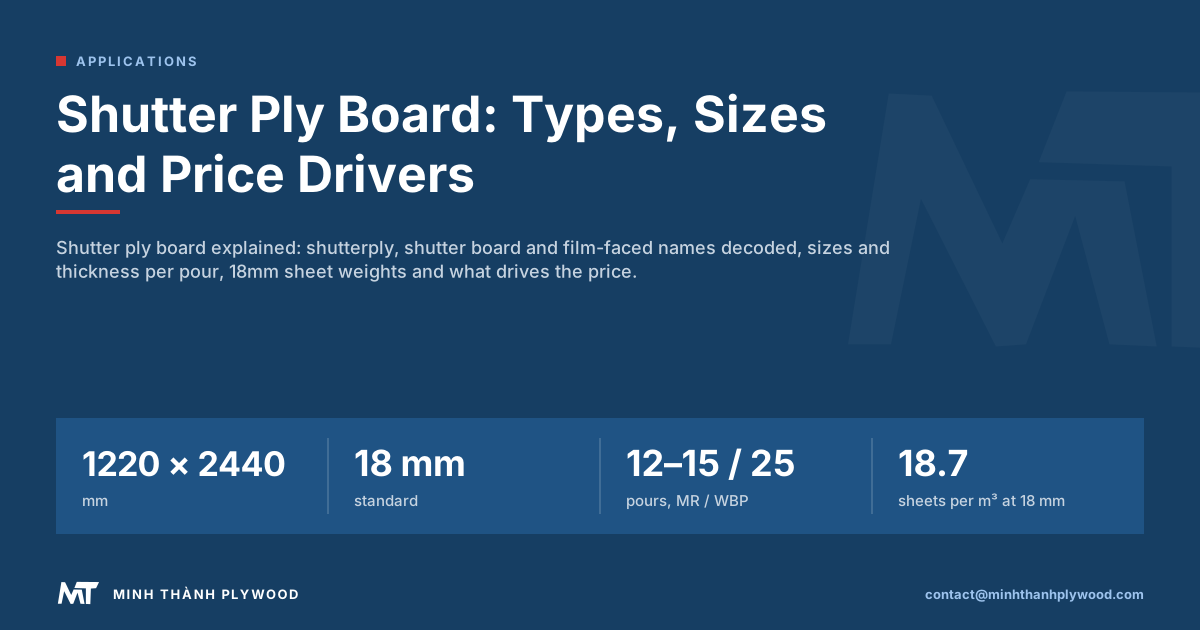
Shutter ply board is plywood used as the face of concrete formwork: either plain-faced hardwood or pine shuttering ply, or film-faced plywood with a resin film for smoother concrete and more pours. The standard sheet is 1220 × 2440 mm, and 18 mm is the usual thickness for walls and columns. Minh Thanh Plywood makes film-faced panels from 12 to 21 mm and exterior-glued plain panels in Vietnam; this guide decodes the names, sizes and price drivers.
What is shutter ply board?
Shutter ply board is plywood used as the face of concrete formwork: the panel the concrete touches while it sets. It comes in two main kinds: plain-faced shuttering ply with hardwood or pine faces, and film-faced plywood with a resin-impregnated film for a smoother finish and more pours.
The panel does three jobs in a form. It holds the shape of the wet concrete, it carries the concrete pressure to the studs and walers behind it, and it gives the concrete its surface. The first two depend on thickness and core; the third depends on the face.
Three choices make one sheet of shutter ply board different from another:
- Face: plain veneer (hardwood or pine) or a phenolic or melamine resin film.
- Glue: melamine-fortified (MR) for a limited number of pours or phenolic WBP for repeated wetting.
- Core and thickness: the core species sets weight and stiffness; the thickness sets how far the sheet can span between supports.
Our film-faced plywood is the form face most of our construction buyers order; plain exterior-glued panels cover hoarding, temporary works and backing forms.
Shutterply, shutter board, shuttering ply: are they the same product?
Yes. Shutterply, shutter ply board, shutter board, shuttering ply and formwork plywood are regional names for the same family of panels. The name tells you the job; it does not tell you the face, glue or core, which is why two quotations for “shutter ply” can describe very different boards.
| Name on the order | Where it is common | What it usually means |
|---|---|---|
| Shuttering ply, shuttering plywood | UK, Ireland, India | Plain-faced hardwood plywood with an exterior glue |
| Shutter ply, shutterply, shutter ply board | South Africa, India, Middle East | Plain or film-faced formwork plywood |
| Shutter board | South Africa, East Africa | Any board for formwork, often film-faced |
| Film-faced plywood, phenolic board | Worldwide | Plywood with a resin film on both faces |
| Formwork plywood | Europe, Australia | Film-faced or plain panels for formwork systems |
| Plyform | United States | APA-graded concrete form plywood classes |
In the United States, concrete form plywood is graded by APA – The Engineered Wood Association under its Plyform classes; our guide to Plyform plywood covers that system. Whatever the name, write the face, glue, core, thickness and size on the order.
Which types of shutter ply board are there?
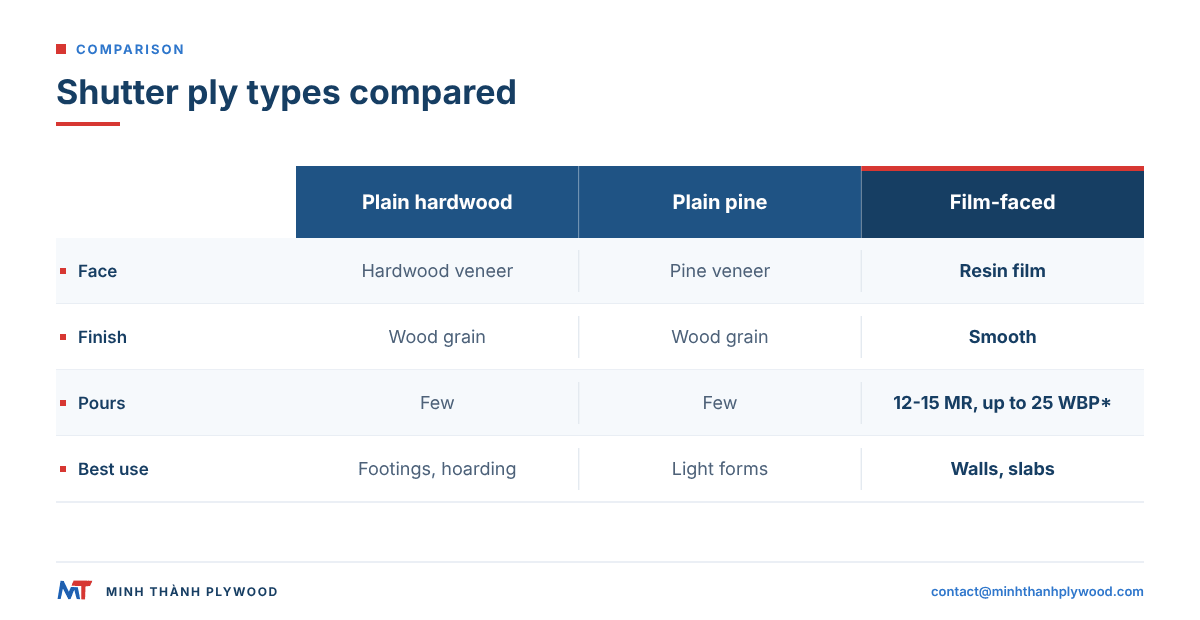
There are three types: plain hardwood-faced shuttering ply, plain pine-faced shuttering ply and film-faced plywood. Plain panels cost less per sheet and suit rough finishes and few pours; film-faced panels cost more per sheet and give smoother concrete and many more pours.
| Metric | Plain hardwood-faced | Plain pine-faced | Film-faced |
|---|---|---|---|
| Face | Hardwood veneer, utility grade | Pine veneer, graded A/A to B/C | Phenolic or melamine resin film |
| Typical glue | MR or phenolic WBP | MR or phenolic WBP | MR or phenolic WBP |
| Concrete finish | Shows wood grain | Shows wood grain | Smooth, close to fair-faced |
| Pours per sheet | Few; face wears quickly | Few; face wears quickly | About 12–15 (MR) or up to about 25 (WBP)* |
| Release agent | Needed every pour | Needed every pour | Needed every pour |
| Best use | Footings, blinding, hidden concrete, hoarding | Light forms, temporary works | Walls, columns, slabs, visible concrete |
*With proper handling, release agent and edge sealing.
Film-faced plywood is the most ordered type for walls, columns and slabs because the cost per pour, not the cost per sheet, decides the budget. Plain panels win where concrete will be buried or covered, or where the form is used once. Our HDO vs MDO comparison explains the overlay types used in North American forming.
What sizes does shutter ply board come in?
The standard shutter ply board size is 1220 × 2440 mm, the metric form of 8 × 4 feet, and the common thicknesses are 9, 12, 15, 18 and 21 mm. Some formwork systems and European markets use 1250 × 2500 mm sheets instead.
| Size field | Standard | Also available |
|---|---|---|
| Sheet size | 1220 × 2440 mm | 1250 × 2500 mm; custom sizes such as 1220 × 2500 mm |
| Film-faced thickness | 12, 15, 18, 21 mm | Within 12–21 mm to order |
| Plain panel thickness | 9–18 mm | Other thicknesses to order |
| Thickness tolerance | ±0.5 mm | — |
| Length and width tolerance | ±2 mm | — |
Thickness tolerance matters more on formwork than buyers expect. Two sheets side by side in a wall form that differ by a full millimetre leave a step in the concrete. Our film-faced and commercial panels are held to ±0.5 mm, and sheet size to ±2 mm. The shuttering plywood sizes guide lists every format in detail.
UK merchants also sell cut sizes of the 1220 × 2440 mm (8 × 4 ft) sheet: 4 × 4 ft, 4 × 2 ft, 2 × 2 ft and 2 × 1 ft, with custom cuts at about £2.50 each at one national merchant. We cut 1220 × 2440 mm sheets to size at the factory, so a distributor can buy the full sheet and stock the cut formats.
Shutter ply 18mm or 12mm: which thickness for which pour?
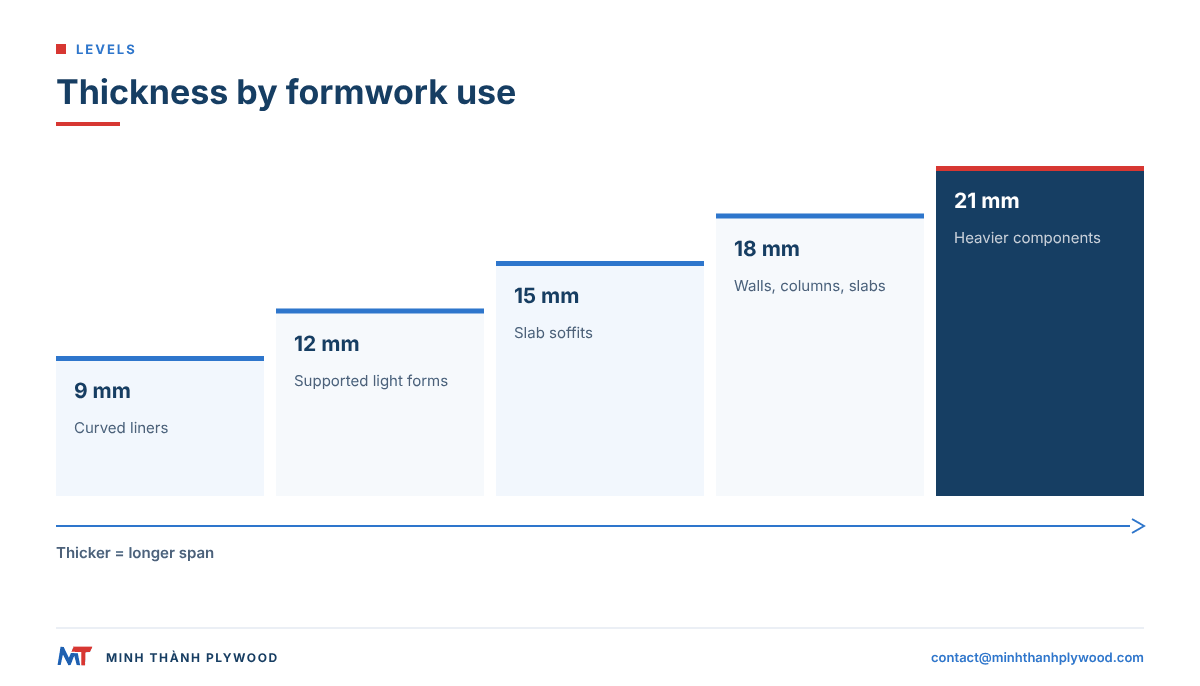
Use 18 mm for walls and columns, 15 mm for closely supported slab soffits, 12 mm for supported light forms and liners and 21 mm for heavier formwork components. Thinner sheets need closer supports; the formwork design sets the final choice from concrete pressure and support spacing.
| Thickness | Typical formwork use | 1220 × 2440 mm sheet on Acacia core |
|---|---|---|
| 9 mm | Curved liners, backing for system forms | About 15.5 kg |
| 12 mm | Supported light forms, liners | About 20.7 kg |
| 15 mm | Closely supported slab soffits | About 25.9 kg |
| 18 mm | Walls, columns, slabs: the standard sheet | About 31.1 kg |
| 21 mm | Heavier formwork components | About 36.3 kg |
Sheet weights are calculated from an Acacia core density of about 580 kg/m³. On a Eucalyptus core at 650 kg/m³, add about 12 % to each sheet. Our guide to plywood formwork design shows how concrete pressure and deflection set the support spacing for each thickness.
Is 18mm shuttering ply the standard sheet?
Yes. 18mm shuttering ply is the standard sheet for wall, column and slab formwork in most markets, because it spans common stud and joist spacings without excessive deflection and still weighs little enough for two people to handle.
What an 18 mm sheet weighs depends on the core:
- Acacia core (about 580 kg/m³): about 31.1 kg per 1220 × 2440 mm sheet.
- Eucalyptus core (650–750 kg/m³): about 34.8 kg at 650 kg/m³ and up to about 40.2 kg on the densest Eucalyptus.
That is why price lists in some markets quote “30 kg” or “34 kg” shuttering plywood: the sheet weight is a quick signal of the core. A heavier sheet of the same thickness usually means a denser core, which is stiffer and holds nails and screws better through many strip-and-reset cycles.
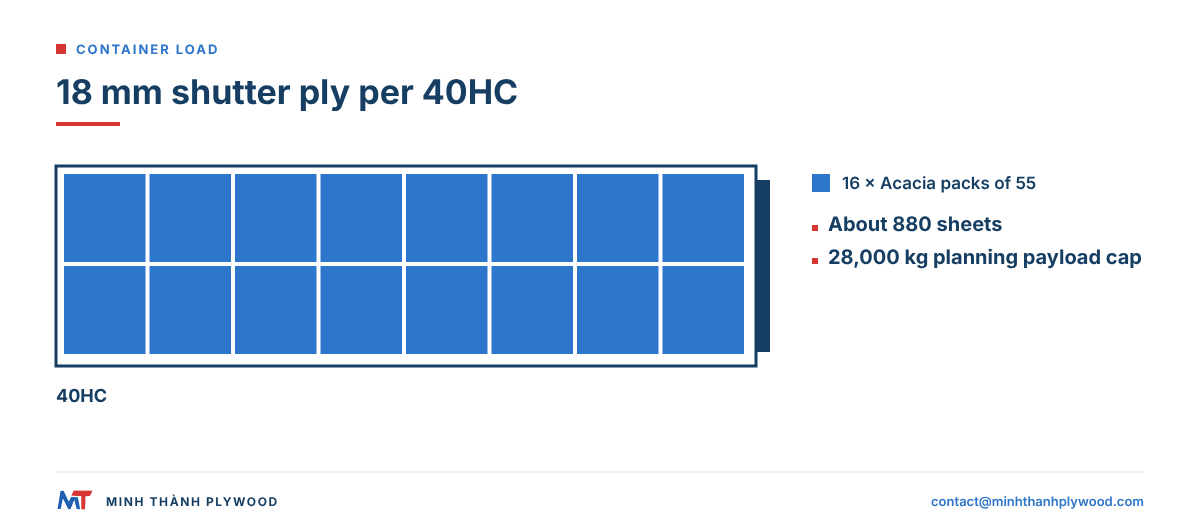
In a 40HC, 18 mm loads plan at about 880 sheets on Acacia core (16 packs of 55) or about 795 sheets on Eucalyptus core (15 packs of 53), each capped by weight at a 28,000 kg planning payload or the lower limit of your booking.
Is shuttering plywood waterproof?
No plywood is fully waterproof. On shuttering plywood the glue line, and on film-faced panels the film, resist water; the edges, cuts and holes do not. Phenolic WBP glue keeps the plies bonded through repeated wetting, while MR glue suits fewer pours and drier storage.
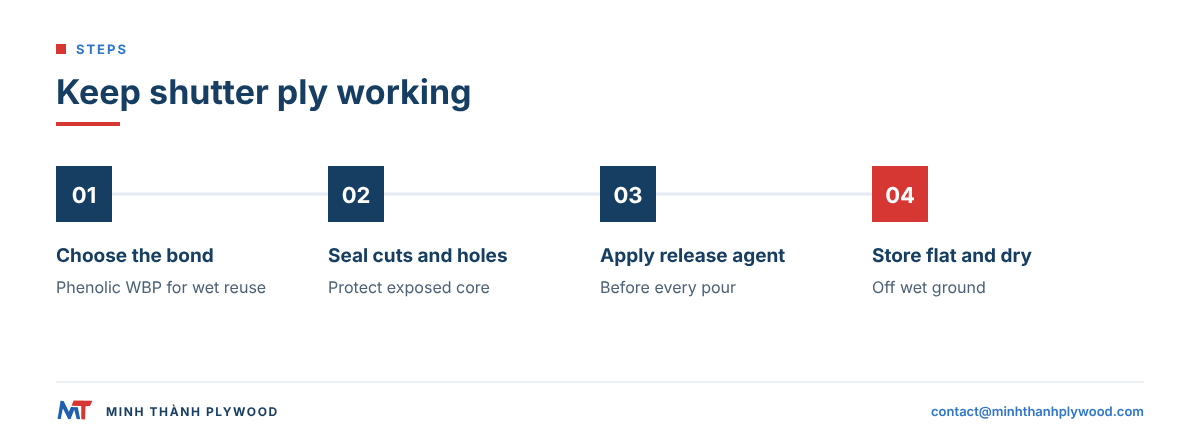
What keeps a shutter ply board working from pour to pour:
- Order the right bond. Phenolic WBP for repeated pours and wet sites; melamine-fortified for budget, short-cycle work.
- Seal every cut and hole. Fresh edges drink water and swell. Paint them with an edge sealer before first use.
- Use release agent every pour. It protects the film and makes stripping clean. Our sibling article on concrete form release agents covers the types.
- Store flat and dry. Stack sheets on bearers, covered, off wet ground between pours.
Our film-faced panels leave the factory at 8–12 % moisture with a melamine-fortified or phenolic WBP bond, as ordered.
What drives shutter ply board prices?
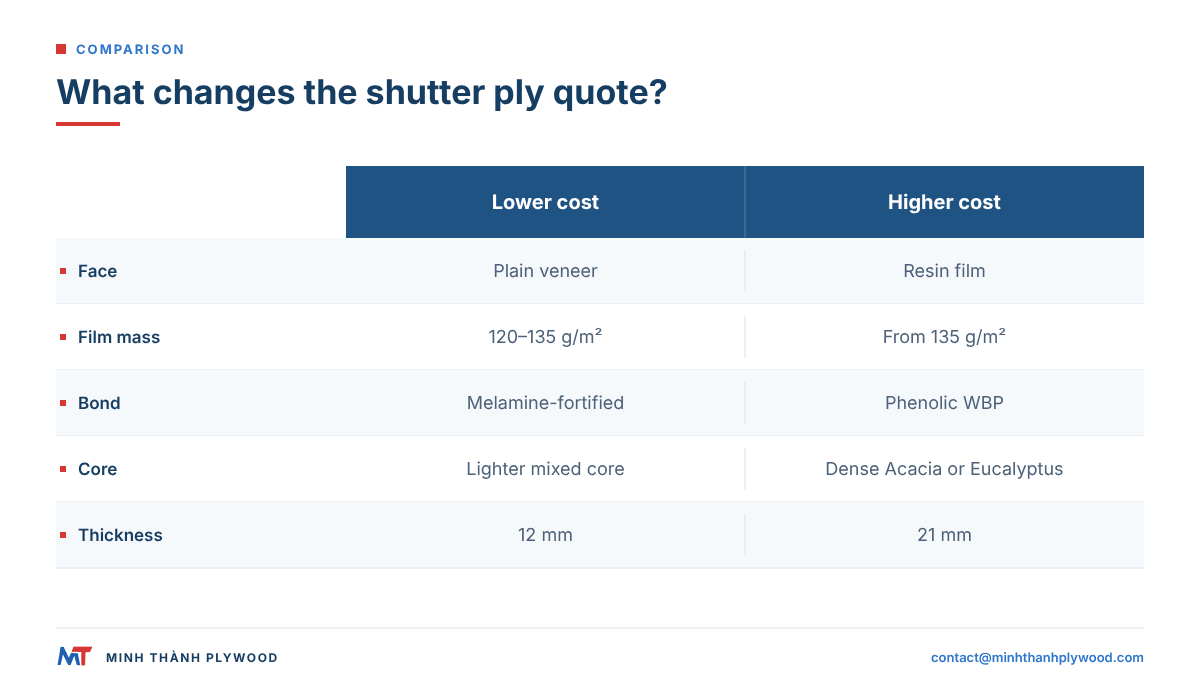
Six things set the price of shutter ply board: the core species, the face (plain or film, and the film mass), the glue, the thickness, the sheet size and the order quantity and delivery term. Two quotes for “18 mm shutter ply” can differ widely because they describe different panels.
| Price driver | Lower cost | Higher cost |
|---|---|---|
| Face | Plain hardwood or pine veneer | Resin film; heavier film mass |
| Film mass | Standard 120–135 g/m² | Premium from 135 g/m² |
| Glue | Melamine-fortified (MR) | Phenolic WBP |
| Core | Lighter, mixed core | Dense Eucalyptus or Acacia core |
| Thickness | 12 mm | 21 mm (more wood per sheet) |
| Quantity and term | Full 40HC, FOB | Small lots, delivered |
Plywood is priced per cubic metre at the factory and per sheet at the merchant. A 1220 × 2440 × 18 mm sheet is about 0.0536 m³, so one cubic metre is about 18.7 sheets; a 12 mm sheet is about 0.0357 m³, or 28 sheets per cubic metre. Multiply the price per m³ by the sheet volume to compare a factory quote with a local sheet price.
As a dated guide, our commercial plywood starts from US$250/m³ (October 2026). Film-faced panels are quoted per specification, because film mass, core and bond each move the price. The film-faced plywood price guide explains the comparison per pour.
What does shutter ply board cost per sheet in the UK?
UK merchants list pine shuttering plywood at about £15–27 ex VAT per 1220 × 2440 mm sheet in October 2026, and a factory-direct container works out far below that per sheet before freight.
| UK merchant listing, 1220 × 2440 mm | Ex VAT per sheet | Notes |
|---|---|---|
| 12 mm Elliotis pine C+/C, CE2+, FSC | £14.85 | Sheet Materials Wholesale |
| 12 mm Uruguayan pine B/C, CE2+, FSC | £20.39 | Sheet Materials Wholesale |
| 15 mm Elliotis pine C+/C, CE2+, pack of 60 | £16.93 | Sheet Materials Wholesale |
| 18 mm Elliotis pine C+/C, CE2+, FSC | £20.65 | Sheet Materials Wholesale |
| 18 mm Uruguayan pine BCX, CE2+, FSC | £26.75 | Sheet Materials Wholesale |
| Shutter plywood, two sheet sizes | £18.90–23.63 | Park Timber, Midlands |
Next to those, the factory-direct arithmetic for an 18 mm sheet: at our commercial starting price of US$250/m³ a sheet of 0.0536 m³ is a raw FOB example of about US$13.40, before film, a Eucalyptus core or phenolic bond, which are quoted per specification.
Sea freight from the Far East to Felixstowe ran about £3,300–3,600 per 40ft in late summer 2026; a 40HC of 18 mm Eucalyptus-core sheets (795 sheets) carries that at about £4.15–4.53 per sheet. Duty on Eucalyptus-faced plywood (commodity code 4412 33 90) is 6 % from third countries and 0 % on Vietnam-origin goods under the UK-Vietnam free trade agreement; VAT is 20 %. The gap between a merchant’s £20 sheet and a container landed at a fraction of that is what a UK importer or builders’ merchant buys direct for.
Pine, hardwood or film-faced: which should a contractor buy?
Buy film-faced plywood for any concrete that will be seen or for forms reused many times; buy plain hardwood-faced shuttering ply for buried concrete, footings and one-off forms; buy pine-faced panels for light temporary works where a lighter sheet is easier to handle.
Verdict by use:
- Exposed walls, columns, soffits: film-faced, phenolic WBP, 18 mm. Smoothest finish, most pours.
- Slabs on system props: film-faced, 15–18 mm to the system’s support spacing.
- Footings, pile caps, blinding: plain hardwood-faced with WBP or MR glue. The concrete is buried.
- Site hoarding and temporary covers: plain panels with exterior glue; utility C/D faces are enough.
- Light forms and edge boards: pine-faced panels, graded A/A, A/B, B/B or B/C to the sample.
We supply all three. Our exterior plywood has low-grade C/D faces with melamine-fortified or phenolic WBP glue for hoarding and temporary works, and our pine plywood is quoted in face/back pairs from A/A to B/C, comparable to European softwood face classes I to IV.
What do importers stock and what do contractors buy?
Importers and builders’ merchants usually stock 18 mm film-faced plywood in 1220 × 2440 mm, with 12 mm and 15 mm as second lines, and keep plain shuttering ply for footings and hoarding. Contractors on large projects often order by the container, to the formwork system’s size and film.
An importer’s container is planned around fast-moving lines: one or two specifications per 40HC is normal, and three to six are possible by agreement. A typical split is 18 mm film-faced as the main line with 12 mm or 15 mm as a second. Contractors ordering direct fix the film colour, film mass, bond and size to their system, and order the full quantity of one specification for a project.
For both, three checks before the first container:
- Sample on site. Pour against a sample sheet and judge the finish and the stripping.
- Thickness and size. Measure several sheets: ±0.5 mm in thickness and ±2 mm in size.
- Edge sealing. Check the factory-sealed edges are fully covered, especially at the corners.
Our sibling guide on film-faced plywood for hot climates covers storage and handling in the Middle East and Africa.
Which Vietnamese factories supply film-faced shuttering plywood?
Minh Thanh Plywood, in Ha Hoa, Phu Tho, is a Vietnamese manufacturer that supplies film-faced shuttering plywood for export: 12–21 mm panels on Eucalyptus or Acacia cores, standard film of 120–135 g/m² or premium film from 135 g/m², with melamine-fortified or phenolic WBP glue.
What a contractor or importer gets from a factory order:
- Sheets: 1220 × 2440 or 1250 × 2500 mm, ±0.5 mm in thickness, 8–12 % moisture at dispatch.
- Order: minimum one 40HC; production 15–45 days after the 30% deposit; balance 70% against the scanned B/L, or irrevocable L/C at sight.
- Terms: FOB Hai Phong, CFR or CIF.
- Transit: typical time at sea from Hai Phong is 15–25 days to the Middle East, 35–50 days to West Africa and 30–40 days to Northern Europe, by carrier and route.
- Proof before loading: every shipment is photographed and filmed before loading, and buyers receive the photos and video.
Our quality page lists the certificates and test reports behind our panels. The factory has over 20 years of plywood-making experience and a capacity of 50,000+ m³ per year, with furniture plywood as its main line and film-faced, commercial and packing panels alongside.
What should a shutter ply board order say?
A shutter ply board order should state the face and film, the film mass, the glue, the core, the thickness and tolerance, the sheet size, the edge sealing, the quantity and the delivery term. With those lines, every quote you receive describes the same panel.
Shutter ply board: film-faced plywood, brown film both faces, 120–135 g/m², Eucalyptus core, phenolic WBP glue, 18 mm ±0.5 mm, 1220 × 2440 mm, edges sealed, moisture 8–12 %; 1×40HC; CFR [your port].
For UK projects, name the required bonding class to EN 314-2 on the order. For construction use, EN 13986 covers panel characteristics, conformity assessment and marking; the project specification must identify the applicable requirements. We arrange third-party testing to the buyer’s method through SGS on request. FSC chain of custody or PEFC certification is a separate requirement the buyer names in the enquiry.
For plain shuttering ply, replace the film line with the face and back grade, for example “C/D utility faces, phenolic WBP glue”. Free samples are available, and a sample poured against on site settles more questions than a datasheet.
Send the specification line, the formwork system you use and the destination port through our quotation page, or read the concrete form plywood buying guide for the full formwork picture.
Buyer questions, answered
How much does shuttering plywood cost per sheet in the UK?
UK merchants list 12 mm pine shuttering plywood at about £15–20 and 18 mm at about £21–27 ex VAT per 1220 × 2440 mm sheet in October 2026. A distributor importing a 40HC buys the same size at a raw FOB example of about US$13.40 for 18 mm, before film and freight.
What is shuttering plywood?
Shuttering plywood is plywood used to build the moulds that hold wet concrete until it sets. It comes plain-faced, in hardwood or pine, or film-faced with a resin film that gives a smoother concrete surface and more reuses.
Is shuttering ply waterproof?
The glue line and, on film-faced panels, the film resist water, but no plywood is waterproof at its edges. Order phenolic WBP glue for repeated pours, seal every cut edge and keep sheets off wet ground between uses.
Is shutterply the same as shuttering ply?
Yes. Shutterply, shutter ply, shutter board and shuttering ply are regional names for the same family of formwork plywood. What matters is the face, the glue, the core and the thickness written on the order, not the name.
What size is a sheet of shutter ply board?
The standard sheet is 1220 × 2440 mm, the metric form of 8 × 4 feet. Some markets use 1250 × 2500 mm. Thicknesses run from 9 mm for liners to 21 mm for heavy formwork, with 18 mm the most common.
How much does an 18mm shuttering ply sheet weigh?
A 1220 × 2440 × 18 mm sheet weighs about 31.1 kg on an Acacia core and about 34.8 kg on a Eucalyptus core at 650 kg/m³; denser Eucalyptus can reach about 40.2 kg.
How many times can film-faced shutter ply be reused?
Melamine-fortified film-faced panels give about 12–15 uses and phenolic WBP panels up to about 25, with proper handling, release agent and edge sealing. Plain-faced shuttering ply gives fewer pours and a rougher finish.
Can I use shuttering ply for flooring?
Plain shuttering ply can serve as a temporary floor or a subfloor under a covering. For a finished floor that must grip when wet, such as a trailer or a platform, use anti-slip film-faced plywood instead.
What is the Indian standard for shuttering plywood?
In India shuttering plywood is specified under IS 4990, the Bureau of Indian Standards specification for plywood for concrete shuttering work. Quote the standard on the order when the project requires it, together with the test evidence.
Which is the best shuttering plywood brand?
The best shuttering plywood is the one whose core, glue and film suit your pour cycle, whatever the brand. Compare core species, film mass, bond and thickness tolerance on the specification, then test a sample on site.
Do Vietnamese factories supply film-faced shuttering plywood to the Middle East?
Yes. Minh Thanh Plywood makes film-faced plywood in 12–21 mm on Eucalyptus or Acacia cores and ships FOB Hai Phong, CFR or CIF; typical time at sea to the Middle East is 15–25 days.