
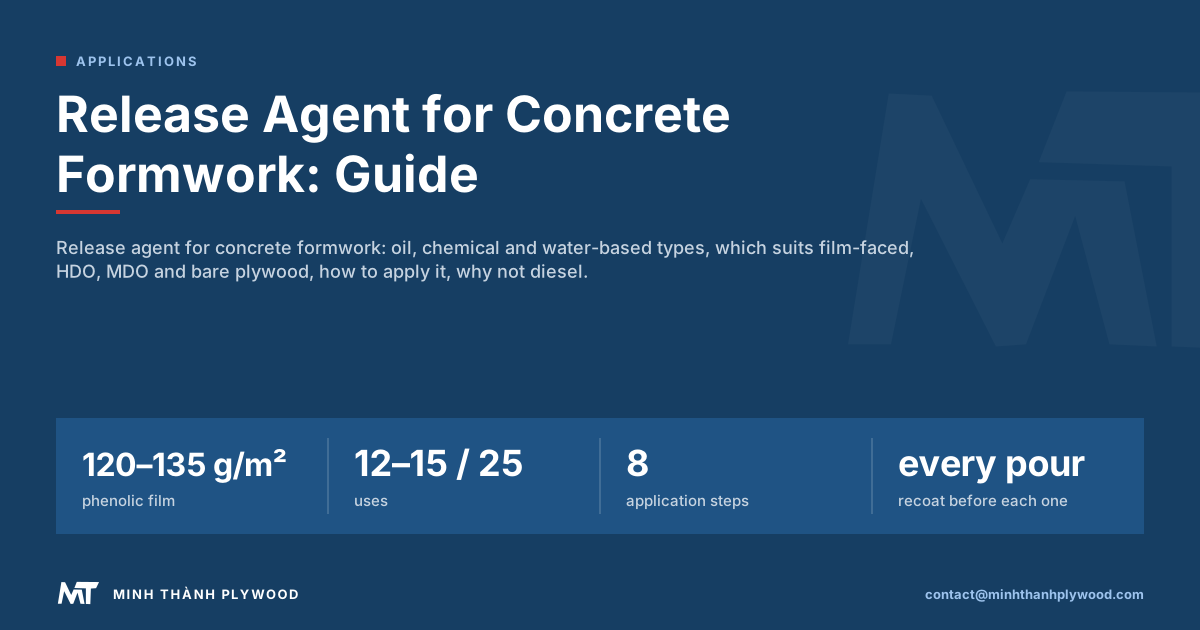
A release agent for concrete formwork is a thin coat on the form face that stops cement paste bonding to it, so the form strips cleanly and the concrete keeps a sound surface. Match the agent to the face: chemical or water-based agents for film-faced and HDO plywood, heavier coats on bare plywood. Minh Thanh Plywood makes film-faced plywood for concrete formwork.
What is a release agent for concrete formwork?
A release agent for concrete formwork is a liquid applied to the face of the form before the pour that stops cement paste bonding to the face. The form then strips cleanly, the concrete surface stays sound, and the panel is ready for the next use.
It works in one of two ways:
- Barrier. An oil film physically separates the paste from the face.
- Chemical reaction. Fatty-acid compounds in the agent react with the lime in fresh cement paste and form a thin soapy layer at the surface, which does not bond to the form.
Concrete form release agents are also called formwork oil, shuttering oil, mould oil or form release. The name does not tell you the chemistry; the product data sheet does.
Will concrete stick to plywood?
Concrete sticks firmly to bare plywood. Cement paste soaks into open wood fibres, hardens there and tears them out when the form is stripped, leaving a rough panel and a damaged concrete surface. Two layers stop this: a sealed face that keeps paste out of the wood, and a thin release agent coat on that face.
The two layers in detail:
- A sealed face. Film-faced plywood carries a phenolic film pressed onto both faces, 120–135 g/m² on our standard grade and from 135 g/m² on premium. HDO and MDO plywood carry resin-fibre overlays. The film keeps paste out of the wood.
- A release agent. A thin coat on the film stops the paste gripping the film itself, so the panel strips cleanly pour after pour.
Bare plywood needs a heavier coat, often a sealing first coat before the first pour, and still gives far fewer uses.
Types of concrete form release agent
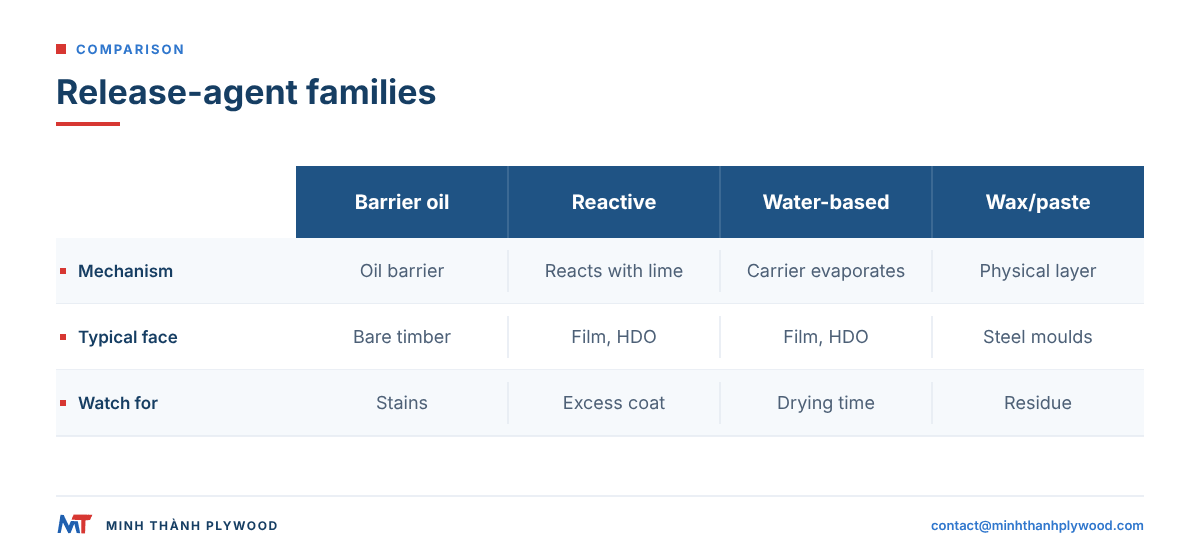
Concrete form release agents fall into four groups: barrier oils, chemically reactive agents, water-based emulsions and specialty products such as waxes and pastes.
| Type | How it works | Suits | Watch for |
|---|---|---|---|
| Barrier oil (mineral or vegetable) | Oil film separates paste from face | Bare plywood, timber, hidden concrete | Staining, bug holes from heavy coats, poor adhesion for paint and render |
| Chemically reactive agent | Fatty acids react with lime to form a non-stick soap layer | Film-faced plywood, HDO, steel, fair-faced concrete | Needs a thin, even coat; reaction time before the pour |
| Water-based emulsion | Water carries the active agent and evaporates | Film-faced plywood, HDO, enclosed spaces | Must dry before the pour; protect from frost and rain |
| Wax, paste and specialty agents | Heavier physical layer | Steel moulds, precast, complex shapes | Residue prints into concrete; poor fit on plywood |
Reactive agents are often vegetable-based and water-based emulsions are sold as concentrates that you dilute on site. Most modern “formwork oils” are hybrids: a refined oil carrier with chemically reactive additives. They behave like reactive agents when applied thin.
Which release agent for which plywood face?
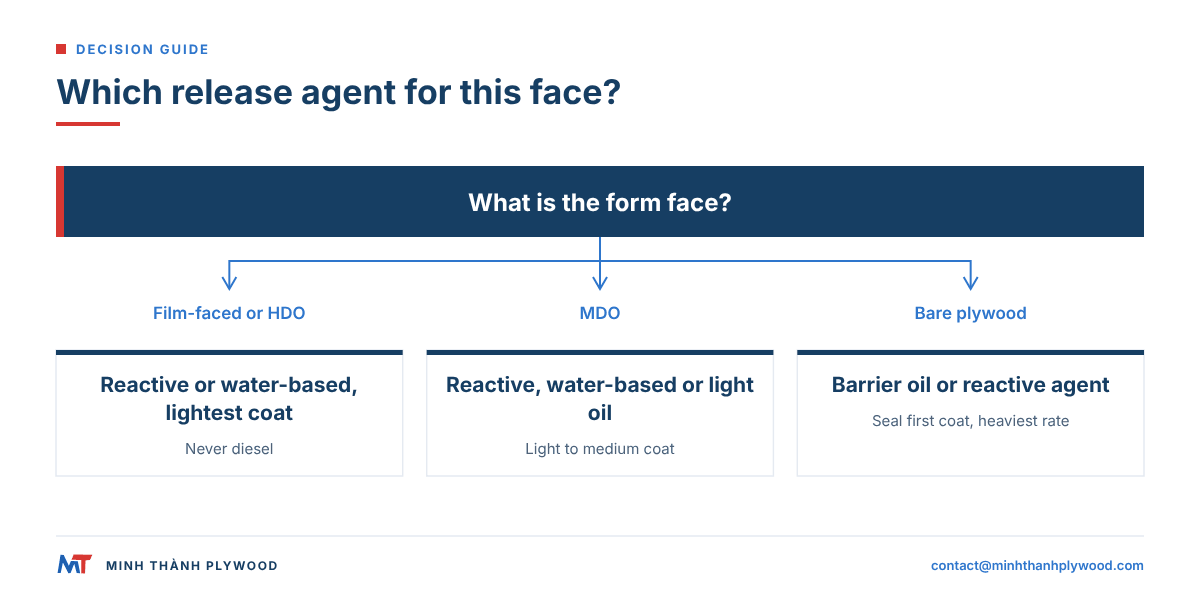
The form face decides the agent and the coat. A sealed, dense face takes a light coat of a reactive or water-based agent; an open face takes a heavier coat and tolerates barrier oils.
| Form face | Best agent | Coat | Note |
|---|---|---|---|
| Film-faced plywood | Chemically reactive or water-based | Lightest, thin and even | Never diesel or heavy oils; they soften the phenolic film |
| HDO plywood | Chemically reactive or water-based | Lightest | Glossy face shows every streak of excess agent |
| MDO plywood | Reactive, water-based or a light barrier oil | Light to medium | Matte overlay is slightly more open than film |
| Bare or sanded plywood | Barrier oil or reactive agent | Heaviest; a sealing first coat before the first pour | Grain prints into the concrete; fewer uses |
| Steel and aluminium | Reactive agent or specialty agent | Very light | Rust protection is a separate need |
For the difference between HDO and MDO overlays, see our HDO vs MDO plywood guide. For the panel itself, our concrete form plywood buying guide matches film, glue and core to each pour.
What is the best release agent for concrete forms?
The best release agent for concrete forms of film-faced or HDO plywood is a chemically reactive agent or a water-based emulsion, applied thin before every pour. It gives the cleanest strip, an even concrete colour and the longest life from each panel.
Choose by three questions:
- What is the form face? Film-faced, HDO, MDO or bare plywood (table above).
- What finish does the concrete need? Fair-faced concrete left exposed calls for a reactive agent and a single product for the whole job. Concrete that will be painted or rendered needs an agent the coating maker accepts.
- Where is the work? Enclosed spaces, hot climates and sites near water favour water-based or low-solvent products.
On fair-faced work, test the agent on a trial panel with the real concrete mix and keep the same product, panel batch and crew method from the first pour to the last. Our guide to fair-faced concrete and the plywood finish covers the panel side.
How to apply form release agent: step by step
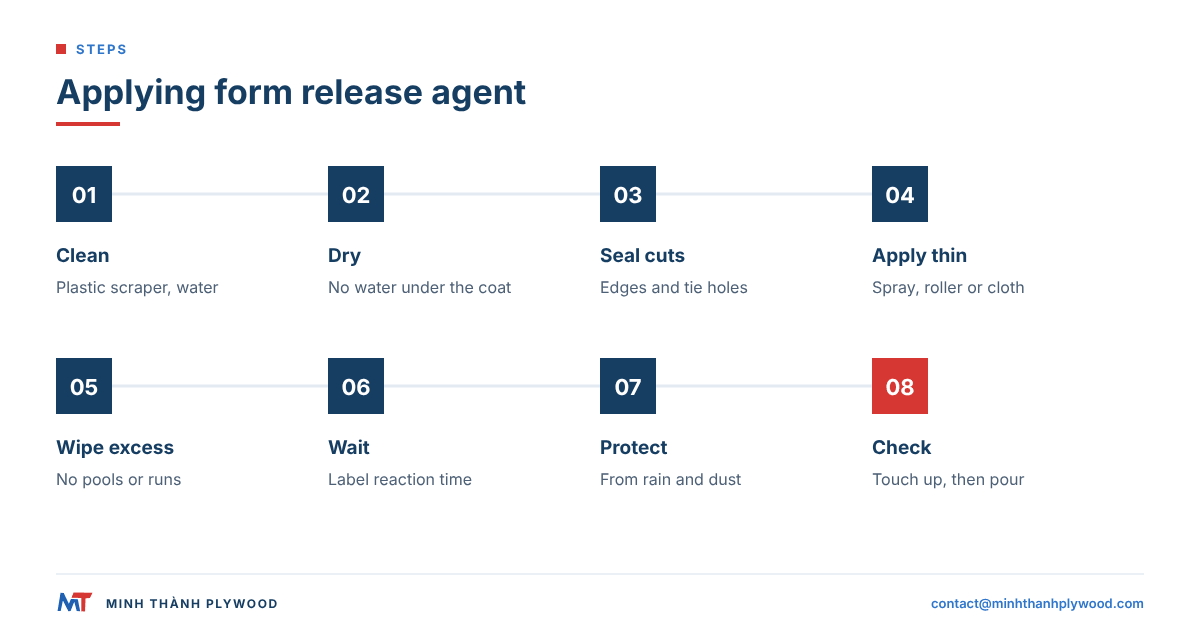
Most release problems are application problems. Apply the agent to a clean, dry face in a thin, even coat, and pour within the time the label gives.
- Clean the face. Remove cement residue with a plastic or rubber scraper and water. No wire brushes or steel scrapers on film or overlays.
- Let it dry. Water under the agent blocks the coat and leaves blotches on the concrete.
- Seal cuts and holes. Coat fresh saw cuts and tie holes with edge sealer before the release agent; see cutting and painting film-faced plywood.
- Apply thin and even. Low-pressure sprayer with a fan nozzle, a lint-free roller or a cloth. Aim for a faint sheen, never a wet, dripping film.
- Wipe off excess. Remove runs and pools in corners and at the bottom of wall forms with a cloth.
- Allow reaction or drying time. Apply the agent the same day as the pour, about 15 to 30 minutes before the concrete goes in. A water-based agent sets in about 10 to 20 minutes, turning from milky to clear, depending on temperature and humidity (MudMixer guide, checked in October 2026). Follow the label for reactive and oil products.
- Protect the coat. Keep coated forms out of rain and dust, and recoat areas walked on or left exposed for long.
- Check before the pour. Walk the forms in raking light and touch up missed patches.
Coat wall and column panels before they are erected where you can, so the agent does not fall on the reinforcement. Agent on rebar weakens the bond between steel and concrete.
How much release agent: coverage and coat thickness
Use the least agent that covers the whole face evenly. The right coat on film-faced plywood is a thin film you can barely see; more agent does not release better, it pools, stains and causes bug holes.
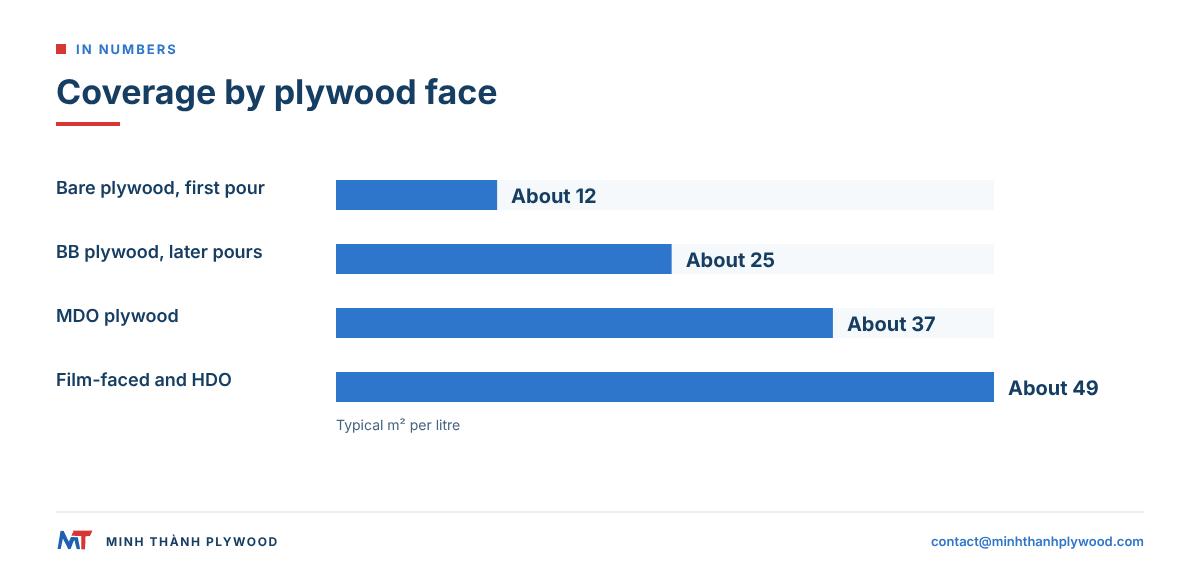
| Face | Typical coverage, US units | Typical coverage, m2 per litre | What a correct coat looks like |
|---|---|---|---|
| Steel and aluminium | Up to 2,000 sq ft per gallon | About 49 | Faint sheen; the main risk is rust, not coverage |
| Film-faced and HDO plywood | About 2,000 sq ft per gallon | About 49 | Faint, even sheen; no drops |
| MDO plywood | About 1,500 sq ft per gallon | About 37 | Even sheen, slightly duller |
| BB-grade plywood and dimensional lumber, later pours | About 1,000 sq ft per gallon | About 25 | Even sheen, no dry spots |
| Bare plywood, first pour | About 500 sq ft per gallon, two coats | About 12 | Two thin coats, the first one sealing |
The HDO, MDO and BB-grade rates are from the MASCO forming catalog, and the 500 sq ft per gallon first-coat rate on bare porous plywood from the Sika Form Release 8000 data sheet (which gives about 800 sq ft per gallon for later coats), both checked in October 2026. MudMixer gives up to 2,000 sq ft per gallon on steel and aluminium. Products differ, so the data sheet rate beats this table.
Coverage in square metres per litre is given on every product’s data sheet, and it changes with temperature: agents thin out and spread further in heat and thicken in cold. Check your rate on site by coating a known area, such as ten sheets of 1220 × 2440 mm, and measuring the litres used.
How often should release agent be applied?
Apply release agent before every pour. Each pour uses up the film on the face, and yesterday’s sheen is not enough to release today’s concrete.
- Every pour: clean, dry, thin fresh coat.
- Recoat after rain on coated forms, after long exposure to sun, and wherever workers have walked on or wiped the face.
- First use of new panels: film-faced panels arrive ready to coat; bare plywood needs a sealing first coat.
- Storage: a light coat on cleaned panels before they go into storage helps protect the face between jobs.
Can you use diesel or used engine oil as formwork oil?
No. Diesel and used engine oil are not release agents and damage both the form and the concrete.
| Problem | Why it happens |
|---|---|
| Film and overlay damage | Diesel is a solvent; it softens the phenolic resin of film-faced and HDO plywood, and the face blisters and peels within a few pours |
| Stains | Dark, uneven patches on the concrete surface |
| Poor adhesion | Oily residue stops paint, render, plaster and tile adhesive gripping the concrete |
| Weak surface | Excess oil disturbs the surface paste and leaves dusting and bug holes |
| Health and environment | Solvent fumes, skin contact, and run-off into soil and drains |
A form panel built for up to about 25 uses can be finished well before that when diesel is used on it. Purpose-made agents cost more per litre and much less per pour.
Why is concrete sticking to the form?
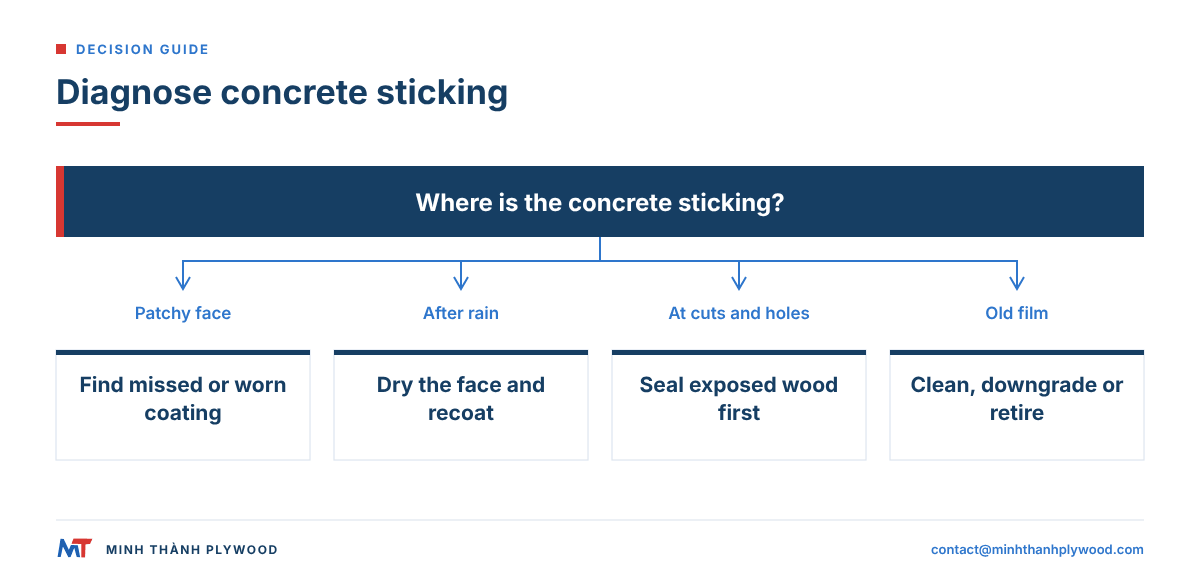
Concrete sticks to the form where the release agent is missing, too thin, contaminated or applied to a wet or dirty face. Find the cause from where and how it sticks.
| Symptom | Likely cause | Fix |
|---|---|---|
| Patches of paste on the panel | Missed areas, worn spots | Walk forms before the pour; recoat by touch and light |
| Whole face sticking | Wrong agent for the face, or no reaction time | Use a reactive agent on film; wait the label time |
| Sticking after rain | Agent washed off or face wet under the coat | Dry and recoat |
| Sticking on old panels | Worn or damaged film, cement build-up | Clean thoroughly; move worn panels to hidden pours or retire them |
| Sticking at cut edges and holes | Unsealed wood exposed | Seal edges and holes before coating |
| Sticking in hot weather | Agent evaporated or forms left too long before the pour | Coat closer to the pour; shade forms |
When sticking starts on panels that released well before, look at the film first: a release agent cannot fix a face that has worn through to the wood.
How release agent affects the concrete finish
The release agent shows on the concrete. A thin, even coat of the right agent gives a uniform colour and a dense surface; too much gives stains, blowholes and a surface coatings will not grip.
- Colour. Changing agent, coat or panel batch mid-job changes the concrete colour. On fair-faced work keep all three the same.
- Blowholes (bug holes). Excess agent holds air bubbles against the face; thin coats and good vibration reduce them.
- Dusting. Heavy oil coats can weaken the outer skin of the concrete.
- Coatings. Paint, render, waterproofing and tile adhesive need a clean surface; ask the coating maker which release agents they accept, or plan to clean the surface.
The panel face matters just as much: a smooth phenolic film gives a smooth, even concrete face; a worn film prints its scratches.
Release agent and plywood reuse: protecting the film
The release agent is one of the four conditions behind every reuse figure for form plywood. Melamine-fortified film-faced plywood gives about 12–15 uses and phenolic WBP film-faced plywood up to about 25, with proper handling, release agent and edge sealing.
A good agent routine protects the film in three ways:
- Clean strips mean no tearing of the film at stripping.
- Less scraping means less abrasion of the face between pours.
- No solvents means the phenolic resin stays hard.
Pair it with the other conditions: wedges and timber or plastic tools at stripping, sealed cuts and holes, and flat, covered storage. Then count uses by panel, and move worn panels from fair-faced work to hidden pours before retiring them.
Safety, storage and the environment
Treat release agents as site chemicals: follow the safety data sheet, protect skin and eyes, and keep the agent out of drains and soil.
- Personal protection: gloves and eye protection; respiratory protection with solvent-based products in enclosed spaces.
- Spraying: low pressure, out of the wind, away from reinforcement and people.
- Storage: closed drums, upright, between 40 and 90°F (4 to 32°C), out of direct sunlight and protected from frost for water-based products. One water-based concentrate lasts up to 60 months unmixed and up to 18 months once mixed (MudMixer, checked 21 October 2026).
- Spills and washing: collect run-off and dispose of it through the site’s waste route, not storm drains. In the US, construction-site run-off is regulated as stormwater discharge.
- Rules: federal and state VOC limits apply to form release agents in the US, and many regions limit solvent content or require low-emission products on enclosed sites; ask the supplier for the VOC content on the safety data sheet and check it against the rules for the project state.
Water-based and vegetable-oil products make these rules easier to meet, and on film-faced plywood they release as well as solvent-based agents. On US sites, formwork for cast-in-place concrete falls under OSHA standard 1926.703. The American Concrete Institute covers form release agents in its formwork guidance, ACI 347.
What this means for your plywood order
Buy the form face and the release routine together. The face sets the agent and the coat; the agent decides how close the panel gets to its reuse figure.
| Line on the plywood order | Our film-faced plywood |
|---|---|
| Film | 120–135 g/m² standard; premium from 135 g/m²; smooth black or brown |
| Glue | Melamine-fortified (about 12–15 uses) or phenolic WBP (up to about 25 uses), with proper handling, release agent and edge sealing |
| Edges | Sealed on all four sides |
| Core | Eucalyptus or acacia |
| Thickness | 12–21 mm, ±0.5 mm |
| Sizes | 1220 × 2440 mm, 1250 × 2500 mm |
Tell us the release agent your crews use and the finish the concrete needs, and we match the film grade to it. Free samples go out before the first order, so you can run a trial panel with your own agent. Our certificates and test reports are on the quality page. Send your specification through the film-faced plywood page; for the US Plyform classes, see our guide to Plyform plywood.
Buyer questions, answered
What is the best release agent for concrete forms?
For film-faced and HDO plywood, a chemically reactive release agent or a water-based emulsion, applied thin, gives the cleanest strip and the longest panel life. Barrier oils suit bare plywood and hidden structural concrete.
Will concrete stick to plywood?
Yes. Cement paste bonds to bare wood fibres and pulls them out when the form is stripped. A sealed film face plus a thin coat of release agent stops the bond.
Can I use diesel as a concrete form release agent?
No. Diesel softens the resin of phenolic film and overlays, stains the concrete and leaves an oily surface that paint and render will not hold to. Use a purpose-made release agent.
How often should release agent be applied to forms?
Before every pour. Each pour uses up the film of agent on the face, so clean the panel, let it dry and apply a fresh thin coat each time.
Why is my concrete sticking to the form?
The usual causes are missed patches, a coat too thin for the face, cement residue left on the panel, a wet face under the agent, or forms left too long in sun or rain after coating.
What release rate should I use on MDO plywood?
MDO has a matte overlay a little more open than phenolic film, so it takes a slightly heavier coat than film-faced or HDO plywood and less than bare plywood. Start from the product data sheet's rate for overlaid plywood and adjust after a test panel.
What is formwork oil?
Formwork oil, or shuttering oil, is the trade name for oil-based release agents brushed, rolled or sprayed on form faces. Modern formwork oils are refined mineral or vegetable oils, often with chemically reactive additives.
Do film-faced plywood forms need release agent?
Yes. The phenolic film resists sticking, but a thin coat of release agent before every pour gives a cleaner strip, a more even concrete colour and many more uses from each panel.
Does release agent affect painting the concrete?
It can. Heavy coats or oily barrier agents leave a film that paint, render and tile adhesive do not grip well. On concrete that will be finished, use a thin coat of a chemically reactive or water-based agent and check the coating maker's advice.
How long before the pour can release agent be applied?
Follow the label; most agents need a short drying or reaction time before concrete is placed. Recoat forms that have been left in sun or rain after coating, or that have been walked on.