
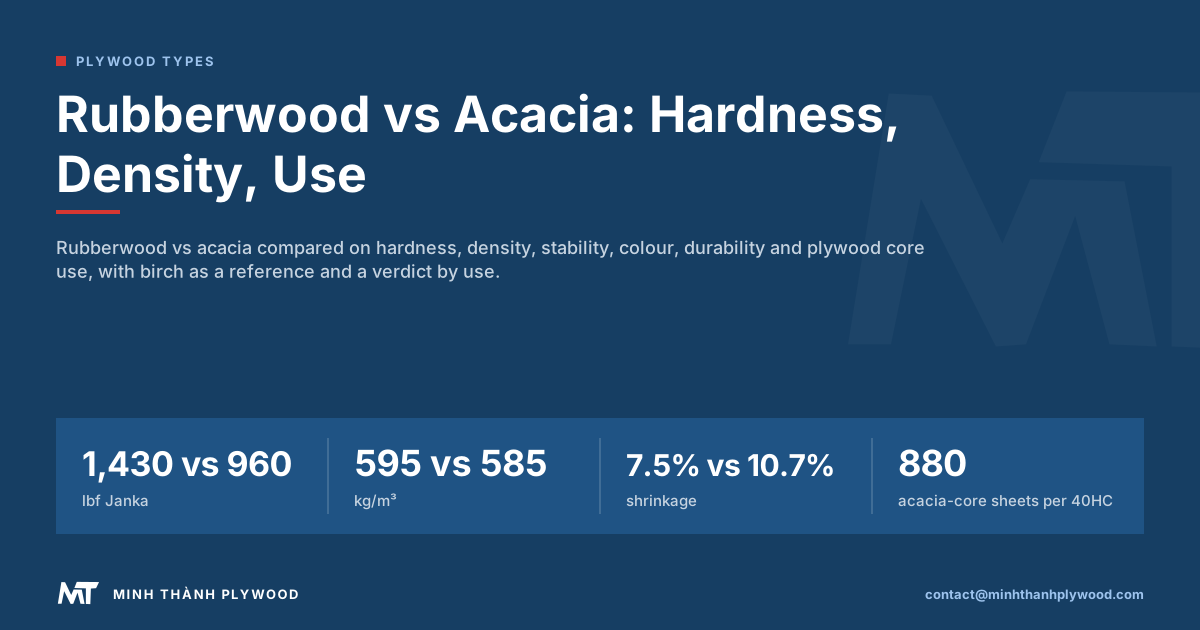
Rubberwood vs acacia comes down to hardness and stability. Acacia is about 49% harder (1,430 vs 960 lbf Janka) and stiffer; rubberwood shrinks less, machines more evenly and stains to a uniform pale tone. Choose rubberwood for indoor solid-wood furniture parts, acacia for worktops, floors and plywood cores that must carry load. Minh Thanh Plywood makes acacia-core plywood on order.
Rubberwood vs acacia wood: the short answer
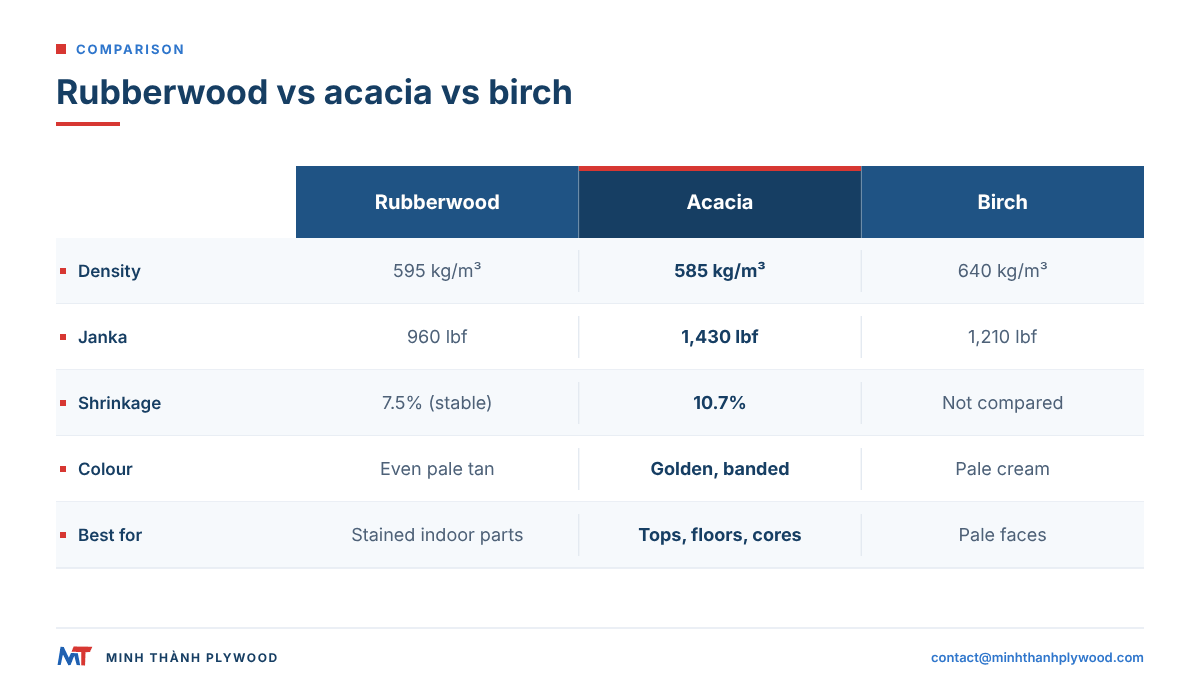
Acacia is harder, stiffer and more decay-resistant; rubberwood is more stable, more even in colour and easier to finish evenly. Dried, both weigh about 585–595 kg/m³. The table compares them, with birch as the reference furniture wood.
| Metric | Rubberwood (hevea) | Acacia (A. mangium) | Birch (silver birch) |
|---|---|---|---|
| Botanical name | Hevea brasiliensis | Acacia mangium and hybrids | Betula pendula |
| Dried density | 595 kg/m³ | 585 kg/m³ | 640 kg/m³ |
| Janka hardness | 960 lbf (4,280 N) | 1,430 lbf (6,340 N) | 1,210 lbf (5,360 N) |
| Bending strength (MOR) | 71.9 MPa | 98.2 MPa | Not compared |
| Stiffness (MOE) | 9.07 GPa | 11.07 GPa | Not compared |
| Volumetric shrinkage | 7.5% | 10.7% | Not compared |
| Natural durability | Perishable, treated after sawing | Higher than rubberwood | Perishable |
| Colour | Even pale blonde to tan | Golden to mid brown, varied | Pale cream to light brown |
| Role in Vietnamese plywood | Niche core, southern Vietnam | Main core for commercial and film-faced | Imported face veneer only |
Wood figures are averages from the Wood Database species pages (accessed October 2026); a given board varies with growth and moisture.
Verdict by use: rubberwood for indoor furniture parts with an even finish; acacia for tops, floors and load-bearing plywood cores; birch where a pale, hard face is the design.
What is rubberwood (hevea wood)?
Rubberwood is the timber of the rubber tree, Hevea brasiliensis, felled when the tree stops giving enough latex. It is also sold as hevea wood or parawood. Plantations in Thailand, Malaysia, Vietnam and Indonesia supply most of it.
What a buyer gets:
- A medium-density hardwood: about 595 kg/m³ dried, 960 lbf on the Janka scale.
- Even, pale wood: light blonde to tan, with little difference between sapwood and heartwood.
- Short lengths: logs from plantation trees give short boards, so rubberwood furniture parts are often finger-jointed and edge-glued into panels.
- Mandatory treatment: the sugar-rich wood stains and attracts borers, so sawmills kiln-dry and preservative-treat it soon after sawing.
In Vietnam, rubberwood is grown mainly in the south-east and Central Highlands. It feeds solid-wood furniture plants and a small number of plywood mills; for plywood it is a niche, higher-cost core. The full profile is in what is rubberwood.
What is acacia wood?
Acacia wood, in the furniture and plywood trade of South-East Asia, is mostly plantation Acacia mangium and its hybrid with Acacia auriculiformis. Vietnam grows it widely on short rotations for veneer, chips and sawn timber.
What a buyer gets:
- A hard, stiff wood: about 585 kg/m³ dried, 1,430 lbf Janka, 98.2 MPa bending strength.
- Varied colour: golden to mid brown heartwood with lighter sapwood, often with a bold, wavy grain.
- Higher movement: 10.7% volumetric shrinkage, so it needs careful drying and balanced construction.
- Wide supply: acacia is one of the main peeled-veneer species for Vietnamese plywood cores.
Large “acacia” tabletops sold in Europe and the US can also come from other acacia species with different looks. When a buyer orders acacia, the species and the grade should both be on the order.
Is rubberwood harder than acacia?
No. Acacia mangium rates 1,430 lbf (6,340 N) on the Janka scale and rubberwood 960 lbf (4,280 N), so acacia is about 49% harder. In use, acacia resists dents from chair legs, plates and tools better.
The Janka test measures the force needed to press a 11.28 mm steel ball halfway into the wood. It predicts dent resistance well, and it also hints at machining effort and screw holding.
| Wood | Janka hardness | Compared with rubberwood |
|---|---|---|
| Rubberwood | 960 lbf (4,280 N) | Reference |
| Birch (silver birch) | 1,210 lbf (5,360 N) | About 26% harder |
| Acacia mangium | 1,430 lbf (6,340 N) | About 49% harder |
For a dining table top or a shop counter, the extra hardness of acacia shows within months. For a bed frame, a chair back or a cabinet carcass, rubberwood’s hardness is enough.
Which is denser and heavier?
As dried solid wood they weigh almost the same: about 595 kg/m³ for rubberwood and 585 kg/m³ for acacia mangium. Weight is not the reason to choose one over the other.
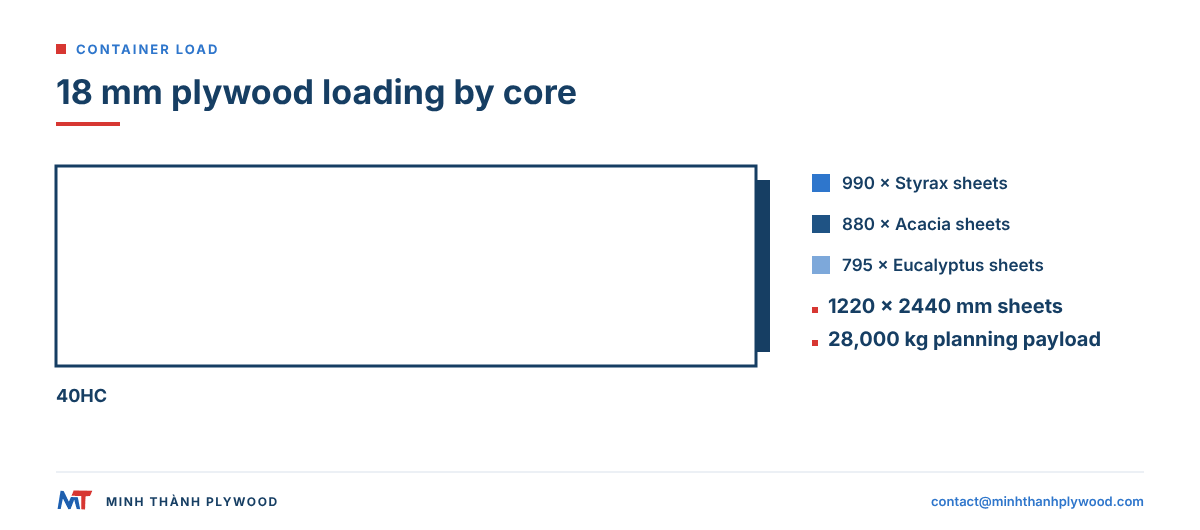
In plywood the picture changes, because the core species and the glue line decide the panel weight. Minh Thanh plans container loads with reference panel densities of 500 kg/m³ for white Styrax, 580 kg/m³ for Acacia and 650 kg/m³ for Eucalyptus. At 18 mm and 1220 × 2440 mm, that gives:
| Core | Reference density | 18 mm sheet weight | Sheets per 40HC |
|---|---|---|---|
| White Styrax | 500 kg/m³ | About 26.8 kg | 990 |
| Acacia | 580 kg/m³ | About 31.1 kg | 880 |
| Eucalyptus | 650 kg/m³ | About 34.8 kg | 795 |
The 40HC counts come from pack height (about 1,000 mm) and a planning payload of 28,000 kg, whichever limit is reached first. Weigh real sheets from the approved sample before you book a lighter container.
Which wood is more stable?
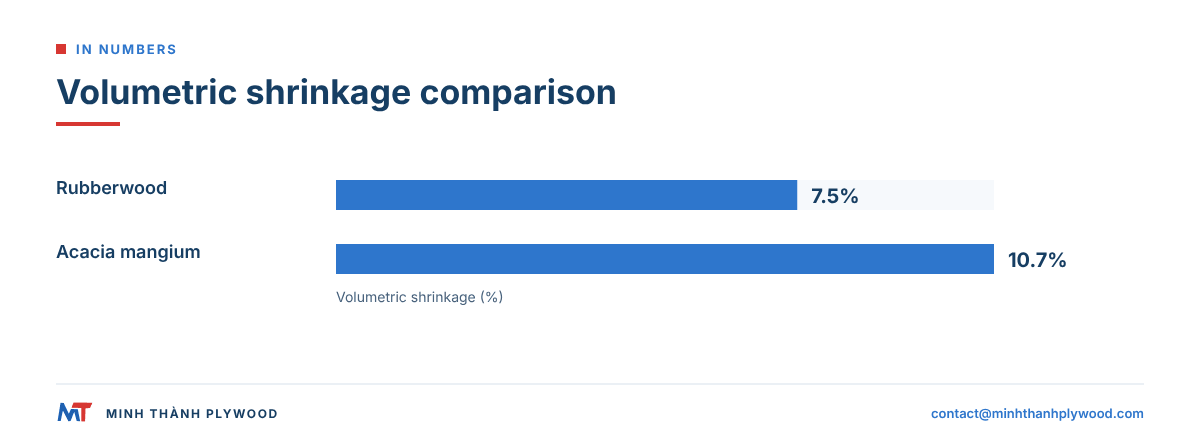
Rubberwood is more stable. Its volumetric shrinkage from green to oven-dry is 7.5% against 10.7% for acacia mangium, so a rubberwood part moves less when the room’s humidity changes.
What that means in practice:
- Wide glued panels: rubberwood tabletops and door panels stay flatter at the same width.
- Acacia tops: need well-dried stock, end-grain sealing and fixings that let the top move.
- Plywood cores: cross-laminated veneers cancel most movement, so the shrinkage gap between the two woods matters far less in plywood than in solid wood.
Moisture at dispatch matters as much as species. Minh Thanh dries veneers and finished panels to 8–12% moisture content, the normal range for furniture plywood, so the panel arrives close to the moisture it will settle at indoors.
Colour, grain and finishing
Rubberwood finishes more evenly; acacia shows more character. Pick by the look the product sells on.
| Rubberwood | Acacia | |
|---|---|---|
| Natural colour | Pale blonde to tan, even | Golden to mid brown, light and dark bands |
| Grain | Straight to slightly interlocked, medium texture | Often wavy or interlocked, bold figure |
| Stain | Takes stain evenly; often stained to look like oak, walnut or cherry | Usually clear-finished to show its colour |
| Paint | Paints well after sanding | Paints, but the grain can raise |
| Machining | Turns, routes and moulds cleanly | Harder on tools; interlocked grain can tear |
Rubberwood is the classic substrate for stained “walnut” or “cherry” furniture sold at a mid-market price. Acacia sells on its own colour, so retailers keep it natural with an oil or clear lacquer.
Durability, decay and insects
Acacia lasts longer in damp conditions; rubberwood is perishable and needs preservative treatment even for indoor use. Neither is an outdoor wood without a finish.
Rubberwood carries sugars and starch from the latex-producing tree. Untreated boards attract powderpost beetles and blue-stain fungi within weeks, which is why sawmills dip or pressure-treat the timber with a boron-based preservative and kiln-dry it right after sawing. Treated, kiln-dried rubberwood is a sound indoor furniture wood.
Acacia heartwood has more natural decay resistance than rubberwood, and acacia garden furniture is common. Outdoors it still needs oil and maintenance.
For plywood, durability depends far more on the bond than on the core species. Interior panels use UF glue at E0 emission; damp and outdoor uses need a melamine-fortified or phenolic (WBP) bond, which Minh Thanh makes to the customer’s specification.
Rubberwood vs acacia for furniture: which to choose?
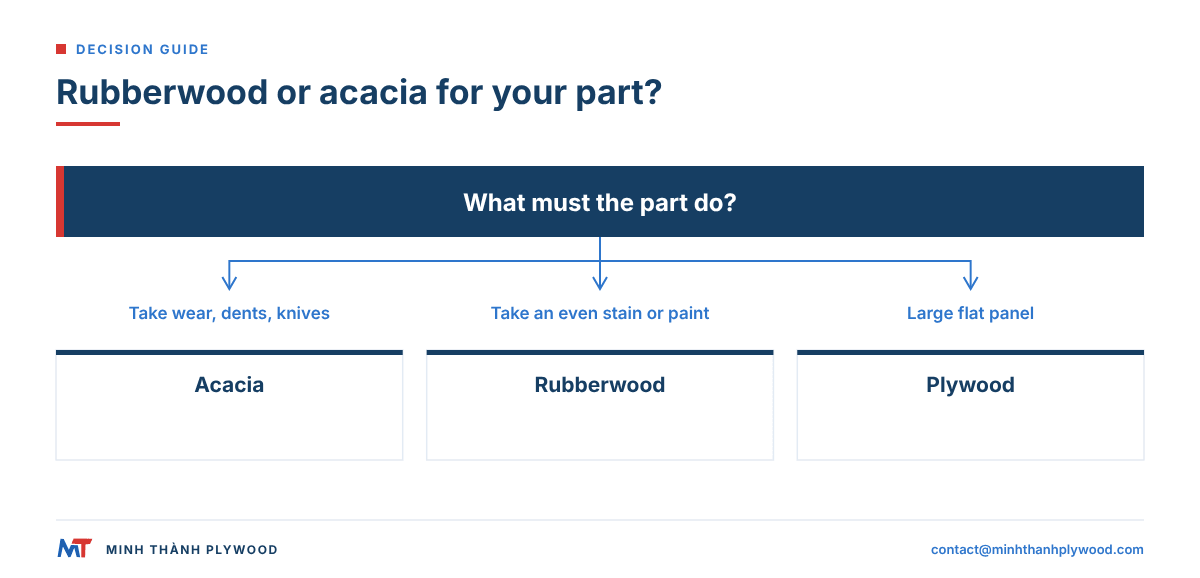
Choose rubberwood for indoor furniture that is stained, painted or turned; choose acacia for surfaces that take wear and for pieces that sell on natural wood colour. Acacia is about 49% harder on the Janka scale, so the choice follows what the part must withstand. The table gives a verdict by product.
| Furniture part | Better choice | Why |
|---|---|---|
| Dining and coffee table tops | Acacia | 49% harder, resists dents and scratches |
| Kitchen worktops and chopping boards | Acacia | Hardness and a bold natural look |
| Chairs, stools, turned legs | Rubberwood | Machines and turns cleanly, stains evenly |
| Bed frames and cabinet carcasses | Rubberwood | Stable, even, cost-effective |
| Stained “walnut” or “cherry” furniture | Rubberwood | Takes stain uniformly |
| Garden benches and outdoor tables | Acacia | Higher decay resistance, with a finish |
| Children’s furniture, painted | Rubberwood | Paints well, stable panels |
| Drawer boxes and back panels | Plywood | Flat, light and cheaper than either solid wood |
Large flat parts, such as cabinet sides, shelves and backs, are usually plywood in both product lines. See best plywood for furniture for which core and face suit each part.
Acacia wood vs rubber wood in plywood cores
In Vietnamese plywood, acacia is a mainstream core and rubberwood is a niche one. Acacia, Eucalyptus and white Styrax make up most core veneer in Vietnam; rubberwood cores are made mainly in the south and cost more.
How the cores line up for a buyer:
- White Styrax: the light, pale core for furniture plywood, grown in northern Vietnam; about 26.8 kg per 18 mm sheet.
- Eucalyptus: the stiff core for furniture and construction panels; about 34.8 kg per 18 mm sheet.
- Acacia: the core for commercial and film-faced plywood; film-faced and anti-slip panels use only acacia or eucalyptus cores.
- Rubberwood: a niche, higher-cost core with a pale colour, made mainly by mills in southern Vietnam.
Minh Thanh’s furniture panels use white Styrax or Eucalyptus cores as standard; Acacia and Pine cores are made on order. Core layers are stitched horizontally and vertically, and furniture panels are pressed twice. More on the acacia build in acacia plywood.
The product standard does not depend on the core species: BS EN 636:2012+A1:2015 covers plywood for structural and general-purpose use in dry, humid or exterior conditions.
Rubberwood vs birch: how do they compare?
Birch is harder and denser than rubberwood: 1,210 lbf Janka and 640 kg/m³ against 960 lbf and 595 kg/m³. Birch is the reference face for pale furniture plywood; rubberwood competes as solid timber for furniture parts.
Where each one wins:
- Plywood faces: birch. Vietnamese mills press imported birch face veneer onto a Styrax or Eucalyptus core; there are no birch cores in Vietnamese production.
- Solid furniture parts in Asia: rubberwood, because it is grown locally on plantations and is cheaper than imported birch timber.
- Exposed multi-ply edges: all-birch plywood, which is a different product from birch-faced panels.
- Stained finishes: both take stain; rubberwood is more forgiving, birch can blotch without a sealer.
Birch faces at Minh Thanh are graded D+, D and E and quoted as pairs such as D+/D, comparable to the European B/BB ladder. The grade rules are in birch plywood grades and acceptance criteria.
Is rubberwood a hardwood?
Yes. Rubberwood comes from a broadleaf tree, so it is a hardwood botanically, like acacia, birch and eucalyptus. Hardwood is a botanical class, not a hardness grade.
On hardness, rubberwood sits in the middle of common furniture hardwoods: softer than acacia (1,430 lbf), birch (1,210 lbf) and white ash (1,320 lbf). For buyers comparing rubberwood vs hardwood plywood, the useful question is which core and face, because both are hardwood plywood. The difference between hardwood and softwood panels, such as pine, is covered in hardwood vs softwood plywood.
Hevea vs acacia: supply and price from Vietnam
Acacia is the larger and steadier supply in Vietnam; hevea comes in waves as rubber plantations are replanted. Both are plantation woods, and EU buyers get origin records for either.
What drives supply and price:
- Acacia is grown across the north and centre of Vietnam on short rotations, so peeled veneer and sawn timber are available all year.
- Hevea volume depends on when rubber estates fell old trees, and the latex price affects that decision.
- Plywood price depends on face, core, glue, thickness, size and quantity more than on the core species alone. Minh Thanh’s commercial plywood starts from US$250/m³ and furniture plywood from US$350/m³ (October 2026), FOB Hai Phong, CFR or CIF.
For EU orders, Minh Thanh supplies the EUDR compliance dossier with origin records and geolocation files, whatever the core species. The rules are in Regulation (EU) 2023/1115, and the current application dates are in Article 38 as replaced by Regulation (EU) 2025/2650.
How do you specify the wood on a plywood order?
Name the core and face species on separate lines, then the glue and emission, so the mill cannot swap one wood for another. Six lines cover a plywood order:
- Use: furniture carcass, table top substrate, packing, formwork.
- Core: Acacia, Eucalyptus, white Styrax or another species, stitched or loose.
- Glue and emission: UF glue at E0 emission for furniture; melamine-fortified or phenolic for damp use.
- Faces: species and grade pair, for example eucalyptus A/B or birch D+/D, sanded or polished.
- Sheet: thickness, size such as 1220 × 2440 or 1250 × 2500 mm, tolerance (±0.2–0.3 mm for sanded furniture panels).
- Packing and quantity: packs, marks, sheets or m³, destination port.
The minimum order is one 40HC, with 1–2 specifications per container as usual and more by agreement. Free samples are available. Send the six lines to contact@minhthanhplywood.com, or start from the eucalyptus-faced plywood page if you want a stiff, warm-coloured panel.
Buyer questions, answered
Is rubberwood harder than acacia?
No. Acacia mangium rates 1,430 lbf (6,340 N) on the Janka scale and rubberwood 960 lbf (4,280 N), so acacia is about 49% harder and resists dents better.
Which is better for furniture, rubberwood or acacia?
Rubberwood suits indoor furniture with an even stained or painted finish, such as chairs, beds and cabinet frames. Acacia suits table tops, benches and worktops where hardness and a bold grain matter.
Is rubberwood a hardwood?
Yes. Rubberwood comes from Hevea brasiliensis, a broadleaf tree, so it is a hardwood botanically. It is a medium-density hardwood, softer than acacia, birch or ash.
Is acacia wood waterproof?
No wood is waterproof. Acacia has higher natural decay resistance than rubberwood, but outdoor furniture still needs a finish, and outdoor plywood needs a phenolic (WBP) bond.
Does rubberwood rot or get insects?
Untreated rubberwood is perishable and attracts borers and sap-stain fungi. Commercial rubberwood is kiln-dried and preservative-treated soon after sawing, and it is meant for indoor use.
Which is heavier, rubberwood or acacia?
They weigh about the same as solid wood: around 595 kg/m³ for rubberwood and 585 kg/m³ for acacia mangium, dried. Acacia plywood is planned at about 580 kg/m³.
Is rubberwood better than birch?
Birch is harder (1,210 lbf vs 960 lbf Janka) and is the reference face for furniture plywood. Rubberwood is cheaper as solid timber in South-East Asia and machines well for turned and moulded parts.
Is acacia a good plywood core?
Yes. Acacia is one of the main plywood cores in Vietnam, used for commercial and film-faced panels. An 18 mm 1220 × 2440 mm acacia-core sheet weighs about 31.1 kg.
Can I order rubberwood-core plywood from Vietnam?
Rubberwood core is a niche, higher-cost core grown in southern Vietnam. Minh Thanh's cores are white Styrax and Eucalyptus as standard, with Acacia and Pine on order.
What does hevea mean?
Hevea is the botanical genus of the rubber tree, Hevea brasiliensis. Hevea wood, rubberwood and parawood are three names for the same timber.