
Finished plywood comes two ways: prefinished, with a clear or coloured coating cured on a factory line, or unfinished, sanded and coated after cutting. Prefinished saves labour on cabinet boxes and shelving; unfinished gives control over colour and edges. This guide compares UV, lacquer, paint and primer finishes, the cost trade-off and the panel a coating line needs, written by Minh Thanh Plywood.
What is prefinished plywood?
Prefinished plywood is a sanded hardwood plywood panel that has been coated on one or both faces on a factory line before sale. It arrives with a cured clear or coloured finish and is ready to cut and assemble. Finished plywood is the wider term: any panel with a finish, applied at the factory or after cutting.
Most prefinished panels carry a clear UV-cured acrylic coating, built up in several thin layers and hardened in seconds under ultraviolet lamps. Others carry a factory lacquer, paint or primer. The faces are usually birch, maple, poplar or a decorative hardwood.
Prefinished plywood is made for interiors: cabinet boxes, shelving, wardrobes, store fixtures and wall panels. It is not a structural or exterior product unless the glue bond and edge sealing are specified for that.
Prefinished plywood sheet sizes and prices
A standard prefinished sheet is 4 x 8 ft (48 x 96 in, 32 sq ft), in thicknesses from 1/4 to 3/4 inch, coated on one or two faces. In Canada, a 4 x 8 sheet of prefinished plywood retails at roughly CAD 53 to CAD 146 depending on species, thickness and grade (October 2026); made in Vietnam the same sheet is 1220 × 2440 mm.
| Where | What | Price per 4 x 8 sheet |
|---|---|---|
| Peacock Lumber (Ontario), pre-finished category | Pre-finished birch | CAD 52.95 to CAD 75.25 |
| Peacock Lumber, pre-finished category | Other sheets in the same category | CAD 105.95 to CAD 145.95 |
| TimberTown (Alberta), 4x8 sheet goods | Fir, spruce and other plywood, all grades | CAD 17.97 to CAD 152.97 |
| Minh Thanh Plywood, container order | Furniture plywood, 1220 × 2440 mm | From US$350/m³ FOB (October 2026), a raw FOB price per cubic metre, not a sheet price |
Retail adds cutting charges on top. Peacock Lumber makes the first cut free on each of the first three sheets, then charges CAD 2.00 per cut, and adds CAD 5.00 when the plywood is thicker than 3/4 inch or longer than 8 ft; half and quarter sheets cost a premium. A furniture plant ordering by the container avoids both: Minh Thanh presses custom sizes such as 1220 × 2500 or 1220 × 2280 mm on order, cuts panels into 4, 6 or 8 pieces, and makes 1250 × 2500 mm for Europe, so the plant receives the size it nests on its CNC.
For a Canadian importer or cabinet plant the comparison is landed cost per finished part, not the shelf price of one sheet. The retail range above is what a customer pays a Canadian dealer; the FOB figure is where a container buyer starts before freight and duty.
Finish types compared: UV, lacquer, paint and primer
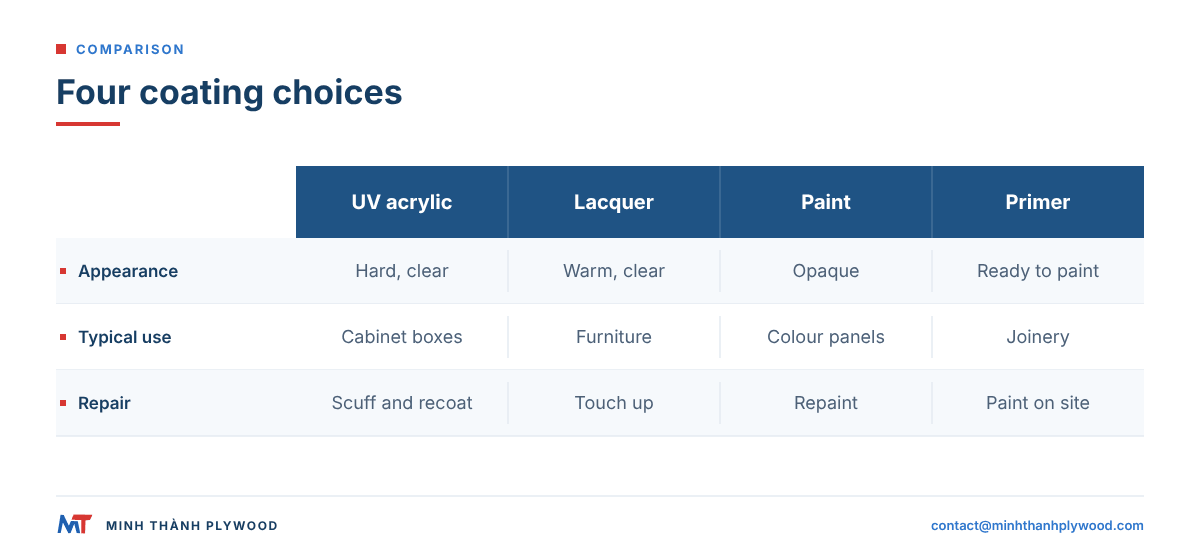
Four factory finishes cover nearly all finished plywood. They differ in hardness, look and how easily the surface can be repaired or recoated.
| Finish | How it is applied | Surface | Best uses | Recoat or repair |
|---|---|---|---|---|
| UV-cured acrylic | Roller coats cured under UV lamps | Hard, clear, low or medium sheen | Cabinet boxes, shelving, fixtures | Hard to touch up; scuff and recoat |
| Lacquer (nitrocellulose or catalysed) | Spray or curtain coater, air or oven dried | Clear, warm look, adjustable sheen | Furniture, decorative panels | Easy to touch up |
| Factory paint | Spray or roller, opaque colour | Solid colour, hides the grain | Children’s furniture, retail, colour schemes | Repaint after scuffing |
| Primer only | One or two primer coats, sanded | Smooth, ready for site paint | Painted joinery and walls | Painted on site |
| Overlay (melamine paper or film) | Pressed on, not coated | Decor print or film, very hard | Cabinets, formwork, packaging | Not recoated |
UV-cured coatings dominate prefinished cabinet plywood because the line runs fast and the surface resists chemicals and scratches. Lacquer gives a warmer look and repairs more easily. For the UV route in detail, see UV-coated plywood and UV-ready panels.
How prefinished plywood is made on a UV line
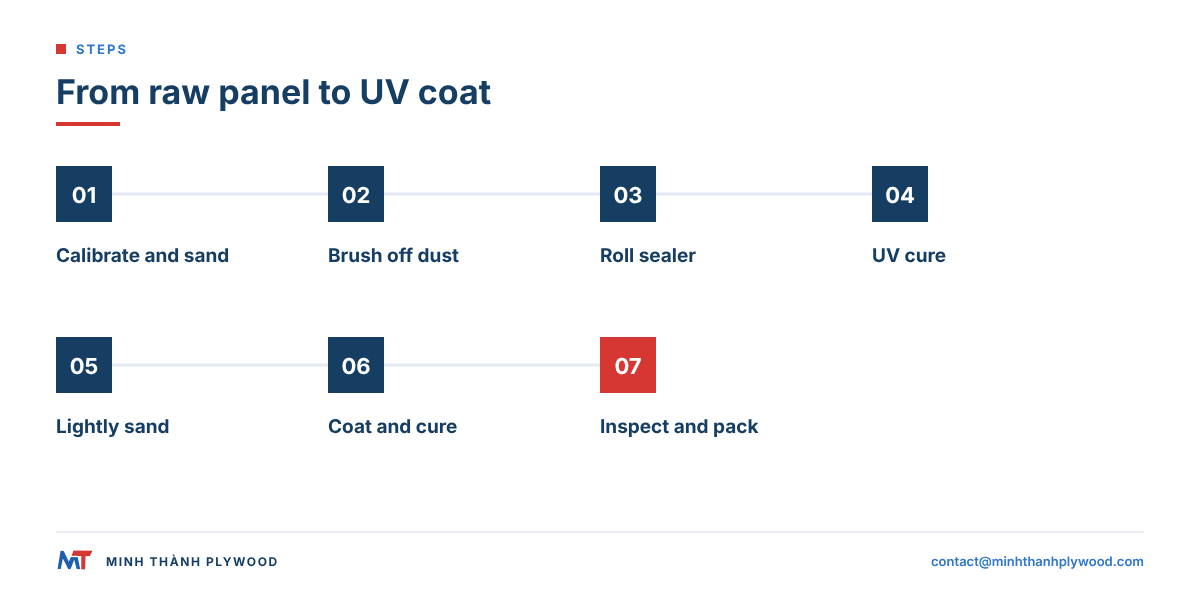
Prefinished plywood is made by running sanded panels through a coating line that applies thin layers and cures each one under ultraviolet lamps in seconds. The whole line runs flat, panel after panel, so the result depends on how flat and even the incoming panels are.
- Calibrate and sand the raw panel to an even thickness and a smooth face.
- Brush and de-dust the face so no particle is trapped under the coating.
- Apply a sealer or filler coat by roller, filling the open grain.
- Cure the coat under UV lamps.
- Sand lightly between coats to cut raised fibres.
- Apply base and top coats, each cured in turn, until the specified film build and sheen are reached.
- Inspect, stack and pack with protective sheets between panels.
A lacquered plywood line works the same way with spray or curtain coaters and drying ovens instead of UV lamps; it is slower but gives a warmer look and easier touch-up. Painted plywood adds a pigmented base coat and often a clear protective top coat.
Prefinished vs unfinished plywood: the difference
Prefinished plywood trades control for speed: the coating is done before you cut, so the shop only cuts, bands and assembles. Unfinished plywood is sanded and bare, so you choose the colour, sheen and coating, and you do the work.
| Point | Prefinished plywood | Unfinished (raw) plywood |
|---|---|---|
| Labour in the shop | Cut, band, assemble | Sand, seal, coat, dry, then assemble |
| Look | Fixed factory sheen and colour | Any stain, sheen or paint |
| Cut edges | Bare, need banding | Finished with the faces |
| Surface damage | Visible scratches need recoating | Sanded out before finishing |
| Glue joints | Coating must be kept off glue areas | Glue to bare wood |
| Best for | Cabinet boxes, shelving, interiors of furniture | Visible fronts, stained or painted work |
Many cabinet shops use both: prefinished panels for boxes and shelves, unfinished panels for the doors and visible ends they finish to the client’s colour.
Prefinished vs unfinished cost
A prefinished sheet costs more than an unfinished sheet of the same build, because the price includes the coating, the line time and protective packing. The finished part often costs less, because the shop skips its own finishing steps.
Finishing a raw panel by hand or spray usually takes these steps, each with labour and drying time:
- Sand both faces to the finishing grit.
- Apply a sealer or conditioner.
- Sand the sealer lightly.
- Apply the first top coat.
- Sand lightly between coats.
- Apply the second top coat, and a third for heavy-wear surfaces.
- Dry, stack and protect the parts before assembly.
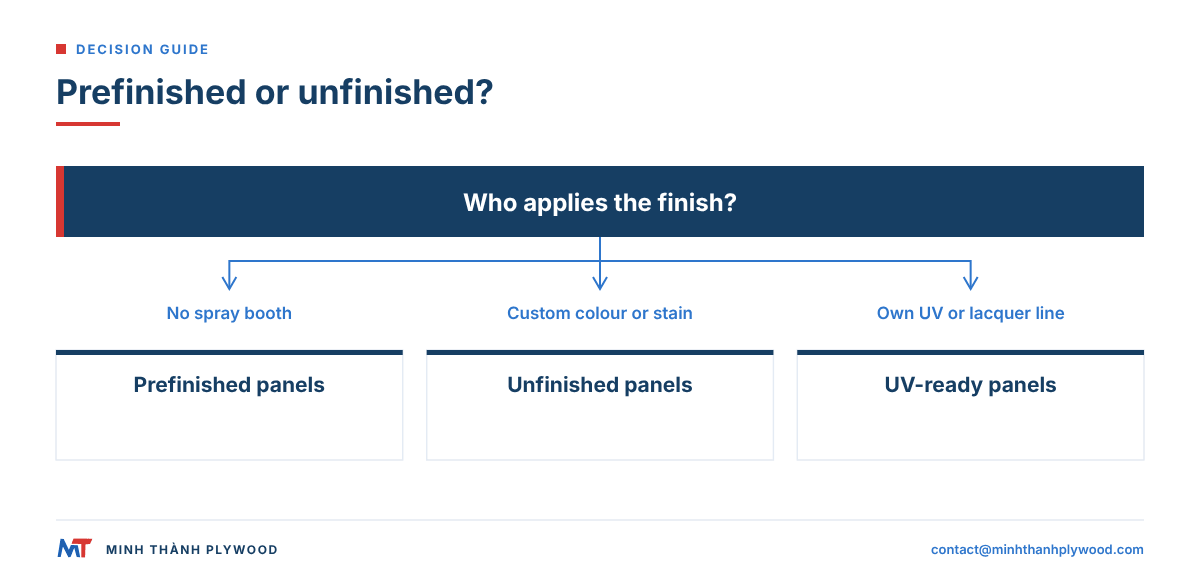
What decides which route is cheaper:
- Volume: on a large run of boxes, prefinished saves the most.
- Spray booth: without one, prefinished avoids an investment and dust control.
- Colour: a custom colour or stain favours unfinished panels.
- Own coating line: furniture plants with a UV or lacquer line buy UV-ready panels and coat them in-house, which is often the lowest cost per part at container volume.
Is prefinished plywood waterproof?
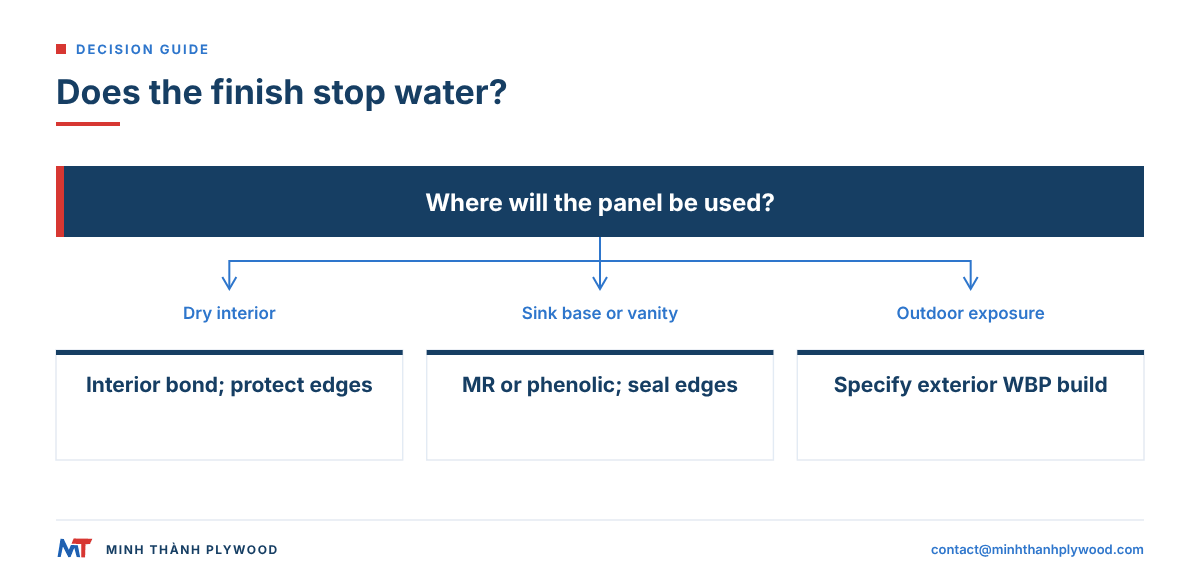
No. A factory coating makes the face resistant to splashes, cleaning and stains, but it does not make the panel waterproof. Water enters through cut edges, screw holes and any damaged spot in the coating.
Two things decide how a finished panel behaves near water:
- The glue bond: interior panels use UF glue; MR (melamine-fortified) bonds take humidity better; phenolic (WBP) bonds are made for exterior and wet conditions.
- The edges: every cut edge must be banded or sealed before installation.
Bond quality is set in EN 314-2, and EN 636 covers plywood for dry, humid or exterior conditions.
For a sink base or a bathroom vanity, specify an MR or phenolic bond, seal all edges and keep the coating continuous. For outdoor use, finished interior plywood is the wrong panel; see exterior plywood for a WBP build.
Prefinished birch plywood
Prefinished birch plywood is the most common prefinished panel: a pale birch face with a clear UV coating on both sides, used for cabinet boxes, drawers and shelving. Birch takes a clear finish well, shows little grain and stays light in colour.
What to check on pre finished birch plywood:
- Face and back grade: in Vietnam, birch face grades are named D+, D and E and quoted as face/back pairs such as D+/D or D/E; as a buying comparison, D+ is close to European B and D close to BB.
- Core: a closed, calibrated core so the coated face stays flat.
- Coating build and sheen: both sides or one, clear or tinted, sheen level.
- Emission: E0 emission for cabinets and furniture.
Minh Thanh’s birch-faced furniture panels are sanded and polished with both faces UV-ready, for buyers who coat on their own line; see birch plywood for builds and sizes.
Where finished plywood is used
Finished plywood goes where a clean, durable surface must be ready fast and the panel will be seen or touched.
- Kitchen and bathroom cabinet boxes: the inside surfaces nobody wants to finish by hand.
- Wardrobes, closets and shelving: wipeable surfaces, light colours.
- Store fixtures and displays: quick assembly in fit-out programmes.
- Wall and ceiling panels: prefinished birch or maple as a fast interior lining.
- Children’s and office furniture: painted or clear finishes that clean easily.
- Vehicle interiors: vans and campers use thin prefinished panels for lining.
Visible fronts and premium furniture are often finished after cutting, so the colour and edge finish match the rest of the piece.
How to finish plywood: step by step
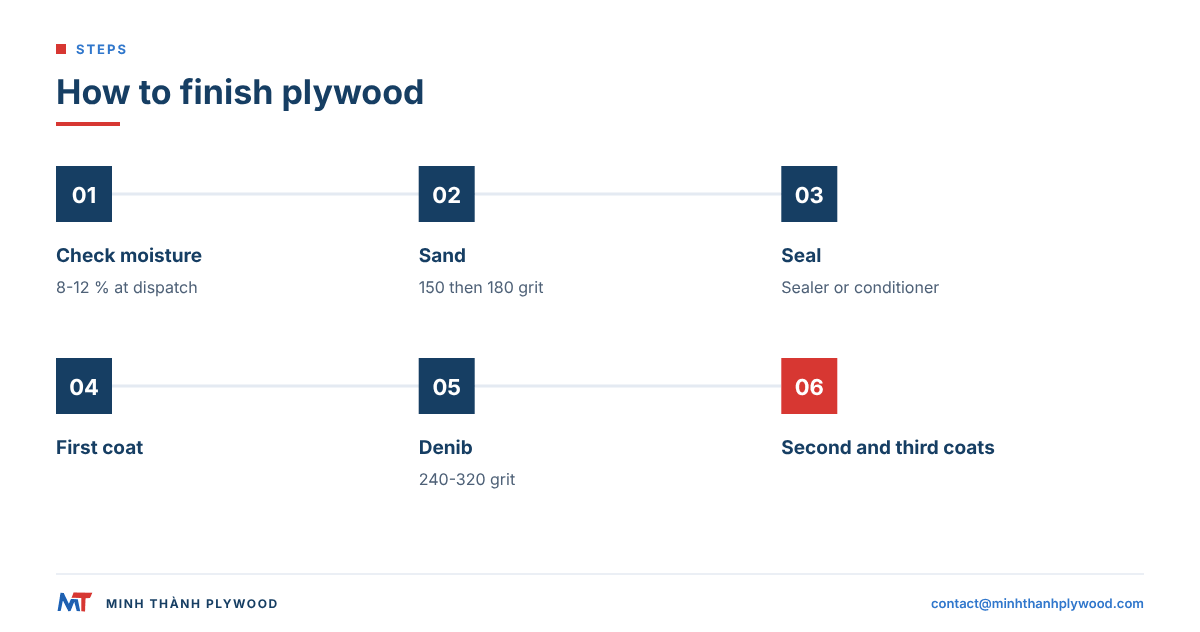
To finish plywood yourself, sand it smooth, seal it and build two or three thin top coats, sanding lightly between coats. The steps below suit a clear finish on a hardwood face such as birch, poplar or oak, and each coat needs to dry fully before the next.
- Check moisture: the panel should be dry and acclimatised to the room; furniture plywood leaves the factory at 8–12 % moisture content.
- Sand the face: start with 120 grit if there are marks, then 150 and 180 grit, always along the grain.
- Remove dust with a vacuum and a tack cloth.
- Seal: a sanding sealer for clear coats, or a pre-stain conditioner before stain on blotch-prone faces such as birch and maple.
- Stain if wanted, testing on an offcut first.
- Apply the first top coat: waterborne polyurethane, lacquer or hardwax oil.
- Denib: sand lightly with 240 to 320 grit once dry.
- Apply the second and third coats for wear surfaces.
For birch plywood specifically, avoid heavy oil stains, which blotch on birch; use a gel stain or a tinted top coat instead.
How to finish plywood edges
Finish plywood edges with edge banding, solid wood lipping or filler and paint, depending on how the edge will be used and seen. A bare plywood edge shows the plies and soaks up finish and moisture.
| Edge method | Look | Strength | Best for |
|---|---|---|---|
| Veneer edge banding (iron-on or hot-melt) | Matches the face | Light duty | Cabinet boxes, shelves |
| PVC or ABS edge banding | Solid colour or wood print | Impact resistant | Commercial furniture, fixtures |
| Solid wood lipping | Matches or contrasts | Strongest | Table tops, shelf fronts, doors |
| Filler and paint | Hidden plies | Medium | Painted joinery |
| Exposed sealed plies | Visible striped edge | Medium | Modern furniture with a ply-edge look |
An exposed ply edge is a design choice in modern furniture, but it needs a void-free core: any gap shows. Minh Thanh stitches core layers both horizontally and vertically so edges stay closed.
How to finish plywood walls
To finish plywood walls, fix the panels with even joints, fill or detail the joints, then sand and coat the whole wall, or use prefinished panels and leave the joints as shadow gaps.
- Plan the joints: a 3 to 5 mm shadow gap between prefinished panels looks deliberate; butt joints need filling.
- Fix the panels: concealed clips or glue and pins for prefinished panels, screws and filler for painted walls.
- Treat the edges at corners and openings with a bead, lipping or banding.
- Finish: clear waterborne coats on raw hardwood faces, or primer and paint for a painted wall.
For walls in hotels, offices and homes, specify E0 emission and, where the building code requires it, a fire-performance treatment for the lining.
UV-ready panels: what a coating line needs from the plywood
A UV coating line needs a panel that is flat, smooth and uniform in thickness, because the rollers apply coatings measured in grams per square metre and any high or low spot shows as an uncoated patch or a run. The panel decides the finish quality as much as the coating does.
What Minh Thanh builds into its UV-ready furniture panels:
- Calibrated thickness: sanded furniture panels at ±0.2–0.3 mm, down to ±0.2 mm, so the rollers touch every point.
- Flatness: pressed twice as standard; the core board is pressed and calibrated, then face and back are pressed on.
- Closed cores: core layers stitched horizontally and vertically, so no gap telegraphs through the coating.
- Sanded and polished faces: both faces UV-ready, to the standard customers need to apply their own UV coating.
- Dry and low emission: 8–12 % moisture content at dispatch, UF glue at E0 emission.
The emission evidence comes with the panels: CARB P2 / TSCA Title VI certification as ICTT mill no. 23024, and six ASTM D6007 chamber tests from April 2025 to June 2026 on 9, 15 and 18 mm panels that averaged 0.014–0.032 ppm, three by Shanghai Hongjun and three by ICTT Vietnam. The limit for veneer-core hardwood plywood is 0.05 ppm under 40 CFR 770.10.
Handling and storing finished plywood
Finished plywood needs more care in transport and storage than raw panels, because a scratch in a factory coating cannot be sanded out on site. Most damage happens at loading, unloading and cutting.
- Interleave the faces: a protective sheet or film between coated panels stops grit from scratching them in transit.
- Store flat and dry: on level bearers, indoors, away from direct sun, which can yellow some clear coats and darken the wood under them.
- Acclimatise: let packs reach the room’s humidity before cutting; plywood leaves a furniture mill at 8–12 % moisture content.
- Cut face up or down by the saw: on a table saw the good face goes up; on a track or panel saw with a scoring blade, follow the machine’s direction to avoid chipping the coating.
- Keep glue off the coating: mask or sand the joint areas, because glue does not bond to a cured finish.
What to specify for prefinished plywood panels
Specify prefinished plywood panels by the panel and the coating separately, because each fails in its own way. A complete line names both.
| Panel | Coating |
|---|---|
| Face species and face/back grade | Coating type (UV acrylic, lacquer, paint, primer) |
| Core species and build | One side or both sides |
| Glue bond and emission class | Sheen level and colour (clear, tinted, white) |
| Thickness and tolerance | Scratch and chemical resistance target |
| Sheet size | Protective film or interleaving for transport |
For panels you will coat yourself, add “both faces sanded and UV-ready” and the grit or smoothness your line needs, and test a sample on your own line before the order.
What this means for your order
Decide first who applies the finish. If a distributor or finisher does, buy prefinished panels locally. If your plant has a UV or lacquer line, import UV-ready panels by the container and coat them yourself, which gives you the colour and sheen control and the lower cost per part.
A specification line for UV-ready furniture plywood looks like this:
18 mm, 1220 × 2440 mm, birch face D+/D, white Styrax core stitched and pressed twice, UF glue at E0, both faces sanded and polished UV-ready, ±0.2 mm, moisture 8–12 %, packed on pallets; quantity; destination port.
Minh Thanh makes furniture panels from 3 to 40 mm in 1220 × 2440 and 1250 × 2500 mm, with birch, poplar, EV, okoume, pine and other faces. The minimum order is one 40HC with mixed specifications by agreement, production takes 15–45 days after the 30% deposit, and free samples go out for line trials. Send your panel and coating line requirements to contact@minhthanhplywood.com.
Buyer questions, answered
What is prefinished plywood?
Prefinished plywood is a sanded hardwood plywood panel coated on one or both faces on a factory line, usually with a clear UV-cured acrylic, before it is sold. It is ready to cut and assemble with no sanding or coating on site.
Is prefinished plywood waterproof?
No. The coating resists splashes and cleaning, but the edges are bare and the glue bond is usually an interior type. For wet areas, choose an exterior bond and seal every cut edge.
What is the advantage of using prefinished plywood?
It removes sanding, sealing and two or more coats from the shop, gives an even factory-cured surface and is ready to assemble. Cabinet makers save labour, drying space and dust control.
Prefinished vs raw plywood: what is the difference?
Prefinished plywood arrives coated and ready to assemble; raw plywood arrives sanded and must be finished after cutting. Prefinished saves labour; raw gives control over colour, sheen and edge finishing.
Where can I find prefinished plywood?
Hardwood distributors stock prefinished birch and maple for cabinet work. Furniture plants with their own coating line buy UV-ready sanded panels in container loads and coat them in-house.
Can you paint prefinished plywood?
Only after scuff-sanding and a bonding primer, because paint does not stick well to a cured UV coating. If the panel will be painted, order it unfinished or primed.
How do I finish the edges of plywood?
Iron-on or machine-applied edge banding in matching veneer or PVC is the standard; solid wood lipping is stronger; filler and paint suit painted work. Seal every cut edge before installation.
How do you finish birch plywood?
Sand with 150 then 180 grit, apply a sanding sealer or pre-stain conditioner if staining, then two to three coats of waterborne polyurethane or lacquer, lightly sanding between coats. Birch blotches with oil stains, so test first.
Is prefinished plywood more expensive than unfinished?
Per sheet, yes, because it includes the coating, the line and careful packing. Per finished cabinet it is often cheaper, because the shop saves the labour and space of finishing.
What is UV-ready plywood?
UV-ready plywood is a sanded, polished panel made flat and smooth enough for a buyer's own UV coating line. Minh Thanh supplies both faces UV-ready on its furniture panels.
Can prefinished plywood be used for walls?
Yes. Prefinished birch or maple panels are a quick interior wall and ceiling finish; plan the joints, use concealed fixings and edge-band or lip any exposed edge.